
· 4 min read
An introduction: the infrastructure singularity, Jordan and 52 free PPP guides
The vision behind this site, what the 52 free guides offer every organization in Jordan, and the person who wrote them.
Every organization in Jordan can launch a PPP program of its own. This site exists to show how, with 52 free guides, one for every kind of organization in the country. This first post sets out the vision behind the guides, what the site offers and who wrote them.
A century of infrastructure is wearing out
Most of the roads, bridges, power plants, water networks, ports and airports the world runs on were built in the last hundred years, and much of that stock is wearing out at the same time. Rebuilding and running it will take about $500 trillion over the next fifty years: $300 trillion to build, $150 trillion to operate and maintain, and $50 trillion for the sensors, compute and robotics inside the assets.
$500T
to rebuild and run the world’s infrastructure over the next fifty years
Governments cannot fund, build and run that rebuild alone, and the private sector cannot do it without them. Public-private partnerships (PPPs) will carry much of the work, and the organizations that know how to take part in them will shape what gets built.
The infrastructure singularity
The next fifty years will build Earth’s largest computer. Roads, grids, ports and water networks will monitor their own condition, predict their own failures and schedule their own repairs, while fleets of machines raise new assets with very few human hands. The point where the built world starts improving itself faster than anyone can direct it is the infrastructure singularity.

Three technologies bring it closer. Artificial intelligence designs and runs the assets, robotics builds and maintains them, and tokenization finances them and opens their ownership to everyone. The Vision page sets out the full picture.
The PPP singularity is the point at which it becomes cheaper to build the pilot than to conduct the study.
Today a single $100 million PPP can spend $10 million on preparation, enough to build 100 pilots at $100,000 each. The World Bank counted 315 private infrastructure projects reaching financial close across all low- and middle-income countries in 2024, only a few per country, and no country learns quickly at that pace.
Why Jordan can move first
Jordan starts with about $86 billion of PPP and infrastructure projects in development, $46 billion of them anchored in Aqaba, Jordan’s only port and its gateway to the Red Sea. The country has engineers who can build what comes next, and Article 15 of PPP Law No. 19 of 2023 lets any private company take its own PPP idea to the Ministry of Investment or a public authority. PPP Regulation No. 9 of 2024 sets out how such a proposal is studied.

Small projects run in parallel would let the country test many legal structures, financing models and construction methods at once. In Jordan, 1% of the budgets of 40 contracting authorities, about $78 million, would fund 780 small PPPs a year at $100,000 each, and a research lab in each sector would run ten of them a year and publish every result.
Futureproofing your organization
Every organization that plans, builds, finances or runs infrastructure will work differently as the singularity approaches. Artificial intelligence will design and test projects, robots will raise and maintain assets, roads and grids will report their own condition, and tokenization will fund small pilots from their own revenue.
The organizations that start learning by building now will be ready to lead that change, with a PPP program of their own, small PPPs in parallel, a research lab in their sector and data from every pilot from its first day. See what changes and where to start.
What this site offers
The site holds 52 free guides, one for every kind of organization in Jordan: the Royal Hashemite Court and the Prime Ministry, ministries and municipalities, banks, funds and insurers, developers and contractors, advisors, operators, technology companies, universities and schools, companies in 14 economic sectors, and humanitarian and relief organizations.
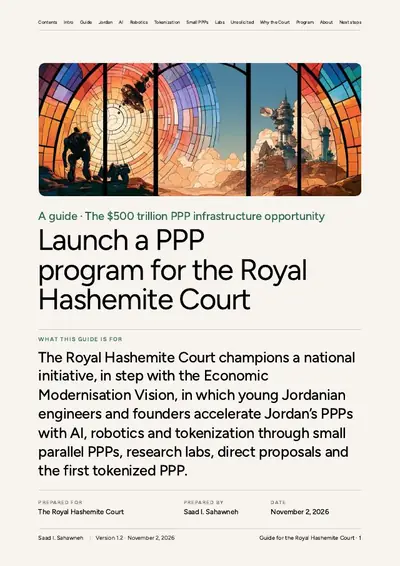
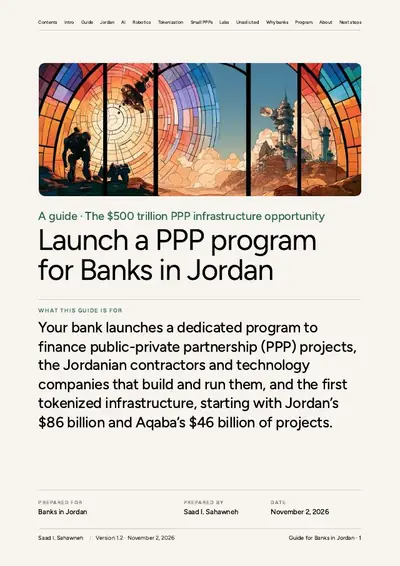
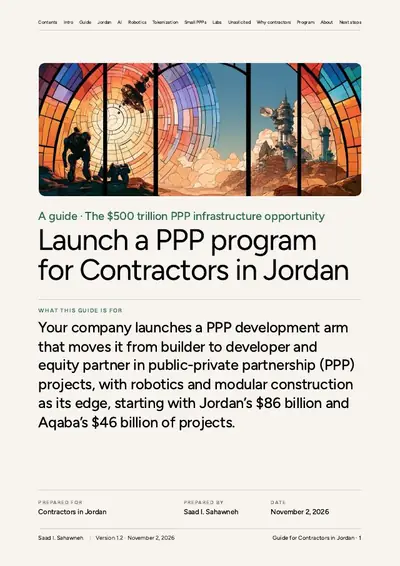
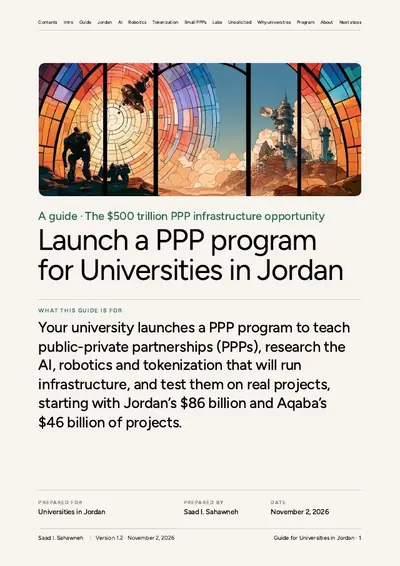
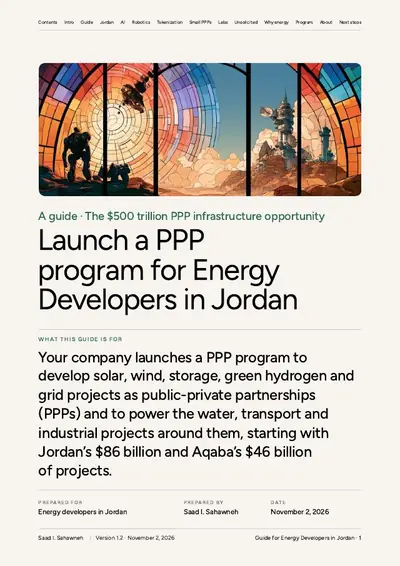
Every guide is a 17-page PDF with the same thirteen sections, from the case for a PPP program to six first steps: a mandate, a team, a map of the pipeline, the organization’s own offer, partners and a first pilot. Each guide can be read in full on its page and downloaded for free, and a free summary brings all 52 together in one document.
The site works in four steps:
- 01Find your kind of organization and open the guide written for it.
- 02Read it online or download the PDF for your board or leadership team.
- 03Take its six first steps, starting with a mandate and a named lead.
- 04Get in touch to talk through your organization’s program.
About the author
Saad I. Sahawneh has spent twenty-two years building companies and shaping how they go to market. He was Chief of Staff at Croquet, working alongside Sam Altman’s Y Combinator research group, the team that became OpenAI, and Alan Kay, the father of the personal computer and a lifelong friend and mentor to Steve Jobs.
That was a front-row seat to the birth of machine intelligence. Today he is Business Development Manager at Construction Management Associates, which builds consortiums for public-private partnership projects in Jordan, and works on go-to-market at Kritical, the AI knowledge engine for construction documents. He is based in Amman.
His work has three aims: accelerate Jordan, accelerate the infrastructure singularity and accelerate superintelligent construction software. More about him.
What comes next
Future posts will go deeper into the ideas behind the guides: small PPPs in parallel, PPP research labs, unsolicited proposals, and how artificial intelligence, robotics and tokenization change the way infrastructure is planned, built, financed and run. To begin, find the guide for your organization.