
Technology and knowledge
Launch a PPP program for Universities in Jordan
A free 17-page guide · The $500 trillion PPP infrastructure opportunity
What this guide is for
Your university launches a PPP program to teach public-private partnerships (PPPs), research the AI, robotics and tokenization that will run infrastructure, and test them on real projects.
The case
Universities supply the people every PPP depends on
Every PPP needs engineers, lawyers and financiers who understand how a project is prepared, financed and operated, and few degree programs teach all of it together. The people who design the projects of the next fifty years are students today. This guide invites universities in Jordan to launch a PPP program that prepares them, starting with the projects at home.
The guide
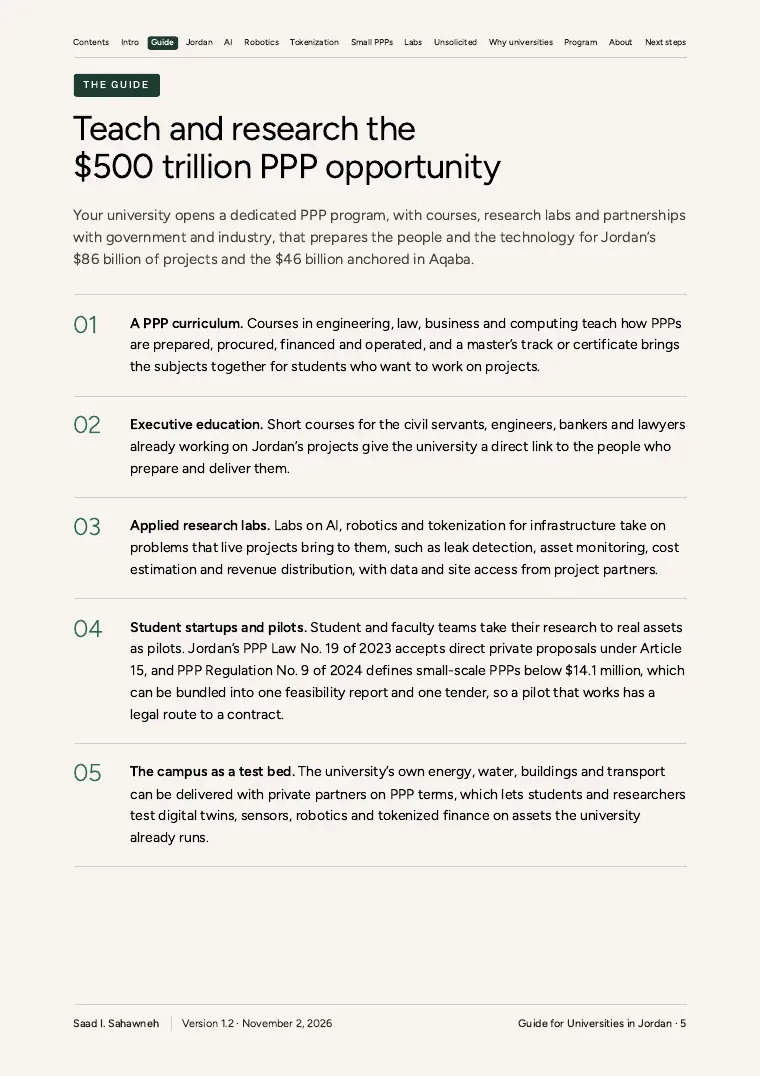
Teach and research the $500 trillion PPP opportunity
Your university opens a dedicated PPP program, with courses, research labs and partnerships with government and industry, that prepares the people and the technology for Jordan’s $86 billion of projects and the $46 billion anchored in Aqaba.
01
A PPP curriculum
Courses in engineering, law, business and computing teach how PPPs are prepared, procured, financed and operated, and a master’s track or certificate brings the subjects together for students who want to work on projects.
02
Executive education
Short courses for the civil servants, engineers, bankers and lawyers already working on Jordan’s projects give the university a direct link to the people who prepare and deliver them.
03
Applied research labs
Labs on AI, robotics and tokenization for infrastructure take on problems that live projects bring to them, such as leak detection, asset monitoring, cost estimation and revenue distribution, with data and site access from project partners.
04
Student startups and pilots
Student and faculty teams take their research to real assets as pilots. Jordan’s PPP Law No. 19 of 2023 accepts direct private proposals under Article 15, and PPP Regulation No. 9 of 2024 defines small-scale PPPs below $14.1 million, which can be bundled into one feasibility report and one tender, so a pilot that works has a legal route to a contract.
05
The campus as a test bed
The university’s own energy, water, buildings and transport can be delivered with private partners on PPP terms, which lets students and researchers test digital twins, sensors, robotics and tokenized finance on assets the university already runs.
Why universities
Universities supply the people every PPP depends on
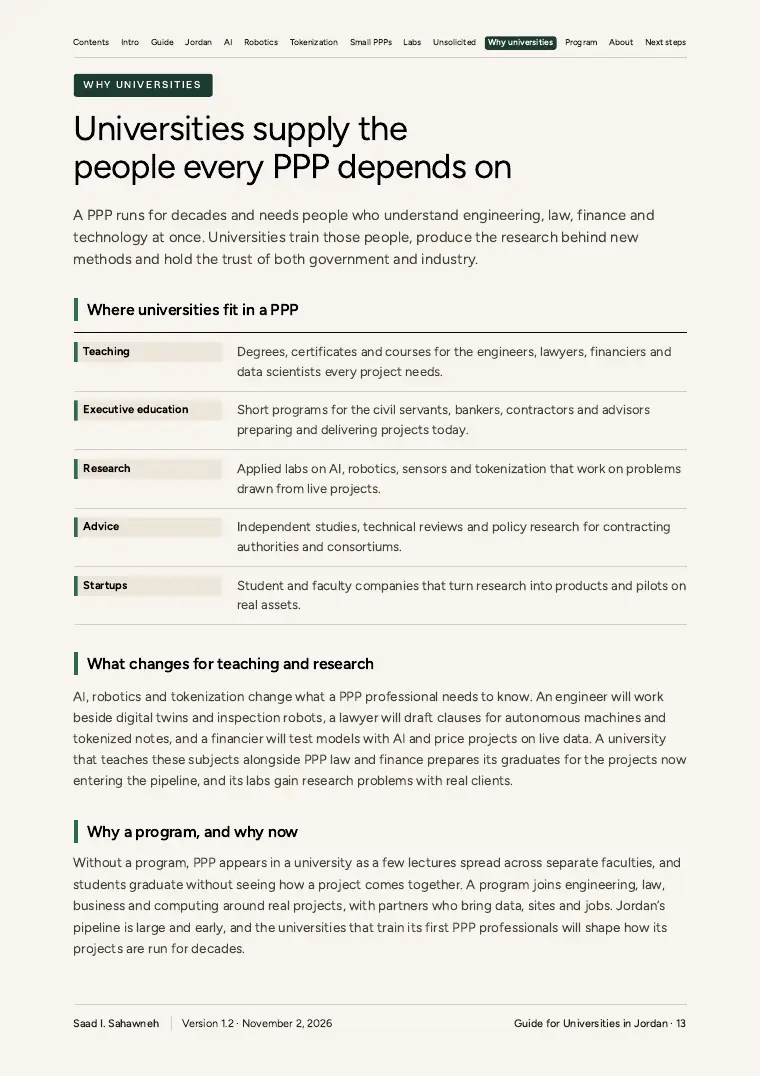
A PPP runs for decades and needs people who understand engineering, law, finance and technology at once. Universities train those people, produce the research behind new methods and hold the trust of both government and industry.
Where universities fit in a PPP
- Teaching
- Degrees, certificates and courses for the engineers, lawyers, financiers and data scientists every project needs.
- Executive education
- Short programs for the civil servants, bankers, contractors and advisors preparing and delivering projects today.
- Research
- Applied labs on AI, robotics, sensors and tokenization that work on problems drawn from live projects.
- Advice
- Independent studies, technical reviews and policy research for contracting authorities and consortiums.
- Startups
- Student and faculty companies that turn research into products and pilots on real assets.
What changes for teaching and research
AI, robotics and tokenization change what a PPP professional needs to know. An engineer will work beside digital twins and inspection robots, a lawyer will draft clauses for autonomous machines and tokenized notes, and a financier will test models with AI and price projects on live data. A university that teaches these subjects alongside PPP law and finance prepares its graduates for the projects now entering the pipeline, and its labs gain research problems with real clients.
Why a program, and why now
Without a program, PPP appears in a university as a few lectures spread across separate faculties, and students graduate without seeing how a project comes together. A program joins engineering, law, business and computing around real projects, with partners who bring data, sites and jobs. Jordan’s pipeline is large and early, and the universities that train its first PPP professionals will shape how its projects are run for decades.

Futureproofing
Futureproof Universities in Jordan for the infrastructure singularity
This free 17-page guide shows how, with small PPPs in parallel, PPP research labs, artificial intelligence, robotics, tokenization and six first steps.

Jordan and Aqaba
An $86 billion pipeline to start with
Every one of them will need trained people and new research. A Jordanian university lab that proves its research on one project at home can carry it to the next one across the region.
- $86B
- of PPP and infrastructure projects in development in Jordan
- $46B
- of them anchored in Aqaba

Artificial intelligence
AI gives a university a research field with real data and real clients. Labs can build tools that prepare feasibility studies, read contracts and monitor assets, and they can test those tools on live projects with partners from government and industry. Students who learn to use them will join PPP teams ready for work that once took years of experience to learn.

Robotics
Robotics turns infrastructure into a field for engineering research and student projects. Inspection drones, pipe crawlers, construction robots and solar-cleaning machines raise problems in control, sensing and design, and Jordan’s projects can supply the sites to test them. Graduates who build those machines can found the companies that supply them to the next projects.

Tokenization
Tokenization joins finance, law and computer science, and a university is one of the few places where all three sit together. A program can research how PPP revenues are tokenized, regulated and paid out, design a pilot issue around a campus asset, and train the lawyers, engineers and financiers the first tokenized PPPs will need.

Small PPPs and research labs
A university is a natural partner for a lab. Its researchers and students can design, build and measure small PPPs on campus and in the community, publish every result and train the engineers, lawyers and financiers who will run hundreds of PPPs a year.

Unsolicited proposals
A university can bring its research to government as a direct proposal through its spinouts and private partners, with its own campus and labs behind it. Students can learn to prepare proposals as part of their courses, so every graduating class leaves with projects that Jordan’s public authorities can study.
The program
How the program could work
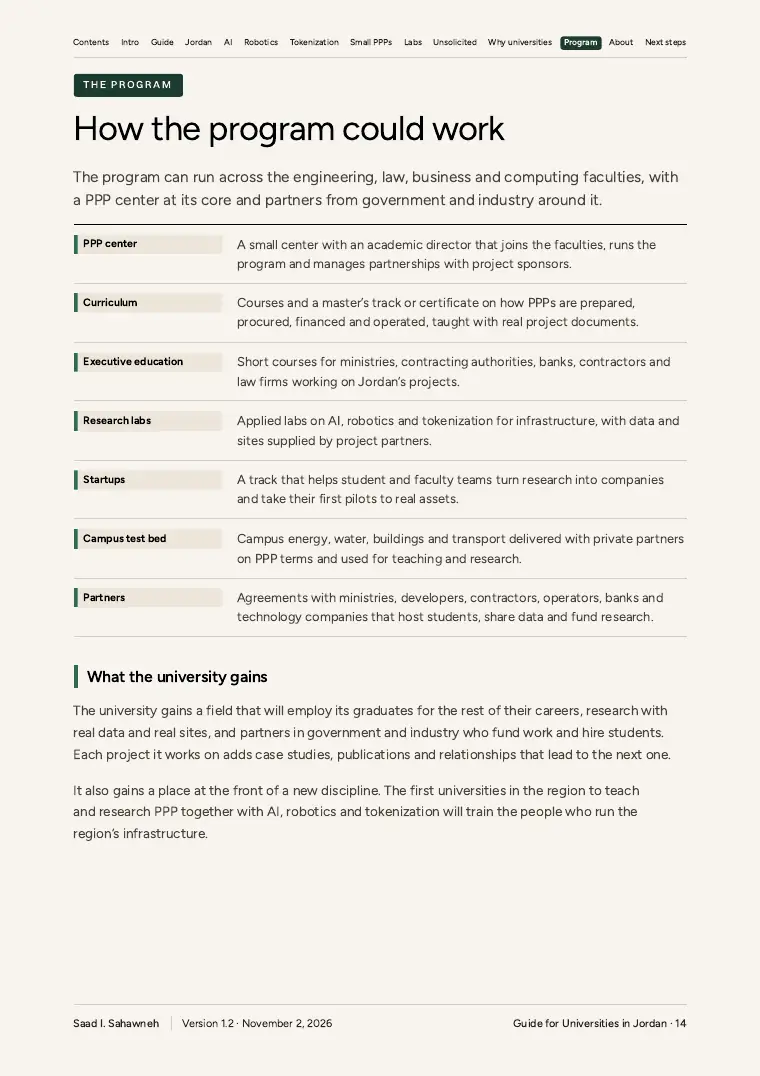
The program can run across the engineering, law, business and computing faculties, with a PPP center at its core and partners from government and industry around it.
- PPP center
- A small center with an academic director that joins the faculties, runs the program and manages partnerships with project sponsors.
- Curriculum
- Courses and a master’s track or certificate on how PPPs are prepared, procured, financed and operated, taught with real project documents.
- Executive education
- Short courses for ministries, contracting authorities, banks, contractors and law firms working on Jordan’s projects.
- Research labs
- Applied labs on AI, robotics and tokenization for infrastructure, with data and sites supplied by project partners.
- Startups
- A track that helps student and faculty teams turn research into companies and take their first pilots to real assets.
- Campus test bed
- Campus energy, water, buildings and transport delivered with private partners on PPP terms and used for teaching and research.
- Partners
- Agreements with ministries, developers, contractors, operators, banks and technology companies that host students, share data and fund research.
What the university gains
The university gains a field that will employ its graduates for the rest of their careers, research with real data and real sites, and partners in government and industry who fund work and hire students. Each project it works on adds case studies, publications and relationships that lead to the next one.
It also gains a place at the front of a new discipline. The first universities in the region to teach and research PPP together with AI, robotics and tokenization will train the people who run the region’s infrastructure.

Next steps
How a university can start
Any university in Jordan can take this guide forward. The first steps use the faculty, students and labs the university already has.
01
Mandate
Board of Trustees approval for a PPP program, with its courses, its research themes and its first-year goals.
02
Team
A named program lead, with faculty from engineering, law, business and computing.
03
Courses
A PPP curriculum across engineering, law and finance, with direct proposals prepared as coursework.
04
Research
Research themes in AI, robotics and tokenization for infrastructure, tied to live projects in Jordan’s pipeline.
05
Partners
Ministries, contracting authorities, developers and technology companies that will host projects and hire graduates.
06
Pilot
A first lab or small-scale PPP on campus or in the community, taken from idea to submission.
Jordan has the projects, the students and a law that accepts unsolicited proposals. A PPP program lets your university educate the people and produce the research that will build the superintelligent infrastructure future, starting with Jordan’s $86 billion and Aqaba’s $46 billion of projects.
The full document
Inside this guide
Seventeen pages and thirteen sections, from the case for a PPP program to the first steps, written for universities in Jordan.
Download the guide (PDF)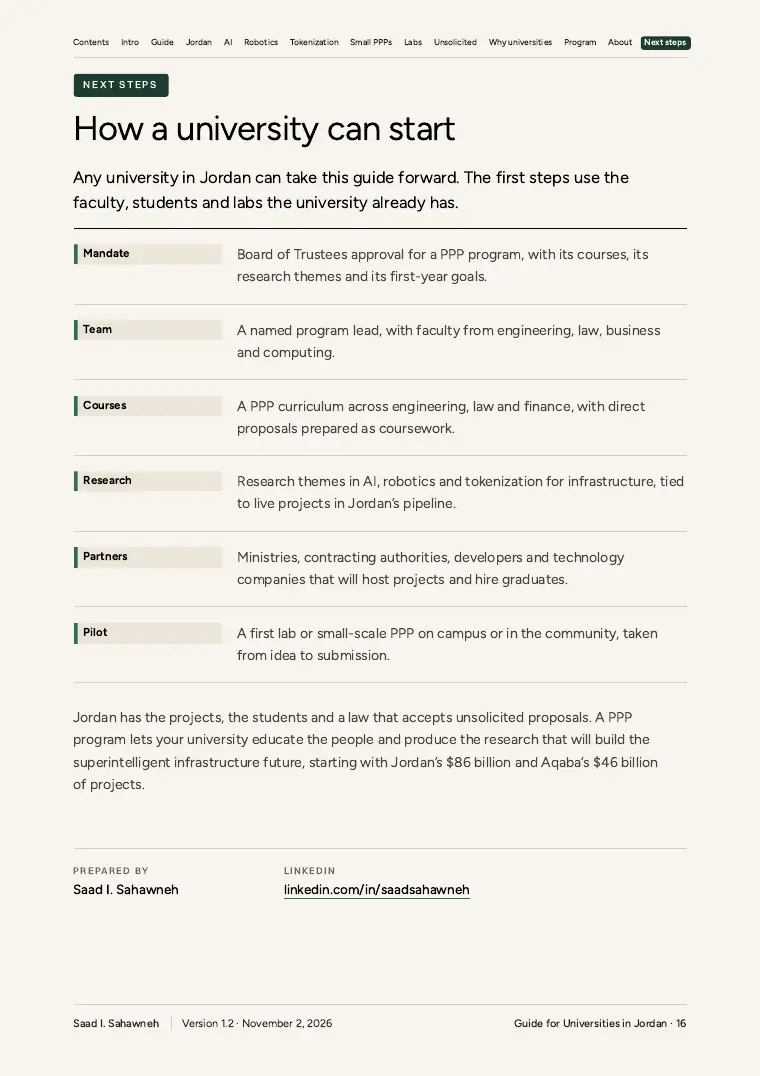
- 01IntroductionWhy a century of infrastructure needs rebuilding, and the $500 trillion it will take.p. 3
- 02The guideTeach and research the $500 trillion PPP opportunityp. 5
- 03Jordan and AqabaAn $86 billion pipeline to start withp. 6
- 04Artificial intelligenceHow AI designs, structures and runs PPP projects, and what it means for universities.p. 7
- 05RoboticsHow robots build infrastructure and keep it running, and what that means for universities.p. 8
- 06TokenizationHow tokenization funds projects from their own revenue, and the role it opens for universities.p. 9
- 07Small PPPs in parallelWhy many small PPPs teach a country faster than a few large ones.p. 10
- 08PPP research labsA lab in each sector, running ten small PPP projects a year.p. 11
- 09Unsolicited proposalsHow Jordan’s PPP law accepts direct proposals from private companies.p. 12
- 10Why universitiesUniversities supply the people every PPP depends onp. 13
- 11The programThe program can run across the engineering, law, business and computing faculties, with a PPP center at its core and partners from government and industry around it.p. 14
- 12AboutAbout Jordan PPP and what it offers.p. 15
- 13Next stepsHow a university can start: six first steps.p. 16
Questions
Questions about the guide for Universities in Jordan
- What does the guide for Universities in Jordan propose?
- Your university launches a PPP program to teach public-private partnerships (PPPs), research the AI, robotics and tokenization that will run infrastructure, and test them on real projects.
- Why should universities in Jordan launch a PPP program?
- Universities supply the people every PPP depends on. A PPP runs for decades and needs people who understand engineering, law, finance and technology at once. Universities train those people, produce the research behind new methods and hold the trust of both government and industry.
- Which PPP projects can universities in Jordan take part in?
- Jordan has about $86 billion of PPP and infrastructure projects in development, $46 billion of them anchored in Aqaba. Every one of them will need trained people and new research. A Jordanian university lab that proves its research on one project at home can carry it to the next one across the region.
- How can universities in Jordan start a PPP program?
- Any university in Jordan can take this guide forward. The first steps use the faculty, students and labs the university already has. The guide sets out six first steps: mandate, team, courses, research, partners and pilot.
- What does a PPP program give universities in Jordan?
- The university gains a field that will employ its graduates for the rest of their careers, research with real data and real sites, and partners in government and industry who fund work and hire students. Each project it works on adds case studies, publications and relationships that lead to the next one.
- Is the guide for Universities in Jordan free?
- Yes. It is free to read on this page and free to download as a 17-page PDF, with the case for a PPP program, Jordan’s pipeline, the role of AI, robotics and tokenization, the program and six first steps.
Guide 32 of 52
Browse all 52 guides