
Technology and knowledge
Launch a PPP program for Robotics Companies in Jordan
A free 17-page guide · The $500 trillion PPP infrastructure opportunity
What this guide is for
Your company launches a PPP program to build, inspect and maintain public-private partnership (PPP) projects with drones, crawlers, construction robots and autonomous machines, and to supply them as a service for the life of each concession.
The case
Robotics companies keep every PPP open and earning
Infrastructure has always been built and repaired by large crews, slowly and at high risk to the people doing the work. The projects of the next fifty years will be raised by machines and maintained by fleets of robots under long-term contracts, and the companies that make and run those machines will work on every asset for as long as it operates. This guide invites robotics companies in Jordan to launch a PPP program, starting with the projects at home.
The guide
Automate the $500 trillion PPP infrastructure opportunity
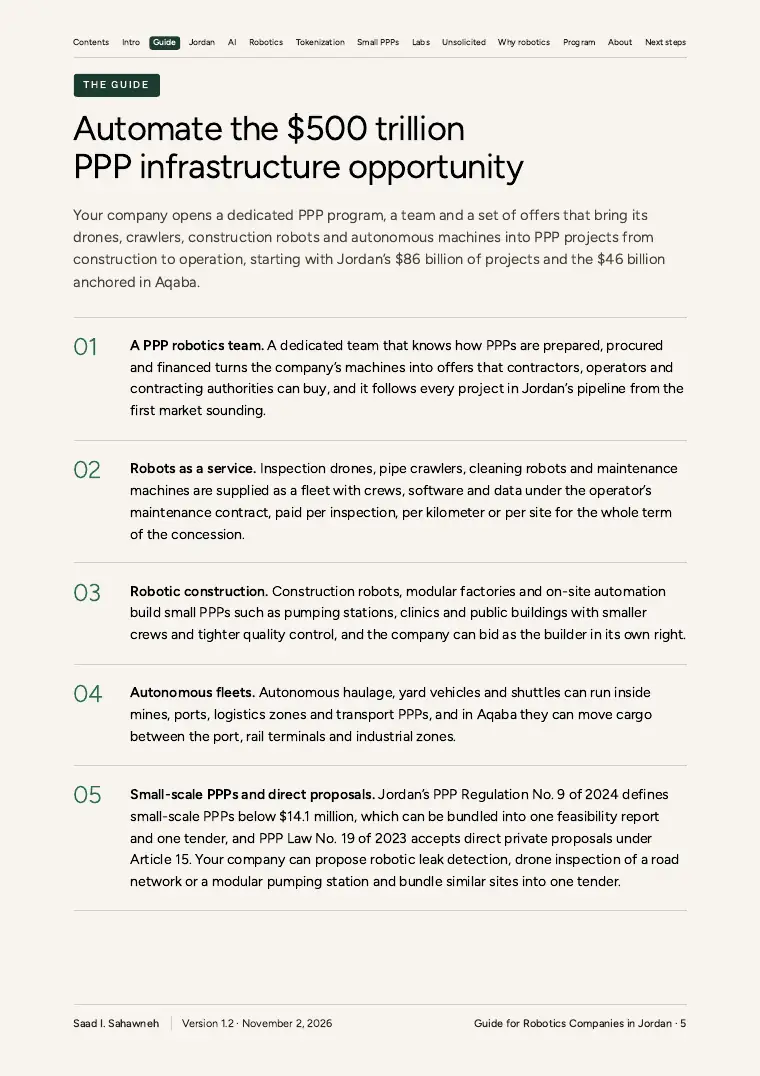
Your company opens a dedicated PPP program, a team and a set of offers that bring its drones, crawlers, construction robots and autonomous machines into PPP projects from construction to operation, starting with Jordan’s $86 billion of projects and the $46 billion anchored in Aqaba.
01
A PPP robotics team
A dedicated team that knows how PPPs are prepared, procured and financed turns the company’s machines into offers that contractors, operators and contracting authorities can buy, and it follows every project in Jordan’s pipeline from the first market sounding.
02
Robots as a service
Inspection drones, pipe crawlers, cleaning robots and maintenance machines are supplied as a fleet with crews, software and data under the operator’s maintenance contract, paid per inspection, per kilometer or per site for the whole term of the concession.
03
Robotic construction
Construction robots, modular factories and on-site automation build small PPPs such as pumping stations, clinics and public buildings with smaller crews and tighter quality control, and the company can bid as the builder in its own right.
04
Autonomous fleets
Autonomous haulage, yard vehicles and shuttles can run inside mines, ports, logistics zones and transport PPPs, and in Aqaba they can move cargo between the port, rail terminals and industrial zones.
05
Small-scale PPPs and direct proposals
Jordan’s PPP Regulation No. 9 of 2024 defines small-scale PPPs below $14.1 million, which can be bundled into one feasibility report and one tender, and PPP Law No. 19 of 2023 accepts direct private proposals under Article 15. Your company can propose robotic leak detection, drone inspection of a road network or a modular pumping station and bundle similar sites into one tender.
Why robotics companies
Robotics companies keep every PPP open and earning
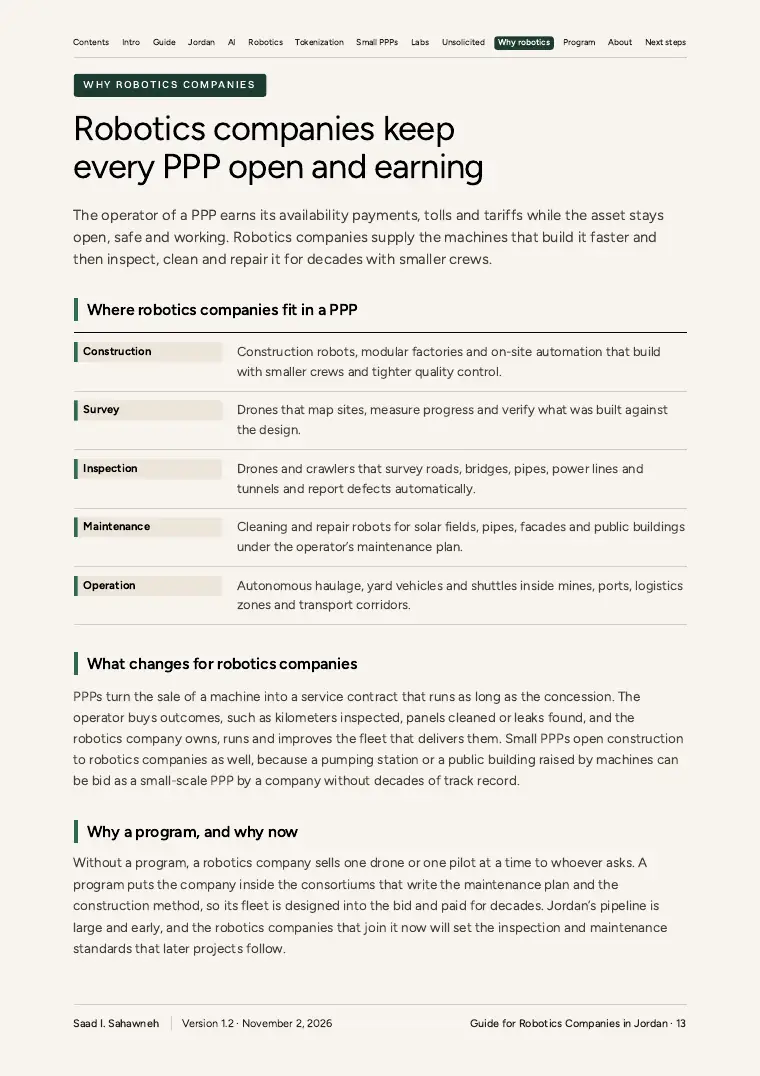
The operator of a PPP earns its availability payments, tolls and tariffs while the asset stays open, safe and working. Robotics companies supply the machines that build it faster and then inspect, clean and repair it for decades with smaller crews.
Where robotics companies fit in a PPP
- Construction
- Construction robots, modular factories and on-site automation that build with smaller crews and tighter quality control.
- Survey
- Drones that map sites, measure progress and verify what was built against the design.
- Inspection
- Drones and crawlers that survey roads, bridges, pipes, power lines and tunnels and report defects automatically.
- Maintenance
- Cleaning and repair robots for solar fields, pipes, facades and public buildings under the operator’s maintenance plan.
- Operation
- Autonomous haulage, yard vehicles and shuttles inside mines, ports, logistics zones and transport corridors.
What changes for robotics companies
PPPs turn the sale of a machine into a service contract that runs as long as the concession. The operator buys outcomes, such as kilometers inspected, panels cleaned or leaks found, and the robotics company owns, runs and improves the fleet that delivers them. Small PPPs open construction to robotics companies as well, because a pumping station or a public building raised by machines can be bid as a small-scale PPP by a company without decades of track record.
Why a program, and why now
Without a program, a robotics company sells one drone or one pilot at a time to whoever asks. A program puts the company inside the consortiums that write the maintenance plan and the construction method, so its fleet is designed into the bid and paid for decades. Jordan’s pipeline is large and early, and the robotics companies that join it now will set the inspection and maintenance standards that later projects follow.

Futureproofing
Futureproof Robotics Companies in Jordan for the infrastructure singularity
This free 17-page guide shows how, with small PPPs in parallel, PPP research labs, artificial intelligence, robotics, tokenization and six first steps.

Jordan and Aqaba
An $86 billion pipeline to start with
Every one of them will need to be built, inspected and maintained, and machines can carry out much of that work. A Jordanian robotics company that builds or maintains one project at home can carry the same fleet to the next one across the region.
- $86B
- of PPP and infrastructure projects in development in Jordan
- $46B
- of them anchored in Aqaba

Artificial intelligence
AI gives every robot on a PPP asset its eyes and its plan. Vision models turn drone and crawler footage into defect reports, planning models route each machine and schedule the repairs, and the digital twin records what the fleet found and fixed. A robotics company that connects its machines to the asset’s twin turns each inspection into evidence the operator can use to earn its performance payments.

Robotics
A PPP turns robots into long contracts. A concession operator is paid for keeping an asset open and safe for decades, so it can buy inspection, cleaning and repair from a robotics company as a service with guaranteed availability, paid per kilometer surveyed or per site maintained. Each contract funds a fleet, and the data that fleet gathers improves the machines for the next concession.

Tokenization
A fleet of robots working under a maintenance contract earns steady revenue, the kind of cash flow a token represents well. A robotics company can tokenize stakes in its fleets or in a small robot-built PPP, pay holders from the service fees as they arrive and publish each machine’s work to the registry, so investors see what the fleet has inspected and repaired.

Small PPPs and research labs
Small PPPs suit robotics well, because a robot-built pumping station or a round of drone inspections can be delivered quickly and measured from the first day. A robotics company can run lab pilots on many sites at once, test new machines on live public assets and carry the results into large concessions as evidence that its fleet performs.

Unsolicited proposals
A robotics company can see where a public asset is inspected by hand, maintained too late or built too slowly. A direct proposal lets it turn that knowledge into a robotic service or a robot-built project of its own design, protect the intellectual property behind its machines and keep the right to match the best offer if the project goes to tender.
The program
How the program could work
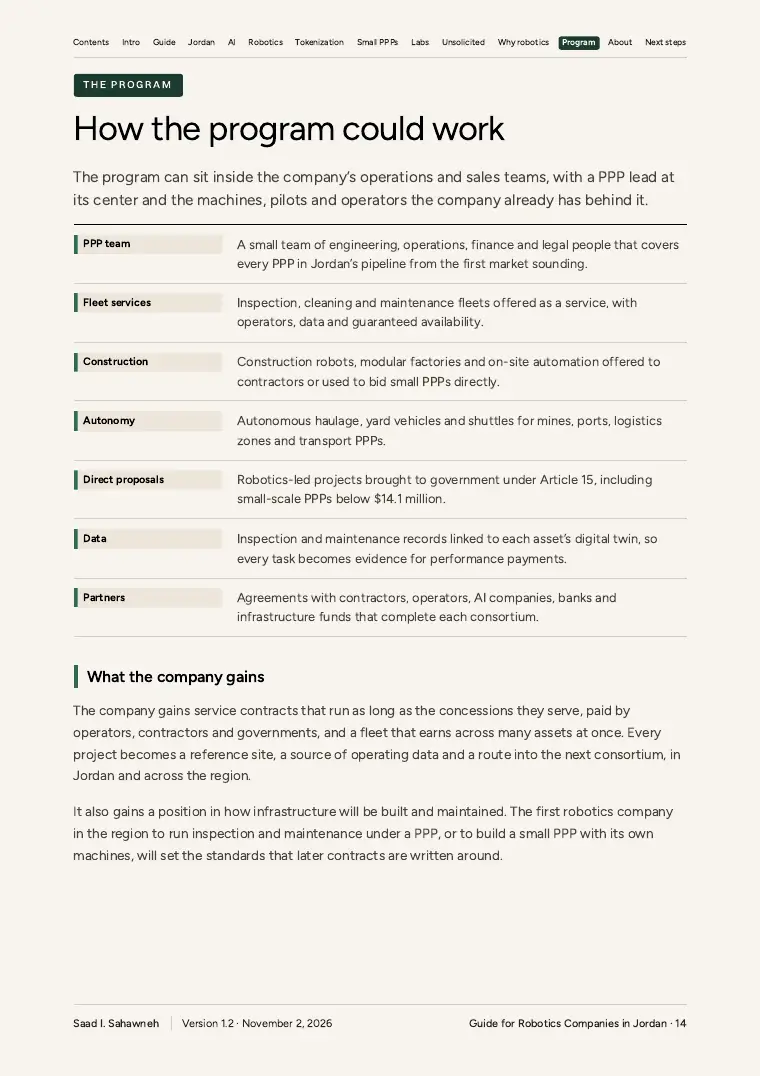
The program can sit inside the company’s operations and sales teams, with a PPP lead at its center and the machines, pilots and operators the company already has behind it.
- PPP team
- A small team of engineering, operations, finance and legal people that covers every PPP in Jordan’s pipeline from the first market sounding.
- Fleet services
- Inspection, cleaning and maintenance fleets offered as a service, with operators, data and guaranteed availability.
- Construction
- Construction robots, modular factories and on-site automation offered to contractors or used to bid small PPPs directly.
- Autonomy
- Autonomous haulage, yard vehicles and shuttles for mines, ports, logistics zones and transport PPPs.
- Direct proposals
- Robotics-led projects brought to government under Article 15, including small-scale PPPs below $14.1 million.
- Data
- Inspection and maintenance records linked to each asset’s digital twin, so every task becomes evidence for performance payments.
- Partners
- Agreements with contractors, operators, AI companies, banks and infrastructure funds that complete each consortium.
What the company gains
The company gains service contracts that run as long as the concessions they serve, paid by operators, contractors and governments, and a fleet that earns across many assets at once. Every project becomes a reference site, a source of operating data and a route into the next consortium, in Jordan and across the region.
It also gains a position in how infrastructure will be built and maintained. The first robotics company in the region to run inspection and maintenance under a PPP, or to build a small PPP with its own machines, will set the standards that later contracts are written around.

Next steps
How a robotics company can start
Any robotics company in Jordan can take this guide forward. The first steps use the machines, engineers and operators the company already has.
01
Mandate
Board approval for a PPP robotics program, with its machines, its sectors and its first-year goals.
02
Team
A named program lead, with engineering, operations, finance and legal people drawn from the company’s existing teams.
03
Pipeline
A map of Jordan’s $86 billion of projects by sector and stage, and early meetings with the contractors, operators and contracting authorities that will buy robotic services.
04
Fleet offers
Inspection, cleaning, maintenance and construction services packaged per kilometer, per site or per task and priced for whole-life contracts.
05
Partners
Contractors, operators, AI companies, lenders and infrastructure funds to complete each consortium.
06
Pilot
A first robotic service or robot-built small PPP as a direct proposal, taken from idea to submission.
Jordan has the projects, the engineers and a law that lets a company propose its own. A PPP program puts your machines inside the assets of the superintelligent infrastructure future, from their first foundation to their last year of operation.
The full document
Inside this guide
Seventeen pages and thirteen sections, from the case for a PPP program to the first steps, written for robotics companies in Jordan.
Download the guide (PDF)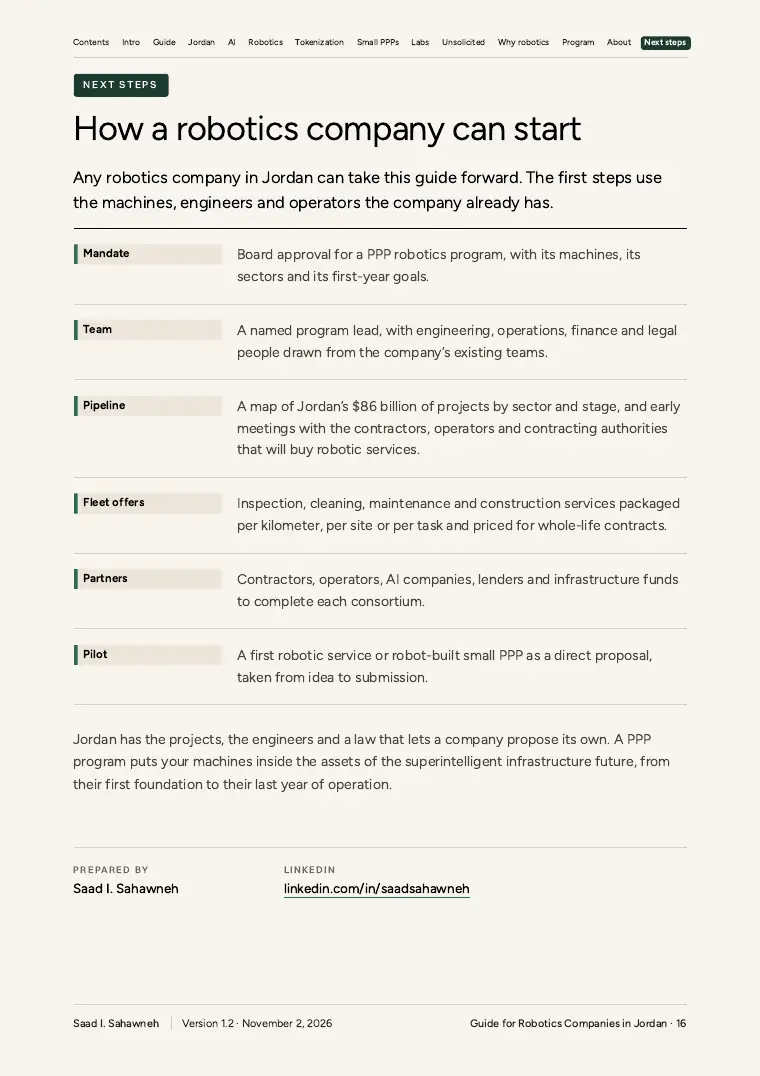
- 01IntroductionWhy a century of infrastructure needs rebuilding, and the $500 trillion it will take.p. 3
- 02The guideAutomate the $500 trillion PPP infrastructure opportunityp. 5
- 03Jordan and AqabaAn $86 billion pipeline to start withp. 6
- 04Artificial intelligenceHow AI designs, structures and runs PPP projects, and what it means for robotics companies.p. 7
- 05RoboticsHow robots build infrastructure and keep it running, and what that means for robotics companies.p. 8
- 06TokenizationHow tokenization funds projects from their own revenue, and the role it opens for robotics companies.p. 9
- 07Small PPPs in parallelWhy many small PPPs teach a country faster than a few large ones.p. 10
- 08PPP research labsA lab in each sector, running ten small PPP projects a year.p. 11
- 09Unsolicited proposalsHow Jordan’s PPP law accepts direct proposals from private companies.p. 12
- 10Why robotics companiesRobotics companies keep every PPP open and earningp. 13
- 11The programThe program can sit inside the company’s operations and sales teams, with a PPP lead at its center and the machines, pilots and operators the company already has behind it.p. 14
- 12AboutAbout Jordan PPP and what it offers.p. 15
- 13Next stepsHow a robotics company can start: six first steps.p. 16
Questions
Questions about the guide for Robotics Companies in Jordan
- What does the guide for Robotics Companies in Jordan propose?
- Your company launches a PPP program to build, inspect and maintain public-private partnership (PPP) projects with drones, crawlers, construction robots and autonomous machines, and to supply them as a service for the life of each concession.
- Why should robotics companies in Jordan launch a PPP program?
- Robotics companies keep every PPP open and earning. The operator of a PPP earns its availability payments, tolls and tariffs while the asset stays open, safe and working. Robotics companies supply the machines that build it faster and then inspect, clean and repair it for decades with smaller crews.
- Which PPP projects can robotics companies in Jordan take part in?
- Jordan has about $86 billion of PPP and infrastructure projects in development, $46 billion of them anchored in Aqaba. Every one of them will need to be built, inspected and maintained, and machines can carry out much of that work. A Jordanian robotics company that builds or maintains one project at home can carry the same fleet to the next one across the region.
- How can robotics companies in Jordan start a PPP program?
- Any robotics company in Jordan can take this guide forward. The first steps use the machines, engineers and operators the company already has. The guide sets out six first steps: mandate, team, pipeline, fleet offers, partners and pilot.
- What does a PPP program give robotics companies in Jordan?
- The company gains service contracts that run as long as the concessions they serve, paid by operators, contractors and governments, and a fleet that earns across many assets at once. Every project becomes a reference site, a source of operating data and a route into the next consortium, in Jordan and across the region.
- Is the guide for Robotics Companies in Jordan free?
- Yes. It is free to read on this page and free to download as a 17-page PDF, with the case for a PPP program, Jordan’s pipeline, the role of AI, robotics and tokenization, the program and six first steps.
Guide 30 of 52
Browse all 52 guides