
Public sector
Launch a PPP program for Financial Regulators and Markets in Jordan
A free 17-page guide · The $500 trillion PPP infrastructure opportunity
What this guide is for
Your institution launches a program to prepare Jordan’s markets for public-private partnership (PPP) finance, with a sandbox for tokenized notes, rules for project bonds and sukuk and a route to listing.
The case
Market rules decide how much local capital reaches a PPP
Infrastructure is financed over decades, and most of that finance passes at some point through banks, bond and sukuk markets, exchanges and depositories. The rules those markets follow decide how much of a country’s own savings can reach its projects, and how safely. This guide invites financial regulators and market institutions in Jordan to prepare the markets for PPP finance, starting with the projects at home.
The guide
Prepare Jordan’s markets for the $500 trillion PPP infrastructure opportunity
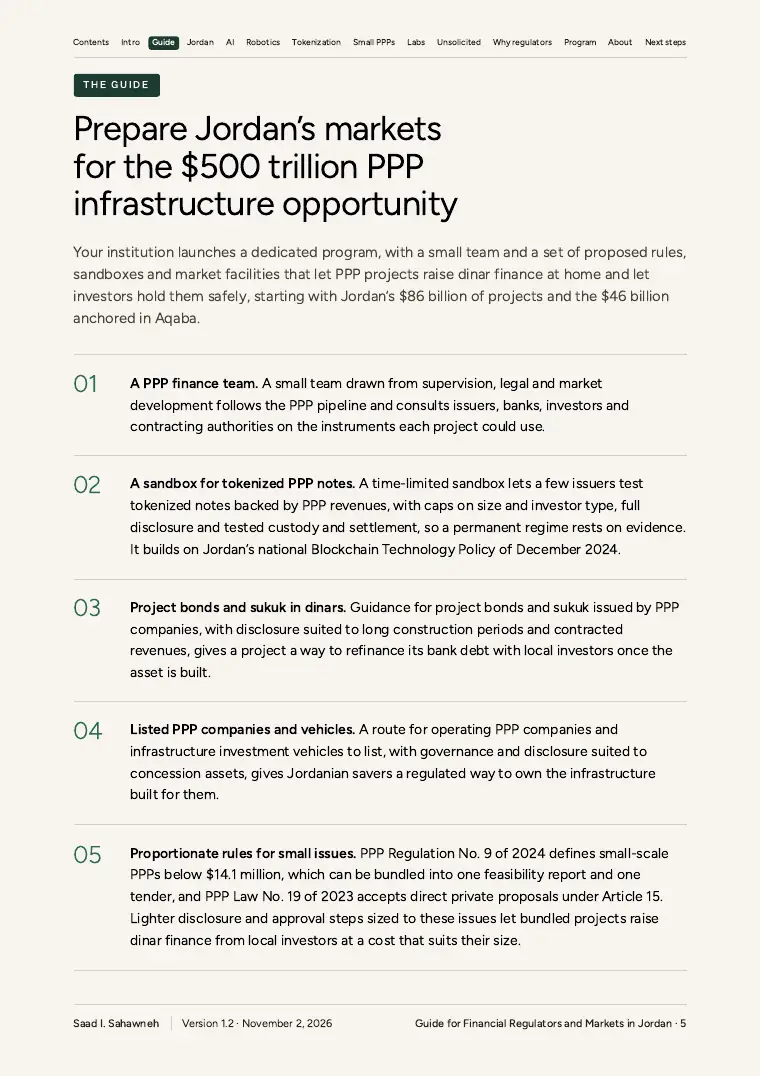
Your institution launches a dedicated program, with a small team and a set of proposed rules, sandboxes and market facilities that let PPP projects raise dinar finance at home and let investors hold them safely, starting with Jordan’s $86 billion of projects and the $46 billion anchored in Aqaba.
01
A PPP finance team
A small team drawn from supervision, legal and market development follows the PPP pipeline and consults issuers, banks, investors and contracting authorities on the instruments each project could use.
02
A sandbox for tokenized PPP notes
A time-limited sandbox lets a few issuers test tokenized notes backed by PPP revenues, with caps on size and investor type, full disclosure and tested custody and settlement, so a permanent regime rests on evidence. It builds on Jordan’s national Blockchain Technology Policy of December 2024.
03
Project bonds and sukuk in dinars
Guidance for project bonds and sukuk issued by PPP companies, with disclosure suited to long construction periods and contracted revenues, gives a project a way to refinance its bank debt with local investors once the asset is built.
04
Listed PPP companies and vehicles
A route for operating PPP companies and infrastructure investment vehicles to list, with governance and disclosure suited to concession assets, gives Jordanian savers a regulated way to own the infrastructure built for them.
05
Proportionate rules for small issues
PPP Regulation No. 9 of 2024 defines small-scale PPPs below $14.1 million, which can be bundled into one feasibility report and one tender, and PPP Law No. 19 of 2023 accepts direct private proposals under Article 15. Lighter disclosure and approval steps sized to these issues let bundled projects raise dinar finance from local investors at a cost that suits their size.
Why financial regulators and market institutions
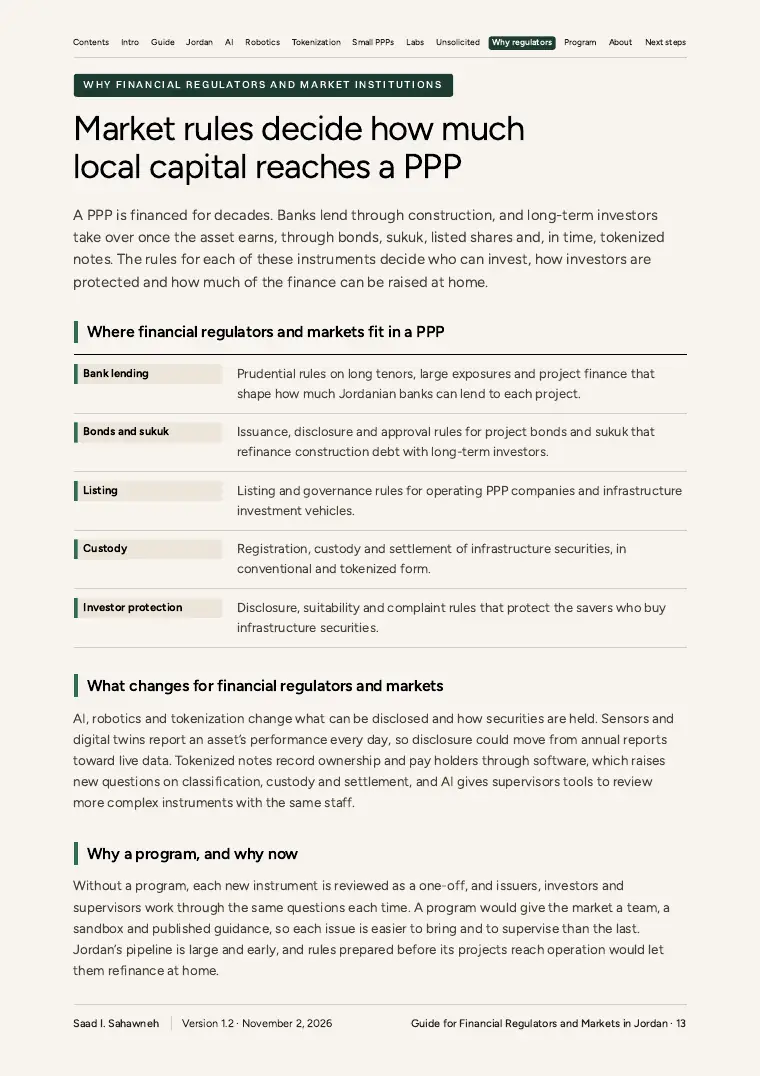
Market rules decide how much local capital reaches a PPP
A PPP is financed for decades. Banks lend through construction, and long-term investors take over once the asset earns, through bonds, sukuk, listed shares and, in time, tokenized notes. The rules for each of these instruments decide who can invest, how investors are protected and how much of the finance can be raised at home.
Where financial regulators and markets fit in a PPP
- Bank lending
- Prudential rules on long tenors, large exposures and project finance that shape how much Jordanian banks can lend to each project.
- Bonds and sukuk
- Issuance, disclosure and approval rules for project bonds and sukuk that refinance construction debt with long-term investors.
- Listing
- Listing and governance rules for operating PPP companies and infrastructure investment vehicles.
- Custody
- Registration, custody and settlement of infrastructure securities, in conventional and tokenized form.
- Investor protection
- Disclosure, suitability and complaint rules that protect the savers who buy infrastructure securities.
What changes for financial regulators and markets
AI, robotics and tokenization change what can be disclosed and how securities are held. Sensors and digital twins report an asset’s performance every day, so disclosure could move from annual reports toward live data. Tokenized notes record ownership and pay holders through software, which raises new questions on classification, custody and settlement, and AI gives supervisors tools to review more complex instruments with the same staff.
Why a program, and why now
Without a program, each new instrument is reviewed as a one-off, and issuers, investors and supervisors work through the same questions each time. A program would give the market a team, a sandbox and published guidance, so each issue is easier to bring and to supervise than the last. Jordan’s pipeline is large and early, and rules prepared before its projects reach operation would let them refinance at home.

Futureproofing
Futureproof Financial Regulators and Markets in Jordan for the infrastructure singularity
This free 17-page guide shows how, with small PPPs in parallel, PPP research labs, artificial intelligence, robotics, tokenization and six first steps.
Jordan and Aqaba
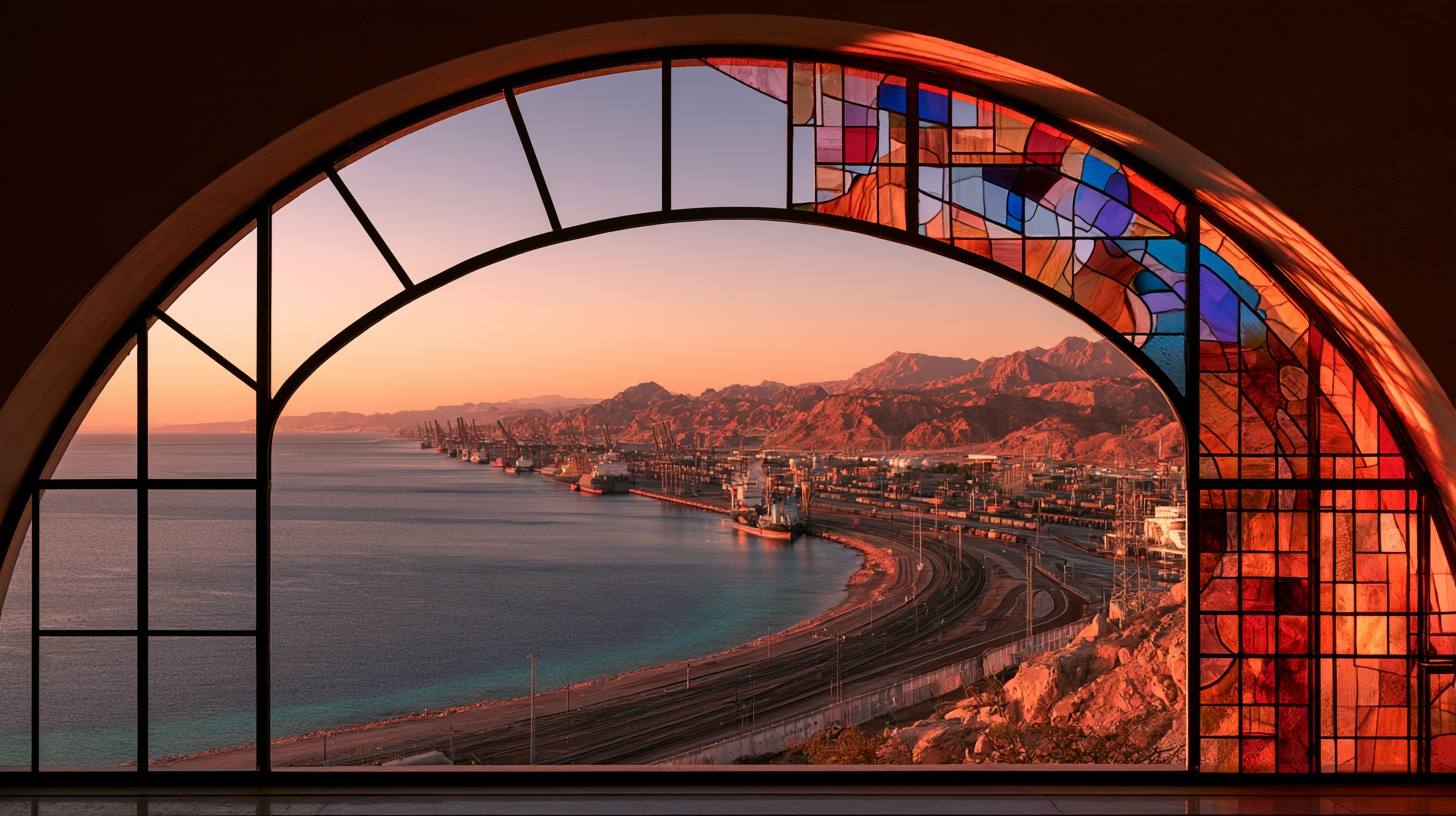
An $86 billion pipeline to start with
As they reach operation, many of them could look to local banks, bond and sukuk investors and the exchange for long-term finance in dinars. Market rules that work for one Jordanian project can serve every project that follows, and they give regional investors a clear way into Jordan’s infrastructure.
- $86B
- of PPP and infrastructure projects in development in Jordan
- $46B
- of them anchored in Aqaba

Artificial intelligence
AI gives a regulator or market institution the capacity to review and supervise more complex instruments with the same staff. Prospectuses, concession agreements and financial models can be read and compared in hours, disclosures can be checked against live performance data from the asset, and unusual trading or settlement patterns can surface early. Any supervisory use of AI would follow the institution’s own standards on data, privacy and accountability.

Robotics
Robotics reaches the markets through the data it produces. Drones, crawlers and sensors that inspect roads, pipes and power lines create an independent record of an asset’s condition, which issuers could use in their continuing disclosure and investors could use to judge an operating PPP company or a tokenized note on evidence.

Tokenization
Tokenized PPP notes raise questions that regulators and market institutions are best placed to answer: how a note is classified, who may hold it, where ownership is recorded, how custody and settlement work and how holders are paid and protected. A sandbox and clear rules on these points would let Jordanian savers hold infrastructure safely and give Jordan a regulated market for tokenized infrastructure that other markets in the region can recognize.

Small PPPs and research labs
Small PPPs give a regulator a low-risk place to learn. Bundled small-scale projects can test tokenized notes, small issues and new forms of disclosure on real assets inside a sandbox, with caps that limit what any investor can lose, and each published result shows what the permanent rules should say.

Unsolicited proposals
Direct proposals widen the range of projects that may one day come to market. A proposal under Article 15 must show value for money and cover the government’s obligations from project revenues, and a proposer that can show a route to dinar finance, a bond or sukuk issue or a listing after construction presents a stronger financial case. Clear market rules give every proposer, large or small, the same picture of how its project could be refinanced at home.
The program
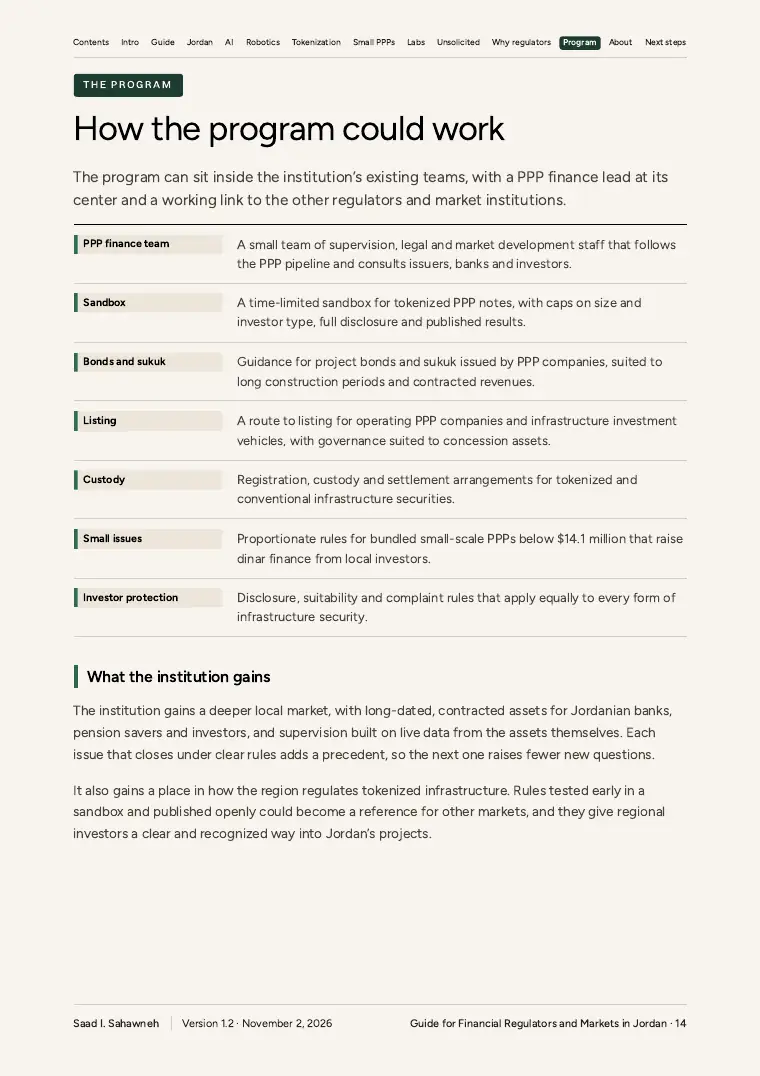
How the program could work
The program can sit inside the institution’s existing teams, with a PPP finance lead at its center and a working link to the other regulators and market institutions.
- PPP finance team
- A small team of supervision, legal and market development staff that follows the PPP pipeline and consults issuers, banks and investors.
- Sandbox
- A time-limited sandbox for tokenized PPP notes, with caps on size and investor type, full disclosure and published results.
- Bonds and sukuk
- Guidance for project bonds and sukuk issued by PPP companies, suited to long construction periods and contracted revenues.
- Listing
- A route to listing for operating PPP companies and infrastructure investment vehicles, with governance suited to concession assets.
- Custody
- Registration, custody and settlement arrangements for tokenized and conventional infrastructure securities.
- Small issues
- Proportionate rules for bundled small-scale PPPs below $14.1 million that raise dinar finance from local investors.
- Investor protection
- Disclosure, suitability and complaint rules that apply equally to every form of infrastructure security.
What the institution gains
The institution gains a deeper local market, with long-dated, contracted assets for Jordanian banks, pension savers and investors, and supervision built on live data from the assets themselves. Each issue that closes under clear rules adds a precedent, so the next one raises fewer new questions.
It also gains a place in how the region regulates tokenized infrastructure. Rules tested early in a sandbox and published openly could become a reference for other markets, and they give regional investors a clear and recognized way into Jordan’s projects.

Next steps
How a regulator or market institution can start
Any financial regulator or market institution in Jordan can take this guide forward. The first steps use the mandate, staff and market knowledge the institution already has.
01
Mandate
A decision by the institution’s board to study a PPP finance program, with its scope, its priorities and its first-year goals.
02
Team
A named program lead, with supervision, legal and market development staff drawn from the institution’s existing departments.
03
Pipeline
A review of Jordan’s $86 billion of projects by sector and stage, to see which could raise bonds, sukuk, listed equity or tokenized notes as they reach operation.
04
Sandbox
Terms of reference for a sandbox for tokenized PPP notes, with its eligibility, caps, custody arrangements and reporting.
05
Partners
Consultation with the other financial regulators and market institutions, contracting authorities, banks, issuers and investors.
06
Pilot
A first project bond, sukuk or tokenized note from an operating PPP, reviewed under the new guidance from application to settlement.
Jordan has the projects, a national Blockchain Technology Policy and a law that accepts unsolicited proposals. A program for PPP finance would give Jordanian savers a safe way to own the assets built for them and give the superintelligent infrastructure future a regulated market at home.
The full document
Inside this guide
Seventeen pages and thirteen sections, from the case for a PPP program to the first steps, written for financial regulators and market institutions in Jordan.
Download the guide (PDF)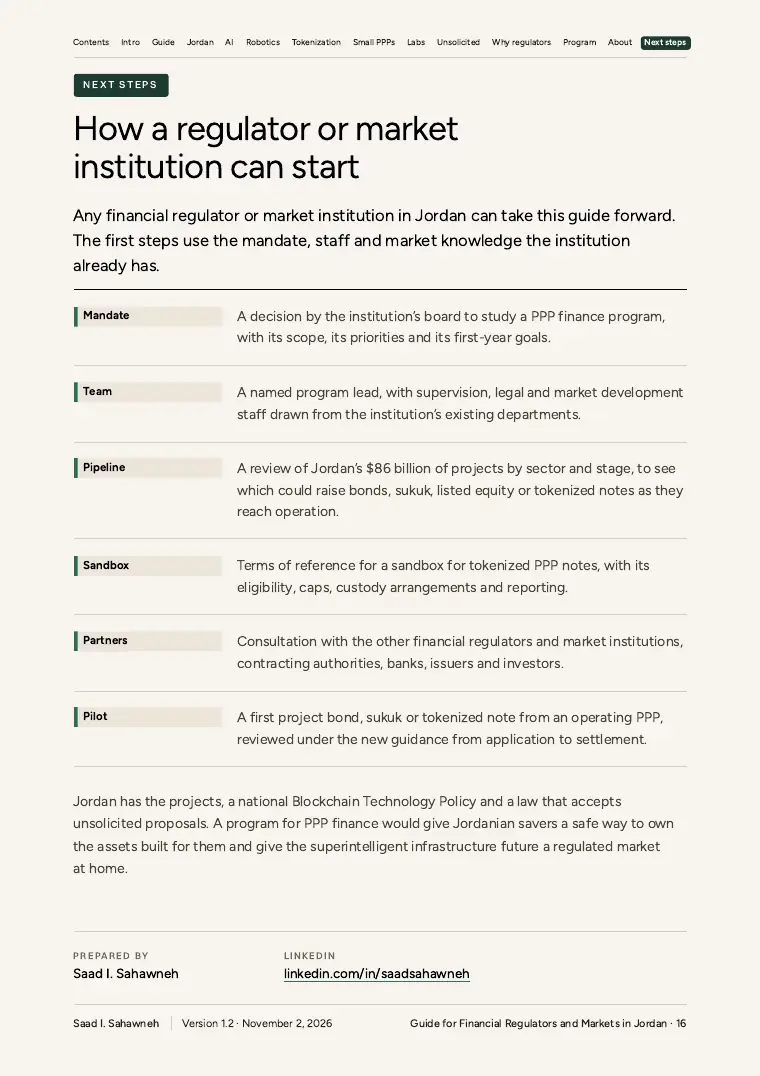
- 01IntroductionWhy a century of infrastructure needs rebuilding, and the $500 trillion it will take.p. 3
- 02The guidePrepare Jordan’s markets for the $500 trillion PPP infrastructure opportunityp. 5
- 03Jordan and AqabaAn $86 billion pipeline to start withp. 6
- 04Artificial intelligenceHow AI designs, structures and runs PPP projects, and what it means for financial regulators and market institutions.p. 7
- 05RoboticsHow robots build infrastructure and keep it running, and what that means for financial regulators and market institutions.p. 8
- 06TokenizationHow tokenization funds projects from their own revenue, and the role it opens for financial regulators and market institutions.p. 9
- 07Small PPPs in parallelWhy many small PPPs teach a country faster than a few large ones.p. 10
- 08PPP research labsA lab in each sector, running ten small PPP projects a year.p. 11
- 09Unsolicited proposalsHow Jordan’s PPP law accepts direct proposals from private companies.p. 12
- 10Why financial regulators and market institutionsMarket rules decide how much local capital reaches a PPPp. 13
- 11The programThe program can sit inside the institution’s existing teams, with a PPP finance lead at its center and a working link to the other regulators and market institutions.p. 14
- 12AboutAbout Jordan PPP and what it offers.p. 15
- 13Next stepsHow a regulator or market institution can start: six first steps.p. 16
Questions
Questions about the guide for Financial Regulators and Markets in Jordan
- What does the guide for Financial Regulators and Markets in Jordan propose?
- Your institution launches a program to prepare Jordan’s markets for public-private partnership (PPP) finance, with a sandbox for tokenized notes, rules for project bonds and sukuk and a route to listing.
- Why should financial regulators and market institutions in Jordan launch a PPP program?
- Market rules decide how much local capital reaches a PPP. A PPP is financed for decades. Banks lend through construction, and long-term investors take over once the asset earns, through bonds, sukuk, listed shares and, in time, tokenized notes. The rules for each of these instruments decide who can invest, how investors are protected and how much of the finance can be raised at home.
- Which PPP projects can financial regulators and market institutions in Jordan take part in?
- Jordan has about $86 billion of PPP and infrastructure projects in development, $46 billion of them anchored in Aqaba. As they reach operation, many of them could look to local banks, bond and sukuk investors and the exchange for long-term finance in dinars. Market rules that work for one Jordanian project can serve every project that follows, and they give regional investors a clear way into Jordan’s infrastructure.
- How can financial regulators and market institutions in Jordan start a PPP program?
- Any financial regulator or market institution in Jordan can take this guide forward. The first steps use the mandate, staff and market knowledge the institution already has. The guide sets out six first steps: mandate, team, pipeline, sandbox, partners and pilot.
- What does a PPP program give financial regulators and market institutions in Jordan?
- The institution gains a deeper local market, with long-dated, contracted assets for Jordanian banks, pension savers and investors, and supervision built on live data from the assets themselves. Each issue that closes under clear rules adds a precedent, so the next one raises fewer new questions.
- Is the guide for Financial Regulators and Markets in Jordan free?
- Yes. It is free to read on this page and free to download as a 17-page PDF, with the case for a PPP program, Jordan’s pipeline, the role of AI, robotics and tokenization, the program and six first steps.
Guide 6 of 52
Browse all 52 guides