
Technology and knowledge
Launch a PPP program for Blockchain Companies in Jordan
A free 17-page guide · The $500 trillion PPP infrastructure opportunity
What this guide is for
Your company launches a PPP program to tokenize public-private partnership (PPP) projects and to run the registries, smart contracts and investor onboarding behind them.
The case
Blockchain companies open infrastructure to every investor
Infrastructure has always been financed by a few banks and funds, and its ownership has stayed closed to almost everyone else. The projects of the next fifty years will be financed, recorded and owned on shared ledgers, and the companies that build those rails will run them for as long as the assets last. This guide invites blockchain companies in Jordan to launch a PPP program, starting with the projects at home.
The guide
Put the $500 trillion PPP infrastructure opportunity on chain
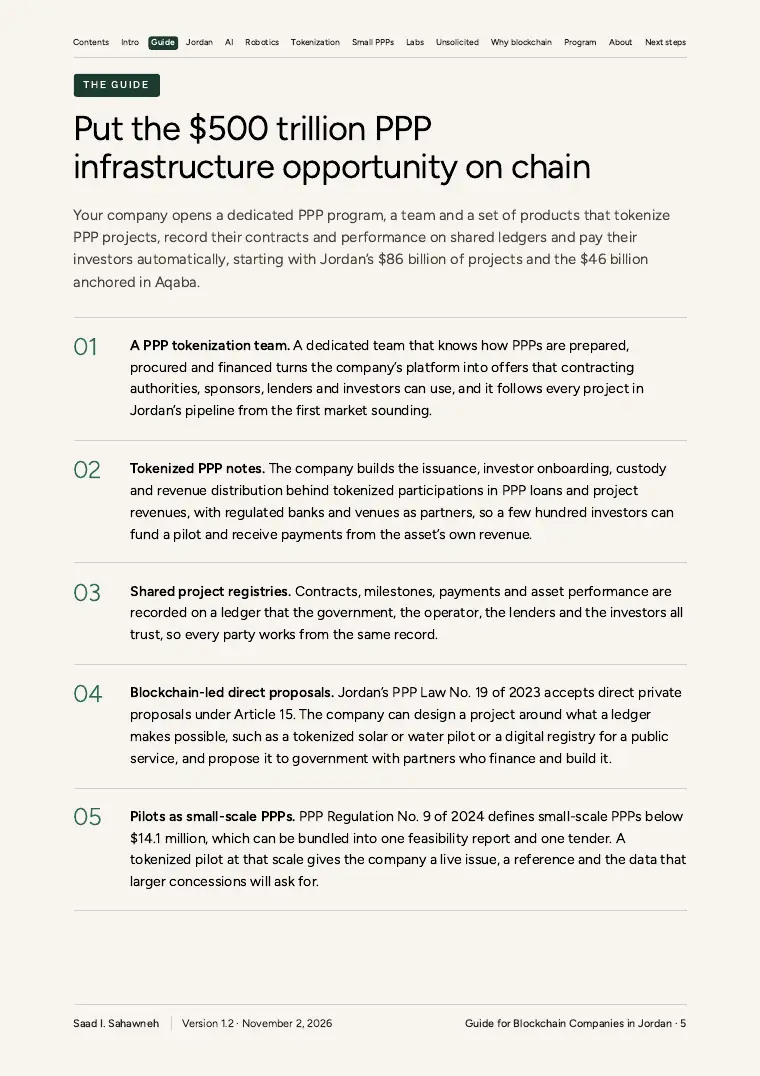
Your company opens a dedicated PPP program, a team and a set of products that tokenize PPP projects, record their contracts and performance on shared ledgers and pay their investors automatically, starting with Jordan’s $86 billion of projects and the $46 billion anchored in Aqaba.
01
A PPP tokenization team
A dedicated team that knows how PPPs are prepared, procured and financed turns the company’s platform into offers that contracting authorities, sponsors, lenders and investors can use, and it follows every project in Jordan’s pipeline from the first market sounding.
02
Tokenized PPP notes
The company builds the issuance, investor onboarding, custody and revenue distribution behind tokenized participations in PPP loans and project revenues, with regulated banks and venues as partners, so a few hundred investors can fund a pilot and receive payments from the asset’s own revenue.
03
Shared project registries
Contracts, milestones, payments and asset performance are recorded on a ledger that the government, the operator, the lenders and the investors all trust, so every party works from the same record.
04
Blockchain-led direct proposals
Jordan’s PPP Law No. 19 of 2023 accepts direct private proposals under Article 15. The company can design a project around what a ledger makes possible, such as a tokenized solar or water pilot or a digital registry for a public service, and propose it to government with partners who finance and build it.
05
Pilots as small-scale PPPs
PPP Regulation No. 9 of 2024 defines small-scale PPPs below $14.1 million, which can be bundled into one feasibility report and one tender. A tokenized pilot at that scale gives the company a live issue, a reference and the data that larger concessions will ask for.
Why blockchain companies
Blockchain companies open infrastructure to every investor
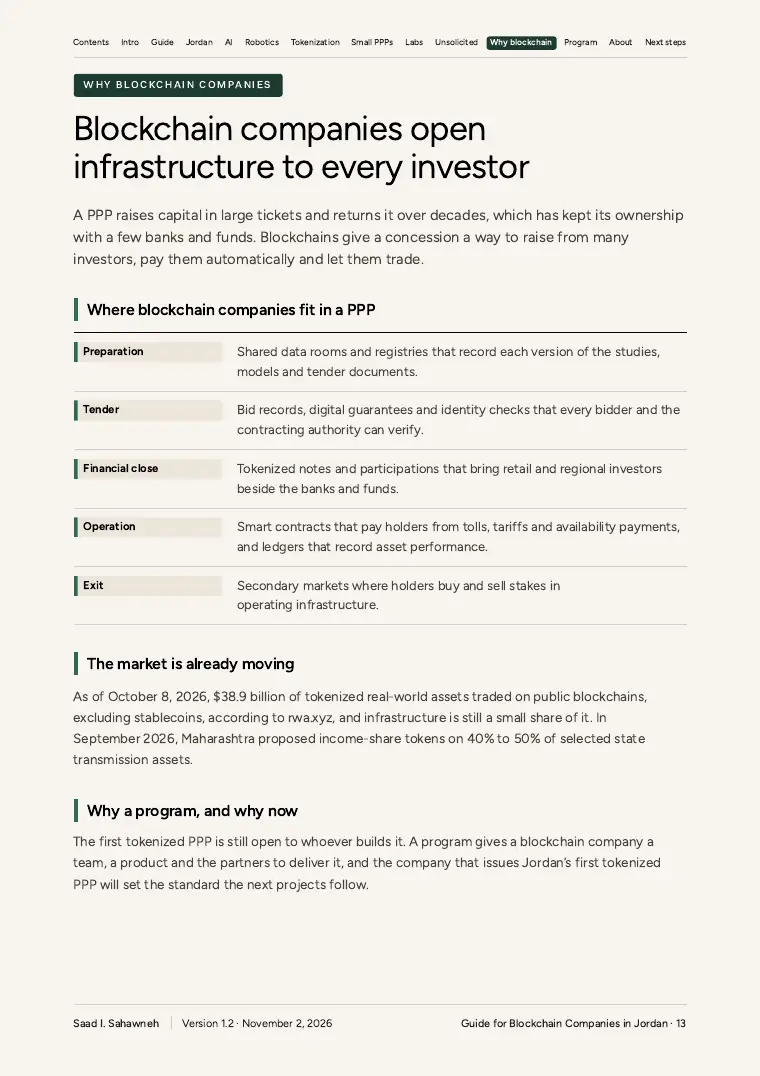
A PPP raises capital in large tickets and returns it over decades, which has kept its ownership with a few banks and funds. Blockchains give a concession a way to raise from many investors, pay them automatically and let them trade.
Where blockchain companies fit in a PPP
- Preparation
- Shared data rooms and registries that record each version of the studies, models and tender documents.
- Tender
- Bid records, digital guarantees and identity checks that every bidder and the contracting authority can verify.
- Financial close
- Tokenized notes and participations that bring retail and regional investors beside the banks and funds.
- Operation
- Smart contracts that pay holders from tolls, tariffs and availability payments, and ledgers that record asset performance.
- Exit
- Secondary markets where holders buy and sell stakes in operating infrastructure.
The market is already moving
As of October 8, 2026, $38.9 billion of tokenized real-world assets traded on public blockchains, excluding stablecoins, according to rwa.xyz, and infrastructure is still a small share of it. In September 2026, Maharashtra proposed income-share tokens on 40% to 50% of selected state transmission assets.
Why a program, and why now
The first tokenized PPP is still open to whoever builds it. A program gives a blockchain company a team, a product and the partners to deliver it, and the company that issues Jordan’s first tokenized PPP will set the standard the next projects follow.

Futureproofing
Futureproof Blockchain Companies in Jordan for the infrastructure singularity
This free 17-page guide shows how, with small PPPs in parallel, PPP research labs, artificial intelligence, robotics, tokenization and six first steps.

Jordan and Aqaba
An $86 billion pipeline to start with
Every one of them will need capital, records and payments that every party can trust. A Jordanian company that tokenizes one project at home can carry the same platform to the next one across the region.
- $86B
- of PPP and infrastructure projects in development in Jordan
- $46B
- of them anchored in Aqaba

Artificial intelligence
AI and blockchains work together inside a PPP. AI reads the contracts, models the revenues and monitors the asset, and a ledger records what it finds so the government, the lenders and the investors share one version of the truth. A blockchain company can link each payment on a tokenized note to the asset data that triggered it.

Robotics
Robots and sensors produce a steady stream of data on what was built, inspected and repaired. A blockchain company can record that data as it arrives, so performance payments, maintenance records and quality certificates rest on evidence every party can check, the way supply-chain certification already works on ledgers.

Tokenization
Tokenization is the core product. A blockchain company can issue tokenized stakes in PPP companies, portfolios and projects, onboard Jordanian and regional investors with identity checks built in, pay holders through smart contracts as tolls and tariffs arrive and run the secondary market where those stakes trade.

Small PPPs and research labs
Every small PPP is a chance to tokenize a real asset at low risk. A blockchain company can fund lab pilots from a few hundred investors, pay them from each asset’s own revenue and publish every result on a ledger the public can read, which turns the labs into Jordan’s first live market for tokenized infrastructure.

Unsolicited proposals
Article 15 asks for an innovative solution for a public service, and a tokenized financing structure or a public registry can be one. A direct proposal lets a blockchain company bring that solution to a ministry as a project of its own, protect the intellectual property behind it and keep the right to match the best offer at tender.
The program
How the program could work
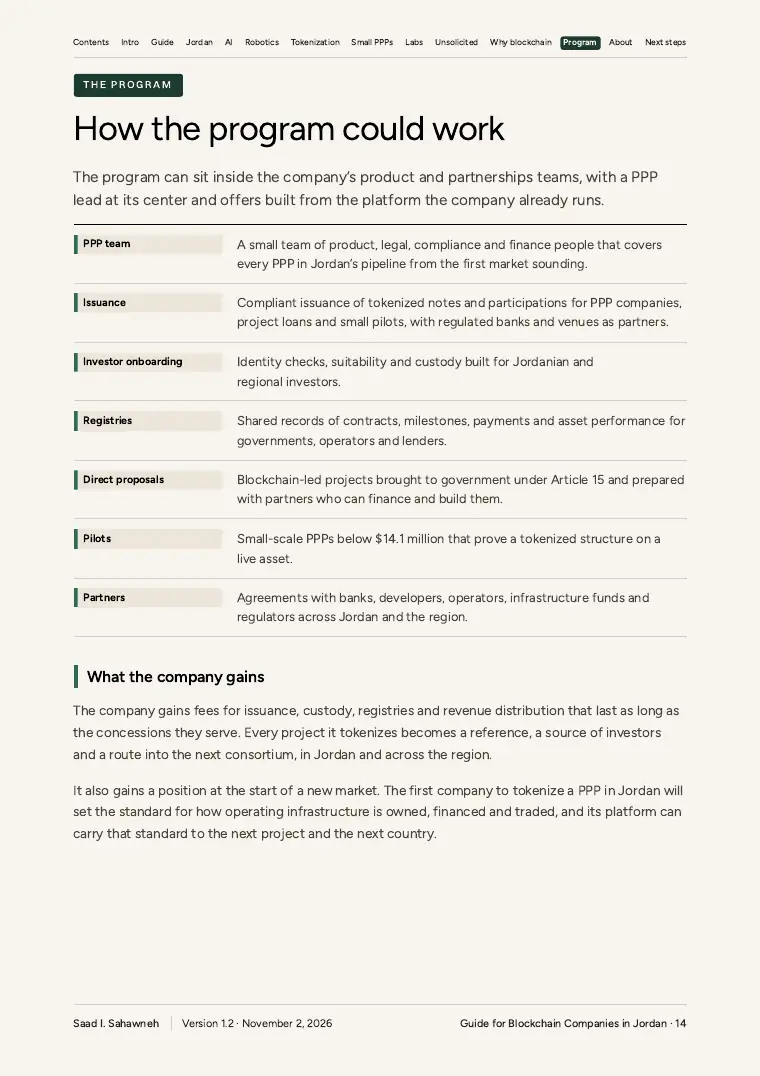
The program can sit inside the company’s product and partnerships teams, with a PPP lead at its center and offers built from the platform the company already runs.
- PPP team
- A small team of product, legal, compliance and finance people that covers every PPP in Jordan’s pipeline from the first market sounding.
- Issuance
- Compliant issuance of tokenized notes and participations for PPP companies, project loans and small pilots, with regulated banks and venues as partners.
- Investor onboarding
- Identity checks, suitability and custody built for Jordanian and regional investors.
- Registries
- Shared records of contracts, milestones, payments and asset performance for governments, operators and lenders.
- Direct proposals
- Blockchain-led projects brought to government under Article 15 and prepared with partners who can finance and build them.
- Pilots
- Small-scale PPPs below $14.1 million that prove a tokenized structure on a live asset.
- Partners
- Agreements with banks, developers, operators, infrastructure funds and regulators across Jordan and the region.
What the company gains
The company gains fees for issuance, custody, registries and revenue distribution that last as long as the concessions they serve. Every project it tokenizes becomes a reference, a source of investors and a route into the next consortium, in Jordan and across the region.
It also gains a position at the start of a new market. The first company to tokenize a PPP in Jordan will set the standard for how operating infrastructure is owned, financed and traded, and its platform can carry that standard to the next project and the next country.

Next steps
How a blockchain company can start
Any blockchain company in Jordan can take this guide forward. The first steps use the platform, engineers and partners the company already has.
01
Mandate
Board approval for a PPP tokenization program, with its products, its sectors and its first-year goals.
02
Team
A named program lead, with product, legal, compliance and finance people drawn from the company’s existing teams.
03
Pipeline
A map of Jordan’s $86 billion of projects by sector and stage, and early meetings with the sponsors and lenders open to tokenized notes.
04
Products
Issuance, investor onboarding, registries and revenue distribution packaged into one PPP offer.
05
Partners
Regulated banks, venues, developers and regulators across Jordan and the region.
06
Pilot
A first tokenized pilot or blockchain-led direct proposal, taken from idea to submission.
Jordan has the projects, a national Blockchain Technology Policy and a law that lets a company propose its own. A PPP program puts your platform at the center of how the superintelligent infrastructure future is financed and owned.
The full document
Inside this guide
Seventeen pages and thirteen sections, from the case for a PPP program to the first steps, written for blockchain companies in Jordan.
Download the guide (PDF)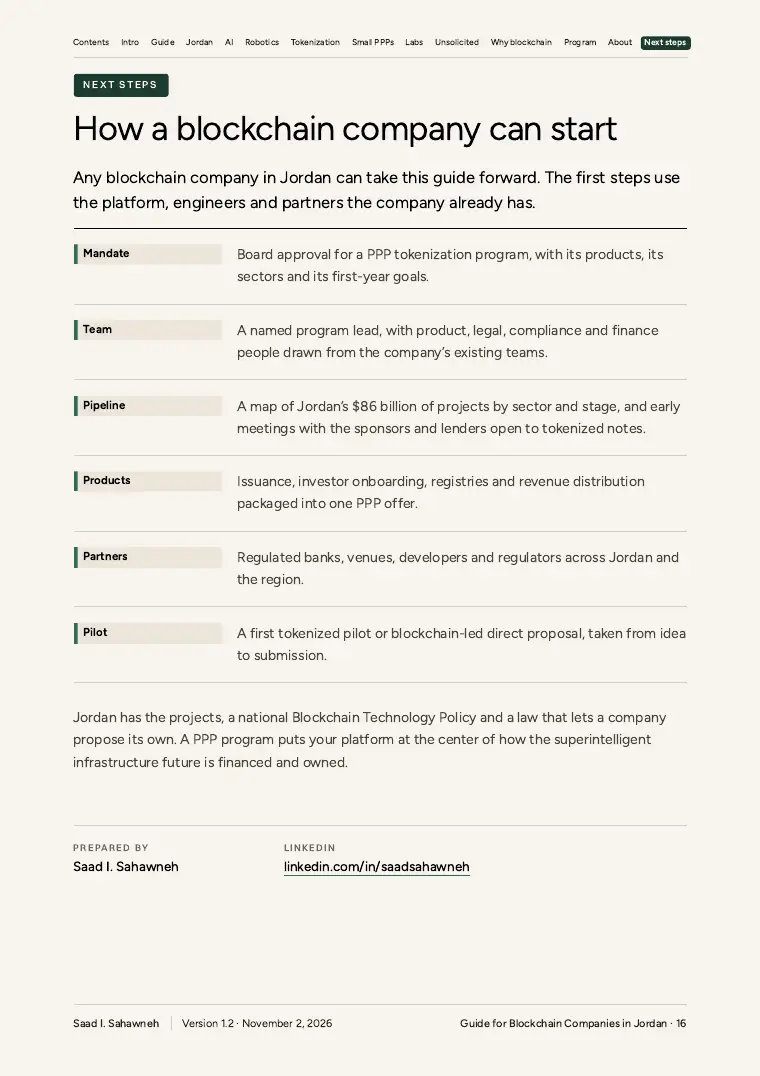
- 01IntroductionWhy a century of infrastructure needs rebuilding, and the $500 trillion it will take.p. 3
- 02The guidePut the $500 trillion PPP infrastructure opportunity on chainp. 5
- 03Jordan and AqabaAn $86 billion pipeline to start withp. 6
- 04Artificial intelligenceHow AI designs, structures and runs PPP projects, and what it means for blockchain companies.p. 7
- 05RoboticsHow robots build infrastructure and keep it running, and what that means for blockchain companies.p. 8
- 06TokenizationHow tokenization funds projects from their own revenue, and the role it opens for blockchain companies.p. 9
- 07Small PPPs in parallelWhy many small PPPs teach a country faster than a few large ones.p. 10
- 08PPP research labsA lab in each sector, running ten small PPP projects a year.p. 11
- 09Unsolicited proposalsHow Jordan’s PPP law accepts direct proposals from private companies.p. 12
- 10Why blockchain companiesBlockchain companies open infrastructure to every investorp. 13
- 11The programThe program can sit inside the company’s product and partnerships teams, with a PPP lead at its center and offers built from the platform the company already runs.p. 14
- 12AboutAbout Jordan PPP and what it offers.p. 15
- 13Next stepsHow a blockchain company can start: six first steps.p. 16
Questions
Questions about the guide for Blockchain Companies in Jordan
- What does the guide for Blockchain Companies in Jordan propose?
- Your company launches a PPP program to tokenize public-private partnership (PPP) projects and to run the registries, smart contracts and investor onboarding behind them.
- Why should blockchain companies in Jordan launch a PPP program?
- Blockchain companies open infrastructure to every investor. A PPP raises capital in large tickets and returns it over decades, which has kept its ownership with a few banks and funds. Blockchains give a concession a way to raise from many investors, pay them automatically and let them trade.
- Which PPP projects can blockchain companies in Jordan take part in?
- Jordan has about $86 billion of PPP and infrastructure projects in development, $46 billion of them anchored in Aqaba. Every one of them will need capital, records and payments that every party can trust. A Jordanian company that tokenizes one project at home can carry the same platform to the next one across the region.
- How can blockchain companies in Jordan start a PPP program?
- Any blockchain company in Jordan can take this guide forward. The first steps use the platform, engineers and partners the company already has. The guide sets out six first steps: mandate, team, pipeline, products, partners and pilot.
- What does a PPP program give blockchain companies in Jordan?
- The company gains fees for issuance, custody, registries and revenue distribution that last as long as the concessions they serve. Every project it tokenizes becomes a reference, a source of investors and a route into the next consortium, in Jordan and across the region.
- Is the guide for Blockchain Companies in Jordan free?
- Yes. It is free to read on this page and free to download as a 17-page PDF, with the case for a PPP program, Jordan’s pipeline, the role of AI, robotics and tokenization, the program and six first steps.
Guide 31 of 52
Browse all 52 guides