
Technology and knowledge
Launch a PPP program for Technology Companies in Jordan
A free 17-page guide · The $500 trillion PPP infrastructure opportunity
What this guide is for
Your company launches a PPP program to sell AI, robotics, sensors, digital twins and tokenization platforms into public-private partnership (PPP) projects and to join the consortiums that win them.
The case
Technology companies decide how well a PPP performs
Infrastructure has long been bought as concrete and steel, with technology added late. The projects of the next fifty years will specify their software layer from the start, and the companies that supply it will hold contracts that run as long as the concessions. This guide invites technology companies in Jordan to launch a PPP program, starting with the projects at home.
The guide
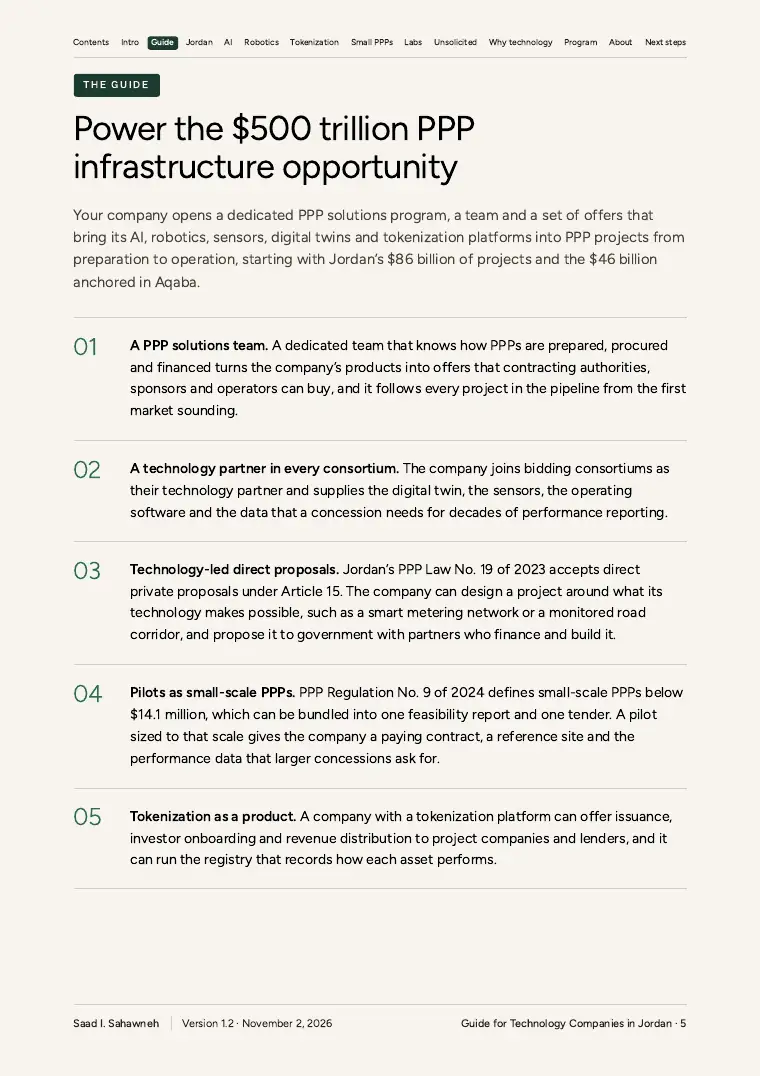
Power the $500 trillion PPP infrastructure opportunity
Your company opens a dedicated PPP solutions program, a team and a set of offers that bring its AI, robotics, sensors, digital twins and tokenization platforms into PPP projects from preparation to operation, starting with Jordan’s $86 billion of projects and the $46 billion anchored in Aqaba.
01
A PPP solutions team
A dedicated team that knows how PPPs are prepared, procured and financed turns the company’s products into offers that contracting authorities, sponsors and operators can buy, and it follows every project in the pipeline from the first market sounding.
02
A technology partner in every consortium
The company joins bidding consortiums as their technology partner and supplies the digital twin, the sensors, the operating software and the data that a concession needs for decades of performance reporting.
03
Technology-led direct proposals
Jordan’s PPP Law No. 19 of 2023 accepts direct private proposals under Article 15. The company can design a project around what its technology makes possible, such as a smart metering network or a monitored road corridor, and propose it to government with partners who finance and build it.
04
Pilots as small-scale PPPs
PPP Regulation No. 9 of 2024 defines small-scale PPPs below $14.1 million, which can be bundled into one feasibility report and one tender. A pilot sized to that scale gives the company a paying contract, a reference site and the performance data that larger concessions ask for.
05
Tokenization as a product
A company with a tokenization platform can offer issuance, investor onboarding and revenue distribution to project companies and lenders, and it can run the registry that records how each asset performs.
Why technology companies
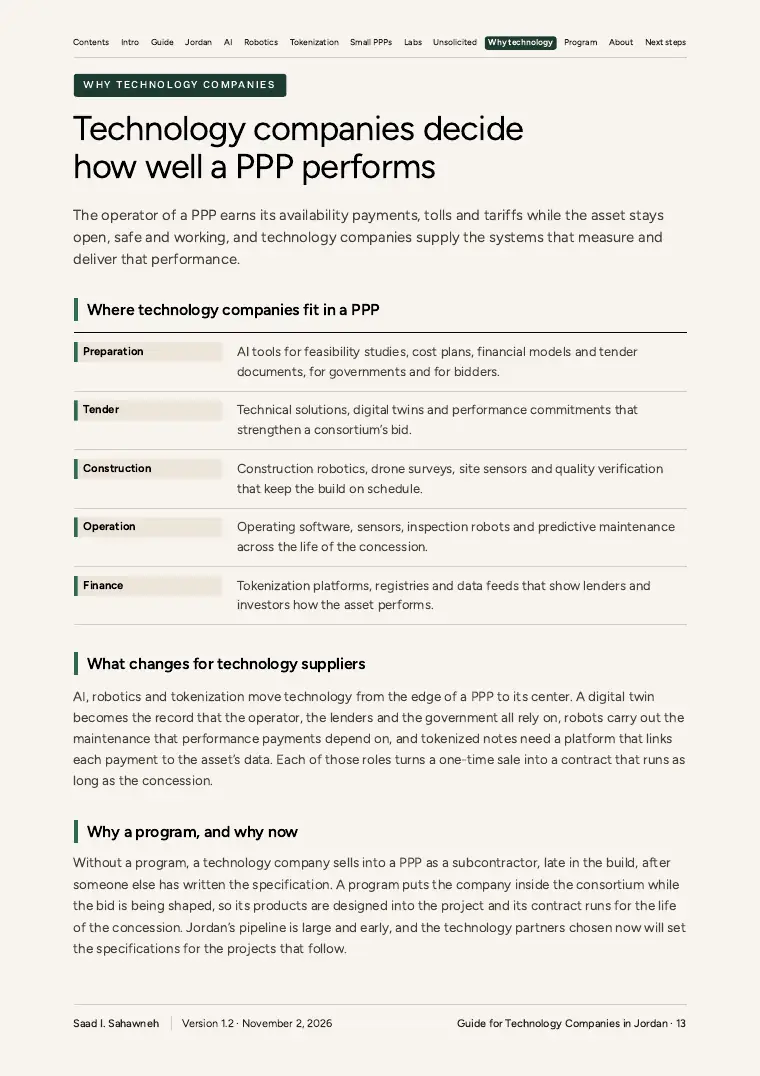
Technology companies decide how well a PPP performs
The operator of a PPP earns its availability payments, tolls and tariffs while the asset stays open, safe and working, and technology companies supply the systems that measure and deliver that performance.
Where technology companies fit in a PPP
- Preparation
- AI tools for feasibility studies, cost plans, financial models and tender documents, for governments and for bidders.
- Tender
- Technical solutions, digital twins and performance commitments that strengthen a consortium’s bid.
- Construction
- Construction robotics, drone surveys, site sensors and quality verification that keep the build on schedule.
- Operation
- Operating software, sensors, inspection robots and predictive maintenance across the life of the concession.
- Finance
- Tokenization platforms, registries and data feeds that show lenders and investors how the asset performs.
What changes for technology suppliers
AI, robotics and tokenization move technology from the edge of a PPP to its center. A digital twin becomes the record that the operator, the lenders and the government all rely on, robots carry out the maintenance that performance payments depend on, and tokenized notes need a platform that links each payment to the asset’s data. Each of those roles turns a one-time sale into a contract that runs as long as the concession.
Why a program, and why now
Without a program, a technology company sells into a PPP as a subcontractor, late in the build, after someone else has written the specification. A program puts the company inside the consortium while the bid is being shaped, so its products are designed into the project and its contract runs for the life of the concession. Jordan’s pipeline is large and early, and the technology partners chosen now will set the specifications for the projects that follow.

Futureproofing
Futureproof Technology Companies in Jordan for the infrastructure singularity
This free 17-page guide shows how, with small PPPs in parallel, PPP research labs, artificial intelligence, robotics, tokenization and six first steps.

Jordan and Aqaba
An $86 billion pipeline to start with
Every one of them will need software, sensors, machines and data. A Jordanian company that proves its technology on one project at home can sell it to the next one across the region.
- $86B
- of PPP and infrastructure projects in development in Jordan
- $46B
- of them anchored in Aqaba

Artificial intelligence
AI gives a technology company a role at every stage of a PPP. Preparation tools speed up the feasibility studies, financial models and tender documents that governments and bidders produce. Operating software then runs the asset for the life of the concession, and each contract brings years of recurring revenue and a growing body of data that improves the product on the next project.

Robotics
Robotics turns inspection, maintenance and construction into services a technology company can sell under contract. Drones, crawlers and cleaning robots can be supplied as a fleet with operators and data, paid per inspection or per kilometer, and a PPP operator can buy them as part of its maintenance plan for the whole term of the concession.

Tokenization
Tokenization opens a new product line for platform companies. A technology company can supply the issuance, investor onboarding, custody and revenue distribution software behind a tokenized PPP, connect it to the asset’s sensors so holders see performance as it happens, and license the same stack to the next project and the next country.

Small PPPs and research labs
Every lab is a paying first customer for new technology on a real public asset. A technology company can place its AI, robotics, sensors or tokenization platform into small PPPs across many sectors at once, prove it quickly and carry the results into the large projects as a reference that buyers can visit.

Unsolicited proposals
A direct proposal under Article 15 has to offer an innovative solution for a public service, which is what a technology company sells. A direct proposal lets the company bring its technology to a ministry as a project of its own, protect the intellectual property behind it and keep the right to match the best offer at tender.
The program
How the program could work
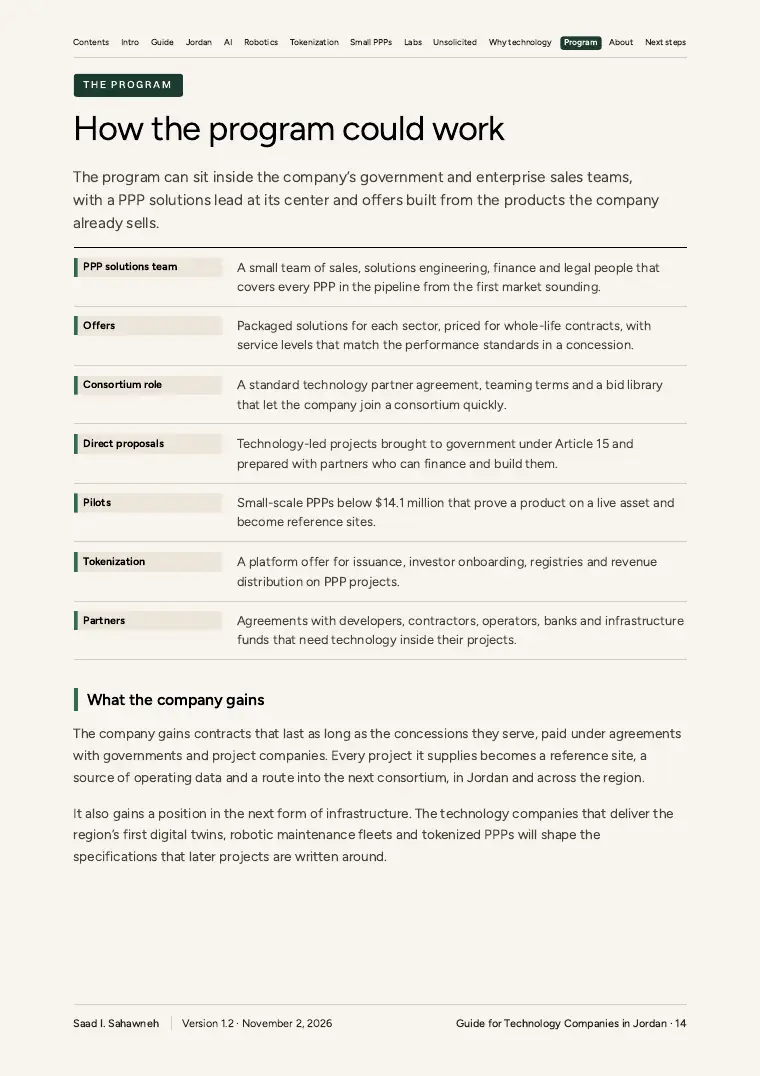
The program can sit inside the company’s government and enterprise sales teams, with a PPP solutions lead at its center and offers built from the products the company already sells.
- PPP solutions team
- A small team of sales, solutions engineering, finance and legal people that covers every PPP in the pipeline from the first market sounding.
- Offers
- Packaged solutions for each sector, priced for whole-life contracts, with service levels that match the performance standards in a concession.
- Consortium role
- A standard technology partner agreement, teaming terms and a bid library that let the company join a consortium quickly.
- Direct proposals
- Technology-led projects brought to government under Article 15 and prepared with partners who can finance and build them.
- Pilots
- Small-scale PPPs below $14.1 million that prove a product on a live asset and become reference sites.
- Tokenization
- A platform offer for issuance, investor onboarding, registries and revenue distribution on PPP projects.
- Partners
- Agreements with developers, contractors, operators, banks and infrastructure funds that need technology inside their projects.
What the company gains
The company gains contracts that last as long as the concessions they serve, paid under agreements with governments and project companies. Every project it supplies becomes a reference site, a source of operating data and a route into the next consortium, in Jordan and across the region.
It also gains a position in the next form of infrastructure. The technology companies that deliver the region’s first digital twins, robotic maintenance fleets and tokenized PPPs will shape the specifications that later projects are written around.

Next steps
How a technology company can start
Any technology company in Jordan can take this guide forward. The first steps use the products, engineers and customers the company already has.
01
Mandate
Board approval for a PPP solutions program, with its sectors, its offers and its first-year goals.
02
Team
A named solutions lead, with sales, solutions engineering, finance and legal people drawn from the company’s existing teams.
03
Pipeline
A map of Jordan’s $86 billion of projects by sector and stage, and early meetings with the contracting authorities, sponsors and operators that will buy technology.
04
Offers
Packaged solutions for each sector, priced for whole-life contracts with service levels that match a concession.
05
Partners
Developers, contractors, operators and banks that need technology inside their projects.
06
Pilot
A first pilot or technology-led direct proposal, taken from idea to submission.
Jordan has the projects, the engineers and a law that lets a company propose its own. A PPP program puts your technology inside the assets of the superintelligent infrastructure future, from their first design to their last year of operation.
The full document
Inside this guide
Seventeen pages and thirteen sections, from the case for a PPP program to the first steps, written for technology companies in Jordan.
Download the guide (PDF)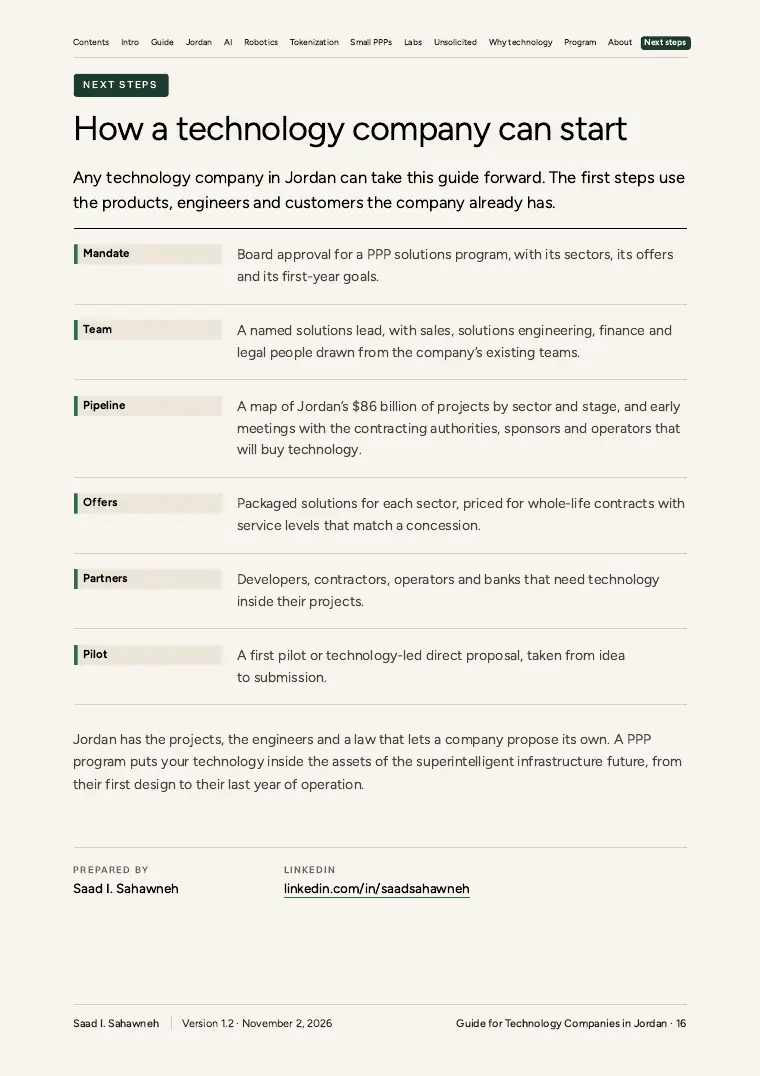
- 01IntroductionWhy a century of infrastructure needs rebuilding, and the $500 trillion it will take.p. 3
- 02The guidePower the $500 trillion PPP infrastructure opportunityp. 5
- 03Jordan and AqabaAn $86 billion pipeline to start withp. 6
- 04Artificial intelligenceHow AI designs, structures and runs PPP projects, and what it means for technology companies.p. 7
- 05RoboticsHow robots build infrastructure and keep it running, and what that means for technology companies.p. 8
- 06TokenizationHow tokenization funds projects from their own revenue, and the role it opens for technology companies.p. 9
- 07Small PPPs in parallelWhy many small PPPs teach a country faster than a few large ones.p. 10
- 08PPP research labsA lab in each sector, running ten small PPP projects a year.p. 11
- 09Unsolicited proposalsHow Jordan’s PPP law accepts direct proposals from private companies.p. 12
- 10Why technology companiesTechnology companies decide how well a PPP performsp. 13
- 11The programThe program can sit inside the company’s government and enterprise sales teams, with a PPP solutions lead at its center and offers built from the products the company already sells.p. 14
- 12AboutAbout Jordan PPP and what it offers.p. 15
- 13Next stepsHow a technology company can start: six first steps.p. 16
Questions
Questions about the guide for Technology Companies in Jordan
- What does the guide for Technology Companies in Jordan propose?
- Your company launches a PPP program to sell AI, robotics, sensors, digital twins and tokenization platforms into public-private partnership (PPP) projects and to join the consortiums that win them.
- Why should technology companies in Jordan launch a PPP program?
- Technology companies decide how well a PPP performs. The operator of a PPP earns its availability payments, tolls and tariffs while the asset stays open, safe and working, and technology companies supply the systems that measure and deliver that performance.
- Which PPP projects can technology companies in Jordan take part in?
- Jordan has about $86 billion of PPP and infrastructure projects in development, $46 billion of them anchored in Aqaba. Every one of them will need software, sensors, machines and data. A Jordanian company that proves its technology on one project at home can sell it to the next one across the region.
- How can technology companies in Jordan start a PPP program?
- Any technology company in Jordan can take this guide forward. The first steps use the products, engineers and customers the company already has. The guide sets out six first steps: mandate, team, pipeline, offers, partners and pilot.
- What does a PPP program give technology companies in Jordan?
- The company gains contracts that last as long as the concessions they serve, paid under agreements with governments and project companies. Every project it supplies becomes a reference site, a source of operating data and a route into the next consortium, in Jordan and across the region.
- Is the guide for Technology Companies in Jordan free?
- Yes. It is free to read on this page and free to download as a 17-page PDF, with the case for a PPP program, Jordan’s pipeline, the role of AI, robotics and tokenization, the program and six first steps.
Guide 28 of 52
Browse all 52 guides