
Operators and services
Launch a PPP program for Logistics and Port Companies in Jordan
A free 17-page guide · The $500 trillion PPP infrastructure opportunity
What this guide is for
Your company launches a PPP program to bid for port terminals, dry ports, logistics zones, rail freight and border-crossing concessions in public-private partnership (PPP) projects.
The case
Logistics and port companies keep projects and trade moving
Every project in the rebuild depends on cargo that crosses a port, a border and a road before it reaches the site. The projects of the next fifty years will run on automated terminals, connected corridors and tracked freight, and the companies that operate them will hold concessions that last for decades. This guide invites logistics and port companies in Jordan to launch a PPP program, starting with the projects at home.
The guide
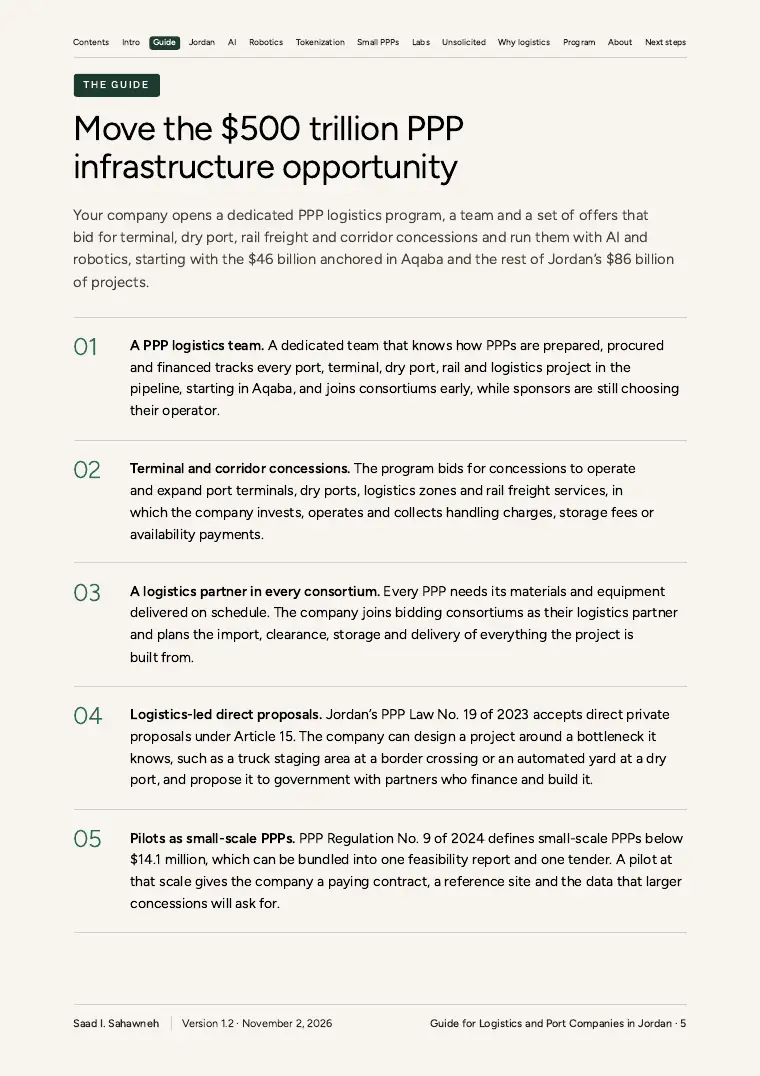
Move the $500 trillion PPP infrastructure opportunity
Your company opens a dedicated PPP logistics program, a team and a set of offers that bid for terminal, dry port, rail freight and corridor concessions and run them with AI and robotics, starting with the $46 billion anchored in Aqaba and the rest of Jordan’s $86 billion of projects.
01
A PPP logistics team
A dedicated team that knows how PPPs are prepared, procured and financed tracks every port, terminal, dry port, rail and logistics project in the pipeline, starting in Aqaba, and joins consortiums early, while sponsors are still choosing their operator.
02
Terminal and corridor concessions
The program bids for concessions to operate and expand port terminals, dry ports, logistics zones and rail freight services, in which the company invests, operates and collects handling charges, storage fees or availability payments.
03
A logistics partner in every consortium
Every PPP needs its materials and equipment delivered on schedule. The company joins bidding consortiums as their logistics partner and plans the import, clearance, storage and delivery of everything the project is built from.
04
Logistics-led direct proposals
Jordan’s PPP Law No. 19 of 2023 accepts direct private proposals under Article 15. The company can design a project around a bottleneck it knows, such as a truck staging area at a border crossing or an automated yard at a dry port, and propose it to government with partners who finance and build it.
05
Pilots as small-scale PPPs
PPP Regulation No. 9 of 2024 defines small-scale PPPs below $14.1 million, which can be bundled into one feasibility report and one tender. A pilot at that scale gives the company a paying contract, a reference site and the data that larger concessions will ask for.
Why logistics and port companies
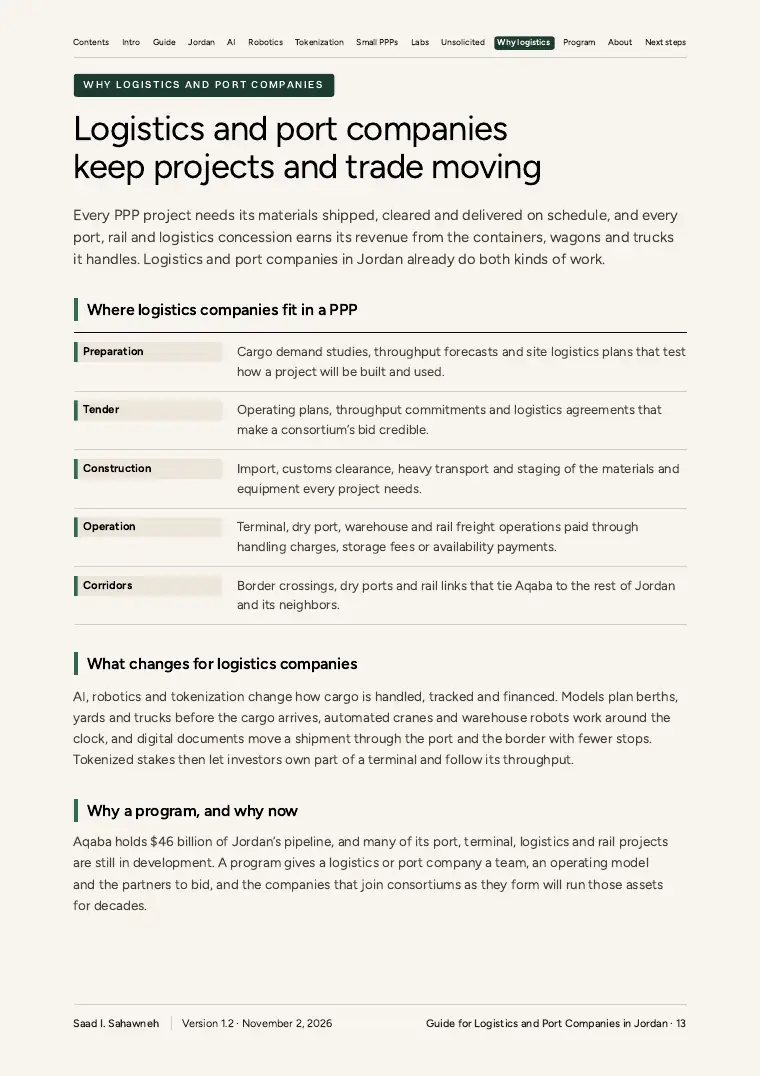
Logistics and port companies keep projects and trade moving
Every PPP project needs its materials shipped, cleared and delivered on schedule, and every port, rail and logistics concession earns its revenue from the containers, wagons and trucks it handles. Logistics and port companies in Jordan already do both kinds of work.
Where logistics companies fit in a PPP
- Preparation
- Cargo demand studies, throughput forecasts and site logistics plans that test how a project will be built and used.
- Tender
- Operating plans, throughput commitments and logistics agreements that make a consortium’s bid credible.
- Construction
- Import, customs clearance, heavy transport and staging of the materials and equipment every project needs.
- Operation
- Terminal, dry port, warehouse and rail freight operations paid through handling charges, storage fees or availability payments.
- Corridors
- Border crossings, dry ports and rail links that tie Aqaba to the rest of Jordan and its neighbors.
What changes for logistics companies
AI, robotics and tokenization change how cargo is handled, tracked and financed. Models plan berths, yards and trucks before the cargo arrives, automated cranes and warehouse robots work around the clock, and digital documents move a shipment through the port and the border with fewer stops. Tokenized stakes then let investors own part of a terminal and follow its throughput.
Why a program, and why now
Aqaba holds $46 billion of Jordan’s pipeline, and many of its port, terminal, logistics and rail projects are still in development. A program gives a logistics or port company a team, an operating model and the partners to bid, and the companies that join consortiums as they form will run those assets for decades.

Futureproofing
Futureproof Logistics and Port Companies in Jordan for the infrastructure singularity
This free 17-page guide shows how, with small PPPs in parallel, PPP research labs, artificial intelligence, robotics, tokenization and six first steps.

Jordan and Aqaba
An $86 billion pipeline to start with
Every one of them will need its materials shipped, cleared, stored and delivered. A Jordanian logistics company that moves the cargo of one project at home can carry the same operation to the next one across the region.
- $86B
- of PPP and infrastructure projects in development in Jordan
- $46B
- of them anchored in Aqaba

Artificial intelligence
AI turns a port and its corridors into one planned flow. Models forecast vessel arrivals, plan berths and yards, check customs documents before the cargo lands and route trucks and trains so containers spend less time waiting. A logistics company that runs those models on a PPP terminal or dry port handles more cargo with the same quay, yard and fleet.

Robotics
Robotics is already changing how cargo is handled. Automated cranes, yard vehicles and warehouse robots move containers and pallets around the clock, and drones survey stockpiles and inspect quays. A logistics company can bring that equipment into a PPP terminal or dry port and price its bid on the capacity it adds.

Tokenization
A terminal, dry port or warehouse earns from every container and pallet it handles, and that revenue can be shared with many investors. A logistics company can offer tokenized stakes in the PPP assets it runs, pay holders from handling and storage fees as they arrive and publish throughput data so investors follow the asset as it performs.

Small PPPs and research labs
Small PPPs let a logistics company test new ways to move cargo at low risk, from an automated gate at a dry port to a digital corridor at a border crossing. Every pilot leaves behind throughput data that sharpens the company’s pricing, and a company that runs pilots sees the next generation of terminals and corridors before they reach tender.

Unsolicited proposals
A logistics company sees every day where cargo waits, at the quay, the yard, the warehouse or the border. A direct proposal lets it turn that knowledge into a terminal, dry port or corridor project of its own design, and keep the right to match the best offer if the project goes to tender.
The program
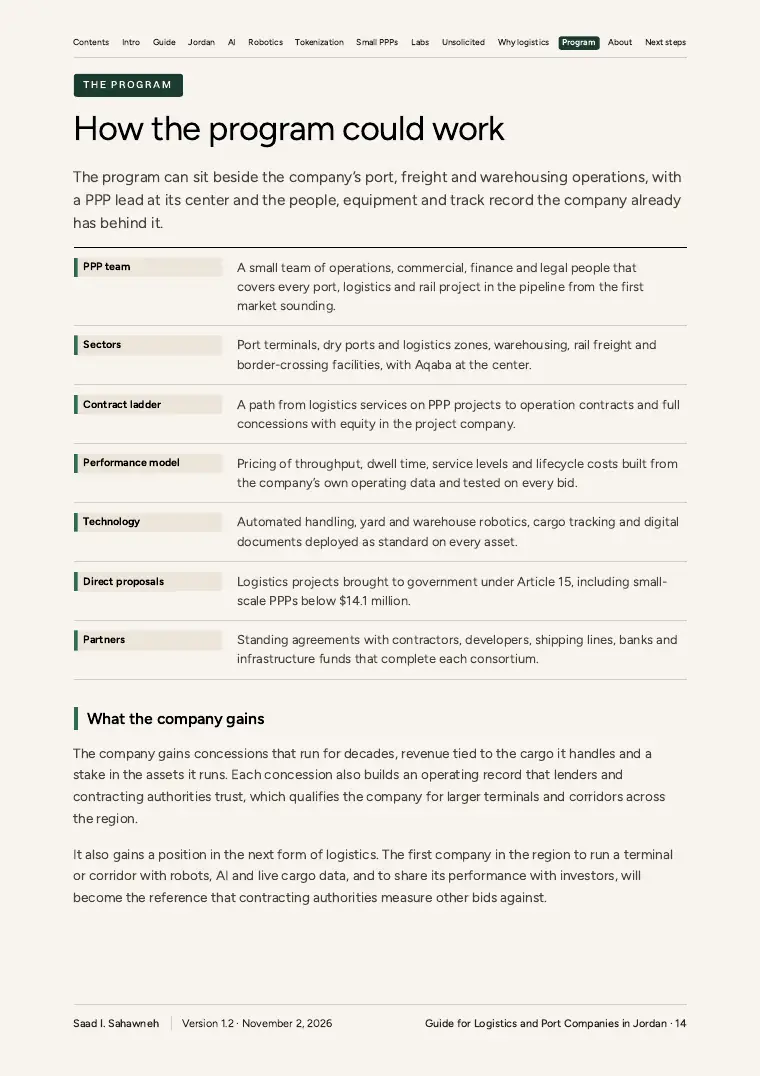
How the program could work
The program can sit beside the company’s port, freight and warehousing operations, with a PPP lead at its center and the people, equipment and track record the company already has behind it.
- PPP team
- A small team of operations, commercial, finance and legal people that covers every port, logistics and rail project in the pipeline from the first market sounding.
- Sectors
- Port terminals, dry ports and logistics zones, warehousing, rail freight and border-crossing facilities, with Aqaba at the center.
- Contract ladder
- A path from logistics services on PPP projects to operation contracts and full concessions with equity in the project company.
- Performance model
- Pricing of throughput, dwell time, service levels and lifecycle costs built from the company’s own operating data and tested on every bid.
- Technology
- Automated handling, yard and warehouse robotics, cargo tracking and digital documents deployed as standard on every asset.
- Direct proposals
- Logistics projects brought to government under Article 15, including small-scale PPPs below $14.1 million.
- Partners
- Standing agreements with contractors, developers, shipping lines, banks and infrastructure funds that complete each consortium.
What the company gains
The company gains concessions that run for decades, revenue tied to the cargo it handles and a stake in the assets it runs. Each concession also builds an operating record that lenders and contracting authorities trust, which qualifies the company for larger terminals and corridors across the region.
It also gains a position in the next form of logistics. The first company in the region to run a terminal or corridor with robots, AI and live cargo data, and to share its performance with investors, will become the reference that contracting authorities measure other bids against.

Next steps
How a logistics or port company can start
Any logistics or port company in Jordan can take this guide forward. The first steps use the terminals, warehouses, fleets and teams the company already has.
01
Mandate
Board approval for a PPP logistics program, with its sectors, the concessions it will bid for and its first-year goals.
02
Team
A named program lead, with operations, commercial, finance and legal people drawn from the company’s existing teams.
03
Pipeline
A map of Jordan’s $86 billion of projects by sector and stage, starting with the $46 billion in Aqaba, and early meetings with the contracting authorities that will tender ports, logistics zones and rail.
04
Operations
The handling equipment, robotics, cargo tracking and operating data the company will bring to its first bids.
05
Partners
Contractors, developers, shipping lines, lenders and technology companies to complete each consortium.
06
Pilot
A first logistics contract, small-scale PPP or direct proposal, taken from idea to submission.
Jordan has the projects, a port at its gateway to the Red Sea and a law that accepts unsolicited proposals. A PPP program gives your company the terminals and corridors to run and a head start in moving the cargo of the superintelligent infrastructure future.
The full document
Inside this guide
Seventeen pages and thirteen sections, from the case for a PPP program to the first steps, written for logistics and port companies in Jordan.
Download the guide (PDF)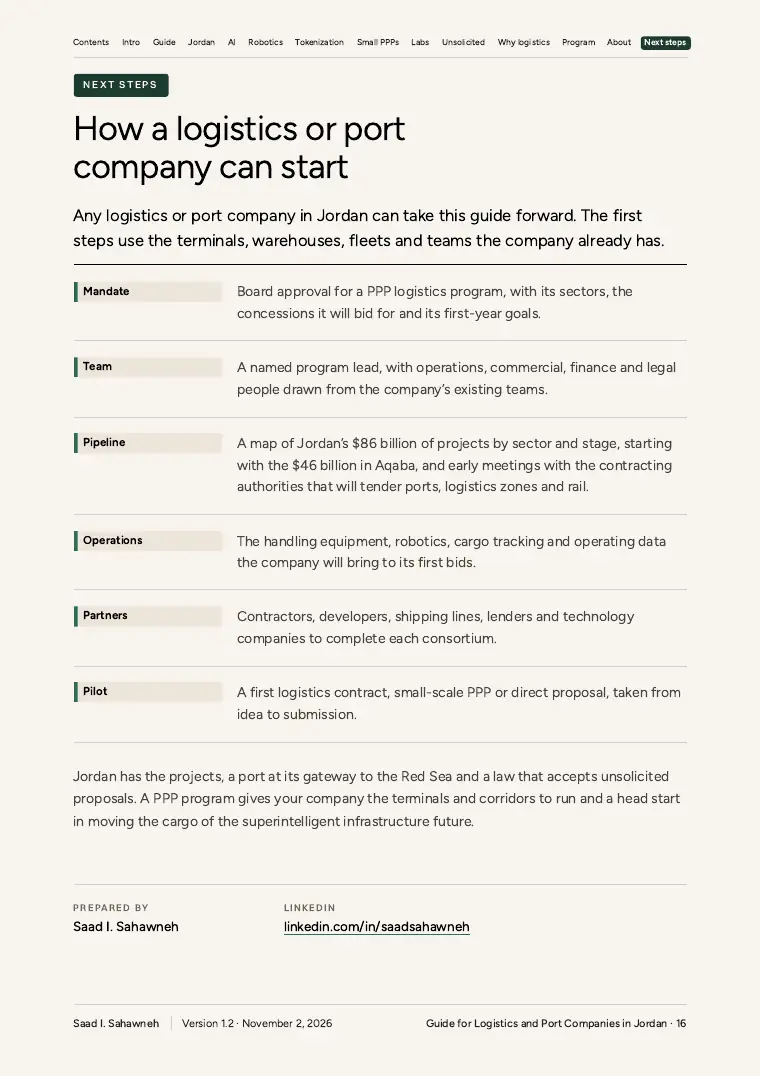
- 01IntroductionWhy a century of infrastructure needs rebuilding, and the $500 trillion it will take.p. 3
- 02The guideMove the $500 trillion PPP infrastructure opportunityp. 5
- 03Jordan and AqabaAn $86 billion pipeline to start withp. 6
- 04Artificial intelligenceHow AI designs, structures and runs PPP projects, and what it means for logistics and port companies.p. 7
- 05RoboticsHow robots build infrastructure and keep it running, and what that means for logistics and port companies.p. 8
- 06TokenizationHow tokenization funds projects from their own revenue, and the role it opens for logistics and port companies.p. 9
- 07Small PPPs in parallelWhy many small PPPs teach a country faster than a few large ones.p. 10
- 08PPP research labsA lab in each sector, running ten small PPP projects a year.p. 11
- 09Unsolicited proposalsHow Jordan’s PPP law accepts direct proposals from private companies.p. 12
- 10Why logistics and port companiesLogistics and port companies keep projects and trade movingp. 13
- 11The programThe program can sit beside the company’s port, freight and warehousing operations, with a PPP lead at its center and the people, equipment and track record the company already has behind it.p. 14
- 12AboutAbout Jordan PPP and what it offers.p. 15
- 13Next stepsHow a logistics or port company can start: six first steps.p. 16
Questions
Questions about the guide for Logistics and Port Companies in Jordan
- What does the guide for Logistics and Port Companies in Jordan propose?
- Your company launches a PPP program to bid for port terminals, dry ports, logistics zones, rail freight and border-crossing concessions in public-private partnership (PPP) projects.
- Why should logistics and port companies in Jordan launch a PPP program?
- Logistics and port companies keep projects and trade moving. Every PPP project needs its materials shipped, cleared and delivered on schedule, and every port, rail and logistics concession earns its revenue from the containers, wagons and trucks it handles. Logistics and port companies in Jordan already do both kinds of work.
- Which PPP projects can logistics and port companies in Jordan take part in?
- Jordan has about $86 billion of PPP and infrastructure projects in development, $46 billion of them anchored in Aqaba. Every one of them will need its materials shipped, cleared, stored and delivered. A Jordanian logistics company that moves the cargo of one project at home can carry the same operation to the next one across the region.
- How can logistics and port companies in Jordan start a PPP program?
- Any logistics or port company in Jordan can take this guide forward. The first steps use the terminals, warehouses, fleets and teams the company already has. The guide sets out six first steps: mandate, team, pipeline, operations, partners and pilot.
- What does a PPP program give logistics and port companies in Jordan?
- The company gains concessions that run for decades, revenue tied to the cargo it handles and a stake in the assets it runs. Each concession also builds an operating record that lenders and contracting authorities trust, which qualifies the company for larger terminals and corridors across the region.
- Is the guide for Logistics and Port Companies in Jordan free?
- Yes. It is free to read on this page and free to download as a 17-page PDF, with the case for a PPP program, Jordan’s pipeline, the role of AI, robotics and tokenization, the program and six first steps.
Guide 26 of 52
Browse all 52 guides