
Public sector
Launch a PPP program for State-Owned Utilities and Companies in Jordan
A free 17-page guide · The $500 trillion PPP infrastructure opportunity
What this guide is for
Your utility or company launches its own public-private partnership (PPP) program, with performance-based contracts for its networks and plants, a research lab that runs small PPPs in parallel and an open door to direct proposals from the private sector.
The case
State-owned companies run the networks that every project connects to
Much of the water that reaches Jordan’s taps, the power that crosses its grid and the freight that moves by rail passes through networks run by state-owned companies. These companies hold the assets, the customers and the operating data, and PPP Law No. 19 of 2023 counts them as public authorities that can sign PPP contracts and receive direct proposals. This guide invites state-owned utilities and companies in Jordan to launch a PPP program of their own, starting with the projects at home.
The guide
Bring Jordan’s public networks into the $500 trillion PPP infrastructure opportunity
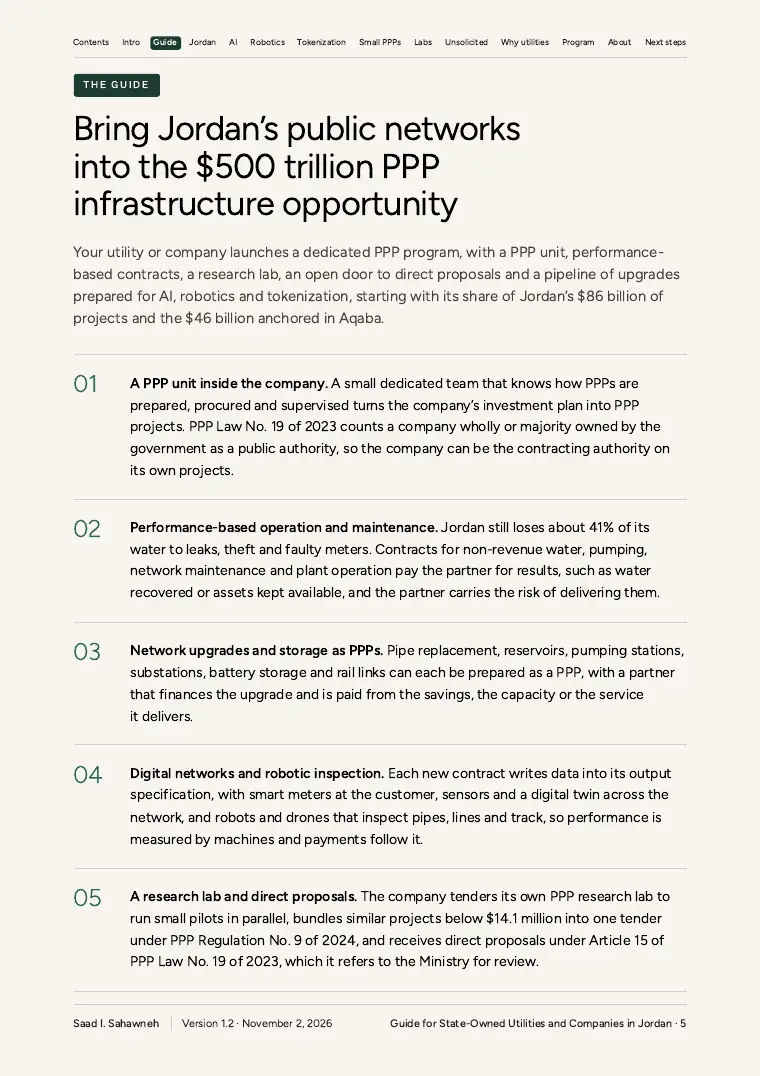
Your utility or company launches a dedicated PPP program, with a PPP unit, performance-based contracts, a research lab, an open door to direct proposals and a pipeline of upgrades prepared for AI, robotics and tokenization, starting with its share of Jordan’s $86 billion of projects and the $46 billion anchored in Aqaba.
01
A PPP unit inside the company
A small dedicated team that knows how PPPs are prepared, procured and supervised turns the company’s investment plan into PPP projects. PPP Law No. 19 of 2023 counts a company wholly or majority owned by the government as a public authority, so the company can be the contracting authority on its own projects.
02
Performance-based operation and maintenance
Jordan still loses about 41% of its water to leaks, theft and faulty meters. Contracts for non-revenue water, pumping, network maintenance and plant operation pay the partner for results, such as water recovered or assets kept available, and the partner carries the risk of delivering them.
03
Network upgrades and storage as PPPs
Pipe replacement, reservoirs, pumping stations, substations, battery storage and rail links can each be prepared as a PPP, with a partner that finances the upgrade and is paid from the savings, the capacity or the service it delivers.
04
Digital networks and robotic inspection
Each new contract writes data into its output specification, with smart meters at the customer, sensors and a digital twin across the network, and robots and drones that inspect pipes, lines and track, so performance is measured by machines and payments follow it.
05
A research lab and direct proposals
The company tenders its own PPP research lab to run small pilots in parallel, bundles similar projects below $14.1 million into one tender under PPP Regulation No. 9 of 2024, and receives direct proposals under Article 15 of PPP Law No. 19 of 2023, which it refers to the Ministry for review.
Why state-owned utilities and companies
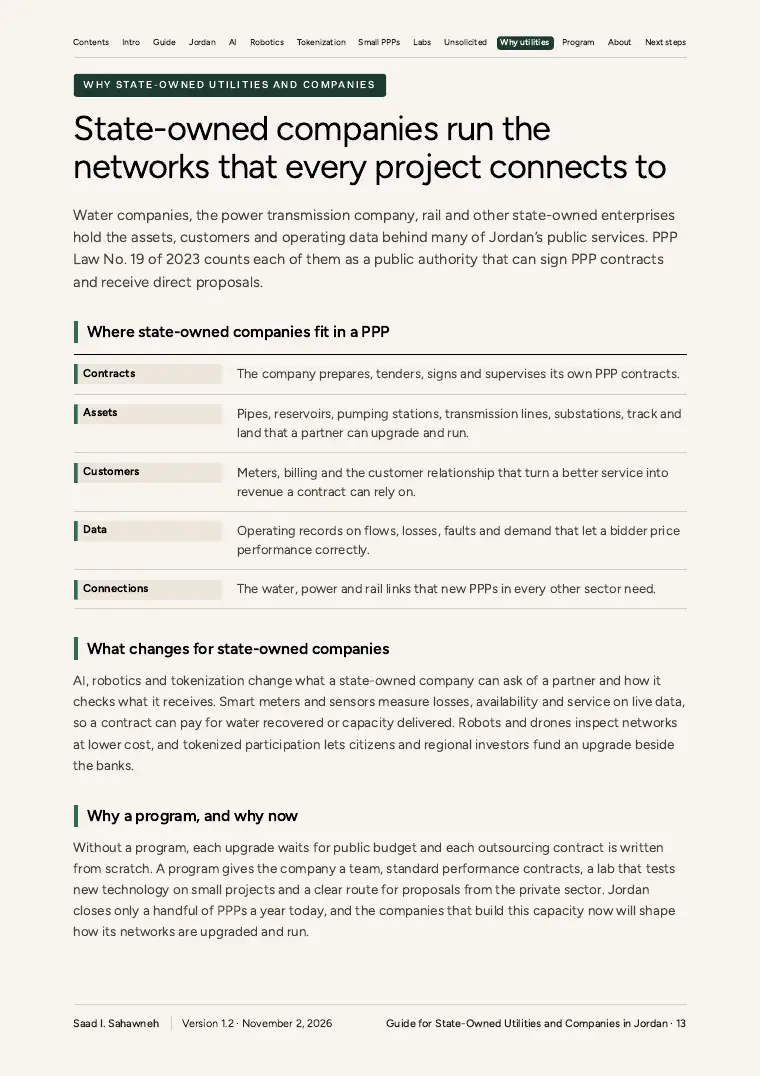
State-owned companies run the networks that every project connects to
Water companies, the power transmission company, rail and other state-owned enterprises hold the assets, customers and operating data behind many of Jordan’s public services. PPP Law No. 19 of 2023 counts each of them as a public authority that can sign PPP contracts and receive direct proposals.
Where state-owned companies fit in a PPP
- Contracts
- The company prepares, tenders, signs and supervises its own PPP contracts.
- Assets
- Pipes, reservoirs, pumping stations, transmission lines, substations, track and land that a partner can upgrade and run.
- Customers
- Meters, billing and the customer relationship that turn a better service into revenue a contract can rely on.
- Data
- Operating records on flows, losses, faults and demand that let a bidder price performance correctly.
- Connections
- The water, power and rail links that new PPPs in every other sector need.
What changes for state-owned companies
AI, robotics and tokenization change what a state-owned company can ask of a partner and how it checks what it receives. Smart meters and sensors measure losses, availability and service on live data, so a contract can pay for water recovered or capacity delivered. Robots and drones inspect networks at lower cost, and tokenized participation lets citizens and regional investors fund an upgrade beside the banks.
Why a program, and why now
Without a program, each upgrade waits for public budget and each outsourcing contract is written from scratch. A program gives the company a team, standard performance contracts, a lab that tests new technology on small projects and a clear route for proposals from the private sector. Jordan closes only a handful of PPPs a year today, and the companies that build this capacity now will shape how its networks are upgraded and run.

Futureproofing
Futureproof State-Owned Utilities and Companies in Jordan for the infrastructure singularity
This free 17-page guide shows how, with small PPPs in parallel, PPP research labs, artificial intelligence, robotics, tokenization and six first steps.

Jordan and Aqaba
An $86 billion pipeline to start with
Many of them will connect to the water, power and rail networks that state-owned companies run, and each new connection needs the network behind it to keep pace. A state-owned company that proves a model on one part of its network at home can repeat it across its whole service area.
- $86B
- of PPP and infrastructure projects in development in Jordan
- $46B
- of them anchored in Aqaba

Artificial intelligence
AI gives a state-owned company the capacity of a much larger PPP team. Its staff can draft output specifications, test value for money and compare bids on whole-life cost. On the network, models forecast demand, balance pressure and load, flag leaks and faults from meter and sensor readings and schedule pumping when power costs least, so the company supervises its partners on evidence and pays them on results.

Robotics
Robotics lets a state-owned company see inside assets buried under its streets or spread across the desert. Robots travel inside pipes to find leaks and weak sections, drones survey transmission lines, reservoirs and track, and crawlers inspect substations and pumping stations, so a small team can supervise a large network and every inspection is recorded as data.

Tokenization
Tokenization lets citizens and regional investors take a share in the assets that serve them. A state-owned company can place an operating asset, such as a pumping station, a storage plant or a treatment works, in a project company, raise part of its capital through tokenized participation and pay holders from the asset’s own revenue, while a public registry records the contract, the payments and the asset’s performance for everyone to see.

Small PPPs and research labs
A state-owned company can run small PPPs on its own assets, such as leak reduction in one district, a battery at one substation or smart meters on one street, and measure each result from the first day. Its lab can test many of these at once, publish every result, including the failures, and carry what works across the whole network.

Unsolicited proposals
Direct proposals bring a state-owned company ideas from partners that already know its networks, prepared at their own cost. A proposal it receives goes to the Ministry for review and a qualifying one enters the PPP Registry, while the tender still tests the idea against the market: the proposer can match the best offer, and the winning bidder pays the proposer’s direct study costs. A published list of needs, such as losses to cut or capacity to add, points proposals at the problems that matter most.
The program
How the program could work
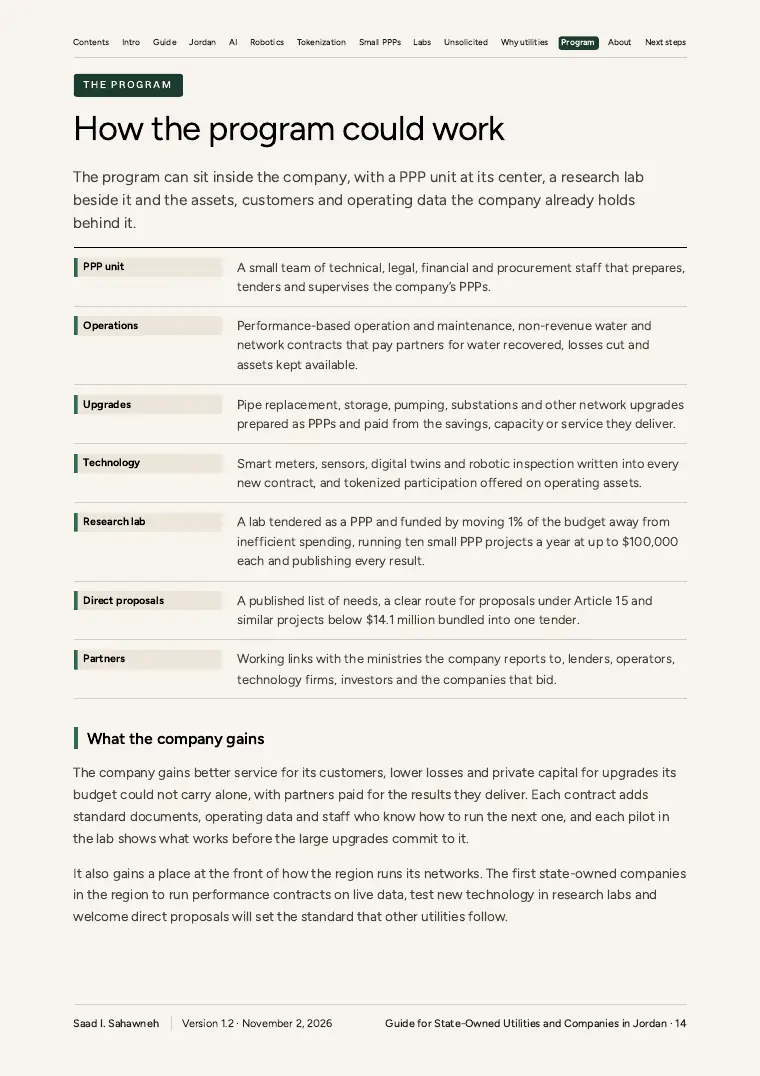
The program can sit inside the company, with a PPP unit at its center, a research lab beside it and the assets, customers and operating data the company already holds behind it.
- PPP unit
- A small team of technical, legal, financial and procurement staff that prepares, tenders and supervises the company’s PPPs.
- Operations
- Performance-based operation and maintenance, non-revenue water and network contracts that pay partners for water recovered, losses cut and assets kept available.
- Upgrades
- Pipe replacement, storage, pumping, substations and other network upgrades prepared as PPPs and paid from the savings, capacity or service they deliver.
- Technology
- Smart meters, sensors, digital twins and robotic inspection written into every new contract, and tokenized participation offered on operating assets.
- Research lab
- A lab tendered as a PPP and funded by moving 1% of the budget away from inefficient spending, running ten small PPP projects a year at up to $100,000 each and publishing every result.
- Direct proposals
- A published list of needs, a clear route for proposals under Article 15 and similar projects below $14.1 million bundled into one tender.
- Partners
- Working links with the ministries the company reports to, lenders, operators, technology firms, investors and the companies that bid.
What the company gains
The company gains better service for its customers, lower losses and private capital for upgrades its budget could not carry alone, with partners paid for the results they deliver. Each contract adds standard documents, operating data and staff who know how to run the next one, and each pilot in the lab shows what works before the large upgrades commit to it.
It also gains a place at the front of how the region runs its networks. The first state-owned companies in the region to run performance contracts on live data, test new technology in research labs and welcome direct proposals will set the standard that other utilities follow.

Next steps
How a state-owned company can start
Any state-owned utility or company in Jordan can take this guide forward. The first steps use the mandate, staff, assets and data the company already has.
01
Mandate
A decision by the board to launch a PPP program, with its networks, its research themes and its first-year goals.
02
Team
A named program lead, with technical, legal, financial and procurement staff drawn from the company’s existing departments.
03
Pipeline
A list of the company’s networks, plants and planned upgrades, ranked by losses, condition and readiness, with similar projects grouped for bundling.
04
Contracts
Standard performance contracts for non-revenue water, operation and maintenance, and network upgrades, with smart meters, sensors and robotic inspection written in.
05
Partners
The ministries the company reports to, lenders, operators, technology firms and the companies that will bid for the lab and propose new projects.
06
Pilot
A first small-scale PPP or direct proposal, taken from idea to tender.
Jordan has the projects, a law that counts state-owned companies as contracting authorities and networks that will need upgrading for decades. A PPP program gives your company the team, the contracts and the lab to put private capital and new technology to work on them and to run its share of the superintelligent infrastructure future.
The full document
Inside this guide
Seventeen pages and thirteen sections, from the case for a PPP program to the first steps, written for state-owned utilities and companies in Jordan.
Download the guide (PDF)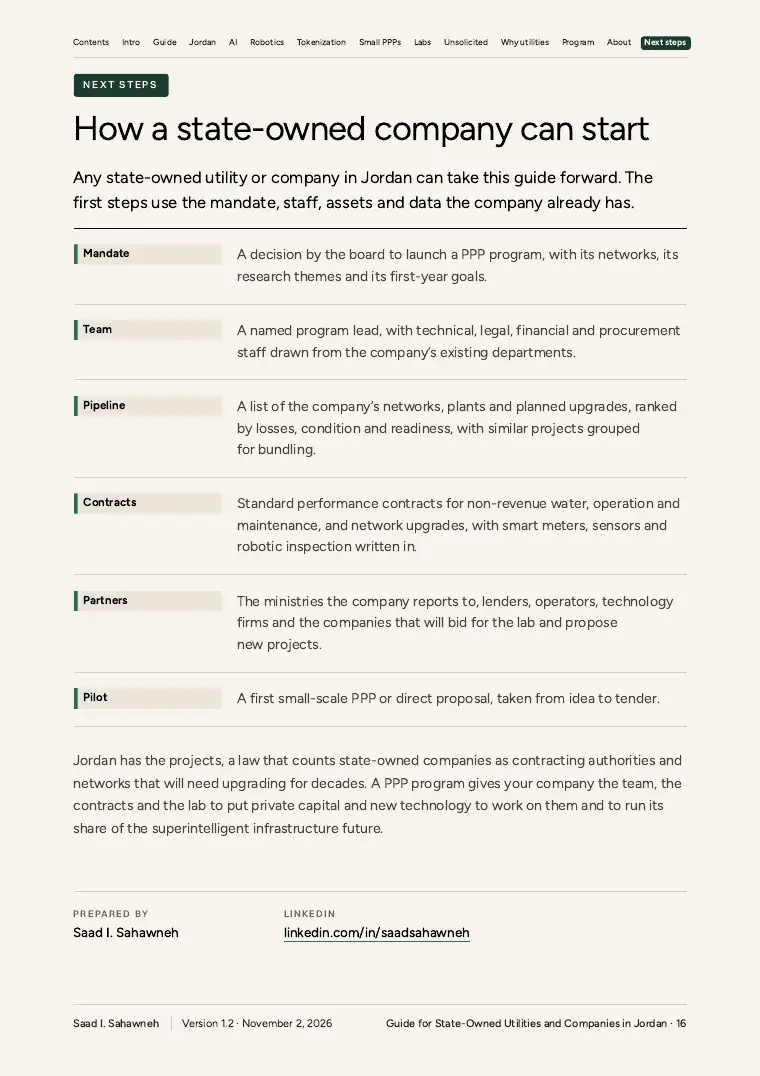
- 01IntroductionWhy a century of infrastructure needs rebuilding, and the $500 trillion it will take.p. 3
- 02The guideBring Jordan’s public networks into the $500 trillion PPP infrastructure opportunityp. 5
- 03Jordan and AqabaAn $86 billion pipeline to start withp. 6
- 04Artificial intelligenceHow AI designs, structures and runs PPP projects, and what it means for state-owned utilities and companies.p. 7
- 05RoboticsHow robots build infrastructure and keep it running, and what that means for state-owned utilities and companies.p. 8
- 06TokenizationHow tokenization funds projects from their own revenue, and the role it opens for state-owned utilities and companies.p. 9
- 07Small PPPs in parallelWhy many small PPPs teach a country faster than a few large ones.p. 10
- 08PPP research labsA lab in each sector, running ten small PPP projects a year.p. 11
- 09Unsolicited proposalsHow Jordan’s PPP law accepts direct proposals from private companies.p. 12
- 10Why state-owned utilities and companiesState-owned companies run the networks that every project connects top. 13
- 11The programThe program can sit inside the company, with a PPP unit at its center, a research lab beside it and the assets, customers and operating data the company already holds behind it.p. 14
- 12AboutAbout Jordan PPP and what it offers.p. 15
- 13Next stepsHow a state-owned company can start: six first steps.p. 16
Questions
Questions about the guide for State-Owned Utilities and Companies in Jordan
- What does the guide for State-Owned Utilities and Companies in Jordan propose?
- Your utility or company launches its own public-private partnership (PPP) program, with performance-based contracts for its networks and plants, a research lab that runs small PPPs in parallel and an open door to direct proposals from the private sector.
- Why should state-owned utilities and companies in Jordan launch a PPP program?
- State-owned companies run the networks that every project connects to. Water companies, the power transmission company, rail and other state-owned enterprises hold the assets, customers and operating data behind many of Jordan’s public services. PPP Law No. 19 of 2023 counts each of them as a public authority that can sign PPP contracts and receive direct proposals.
- Which PPP projects can state-owned utilities and companies in Jordan take part in?
- Jordan has about $86 billion of PPP and infrastructure projects in development, $46 billion of them anchored in Aqaba. Many of them will connect to the water, power and rail networks that state-owned companies run, and each new connection needs the network behind it to keep pace. A state-owned company that proves a model on one part of its network at home can repeat it across its whole service area.
- How can state-owned utilities and companies in Jordan start a PPP program?
- Any state-owned utility or company in Jordan can take this guide forward. The first steps use the mandate, staff, assets and data the company already has. The guide sets out six first steps: mandate, team, pipeline, contracts, partners and pilot.
- What does a PPP program give state-owned utilities and companies in Jordan?
- The company gains better service for its customers, lower losses and private capital for upgrades its budget could not carry alone, with partners paid for the results they deliver. Each contract adds standard documents, operating data and staff who know how to run the next one, and each pilot in the lab shows what works before the large upgrades commit to it.
- Is the guide for State-Owned Utilities and Companies in Jordan free?
- Yes. It is free to read on this page and free to download as a 17-page PDF, with the case for a PPP program, Jordan’s pipeline, the role of AI, robotics and tokenization, the program and six first steps.
Guide 5 of 52
Browse all 52 guides