
Economic sectors
Launch a PPP program for Tourism and Hospitality Companies in Jordan
A free 17-page guide · The $500 trillion PPP infrastructure opportunity
What this guide is for
Your company launches a PPP program to develop and run hotels, resorts and visitor experiences at the country’s heritage and nature sites, from Petra and Wadi Rum to the Dead Sea and Aqaba.
The case
Tourism companies turn public sites into destinations
Governments own many of the sites, coastlines and protected areas that draw visitors, and they need partners to build and run the hotels, visitor centers and services around them. The destinations of the next fifty years will be developed and operated as partnerships, and the companies that run them will hold contracts as long as the concessions. This guide invites tourism and hospitality companies in Jordan to launch a PPP program, starting with the projects at home.
The guide
Build the destinations of the $500 trillion PPP opportunity
Your company opens a dedicated PPP program, a team and a set of partnerships that develop and run hotels, resorts, heritage sites and visitor experiences with government partners, starting with Jordan’s $86 billion of projects and the $46 billion anchored in Aqaba.
01
A tourism PPP team
A dedicated team that knows how PPPs are prepared, procured and paid follows every resort, heritage site, visitor center and development zone in Jordan’s pipeline from the first market sounding, and it joins consortiums while the sites are still being planned.
02
Heritage and nature site concessions
Visitor centers, transport, ticketing, lodging and services at heritage and nature sites can be delivered as concessions in which the company invests, operates and shares revenue with the public owner, while the site itself stays protected under public control.
03
Hotels and resorts on public land
Public authorities and development zones hold much of the land at the Dead Sea, in Aqaba and around Petra and Wadi Rum. The program offers them long leases and joint ventures in which the government contributes land, the company brings design, capital and operation, and both share in the value the destination creates.
04
Direct proposals and small-scale PPPs
Jordan’s PPP Law No. 19 of 2023 accepts direct private proposals under Article 15, and PPP Regulation No. 9 of 2024 defines small-scale PPPs below $14.1 million, which can be bundled into one feasibility report and one tender. The company can propose an eco-lodge, a visitor center or a trail network and run it as a concession.
05
Tokenized ownership
The program can issue tokenized stakes in its hotels, resorts and visitor sites, which lets residents, regional investors, the diaspora and visitors themselves own part of the destinations they visit.
Why tourism and hospitality companies
Tourism companies turn public sites into destinations
Governments own the heritage sites, coastlines and protected areas that draw visitors, and tourism and hospitality companies know how to bring people to them, host them and run the services around them for decades under a PPP.
Where tourism companies fit in a PPP
- Land and sites
- Long leases, joint ventures and concessions on public land, coastline and heritage sites, with the public owner sharing in the revenue.
- Master plan
- Destination plans that combine hotels, attractions and services with the roads, water and power a site needs.
- Visitor services
- Visitor centers, ticketing, guiding, transport and food services at heritage and nature sites.
- Hospitality
- Hotels, resorts, eco-lodges and desert camps developed and run under long contracts.
- Marketing
- Booking platforms, tour programs and international distribution that fill each asset through the year.
What changes for tourism companies
AI, robotics and tokenization change how a destination is planned, run and owned. AI forecasts demand and spreads visitors across sites and seasons, modular construction brings lodges and visitor centers into service with a lighter footprint, and sensors and drones watch over the monuments and landscapes visitors come to see. Tokenized stakes let residents and visitors own part of a resort or a visitor site in small amounts.
Why a program, and why now
A program gives a tourism company a team, a partnership model and standard terms that make each new site faster to agree than the last. Jordan’s pipeline includes resorts, hotels, eco-lodges, cable cars, hot springs and museums from Ajloun to Aqaba, and the companies that partner with government early will hold the strongest sites when the projects come to market.

Futureproofing
Futureproof Tourism and Hospitality Companies in Jordan for the infrastructure singularity
This free 17-page guide shows how, with small PPPs in parallel, PPP research labs, artificial intelligence, robotics, tokenization and six first steps.
Jordan and Aqaba
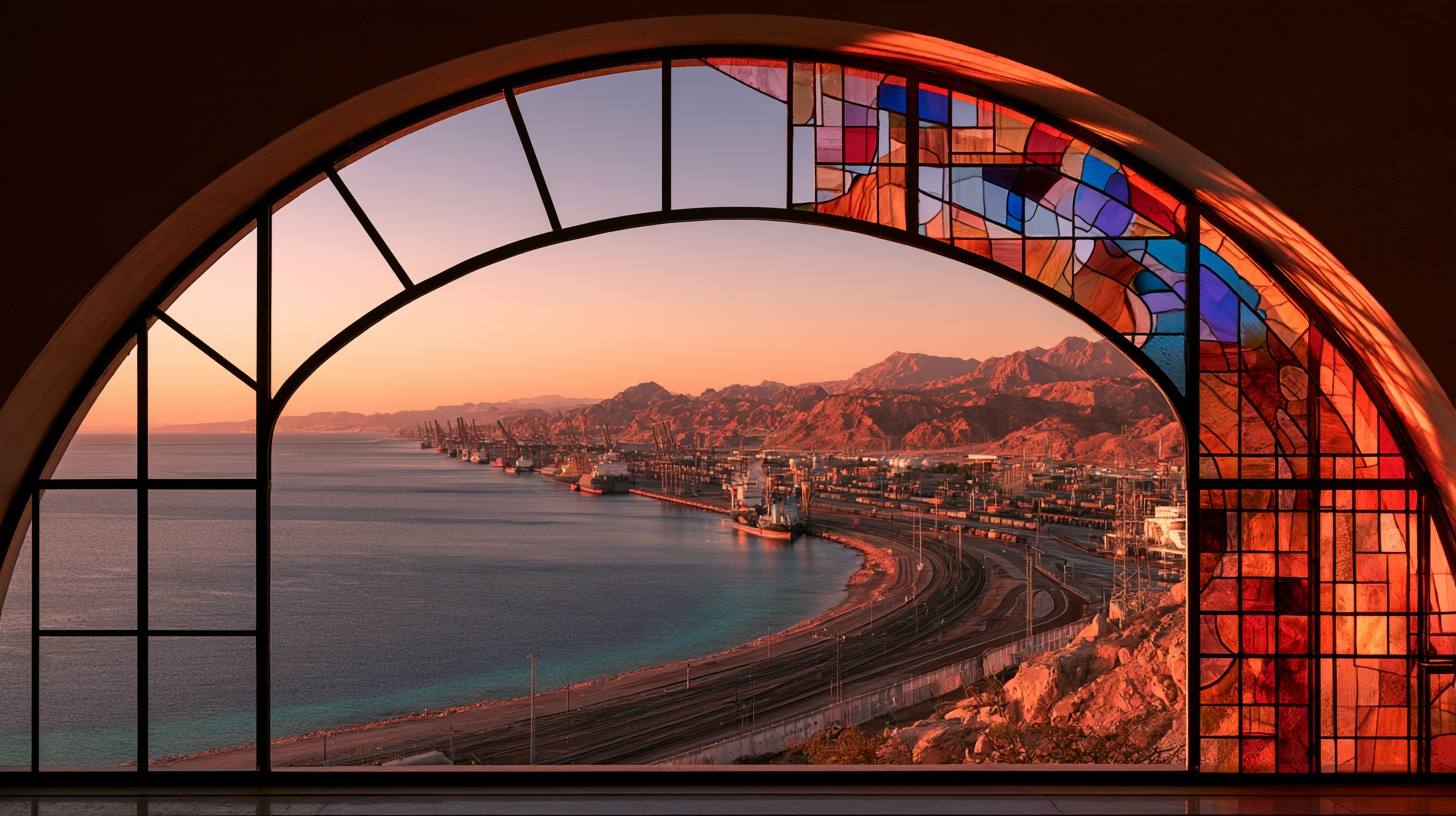
An $86 billion pipeline to start with
The road, water and power projects among them decide where visitors can go, and the resorts and heritage projects decide what they find when they arrive. A Jordanian tourism company that runs one destination concession at home can carry the same model to the next one across the region.
- $86B
- of PPP and infrastructure projects in development in Jordan
- $46B
- of them anchored in Aqaba

Artificial intelligence
AI lets a tourism company run a destination the way an operator runs an asset. It forecasts demand, prices rooms and tickets, manages visitor flows at busy sites and plans transport, staffing and maintenance around them. At a heritage site the same models can protect the monuments by spreading visitors across the day and the season.

Robotics
Modular construction lets a tourism company build lodges, visitor centers and resort facilities with a light footprint at sensitive sites. Drones can survey heritage sites and trails and record their condition over time, while robots and sensors keep pools, solar fields and water systems running for the life of the concession.

Tokenization
A hotel, resort or visitor concession earns steady revenue from rooms, tickets and services, the kind of cash flow a token represents well. A tourism company can sell tokenized stakes in its PPP assets to residents, regional investors and the diaspora, pay holders as the revenue arrives and give them a share in the destinations they visit.
Small PPPs and research labs
Small PPPs let a tourism company test new visitor experiences at low risk, from an eco-lodge or a trail network to digital ticketing and visitor-flow systems at a heritage site. A tourism lab can run these pilots at several sites at once, publish what works and give the company the evidence to scale the best ideas into larger concessions.

Unsolicited proposals
A tourism company knows which sites draw visitors but lack the lodging, transport or services to keep them longer. A direct proposal lets it turn that knowledge into a concession of its own design, such as a visitor center or a desert camp, protect the concept behind it and keep the right to match the best offer if the project goes to tender.
The program
How the program could work
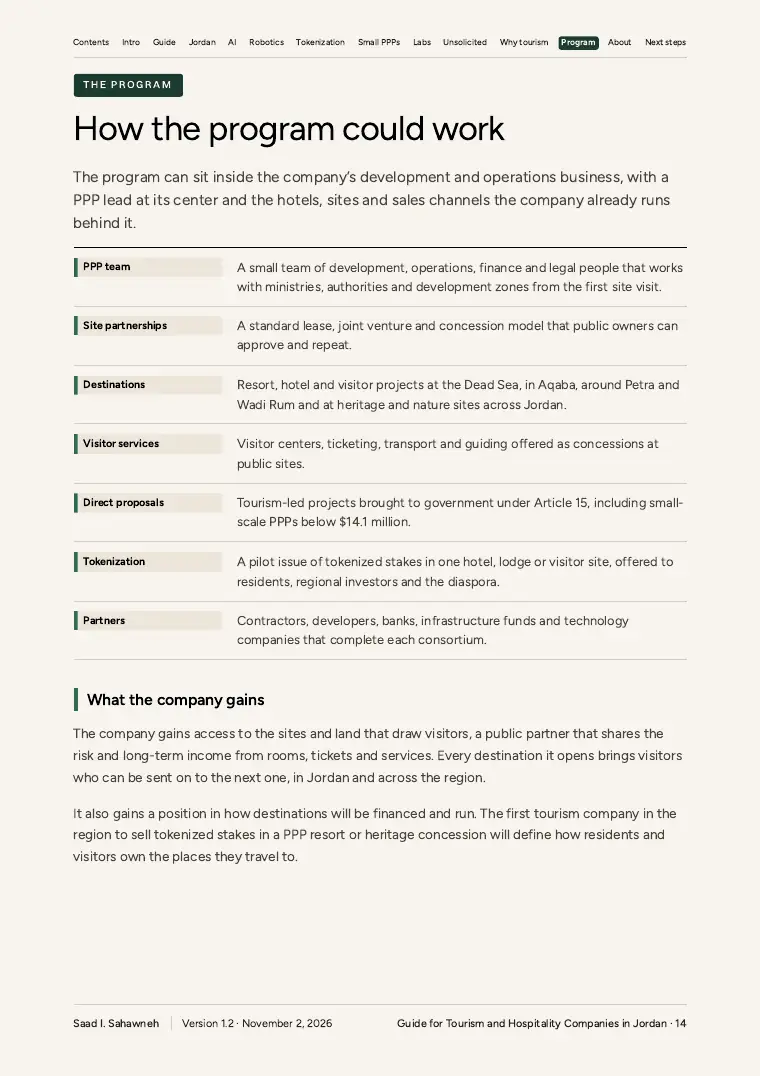
The program can sit inside the company’s development and operations business, with a PPP lead at its center and the hotels, sites and sales channels the company already runs behind it.
- PPP team
- A small team of development, operations, finance and legal people that works with ministries, authorities and development zones from the first site visit.
- Site partnerships
- A standard lease, joint venture and concession model that public owners can approve and repeat.
- Destinations
- Resort, hotel and visitor projects at the Dead Sea, in Aqaba, around Petra and Wadi Rum and at heritage and nature sites across Jordan.
- Visitor services
- Visitor centers, ticketing, transport and guiding offered as concessions at public sites.
- Direct proposals
- Tourism-led projects brought to government under Article 15, including small-scale PPPs below $14.1 million.
- Tokenization
- A pilot issue of tokenized stakes in one hotel, lodge or visitor site, offered to residents, regional investors and the diaspora.
- Partners
- Contractors, developers, banks, infrastructure funds and technology companies that complete each consortium.
What the company gains
The company gains access to the sites and land that draw visitors, a public partner that shares the risk and long-term income from rooms, tickets and services. Every destination it opens brings visitors who can be sent on to the next one, in Jordan and across the region.
It also gains a position in how destinations will be financed and run. The first tourism company in the region to sell tokenized stakes in a PPP resort or heritage concession will define how residents and visitors own the places they travel to.

Next steps
How a tourism company can start
Any tourism or hospitality company in Jordan can take this guide forward. The first steps use the hotels, sites and sales channels the company already has.
01
Mandate
Board approval for a tourism PPP program, with its target destinations, the equity it can commit and its first-year goals.
02
Team
A named program lead, with development, operations, finance and legal people drawn from the company’s existing teams.
03
Pipeline
A map of the resorts, heritage sites and visitor projects in Jordan’s $86 billion pipeline, and early meetings with the ministries, authorities and development zones that hold them.
04
Destinations
A shortlist of sites at the Dead Sea, in Aqaba, around Petra and Wadi Rum and elsewhere in Jordan where the company can add the most value.
05
Partners
Developers, contractors, banks and technology companies to complete each consortium.
06
Pilot
A first visitor concession, small-scale PPP or direct proposal, taken from idea to submission.
Jordan has the projects, some of the world’s best-known heritage and nature sites and a law that accepts unsolicited proposals. A PPP program gives your company the partnerships to develop those sites and a head start in hosting visitors inside the superintelligent infrastructure future.
The full document
Inside this guide
Seventeen pages and thirteen sections, from the case for a PPP program to the first steps, written for tourism and hospitality companies in Jordan.
Download the guide (PDF)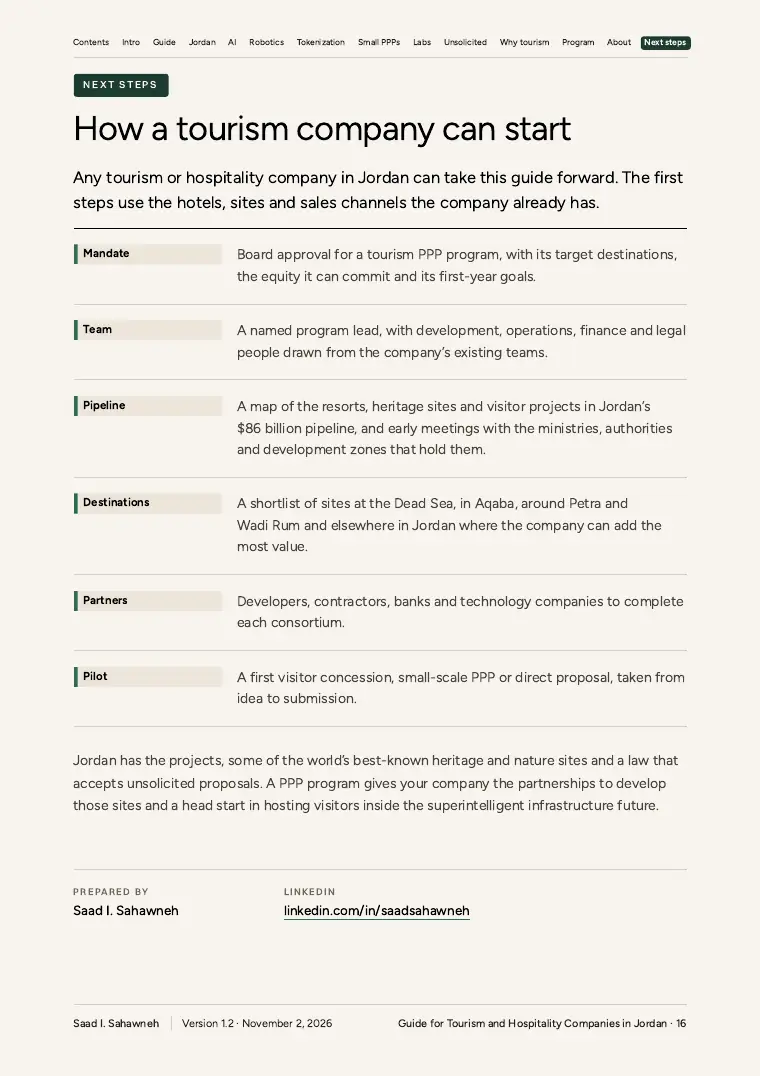
- 01IntroductionWhy a century of infrastructure needs rebuilding, and the $500 trillion it will take.p. 3
- 02The guideBuild the destinations of the $500 trillion PPP opportunityp. 5
- 03Jordan and AqabaAn $86 billion pipeline to start withp. 6
- 04Artificial intelligenceHow AI designs, structures and runs PPP projects, and what it means for tourism and hospitality companies.p. 7
- 05RoboticsHow robots build infrastructure and keep it running, and what that means for tourism and hospitality companies.p. 8
- 06TokenizationHow tokenization funds projects from their own revenue, and the role it opens for tourism and hospitality companies.p. 9
- 07Small PPPs in parallelWhy many small PPPs teach a country faster than a few large ones.p. 10
- 08PPP research labsA lab in each sector, running ten small PPP projects a year.p. 11
- 09Unsolicited proposalsHow Jordan’s PPP law accepts direct proposals from private companies.p. 12
- 10Why tourism and hospitality companiesTourism companies turn public sites into destinationsp. 13
- 11The programThe program can sit inside the company’s development and operations business, with a PPP lead at its center and the hotels, sites and sales channels the company already runs behind it.p. 14
- 12AboutAbout Jordan PPP and what it offers.p. 15
- 13Next stepsHow a tourism company can start: six first steps.p. 16
Questions
Questions about the guide for Tourism and Hospitality Companies in Jordan
- What does the guide for Tourism and Hospitality Companies in Jordan propose?
- Your company launches a PPP program to develop and run hotels, resorts and visitor experiences at the country’s heritage and nature sites, from Petra and Wadi Rum to the Dead Sea and Aqaba.
- Why should tourism and hospitality companies in Jordan launch a PPP program?
- Tourism companies turn public sites into destinations. Governments own the heritage sites, coastlines and protected areas that draw visitors, and tourism and hospitality companies know how to bring people to them, host them and run the services around them for decades under a PPP.
- Which PPP projects can tourism and hospitality companies in Jordan take part in?
- Jordan has about $86 billion of PPP and infrastructure projects in development, $46 billion of them anchored in Aqaba. The road, water and power projects among them decide where visitors can go, and the resorts and heritage projects decide what they find when they arrive. A Jordanian tourism company that runs one destination concession at home can carry the same model to the next one across the region.
- How can tourism and hospitality companies in Jordan start a PPP program?
- Any tourism or hospitality company in Jordan can take this guide forward. The first steps use the hotels, sites and sales channels the company already has. The guide sets out six first steps: mandate, team, pipeline, destinations, partners and pilot.
- What does a PPP program give tourism and hospitality companies in Jordan?
- The company gains access to the sites and land that draw visitors, a public partner that shares the risk and long-term income from rooms, tickets and services. Every destination it opens brings visitors who can be sent on to the next one, in Jordan and across the region.
- Is the guide for Tourism and Hospitality Companies in Jordan free?
- Yes. It is free to read on this page and free to download as a 17-page PDF, with the case for a PPP program, Jordan’s pipeline, the role of AI, robotics and tokenization, the program and six first steps.
Guide 42 of 52
Browse all 52 guides