
Singularity · Robotics
What robotics changes for PPPs in Jordan
Robotics builds infrastructure and keeps it running, with fleets of machines raising new assets with very few human hands. Every guide sets out what it changes for one kind of organization.
In every guide
A section of its own in every guide
Page 8
Robotics
How robots build infrastructure and keep it running.
Each of the 52 guides writes this section for its own kind of organization; 50 of them are gathered below.
Read the guide for Robotics Companies in Jordan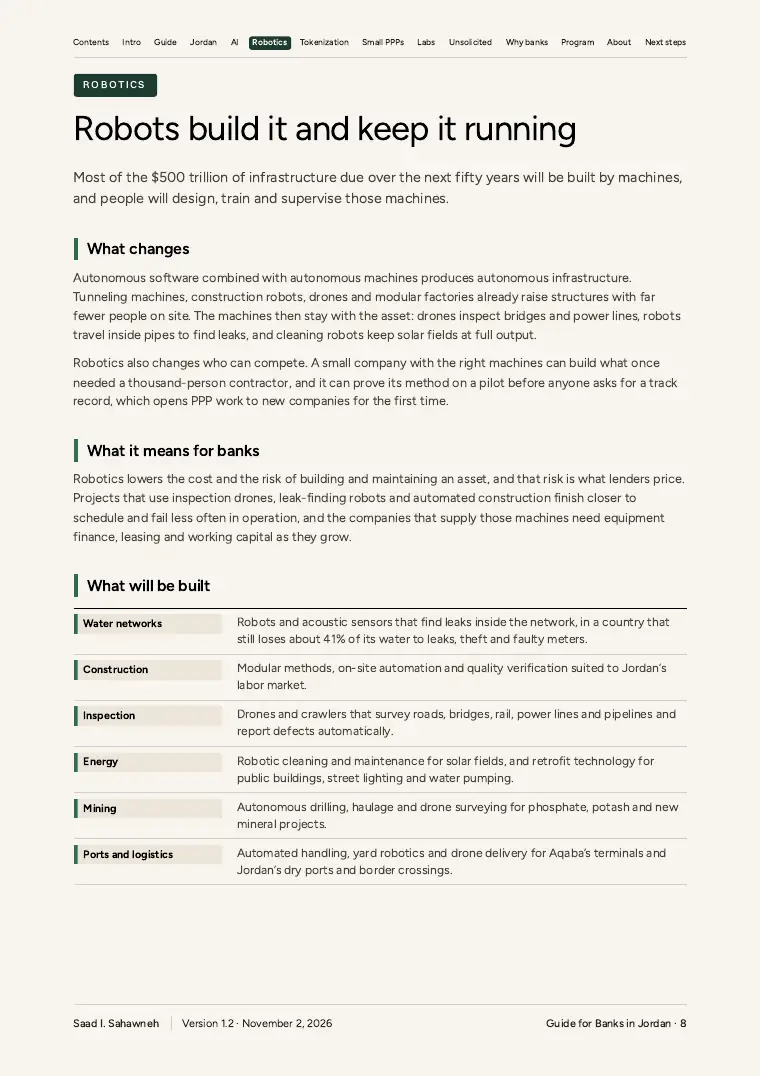
Page 8 of the guide for banks
In the guides’ own words
“Robotics changes what a ministry can ask for in a tender.”
“Robotics lowers the cost and the risk of building and maintaining an asset, and that risk is what lenders price.”
“Robotics lowers the cost of running a solar or wind plant for decades.”
From the 52 guides
What robotics changes for each kind of organization
Point at an organization to read what its guide says.Tap an organization to read what its guide says.
Robotics gives young Jordanian engineers and founders a direct way into infrastructure. A national initiative can open small PPP pilots to companies that build, inspect and maintain assets with machines, such as leak-detection robots for water networks or drones that survey roads, so a new company can prove its method on a real asset and grow with Jordan’s pipeline.
Read the guideRobotics changes what government can ask for in its tenders. Standard output specifications issued from the center can require drone inspection, robotic leak detection and automated maintenance records on every PPP, so performance is measured by machines, reported as data and compared across ministries.
Read the guide
Robotics changes what a ministry can ask for in a tender. Output specifications can require drone inspection, robotic leak detection and automated maintenance records, so performance is measured by machines and reported as data. A ministry that writes these requirements into its contracts receives assets that cost less to supervise and fail less often.
Read the guideRobotics brings city services within reach of small partners. Street-cleaning machines, waste-sorting lines, drones that survey local roads and sensors that find leaks in public buildings let a local company deliver a service with a small team, and their records show the municipality what was cleaned, collected or repaired.
Read the guideRobotics lets a state-owned company see inside assets buried under its streets or spread across the desert. Robots travel inside pipes to find leaks and weak sections, drones survey transmission lines, reservoirs and track, and crawlers inspect substations and pumping stations, so a small team can supervise a large network and every inspection is recorded as data.
Read the guideRobotics reaches the markets through the data it produces. Drones, crawlers and sensors that inspect roads, pipes and power lines create an independent record of an asset’s condition, which issuers could use in their continuing disclosure and investors could use to judge an operating PPP company or a tokenized note on evidence.
Read the guide
03Capital
Robotics lowers the cost and the risk of building and maintaining an asset, and that risk is what lenders price. Projects that use inspection drones, leak-finding robots and automated construction finish closer to schedule and fail less often in operation, and the companies that supply those machines need equipment finance, leasing and working capital as they grow.
Read the guideRobotics lowers the construction and maintenance risk that a development lender carries for the life of a loan. Robotic construction keeps projects closer to schedule, and drones and crawlers inspect roads, pipes and power lines and report defects automatically, which gives the lender and the public an independent record of how each asset performs. Technical assistance can train the Jordanian technicians who run and repair the machines, so the skills stay in the country.
Read the guideRobotics changes the economics of the assets a fund owns. Projects that use automated construction finish closer to schedule, and assets inspected by drones and maintained by robots run with fewer failures and lower operating costs across the concession. Those savings reach the equity, and the companies that supply the machines become investments in their own right for the fund’s technology sleeve.
Read the guideRobotics protects the value of an asset over the decades a long-term owner holds it. Drones that inspect roads, bridges and power lines, robots that find leaks inside pipes and machines that clean solar fields keep assets performing and cut the cost of maintenance. Assets that machines monitor and maintain reach handback in better condition, which protects the returns a pension or sovereign fund depends on.
Read the guideRobotics reduces the losses an insurer pays. Projects that use automated construction and quality verification finish with fewer defects, and assets inspected by drones and maintained by robots fail less often in operation. The data those machines collect gives underwriters a record of each asset’s condition, and the companies that run them need equipment, liability and professional cover as they grow.
Read the guideRobotics lowers the cost and the risk of building and running the assets a family owns. Projects that use automated construction finish closer to schedule, and drones and maintenance robots keep operating assets performing for longer. The companies that make those machines are also candidates for the family’s own venture investments, so the family can own the technology as well as the asset.
Read the guide
Robotics changes the risks a developer prices into each bid. Modular construction, site robots and drones make the cost and schedule of the build more certain, and inspection and maintenance robots lower the operating cost across the concession, so the consortium can offer a lower tariff or availability payment and still repay its lenders on schedule.
Read the guideRobotics lowers the cost of running a zone and raises what it offers tenants. Automated warehouses and yards move goods around the clock, drones and crawlers inspect pipes, substations and roads and report defects automatically, and robotic patrols watch gates and perimeters, so a zone can serve more tenants with a small operations team.
Read the guideRobotics is the edge a contractor brings to a consortium. Construction robots, modular factories and drones shorten the build and make its cost more predictable, which lowers the risk that lenders and sponsors price. The same machines can stay with the asset for inspection and maintenance, which turns a construction contract into an operation and maintenance contract that runs for decades.
Read the guideRobotics and modular construction let a developer deliver social infrastructure at the speed and cost a PPP requires. Schools, clinics and housing built from factory modules reach occupancy sooner, and robots and drones keep the district’s buildings, utilities and public spaces in good order at a cost the developer can commit to for the life of the concession.
Read the guideRobotics gives engineers better evidence. Drones, crawlers and sensors survey sites and inspect structures more often than field crews can, so a lenders’ engineer can certify progress from verified data and an owner’s engineer can track an asset’s condition across its life. Firms that design for robotic construction and inspection from the first drawing will shape how the next generation of assets is built.
Read the guide
05Advisors and professional bodies
Robotics brings new clauses into PPP contracts. Autonomous machines on site and in operation raise questions of liability, insurance, safety approvals and data ownership. Contracts will need to set who answers when a drone, a crawler or an automated system fails, and a firm that drafts these clauses can use them across every project it advises.
Read the guideRobotics changes the numbers inside the model. Robotic construction and maintenance shift the cost, schedule and lifecycle assumptions that set a project’s price, and sensors give lenders verified data on how an asset performs. A firm that understands these technologies can model their risks and savings with confidence and advise lenders and governments on pricing the first robotic projects in the region.
Read the guideRobotics changes what a small member firm can take on. Drones survey sites and inspect roads, bridges and power lines, modular methods and on-site automation cut the crew a project needs, and crawlers inspect pipes and tanks, so a firm with a small team and the right machines can deliver work that once needed a far larger one. Member bodies can set the training and safety standards for this work and certify the people who do it.
Read the guide
Robotics lets an operator hand more of the dangerous and repetitive work to machines. Pipe robots locate leaks from inside the network, drones survey power lines, roads and port cranes, and automated lines sort waste, so a small team can maintain a large network and still meet its performance targets.
Read the guideRobotics takes on the repetitive and hard-to-reach work inside a building. Cleaning robots cover corridors, wards and concourses overnight, drones inspect roofs and facades, and delivery robots carry linen, meals and supplies through hospitals, so a smaller team meets the same service levels and spends its time on the faults that need people.
Read the guideEvery robot, drone and autonomous machine on a PPP site needs a fast, reliable link to the systems that steer it. A telecom operator can supply private 5G networks for construction sites, terminals and mines, and it can use drones and robots to inspect its own towers and fiber routes along the same corridors.
Read the guideRobotics is already changing how cargo is handled. Automated cranes, yard vehicles and warehouse robots move containers and pallets around the clock, and drones survey stockpiles and inspect quays. A logistics company can bring that equipment into a PPP terminal or dry port and price its bid on the capacity it adds.
Read the guideRobots already assist surgeons, dispense medicines and move supplies through hospital corridors. A hospital group can bring that automation into the services of a PPP hospital, from pharmacy and laboratory automation to disinfection and logistics robots, and use modular construction to bring new clinics into service sooner.
Read the guide
Robotics turns inspection, maintenance and construction into services a technology company can sell under contract. Drones, crawlers and cleaning robots can be supplied as a fleet with operators and data, paid per inspection or per kilometer, and a PPP operator can buy them as part of its maintenance plan for the whole term of the concession.
Read the guideRobots on a PPP asset depend on AI to see, plan and report. Vision models turn drone and crawler footage into defect reports, planning models route each machine and schedule the repairs, and the digital twin records what the fleet found and fixed. An AI company can supply that intelligence layer to robotics makers and operators and earn from every inspection and repair they carry out.
Read the guideA PPP turns robots into long contracts. A concession operator is paid for keeping an asset open and safe for decades, so it can buy inspection, cleaning and repair from a robotics company as a service with guaranteed availability, paid per kilometer surveyed or per site maintained. Each contract funds a fleet, and the data that fleet gathers improves the machines for the next concession.
Read the guideRobots and sensors produce a steady stream of data on what was built, inspected and repaired. A blockchain company can record that data as it arrives, so performance payments, maintenance records and quality certificates rest on evidence every party can check, the way supply-chain certification already works on ledgers.
Read the guideRobotics turns infrastructure into a field for engineering research and student projects. Inspection drones, pipe crawlers, construction robots and solar-cleaning machines raise problems in control, sensing and design, and Jordan’s projects can supply the sites to test them. Graduates who build those machines can found the companies that supply them to the next projects.
Read the guideRobotics turns the campus into a workshop. Solar-cleaning machines, inspection drones and small maintenance robots can keep school assets running, and students who build and program robots in clubs and classes learn the skills the construction and operation of infrastructure will need.
Read the guide
Robotics lowers the cost of running a solar or wind plant for decades. Cleaning robots keep panels at full output, drones inspect blades, panels and power lines and report defects automatically, and crawlers survey substations and pipelines, so a small team can run a large fleet of assets and meet its availability targets.
Read the guideRobotics makes fuel assets safer and cheaper to run for decades. Inspection robots travel inside pipelines to find corrosion, drones survey routes and terminals and detect leaks, and crawlers inspect tanks and vessels with fewer people in hazardous areas, so a small team can keep a large network safe and meet its availability targets.
Read the guideRobotics lets a water company see inside a network buried under its streets. Robots travel inside pipes to find leaks and weak sections, acoustic sensors listen for bursts, drones survey canals, reservoirs and pipelines, and automated systems clean membranes and screens at treatment plants, so a small team can run a large network and meet its performance targets.
Read the guideRobotics lowers the cost of keeping roads, rail and fleets in service. Drones and inspection vehicles survey pavements, bridges and track and report defects automatically, robots clean and service buses and trains in the depot, and automated parking and driverless shuttles extend what a network can offer. A small team can then keep a large network open and meet its availability targets.
Read the guideRobotics lets an agriculture company farm more land and more greenhouse space with the same people. Robots seed, prune and harvest under glass, drones survey fields and spray only where a crop needs it, and automated lines grade, pack and store produce, so a farm keeps its quality and output steady across the season.
Read the guideAutonomous drilling and haulage let a mine run around the clock with fewer people in harm’s way, drones survey pits and stockpiles, and sensor-based sorting removes waste rock before it reaches the plant. A mining company can bring the same machines, and the people who run them, to the earthworks, tunnels and inspection work of other PPPs.
Read the guideRobotics lets a factory produce components for many projects at once. Robotic welding, cutting, casting and assembly turn out modules and precast elements to the same standard every time, and automated warehouses send them to site in the order they will be installed. A manufacturer that makes modules this way shortens the build on every PPP it supplies.
Read the guideRobots already fill vials, pack medicines and run laboratory tests around the clock. A life sciences company can bring that automation into the plants, warehouses and laboratories of a PPP, from automated dispensing and sample handling to robotic warehouses that keep medicines at the right temperature, so a small team can serve many hospitals with fewer errors.
Read the guideModular construction lets a tourism company build lodges, visitor centers and resort facilities with a light footprint at sensitive sites. Drones can survey heritage sites and trails and record their condition over time, while robots and sensors keep pools, solar fields and water systems running for the life of the concession.
Read the guideRobotics gives a training center a new curriculum and a new kind of workshop. Students learn to operate and repair drones, construction robots, inspection crawlers and automated equipment, the machines that will build and maintain Jordan’s projects, and modular construction lets the company add classrooms and workshops quickly where demand grows.
Read the guideRobotics changes the economics of sorting. Vision-guided robots pick plastics, metals, paper and glass from mixed waste at high speed, sensors grade each stream and automated crushers turn demolition waste into reusable aggregate, so a plant recovers more material at a lower cost and keeps its people away from the most hazardous work.
Read the guideRobotics makes efficiency work faster and cheaper to deliver. Drones with thermal cameras survey roofs and facades for heat loss, robots clean solar panels and sort waste for recycling, and prefabricated retrofit kits let a small crew upgrade many public buildings at once. A green economy company can price a portfolio of retrofits on that speed.
Read the guideRobotics gives creative companies new tools and new subjects. Camera drones film sites and construction progress from the air, laser scanners and robotic rigs capture heritage sites and buildings in three dimensions, and motion control and animatronics bring exhibits to life. The same scans feed the digital twins that operators use to run each asset.
Read the guideModular construction lets a sports and entertainment company build arenas, stands and pavilions faster and reconfigure them for different events. Robots and sensors keep pitches, pools and cooling systems in condition, drones inspect roofs and structures, and automated entry and cleaning let a small team turn a venue around between events.
Read the guide
Robotics keeps essential systems running with small local teams. Pipe-inspection robots find leaks, drones survey water and power networks, and automated waste-sorting lines turn camp waste into materials and jobs. Their records give donors and residents an independent account of what was delivered.
Read the guideRobotics lowers the cost and risk of building and maintaining the assets donors help fund. Drones and inspection robots check roads, pipes and power lines and report defects automatically, which gives the donor and the public an independent record of how each asset performs, and training can keep the skills in Jordan.
Read the guideRobotics brings maintenance within reach of small local partners. Drones survey roofs and water tanks, sensors find leaks and failing equipment, and automated cleaning keeps solar panels producing, so a small team can keep many community assets running and every donor can see the record.
Read the guideRobotics keeps services running when people are stretched. Drones survey damage after floods and watch for fires, robots inspect pipes and drains, and automated waste-sorting lines handle the extra load, so small local teams can keep up and every response is recorded.
Read the guideRobotics lets a small team deliver more. Automated recycling lines, solar-cleaning robots, drones that check water systems and sensors that report failures keep services running at low cost, and their records prove what was delivered.
Read the guide
01 · National leadership
Royal Hashemite Court
Robotics
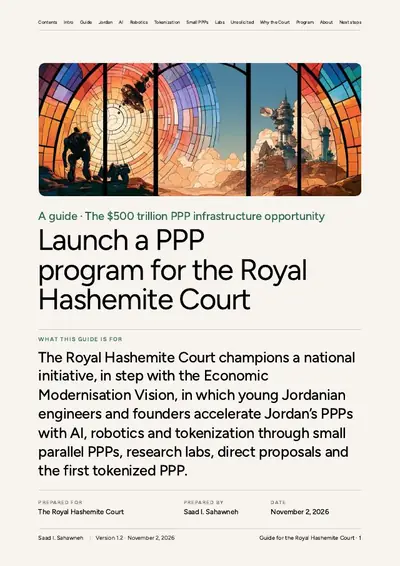
Robotics gives young Jordanian engineers and founders a direct way into infrastructure. A national initiative can open small PPP pilots to companies that build, inspect and maintain assets with machines, such as leak-detection robots for water networks or drones that survey roads, so a new company can prove its method on a real asset and grow with Jordan’s pipeline.
More on the singularity
 The infrastructure singularityThe $500 trillion rebuild
 Futureproof your organizationWhat changes, and where to start
 Artificial intelligenceDesigns, structures and runs the assets
 TokenizationFinances the assets and opens ownership
 Small PPPs and research labsMany small projects, run in parallel
 Unsolicited proposalsTake your own PPP idea to government