
Operators and services
Launch a PPP program for Telecom Operators in Jordan
A free 17-page guide · The $500 trillion PPP infrastructure opportunity
What this guide is for
Your company launches a PPP program to connect public-private partnership (PPP) projects with fiber, 5G, data centers and IoT networks and to join the consortiums that win them.
The case
Telecom operators connect every asset into one system
Networks were long treated as a utility that infrastructure plugged into after it was built. The projects of the next fifty years will be designed as connected systems from the first drawing, and the operators that carry their data will hold contracts that run as long as the concessions. This guide invites telecom operators in Jordan to launch a PPP program, starting with the projects at home.
The guide
Connect the $500 trillion PPP infrastructure opportunity
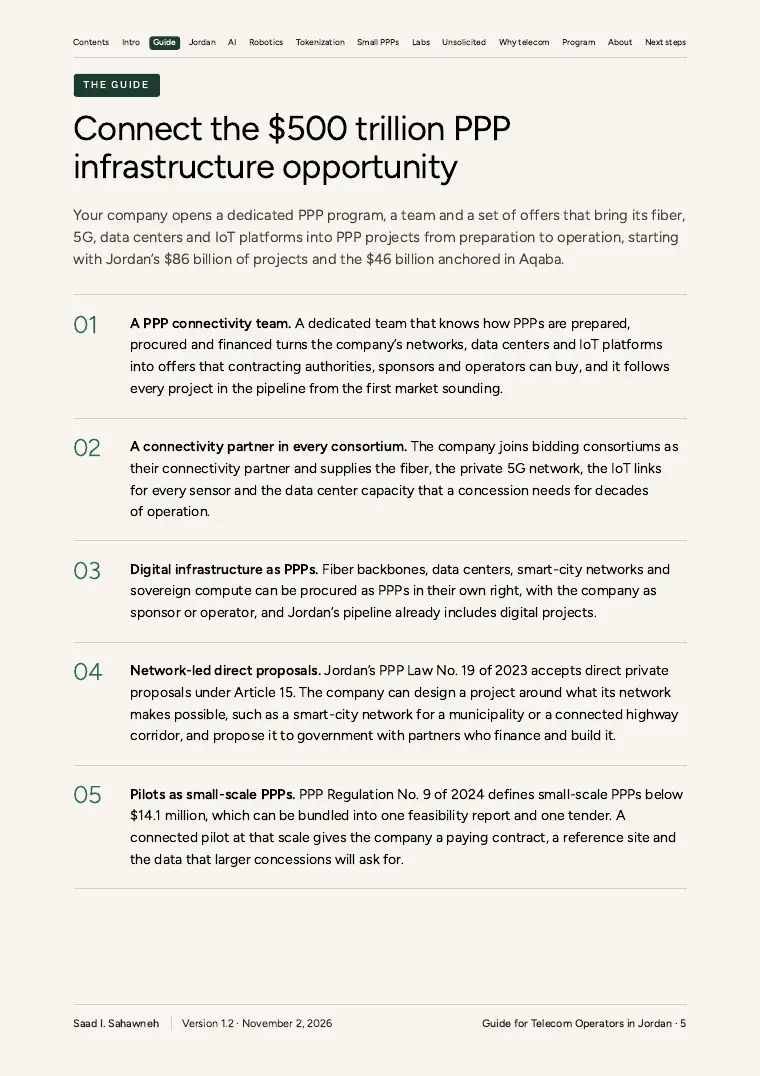
Your company opens a dedicated PPP program, a team and a set of offers that bring its fiber, 5G, data centers and IoT platforms into PPP projects from preparation to operation, starting with Jordan’s $86 billion of projects and the $46 billion anchored in Aqaba.
01
A PPP connectivity team
A dedicated team that knows how PPPs are prepared, procured and financed turns the company’s networks, data centers and IoT platforms into offers that contracting authorities, sponsors and operators can buy, and it follows every project in the pipeline from the first market sounding.
02
A connectivity partner in every consortium
The company joins bidding consortiums as their connectivity partner and supplies the fiber, the private 5G network, the IoT links for every sensor and the data center capacity that a concession needs for decades of operation.
03
Digital infrastructure as PPPs
Fiber backbones, data centers, smart-city networks and sovereign compute can be procured as PPPs in their own right, with the company as sponsor or operator, and Jordan’s pipeline already includes digital projects.
04
Network-led direct proposals
Jordan’s PPP Law No. 19 of 2023 accepts direct private proposals under Article 15. The company can design a project around what its network makes possible, such as a smart-city network for a municipality or a connected highway corridor, and propose it to government with partners who finance and build it.
05
Pilots as small-scale PPPs
PPP Regulation No. 9 of 2024 defines small-scale PPPs below $14.1 million, which can be bundled into one feasibility report and one tender. A connected pilot at that scale gives the company a paying contract, a reference site and the data that larger concessions will ask for.
Why telecom operators
Telecom operators connect every asset into one system
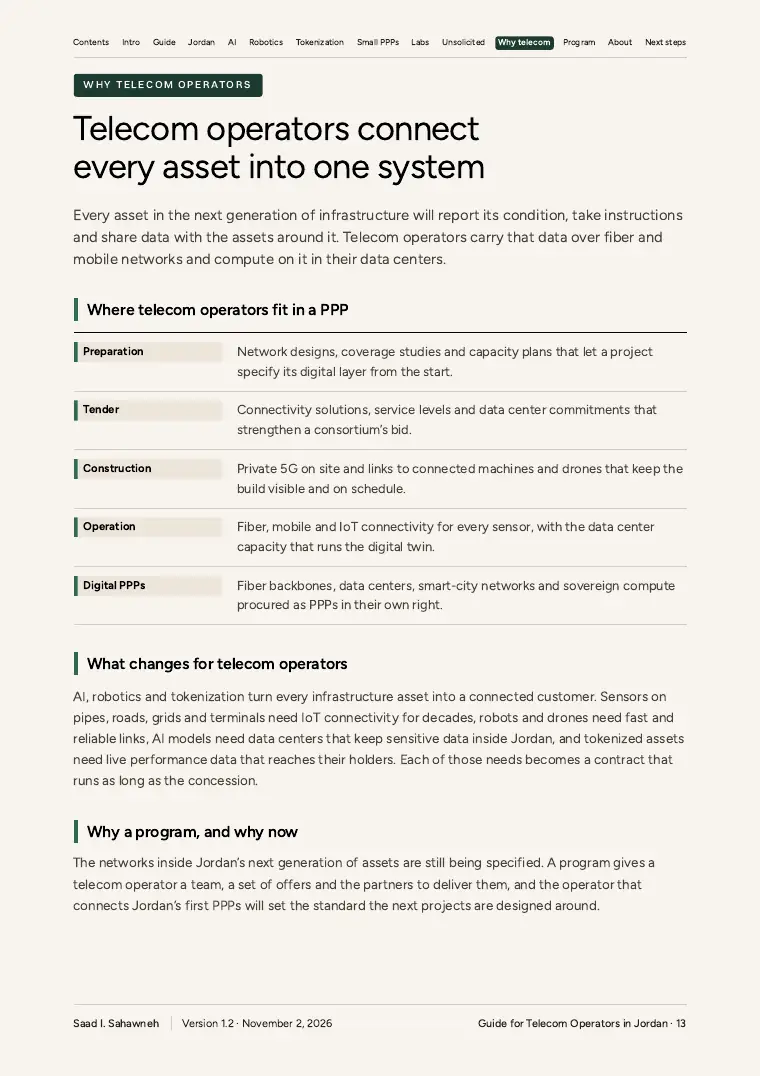
Every asset in the next generation of infrastructure will report its condition, take instructions and share data with the assets around it. Telecom operators carry that data over fiber and mobile networks and compute on it in their data centers.
Where telecom operators fit in a PPP
- Preparation
- Network designs, coverage studies and capacity plans that let a project specify its digital layer from the start.
- Tender
- Connectivity solutions, service levels and data center commitments that strengthen a consortium’s bid.
- Construction
- Private 5G on site and links to connected machines and drones that keep the build visible and on schedule.
- Operation
- Fiber, mobile and IoT connectivity for every sensor, with the data center capacity that runs the digital twin.
- Digital PPPs
- Fiber backbones, data centers, smart-city networks and sovereign compute procured as PPPs in their own right.
What changes for telecom operators
AI, robotics and tokenization turn every infrastructure asset into a connected customer. Sensors on pipes, roads, grids and terminals need IoT connectivity for decades, robots and drones need fast and reliable links, AI models need data centers that keep sensitive data inside Jordan, and tokenized assets need live performance data that reaches their holders. Each of those needs becomes a contract that runs as long as the concession.
Why a program, and why now
The networks inside Jordan’s next generation of assets are still being specified. A program gives a telecom operator a team, a set of offers and the partners to deliver them, and the operator that connects Jordan’s first PPPs will set the standard the next projects are designed around.

Futureproofing
Futureproof Telecom Operators in Jordan for the infrastructure singularity
This free 17-page guide shows how, with small PPPs in parallel, PPP research labs, artificial intelligence, robotics, tokenization and six first steps.

Jordan and Aqaba
An $86 billion pipeline to start with
Every one of them will need networks, data centers and connected sensors. A Jordanian telecom operator that connects one project at home can carry the same network and services to the next one across the region.
- $86B
- of PPP and infrastructure projects in development in Jordan
- $46B
- of them anchored in Aqaba

Artificial intelligence
AI runs on data and compute, and a telecom operator supplies both. Every digital twin and predictive model on a PPP asset depends on a network that delivers sensor data without gaps and a data center that processes it inside Jordan. An operator can sell that capacity under contracts as long as the concession and use the same AI to keep its own network available.

Robotics
Every robot, drone and autonomous machine on a PPP site needs a fast, reliable link to the systems that steer it. A telecom operator can supply private 5G networks for construction sites, terminals and mines, and it can use drones and robots to inspect its own towers and fiber routes along the same corridors.

Tokenization
Fiber routes, towers and data centers earn contracted revenue for decades, the kind of cash flow a token represents well. A telecom operator can offer tokenized stakes in the digital infrastructure it builds under a PPP, pay holders from capacity and lease payments as they arrive and let its customers own part of the network.

Small PPPs and research labs
Every lab needs its pilots connected, monitored and reported in public. A telecom operator can connect small PPPs across many sectors at once, give each pilot its sensors, data and compute as one service and carry the results into the large projects, where the same network becomes part of the specification.

Unsolicited proposals
A direct proposal under Article 15 has to offer an innovative solution for a public service, and a smart-city network, a fiber route or a public data center can be one. A direct proposal lets a telecom operator bring that project to government as its own design, protect the intellectual property behind it and keep the right to match the best offer at tender.
The program
How the program could work
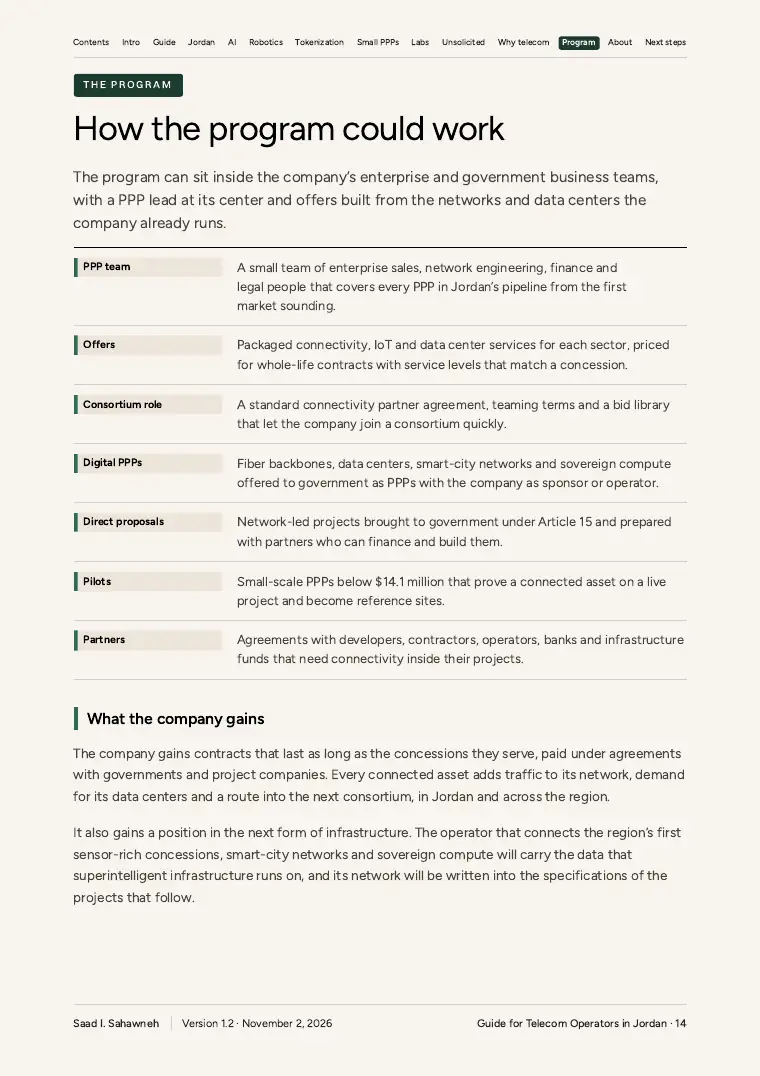
The program can sit inside the company’s enterprise and government business teams, with a PPP lead at its center and offers built from the networks and data centers the company already runs.
- PPP team
- A small team of enterprise sales, network engineering, finance and legal people that covers every PPP in Jordan’s pipeline from the first market sounding.
- Offers
- Packaged connectivity, IoT and data center services for each sector, priced for whole-life contracts with service levels that match a concession.
- Consortium role
- A standard connectivity partner agreement, teaming terms and a bid library that let the company join a consortium quickly.
- Digital PPPs
- Fiber backbones, data centers, smart-city networks and sovereign compute offered to government as PPPs with the company as sponsor or operator.
- Direct proposals
- Network-led projects brought to government under Article 15 and prepared with partners who can finance and build them.
- Pilots
- Small-scale PPPs below $14.1 million that prove a connected asset on a live project and become reference sites.
- Partners
- Agreements with developers, contractors, operators, banks and infrastructure funds that need connectivity inside their projects.
What the company gains
The company gains contracts that last as long as the concessions they serve, paid under agreements with governments and project companies. Every connected asset adds traffic to its network, demand for its data centers and a route into the next consortium, in Jordan and across the region.
It also gains a position in the next form of infrastructure. The operator that connects the region’s first sensor-rich concessions, smart-city networks and sovereign compute will carry the data that superintelligent infrastructure runs on, and its network will be written into the specifications of the projects that follow.

Next steps
How a telecom operator can start
Any telecom operator in Jordan can take this guide forward. The first steps use the networks, data centers and engineers the company already has.
01
Mandate
Board approval for a PPP connectivity program, with its sectors, its offers and its first-year goals.
02
Team
A named program lead, with enterprise sales, network engineering, finance and legal people drawn from the company’s existing teams.
03
Pipeline
A map of Jordan’s $86 billion of projects by sector and stage, and early meetings with the contracting authorities, sponsors and operators that will need connectivity.
04
Network offers
Fiber, private 5G, IoT connectivity and data center capacity packaged into one PPP offer with service levels that match a concession.
05
Partners
Developers, contractors, operators, banks and technology companies that need connectivity inside their projects.
06
Pilot
A first connected pilot or network-led direct proposal, taken from idea to submission.
Jordan has the projects, the networks and a law that lets a company propose its own. A PPP program makes your network the link that joins the assets of the superintelligent infrastructure future into one system.
The full document
Inside this guide
Seventeen pages and thirteen sections, from the case for a PPP program to the first steps, written for telecom operators in Jordan.
Download the guide (PDF)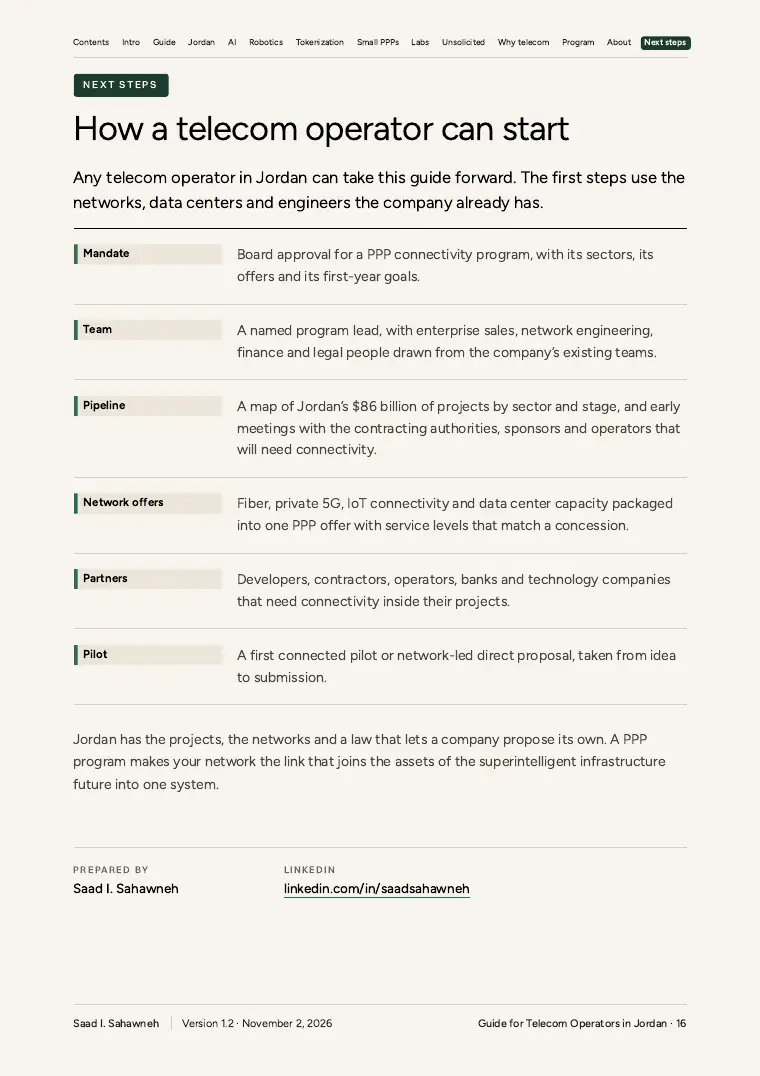
- 01IntroductionWhy a century of infrastructure needs rebuilding, and the $500 trillion it will take.p. 3
- 02The guideConnect the $500 trillion PPP infrastructure opportunityp. 5
- 03Jordan and AqabaAn $86 billion pipeline to start withp. 6
- 04Artificial intelligenceHow AI designs, structures and runs PPP projects, and what it means for telecom operators.p. 7
- 05RoboticsHow robots build infrastructure and keep it running, and what that means for telecom operators.p. 8
- 06TokenizationHow tokenization funds projects from their own revenue, and the role it opens for telecom operators.p. 9
- 07Small PPPs in parallelWhy many small PPPs teach a country faster than a few large ones.p. 10
- 08PPP research labsA lab in each sector, running ten small PPP projects a year.p. 11
- 09Unsolicited proposalsHow Jordan’s PPP law accepts direct proposals from private companies.p. 12
- 10Why telecom operatorsTelecom operators connect every asset into one systemp. 13
- 11The programThe program can sit inside the company’s enterprise and government business teams, with a PPP lead at its center and offers built from the networks and data centers the company already runs.p. 14
- 12AboutAbout Jordan PPP and what it offers.p. 15
- 13Next stepsHow a telecom operator can start: six first steps.p. 16
Questions
Questions about the guide for Telecom Operators in Jordan
- What does the guide for Telecom Operators in Jordan propose?
- Your company launches a PPP program to connect public-private partnership (PPP) projects with fiber, 5G, data centers and IoT networks and to join the consortiums that win them.
- Why should telecom operators in Jordan launch a PPP program?
- Telecom operators connect every asset into one system. Every asset in the next generation of infrastructure will report its condition, take instructions and share data with the assets around it. Telecom operators carry that data over fiber and mobile networks and compute on it in their data centers.
- Which PPP projects can telecom operators in Jordan take part in?
- Jordan has about $86 billion of PPP and infrastructure projects in development, $46 billion of them anchored in Aqaba. Every one of them will need networks, data centers and connected sensors. A Jordanian telecom operator that connects one project at home can carry the same network and services to the next one across the region.
- How can telecom operators in Jordan start a PPP program?
- Any telecom operator in Jordan can take this guide forward. The first steps use the networks, data centers and engineers the company already has. The guide sets out six first steps: mandate, team, pipeline, network offers, partners and pilot.
- What does a PPP program give telecom operators in Jordan?
- The company gains contracts that last as long as the concessions they serve, paid under agreements with governments and project companies. Every connected asset adds traffic to its network, demand for its data centers and a route into the next consortium, in Jordan and across the region.
- Is the guide for Telecom Operators in Jordan free?
- Yes. It is free to read on this page and free to download as a 17-page PDF, with the case for a PPP program, Jordan’s pipeline, the role of AI, robotics and tokenization, the program and six first steps.
Guide 25 of 52
Browse all 52 guides