
National leadership
Launch a PPP program for the Prime Ministry of Jordan
A free 17-page guide · The $500 trillion PPP infrastructure opportunity
What this guide is for
The Prime Ministry launches a government-wide PPP acceleration program, with a PPP research lab in every ministry and public authority funded by moving 1% of budgets away from inefficient spending, a fast track for small-scale PPPs and direct proposals, AI-assisted project preparation and a national framework for tokenized PPP notes.
The case
Every PPP crosses several ministries before it reaches the market
A single PPP passes through many parts of government: the sector ministry that needs the service, the institutions that review, fund and approve it, and the authorities that permit and supervise it for decades. A program run from the center lets all of them move at the same pace and learn from one another. This guide invites the Prime Ministry to launch a government-wide PPP acceleration program, starting with the projects at home.
The guide
A government-wide program for the $500 trillion PPP opportunity
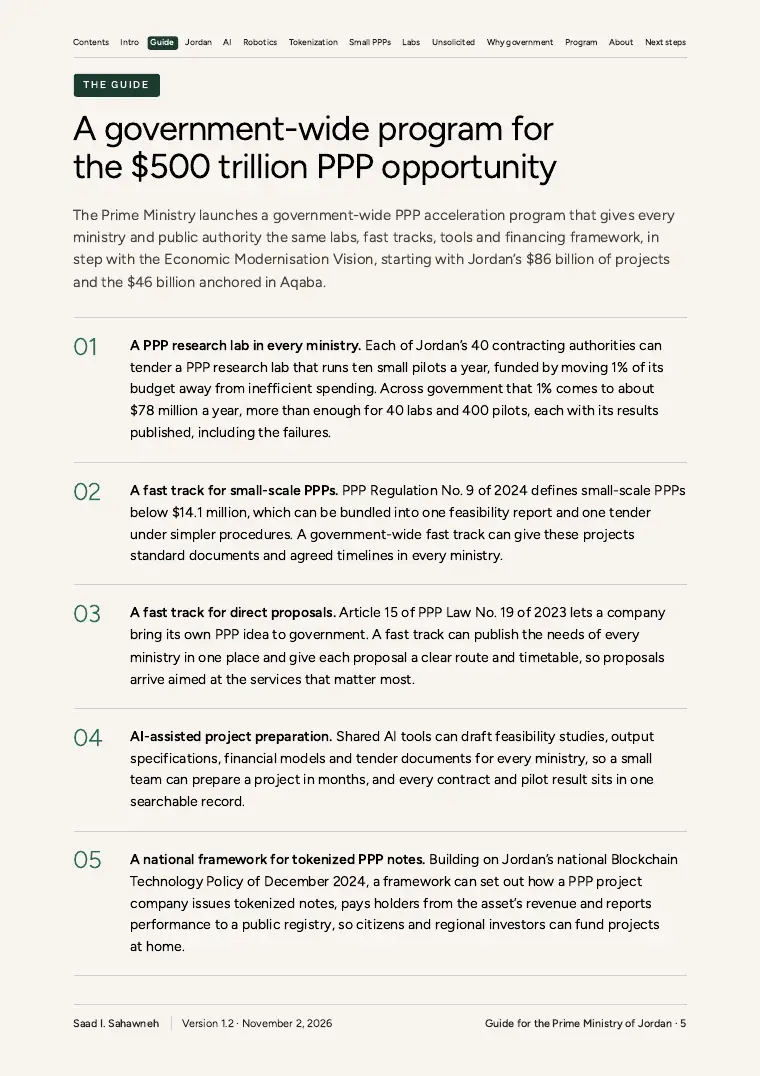
The Prime Ministry launches a government-wide PPP acceleration program that gives every ministry and public authority the same labs, fast tracks, tools and financing framework, in step with the Economic Modernisation Vision, starting with Jordan’s $86 billion of projects and the $46 billion anchored in Aqaba.
01
A PPP research lab in every ministry
Each of Jordan’s 40 contracting authorities can tender a PPP research lab that runs ten small pilots a year, funded by moving 1% of its budget away from inefficient spending. Across government that 1% comes to about $78 million a year, more than enough for 40 labs and 400 pilots, each with its results published, including the failures.
02
A fast track for small-scale PPPs
PPP Regulation No. 9 of 2024 defines small-scale PPPs below $14.1 million, which can be bundled into one feasibility report and one tender under simpler procedures. A government-wide fast track can give these projects standard documents and agreed timelines in every ministry.
03
A fast track for direct proposals
Article 15 of PPP Law No. 19 of 2023 lets a company bring its own PPP idea to government. A fast track can publish the needs of every ministry in one place and give each proposal a clear route and timetable, so proposals arrive aimed at the services that matter most.
04
AI-assisted project preparation
Shared AI tools can draft feasibility studies, output specifications, financial models and tender documents for every ministry, so a small team can prepare a project in months, and every contract and pilot result sits in one searchable record.
05
A national framework for tokenized PPP notes
Building on Jordan’s national Blockchain Technology Policy of December 2024, a framework can set out how a PPP project company issues tokenized notes, pays holders from the asset’s revenue and reports performance to a public registry, so citizens and regional investors can fund projects at home.
Why the Prime Ministry
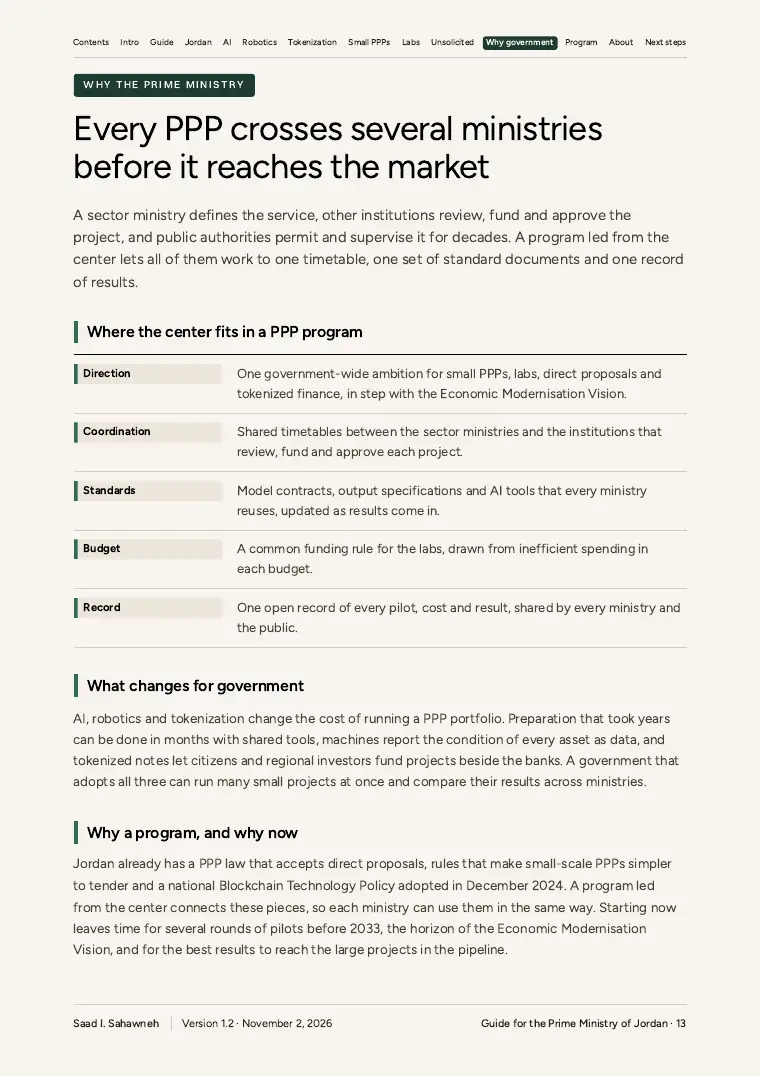
Every PPP crosses several ministries before it reaches the market
A sector ministry defines the service, other institutions review, fund and approve the project, and public authorities permit and supervise it for decades. A program led from the center lets all of them work to one timetable, one set of standard documents and one record of results.
Where the center fits in a PPP program
- Direction
- One government-wide ambition for small PPPs, labs, direct proposals and tokenized finance, in step with the Economic Modernisation Vision.
- Coordination
- Shared timetables between the sector ministries and the institutions that review, fund and approve each project.
- Standards
- Model contracts, output specifications and AI tools that every ministry reuses, updated as results come in.
- Budget
- A common funding rule for the labs, drawn from inefficient spending in each budget.
- Record
- One open record of every pilot, cost and result, shared by every ministry and the public.
What changes for government
AI, robotics and tokenization change the cost of running a PPP portfolio. Preparation that took years can be done in months with shared tools, machines report the condition of every asset as data, and tokenized notes let citizens and regional investors fund projects beside the banks. A government that adopts all three can run many small projects at once and compare their results across ministries.
Why a program, and why now
Jordan already has a PPP law that accepts direct proposals, rules that make small-scale PPPs simpler to tender and a national Blockchain Technology Policy adopted in December 2024. A program led from the center connects these pieces, so each ministry can use them in the same way. Starting now leaves time for several rounds of pilots before 2033, the horizon of the Economic Modernisation Vision, and for the best results to reach the large projects in the pipeline.

Futureproofing
Futureproof the Prime Ministry of Jordan for the infrastructure singularity
This free 17-page guide shows how, with small PPPs in parallel, PPP research labs, artificial intelligence, robotics, tokenization and six first steps.

Jordan and Aqaba
An $86 billion pipeline to start with
They are spread across many ministries and public authorities, and they will move fastest when those institutions work from one approach and learn from each other’s results. A government that prepares, tenders and supervises its PPPs as one program can set a model the region can follow, with each ministry’s results open to the others.
- $86B
- of PPP and infrastructure projects in development in Jordan
- $46B
- of them anchored in Aqaba

Artificial intelligence
AI-assisted preparation lets every ministry draw on the same tools and the same data. A shared platform can draft feasibility studies, output specifications and tender documents, test value for money, compare bids on whole-life cost and keep every contract and pilot result in one record that each ministry can search. A small central team can maintain it for all 40 contracting authorities.

Robotics
Robotics changes what government can ask for in its tenders. Standard output specifications issued from the center can require drone inspection, robotic leak detection and automated maintenance records on every PPP, so performance is measured by machines, reported as data and compared across ministries.

Tokenization
A national framework for tokenized PPP notes gives every ministry the same route to a new pool of capital. It can set how a project company issues notes, who may hold them, how holders are paid from the asset’s revenue and how performance is reported, so the first issue can be a small project and later issues can follow the same rules.

Small PPPs and research labs
From the center, the labs become one national portfolio. With 1% of each budget moved away from inefficient spending, Jordan’s 40 contracting authorities could fund about 780 small PPPs a year for about $78 million, and one shared brief, one model tender and one public record let every ministry learn from the pilots of the others.

Unsolicited proposals
A fast track for direct proposals gives every ministry the same route and the same timetable. The authority can charge the proposer a study fee for each review and a qualifying proposal enters the PPP Registry, while the tender still tests the idea against the market. One public list of needs across government points proposals at the services that matter most, and small-scale proposals below $14.1 million can move on simpler procedures.
The program
How the program could work
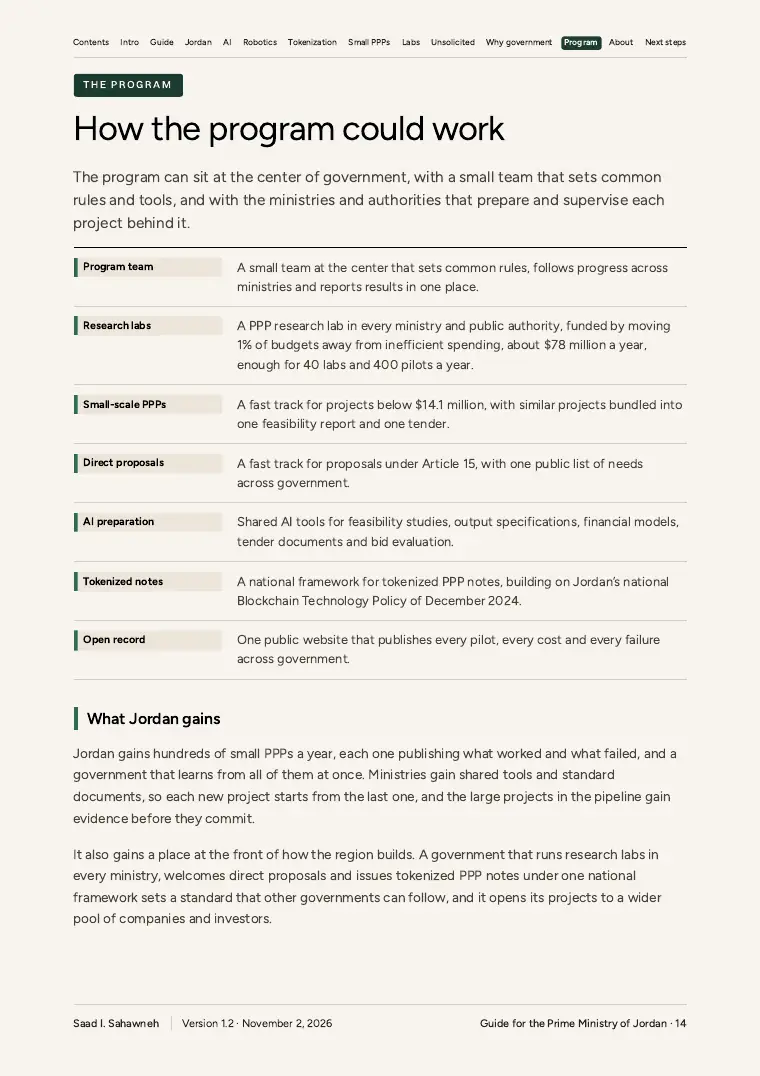
The program can sit at the center of government, with a small team that sets common rules and tools, and with the ministries and authorities that prepare and supervise each project behind it.
- Program team
- A small team at the center that sets common rules, follows progress across ministries and reports results in one place.
- Research labs
- A PPP research lab in every ministry and public authority, funded by moving 1% of budgets away from inefficient spending, about $78 million a year, enough for 40 labs and 400 pilots a year.
- Small-scale PPPs
- A fast track for projects below $14.1 million, with similar projects bundled into one feasibility report and one tender.
- Direct proposals
- A fast track for proposals under Article 15, with one public list of needs across government.
- AI preparation
- Shared AI tools for feasibility studies, output specifications, financial models, tender documents and bid evaluation.
- Tokenized notes
- A national framework for tokenized PPP notes, building on Jordan’s national Blockchain Technology Policy of December 2024.
- Open record
- One public website that publishes every pilot, every cost and every failure across government.
What Jordan gains
Jordan gains hundreds of small PPPs a year, each one publishing what worked and what failed, and a government that learns from all of them at once. Ministries gain shared tools and standard documents, so each new project starts from the last one, and the large projects in the pipeline gain evidence before they commit.
It also gains a place at the front of how the region builds. A government that runs research labs in every ministry, welcomes direct proposals and issues tokenized PPP notes under one national framework sets a standard that other governments can follow, and it opens its projects to a wider pool of companies and investors.

Next steps
How the program can start
Should the Prime Ministry wish to take this guide forward, the first steps can use the ministries, staff and rules that are already in place.
01
Mandate
A government decision to launch the PPP acceleration program, with its scope, its themes and its first-year goals.
02
Team
A small program team at the center, with a named lead and a focal point in each ministry and public authority.
03
Pipeline
A review of Jordan’s $86 billion of projects by ministry and stage, marking where small PPPs and direct proposals can start first.
04
Research labs
A common brief, a model tender and a funding rule for the PPP research labs in every ministry and public authority.
05
Partners
Ministries, public authorities, regulators, lenders, universities and the companies that will bid for the labs and propose projects.
06
Pilot
A first round of small-scale PPPs and direct proposals taken from idea to tender, and a first issue of tokenized PPP notes on a small project.
Jordan has the projects, a law that accepts unsolicited proposals, rules that make small PPPs simpler to tender and a national Blockchain Technology Policy. A program led from the Prime Ministry can join them into one approach across government and give Jordan an early place in the superintelligent infrastructure future.
The full document
Inside this guide
Seventeen pages and thirteen sections, from the case for a PPP program to the first steps, written for the Prime Ministry of Jordan.
Download the guide (PDF)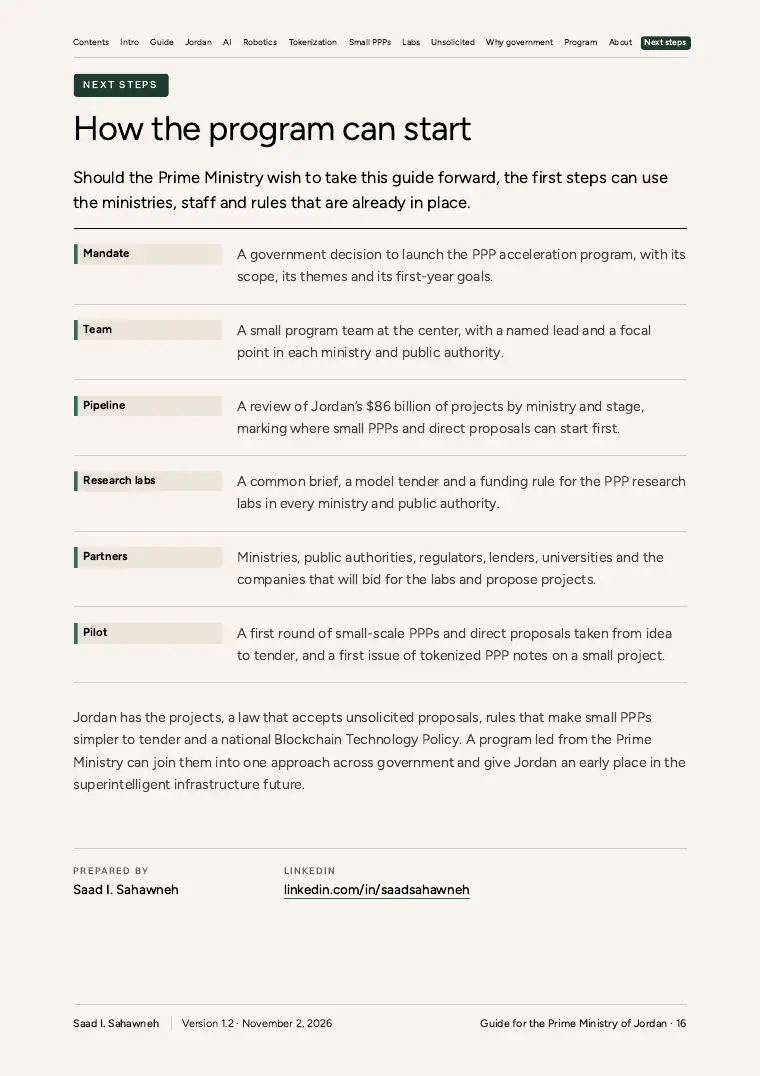
- 01IntroductionWhy a century of infrastructure needs rebuilding, and the $500 trillion it will take.p. 3
- 02The guideA government-wide program for the $500 trillion PPP opportunityp. 5
- 03Jordan and AqabaAn $86 billion pipeline to start withp. 6
- 04Artificial intelligenceHow AI designs, structures and runs PPP projects, and what it means for the Prime Ministry.p. 7
- 05RoboticsHow robots build infrastructure and keep it running, and what that means for the Prime Ministry.p. 8
- 06TokenizationHow tokenization funds projects from their own revenue, and the role it opens for the Prime Ministry.p. 9
- 07Small PPPs in parallelWhy many small PPPs teach a country faster than a few large ones.p. 10
- 08PPP research labsA lab in each sector, running ten small PPP projects a year.p. 11
- 09Unsolicited proposalsHow Jordan’s PPP law accepts direct proposals from private companies.p. 12
- 10Why the Prime MinistryEvery PPP crosses several ministries before it reaches the marketp. 13
- 11The programThe program can sit at the center of government, with a small team that sets common rules and tools, and with the ministries and authorities that prepare and supervise each project behind it.p. 14
- 12AboutAbout Jordan PPP and what it offers.p. 15
- 13Next stepsHow the program can start: six first steps.p. 16
Questions
Questions about the guide for the Prime Ministry of Jordan
- What does the guide for the Prime Ministry of Jordan propose?
- The Prime Ministry launches a government-wide PPP acceleration program, with a PPP research lab in every ministry and public authority funded by moving 1% of budgets away from inefficient spending, a fast track for small-scale PPPs and direct proposals, AI-assisted project preparation and a national framework for tokenized PPP notes.
- Why should the Prime Ministry of Jordan launch a PPP program?
- Every PPP crosses several ministries before it reaches the market. A sector ministry defines the service, other institutions review, fund and approve the project, and public authorities permit and supervise it for decades. A program led from the center lets all of them work to one timetable, one set of standard documents and one record of results.
- Which PPP projects can the Prime Ministry of Jordan take part in?
- Jordan has about $86 billion of PPP and infrastructure projects in development, $46 billion of them anchored in Aqaba. They are spread across many ministries and public authorities, and they will move fastest when those institutions work from one approach and learn from each other’s results. A government that prepares, tenders and supervises its PPPs as one program can set a model the region can follow, with each ministry’s results open to the others.
- How can the Prime Ministry of Jordan start a PPP program?
- Should the Prime Ministry wish to take this guide forward, the first steps can use the ministries, staff and rules that are already in place. The guide sets out six first steps: mandate, team, pipeline, research labs, partners and pilot.
- What does a PPP program give the Prime Ministry of Jordan?
- Jordan gains hundreds of small PPPs a year, each one publishing what worked and what failed, and a government that learns from all of them at once. Ministries gain shared tools and standard documents, so each new project starts from the last one, and the large projects in the pipeline gain evidence before they commit.
- Is the guide for the Prime Ministry of Jordan free?
- Yes. It is free to read on this page and free to download as a 17-page PDF, with the case for a PPP program, Jordan’s pipeline, the role of AI, robotics and tokenization, the program and six first steps.
Guide 2 of 52
Browse all 52 guides