
Capital
Launch a PPP program for Insurance Companies in Jordan
A free 17-page guide · The $500 trillion PPP infrastructure opportunity
What this guide is for
Your company launches a program to insure public-private partnership (PPP) projects from construction through operation and to invest long-dated reserves in operating PPPs.
The case
Insurance stands behind every stage of a PPP
Every PPP carries risks that sponsors and lenders insure before they commit, and the assets of the next fifty years will report on those risks in real time. Insurers that build a PPP program now will cover the rebuild and invest in it from the start. This guide invites insurance and takaful companies in Jordan to launch that program, starting with the projects at home.
The guide
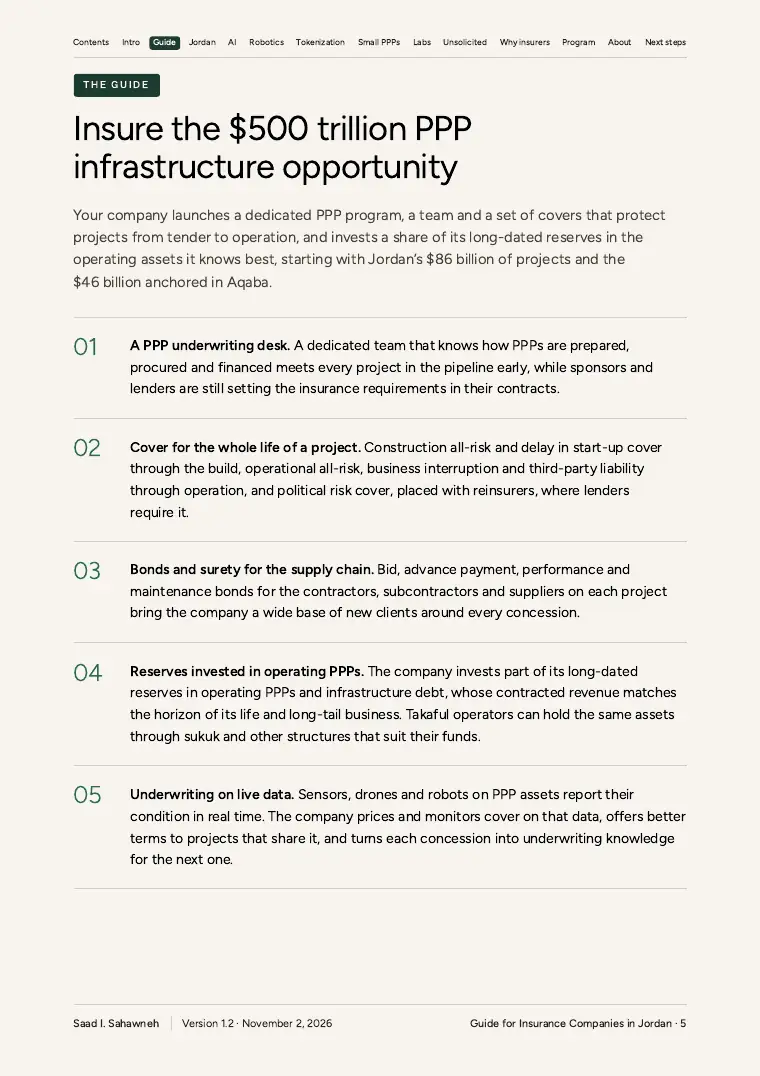
Insure the $500 trillion PPP infrastructure opportunity
Your company launches a dedicated PPP program, a team and a set of covers that protect projects from tender to operation, and invests a share of its long-dated reserves in the operating assets it knows best, starting with Jordan’s $86 billion of projects and the $46 billion anchored in Aqaba.
01
A PPP underwriting desk
A dedicated team that knows how PPPs are prepared, procured and financed meets every project in the pipeline early, while sponsors and lenders are still setting the insurance requirements in their contracts.
02
Cover for the whole life of a project
Construction all-risk and delay in start-up cover through the build, operational all-risk, business interruption and third-party liability through operation, and political risk cover, placed with reinsurers, where lenders require it.
03
Bonds and surety for the supply chain
Bid, advance payment, performance and maintenance bonds for the contractors, subcontractors and suppliers on each project bring the company a wide base of new clients around every concession.
04
Reserves invested in operating PPPs
The company invests part of its long-dated reserves in operating PPPs and infrastructure debt, whose contracted revenue matches the horizon of its life and long-tail business. Takaful operators can hold the same assets through sukuk and other structures that suit their funds.
05
Underwriting on live data
Sensors, drones and robots on PPP assets report their condition in real time. The company prices and monitors cover on that data, offers better terms to projects that share it, and turns each concession into underwriting knowledge for the next one.
Why insurers
Insurance stands behind every stage of a PPP
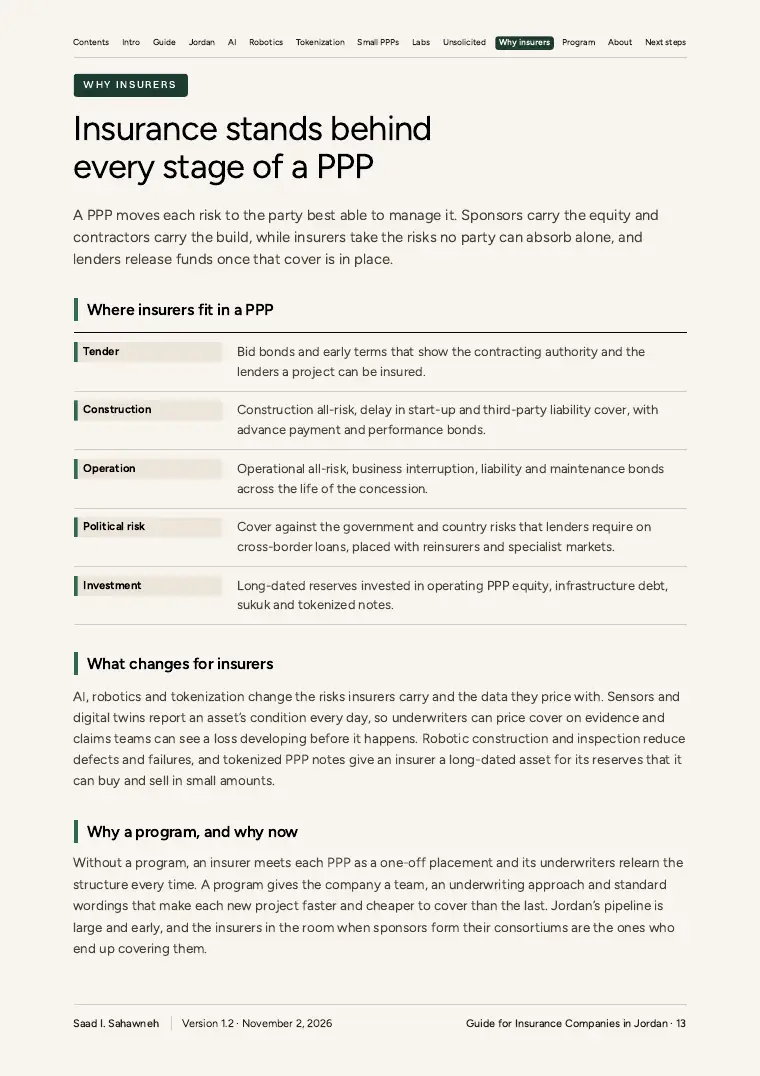
A PPP moves each risk to the party best able to manage it. Sponsors carry the equity and contractors carry the build, while insurers take the risks no party can absorb alone, and lenders release funds once that cover is in place.
Where insurers fit in a PPP
- Tender
- Bid bonds and early terms that show the contracting authority and the lenders a project can be insured.
- Construction
- Construction all-risk, delay in start-up and third-party liability cover, with advance payment and performance bonds.
- Operation
- Operational all-risk, business interruption, liability and maintenance bonds across the life of the concession.
- Political risk
- Cover against the government and country risks that lenders require on cross-border loans, placed with reinsurers and specialist markets.
- Investment
- Long-dated reserves invested in operating PPP equity, infrastructure debt, sukuk and tokenized notes.
What changes for insurers
AI, robotics and tokenization change the risks insurers carry and the data they price with. Sensors and digital twins report an asset’s condition every day, so underwriters can price cover on evidence and claims teams can see a loss developing before it happens. Robotic construction and inspection reduce defects and failures, and tokenized PPP notes give an insurer a long-dated asset for its reserves that it can buy and sell in small amounts.
Why a program, and why now
Without a program, an insurer meets each PPP as a one-off placement and its underwriters relearn the structure every time. A program gives the company a team, an underwriting approach and standard wordings that make each new project faster and cheaper to cover than the last. Jordan’s pipeline is large and early, and the insurers in the room when sponsors form their consortiums are the ones who end up covering them.

Futureproofing
Futureproof Insurance Companies in Jordan for the infrastructure singularity
This free 17-page guide shows how, with small PPPs in parallel, PPP research labs, artificial intelligence, robotics, tokenization and six first steps.

Jordan and Aqaba
An $86 billion pipeline to start with
Every one of them will need cover from construction through operation. A Jordanian insurer that covers one project at home can carry the same program to the next one across the region.
- $86B
- of PPP and infrastructure projects in development in Jordan
- $46B
- of them anchored in Aqaba

Artificial intelligence
AI lets an insurer underwrite a PPP as thoroughly as the team that built it. Underwriters can read a concession agreement and its risk matrix, test the construction program and compare a project against similar risks in hours. Once the asset is operating, digital twins and sensors give the insurer live data on its condition, so losses can be prevented and cover priced on how the asset actually performs.

Robotics
Robotics reduces the losses an insurer pays. Projects that use automated construction and quality verification finish with fewer defects, and assets inspected by drones and maintained by robots fail less often in operation. The data those machines collect gives underwriters a record of each asset’s condition, and the companies that run them need equipment, liability and professional cover as they grow.

Tokenization
Tokenization lets an insurer invest its reserves in infrastructure in smaller pieces it can trade. The company can hold tokenized notes in operating PPPs, receive revenue through smart contracts as it arrives and sell portions to match its liabilities, while it insures the issuers and custodians that build the new market.

Small PPPs and research labs
Every pilot produces loss and performance data on a new technology, construction method or contract. An insurer that covers the labs and their pilots builds the data to price those risks before they reach the large projects, and writes cover for new kinds of infrastructure ahead of the market.

Unsolicited proposals
Direct proposals bring new kinds of projects to Jordan, and each one needs cover from construction through operation. An insurer that works with proposers early can shape the risk allocation in the proposal itself and invest long-dated reserves in the projects that reach operation.
The program
How the program could work
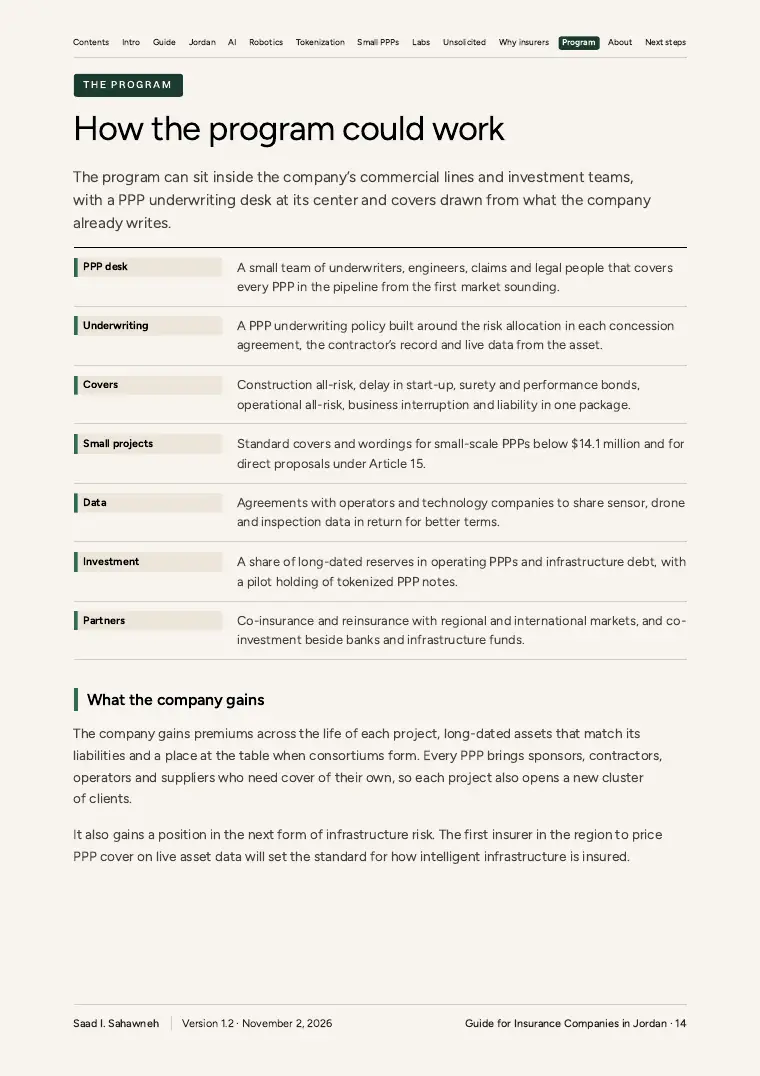
The program can sit inside the company’s commercial lines and investment teams, with a PPP underwriting desk at its center and covers drawn from what the company already writes.
- PPP desk
- A small team of underwriters, engineers, claims and legal people that covers every PPP in the pipeline from the first market sounding.
- Underwriting
- A PPP underwriting policy built around the risk allocation in each concession agreement, the contractor’s record and live data from the asset.
- Covers
- Construction all-risk, delay in start-up, surety and performance bonds, operational all-risk, business interruption and liability in one package.
- Small projects
- Standard covers and wordings for small-scale PPPs below $14.1 million and for direct proposals under Article 15.
- Data
- Agreements with operators and technology companies to share sensor, drone and inspection data in return for better terms.
- Investment
- A share of long-dated reserves in operating PPPs and infrastructure debt, with a pilot holding of tokenized PPP notes.
- Partners
- Co-insurance and reinsurance with regional and international markets, and co-investment beside banks and infrastructure funds.
What the company gains
The company gains premiums across the life of each project, long-dated assets that match its liabilities and a place at the table when consortiums form. Every PPP brings sponsors, contractors, operators and suppliers who need cover of their own, so each project also opens a new cluster of clients.
It also gains a position in the next form of infrastructure risk. The first insurer in the region to price PPP cover on live asset data will set the standard for how intelligent infrastructure is insured.

Next steps
How an insurer can start
Any insurance or takaful company in Jordan can take this guide forward. The first steps use the underwriters, reserves and relationships the company already has.
01
Mandate
Board approval for a PPP program, with its lines of cover, its capacity and the share of reserves it can invest.
02
Team
A named program lead, with underwriting, engineering, claims and investment people drawn from the company’s existing teams.
03
Pipeline
A map of Jordan’s $86 billion of projects by sector and stage, and early meetings with the sponsors and lenders that will require cover.
04
Products
Construction, operational and performance cover packaged into one PPP offer, priced on live asset data where it exists.
05
Partners
Reinsurers, brokers, banks and infrastructure funds on the larger projects.
06
Pilot
A first policy on a small-scale PPP or lab pilot, and a first investment of reserves in an operating PPP.
Jordan has the projects, the lenders who require cover and a law that accepts unsolicited proposals. A PPP program gives your company a place on the projects that reach financial close and a head start in insuring the superintelligent infrastructure future.
The full document
Inside this guide
Seventeen pages and thirteen sections, from the case for a PPP program to the first steps, written for insurance companies in Jordan.
Download the guide (PDF)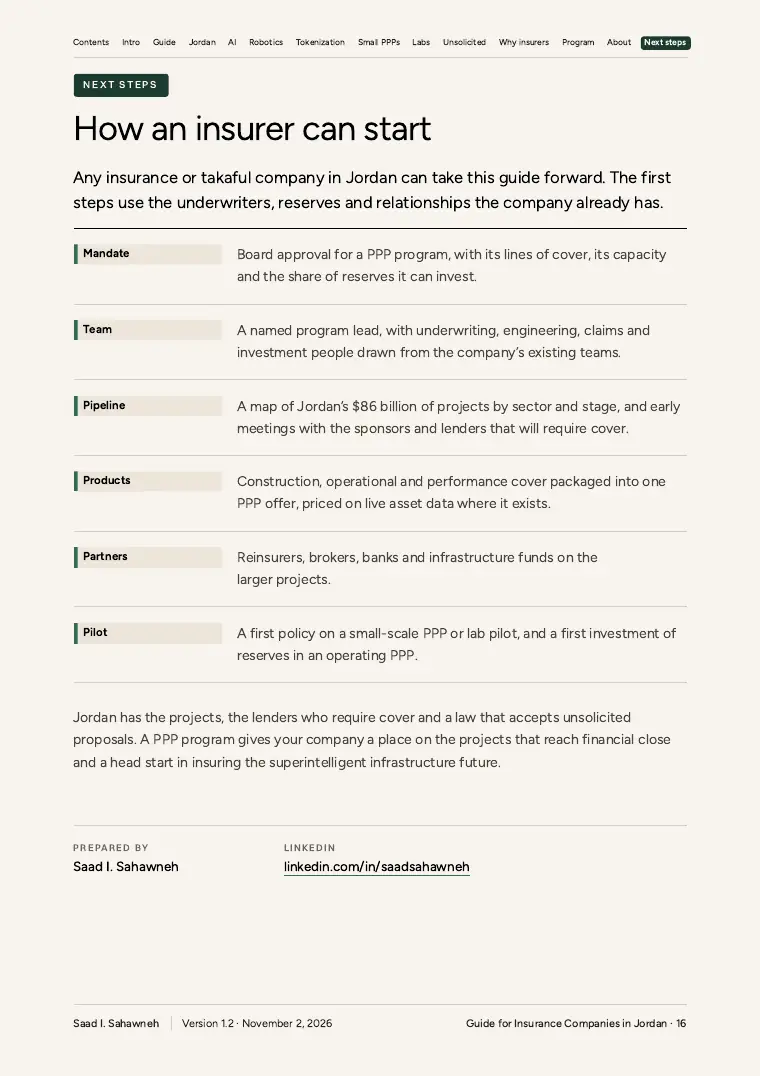
- 01IntroductionWhy a century of infrastructure needs rebuilding, and the $500 trillion it will take.p. 3
- 02The guideInsure the $500 trillion PPP infrastructure opportunityp. 5
- 03Jordan and AqabaAn $86 billion pipeline to start withp. 6
- 04Artificial intelligenceHow AI designs, structures and runs PPP projects, and what it means for insurers.p. 7
- 05RoboticsHow robots build infrastructure and keep it running, and what that means for insurers.p. 8
- 06TokenizationHow tokenization funds projects from their own revenue, and the role it opens for insurers.p. 9
- 07Small PPPs in parallelWhy many small PPPs teach a country faster than a few large ones.p. 10
- 08PPP research labsA lab in each sector, running ten small PPP projects a year.p. 11
- 09Unsolicited proposalsHow Jordan’s PPP law accepts direct proposals from private companies.p. 12
- 10Why insurersInsurance stands behind every stage of a PPPp. 13
- 11The programThe program can sit inside the company’s commercial lines and investment teams, with a PPP underwriting desk at its center and covers drawn from what the company already writes.p. 14
- 12AboutAbout Jordan PPP and what it offers.p. 15
- 13Next stepsHow an insurer can start: six first steps.p. 16
Questions
Questions about the guide for Insurance Companies in Jordan
- What does the guide for Insurance Companies in Jordan propose?
- Your company launches a program to insure public-private partnership (PPP) projects from construction through operation and to invest long-dated reserves in operating PPPs.
- Why should insurance companies in Jordan launch a PPP program?
- Insurance stands behind every stage of a PPP. A PPP moves each risk to the party best able to manage it. Sponsors carry the equity and contractors carry the build, while insurers take the risks no party can absorb alone, and lenders release funds once that cover is in place.
- Which PPP projects can insurance companies in Jordan take part in?
- Jordan has about $86 billion of PPP and infrastructure projects in development, $46 billion of them anchored in Aqaba. Every one of them will need cover from construction through operation. A Jordanian insurer that covers one project at home can carry the same program to the next one across the region.
- How can insurance companies in Jordan start a PPP program?
- Any insurance or takaful company in Jordan can take this guide forward. The first steps use the underwriters, reserves and relationships the company already has. The guide sets out six first steps: mandate, team, pipeline, products, partners and pilot.
- What does a PPP program give insurance companies in Jordan?
- The company gains premiums across the life of each project, long-dated assets that match its liabilities and a place at the table when consortiums form. Every PPP brings sponsors, contractors, operators and suppliers who need cover of their own, so each project also opens a new cluster of clients.
- Is the guide for Insurance Companies in Jordan free?
- Yes. It is free to read on this page and free to download as a 17-page PDF, with the case for a PPP program, Jordan’s pipeline, the role of AI, robotics and tokenization, the program and six first steps.
Guide 11 of 52
Browse all 52 guides