
Technology and knowledge
Launch a PPP program for Schools in Jordan
A free 17-page guide · The $500 trillion PPP infrastructure opportunity
What this guide is for
Your school launches a PPP program that runs its campus energy, water and transport with private partners, teaches its students how infrastructure is built with AI, robotics and tokenization, and takes part in new school projects.
The case
Schools run real infrastructure and raise the people who will run the rest
The engineers, operators and investors of the next fifty years are in school today, and the buildings they learn in are themselves infrastructure: roofs that can carry solar panels, water systems, buses and networks that run every day of the school year. This guide invites schools in Jordan to launch a PPP program that improves their own campus with private partners and prepares their students for the projects at home.
The guide
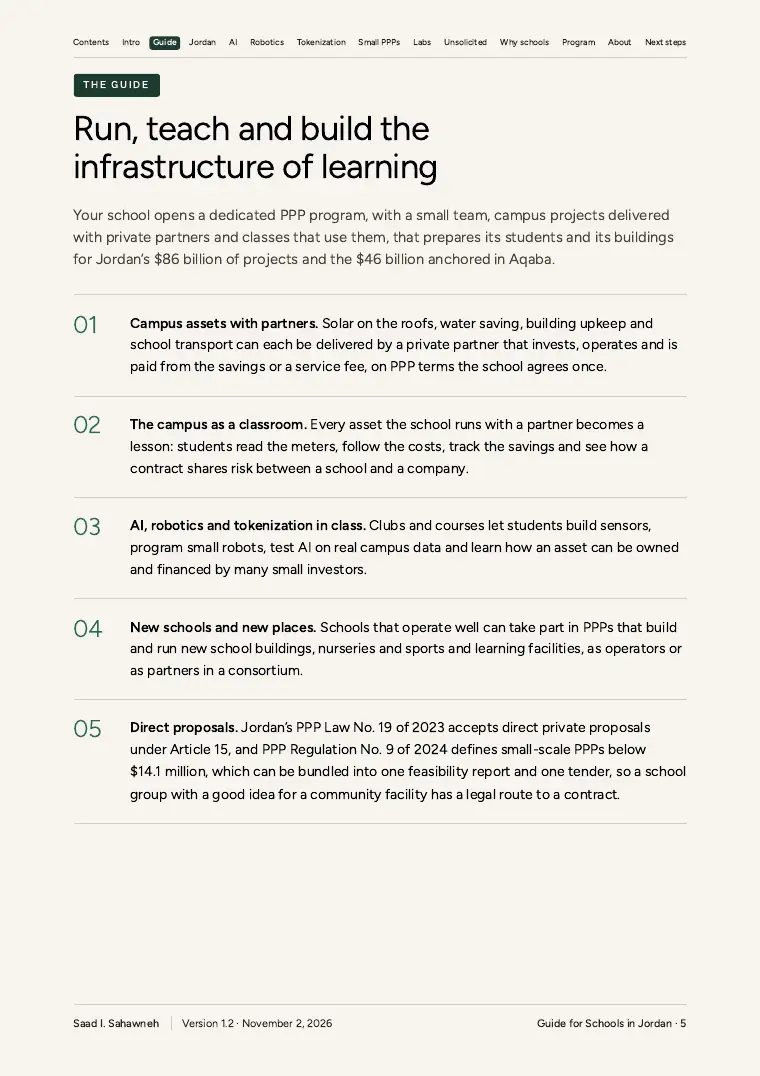
Run, teach and build the infrastructure of learning
Your school opens a dedicated PPP program, with a small team, campus projects delivered with private partners and classes that use them, that prepares its students and its buildings for Jordan’s $86 billion of projects and the $46 billion anchored in Aqaba.
01
Campus assets with partners
Solar on the roofs, water saving, building upkeep and school transport can each be delivered by a private partner that invests, operates and is paid from the savings or a service fee, on PPP terms the school agrees once.
02
The campus as a classroom
Every asset the school runs with a partner becomes a lesson: students read the meters, follow the costs, track the savings and see how a contract shares risk between a school and a company.
03
AI, robotics and tokenization in class
Clubs and courses let students build sensors, program small robots, test AI on real campus data and learn how an asset can be owned and financed by many small investors.
04
New schools and new places
Schools that operate well can take part in PPPs that build and run new school buildings, nurseries and sports and learning facilities, as operators or as partners in a consortium.
05
Direct proposals
Jordan’s PPP Law No. 19 of 2023 accepts direct private proposals under Article 15, and PPP Regulation No. 9 of 2024 defines small-scale PPPs below $14.1 million, which can be bundled into one feasibility report and one tender, so a school group with a good idea for a community facility has a legal route to a contract.
Why schools
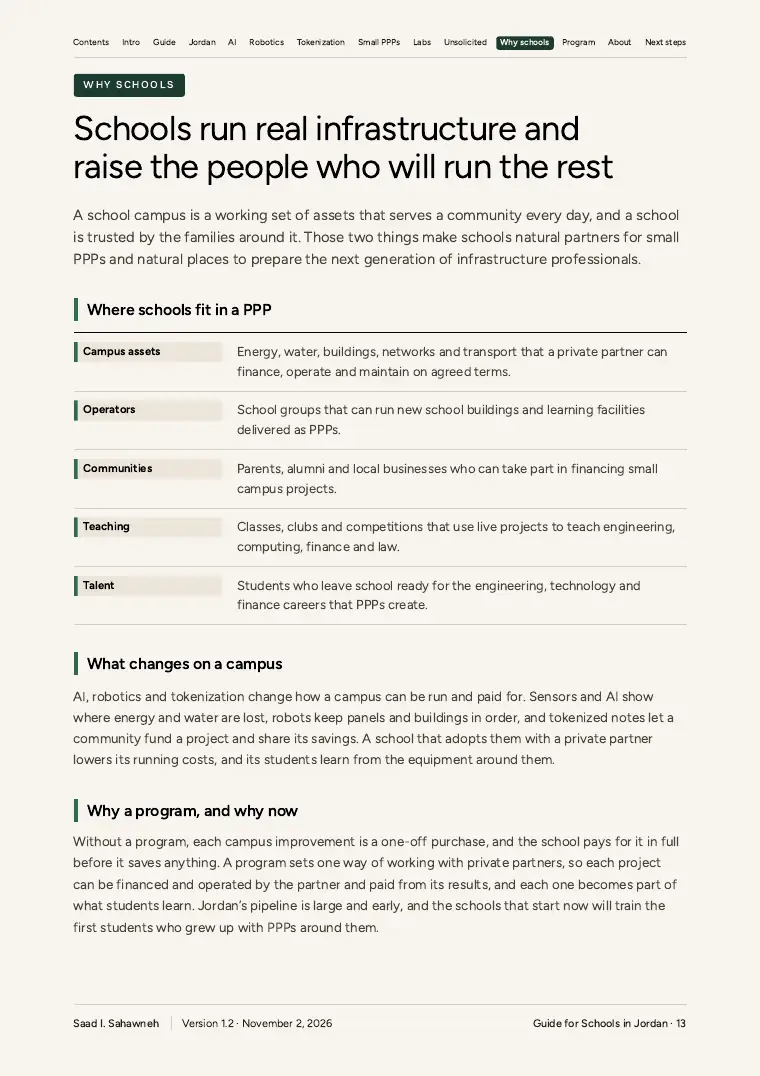
Schools run real infrastructure and raise the people who will run the rest
A school campus is a working set of assets that serves a community every day, and a school is trusted by the families around it. Those two things make schools natural partners for small PPPs and natural places to prepare the next generation of infrastructure professionals.
Where schools fit in a PPP
- Campus assets
- Energy, water, buildings, networks and transport that a private partner can finance, operate and maintain on agreed terms.
- Operators
- School groups that can run new school buildings and learning facilities delivered as PPPs.
- Communities
- Parents, alumni and local businesses who can take part in financing small campus projects.
- Teaching
- Classes, clubs and competitions that use live projects to teach engineering, computing, finance and law.
- Talent
- Students who leave school ready for the engineering, technology and finance careers that PPPs create.
What changes on a campus
AI, robotics and tokenization change how a campus can be run and paid for. Sensors and AI show where energy and water are lost, robots keep panels and buildings in order, and tokenized notes let a community fund a project and share its savings. A school that adopts them with a private partner lowers its running costs, and its students learn from the equipment around them.
Why a program, and why now
Without a program, each campus improvement is a one-off purchase, and the school pays for it in full before it saves anything. A program sets one way of working with private partners, so each project can be financed and operated by the partner and paid from its results, and each one becomes part of what students learn. Jordan’s pipeline is large and early, and the schools that start now will train the first students who grew up with PPPs around them.

Futureproofing
Futureproof Schools in Jordan for the infrastructure singularity
This free 17-page guide shows how, with small PPPs in parallel, PPP research labs, artificial intelligence, robotics, tokenization and six first steps.
Jordan and Aqaba
An $86 billion pipeline to start with
Every one of them will need trained people, and many of them will serve the families whose children attend school. A Jordanian school group that runs one campus project well with a partner can repeat it across its campuses and offer it to others.
- $86B
- of PPP and infrastructure projects in development in Jordan
- $46B
- of them anchored in Aqaba

Artificial intelligence
AI gives a school a way to run its campus on data and to teach with it. Meters and sensors on energy, water and buildings feed simple models that spot waste and plan maintenance, and students can study the same data in class. A school that learns to work with AI on its own buildings is ready to partner on larger facilities.

Robotics
Robotics turns the campus into a workshop. Solar-cleaning machines, inspection drones and small maintenance robots can keep school assets running, and students who build and program robots in clubs and classes learn the skills the construction and operation of infrastructure will need.

Tokenization
Tokenization lets a campus project be financed by a community. A solar roof or a water system can be funded by parents, alumni and local investors who each hold a small share and are paid from the asset’s own savings, and students can follow every step as a lesson in finance and law.

Small PPPs and research labs
A school is a natural home for small PPPs. Its roofs, water systems and transport are ready-made pilots that a partner can improve and measure within a school year, and every result can be shared with other schools and taught in class.

Unsolicited proposals
A school group can bring a community facility to government as a direct proposal with a private partner, such as a shared sports hall, a learning center or a solar project for nearby public buildings, with its own campus and experience behind it.
The program
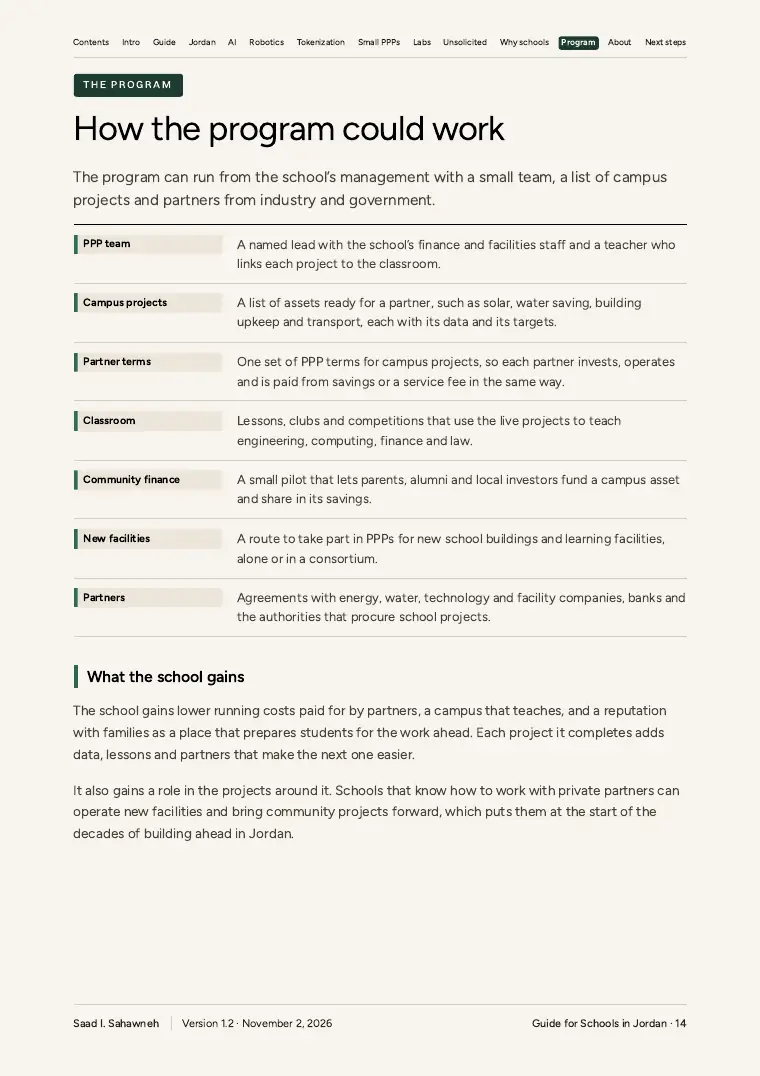
How the program could work
The program can run from the school’s management with a small team, a list of campus projects and partners from industry and government.
- PPP team
- A named lead with the school’s finance and facilities staff and a teacher who links each project to the classroom.
- Campus projects
- A list of assets ready for a partner, such as solar, water saving, building upkeep and transport, each with its data and its targets.
- Partner terms
- One set of PPP terms for campus projects, so each partner invests, operates and is paid from savings or a service fee in the same way.
- Classroom
- Lessons, clubs and competitions that use the live projects to teach engineering, computing, finance and law.
- Community finance
- A small pilot that lets parents, alumni and local investors fund a campus asset and share in its savings.
- New facilities
- A route to take part in PPPs for new school buildings and learning facilities, alone or in a consortium.
- Partners
- Agreements with energy, water, technology and facility companies, banks and the authorities that procure school projects.
What the school gains
The school gains lower running costs paid for by partners, a campus that teaches, and a reputation with families as a place that prepares students for the work ahead. Each project it completes adds data, lessons and partners that make the next one easier.
It also gains a role in the projects around it. Schools that know how to work with private partners can operate new facilities and bring community projects forward, which puts them at the start of the decades of building ahead in Jordan.

Next steps
How a school can start
Any school in Jordan can take this guide forward. The first steps use the campus, the staff and the students the school already has.
01
Mandate
Board or owner approval for a PPP program, with its first campus projects and its first-year goals.
02
Team
A named lead, with the school’s finance and facilities staff and a teacher for the classroom side.
03
Campus map
A list of the school’s energy, water, building and transport assets, with their costs and data.
04
Classroom
A first course or club that follows a campus project from contract to results.
05
Partners
Energy, water, technology and facility companies, and a bank, that can finance and run the first projects.
06
Pilot
A first campus project or small-scale PPP, taken from idea to signed partner.
Jordan has the projects, the schools and a law that accepts unsolicited proposals. A PPP program lets your school run a better campus with partners and prepare the students who will build the superintelligent infrastructure future, starting with Jordan’s $86 billion and Aqaba’s $46 billion of projects.
The full document
Inside this guide
Seventeen pages and thirteen sections, from the case for a PPP program to the first steps, written for schools in Jordan.
Download the guide (PDF)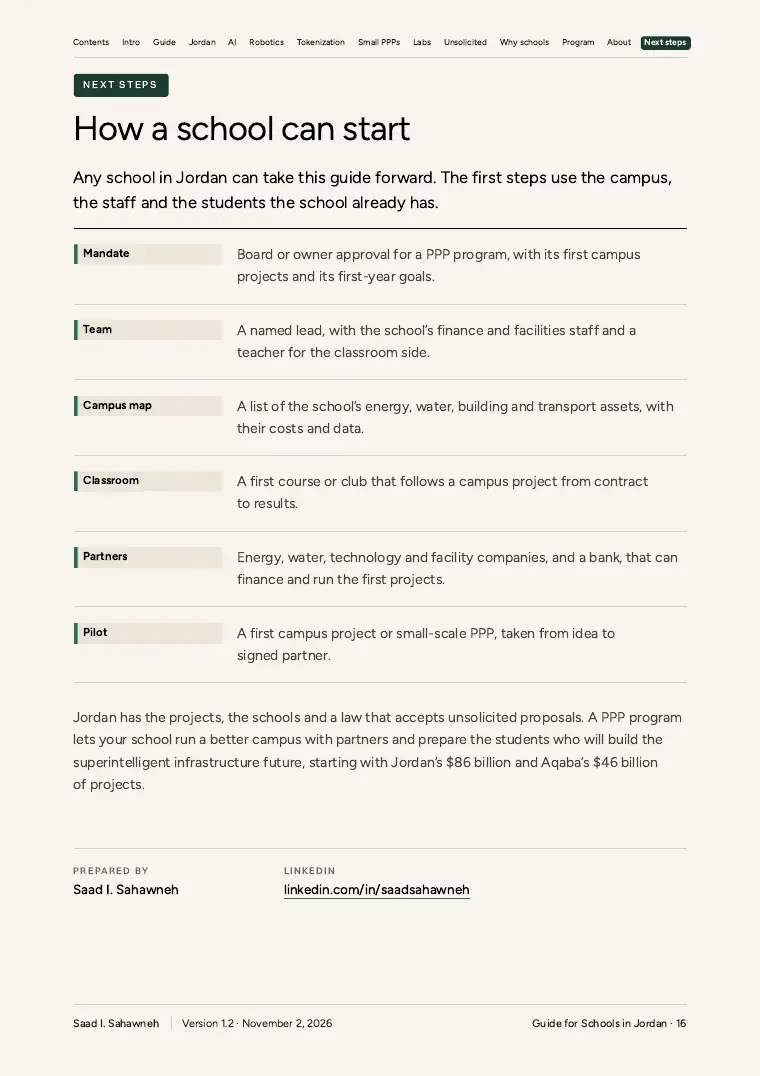
- 01IntroductionWhy a century of infrastructure needs rebuilding, and the $500 trillion it will take.p. 3
- 02The guideRun, teach and build the infrastructure of learningp. 5
- 03Jordan and AqabaAn $86 billion pipeline to start withp. 6
- 04Artificial intelligenceHow AI designs, structures and runs PPP projects, and what it means for schools.p. 7
- 05RoboticsHow robots build infrastructure and keep it running, and what that means for schools.p. 8
- 06TokenizationHow tokenization funds projects from their own revenue, and the role it opens for schools.p. 9
- 07Small PPPs in parallelWhy many small PPPs teach a country faster than a few large ones.p. 10
- 08PPP research labsA lab in each sector, running ten small PPP projects a year.p. 11
- 09Unsolicited proposalsHow Jordan’s PPP law accepts direct proposals from private companies.p. 12
- 10Why schoolsSchools run real infrastructure and raise the people who will run the restp. 13
- 11The programThe program can run from the school’s management with a small team, a list of campus projects and partners from industry and government.p. 14
- 12AboutAbout Jordan PPP and what it offers.p. 15
- 13Next stepsHow a school can start: six first steps.p. 16
Questions
Questions about the guide for Schools in Jordan
- What does the guide for Schools in Jordan propose?
- Your school launches a PPP program that runs its campus energy, water and transport with private partners, teaches its students how infrastructure is built with AI, robotics and tokenization, and takes part in new school projects.
- Why should schools in Jordan launch a PPP program?
- Schools run real infrastructure and raise the people who will run the rest. A school campus is a working set of assets that serves a community every day, and a school is trusted by the families around it. Those two things make schools natural partners for small PPPs and natural places to prepare the next generation of infrastructure professionals.
- Which PPP projects can schools in Jordan take part in?
- Jordan has about $86 billion of PPP and infrastructure projects in development, $46 billion of them anchored in Aqaba. Every one of them will need trained people, and many of them will serve the families whose children attend school. A Jordanian school group that runs one campus project well with a partner can repeat it across its campuses and offer it to others.
- How can schools in Jordan start a PPP program?
- Any school in Jordan can take this guide forward. The first steps use the campus, the staff and the students the school already has. The guide sets out six first steps: mandate, team, campus map, classroom, partners and pilot.
- What does a PPP program give schools in Jordan?
- The school gains lower running costs paid for by partners, a campus that teaches, and a reputation with families as a place that prepares students for the work ahead. Each project it completes adds data, lessons and partners that make the next one easier.
- Is the guide for Schools in Jordan free?
- Yes. It is free to read on this page and free to download as a 17-page PDF, with the case for a PPP program, Jordan’s pipeline, the role of AI, robotics and tokenization, the program and six first steps.
Guide 33 of 52
Browse all 52 guides