
Singularity · Futureproof your organization
Futureproof your organization for the infrastructure singularity
The infrastructure singularity will change how every organization plans, builds, runs and finances what it owns. Organizations that start learning by building now, with small PPPs of their own, will be ready to lead it.
01Plan and design
- Today
- A single $100 million PPP can spend $10 million on studies and preparation before anything is built.
- At the singularity
- Artificial intelligence designs, structures and tests each project, and building the pilot costs less than studying it.
- Start now
- Run small PPPs in parallel and learn by building.
02Build
- Today
- Construction still depends on large crews working by hand on every site.
- At the singularity
- Fleets of robots raise new assets with very few human hands.
- Start now
- Pilot robotics on your own sites through a research lab in your sector.
03Operate and maintain
- Today
- Most repairs follow a breakdown or a fixed inspection calendar.
- At the singularity
- Roads, grids, ports and water networks monitor their own condition, predict their own failures and schedule their own repairs.
- Start now
- Collect data from every asset and every pilot from its first day.
04Finance and own
- Today
- The World Bank counted 315 private infrastructure projects reaching financial close across all low- and middle-income countries in 2024, only a few per country.
- At the singularity
- Tokenization funds small pilots from the asset’s own revenue and opens infrastructure ownership to everyone.
- Start now
- Test tokenized funding on a small pilot that earns its own revenue.
In every guide
Two sections of every guide
Page 3
Introduction
Why a century of infrastructure needs rebuilding, and the $500 trillion it will take.
Page 16
Next steps
Six first steps to launch.
Each of the 52 guides writes this section for its own kind of organization; 52 of them are gathered below.
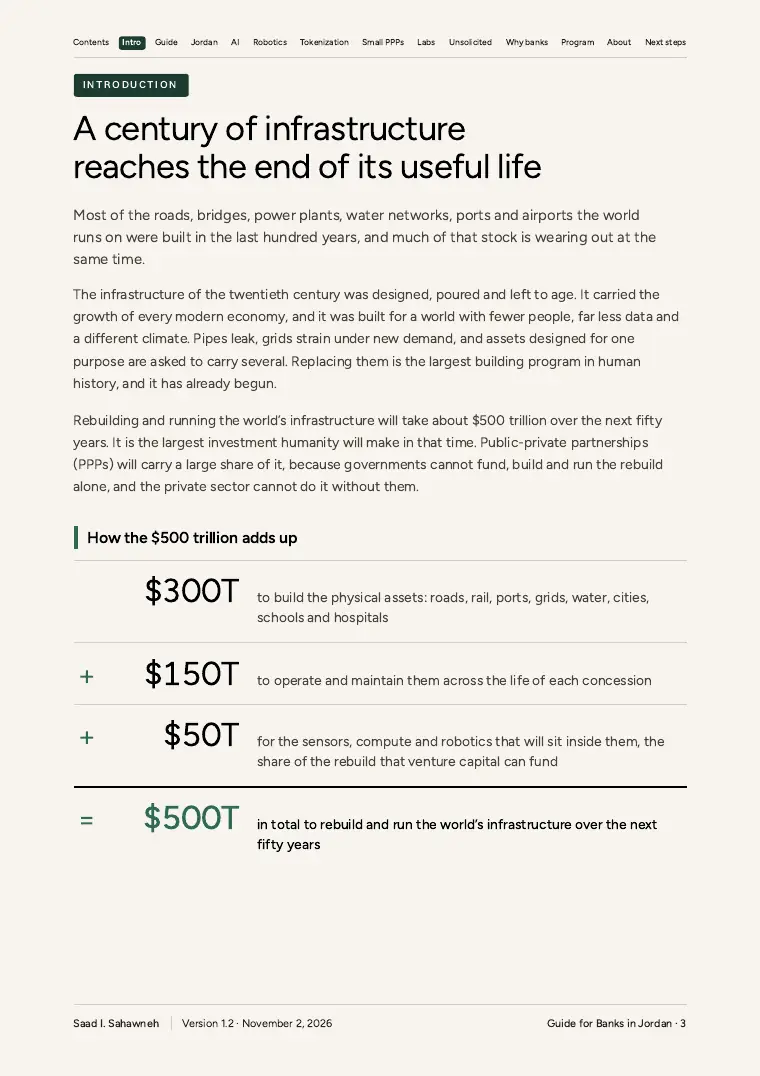
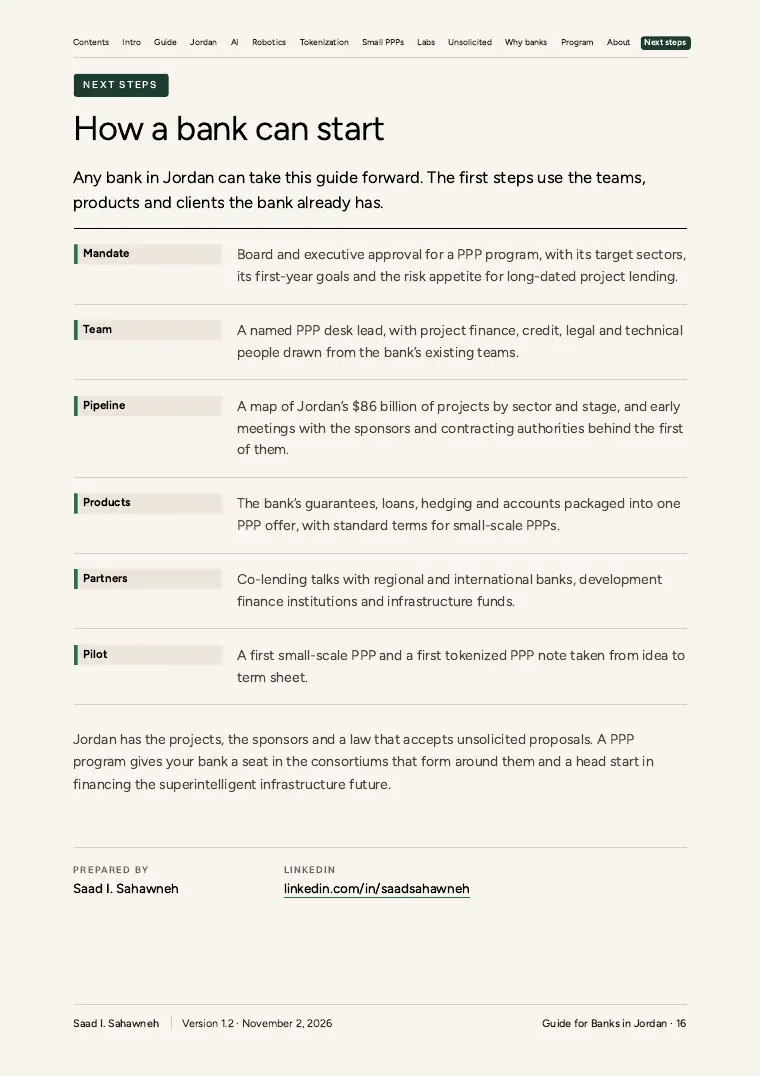
Pages 3 and 16 of the guide for banks
In the guides’ own words
“Every PPP begins with a public need and a ministry or authority that decides to meet it with a partner.”
“Debt carries most of the capital in a typical PPP, and the projects of the next fifty years will be financed, monitored and traded in new ways.”
“Every road, port, water network and data center of the next fifty years will draw on the grid, and much of that power will come from independent producers under long-term contracts.”
From the 52 guides
What the next fifty years mean for each kind of organization
Point at an organization to read what its guide says.Tap an organization to read what its guide says.
Every country will rebuild its infrastructure over the coming decades, and the countries that learn fastest will build at the lowest cost and attract the most capital. Jordan has a pipeline of projects, a PPP law that accepts direct proposals and a generation of young engineers and founders who can build the tools these projects need. This guide respectfully invites the Royal Hashemite Court to champion a national initiative that brings these together, starting with the projects at home.
Read the guideA single PPP passes through many parts of government: the sector ministry that needs the service, the institutions that review, fund and approve it, and the authorities that permit and supervise it for decades. A program run from the center lets all of them move at the same pace and learn from one another. This guide invites the Prime Ministry to launch a government-wide PPP acceleration program, starting with the projects at home.
Read the guide
Every PPP begins with a public need and a ministry or authority that decides to meet it with a partner. Contracting authorities choose which projects go to market, how they are prepared and what the contracts reward, so the way they work sets the pace for everyone else. This guide invites ministries and public authorities in Jordan to launch a PPP program of their own, starting with the projects at home.
Read the guideMost of what residents notice about infrastructure is local: a street light that works, a clean market, a bus station that runs on time and a parking space they can find. Municipalities run those services on tight budgets, and small PPPs let them improve each one with a private partner who invests, builds and operates. This guide invites municipalities in Jordan to launch a PPP program, starting with the projects at home.
Read the guideMuch of the water that reaches Jordan’s taps, the power that crosses its grid and the freight that moves by rail passes through networks run by state-owned companies. These companies hold the assets, the customers and the operating data, and PPP Law No. 19 of 2023 counts them as public authorities that can sign PPP contracts and receive direct proposals. This guide invites state-owned utilities and companies in Jordan to launch a PPP program of their own, starting with the projects at home.
Read the guideInfrastructure is financed over decades, and most of that finance passes at some point through banks, bond and sukuk markets, exchanges and depositories. The rules those markets follow decide how much of a country’s own savings can reach its projects, and how safely. This guide invites financial regulators and market institutions in Jordan to prepare the markets for PPP finance, starting with the projects at home.
Read the guide
03Capital
Debt carries most of the capital in a typical PPP, and the projects of the next fifty years will be financed, monitored and traded in new ways. Lenders that build a PPP program now will finance the rebuild from its first projects onward. This guide invites every bank in Jordan to launch that program, starting with the projects at home.
Read the guideIn emerging markets, development finance often decides whether a PPP reaches the market at all, because it pays for preparation, carries the risks commercial lenders avoid and brings private capital in behind it. Institutions that open a dedicated window now will shape how the rebuild is prepared and financed in the countries that need it most. This guide invites development finance institutions in Jordan to launch that window, starting with the projects at home.
Read the guideEquity takes the development risk in a PPP and earns its return across the concession, and the assets of the next fifty years will be built, run and valued in new ways. Funds that build a PPP program now will own the rebuild from its first projects. This guide invites infrastructure funds and asset managers in Jordan to launch that program, starting with the projects at home.
Read the guideConcessions run for decades and pay contracted, often inflation-linked revenue that matches the liabilities of a pension fund and the horizon of a sovereign fund. The assets of the next fifty years will be built, run and owned in new ways. This guide invites sovereign wealth and pension funds in Jordan to launch a PPP allocation, starting with the projects at home.
Read the guideEvery PPP carries risks that sponsors and lenders insure before they commit, and the assets of the next fifty years will report on those risks in real time. Insurers that build a PPP program now will cover the rebuild and invest in it from the start. This guide invites insurance and takaful companies in Jordan to launch that program, starting with the projects at home.
Read the guideInfrastructure is one of the longest-lived things a family can own, and the assets of the next fifty years will be built, run and financed in new ways. Families that build a PPP program now can own a share of the rebuild and pass it to the next generation. This guide invites family offices in Jordan to launch that program, starting with the projects at home.
Read the guideVenture capital is about to become one of infrastructure’s most important investors. The $50 trillion of intelligence inside the rebuild will be built by companies that look like every company a venture firm already backs, with small teams, new technology and fast iteration. This guide invites venture capital firms in Jordan to back the founders building that future, starting with the projects at home.
Read the guideVenture capital is about to become one of infrastructure’s most important investors, because the $50 trillion of intelligence inside the rebuild will be built by companies that look like every company venture capital already backs: small teams, new technology and fast iteration. This guide invites Jordan’s startup accelerators to fund Jordan’s founders toward that future, starting with the projects at home.
Read the guide
A PPP takes about seven years and roughly 10% of its capital cost to reach financial close, and the developer carries that cost and its risk long before any revenue arrives. Developers that build a new kind of program now, with AI preparing the projects, small PPPs running in parallel and ownership opened through tokens, will lead the consortiums of the next fifty years. This guide invites PPP developers in Jordan to launch that program, starting with the projects at home.
Read the guideFactories, warehouses and data centers choose where to locate by the cost and reliability of power, water, land and logistics, and zones compete on exactly those services. Zone and industrial city developers that deliver them through PPPs can expand faster, share the investment with private partners and offer tenants better infrastructure at known prices. This guide invites economic zone and industrial city developers in Jordan to launch a PPP program of their own, starting with the projects at home.
Read the guideConstruction absorbs most of the capital spent on a typical PPP, and the builder usually hands the asset over at completion while the sponsors keep the decades of revenue that follow. Contractors that build a development arm now will share in that revenue on the projects of the next fifty years. This guide invites contractors in Jordan to build one, starting with the projects at home.
Read the guideGovernments hold much of the land cities need to grow, and they need partners to turn it into homes, schools, clinics and districts that help pay for their own services. Developers that build a PPP program now will shape the cities of the next fifty years. This guide invites real estate developers in Jordan to launch that program, starting with the projects at home.
Read the guideEvery PPP rests on engineering judgment from the first feasibility study to the final handback, and governments, lenders and sponsors each appoint engineers to protect their side of the deal. Firms that build a PPP practice now will advise on the projects of the next fifty years. This guide invites engineering and consulting firms in Jordan to launch that practice, starting with the projects at home.
Read the guide
05Advisors and professional bodies
A PPP is held together by contracts that run for decades, and every party appoints counsel: the government, the sponsors, the lenders, the contractors and the operator. The projects of the next fifty years will add data, machines and digital assets to those contracts. This guide invites law firms in Jordan to launch a PPP practice, starting with the projects at home.
Read the guideEvery PPP rests on a financial model that sets the tariff, the payment, the debt and the return, and governments, bidders and lenders each appoint financial advisors to build or test it. The projects of the next fifty years will be modeled with AI and financed through bonds, sukuk and tokenized notes as well as bank loans. This guide invites financial advisory firms in Jordan to launch a PPP finance practice, starting with the projects at home.
Read the guideMany of the firms that will design, build, supply and maintain Jordan’s next generation of infrastructure belong to a professional body or a chamber, and most of them are small. A large PPP tender asks for a decade of comparable projects that few small firms can show on their own. A member body can train its members, give them standard tools and bring them together into consortiums that qualify. This guide invites professional bodies and chambers in Jordan to launch a PPP program for their members, starting with the projects at home.
Read the guide
Operation and maintenance accounts for about $150 trillion of the rebuild and runs for the whole life of each concession, long after the builders have left. Operators that build a PPP program now will run the assets of the next fifty years. This guide invites utilities and infrastructure operators in Jordan to launch that program, starting with the projects at home.
Read the guideOperation and maintenance accounts for about $150 trillion of the rebuild and runs for the whole life of each concession. In a hospital, a school, a university, a station or a public office, that work is facility management: keeping the building open, clean, safe and working every day the government pays for it. Companies that build a PPP program now will run the public buildings of the next fifty years. This guide invites facility management companies in Jordan to launch that program, starting with the projects at home.
Read the guideNetworks were long treated as a utility that infrastructure plugged into after it was built. The projects of the next fifty years will be designed as connected systems from the first drawing, and the operators that carry their data will hold contracts that run as long as the concessions. This guide invites telecom operators in Jordan to launch a PPP program, starting with the projects at home.
Read the guideEvery project in the rebuild depends on cargo that crosses a port, a border and a road before it reaches the site. The projects of the next fifty years will run on automated terminals, connected corridors and tracked freight, and the companies that operate them will hold concessions that last for decades. This guide invites logistics and port companies in Jordan to launch a PPP program, starting with the projects at home.
Read the guideGovernments build and run most public hospitals and clinics themselves, while demand for care keeps growing with the population. The hospitals of the next fifty years will be built, equipped and run with private partners paid for the service they deliver, and the groups that run them will hold contracts as long as the concessions. This guide invites hospital groups in Jordan to launch a PPP program, starting with the projects at home.
Read the guide
Infrastructure has long been bought as concrete and steel, with technology added late. The projects of the next fifty years will specify their software layer from the start, and the companies that supply it will hold contracts that run as long as the concessions. This guide invites technology companies in Jordan to launch a PPP program, starting with the projects at home.
Read the guideInfrastructure has long been prepared by hand, one study and one spreadsheet at a time, and run on maintenance schedules written decades ago. The projects of the next fifty years will be prepared, procured and operated with AI from the first market sounding to the last year of the concession, and the companies that build those models will hold contracts as long as the assets they run. This guide invites AI companies in Jordan to launch a PPP program, starting with the projects at home.
Read the guideInfrastructure has always been built and repaired by large crews, slowly and at high risk to the people doing the work. The projects of the next fifty years will be raised by machines and maintained by fleets of robots under long-term contracts, and the companies that make and run those machines will work on every asset for as long as it operates. This guide invites robotics companies in Jordan to launch a PPP program, starting with the projects at home.
Read the guideInfrastructure has always been financed by a few banks and funds, and its ownership has stayed closed to almost everyone else. The projects of the next fifty years will be financed, recorded and owned on shared ledgers, and the companies that build those rails will run them for as long as the assets last. This guide invites blockchain companies in Jordan to launch a PPP program, starting with the projects at home.
Read the guideEvery PPP needs engineers, lawyers and financiers who understand how a project is prepared, financed and operated, and few degree programs teach all of it together. The people who design the projects of the next fifty years are students today. This guide invites universities in Jordan to launch a PPP program that prepares them, starting with the projects at home.
Read the guideThe engineers, operators and investors of the next fifty years are in school today, and the buildings they learn in are themselves infrastructure: roofs that can carry solar panels, water systems, buses and networks that run every day of the school year. This guide invites schools in Jordan to launch a PPP program that improves their own campus with private partners and prepares their students for the projects at home.
Read the guide
Every road, port, water network and data center of the next fifty years will draw on the grid, and much of that power will come from independent producers under long-term contracts. Energy developers that build a PPP program now will supply the power for the rebuild and own the assets that produce it. This guide invites energy developers in Jordan to launch that program, starting with the projects at home.
Read the guidePower plants, factories, ports, transport fleets and homes all need fuel delivered safely and on time, and the shift toward lower-carbon fuels will need new networks, terminals and storage. The fuel systems of the next fifty years will be built and run with private partners under long-term contracts, and the companies that hold them will move the region’s energy for decades. This guide invites oil and gas companies in Jordan to launch a PPP program, starting with the projects at home.
Read the guideEvery city, farm, factory and data center of the next fifty years will need water, and in a dry region much of it will come from desalination, reuse and networks that lose far less than they do today. Water companies that build a PPP program now will produce, treat and deliver that water under long-term contracts. This guide invites water companies in Jordan to launch that program, starting with the projects at home.
Read the guideRoads, rail, airports and transit lines are among the largest public assets in any country, and governments build and run more of them with private partners under long-term contracts. The transit lines, toll roads and stations of the next fifty years will run on data, electric fleets and automated systems, and the companies that operate them will hold concessions that last for decades. This guide invites transport companies in Jordan to launch a PPP program, starting with the projects at home.
Read the guideEvery city the rebuild serves will need food, and in a dry region that food depends on water, energy, storage and transport working as one system. Agriculture companies that build a PPP program now will grow, store and process the food of the next fifty years on public land and public infrastructure under long-term contracts. This guide invites agriculture and food companies in Jordan to launch that program, starting with the projects at home.
Read the guideEvery road, grid, battery, solar panel and data center of the next fifty years is built from minerals, and the mines that supply them depend on the rail, ports, water and power around them. Mining companies that build a PPP program now will share in that infrastructure and secure the routes their own output travels on. This guide invites mining companies in Jordan to launch that program, starting with the projects at home.
Read the guideMost infrastructure is still built piece by piece on site, and more of it will now be made in factories and assembled where it stands. The projects of the next fifty years will need precast structures, modules, pipes, cables and panels in large volumes, and the manufacturers that supply them under long-term contracts will grow with the rebuild. This guide invites manufacturing companies in Jordan to launch a PPP program, starting with the projects at home.
Read the guidePublic health systems buy, store and distribute medicines, equipment and tests every day, and much of that supply is still bought one short contract at a time. The health systems of the next fifty years will be supplied, equipped and tested by private partners under long-term contracts, and the companies that hold them will become part of the public infrastructure. This guide invites pharmaceutical and life sciences companies in Jordan to launch a PPP program, starting with the projects at home.
Read the guideGovernments own many of the sites, coastlines and protected areas that draw visitors, and they need partners to build and run the hotels, visitor centers and services around them. The destinations of the next fifty years will be developed and operated as partnerships, and the companies that run them will hold contracts as long as the concessions. This guide invites tourism and hospitality companies in Jordan to launch a PPP program, starting with the projects at home.
Read the guideSchools, training centers and learning platforms are part of the infrastructure every country rebuilds, and governments in many countries build, equip and run them with private partners under long-term contracts. Every project of the next fifty years will also need technicians, operators and engineers trained for machines and software that are only now arriving. This guide invites education companies in Jordan to launch a PPP program, starting with the projects at home.
Read the guideThe rebuild will demolish and replace much of what stands today, and every ton of concrete, steel and asphalt it removes is material that can be used again. The projects of the next fifty years will reuse their materials and recover energy from the rest under long-term contracts. Circular economy companies that build a PPP program now will run those systems for decades. This guide invites circular economy companies in Jordan to launch that program, starting with the projects at home.
Read the guideThe assets of the twentieth century were built for cheap fuel and a stable climate, and the ones that replace them will be measured on energy, water and emissions across their whole life. Green economy companies that build a PPP program now will design those savings into the rebuild and share in the value they create. This guide invites green economy companies in Jordan to launch that program, starting with the projects at home.
Read the guideEvery large project has to win public support, explain itself to investors and give people a reason to visit, and governments own many of the museums, heritage sites and cultural venues that could host new experiences. The projects of the next fifty years will be designed in digital twins and presented in film, games and immersive media long before they are built. This guide invites creative industries companies in Jordan to launch a PPP program, starting with the projects at home.
Read the guideGovernments own many of the stadiums, sports facilities, parks and plots of land where people play and gather, and they need partners to build, renew and run them. The venues of the next fifty years will be developed and operated as partnerships paid for by events, media and tourism, and the companies that run them will hold contracts as long as the concessions. This guide invites sports and entertainment companies in Jordan to launch a PPP program, starting with the projects at home.
Read the guide
Jordan hosts one of the largest refugee populations in the world relative to its size, and UN agencies and international NGOs run much of the water, energy, education and health infrastructure that refugees and host communities use. Grants pay for most of it, year by year. Small PPPs let an agency bring in a private partner that invests, builds and operates a service for years, paid for the results it delivers. This guide invites UN agencies and international NGOs in Jordan to launch a PPP program, starting with the services they run today.
Read the guideBilateral aid agencies, multilateral humanitarian funds and private foundations have funded much of Jordan’s response to the refugee crises of the past decades. Most of that money is spent year by year. Used as preparation funding, results payments and first-loss capital, the same money can bring private investors into infrastructure that serves people for decades. This guide invites donors and foundations active in Jordan to launch a PPP program, starting with the projects at home.
Read the guideJordanian NGOs and charities know their communities better than anyone, and Jordanians give generously through them every year. Most of that giving covers urgent needs one at a time. Placed behind small PPPs, part of it can build assets that serve a neighborhood for decades, with a private partner that invests, builds and operates. This guide invites Jordanian NGOs and charities to launch a PPP program, starting with the communities they serve.
Read the guideMany Jordanian towns, especially in the north, have taken in large refugee populations, and their water, waste, roads and schools now serve far more people than they were built for. Emergency services must protect them all through heat, floods and fires. Small PPPs let a municipality or service add capacity with a private partner that invests, builds and operates, and resilience can be written into every contract. This guide invites host municipalities and emergency services to launch a PPP program, starting with the projects at home.
Read the guideSocial enterprises and impact companies in Jordan already deliver clean water, solar power, recycling, learning and care to communities that larger companies overlook. Most of them sell project by project, grant by grant. Small PPPs give them long-term contracts with public partners, paid for the results they deliver, and a route to bring their own ideas to government. This guide invites social enterprises and impact companies in Jordan to launch a PPP program, starting with the communities they serve.
Read the guide
01 · National leadership
Royal Hashemite Court
Futureproof your organization
Every country will rebuild its infrastructure over the coming decades, and the countries that learn fastest will build at the lowest cost and attract the most capital. Jordan has a pipeline of projects, a PPP law that accepts direct proposals and a generation of young engineers and founders who can build the tools these projects need. This guide respectfully invites the Royal Hashemite Court to champion a national initiative that brings these together, starting with the projects at home.
More on the singularity
 The infrastructure singularityThe $500 trillion rebuild
 Artificial intelligenceDesigns, structures and runs the assets
 RoboticsBuilds the assets and keeps them running
 TokenizationFinances the assets and opens ownership
 Small PPPs and research labsMany small projects, run in parallel
 Unsolicited proposalsTake your own PPP idea to government