· 7 min read
PPP opportunities in Aqaba: where Jordan’s $46 billion of projects are anchored
Where Aqaba’s $46 billion of PPP and infrastructure projects sit, sector by sector, and how a company in Jordan can enter them.
PPP opportunities in Aqaba span port terminals, dry ports, logistics zones and rail freight, fuel and bulk mineral terminals, green hydrogen and ammonia, water, resorts and the utilities of economic zones. About $46 billion of Jordan’s $86 billion of PPP and infrastructure projects in development are anchored in Aqaba, Jordan’s only port and its gateway to the Red Sea. This post maps those opportunities sector by sector, drawing on the 52 free guides on this site, and shows how a company can enter them.
What PPP opportunities does Aqaba offer?
Aqaba offers PPP opportunities in many sectors of Jordan’s pipeline. The guides on this site point to port terminals and logistics, energy and green hydrogen, fuel storage, mining exports, water, tourism, health and the utilities of economic zones, each of which can be delivered as a PPP with a private partner that finances, builds and runs the asset.
- 01Ports and logistics. Concessions to operate and expand port terminals, dry ports, logistics zones and rail freight services, with Aqaba at the center.
- 02Energy. Green hydrogen and ammonia for industry, shipping and export, developed beside the port in Aqaba.
- 03Oil and gas. Fuel and gas storage and import-export terminals paid on availability and throughput, with Aqaba as the first base.
- 04Mining. Rail freight, bulk terminals and storage in Aqaba developed or anchored as PPPs, for the phosphate, potash and other bulk minerals that travel to the port for export.
- 05Water. Desalination, wastewater, reuse and network projects, with the Red Sea at Aqaba.
- 06Tourism and health. Resort, hotel and visitor projects in Aqaba, and private wings, specialist centers and recovery facilities paired with public projects.
Each of these comes from a guide written for one kind of organization. The economic sectors category gathers the guides for energy, water, mining, tourism and ten other sectors, and the operators and services category covers the companies that run ports, utilities and facilities.
Why is Aqaba at the center of Jordan’s PPP pipeline?
Aqaba is at the center of Jordan’s PPP pipeline because it anchors about $46 billion of the country’s $86 billion of PPP and infrastructure projects in development. It is Jordan’s only port and its gateway to the Red Sea, so much of the cargo, fuel and minerals that the rest of the country trades passes through it.
$46B
of Jordan’s $86 billion of PPP and infrastructure projects are anchored in Aqaba, Jordan’s only port
The guides explain the pull of the coast in their own sectors. Aqaba’s port and industrial land make it the natural base for terminals that serve the country. Aqaba combines a port, industrial land and strong sun, the conditions that green hydrogen and ammonia projects need. Phosphate, potash and other bulk minerals already travel to the port in Aqaba for export.
One of Jordan’s most recent PPPs also starts at the coast. A group led by Meridiam and Suez signed the BOT contract for the Aqaba-Amman Water Desalination and Conveyance project on January 12, 2025, and the final agreement for the National Water Carrier was signed on April 21, 2026: about $4.3 billion to build, 300 million m³ of water a year through a 450 km pipeline, with water planned for 2030. The starting guide sets this in the wider story of PPPs in Jordan.
Which port and logistics PPPs can companies bid for in Aqaba?
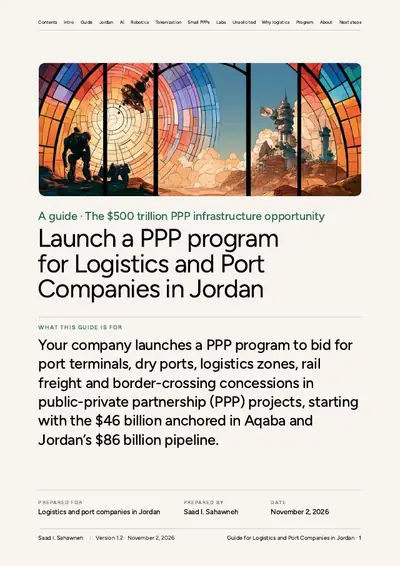
Logistics and port companies in Jordan can bid for concessions to operate and expand port terminals, dry ports, logistics zones and rail freight services, with Aqaba at the center. In these concessions the company invests, operates and collects handling charges, storage fees or availability payments, and holds the asset for decades.
Aqaba holds $46 billion of Jordan’s pipeline, and many of its port, terminal, logistics and rail projects are still in development.
The logistics and port companies guidePDF describes a contract ladder, from logistics services on PPP projects to operation contracts and full concessions with equity in the project company. A company can also join bidding consortiums as their logistics partner, planning the import, clearance, storage and delivery of everything a project is built from. Border crossings, dry ports and rail links tie Aqaba to the rest of Jordan and its neighbors, so corridor concessions sit beside terminal concessions.
Technology shapes how these bids are priced. Models forecast vessel arrivals, plan berths and yards and check customs documents before the cargo lands, while automated cranes, yard vehicles and warehouse robots move containers and pallets around the clock. A logistics company that brings that equipment into a PPP terminal or dry port can price its bid on the capacity it adds.
What energy, water and mining PPPs fit Aqaba?
Aqaba suits energy, water and mining PPPs because it combines a port, industrial land, strong sun and the Red Sea. The guides for Jordan’s economic sectors point to green hydrogen and ammonia beside the port, fuel and gas terminals, desalination, and the rail, bulk terminals and storage that carry minerals to export.
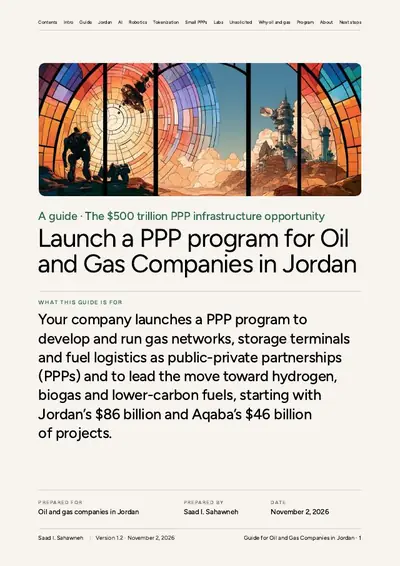
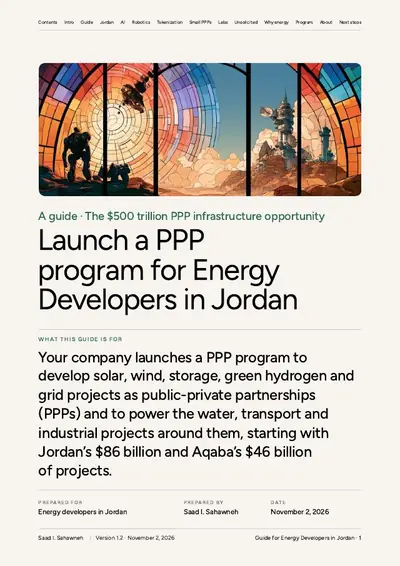
The energy developers guidePDF proposes green hydrogen and ammonia for industry, shipping and export, developed beside the port in Aqaba, alongside solar and wind projects with storage sized into each bid. The oil and gas guidePDF places fuel and gas storage and import-export terminals, paid on availability and throughput, in Aqaba first, with hydrogen, biogas and lower-carbon fuel projects developed in stages from pilots.
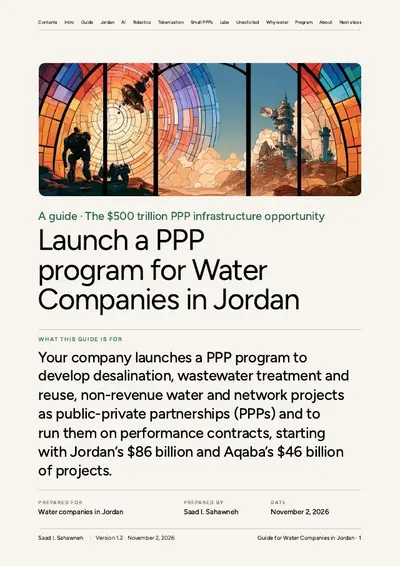
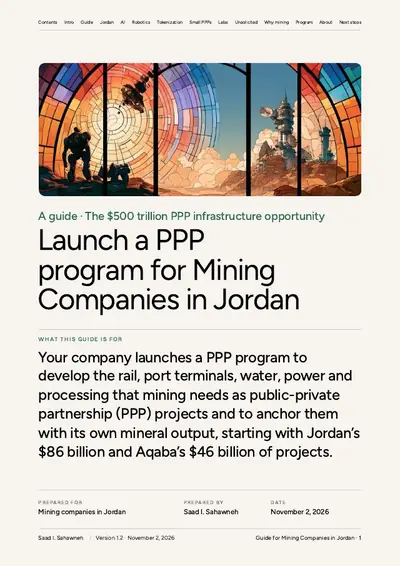
The mining guidePDF describes rail freight, bulk terminals and storage in Aqaba developed or anchored as PPPs, with the company’s volumes committed for the life of each concession, and processing parks with shared utilities beside the mines or in Aqaba. The water companies guidePDF covers desalination, wastewater, reuse and network projects for a country with a need for every liter and the Red Sea at Aqaba.
How can economic zones in Jordan use PPPs?
Economic zones in Jordan can deliver their power, water, wastewater, waste, telecom and logistics as PPPs, with a partner paid for the service it delivers. Many of Jordan’s $86 billion of projects sit in or beside an economic zone or industrial city and will draw on its land, utilities and logistics.
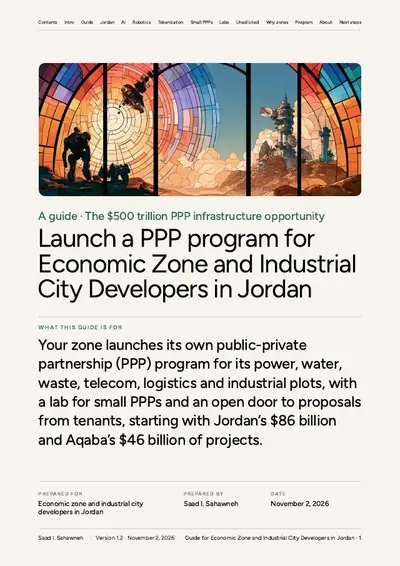
In the model the zone developers guidePDF describes, the zone keeps the master plan, the land and the rules, and private partners finance, build and operate the utilities, logistics and services inside it. Warehouses, cold stores, container yards, rail sidings and ready-built factories can be developed on zone land, leased to tenants and handed back to the zone at the end of each contract.

Zone infrastructure suits tokenization, because utilities and leased plots earn contracted revenue from known tenants. A zone developer can tokenize stakes in its power, water or logistics assets and pay holders from tenant charges as they arrive, so tenants, workers and regional investors can own part of the zone they work in. The $500 trillion opportunity sets out how tokenized PPPs could grow, in five phases.
Can a company propose its own PPP project in Aqaba?
Yes. Article 15 of Jordan’s PPP Law No. 19 of 2023, in effect since November 13, 2023, lets any private company take its own PPP idea to the Ministry of Investment or a public authority, and PPP Regulation No. 9 of 2024 sets out how it is studied. A company that knows a bottleneck in Aqaba can design a project around it.
The guides give examples close to Aqaba’s trade: a bulk storage yard in Aqaba, an automated yard at a dry port, a truck staging area at a border crossing, or a cold store or rail siding inside a zone. The tender still tests the idea against the market, and the proposer keeps the right to match the best offer. The unsolicited proposals page sets out this route for each kind of organization.
$14.1M
the ceiling for small-scale PPPs under PPP Regulation No. 9 of 2024, which can be bundled into one feasibility report and one tender
A pilot at that scale gives a company a paying contract, a reference site and the data that larger concessions will ask for. A logistics company could test an automated gate at a dry port or a digital corridor at a border crossing, and each sector can run a PPP research lab with ten small PPP projects a year at up to $100,000 each. The small PPPs page explains the method.
Where should a company start with PPPs in Aqaba?
A company in Jordan can start with the six first steps every guide shares: a mandate, a team, a map of the pipeline, its own offer, partners and a first pilot. For Aqaba, the pipeline map starts with the $46 billion anchored there and early meetings with the contracting authorities that will tender ports, logistics zones and rail.
Each step uses what the company already has, from its terminals, fleets and land to its operating data and partners. The summary of all 52 guides brings the method together in one document, and the Vision page explains how AI, robotics and tokenization will change the assets these concessions cover over the next fifty years.
Free PDF guides
Download the guides in this post
- Logistics and Port CompaniesPDFDownload
Operators and services
- Energy DevelopersPDFDownload
Economic sectors
- Oil and Gas CompaniesPDFDownload
Economic sectors
- Mining CompaniesPDFDownload
Economic sectors
- Water CompaniesPDFDownload
Economic sectors
- Economic Zone and Industrial City DevelopersPDFDownload
Developers and builders