
What this guide is for
Your company launches a PPP program to collect, pay and finance the revenues of public-private partnership (PPP) projects, from tolls, tariffs and parking fees to availability payments and small investor notes.
The case
Fintech companies connect infrastructure to the people who pay for it
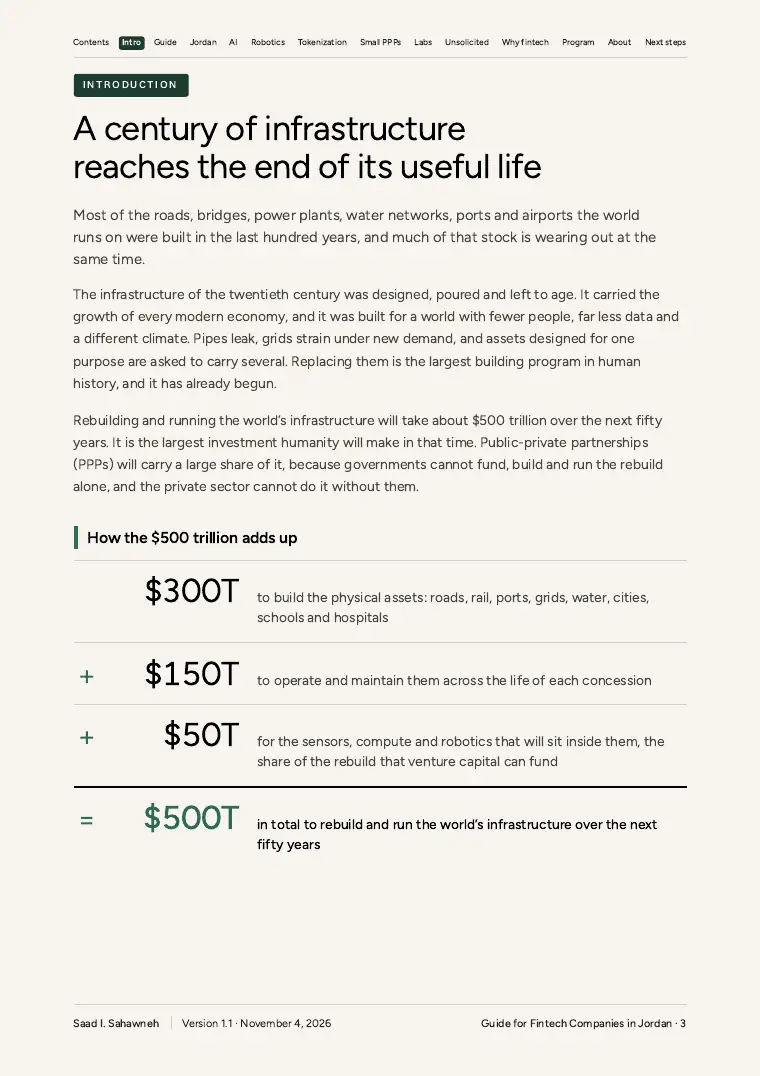
Infrastructure has always collected its revenues through counters, paper bills and slow transfers, and the data behind those payments has stayed locked inside each operator. The projects of the next fifty years will collect, pay and finance themselves in real time, and the companies that run those payment rails will earn from them for as long as the assets last. This guide invites fintech companies in Jordan to launch a PPP program, starting with the projects at home.
The guide
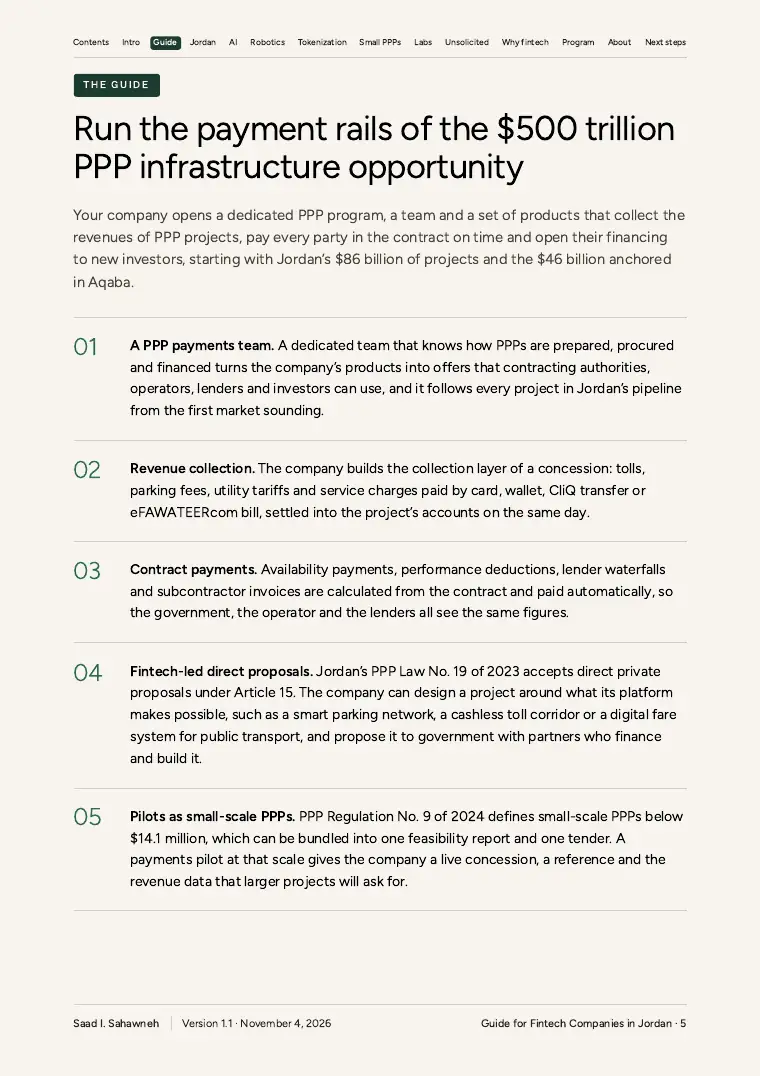
Run the payment rails of the $500 trillion PPP infrastructure opportunity
Your company opens a dedicated PPP program, a team and a set of products that collect the revenues of PPP projects, pay every party in the contract on time and open their financing to new investors, starting with Jordan’s $86 billion of projects and the $46 billion anchored in Aqaba.
01
A PPP payments team
A dedicated team that knows how PPPs are prepared, procured and financed turns the company’s products into offers that contracting authorities, operators, lenders and investors can use, and it follows every project in Jordan’s pipeline from the first market sounding.
02
Revenue collection
The company builds the collection layer of a concession: tolls, parking fees, utility tariffs and service charges paid by card, wallet, CliQ transfer or eFAWATEERcom bill, settled into the project’s accounts on the same day.
03
Contract payments
Availability payments, performance deductions, lender waterfalls and subcontractor invoices are calculated from the contract and paid automatically, so the government, the operator and the lenders all see the same figures.
04
Fintech-led direct proposals
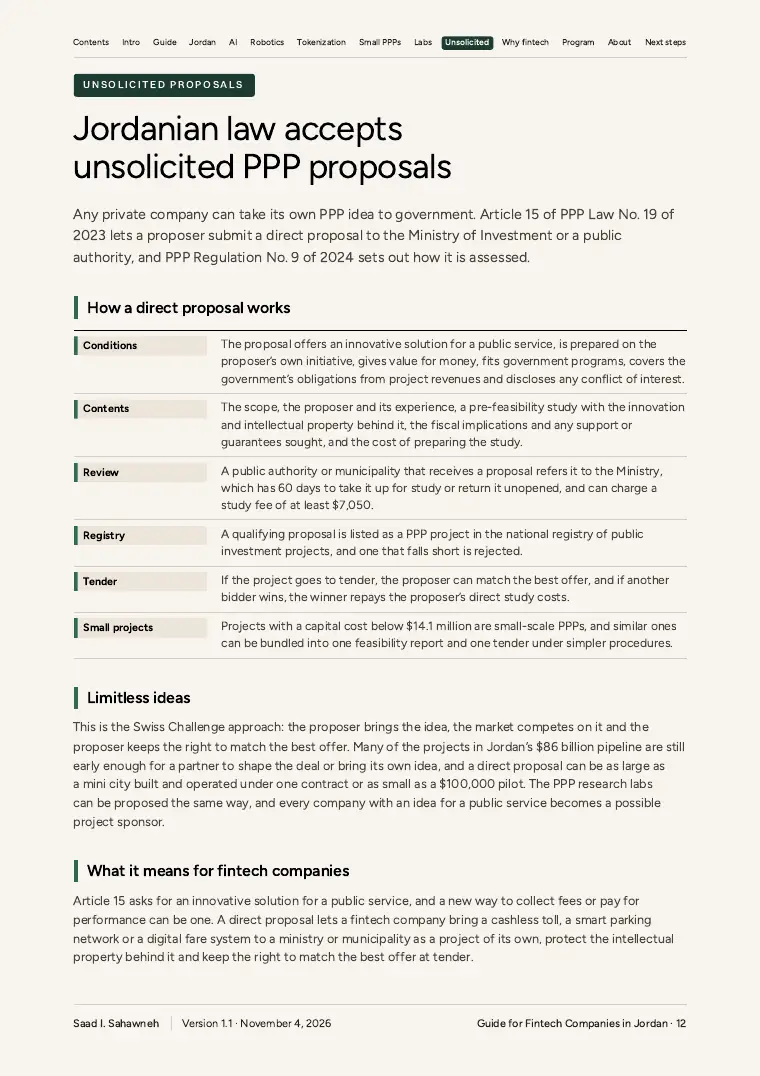
Jordan’s PPP Law No. 19 of 2023 accepts direct private proposals under Article 15. The company can design a project around what its platform makes possible, such as a smart parking network, a cashless toll corridor or a digital fare system for public transport, and propose it to government with partners who finance and build it.
05
Pilots as small-scale PPPs
PPP Regulation No. 9 of 2024 defines small-scale PPPs below $14.1 million, which can be bundled into one feasibility report and one tender. A payments pilot at that scale gives the company a live concession, a reference and the revenue data that larger projects will ask for.
Why fintech companies
Fintech companies connect infrastructure to the people who pay for it
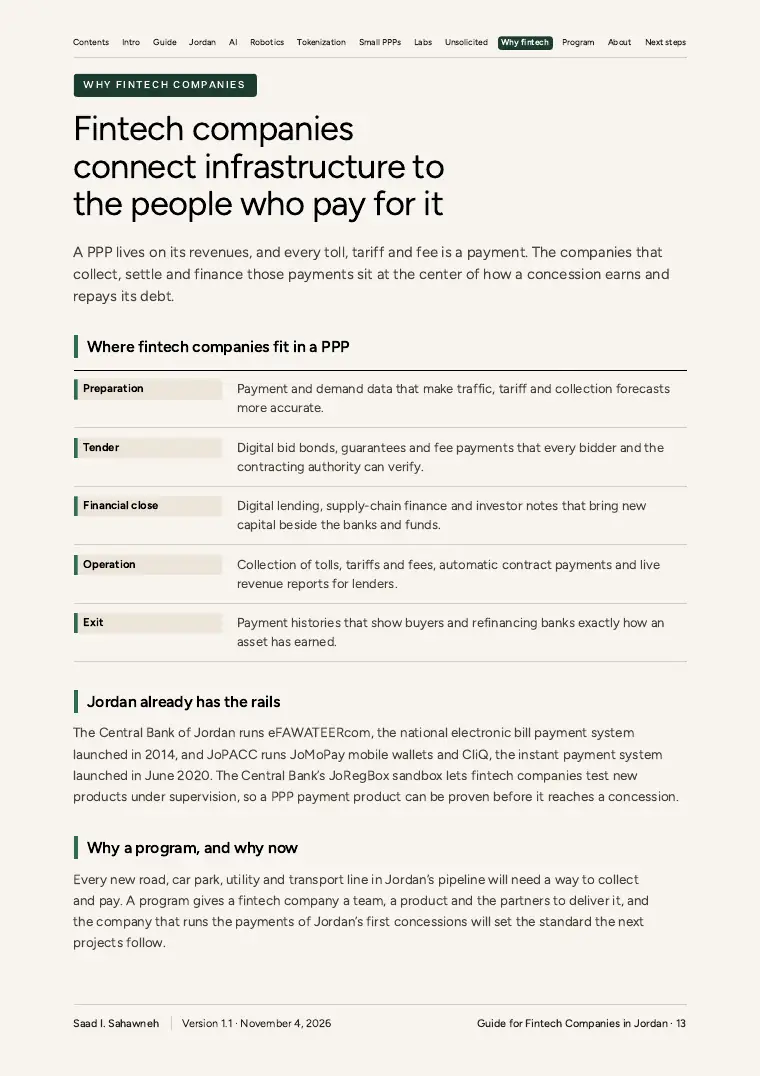
A PPP lives on its revenues, and every toll, tariff and fee is a payment. The companies that collect, settle and finance those payments sit at the center of how a concession earns and repays its debt.
Where fintech companies fit in a PPP
- Preparation
- Payment and demand data that make traffic, tariff and collection forecasts more accurate.
- Tender
- Digital bid bonds, guarantees and fee payments that every bidder and the contracting authority can verify.
- Financial close
- Digital lending, supply-chain finance and investor notes that bring new capital beside the banks and funds.
- Operation
- Collection of tolls, tariffs and fees, automatic contract payments and live revenue reports for lenders.
- Exit
- Payment histories that show buyers and refinancing banks exactly how an asset has earned.
Jordan already has the rails
The Central Bank of Jordan runs eFAWATEERcom, the national electronic bill payment system launched in 2014, and JoPACC runs JoMoPay mobile wallets and CliQ, the instant payment system launched in June 2020. The Central Bank’s JoRegBox sandbox lets fintech companies test new products under supervision, so a PPP payment product can be proven before it reaches a concession.
Why a program, and why now
Every new road, car park, utility and transport line in Jordan’s pipeline will need a way to collect and pay. A program gives a fintech company a team, a product and the partners to deliver it, and the company that runs the payments of Jordan’s first concessions will set the standard the next projects follow.

Futureproofing
Futureproof Fintech Companies in Jordan for the infrastructure singularity
This free 17-page guide shows how, with small PPPs in parallel, PPP research labs, artificial intelligence, robotics, tokenization and six first steps.

Jordan and Aqaba
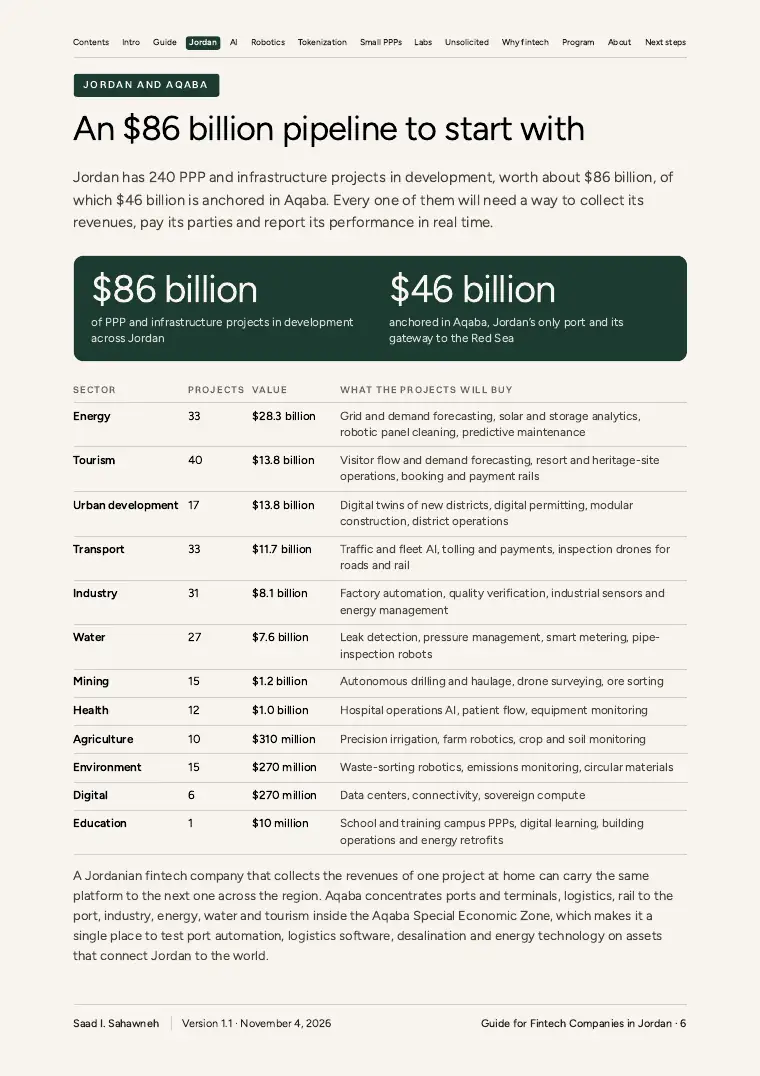
An $86 billion pipeline to start with
Every one of them will need a way to collect its revenues, pay its parties and report its performance in real time. A Jordanian fintech company that collects the revenues of one project at home can carry the same platform to the next one across the region.
- $86B
- of PPP and infrastructure projects in development in Jordan
- $46B
- of them anchored in Aqaba

Artificial intelligence
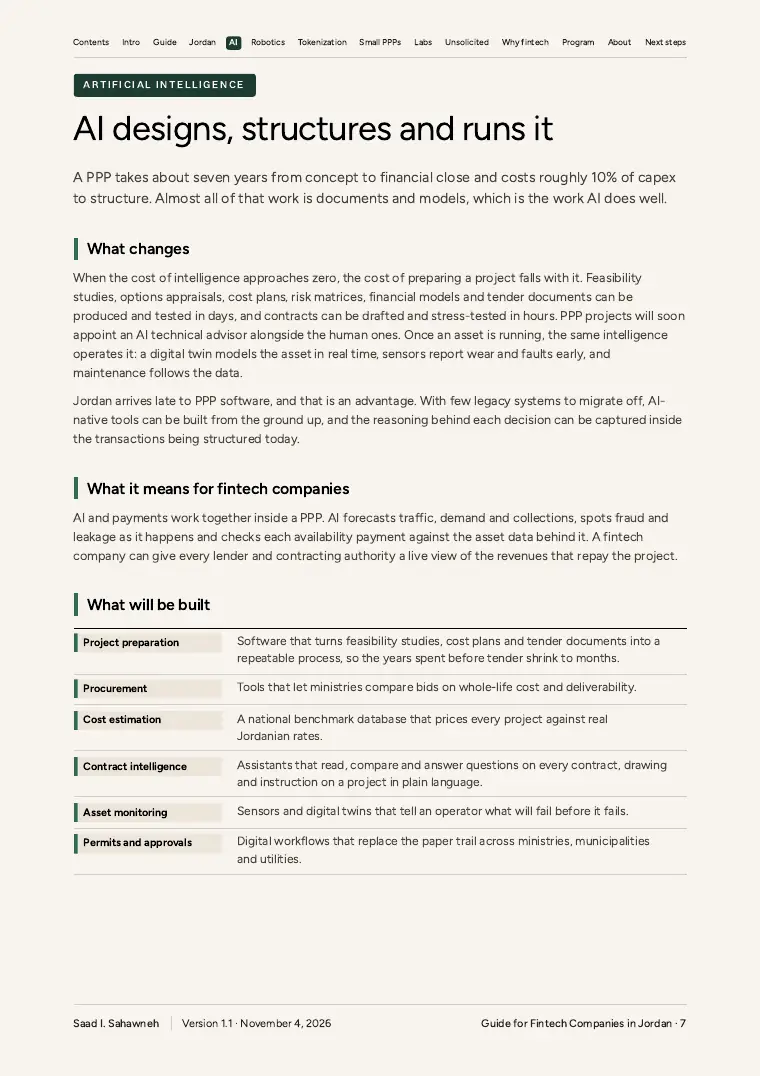
AI and payments work together inside a PPP. AI forecasts traffic, demand and collections, spots fraud and leakage as it happens and checks each availability payment against the asset data behind it. A fintech company can give every lender and contracting authority a live view of the revenues that repay the project.

Robotics
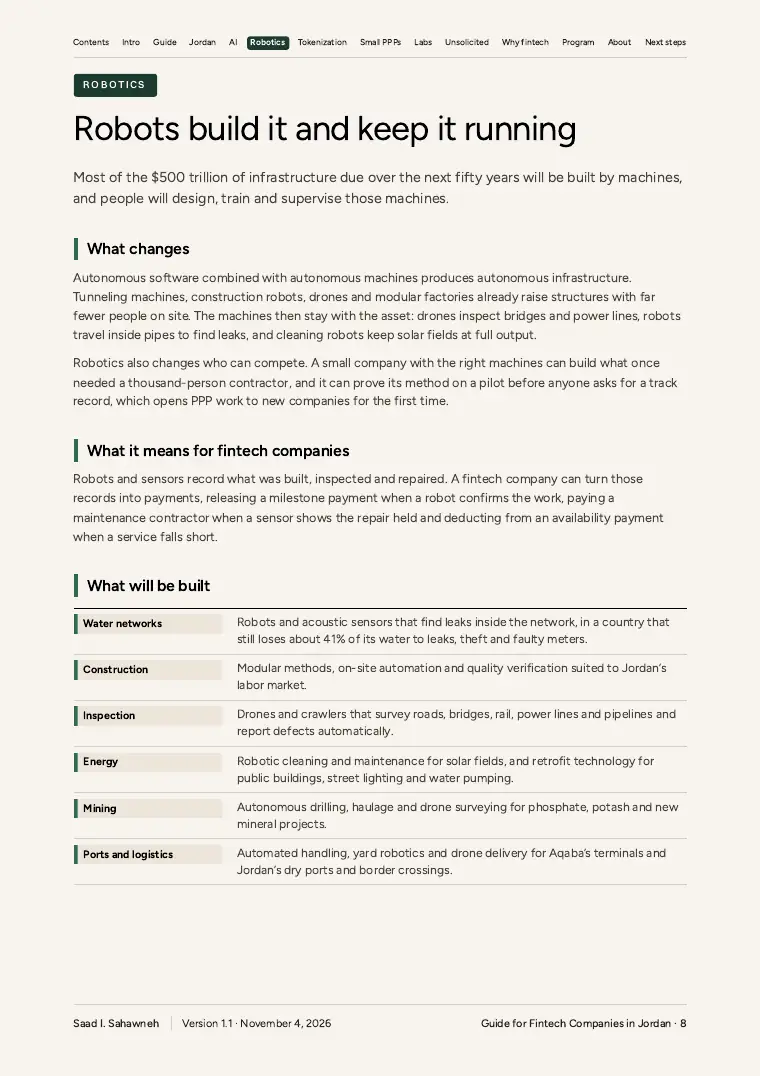
Robots and sensors record what was built, inspected and repaired. A fintech company can turn those records into payments, releasing a milestone payment when a robot confirms the work, paying a maintenance contractor when a sensor shows the repair held and deducting from an availability payment when a service falls short.

Tokenization
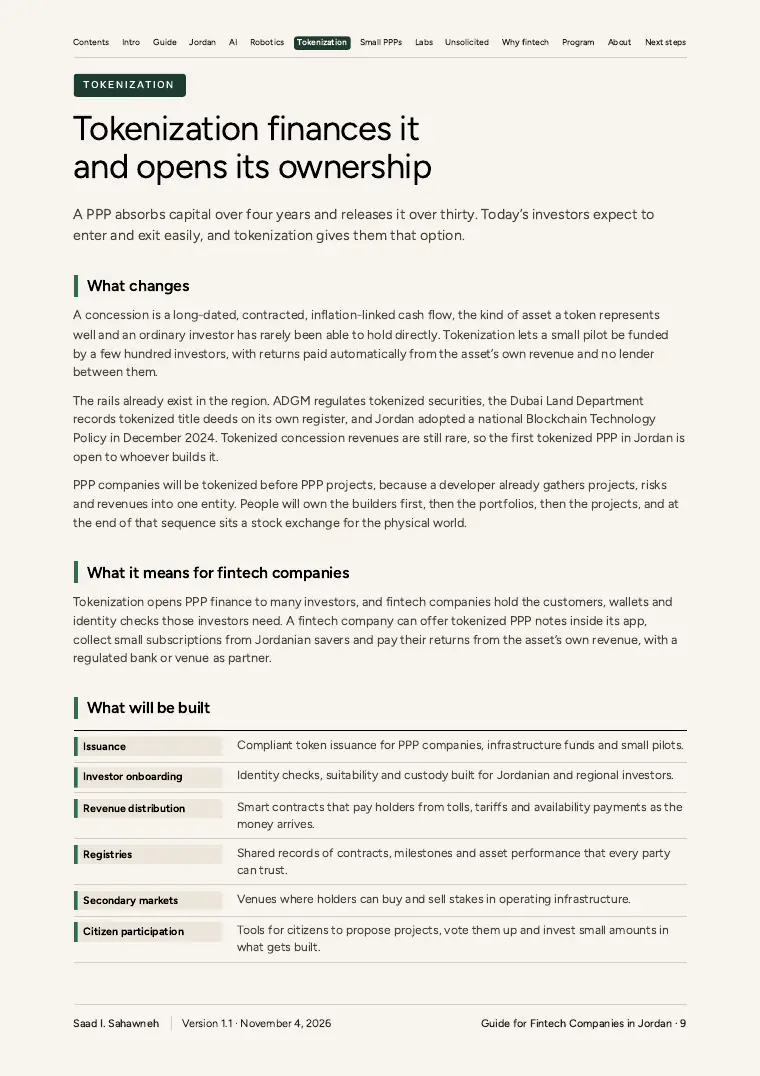
Tokenization opens PPP finance to many investors, and fintech companies hold the customers, wallets and identity checks those investors need. A fintech company can offer tokenized PPP notes inside its app, collect small subscriptions from Jordanian savers and pay their returns from the asset’s own revenue, with a regulated bank or venue as partner.

Small PPPs and research labs
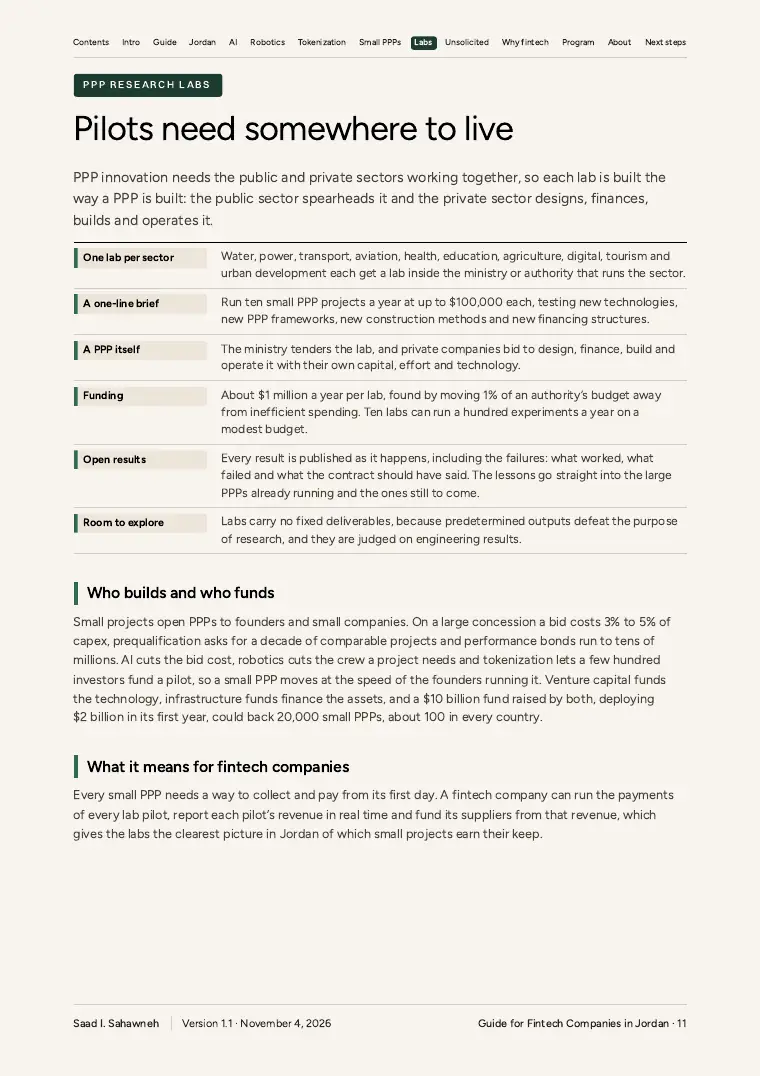
Every small PPP needs a way to collect and pay from its first day. A fintech company can run the payments of every lab pilot, report each pilot’s revenue in real time and fund its suppliers from that revenue, which gives the labs the clearest picture in Jordan of which small projects earn their keep.

Unsolicited proposals
Article 15 asks for an innovative solution for a public service, and a new way to collect fees or pay for performance can be one. A direct proposal lets a fintech company bring a cashless toll, a smart parking network or a digital fare system to a ministry or municipality as a project of its own, protect the intellectual property behind it and keep the right to match the best offer at tender.
The program
How the program could work
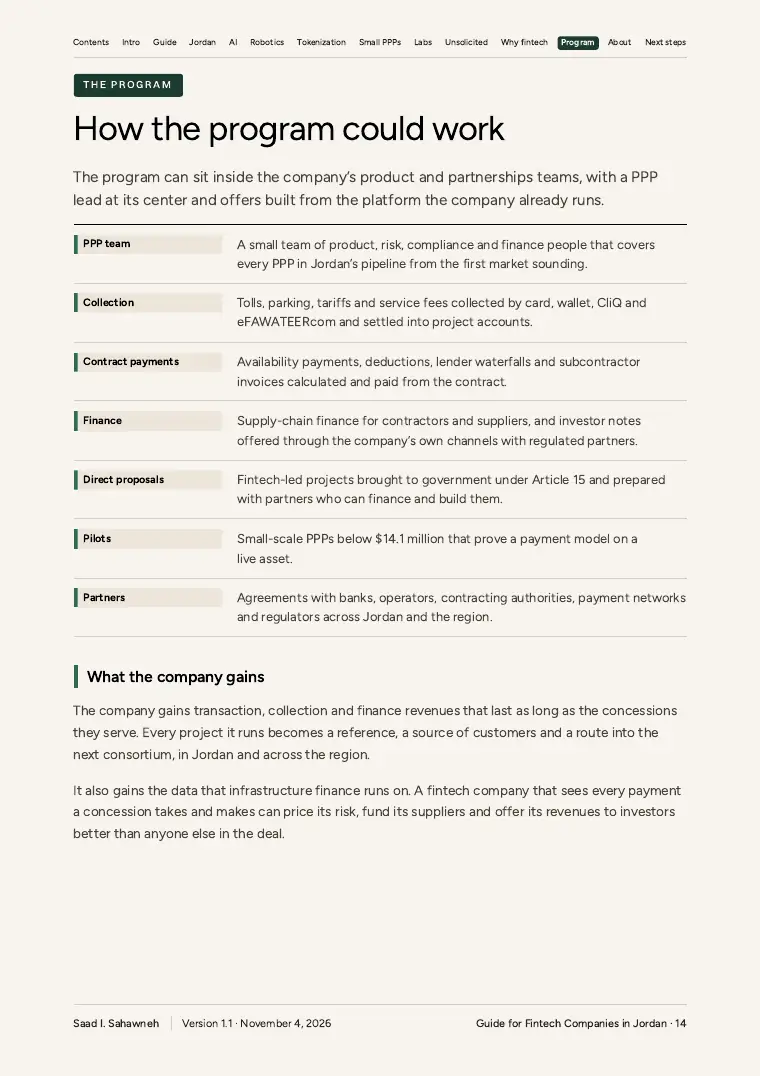
The program can sit inside the company’s product and partnerships teams, with a PPP lead at its center and offers built from the platform the company already runs.
- PPP team
- A small team of product, risk, compliance and finance people that covers every PPP in Jordan’s pipeline from the first market sounding.
- Collection
- Tolls, parking, tariffs and service fees collected by card, wallet, CliQ and eFAWATEERcom and settled into project accounts.
- Contract payments
- Availability payments, deductions, lender waterfalls and subcontractor invoices calculated and paid from the contract.
- Finance
- Supply-chain finance for contractors and suppliers, and investor notes offered through the company’s own channels with regulated partners.
- Direct proposals
- Fintech-led projects brought to government under Article 15 and prepared with partners who can finance and build them.
- Pilots
- Small-scale PPPs below $14.1 million that prove a payment model on a live asset.
- Partners
- Agreements with banks, operators, contracting authorities, payment networks and regulators across Jordan and the region.
What the company gains
The company gains transaction, collection and finance revenues that last as long as the concessions they serve. Every project it runs becomes a reference, a source of customers and a route into the next consortium, in Jordan and across the region.
It also gains the data that infrastructure finance runs on. A fintech company that sees every payment a concession takes and makes can price its risk, fund its suppliers and offer its revenues to investors better than anyone else in the deal.

Next steps
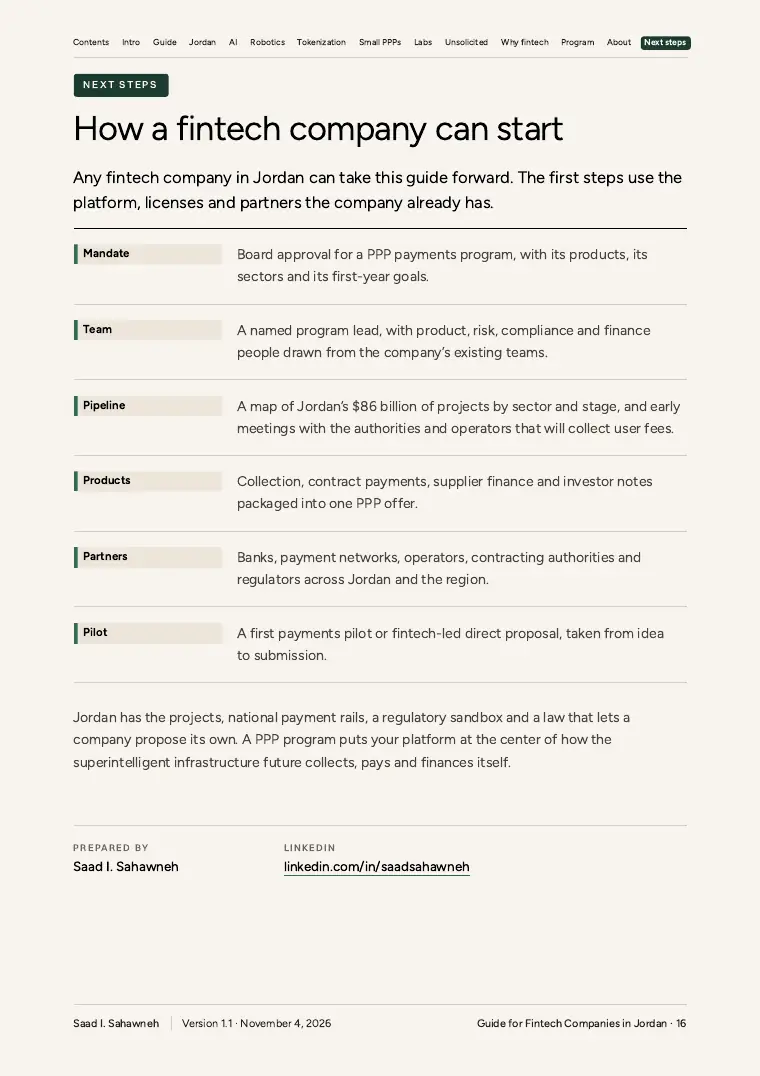
How a fintech company can start
Any fintech company in Jordan can take this guide forward. The first steps use the platform, licenses and partners the company already has.
01
Mandate
Board approval for a PPP payments program, with its products, its sectors and its first-year goals.
02
Team
A named program lead, with product, risk, compliance and finance people drawn from the company’s existing teams.
03
Pipeline
A map of Jordan’s $86 billion of projects by sector and stage, and early meetings with the authorities and operators that will collect user fees.
04
Products
Collection, contract payments, supplier finance and investor notes packaged into one PPP offer.
05
Partners
Banks, payment networks, operators, contracting authorities and regulators across Jordan and the region.
06
Pilot
A first payments pilot or fintech-led direct proposal, taken from idea to submission.
Jordan has the projects, national payment rails, a regulatory sandbox and a law that lets a company propose its own. A PPP program puts your platform at the center of how the superintelligent infrastructure future collects, pays and finances itself.
The full document
Inside this guide
Seventeen pages and thirteen chapters, from the case for a PPP program to the first steps, written for fintech companies in Jordan.
- 17
- pages
- 13
- chapters
- 3
- technologies
- 6
- first steps
01Introduction
Why a century of infrastructure needs rebuilding, and the $500 trillion it will take.
Page 3 of 17
02The guide
Run the payment rails of the $500 trillion PPP infrastructure opportunity
Page 5 of 17
03Jordan and Aqaba
An $86 billion pipeline to start with
Page 6 of 17
04Artificial intelligence
How AI designs, structures and runs PPP projects, and what it means for fintech companies.
Page 7 of 17
05Robotics
How robots build infrastructure and keep it running, and what that means for fintech companies.
Page 8 of 17
06Tokenization
How tokenization funds projects from their own revenue, and the role it opens for fintech companies.
Page 9 of 17
07Small PPPs in parallel
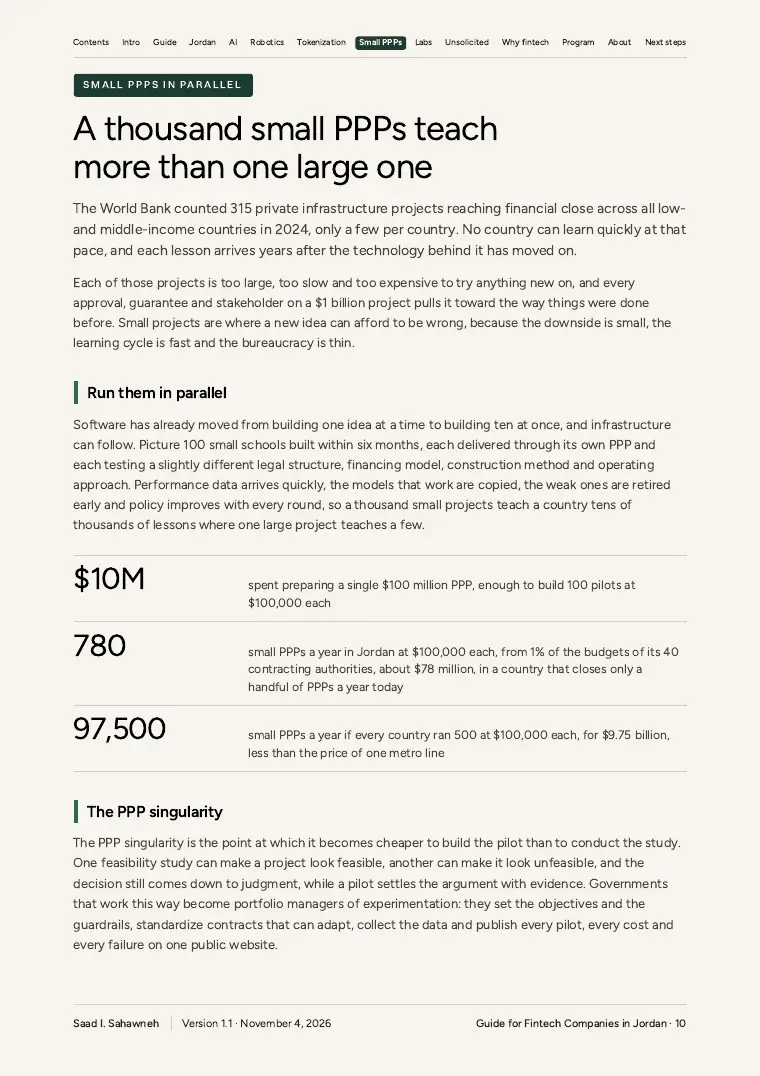
Why many small PPPs teach a country faster than a few large ones.
Page 10 of 17
08PPP research labs
A lab in each sector, running ten small PPP projects a year.
Page 11 of 17
09Unsolicited proposals
How Jordan’s PPP law accepts direct proposals from private companies.
Page 12 of 17
10Why fintech companies
Fintech companies connect infrastructure to the people who pay for it
Page 13 of 17
11The program
The program can sit inside the company’s product and partnerships teams, with a PPP lead at its center and offers built from the platform the company already runs.
Page 14 of 17
12About
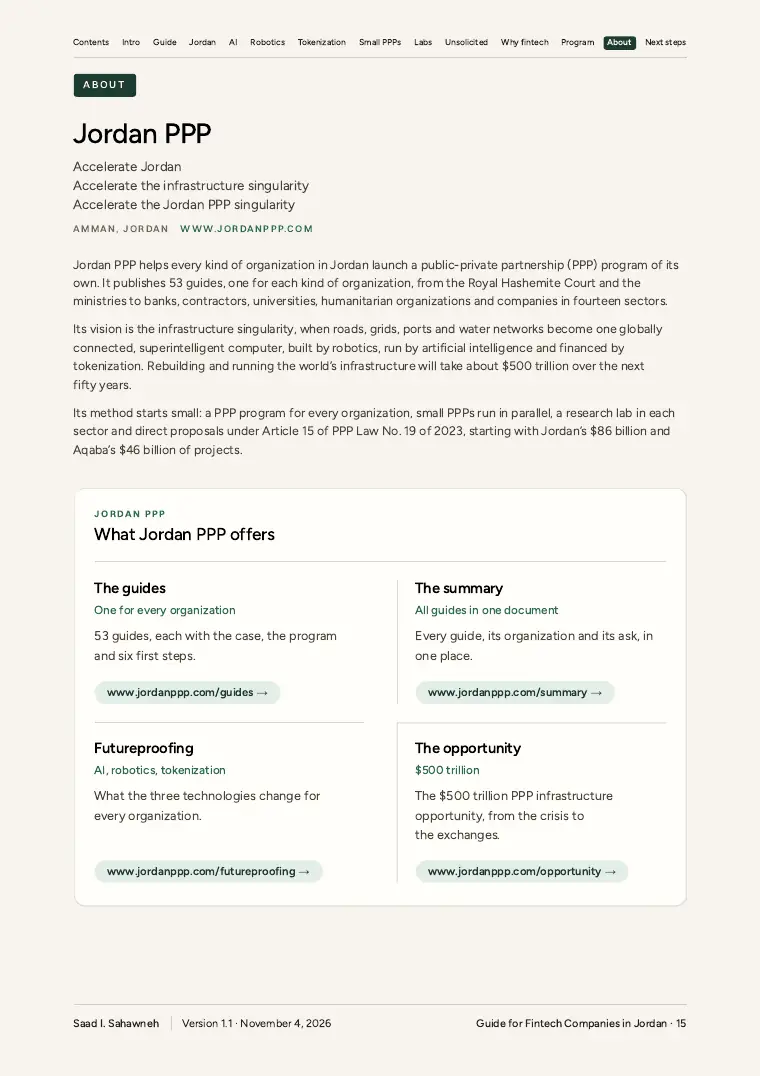
About Jordan PPP and what it offers.
Page 15 of 17
13Next steps
How a fintech company can start: six first steps.
Page 16 of 17
Questions
Questions about the guide for Fintech Companies in Jordan
- What does the guide for Fintech Companies in Jordan propose?
- Your company launches a PPP program to collect, pay and finance the revenues of public-private partnership (PPP) projects, from tolls, tariffs and parking fees to availability payments and small investor notes.
- Why should fintech companies in Jordan launch a PPP program?
- Fintech companies connect infrastructure to the people who pay for it. A PPP lives on its revenues, and every toll, tariff and fee is a payment. The companies that collect, settle and finance those payments sit at the center of how a concession earns and repays its debt.
- Which PPP projects can fintech companies in Jordan take part in?
- Jordan has about $86 billion of PPP and infrastructure projects in development, $46 billion of them anchored in Aqaba. Every one of them will need a way to collect its revenues, pay its parties and report its performance in real time. A Jordanian fintech company that collects the revenues of one project at home can carry the same platform to the next one across the region.
- How can fintech companies in Jordan start a PPP program?
- Any fintech company in Jordan can take this guide forward. The first steps use the platform, licenses and partners the company already has. The guide sets out six first steps: mandate, team, pipeline, products, partners and pilot.
- What does a PPP program give fintech companies in Jordan?
- The company gains transaction, collection and finance revenues that last as long as the concessions they serve. Every project it runs becomes a reference, a source of customers and a route into the next consortium, in Jordan and across the region.
- Is the guide for Fintech Companies in Jordan free?
- Yes. It is free to read on this page and free to download as a 17-page PDF, with the case for a PPP program, Jordan’s pipeline, the role of AI, robotics and tokenization, the program and six first steps.
Guide 32 of 53
Browse all 53 guides