
What this guide is for
Your institution launches a PPP program to build, finance and maintain housing, hospitals, training estates, depots and the energy and water of its bases as public-private partnerships (PPPs).
The case
Defense and security institutions run large civil estates
Housing, hospitals and bases have mostly been built with public budgets and maintained when funds allowed. The estates of the next fifty years will be built, financed and maintained by partners paid for availability and performance, and the institutions that set up those partnerships now will shape how their people live, train and heal for as long as the contracts last. This guide invites defense and security institutions in Jordan to launch a PPP program, starting with the projects at home.
The guide
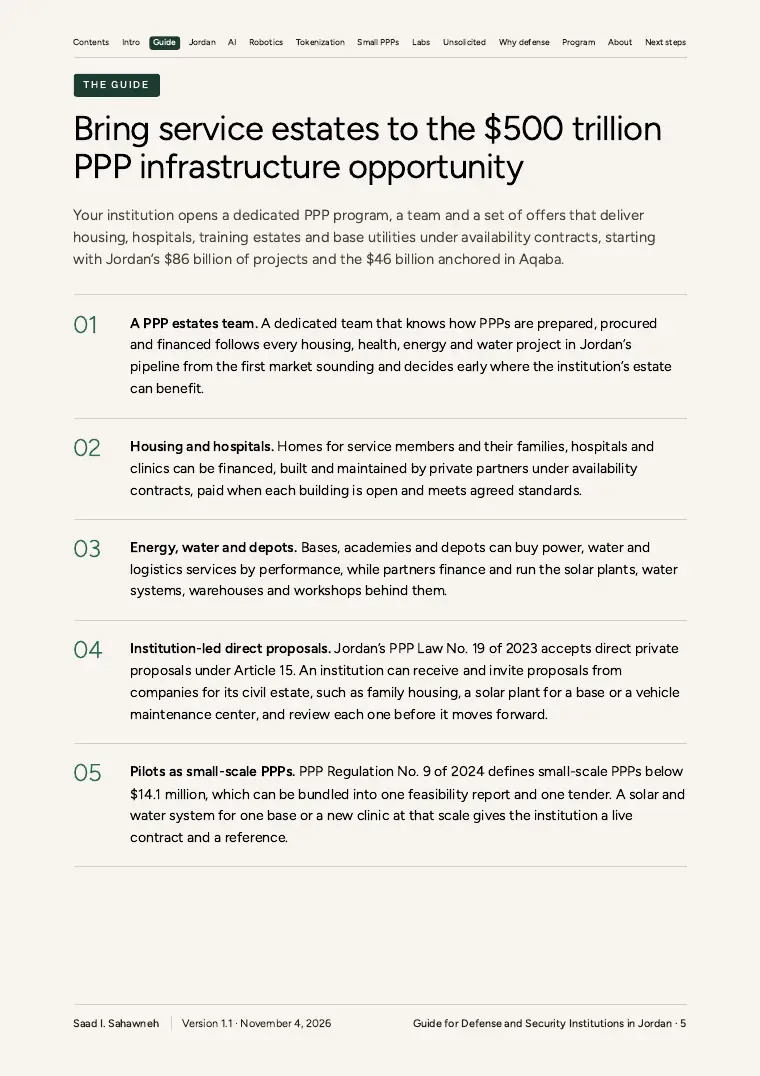
Bring service estates to the $500 trillion PPP infrastructure opportunity
Your institution opens a dedicated PPP program, a team and a set of offers that deliver housing, hospitals, training estates and base utilities under availability contracts, starting with Jordan’s $86 billion of projects and the $46 billion anchored in Aqaba.
01
A PPP estates team
A dedicated team that knows how PPPs are prepared, procured and financed follows every housing, health, energy and water project in Jordan’s pipeline from the first market sounding and decides early where the institution’s estate can benefit.
02
Housing and hospitals
Homes for service members and their families, hospitals and clinics can be financed, built and maintained by private partners under availability contracts, paid when each building is open and meets agreed standards.
03
Energy, water and depots
Bases, academies and depots can buy power, water and logistics services by performance, while partners finance and run the solar plants, water systems, warehouses and workshops behind them.
04
Institution-led direct proposals
Jordan’s PPP Law No. 19 of 2023 accepts direct private proposals under Article 15. An institution can receive and invite proposals from companies for its civil estate, such as family housing, a solar plant for a base or a vehicle maintenance center, and review each one before it moves forward.
05
Pilots as small-scale PPPs
PPP Regulation No. 9 of 2024 defines small-scale PPPs below $14.1 million, which can be bundled into one feasibility report and one tender. A solar and water system for one base or a new clinic at that scale gives the institution a live contract and a reference.
Why defense and security institutions
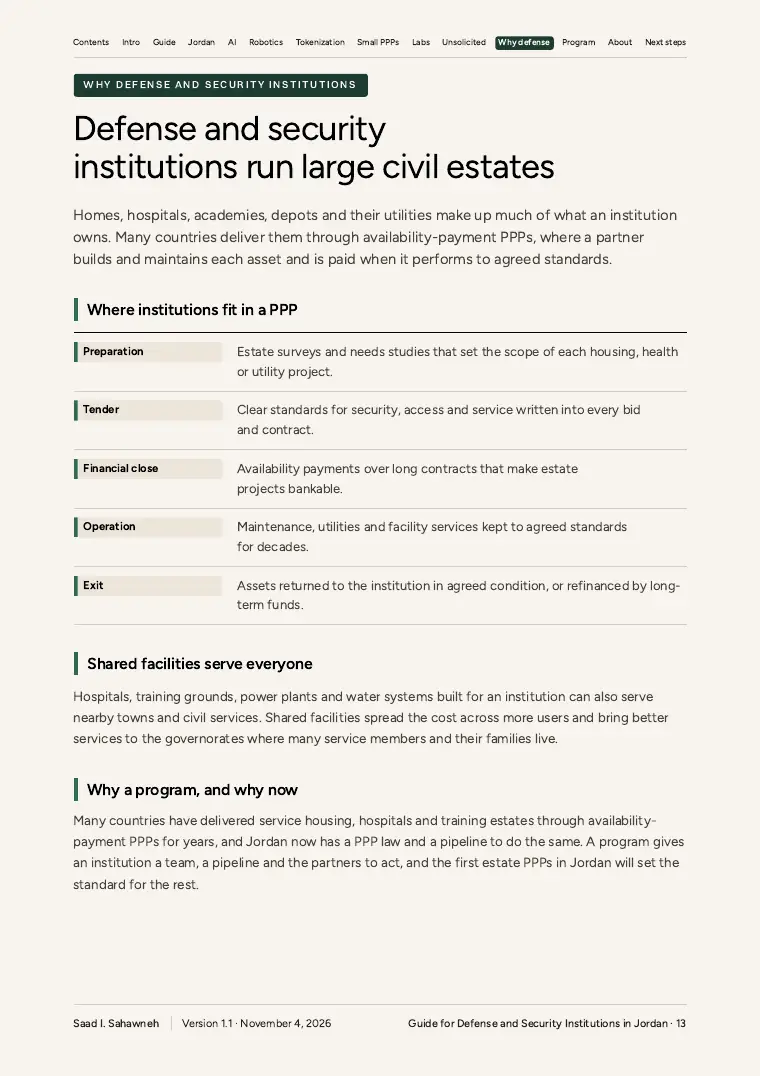
Defense and security institutions run large civil estates
Homes, hospitals, academies, depots and their utilities make up much of what an institution owns. Many countries deliver them through availability-payment PPPs, where a partner builds and maintains each asset and is paid when it performs to agreed standards.
Where institutions fit in a PPP
- Preparation
- Estate surveys and needs studies that set the scope of each housing, health or utility project.
- Tender
- Clear standards for security, access and service written into every bid and contract.
- Financial close
- Availability payments over long contracts that make estate projects bankable.
- Operation
- Maintenance, utilities and facility services kept to agreed standards for decades.
- Exit
- Assets returned to the institution in agreed condition, or refinanced by long-term funds.
Shared facilities serve everyone
Hospitals, training grounds, power plants and water systems built for an institution can also serve nearby towns and civil services. Shared facilities spread the cost across more users and bring better services to the governorates where many service members and their families live.
Why a program, and why now
Many countries have delivered service housing, hospitals and training estates through availability-payment PPPs for years, and Jordan now has a PPP law and a pipeline to do the same. A program gives an institution a team, a pipeline and the partners to act, and the first estate PPPs in Jordan will set the standard for the rest.

Futureproofing
Futureproof Defense and Security Institutions in Jordan for the infrastructure singularity
This free 17-page guide shows how, with small PPPs in parallel, PPP research labs, artificial intelligence, robotics, tokenization and six first steps.
Jordan and Aqaba
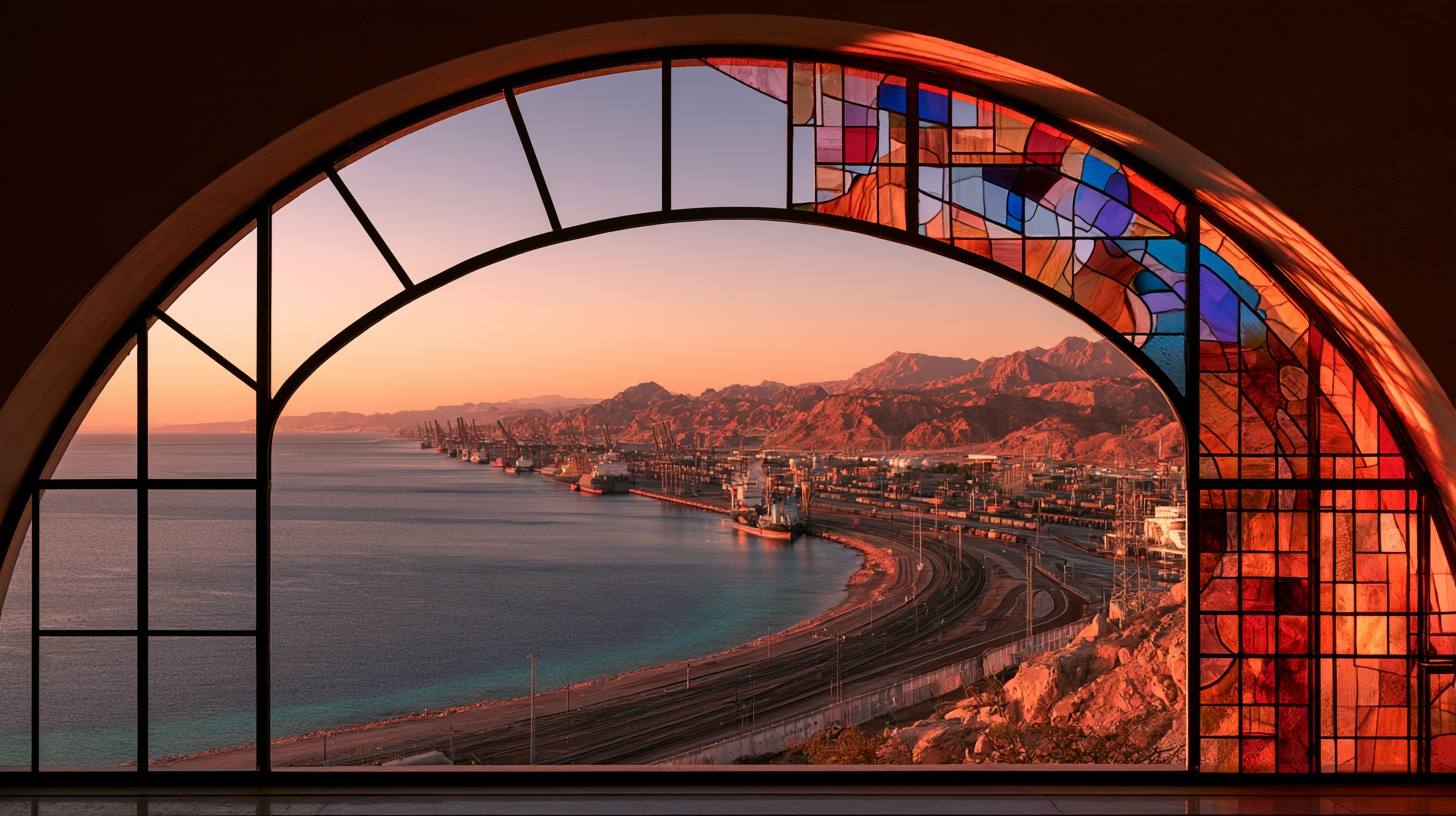
An $86 billion pipeline to start with
Many of them, from housing and hospitals to power and water, match the civil needs of defense estates. A Jordanian institution that delivers one estate PPP at home can share the same model with partner institutions across the region.
- $86B
- of PPP and infrastructure projects in development in Jordan
- $46B
- of them anchored in Aqaba

Artificial intelligence
AI can plan the upkeep of a large estate. It can track the condition of every building, vehicle and generator, forecast energy and water use at each base and schedule repairs before equipment fails. An institution can use those tools to hold its PPP partners to their performance standards and spend each budget where it matters most.

Robotics
Robots can build housing faster, inspect roofs, tanks and pipes and keep warehouses running around the clock. An institution can ask its partners to bring those machines to its estates and workshops, and to train service members and young Jordanians as technicians who run and repair them.

Tokenization
Tokenization can open estate finance to many investors. Stakes in a housing program, a clinic or a solar plant for a base can be offered as tokenized notes, paid from availability payments, so pension funds and citizens can invest in the homes and hospitals of those who serve.

Small PPPs and research labs
Small PPPs let an institution prove a new model on one site at low cost. It can host a PPP research lab that trials robotic construction, AI maintenance and off-grid power at a base or academy, publish every result and carry the pilots that work to every estate.

Unsolicited proposals
Direct proposals let companies bring housing, a solar plant or a maintenance center to an institution as a project of their own. The institution can invite them, review each one against its needs and keep the proposer’s right to match the best offer at tender.
The program
How the program could work
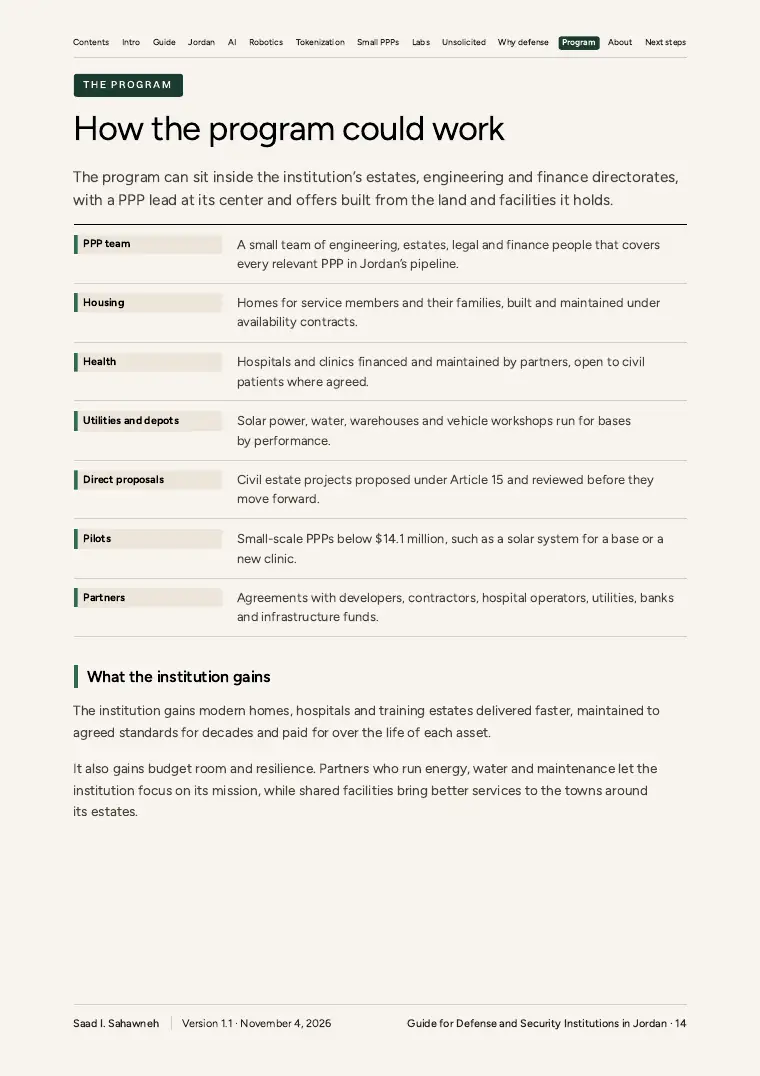
The program can sit inside the institution’s estates, engineering and finance directorates, with a PPP lead at its center and offers built from the land and facilities it holds.
- PPP team
- A small team of engineering, estates, legal and finance people that covers every relevant PPP in Jordan’s pipeline.
- Housing
- Homes for service members and their families, built and maintained under availability contracts.
- Health
- Hospitals and clinics financed and maintained by partners, open to civil patients where agreed.
- Utilities and depots
- Solar power, water, warehouses and vehicle workshops run for bases by performance.
- Direct proposals
- Civil estate projects proposed under Article 15 and reviewed before they move forward.
- Pilots
- Small-scale PPPs below $14.1 million, such as a solar system for a base or a new clinic.
- Partners
- Agreements with developers, contractors, hospital operators, utilities, banks and infrastructure funds.
What the institution gains
The institution gains modern homes, hospitals and training estates delivered faster, maintained to agreed standards for decades and paid for over the life of each asset.
It also gains budget room and resilience. Partners who run energy, water and maintenance let the institution focus on its mission, while shared facilities bring better services to the towns around its estates.

Next steps
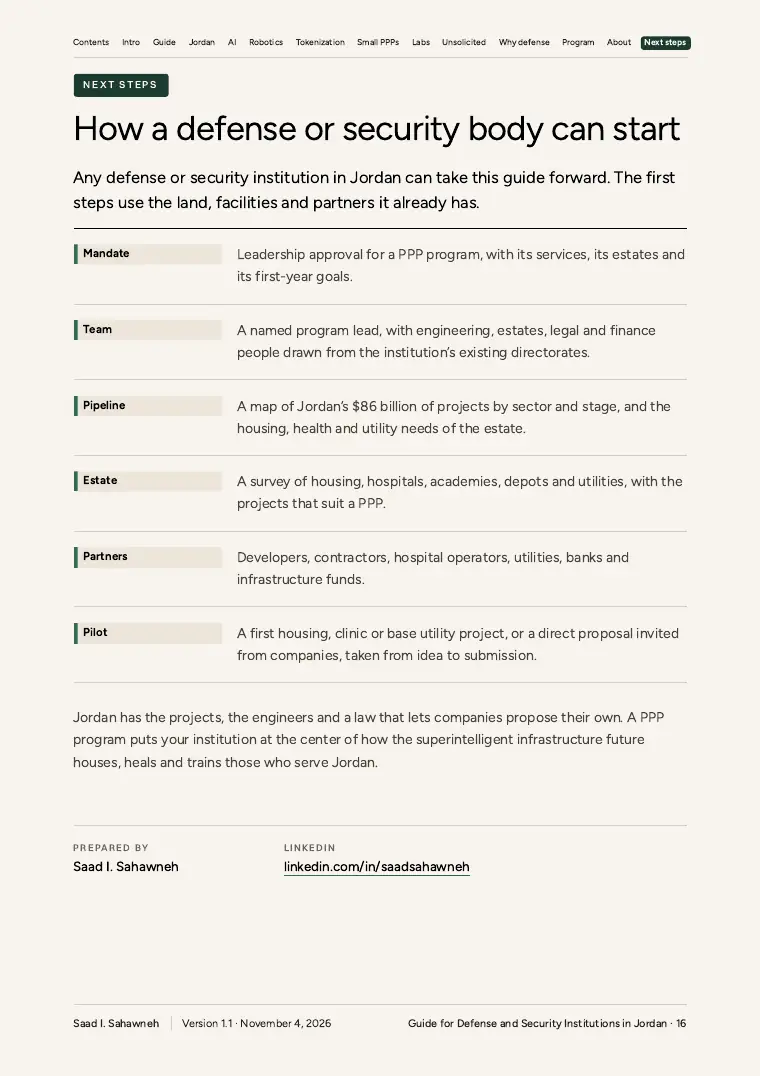
How a defense or security body can start
Any defense or security institution in Jordan can take this guide forward. The first steps use the land, facilities and partners it already has.
01
Mandate
Leadership approval for a PPP program, with its services, its estates and its first-year goals.
02
Team
A named program lead, with engineering, estates, legal and finance people drawn from the institution’s existing directorates.
03
Pipeline
A map of Jordan’s $86 billion of projects by sector and stage, and the housing, health and utility needs of the estate.
04
Estate
A survey of housing, hospitals, academies, depots and utilities, with the projects that suit a PPP.
05
Partners
Developers, contractors, hospital operators, utilities, banks and infrastructure funds.
06
Pilot
A first housing, clinic or base utility project, or a direct proposal invited from companies, taken from idea to submission.
Jordan has the projects, the engineers and a law that lets companies propose their own. A PPP program puts your institution at the center of how the superintelligent infrastructure future houses, heals and trains those who serve Jordan.
The full document
Inside this guide
Seventeen pages and thirteen chapters, from the case for a PPP program to the first steps, written for defense and security institutions in Jordan.
- 17
- pages
- 13
- chapters
- 3
- technologies
- 6
- first steps
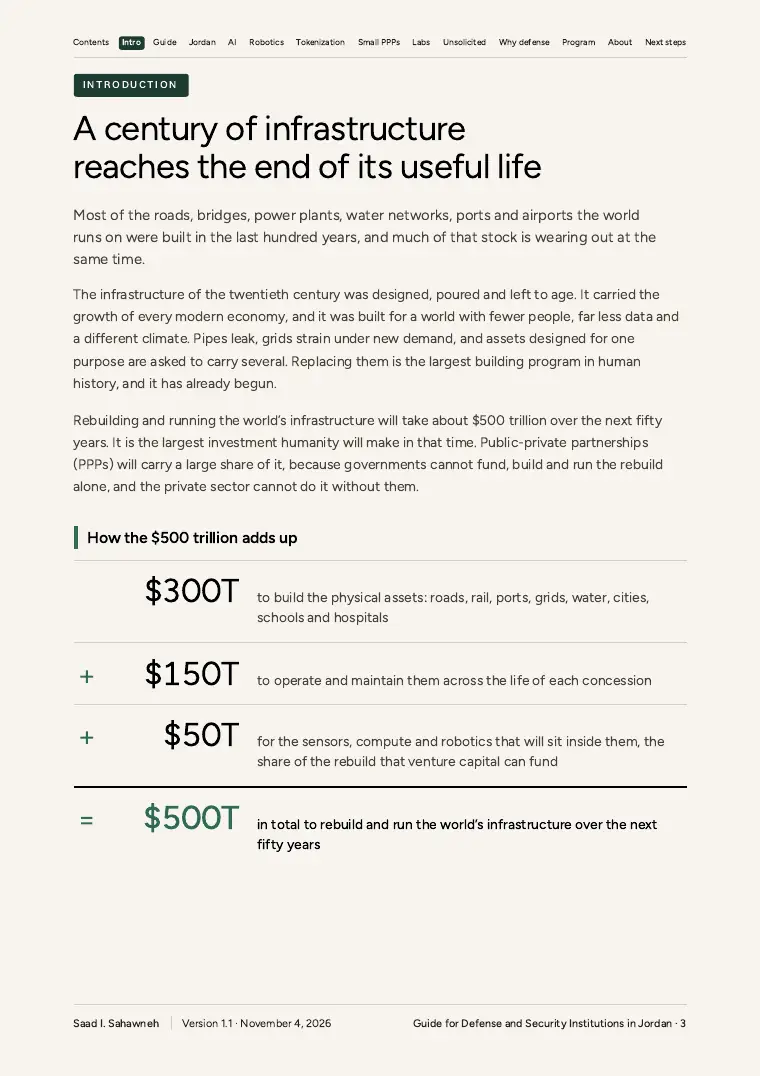
01Introduction
Why a century of infrastructure needs rebuilding, and the $500 trillion it will take.
Page 3 of 17
02The guide
Bring service estates to the $500 trillion PPP infrastructure opportunity
Page 5 of 17
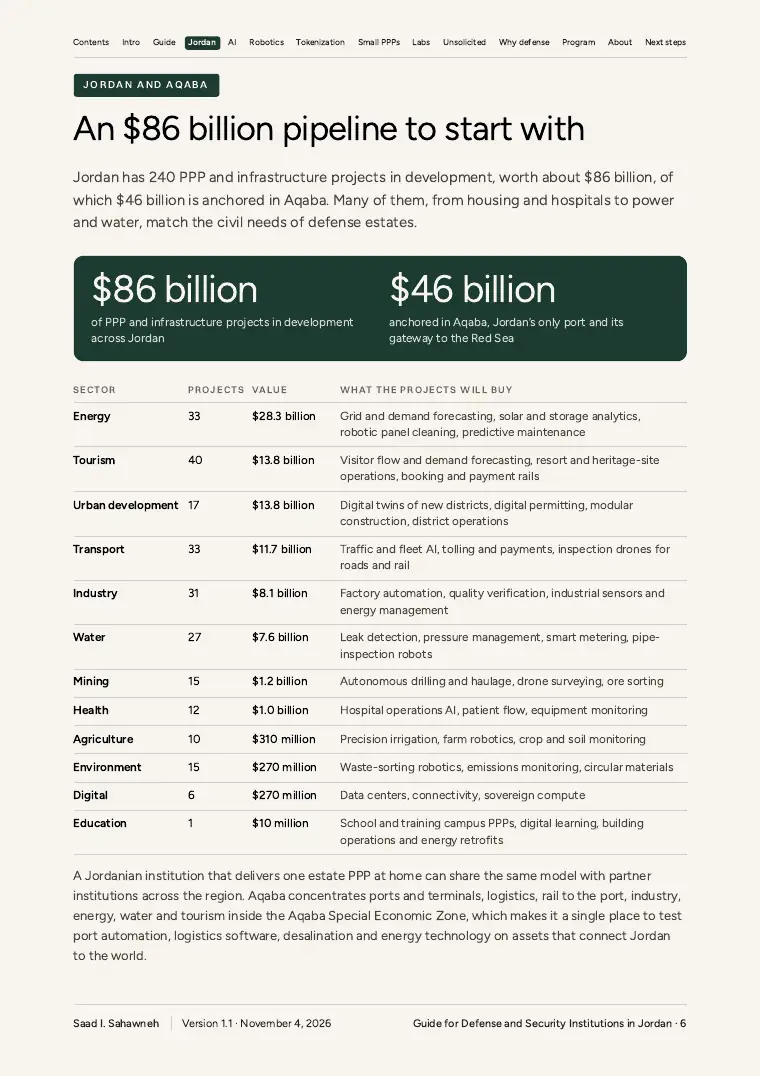
03Jordan and Aqaba
An $86 billion pipeline to start with
Page 6 of 17
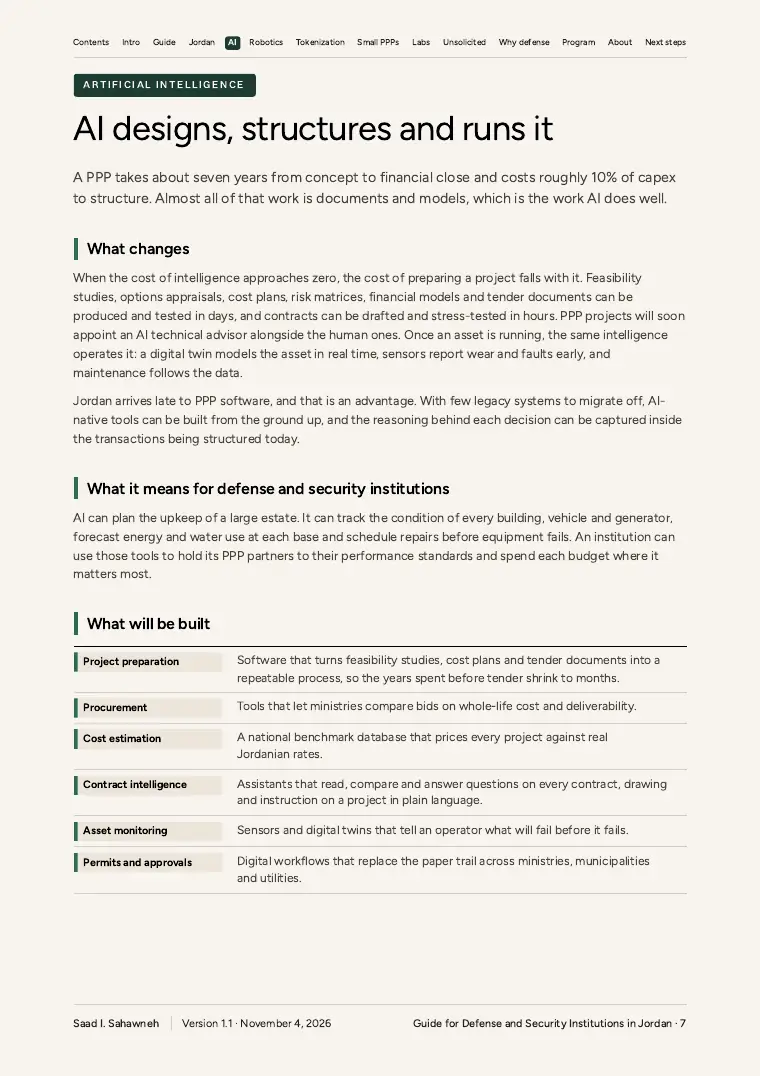
04Artificial intelligence
How AI designs, structures and runs PPP projects, and what it means for defense and security institutions.
Page 7 of 17
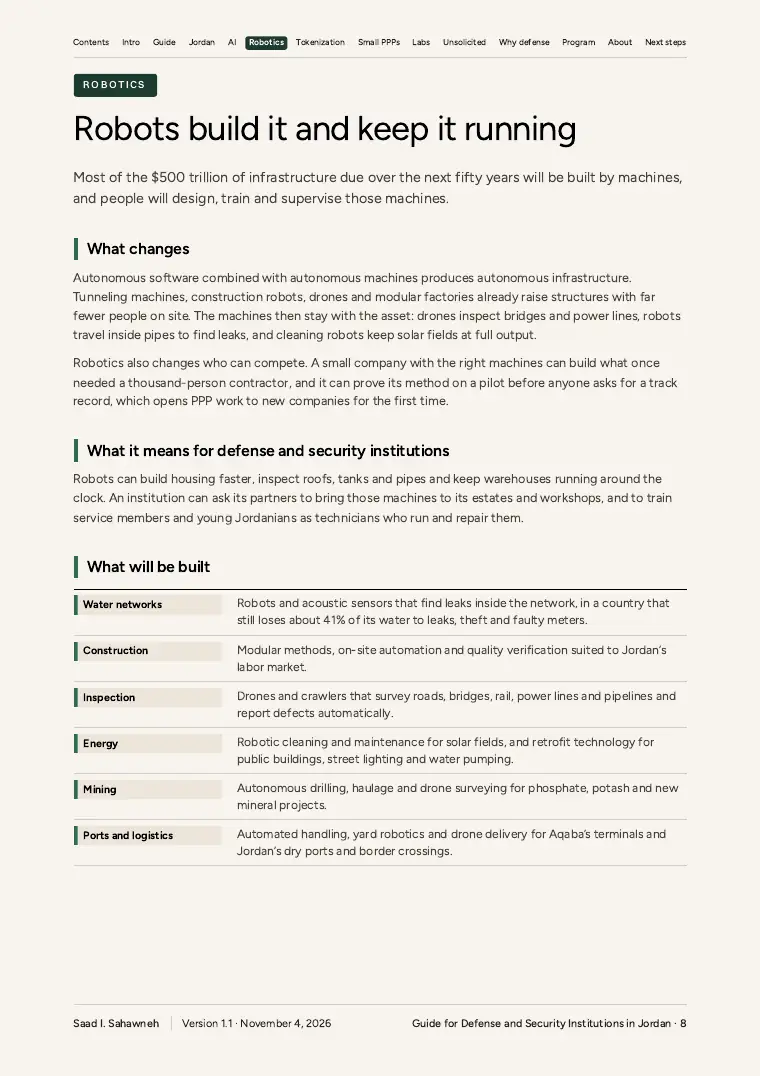
05Robotics
How robots build infrastructure and keep it running, and what that means for defense and security institutions.
Page 8 of 17
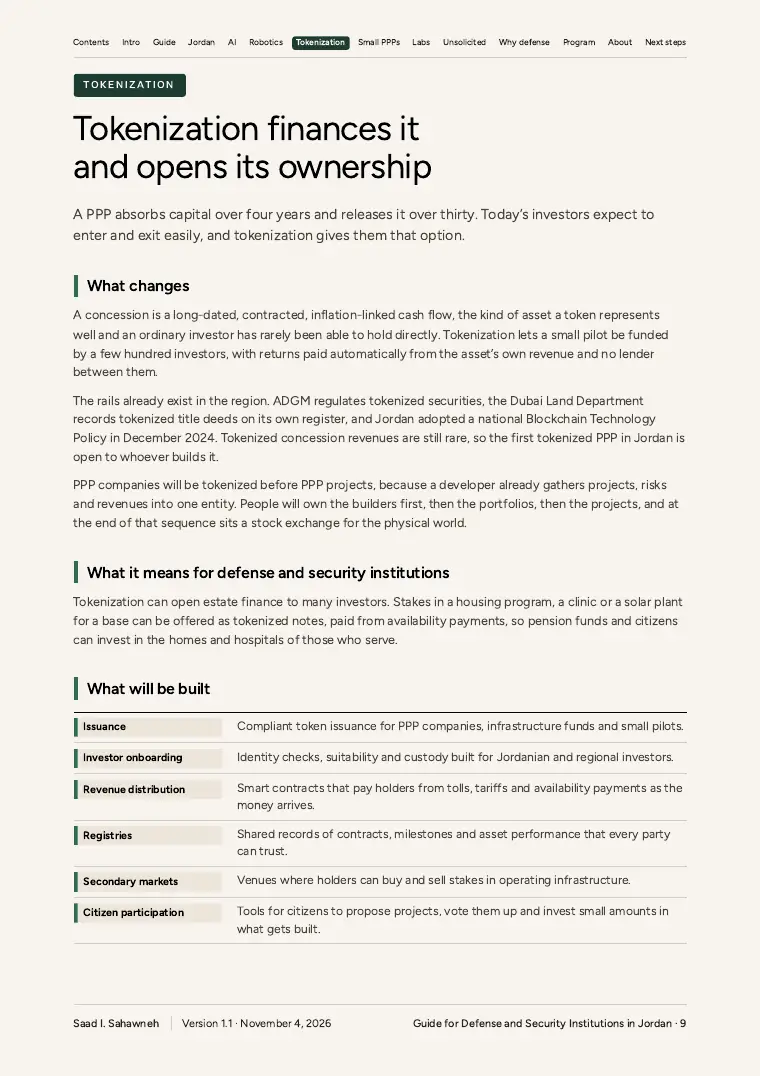
06Tokenization
How tokenization funds projects from their own revenue, and the role it opens for defense and security institutions.
Page 9 of 17
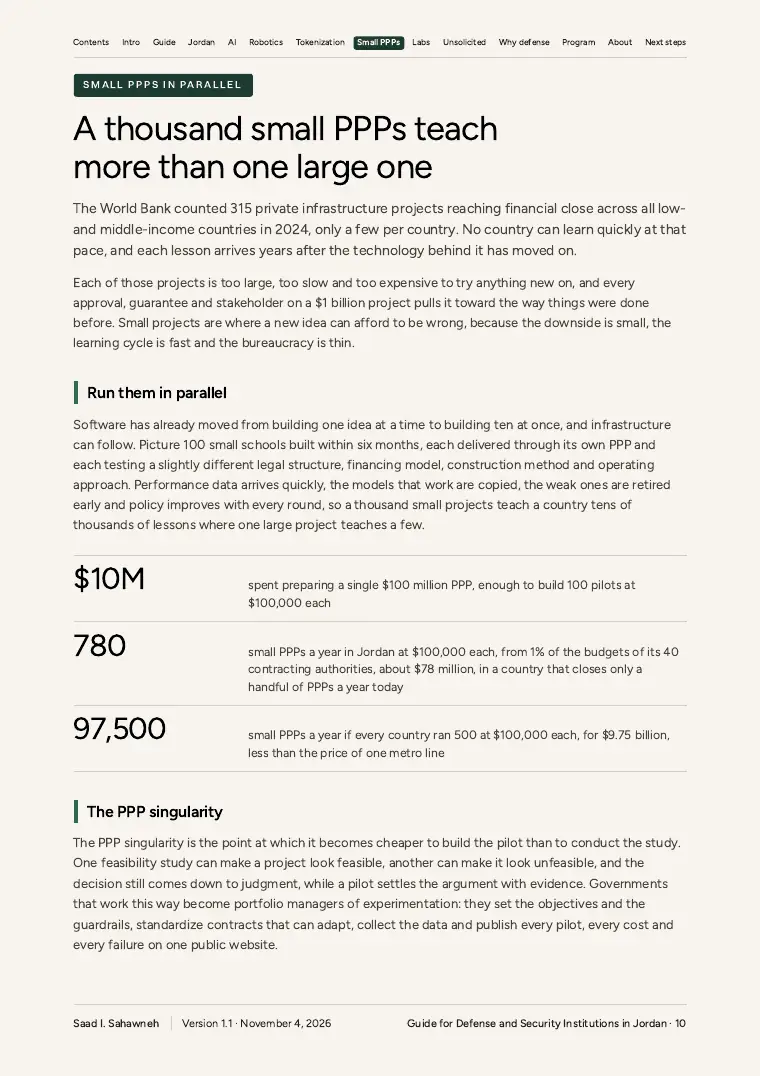
07Small PPPs in parallel
Why many small PPPs teach a country faster than a few large ones.
Page 10 of 17
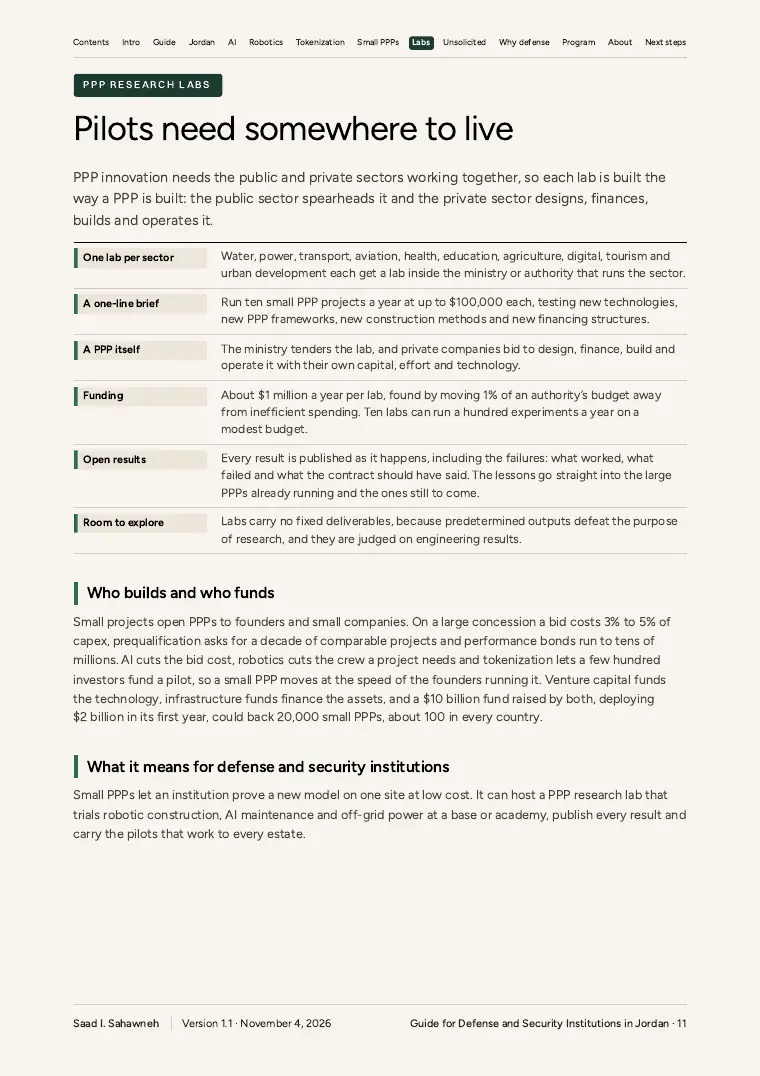
08PPP research labs
A lab in each sector, running ten small PPP projects a year.
Page 11 of 17
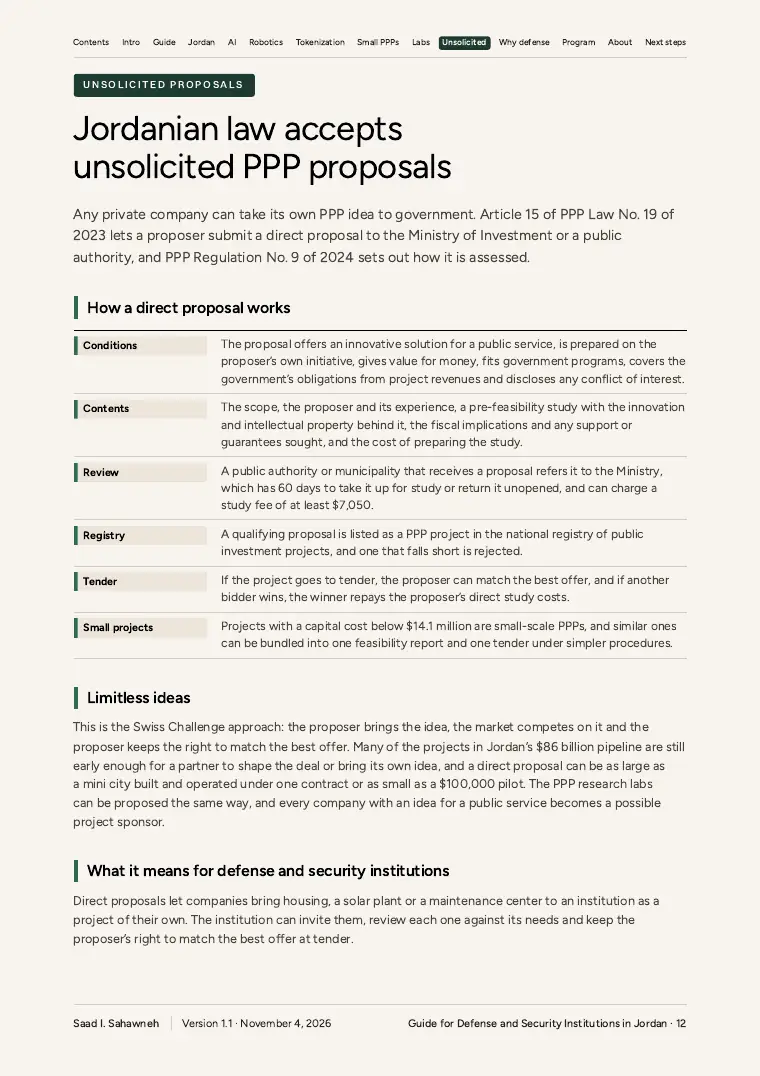
09Unsolicited proposals
How Jordan’s PPP law accepts direct proposals from private companies.
Page 12 of 17
10Why defense and security institutions
Defense and security institutions run large civil estates
Page 13 of 17
11The program
The program can sit inside the institution’s estates, engineering and finance directorates, with a PPP lead at its center and offers built from the land and facilities it holds.
Page 14 of 17
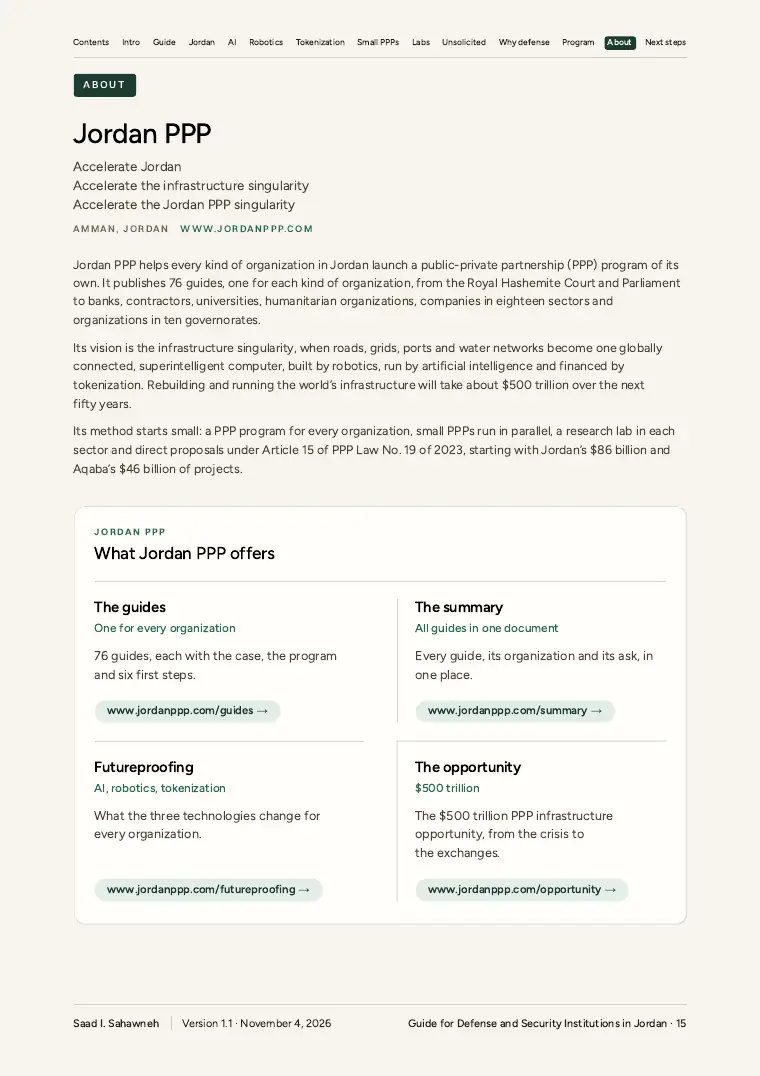
12About
About Jordan PPP and what it offers.
Page 15 of 17
13Next steps
How a defense or security body can start: six first steps.
Page 16 of 17
Questions
Questions about the guide for Defense and Security Institutions in Jordan
- What does the guide for Defense and Security Institutions in Jordan propose?
- Your institution launches a PPP program to build, finance and maintain housing, hospitals, training estates, depots and the energy and water of its bases as public-private partnerships (PPPs).
- Why should defense and security institutions in Jordan launch a PPP program?
- Defense and security institutions run large civil estates. Homes, hospitals, academies, depots and their utilities make up much of what an institution owns. Many countries deliver them through availability-payment PPPs, where a partner builds and maintains each asset and is paid when it performs to agreed standards.
- Which PPP projects can defense and security institutions in Jordan take part in?
- Jordan has about $86 billion of PPP and infrastructure projects in development, $46 billion of them anchored in Aqaba. Many of them, from housing and hospitals to power and water, match the civil needs of defense estates. A Jordanian institution that delivers one estate PPP at home can share the same model with partner institutions across the region.
- How can defense and security institutions in Jordan start a PPP program?
- Any defense or security institution in Jordan can take this guide forward. The first steps use the land, facilities and partners it already has. The guide sets out six first steps: mandate, team, pipeline, estate, partners and pilot.
- What does a PPP program give defense and security institutions in Jordan?
- The institution gains modern homes, hospitals and training estates delivered faster, maintained to agreed standards for decades and paid for over the life of each asset.
- Is the guide for Defense and Security Institutions in Jordan free?
- Yes. It is free to read on this page and free to download as a 17-page PDF, with the case for a PPP program, Jordan’s pipeline, the role of AI, robotics and tokenization, the program and six first steps.
Guide 9 of 76
Browse all 76 guides