What this guide is for
Your organization launches a PPP program to prepare, finance and deliver small modular reactors, nuclear-powered desalination and isotope production as public-private partnerships (PPPs).
The case
Nuclear energy organizations plan assets that serve generations
Nuclear plants have mostly been built by states alone, with public money and long schedules, while companies supplied parts and services. The reactors of the next fifty years will be smaller, built in factories and paired with water and industry, and the organizations that prepare those partnerships now will decide how they are financed and run for as long as the contracts last. This guide invites nuclear energy organizations in Jordan to launch a PPP program, starting with the projects at home.
The guide
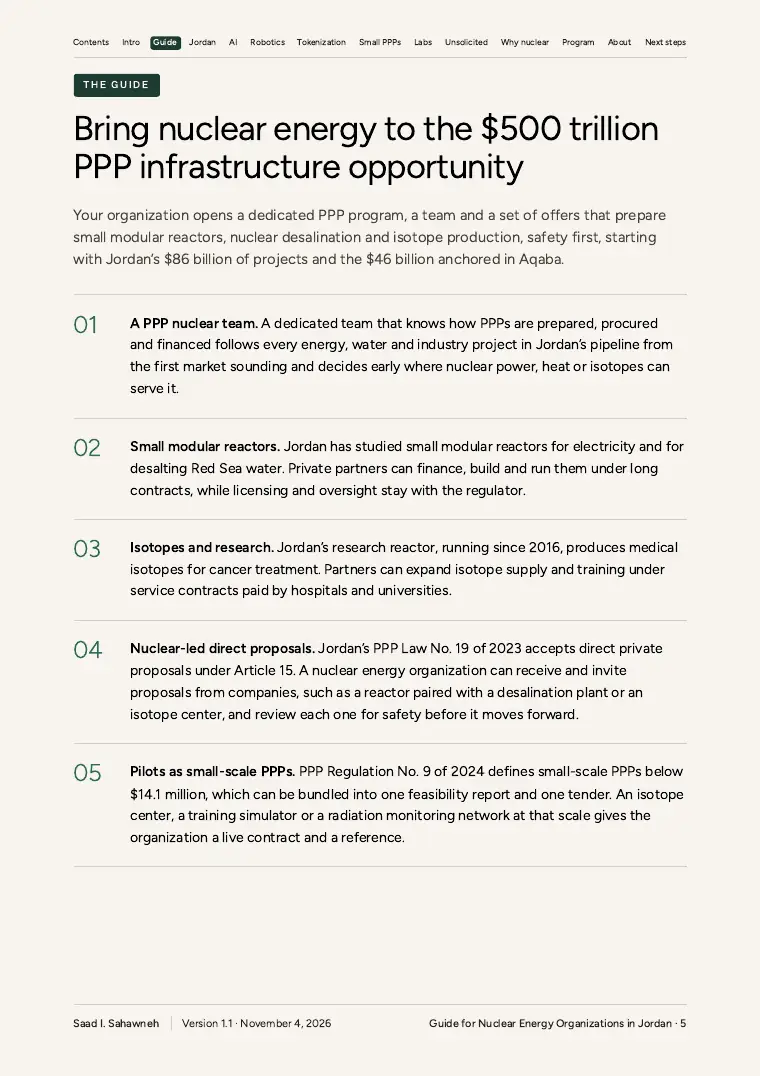
Bring nuclear energy to the $500 trillion PPP infrastructure opportunity
Your organization opens a dedicated PPP program, a team and a set of offers that prepare small modular reactors, nuclear desalination and isotope production, safety first, starting with Jordan’s $86 billion of projects and the $46 billion anchored in Aqaba.
01
A PPP nuclear team
A dedicated team that knows how PPPs are prepared, procured and financed follows every energy, water and industry project in Jordan’s pipeline from the first market sounding and decides early where nuclear power, heat or isotopes can serve it.
02
Small modular reactors
Jordan has studied small modular reactors for electricity and for desalting Red Sea water. Private partners can finance, build and run them under long contracts, while licensing and oversight stay with the regulator.
03
Isotopes and research
Jordan’s research reactor, running since 2016, produces medical isotopes for cancer treatment. Partners can expand isotope supply and training under service contracts paid by hospitals and universities.
04
Nuclear-led direct proposals
Jordan’s PPP Law No. 19 of 2023 accepts direct private proposals under Article 15. A nuclear energy organization can receive and invite proposals from companies, such as a reactor paired with a desalination plant or an isotope center, and review each one for safety before it moves forward.
05
Pilots as small-scale PPPs
PPP Regulation No. 9 of 2024 defines small-scale PPPs below $14.1 million, which can be bundled into one feasibility report and one tender. An isotope center, a training simulator or a radiation monitoring network at that scale gives the organization a live contract and a reference.
Why nuclear energy organizations
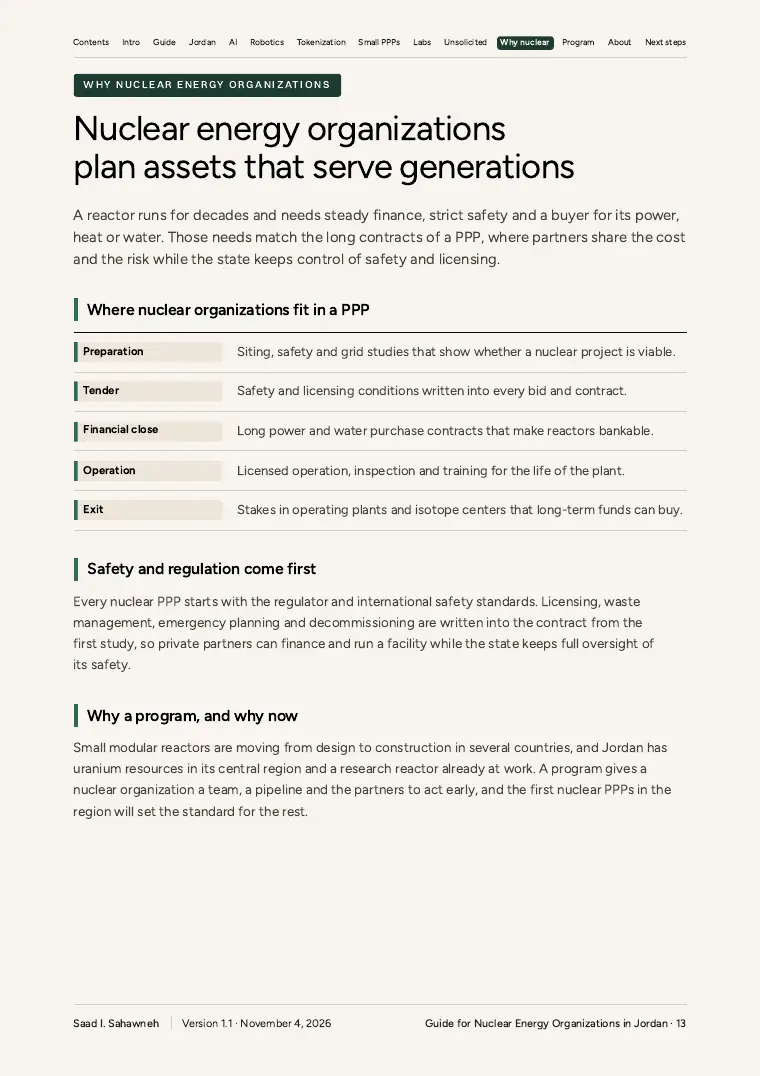
Nuclear energy organizations plan assets that serve generations
A reactor runs for decades and needs steady finance, strict safety and a buyer for its power, heat or water. Those needs match the long contracts of a PPP, where partners share the cost and the risk while the state keeps control of safety and licensing.
Where nuclear organizations fit in a PPP
- Preparation
- Siting, safety and grid studies that show whether a nuclear project is viable.
- Tender
- Safety and licensing conditions written into every bid and contract.
- Financial close
- Long power and water purchase contracts that make reactors bankable.
- Operation
- Licensed operation, inspection and training for the life of the plant.
- Exit
- Stakes in operating plants and isotope centers that long-term funds can buy.
Safety and regulation come first
Every nuclear PPP starts with the regulator and international safety standards. Licensing, waste management, emergency planning and decommissioning are written into the contract from the first study, so private partners can finance and run a facility while the state keeps full oversight of its safety.
Why a program, and why now
Small modular reactors are moving from design to construction in several countries, and Jordan has uranium resources in its central region and a research reactor already at work. A program gives a nuclear organization a team, a pipeline and the partners to act early, and the first nuclear PPPs in the region will set the standard for the rest.

Futureproofing
Futureproof Nuclear Energy Organizations in Jordan for the infrastructure singularity
This free 17-page guide shows how, with small PPPs in parallel, PPP research labs, artificial intelligence, robotics, tokenization and six first steps.
Jordan and Aqaba
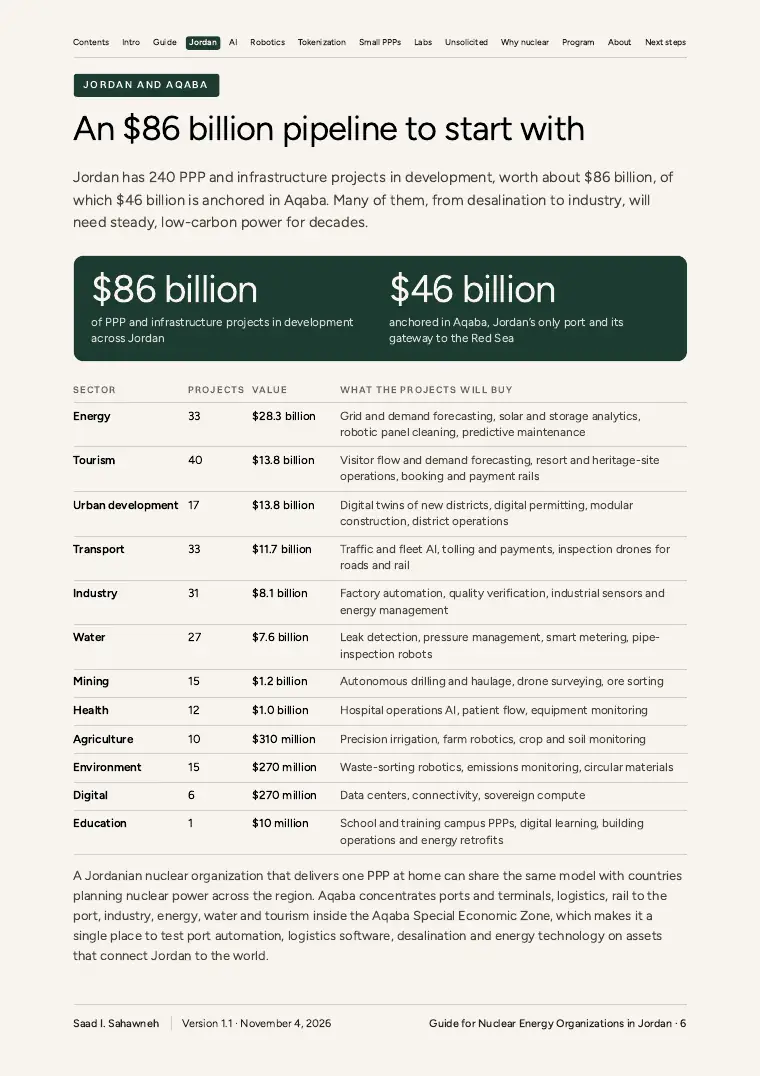
An $86 billion pipeline to start with
Many of them, from desalination to industry, will need steady, low-carbon power for decades. A Jordanian nuclear organization that delivers one PPP at home can share the same model with countries planning nuclear power across the region.
- $86B
- of PPP and infrastructure projects in development in Jordan
- $46B
- of them anchored in Aqaba

Artificial intelligence
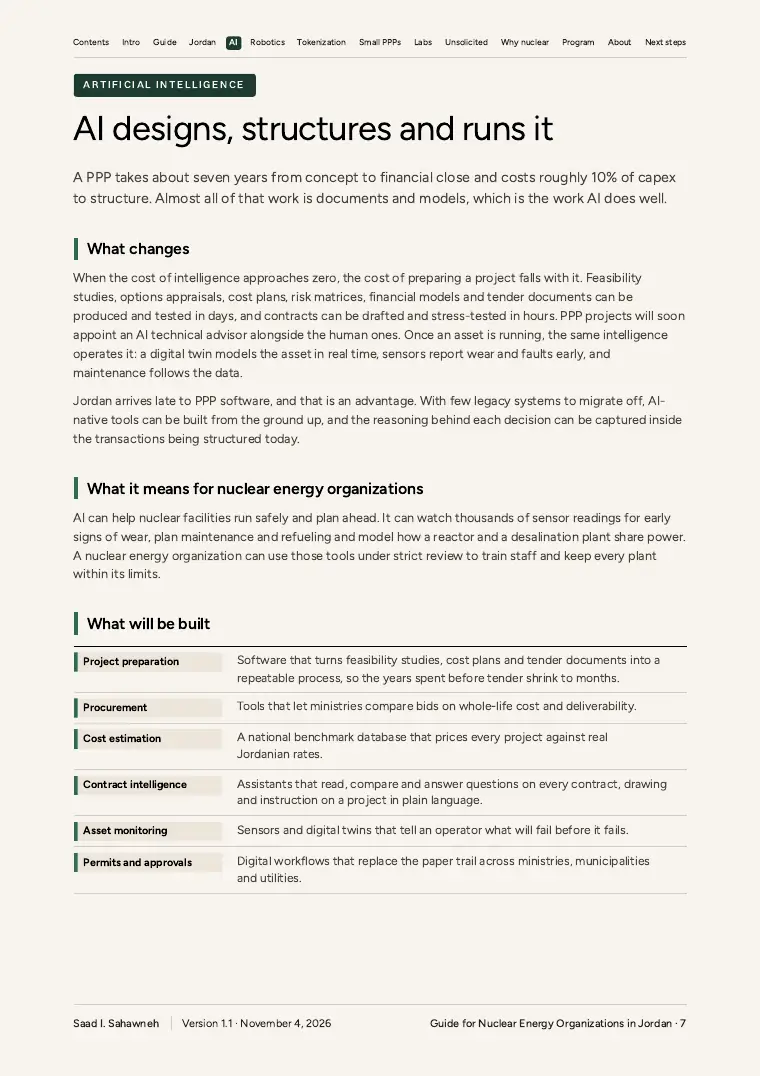
AI can help nuclear facilities run safely and plan ahead. It can watch thousands of sensor readings for early signs of wear, plan maintenance and refueling and model how a reactor and a desalination plant share power. A nuclear energy organization can use those tools under strict review to train staff and keep every plant within its limits.

Robotics
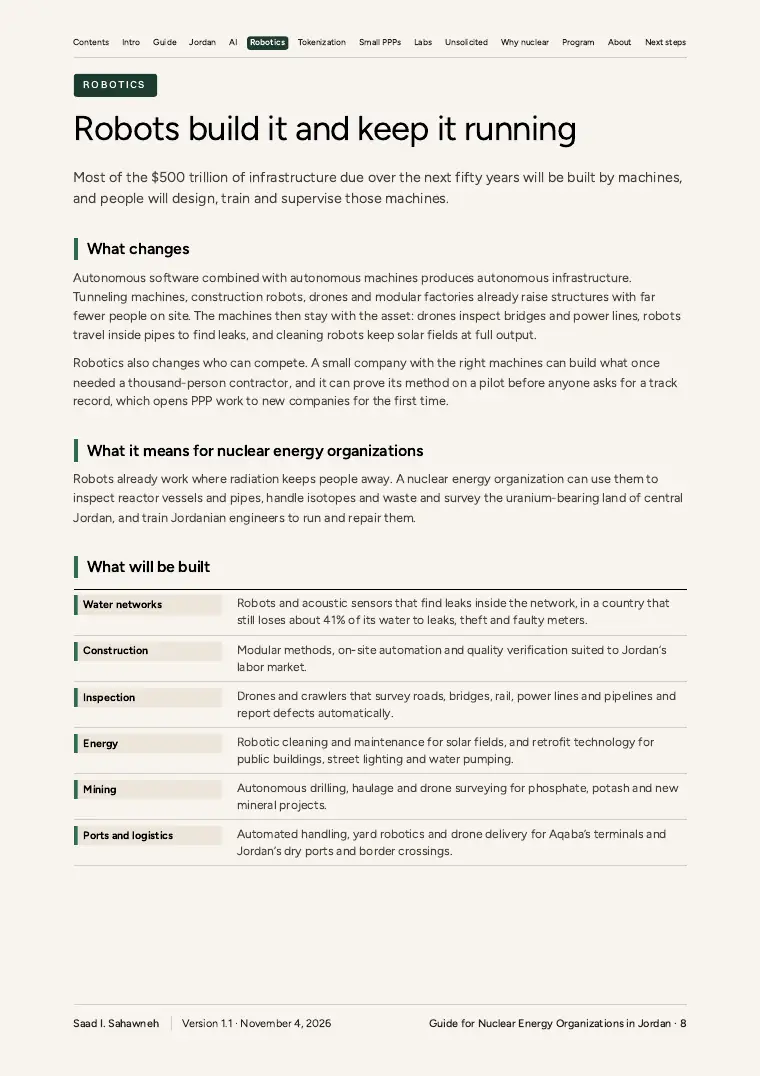
Robots already work where radiation keeps people away. A nuclear energy organization can use them to inspect reactor vessels and pipes, handle isotopes and waste and survey the uranium-bearing land of central Jordan, and train Jordanian engineers to run and repair them.

Tokenization
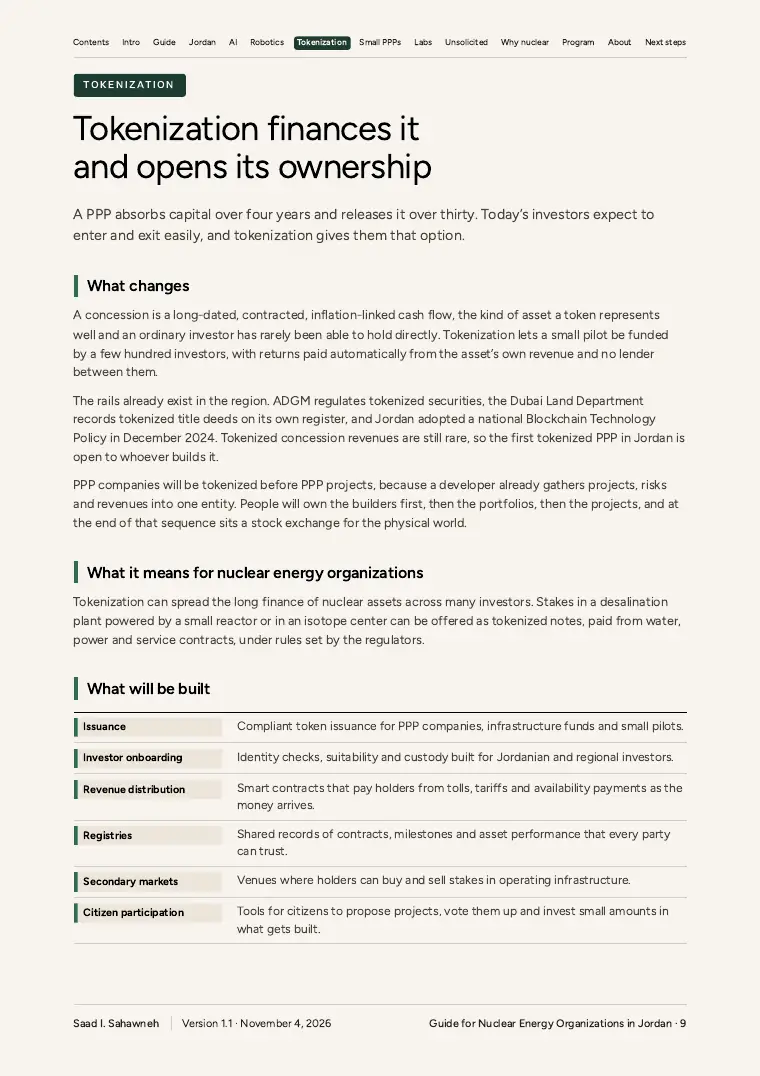
Tokenization can spread the long finance of nuclear assets across many investors. Stakes in a desalination plant powered by a small reactor or in an isotope center can be offered as tokenized notes, paid from water, power and service contracts, under rules set by the regulators.
Small PPPs and research labs
Small PPPs let a nuclear organization prove new models safely at low cost. It can host a PPP research lab that trials AI monitoring, inspection robots and isotope logistics, publish every result and carry the pilots that work into larger power and water contracts.
Unsolicited proposals
Direct proposals let companies bring a small reactor, an isotope center or a desalination plant to Jordan as a project of their own. A nuclear organization can invite them, review each one for safety and keep the proposer’s right to match the best offer at tender.
The program
How the program could work
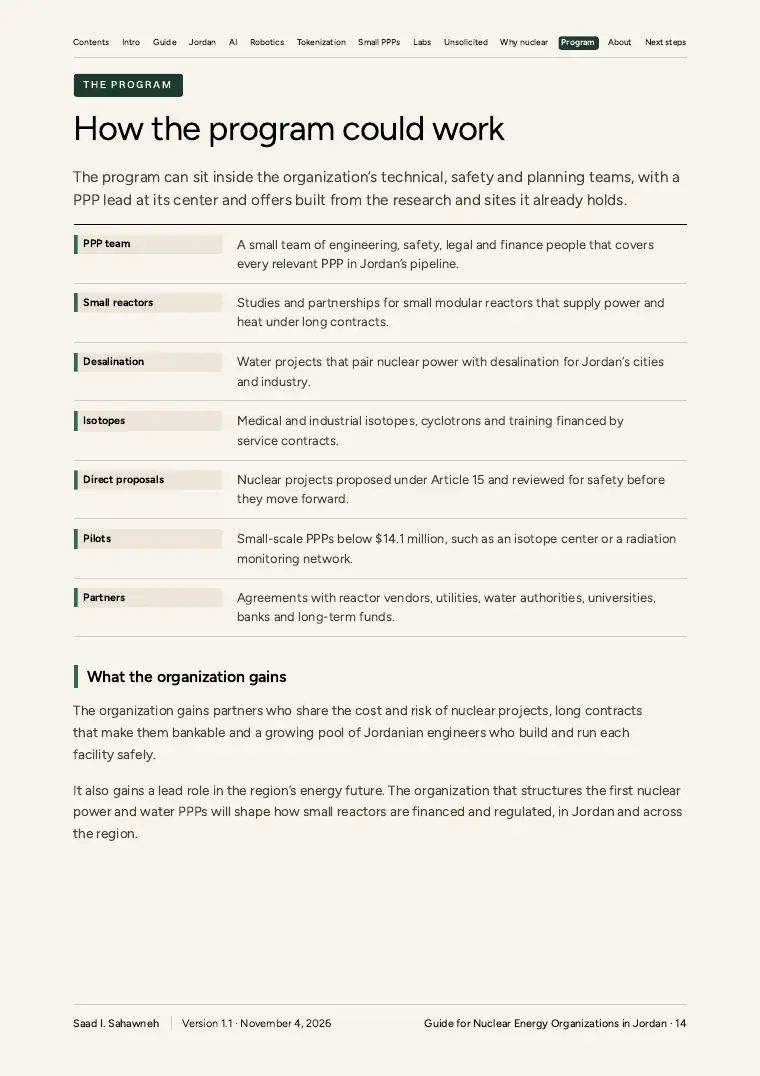
The program can sit inside the organization’s technical, safety and planning teams, with a PPP lead at its center and offers built from the research and sites it already holds.
- PPP team
- A small team of engineering, safety, legal and finance people that covers every relevant PPP in Jordan’s pipeline.
- Small reactors
- Studies and partnerships for small modular reactors that supply power and heat under long contracts.
- Desalination
- Water projects that pair nuclear power with desalination for Jordan’s cities and industry.
- Isotopes
- Medical and industrial isotopes, cyclotrons and training financed by service contracts.
- Direct proposals
- Nuclear projects proposed under Article 15 and reviewed for safety before they move forward.
- Pilots
- Small-scale PPPs below $14.1 million, such as an isotope center or a radiation monitoring network.
- Partners
- Agreements with reactor vendors, utilities, water authorities, universities, banks and long-term funds.
What the organization gains
The organization gains partners who share the cost and risk of nuclear projects, long contracts that make them bankable and a growing pool of Jordanian engineers who build and run each facility safely.
It also gains a lead role in the region’s energy future. The organization that structures the first nuclear power and water PPPs will shape how small reactors are financed and regulated, in Jordan and across the region.

Next steps
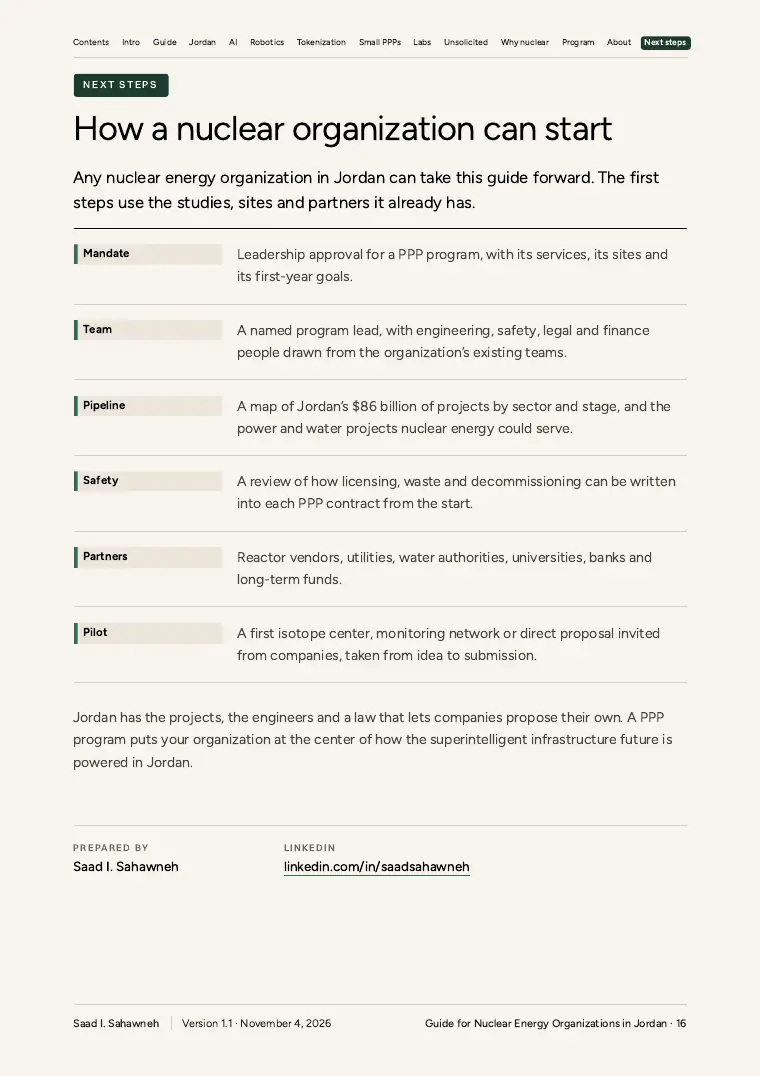
How a nuclear organization can start
Any nuclear energy organization in Jordan can take this guide forward. The first steps use the studies, sites and partners it already has.
01
Mandate
Leadership approval for a PPP program, with its services, its sites and its first-year goals.
02
Team
A named program lead, with engineering, safety, legal and finance people drawn from the organization’s existing teams.
03
Pipeline
A map of Jordan’s $86 billion of projects by sector and stage, and the power and water projects nuclear energy could serve.
04
Safety
A review of how licensing, waste and decommissioning can be written into each PPP contract from the start.
05
Partners
Reactor vendors, utilities, water authorities, universities, banks and long-term funds.
06
Pilot
A first isotope center, monitoring network or direct proposal invited from companies, taken from idea to submission.
Jordan has the projects, the engineers and a law that lets companies propose their own. A PPP program puts your organization at the center of how the superintelligent infrastructure future is powered in Jordan.
The full document
Inside this guide
Seventeen pages and thirteen chapters, from the case for a PPP program to the first steps, written for nuclear energy organizations in Jordan.
- 17
- pages
- 13
- chapters
- 3
- technologies
- 6
- first steps
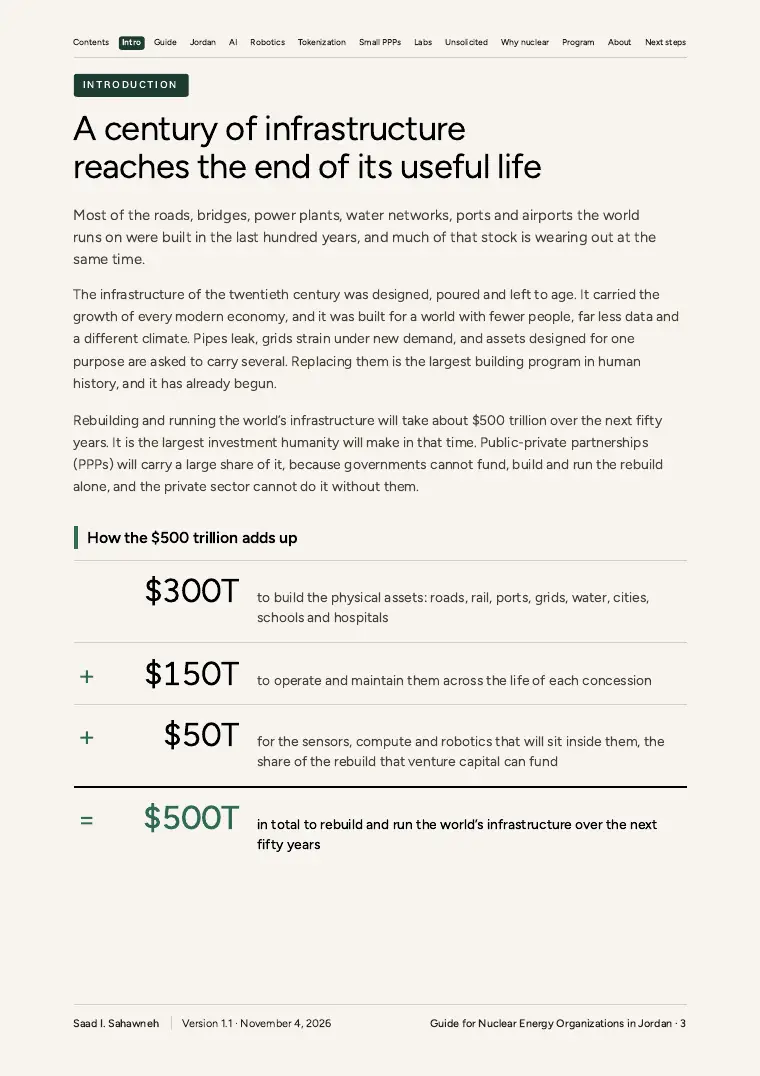
01Introduction
Why a century of infrastructure needs rebuilding, and the $500 trillion it will take.
Page 3 of 17
02The guide
Bring nuclear energy to the $500 trillion PPP infrastructure opportunity
Page 5 of 17
03Jordan and Aqaba
An $86 billion pipeline to start with
Page 6 of 17
04Artificial intelligence
How AI designs, structures and runs PPP projects, and what it means for nuclear energy organizations.
Page 7 of 17
05Robotics
How robots build infrastructure and keep it running, and what that means for nuclear energy organizations.
Page 8 of 17
06Tokenization
How tokenization funds projects from their own revenue, and the role it opens for nuclear energy organizations.
Page 9 of 17
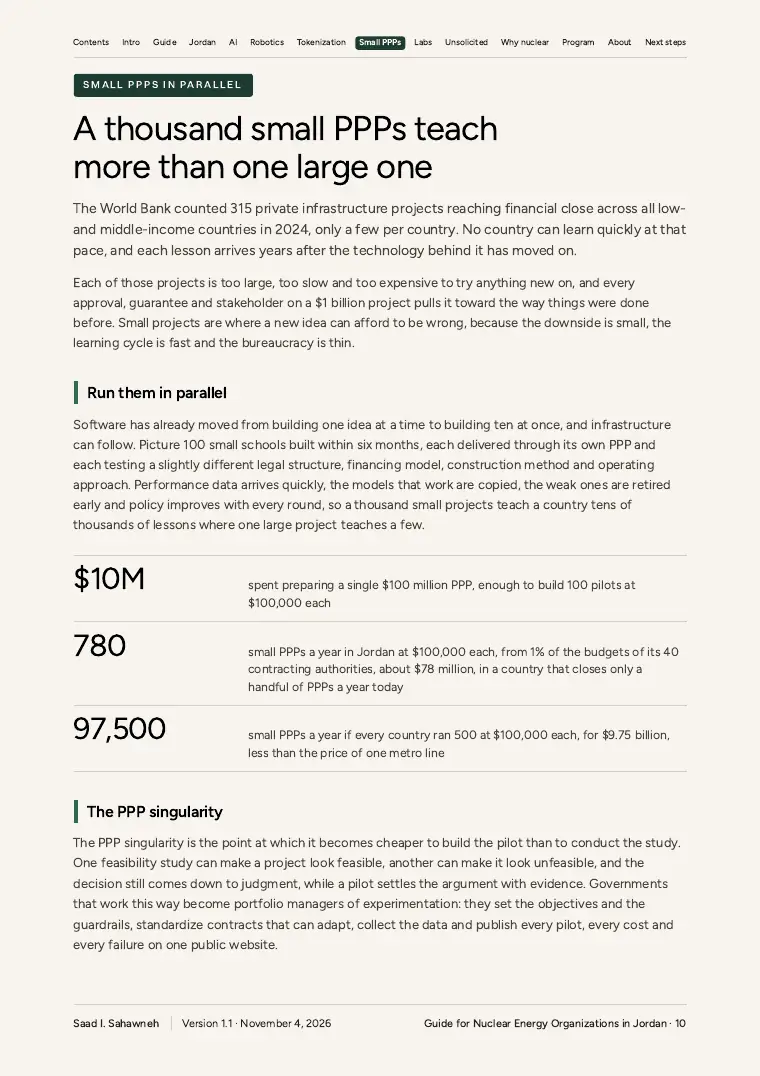
07Small PPPs in parallel
Why many small PPPs teach a country faster than a few large ones.
Page 10 of 17
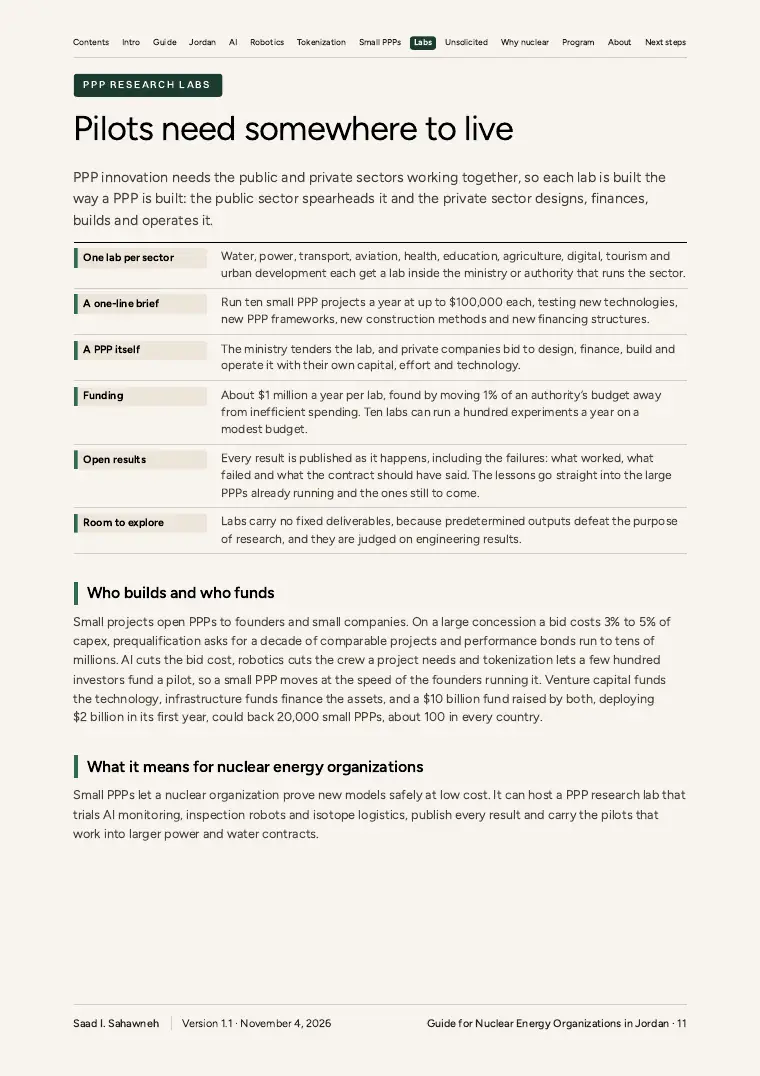
08PPP research labs
A lab in each sector, running ten small PPP projects a year.
Page 11 of 17
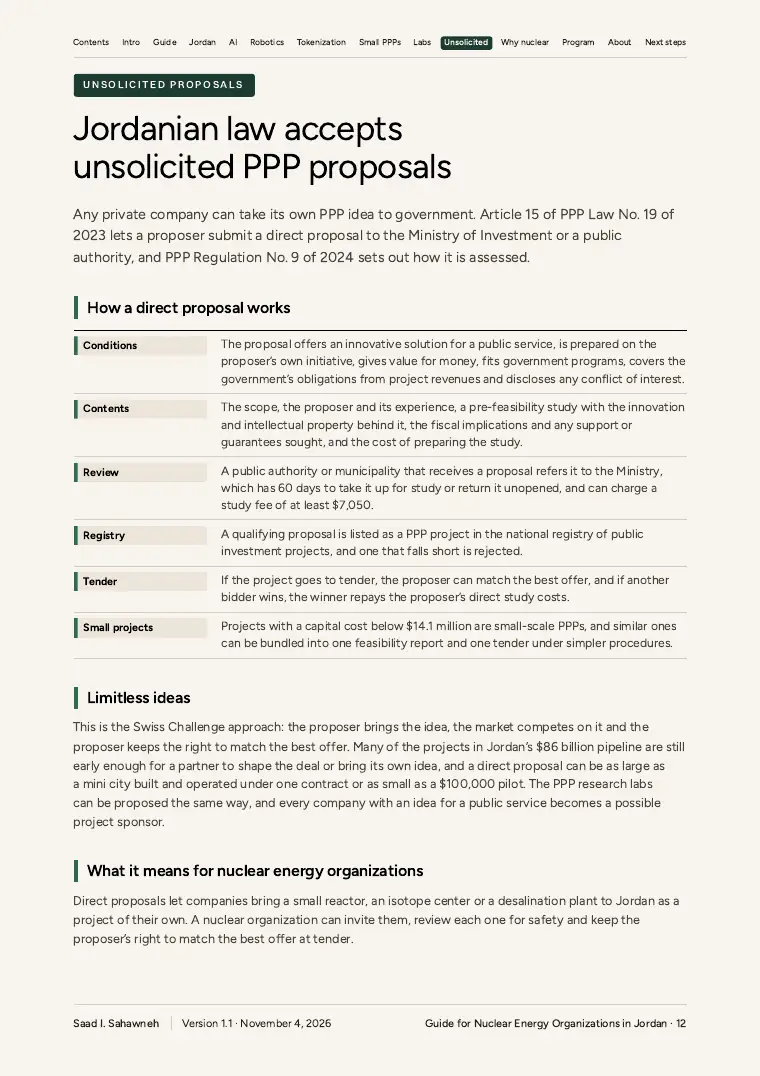
09Unsolicited proposals
How Jordan’s PPP law accepts direct proposals from private companies.
Page 12 of 17
10Why nuclear energy organizations
Nuclear energy organizations plan assets that serve generations
Page 13 of 17
11The program
The program can sit inside the organization’s technical, safety and planning teams, with a PPP lead at its center and offers built from the research and sites it already holds.
Page 14 of 17
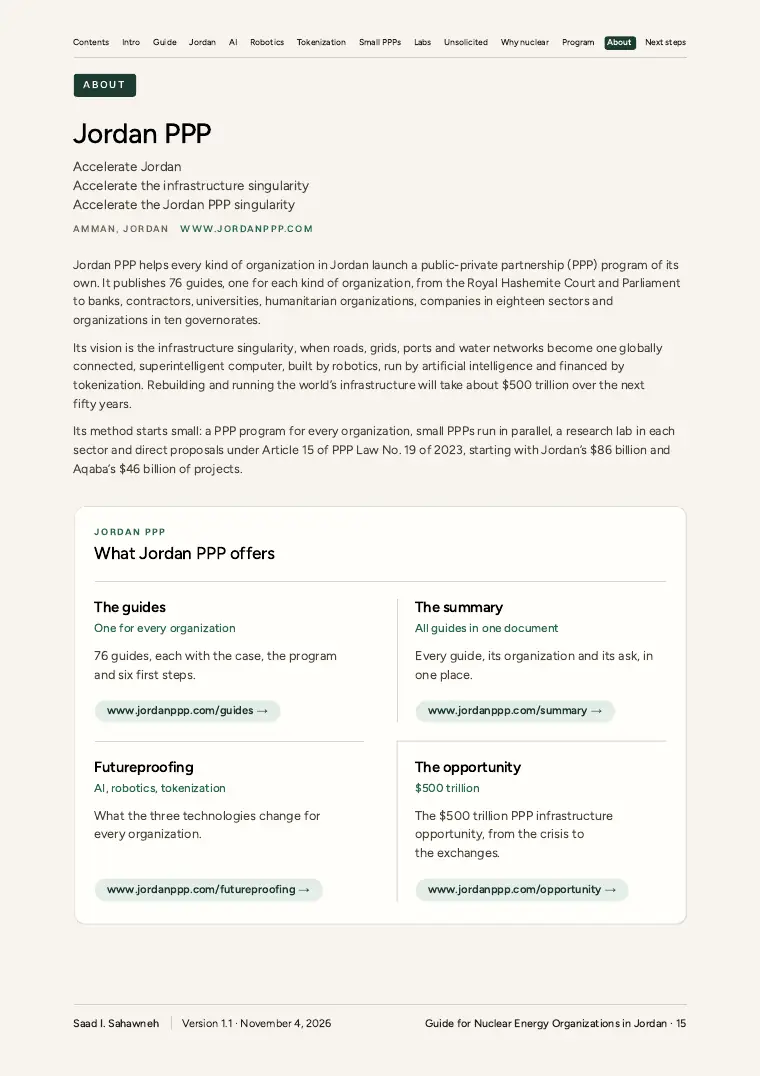
12About
About Jordan PPP and what it offers.
Page 15 of 17
13Next steps
How a nuclear organization can start: six first steps.
Page 16 of 17
Questions
Questions about the guide for Nuclear Energy Organizations in Jordan
- What does the guide for Nuclear Energy Organizations in Jordan propose?
- Your organization launches a PPP program to prepare, finance and deliver small modular reactors, nuclear-powered desalination and isotope production as public-private partnerships (PPPs).
- Why should nuclear energy organizations in Jordan launch a PPP program?
- Nuclear energy organizations plan assets that serve generations. A reactor runs for decades and needs steady finance, strict safety and a buyer for its power, heat or water. Those needs match the long contracts of a PPP, where partners share the cost and the risk while the state keeps control of safety and licensing.
- Which PPP projects can nuclear energy organizations in Jordan take part in?
- Jordan has about $86 billion of PPP and infrastructure projects in development, $46 billion of them anchored in Aqaba. Many of them, from desalination to industry, will need steady, low-carbon power for decades. A Jordanian nuclear organization that delivers one PPP at home can share the same model with countries planning nuclear power across the region.
- How can nuclear energy organizations in Jordan start a PPP program?
- Any nuclear energy organization in Jordan can take this guide forward. The first steps use the studies, sites and partners it already has. The guide sets out six first steps: mandate, team, pipeline, safety, partners and pilot.
- What does a PPP program give nuclear energy organizations in Jordan?
- The organization gains partners who share the cost and risk of nuclear projects, long contracts that make them bankable and a growing pool of Jordanian engineers who build and run each facility safely.
- Is the guide for Nuclear Energy Organizations in Jordan free?
- Yes. It is free to read on this page and free to download as a 17-page PDF, with the case for a PPP program, Jordan’s pipeline, the role of AI, robotics and tokenization, the program and six first steps.
Guide 46 of 76
Browse all 76 guides