
What this guide is for
Your institution launches a PPP program to finance the small contractors, suppliers, operators and households inside public-private partnership (PPP) projects.
The case
Microfinance institutions finance the small firms behind every PPP
Infrastructure finance has long gone to the largest contractors and banks, while the small firms and households around each project were left to find money on their own. The projects of the next fifty years will be built and run by thousands of small businesses, and the institutions that finance them now will grow with every contract. This guide invites microfinance institutions in Jordan to launch a PPP program, starting with the projects at home.
The guide
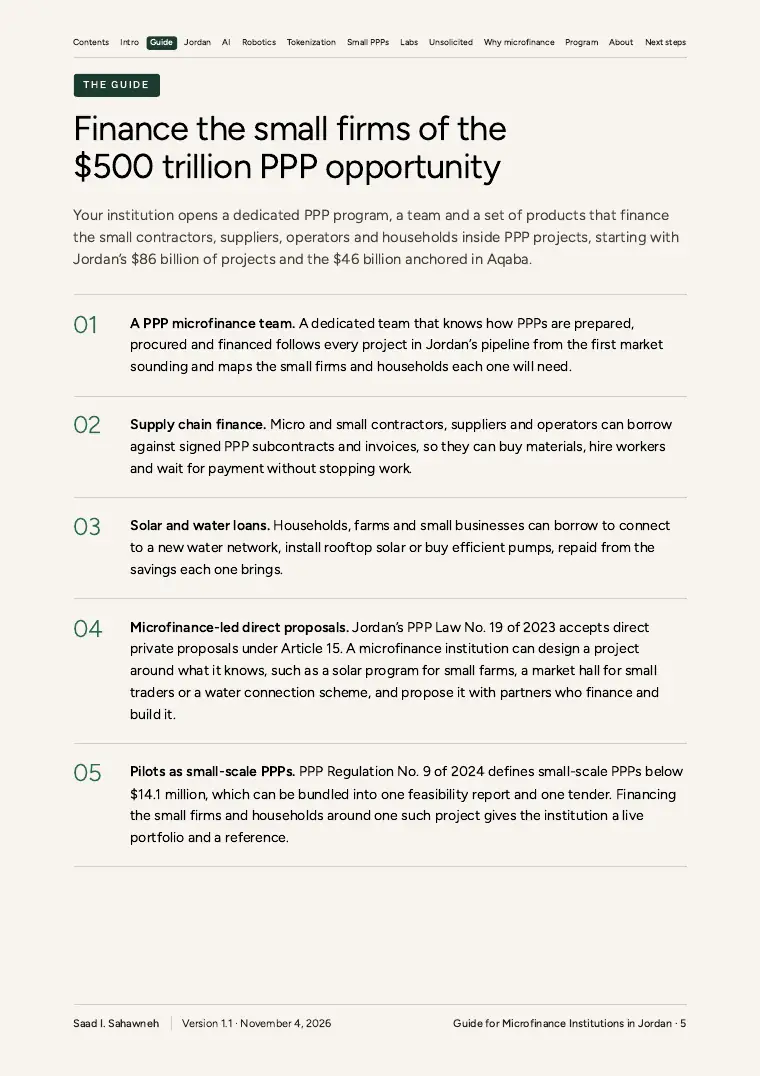
Finance the small firms of the $500 trillion PPP opportunity
Your institution opens a dedicated PPP program, a team and a set of products that finance the small contractors, suppliers, operators and households inside PPP projects, starting with Jordan’s $86 billion of projects and the $46 billion anchored in Aqaba.
01
A PPP microfinance team
A dedicated team that knows how PPPs are prepared, procured and financed follows every project in Jordan’s pipeline from the first market sounding and maps the small firms and households each one will need.
02
Supply chain finance
Micro and small contractors, suppliers and operators can borrow against signed PPP subcontracts and invoices, so they can buy materials, hire workers and wait for payment without stopping work.
03
Solar and water loans
Households, farms and small businesses can borrow to connect to a new water network, install rooftop solar or buy efficient pumps, repaid from the savings each one brings.
04
Microfinance-led direct proposals
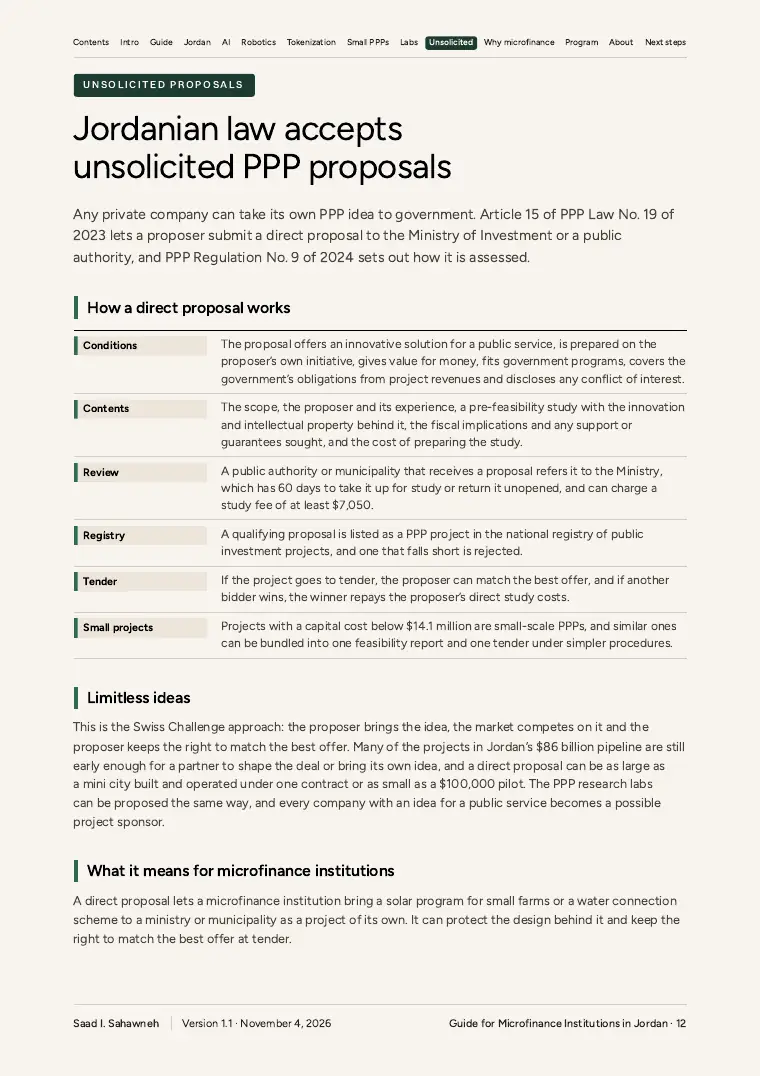
Jordan’s PPP Law No. 19 of 2023 accepts direct private proposals under Article 15. A microfinance institution can design a project around what it knows, such as a solar program for small farms, a market hall for small traders or a water connection scheme, and propose it with partners who finance and build it.
05
Pilots as small-scale PPPs
PPP Regulation No. 9 of 2024 defines small-scale PPPs below $14.1 million, which can be bundled into one feasibility report and one tender. Financing the small firms and households around one such project gives the institution a live portfolio and a reference.
Why microfinance institutions
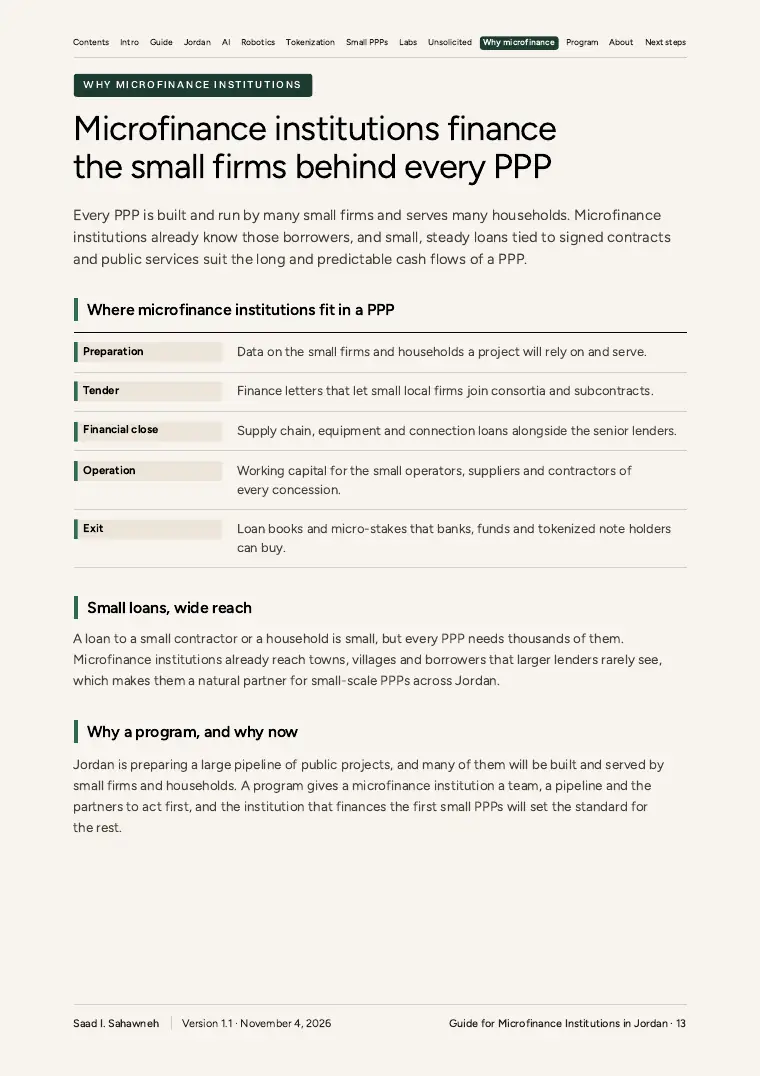
Microfinance institutions finance the small firms behind every PPP
Every PPP is built and run by many small firms and serves many households. Microfinance institutions already know those borrowers, and small, steady loans tied to signed contracts and public services suit the long and predictable cash flows of a PPP.
Where microfinance institutions fit in a PPP
- Preparation
- Data on the small firms and households a project will rely on and serve.
- Tender
- Finance letters that let small local firms join consortia and subcontracts.
- Financial close
- Supply chain, equipment and connection loans alongside the senior lenders.
- Operation
- Working capital for the small operators, suppliers and contractors of every concession.
- Exit
- Loan books and micro-stakes that banks, funds and tokenized note holders can buy.
Small loans, wide reach
A loan to a small contractor or a household is small, but every PPP needs thousands of them. Microfinance institutions already reach towns, villages and borrowers that larger lenders rarely see, which makes them a natural partner for small-scale PPPs across Jordan.
Why a program, and why now
Jordan is preparing a large pipeline of public projects, and many of them will be built and served by small firms and households. A program gives a microfinance institution a team, a pipeline and the partners to act first, and the institution that finances the first small PPPs will set the standard for the rest.

Futureproofing
Futureproof Microfinance Institutions in Jordan for the infrastructure singularity
This free 17-page guide shows how, with small PPPs in parallel, PPP research labs, artificial intelligence, robotics, tokenization and six first steps.

Jordan and Aqaba
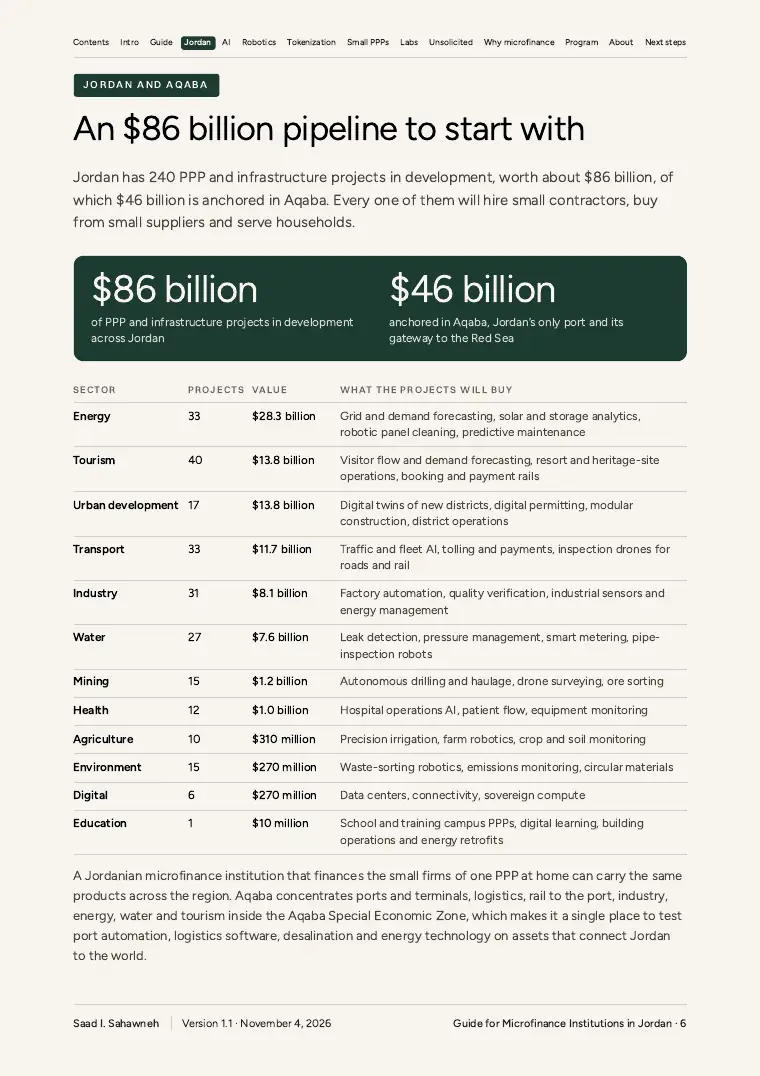
An $86 billion pipeline to start with
Every one of them will hire small contractors, buy from small suppliers and serve households. A Jordanian microfinance institution that finances the small firms of one PPP at home can carry the same products across the region.
- $86B
- of PPP and infrastructure projects in development in Jordan
- $46B
- of them anchored in Aqaba

Artificial intelligence
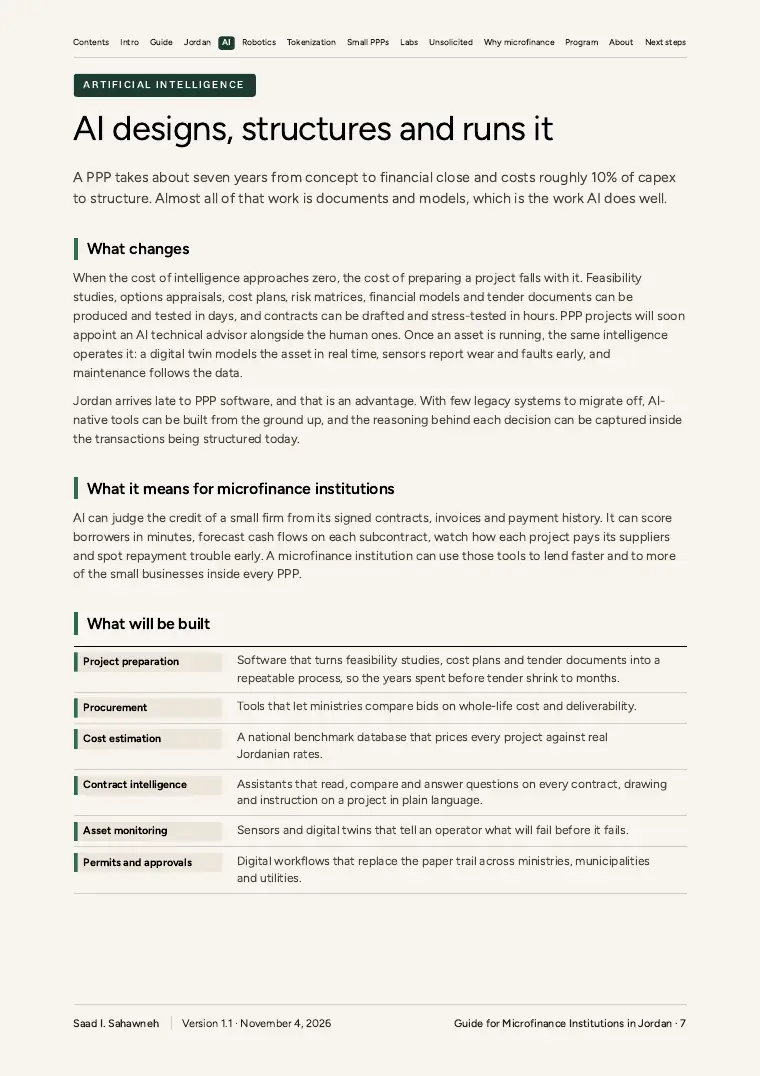
AI can judge the credit of a small firm from its signed contracts, invoices and payment history. It can score borrowers in minutes, forecast cash flows on each subcontract, watch how each project pays its suppliers and spot repayment trouble early. A microfinance institution can use those tools to lend faster and to more of the small businesses inside every PPP.

Robotics
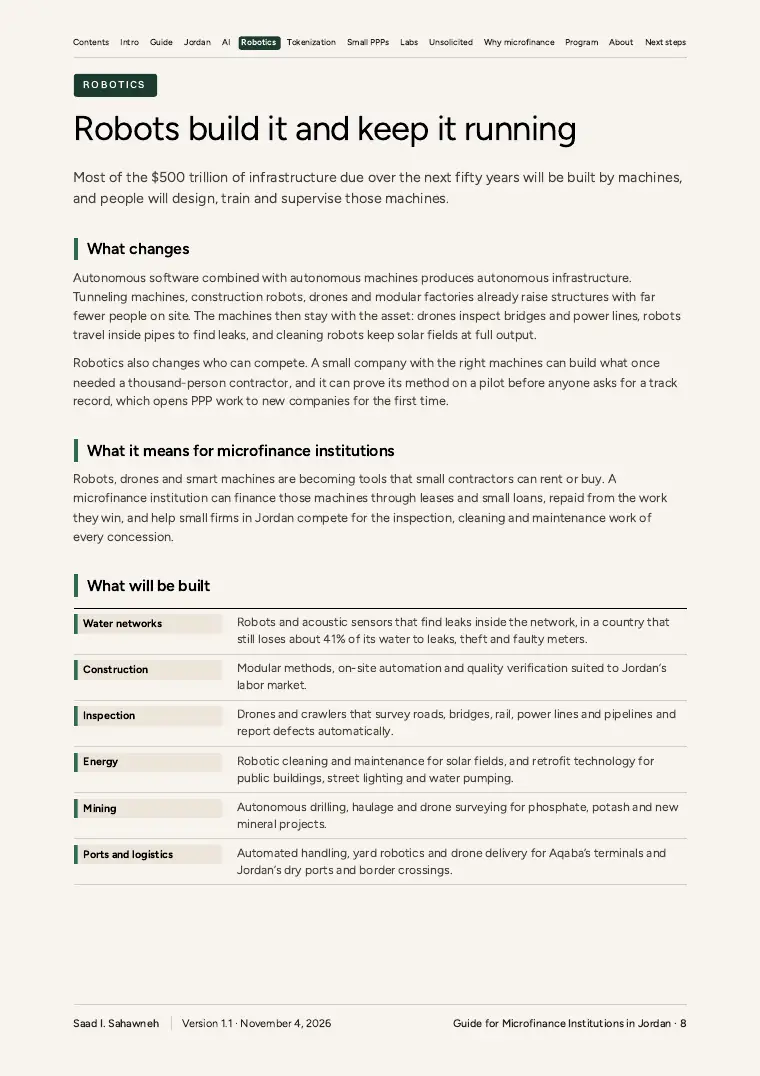
Robots, drones and smart machines are becoming tools that small contractors can rent or buy. A microfinance institution can finance those machines through leases and small loans, repaid from the work they win, and help small firms in Jordan compete for the inspection, cleaning and maintenance work of every concession.

Tokenization
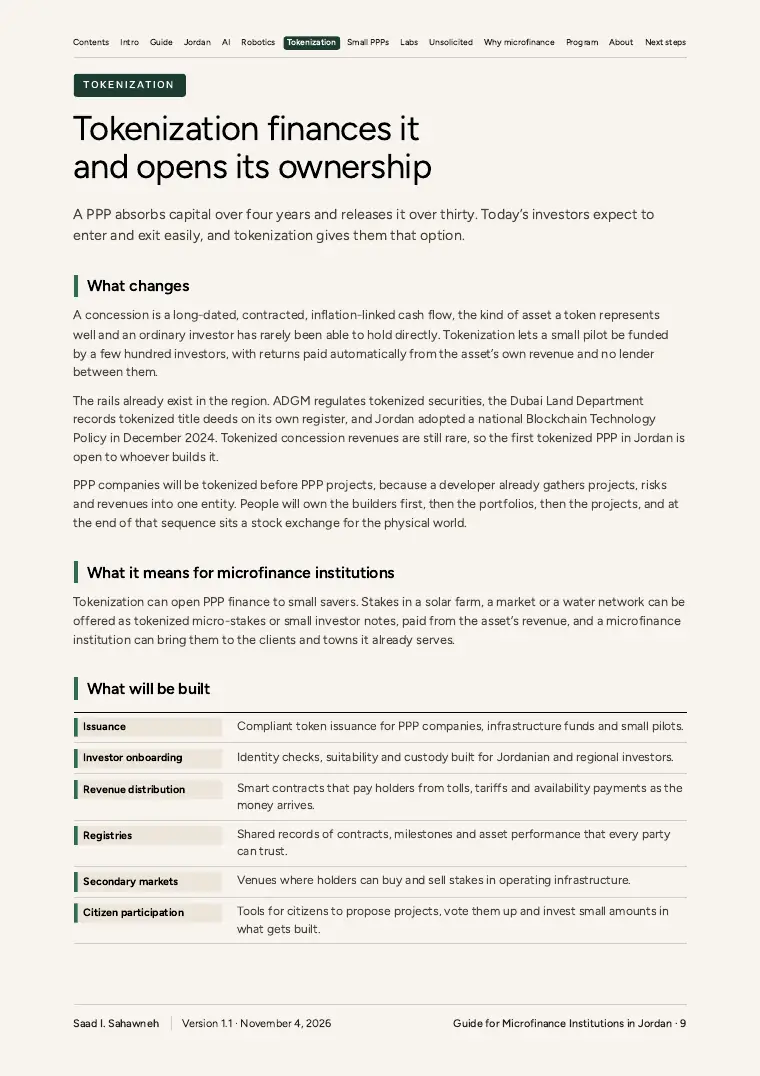
Tokenization can open PPP finance to small savers. Stakes in a solar farm, a market or a water network can be offered as tokenized micro-stakes or small investor notes, paid from the asset’s revenue, and a microfinance institution can bring them to the clients and towns it already serves.

Small PPPs and research labs
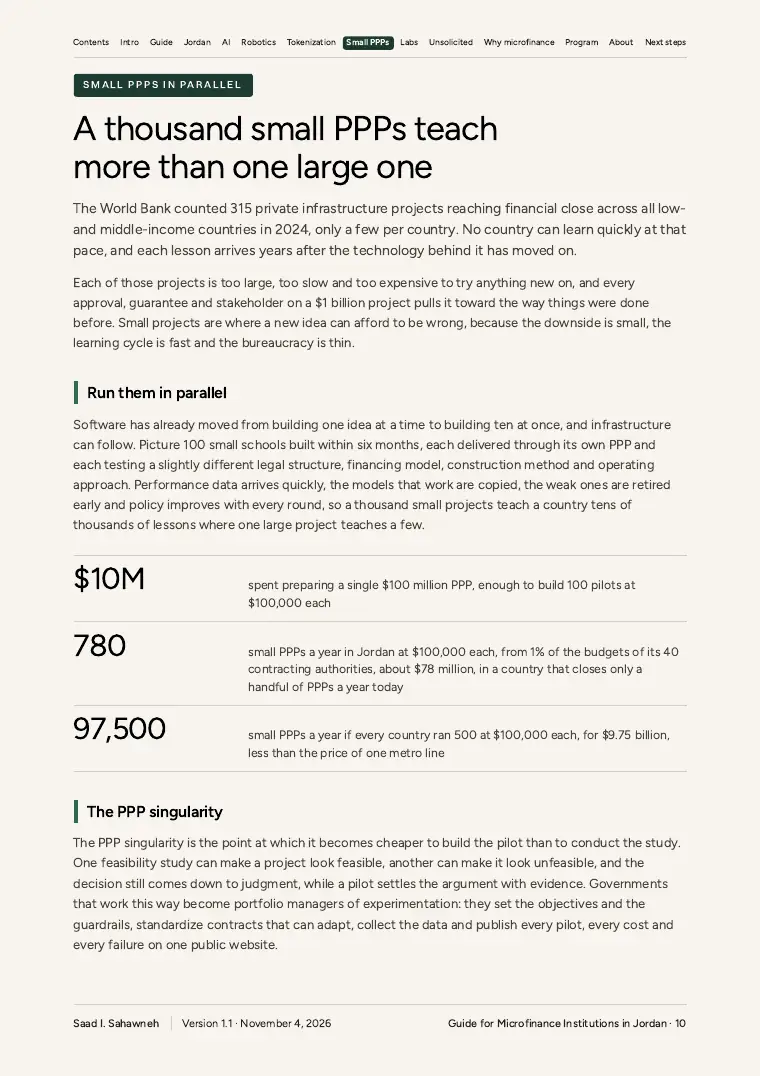
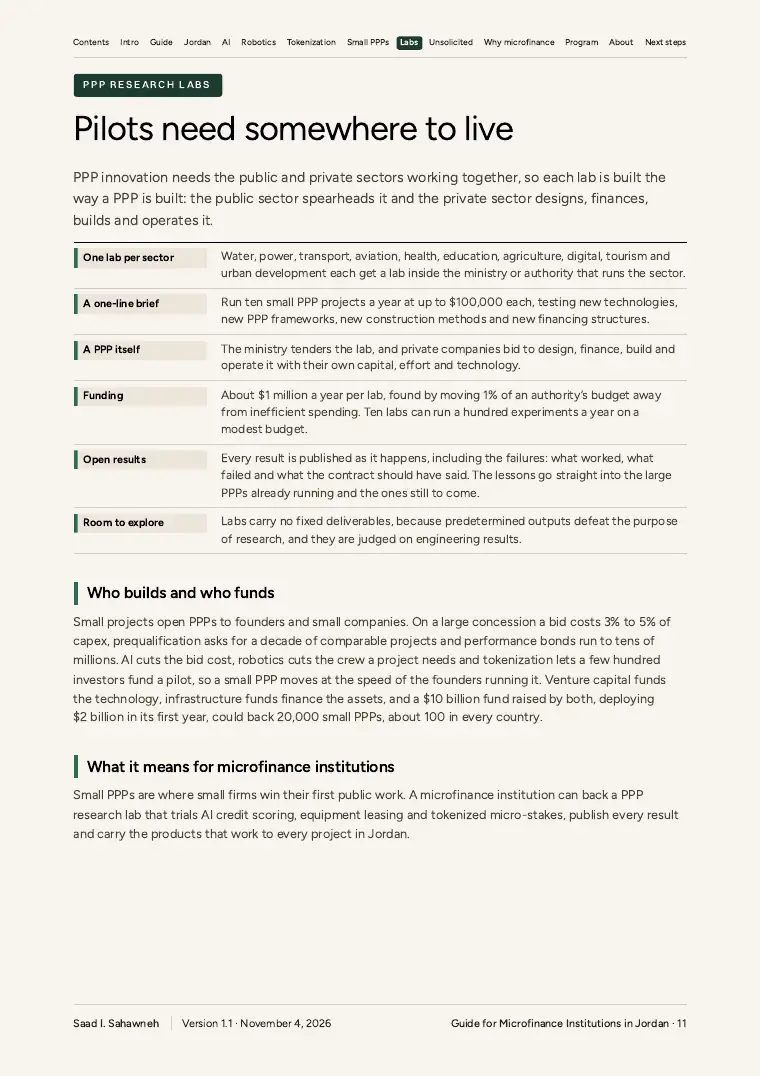
Small PPPs are where small firms win their first public work. A microfinance institution can back a PPP research lab that trials AI credit scoring, equipment leasing and tokenized micro-stakes, publish every result and carry the products that work to every project in Jordan.

Unsolicited proposals
A direct proposal lets a microfinance institution bring a solar program for small farms or a water connection scheme to a ministry or municipality as a project of its own. It can protect the design behind it and keep the right to match the best offer at tender.
The program
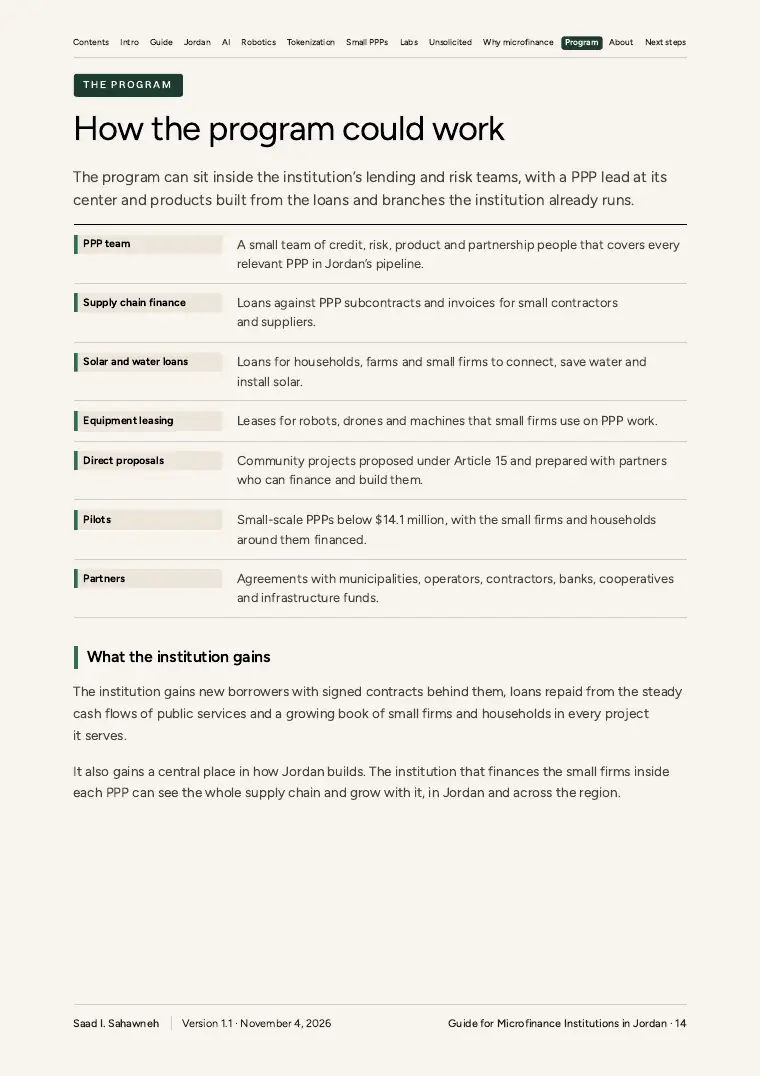
How the program could work
The program can sit inside the institution’s lending and risk teams, with a PPP lead at its center and products built from the loans and branches the institution already runs.
- PPP team
- A small team of credit, risk, product and partnership people that covers every relevant PPP in Jordan’s pipeline.
- Supply chain finance
- Loans against PPP subcontracts and invoices for small contractors and suppliers.
- Solar and water loans
- Loans for households, farms and small firms to connect, save water and install solar.
- Equipment leasing
- Leases for robots, drones and machines that small firms use on PPP work.
- Direct proposals
- Community projects proposed under Article 15 and prepared with partners who can finance and build them.
- Pilots
- Small-scale PPPs below $14.1 million, with the small firms and households around them financed.
- Partners
- Agreements with municipalities, operators, contractors, banks, cooperatives and infrastructure funds.
What the institution gains
The institution gains new borrowers with signed contracts behind them, loans repaid from the steady cash flows of public services and a growing book of small firms and households in every project it serves.
It also gains a central place in how Jordan builds. The institution that finances the small firms inside each PPP can see the whole supply chain and grow with it, in Jordan and across the region.

Next steps
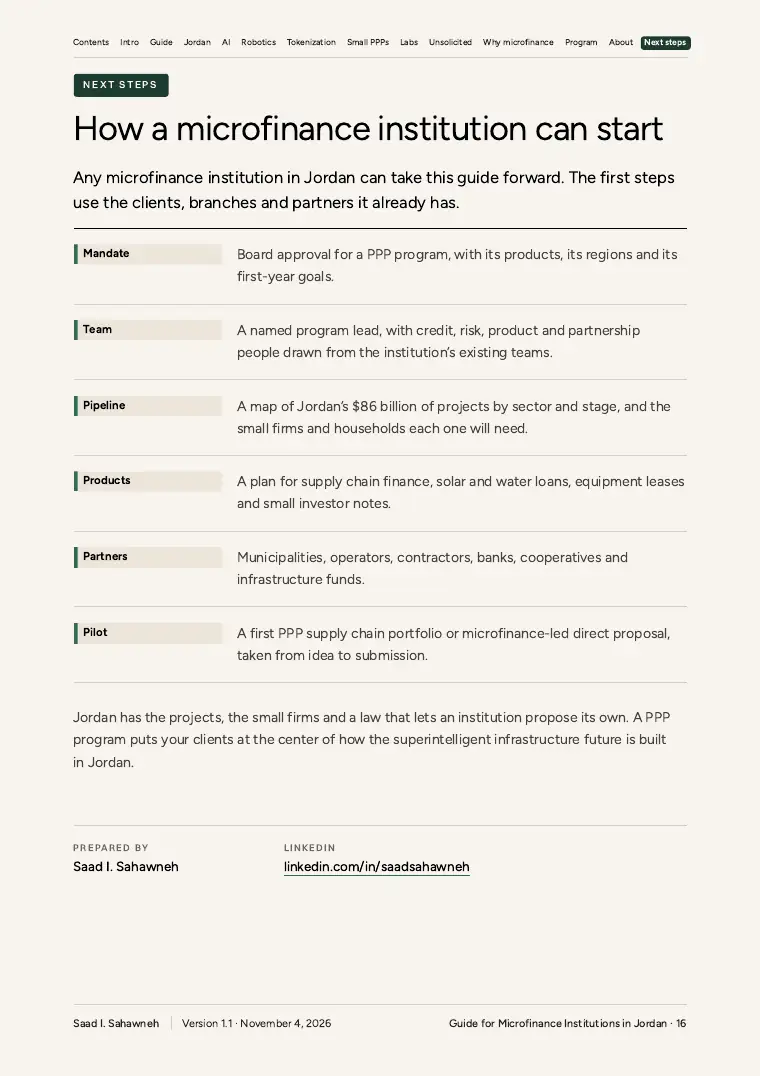
How a microfinance institution can start
Any microfinance institution in Jordan can take this guide forward. The first steps use the clients, branches and partners it already has.
01
Mandate
Board approval for a PPP program, with its products, its regions and its first-year goals.
02
Team
A named program lead, with credit, risk, product and partnership people drawn from the institution’s existing teams.
03
Pipeline
A map of Jordan’s $86 billion of projects by sector and stage, and the small firms and households each one will need.
04
Products
A plan for supply chain finance, solar and water loans, equipment leases and small investor notes.
05
Partners
Municipalities, operators, contractors, banks, cooperatives and infrastructure funds.
06
Pilot
A first PPP supply chain portfolio or microfinance-led direct proposal, taken from idea to submission.
Jordan has the projects, the small firms and a law that lets an institution propose its own. A PPP program puts your clients at the center of how the superintelligent infrastructure future is built in Jordan.
The full document
Inside this guide
Seventeen pages and thirteen chapters, from the case for a PPP program to the first steps, written for microfinance institutions in Jordan.
- 17
- pages
- 13
- chapters
- 3
- technologies
- 6
- first steps
01Introduction
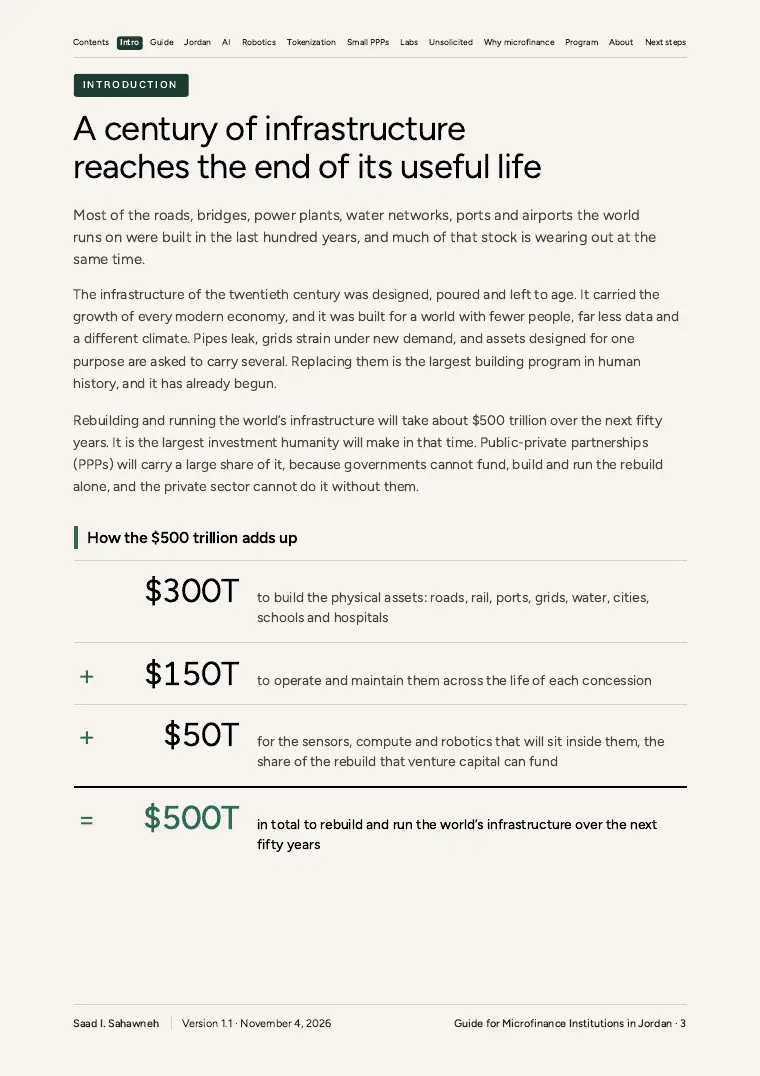
Why a century of infrastructure needs rebuilding, and the $500 trillion it will take.
Page 3 of 17
02The guide
Finance the small firms of the $500 trillion PPP opportunity
Page 5 of 17
03Jordan and Aqaba
An $86 billion pipeline to start with
Page 6 of 17
04Artificial intelligence
How AI designs, structures and runs PPP projects, and what it means for microfinance institutions.
Page 7 of 17
05Robotics
How robots build infrastructure and keep it running, and what that means for microfinance institutions.
Page 8 of 17
06Tokenization
How tokenization funds projects from their own revenue, and the role it opens for microfinance institutions.
Page 9 of 17
07Small PPPs in parallel
Why many small PPPs teach a country faster than a few large ones.
Page 10 of 17
08PPP research labs
A lab in each sector, running ten small PPP projects a year.
Page 11 of 17
09Unsolicited proposals
How Jordan’s PPP law accepts direct proposals from private companies.
Page 12 of 17
10Why microfinance institutions
Microfinance institutions finance the small firms behind every PPP
Page 13 of 17
11The program
The program can sit inside the institution’s lending and risk teams, with a PPP lead at its center and products built from the loans and branches the institution already runs.
Page 14 of 17
12About
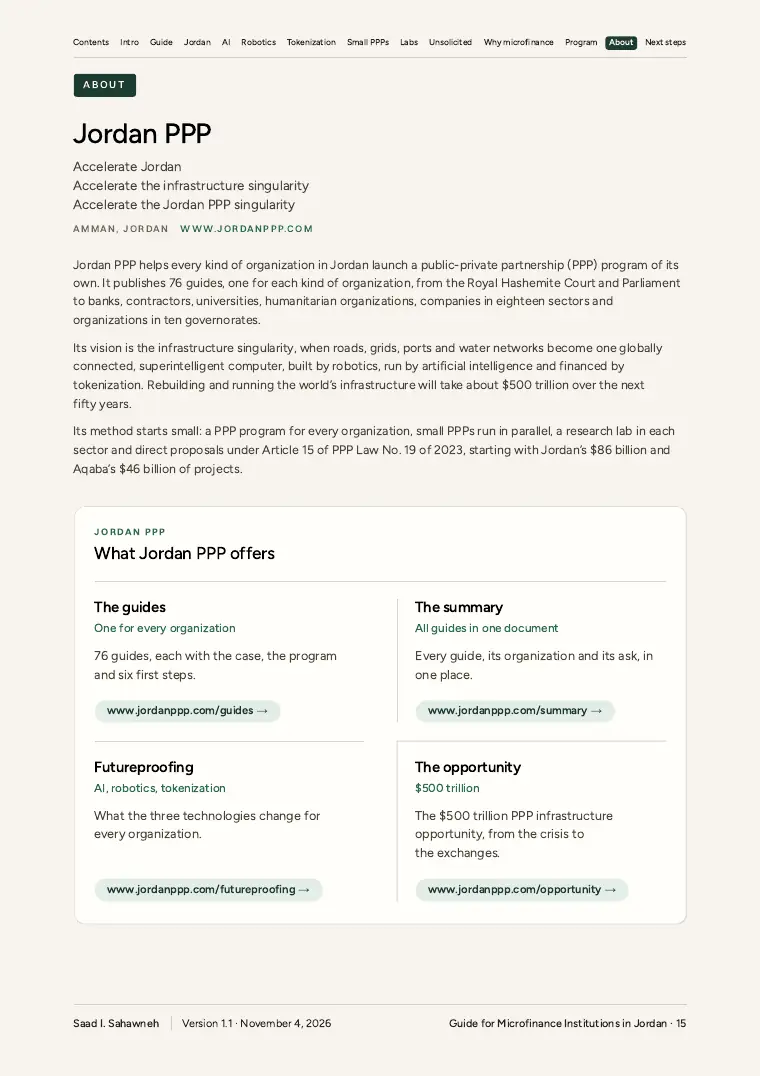
About Jordan PPP and what it offers.
Page 15 of 17
13Next steps
How a microfinance institution can start: six first steps.
Page 16 of 17
Questions
Questions about the guide for Microfinance Institutions in Jordan
- What does the guide for Microfinance Institutions in Jordan propose?
- Your institution launches a PPP program to finance the small contractors, suppliers, operators and households inside public-private partnership (PPP) projects.
- Why should microfinance institutions in Jordan launch a PPP program?
- Microfinance institutions finance the small firms behind every PPP. Every PPP is built and run by many small firms and serves many households. Microfinance institutions already know those borrowers, and small, steady loans tied to signed contracts and public services suit the long and predictable cash flows of a PPP.
- Which PPP projects can microfinance institutions in Jordan take part in?
- Jordan has about $86 billion of PPP and infrastructure projects in development, $46 billion of them anchored in Aqaba. Every one of them will hire small contractors, buy from small suppliers and serve households. A Jordanian microfinance institution that finances the small firms of one PPP at home can carry the same products across the region.
- How can microfinance institutions in Jordan start a PPP program?
- Any microfinance institution in Jordan can take this guide forward. The first steps use the clients, branches and partners it already has. The guide sets out six first steps: mandate, team, pipeline, products, partners and pilot.
- What does a PPP program give microfinance institutions in Jordan?
- The institution gains new borrowers with signed contracts behind them, loans repaid from the steady cash flows of public services and a growing book of small firms and households in every project it serves.
- Is the guide for Microfinance Institutions in Jordan free?
- Yes. It is free to read on this page and free to download as a 17-page PDF, with the case for a PPP program, Jordan’s pipeline, the role of AI, robotics and tokenization, the program and six first steps.
Guide 19 of 76
Browse all 76 guides