
What this guide is for
Members of Parliament launch a parliamentary PPP program that follows, supports and scrutinizes public-private partnerships (PPPs) and brings small projects to every constituency.
The case
Parliament sets the rules every PPP depends on
Infrastructure has mostly been planned in ministries and reported to Parliament after the contracts were signed. The projects of the next fifty years will run for decades, cross many governments and touch every constituency, and the members who understand them early will shape the laws and the projects their voters live with. This guide invites members of parliament in Jordan to launch a PPP program, starting with the projects at home.
The guide
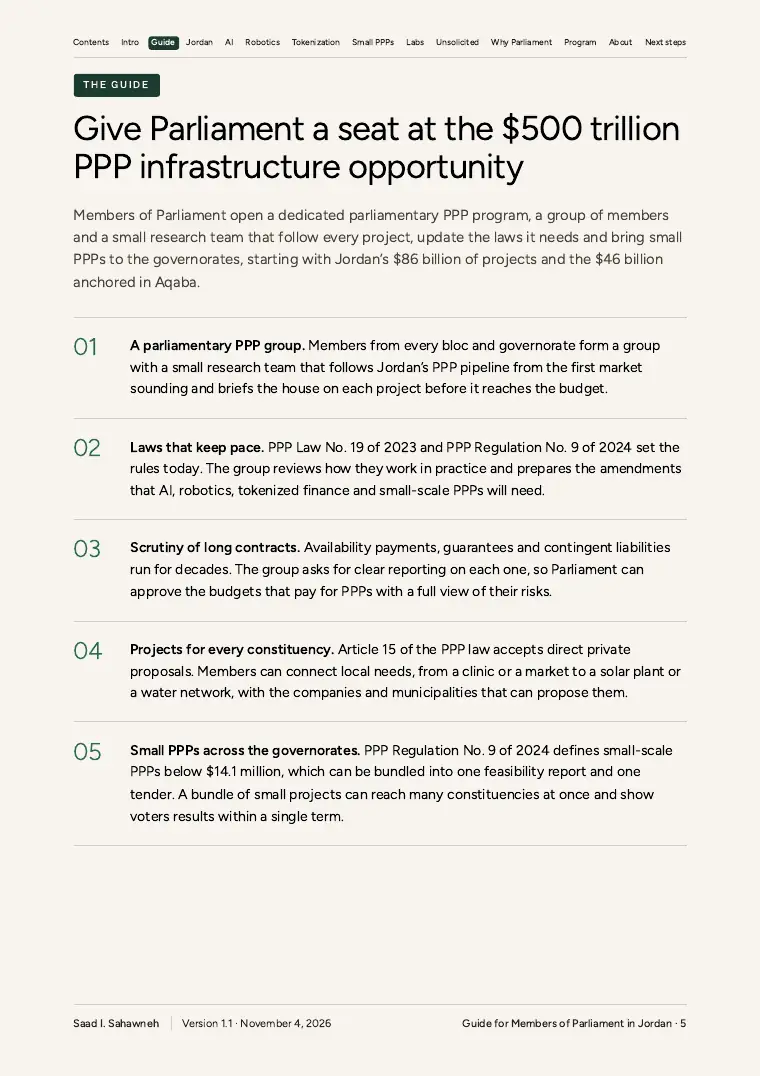
Give Parliament a seat at the $500 trillion PPP infrastructure opportunity
Members of Parliament open a dedicated parliamentary PPP program, a group of members and a small research team that follow every project, update the laws it needs and bring small PPPs to the governorates, starting with Jordan’s $86 billion of projects and the $46 billion anchored in Aqaba.
01
A parliamentary PPP group
Members from every bloc and governorate form a group with a small research team that follows Jordan’s PPP pipeline from the first market sounding and briefs the house on each project before it reaches the budget.
02
Laws that keep pace
PPP Law No. 19 of 2023 and PPP Regulation No. 9 of 2024 set the rules today. The group reviews how they work in practice and prepares the amendments that AI, robotics, tokenized finance and small-scale PPPs will need.
03
Scrutiny of long contracts
Availability payments, guarantees and contingent liabilities run for decades. The group asks for clear reporting on each one, so Parliament can approve the budgets that pay for PPPs with a full view of their risks.
04
Projects for every constituency
Article 15 of the PPP law accepts direct private proposals. Members can connect local needs, from a clinic or a market to a solar plant or a water network, with the companies and municipalities that can propose them.
05
Small PPPs across the governorates
PPP Regulation No. 9 of 2024 defines small-scale PPPs below $14.1 million, which can be bundled into one feasibility report and one tender. A bundle of small projects can reach many constituencies at once and show voters results within a single term.
Why members of parliament
Parliament sets the rules every PPP depends on
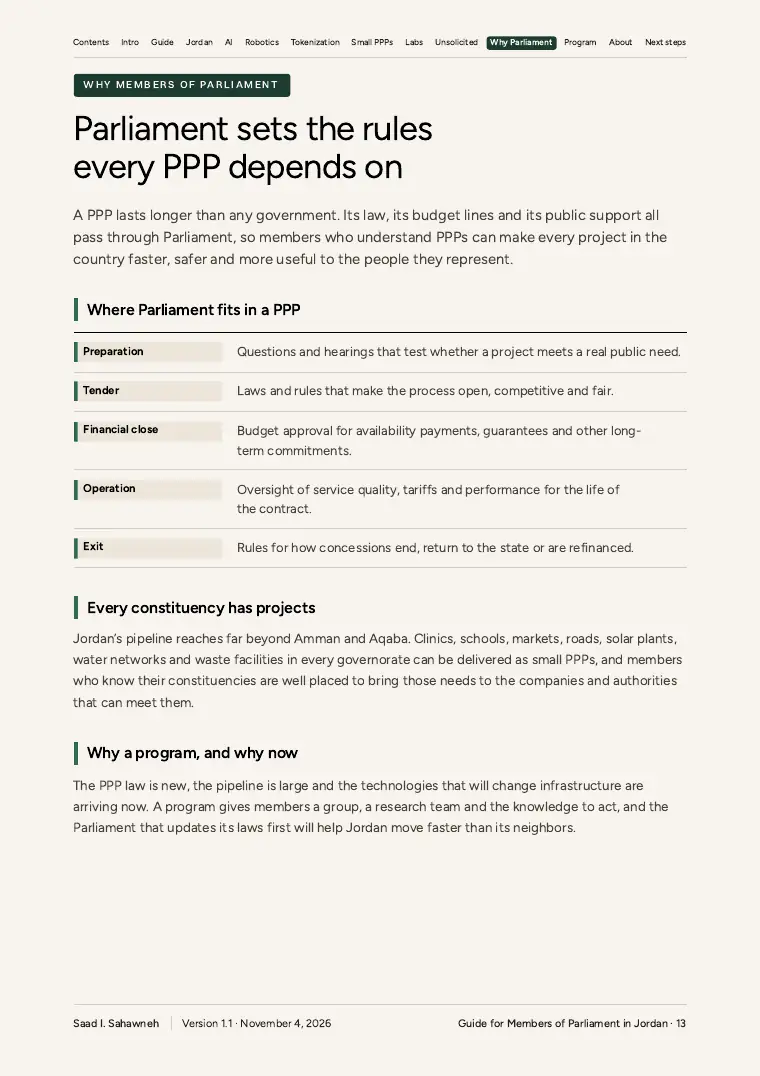
A PPP lasts longer than any government. Its law, its budget lines and its public support all pass through Parliament, so members who understand PPPs can make every project in the country faster, safer and more useful to the people they represent.
Where Parliament fits in a PPP
- Preparation
- Questions and hearings that test whether a project meets a real public need.
- Tender
- Laws and rules that make the process open, competitive and fair.
- Financial close
- Budget approval for availability payments, guarantees and other long-term commitments.
- Operation
- Oversight of service quality, tariffs and performance for the life of the contract.
- Exit
- Rules for how concessions end, return to the state or are refinanced.
Every constituency has projects
Jordan’s pipeline reaches far beyond Amman and Aqaba. Clinics, schools, markets, roads, solar plants, water networks and waste facilities in every governorate can be delivered as small PPPs, and members who know their constituencies are well placed to bring those needs to the companies and authorities that can meet them.
Why a program, and why now
The PPP law is new, the pipeline is large and the technologies that will change infrastructure are arriving now. A program gives members a group, a research team and the knowledge to act, and the Parliament that updates its laws first will help Jordan move faster than its neighbors.

Futureproofing
Futureproof Members of Parliament in Jordan for the infrastructure singularity
This free 17-page guide shows how, with small PPPs in parallel, PPP research labs, artificial intelligence, robotics, tokenization and six first steps.
Jordan and Aqaba
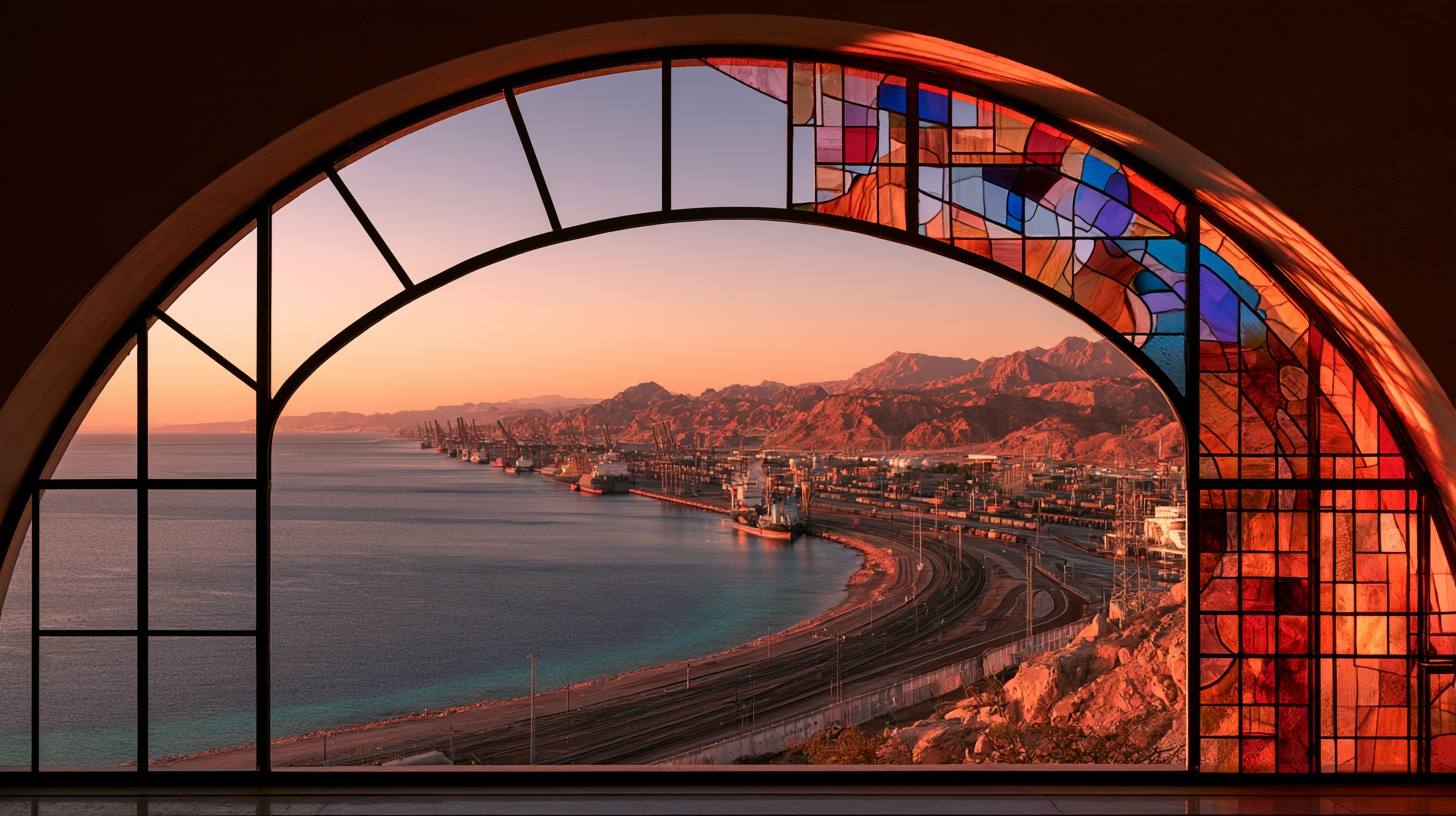
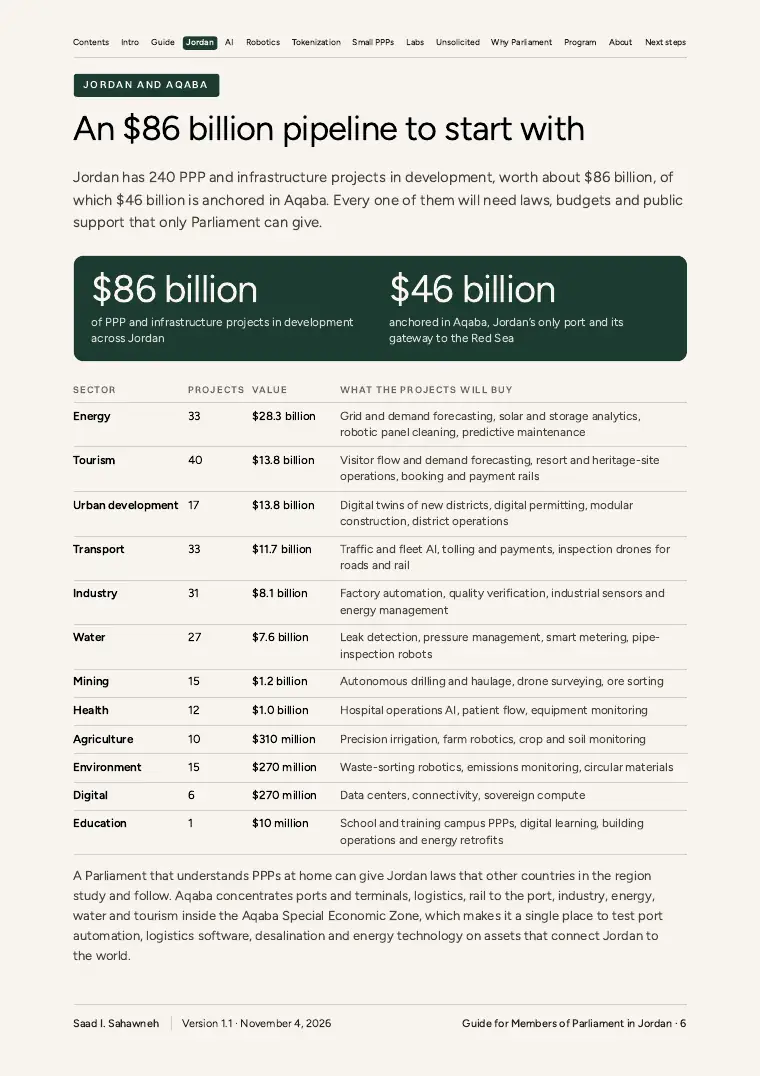
An $86 billion pipeline to start with
Every one of them will need laws, budgets and public support that only Parliament can give. A Parliament that understands PPPs at home can give Jordan laws that other countries in the region study and follow.
- $86B
- of PPP and infrastructure projects in development in Jordan
- $46B
- of them anchored in Aqaba

Artificial intelligence
AI can give every member a clear view of the pipeline. It can read feasibility studies, contracts and budget lines, flag the long-term payments and risks they create and answer a member’s questions in plain Arabic or English. A parliamentary research team can use the same tools to compare Jordan’s PPP laws with those of other countries.

Robotics
Robotic construction and maintenance will change how public works are delivered and who does the work. Members can ask how each project trains Jordanian technicians to run the machines, how robots improve safety on site and how faster delivery reaches their constituencies.

Tokenization
Tokenization could let Jordanian citizens invest small amounts in the projects that serve them. Members can review the rules that would allow tokenized PPP notes, protect small investors and make sure the returns reach the people of each governorate.

Small PPPs and research labs
Small PPPs reach every constituency faster than large ones. Members can support a PPP research lab in each sector, ask for every result to be published and help bring the pilots that work to the governorates they represent.

Unsolicited proposals
Direct proposals let companies and municipalities bring projects built around local needs. Members can point proposers to the needs in their constituencies, ask that every proposal is reviewed openly and on time, and make sure the right to match the best offer keeps each tender competitive.
The program
How the program could work
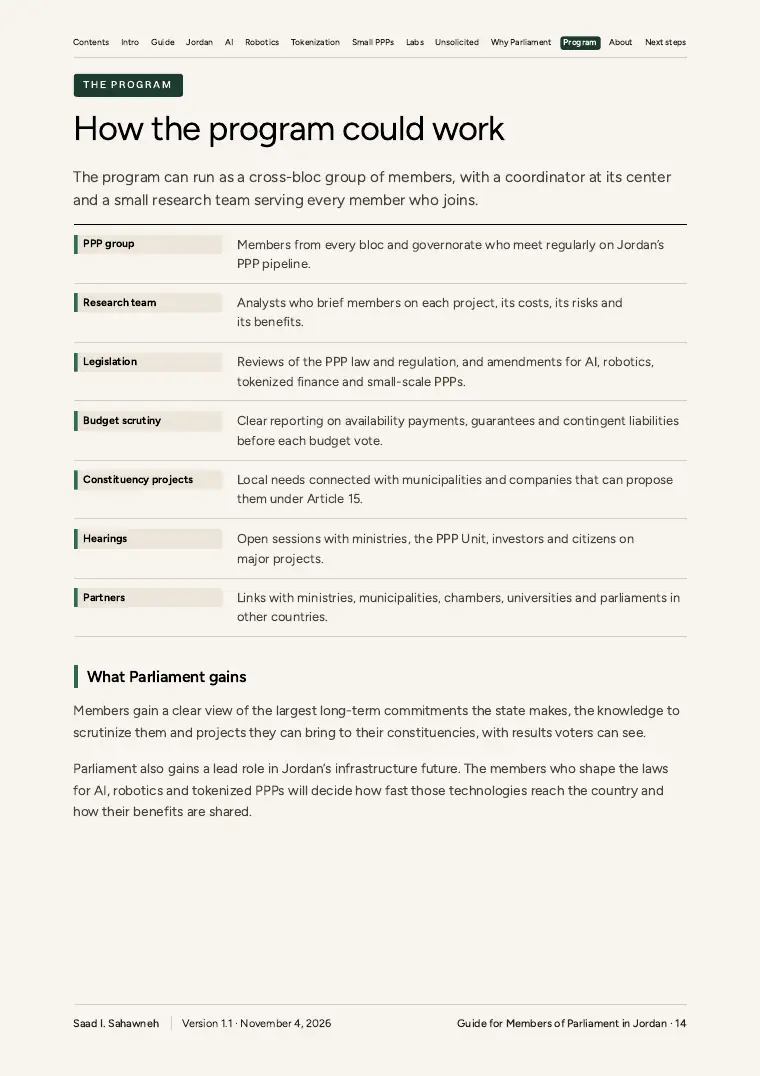
The program can run as a cross-bloc group of members, with a coordinator at its center and a small research team serving every member who joins.
- PPP group
- Members from every bloc and governorate who meet regularly on Jordan’s PPP pipeline.
- Research team
- Analysts who brief members on each project, its costs, its risks and its benefits.
- Legislation
- Reviews of the PPP law and regulation, and amendments for AI, robotics, tokenized finance and small-scale PPPs.
- Budget scrutiny
- Clear reporting on availability payments, guarantees and contingent liabilities before each budget vote.
- Constituency projects
- Local needs connected with municipalities and companies that can propose them under Article 15.
- Hearings
- Open sessions with ministries, the PPP Unit, investors and citizens on major projects.
- Partners
- Links with ministries, municipalities, chambers, universities and parliaments in other countries.
What Parliament gains
Members gain a clear view of the largest long-term commitments the state makes, the knowledge to scrutinize them and projects they can bring to their constituencies, with results voters can see.
Parliament also gains a lead role in Jordan’s infrastructure future. The members who shape the laws for AI, robotics and tokenized PPPs will decide how fast those technologies reach the country and how their benefits are shared.

Next steps
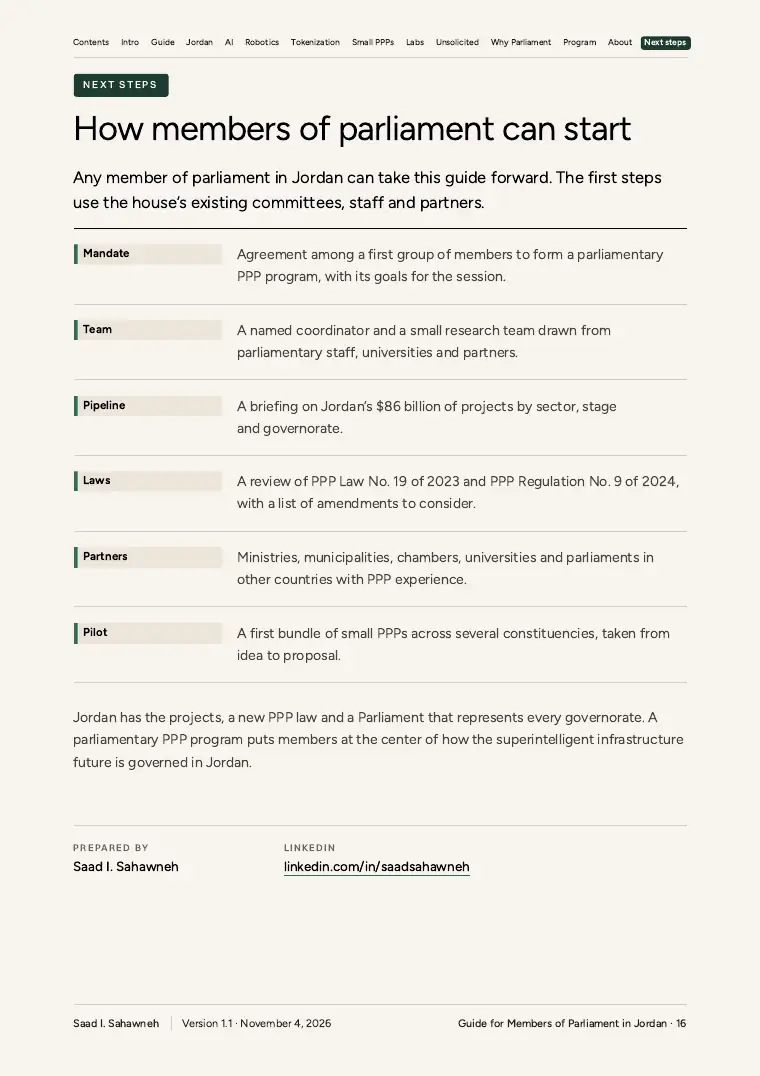
How members of parliament can start
Any member of parliament in Jordan can take this guide forward. The first steps use the house’s existing committees, staff and partners.
01
Mandate
Agreement among a first group of members to form a parliamentary PPP program, with its goals for the session.
02
Team
A named coordinator and a small research team drawn from parliamentary staff, universities and partners.
03
Pipeline
A briefing on Jordan’s $86 billion of projects by sector, stage and governorate.
04
Laws
A review of PPP Law No. 19 of 2023 and PPP Regulation No. 9 of 2024, with a list of amendments to consider.
05
Partners
Ministries, municipalities, chambers, universities and parliaments in other countries with PPP experience.
06
Pilot
A first bundle of small PPPs across several constituencies, taken from idea to proposal.
Jordan has the projects, a new PPP law and a Parliament that represents every governorate. A parliamentary PPP program puts members at the center of how the superintelligent infrastructure future is governed in Jordan.
The full document
Inside this guide
Seventeen pages and thirteen chapters, from the case for a PPP program to the first steps, written for members of parliament in Jordan.
- 17
- pages
- 13
- chapters
- 3
- technologies
- 6
- first steps
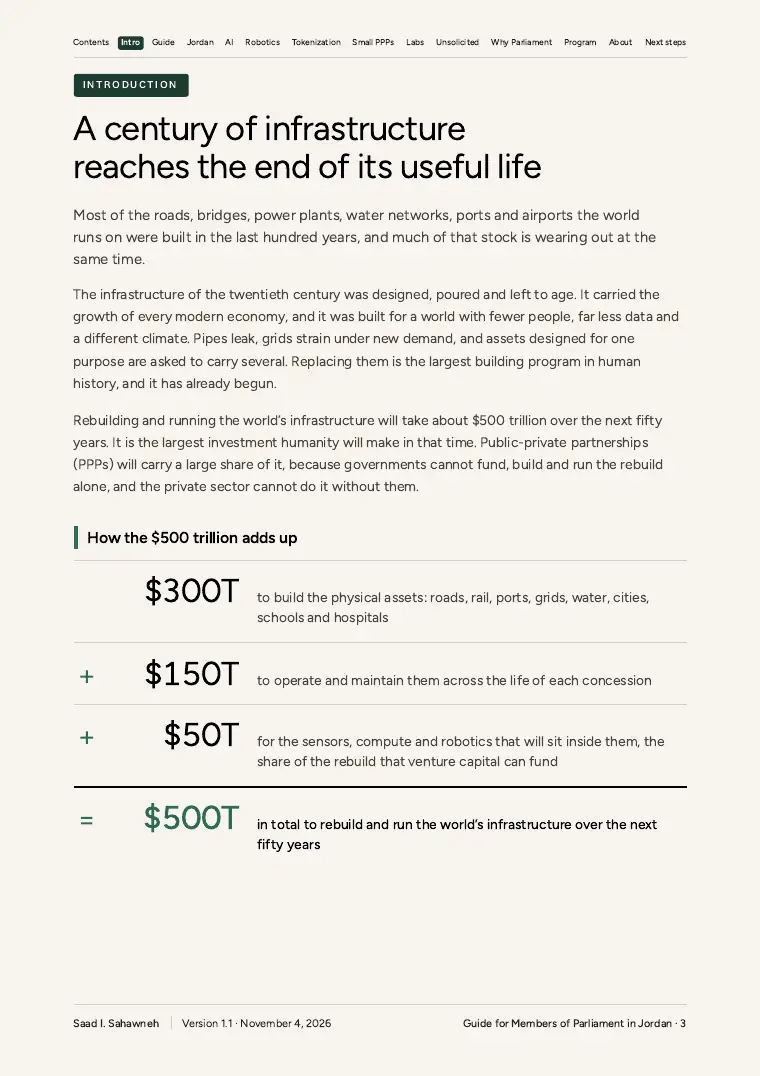
01Introduction
Why a century of infrastructure needs rebuilding, and the $500 trillion it will take.
Page 3 of 17
02The guide
Give Parliament a seat at the $500 trillion PPP infrastructure opportunity
Page 5 of 17
03Jordan and Aqaba
An $86 billion pipeline to start with
Page 6 of 17
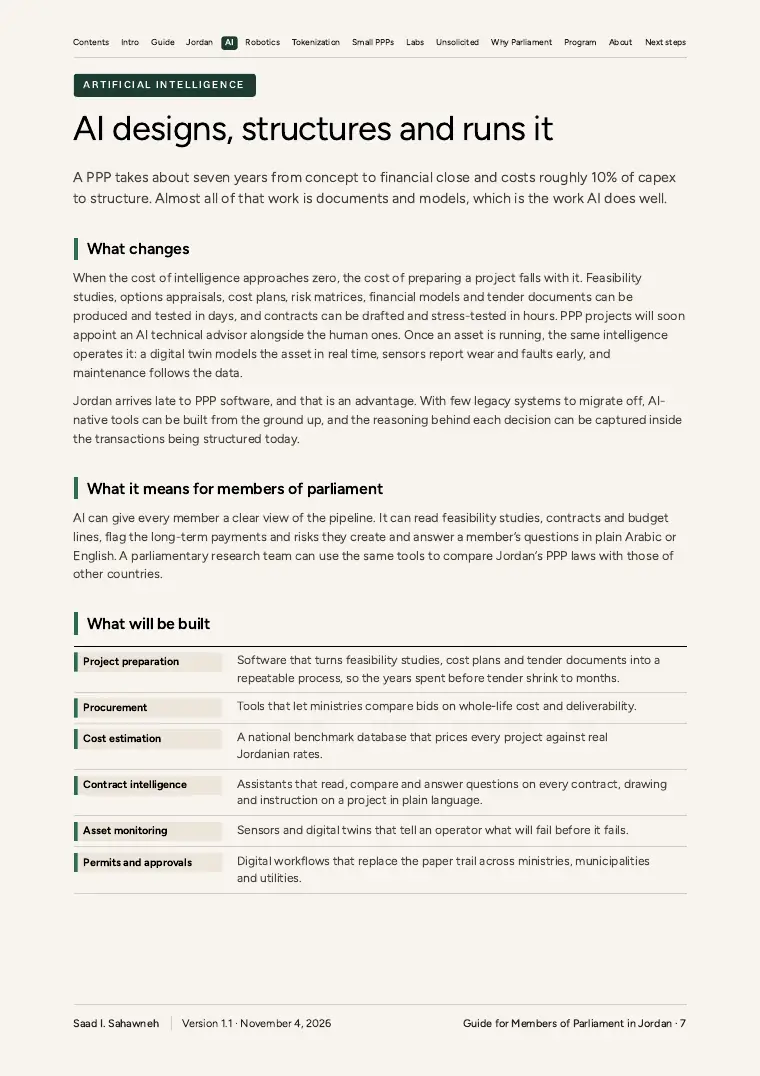
04Artificial intelligence
How AI designs, structures and runs PPP projects, and what it means for members of parliament.
Page 7 of 17
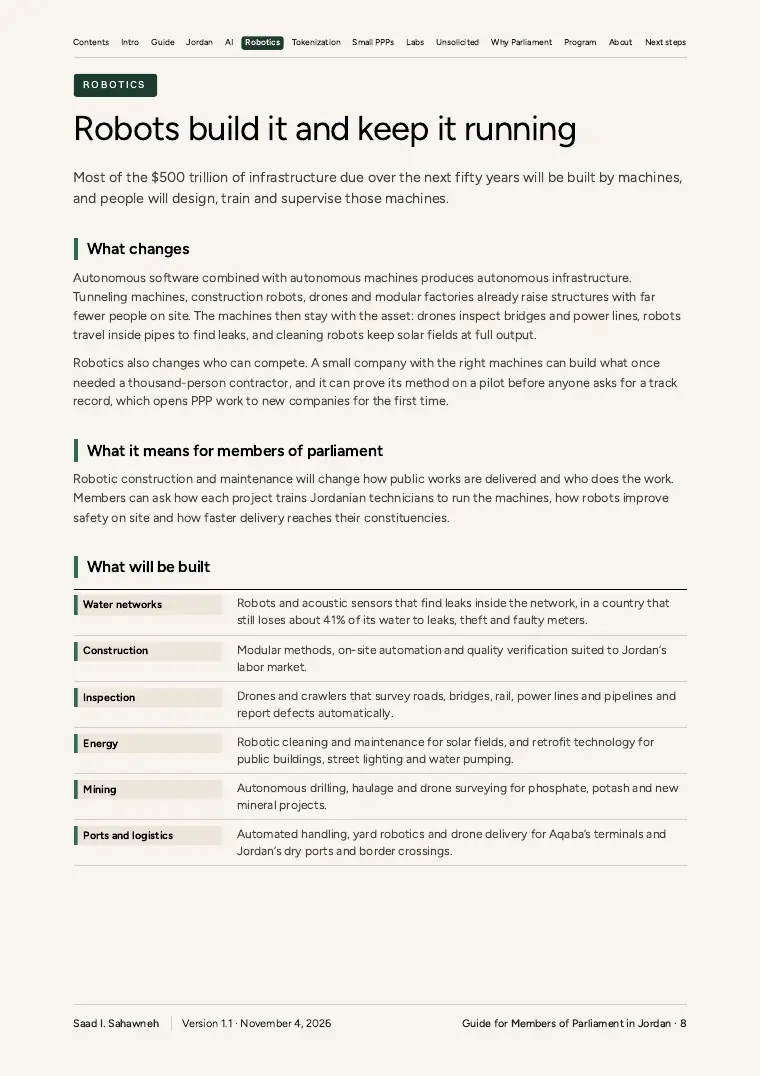
05Robotics
How robots build infrastructure and keep it running, and what that means for members of parliament.
Page 8 of 17
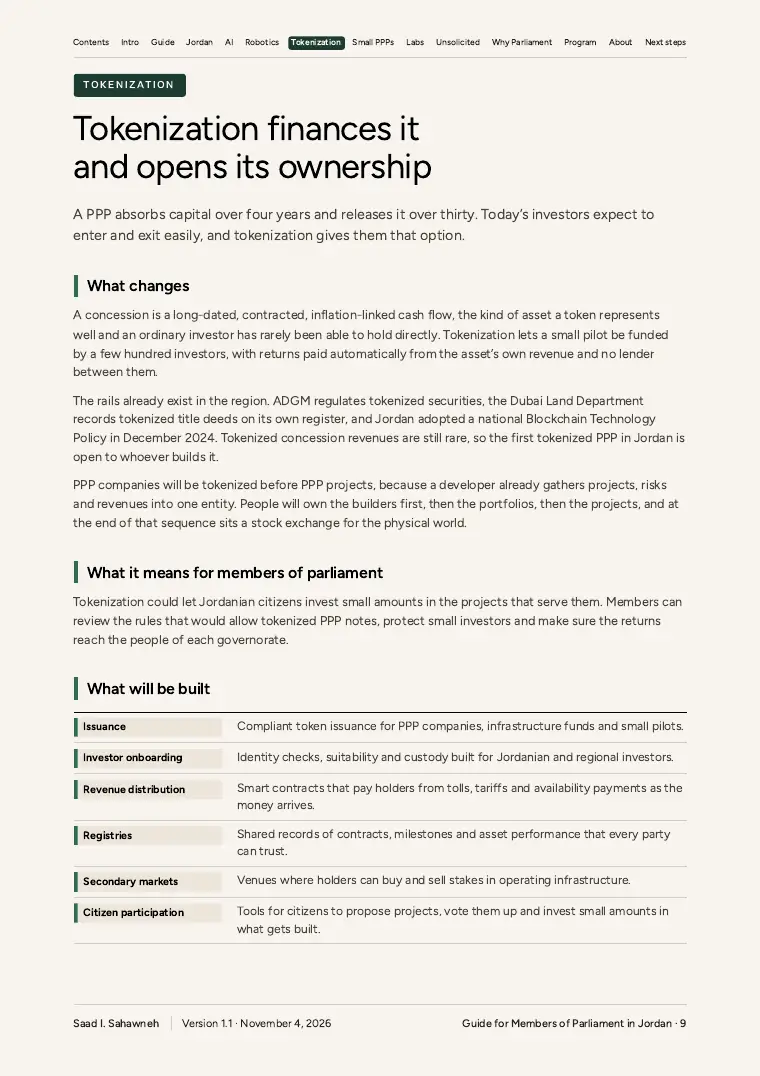
06Tokenization
How tokenization funds projects from their own revenue, and the role it opens for members of parliament.
Page 9 of 17
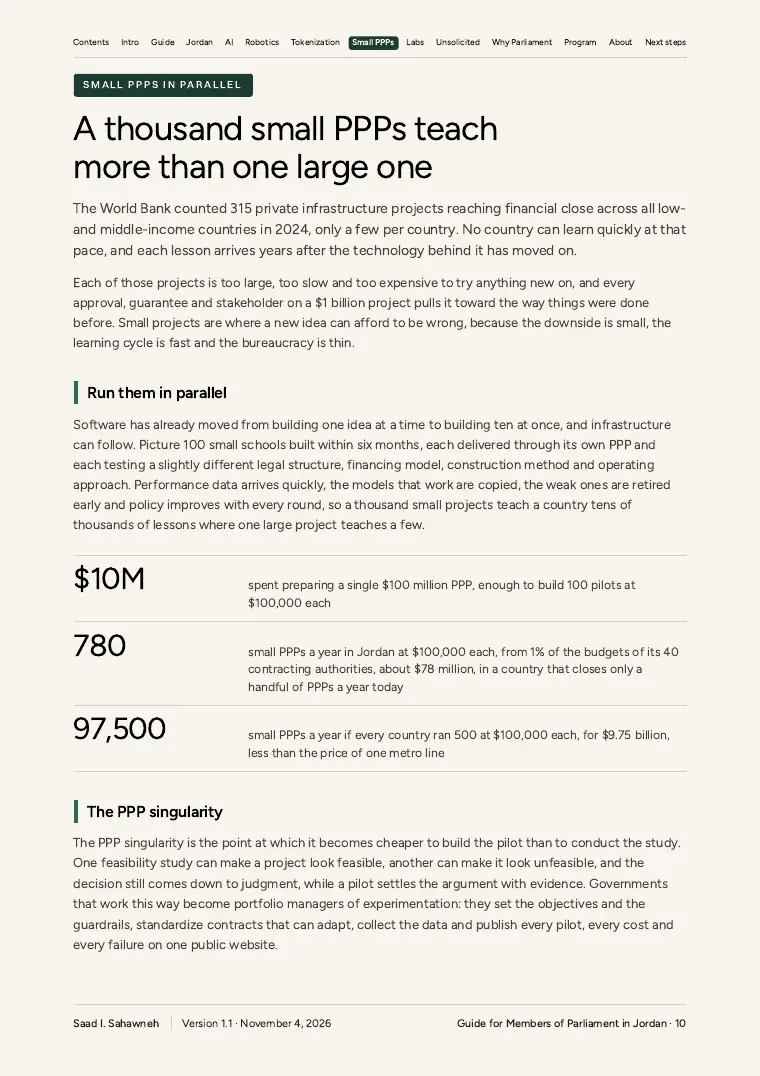
07Small PPPs in parallel
Why many small PPPs teach a country faster than a few large ones.
Page 10 of 17
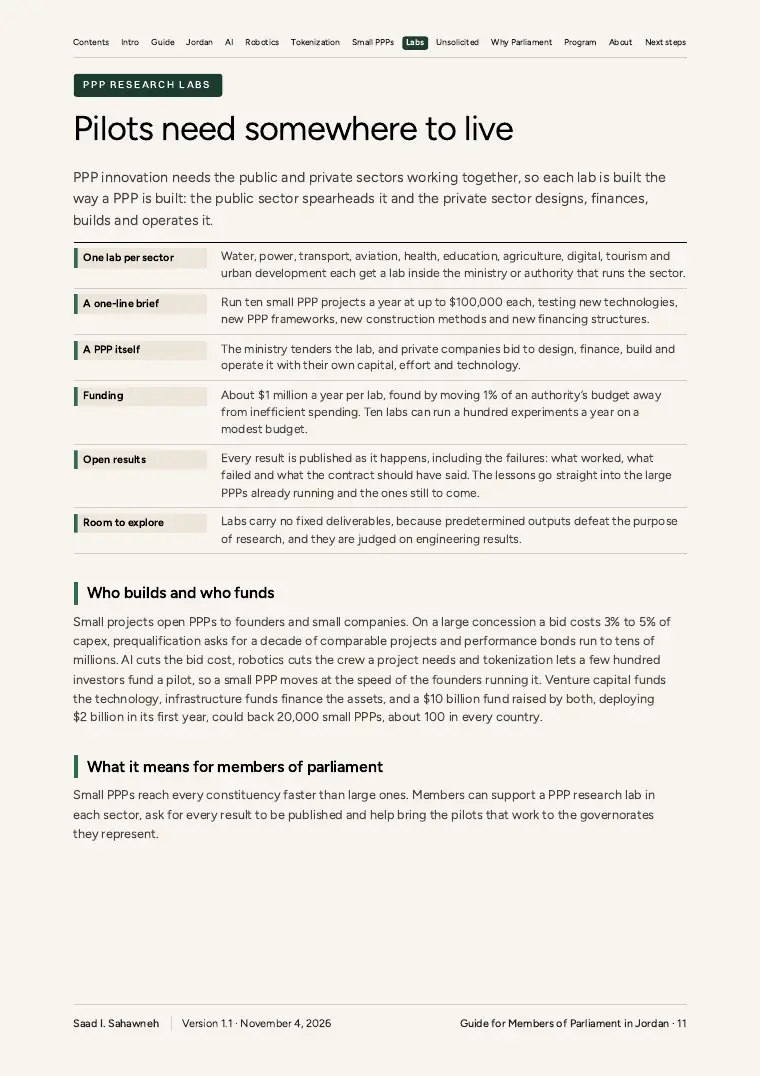
08PPP research labs
A lab in each sector, running ten small PPP projects a year.
Page 11 of 17
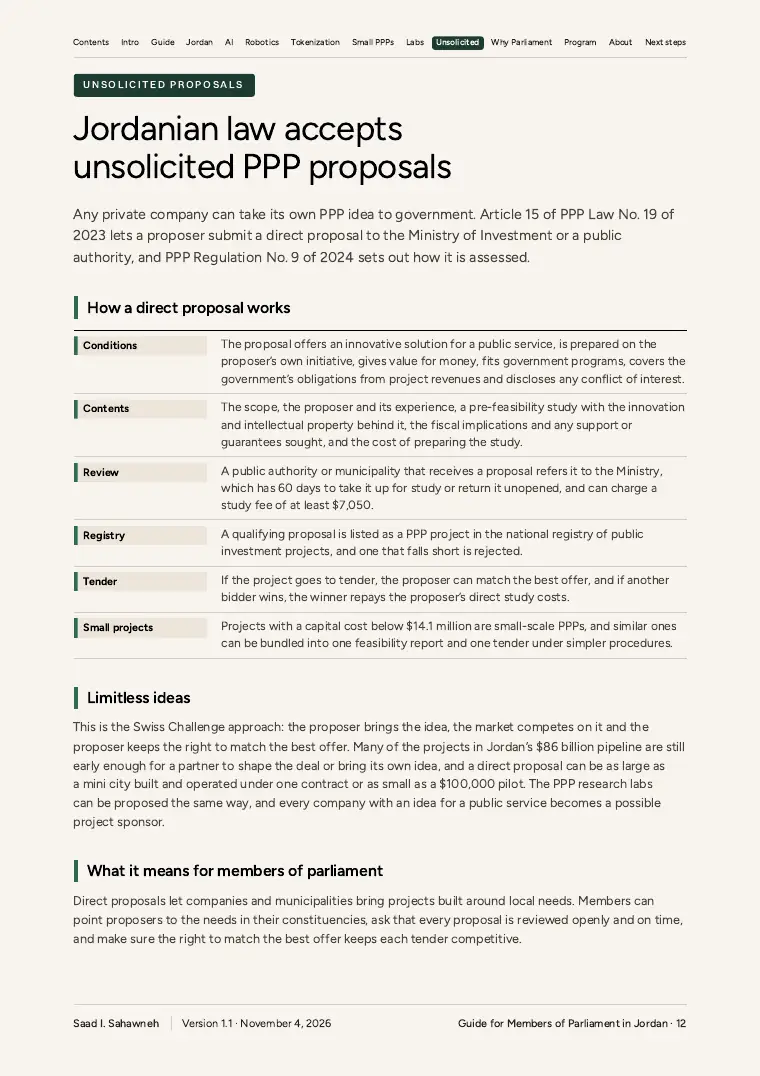
09Unsolicited proposals
How Jordan’s PPP law accepts direct proposals from private companies.
Page 12 of 17
10Why members of parliament
Parliament sets the rules every PPP depends on
Page 13 of 17
11The program
The program can run as a cross-bloc group of members, with a coordinator at its center and a small research team serving every member who joins.
Page 14 of 17
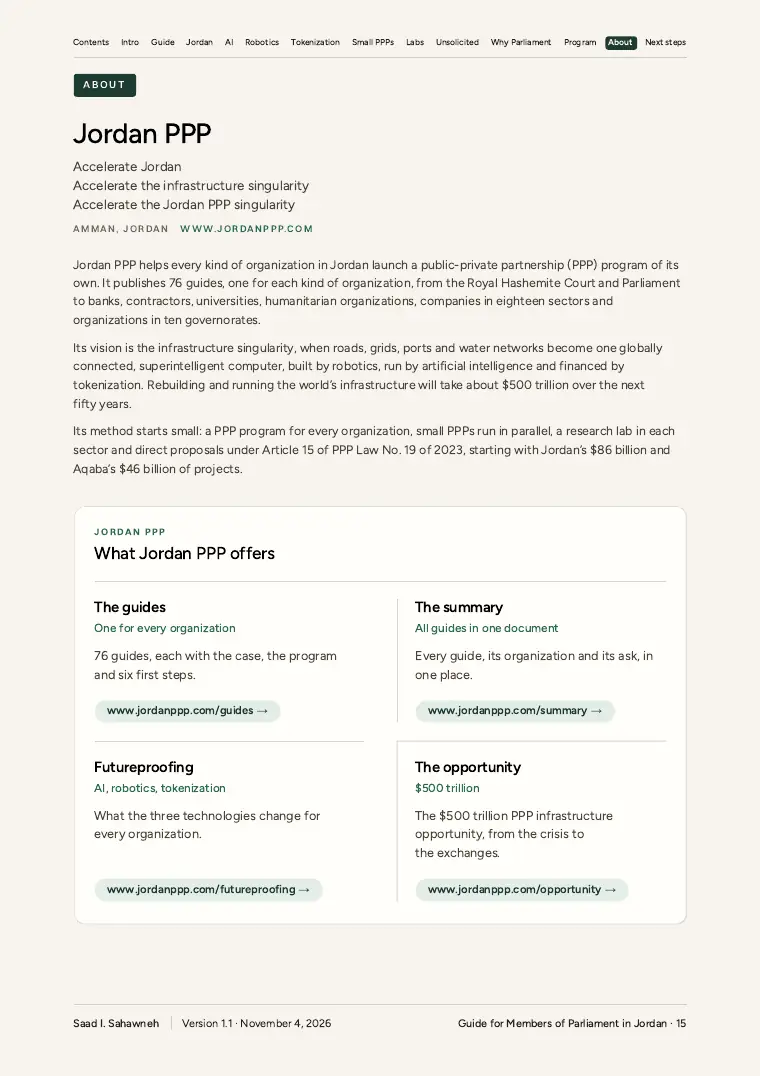
12About
About Jordan PPP and what it offers.
Page 15 of 17
13Next steps
How members of parliament can start: six first steps.
Page 16 of 17
Questions
Questions about the guide for Members of Parliament in Jordan
- What does the guide for Members of Parliament in Jordan propose?
- Members of Parliament launch a parliamentary PPP program that follows, supports and scrutinizes public-private partnerships (PPPs) and brings small projects to every constituency.
- Why should members of parliament in Jordan launch a PPP program?
- Parliament sets the rules every PPP depends on. A PPP lasts longer than any government. Its law, its budget lines and its public support all pass through Parliament, so members who understand PPPs can make every project in the country faster, safer and more useful to the people they represent.
- Which PPP projects can members of parliament in Jordan take part in?
- Jordan has about $86 billion of PPP and infrastructure projects in development, $46 billion of them anchored in Aqaba. Every one of them will need laws, budgets and public support that only Parliament can give. A Parliament that understands PPPs at home can give Jordan laws that other countries in the region study and follow.
- How can members of parliament in Jordan start a PPP program?
- Any member of parliament in Jordan can take this guide forward. The first steps use the house’s existing committees, staff and partners. The guide sets out six first steps: mandate, team, pipeline, laws, partners and pilot.
- What does a PPP program give members of parliament in Jordan?
- Members gain a clear view of the largest long-term commitments the state makes, the knowledge to scrutinize them and projects they can bring to their constituencies, with results voters can see.
- Is the guide for Members of Parliament in Jordan free?
- Yes. It is free to read on this page and free to download as a 17-page PDF, with the case for a PPP program, Jordan’s pipeline, the role of AI, robotics and tokenization, the program and six first steps.
Guide 3 of 76
Browse all 76 guides