
What this guide is for
Your embassy launches a Jordan PPP desk that brings your country’s companies, development funding and export credit to public-private partnership (PPP) projects, from the first feasibility study to the signed concession.
The case
Embassies turn bilateral relations into projects that last for decades
For most of history, governments helped their companies abroad with trade fairs, delegations and the occasional loan. The projects of the next fifty years will be won by consortia that combine engineering, technology and finance from several countries, and the embassies that build those consortia early will see their companies run the assets for decades. This guide invites embassies and bilateral agencies in Jordan to launch a PPP program, starting with the projects in Jordan.
The guide
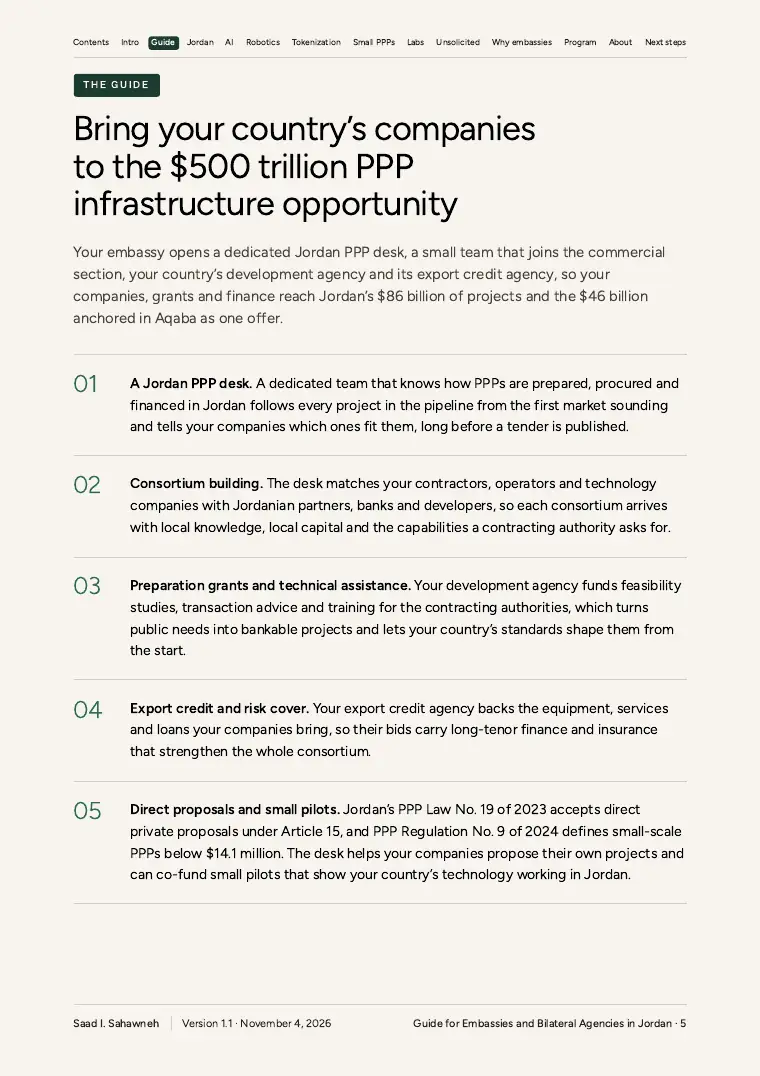
Bring your country’s companies to the $500 trillion PPP infrastructure opportunity
Your embassy opens a dedicated Jordan PPP desk, a small team that joins the commercial section, your country’s development agency and its export credit agency, so your companies, grants and finance reach Jordan’s $86 billion of projects and the $46 billion anchored in Aqaba as one offer.
01
A Jordan PPP desk
A dedicated team that knows how PPPs are prepared, procured and financed in Jordan follows every project in the pipeline from the first market sounding and tells your companies which ones fit them, long before a tender is published.
02
Consortium building
The desk matches your contractors, operators and technology companies with Jordanian partners, banks and developers, so each consortium arrives with local knowledge, local capital and the capabilities a contracting authority asks for.
03
Preparation grants and technical assistance
Your development agency funds feasibility studies, transaction advice and training for the contracting authorities, which turns public needs into bankable projects and lets your country’s standards shape them from the start.
04
Export credit and risk cover
Your export credit agency backs the equipment, services and loans your companies bring, so their bids carry long-tenor finance and insurance that strengthen the whole consortium.
05
Direct proposals and small pilots
Jordan’s PPP Law No. 19 of 2023 accepts direct private proposals under Article 15, and PPP Regulation No. 9 of 2024 defines small-scale PPPs below $14.1 million. The desk helps your companies propose their own projects and can co-fund small pilots that show your country’s technology working in Jordan.
Why embassies and bilateral agencies
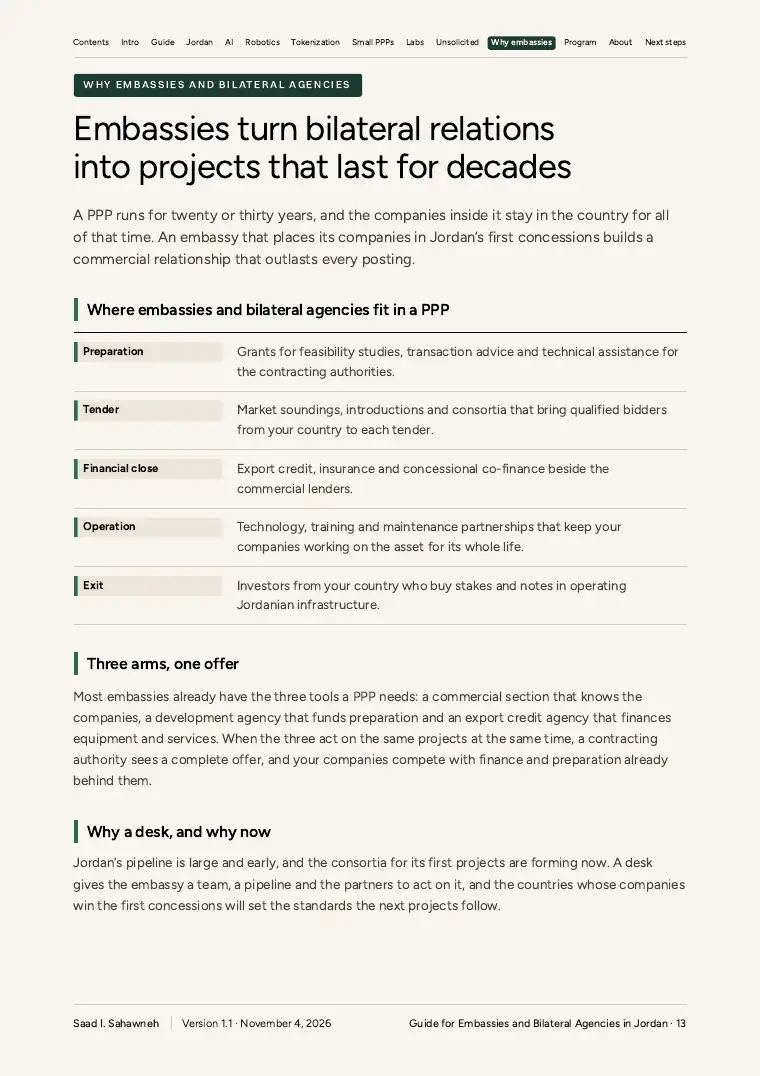
Embassies turn bilateral relations into projects that last for decades
A PPP runs for twenty or thirty years, and the companies inside it stay in the country for all of that time. An embassy that places its companies in Jordan’s first concessions builds a commercial relationship that outlasts every posting.
Where embassies and bilateral agencies fit in a PPP
- Preparation
- Grants for feasibility studies, transaction advice and technical assistance for the contracting authorities.
- Tender
- Market soundings, introductions and consortia that bring qualified bidders from your country to each tender.
- Financial close
- Export credit, insurance and concessional co-finance beside the commercial lenders.
- Operation
- Technology, training and maintenance partnerships that keep your companies working on the asset for its whole life.
- Exit
- Investors from your country who buy stakes and notes in operating Jordanian infrastructure.
Three arms, one offer
Most embassies already have the three tools a PPP needs: a commercial section that knows the companies, a development agency that funds preparation and an export credit agency that finances equipment and services. When the three act on the same projects at the same time, a contracting authority sees a complete offer, and your companies compete with finance and preparation already behind them.
Why a desk, and why now
Jordan’s pipeline is large and early, and the consortia for its first projects are forming now. A desk gives the embassy a team, a pipeline and the partners to act on it, and the countries whose companies win the first concessions will set the standards the next projects follow.

Futureproofing
Futureproof Embassies and Bilateral Agencies in Jordan for the infrastructure singularity
This free 17-page guide shows how, with small PPPs in parallel, PPP research labs, artificial intelligence, robotics, tokenization and six first steps.
Jordan and Aqaba
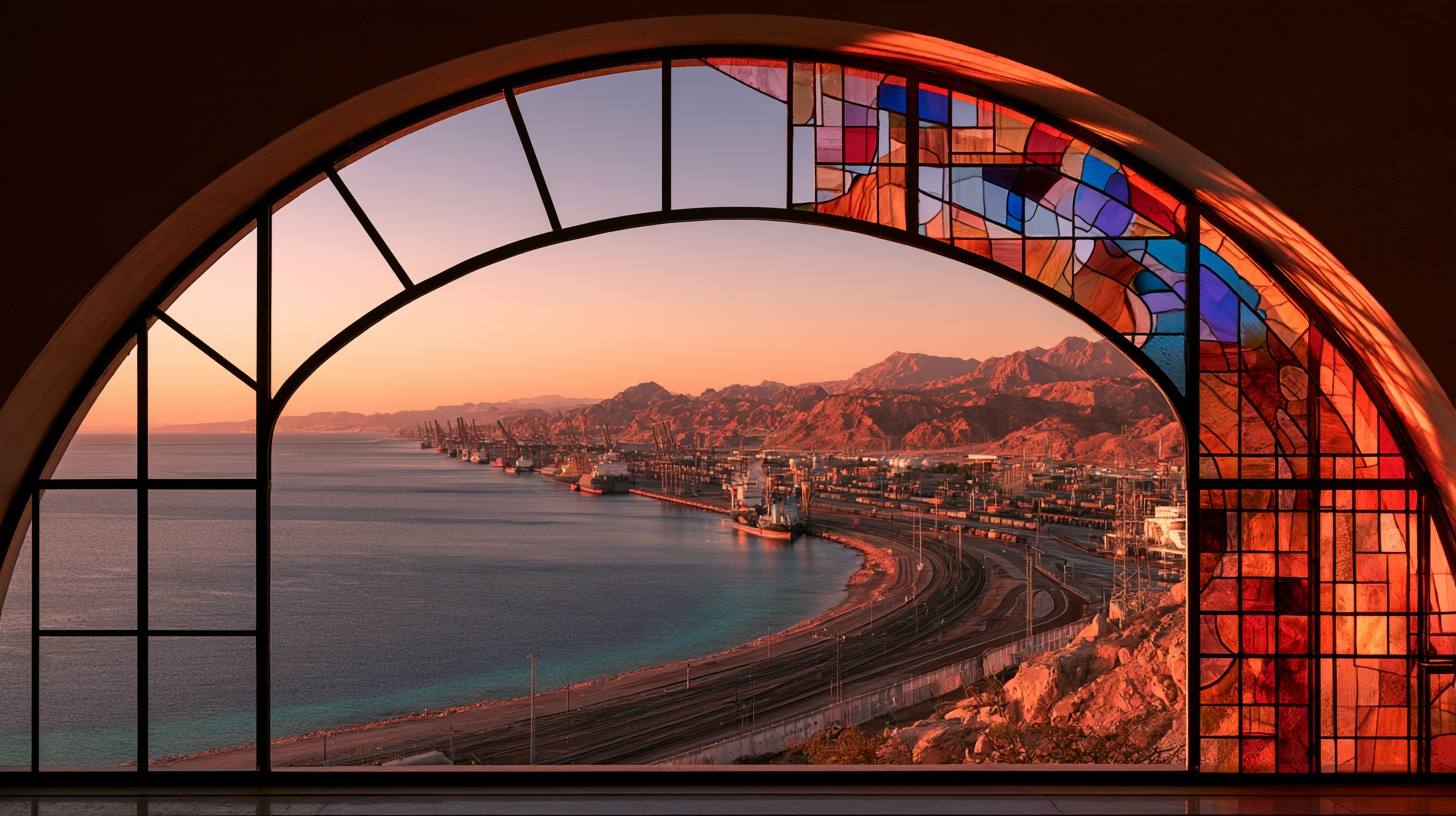
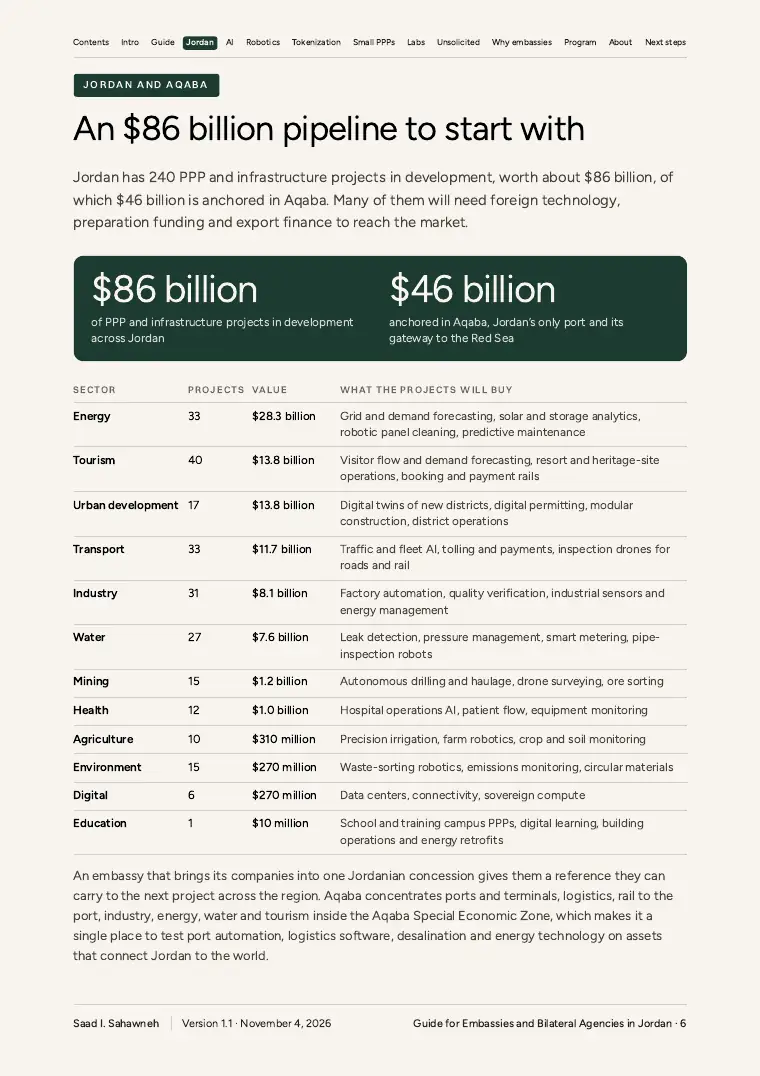
An $86 billion pipeline to start with
Many of them will need foreign technology, preparation funding and export finance to reach the market. An embassy that brings its companies into one Jordanian concession gives them a reference they can carry to the next project across the region.
- $86B
- of PPP and infrastructure projects in development in Jordan
- $46B
- of them anchored in Aqaba

Artificial intelligence
AI lets an embassy see the whole pipeline at once. It can read tender notices, feasibility studies and ministry plans as they appear, match each project to the companies at home that can deliver it and draft the briefings that send the right firm to the right meeting. A development agency can fund AI tools that help Jordan’s contracting authorities prepare projects faster.

Robotics
Robotic construction, inspection and maintenance are built by companies in a handful of countries today. An embassy can put its country’s robotics companies into Jordanian consortia, fund the first pilots that prove their machines on Jordanian roads, pipes and buildings and pair them with Jordanian engineers who will run and maintain them.

Tokenization
Tokenization lets investors in many countries hold a share of the same project. An embassy can bring its country’s banks, funds and platforms to the first tokenized PPP notes in Jordan, and its development agency can fund the legal and technical work that makes those notes safe for investors at home to buy.

Small PPPs and research labs
Small PPPs give an embassy a low-cost way to show its country’s technology working in Jordan. A development agency can fund a PPP research lab or a set of pilots, pair each one with a company from home and a Jordanian partner and publish every result, so the companies that prove themselves in a pilot move first when the larger projects come to market.

Unsolicited proposals
A direct proposal lets a company from your country bring its own solution to a Jordanian ministry or municipality as a project of its own. The embassy can introduce the company to the right authority, the development agency can co-fund the pre-feasibility study the proposal needs and the export credit agency can show early support for its finance, while the proposer keeps the right to match the best offer at tender.
The program
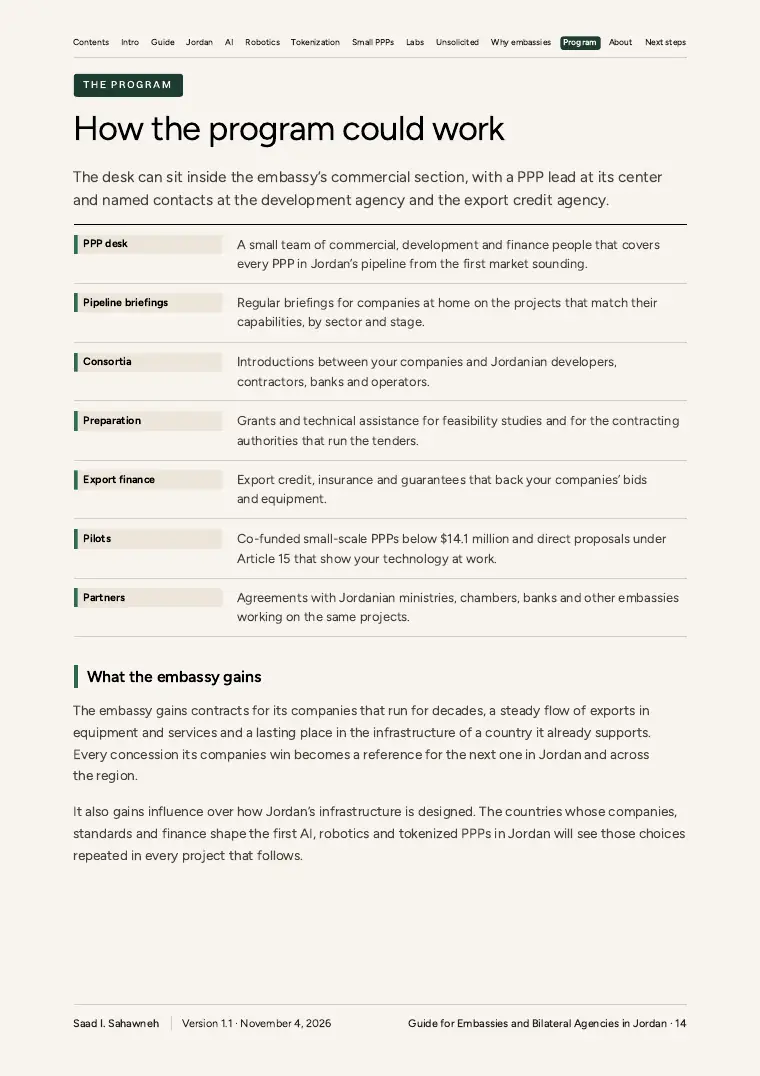
How the program could work
The desk can sit inside the embassy’s commercial section, with a PPP lead at its center and named contacts at the development agency and the export credit agency.
- PPP desk
- A small team of commercial, development and finance people that covers every PPP in Jordan’s pipeline from the first market sounding.
- Pipeline briefings
- Regular briefings for companies at home on the projects that match their capabilities, by sector and stage.
- Consortia
- Introductions between your companies and Jordanian developers, contractors, banks and operators.
- Preparation
- Grants and technical assistance for feasibility studies and for the contracting authorities that run the tenders.
- Export finance
- Export credit, insurance and guarantees that back your companies’ bids and equipment.
- Pilots
- Co-funded small-scale PPPs below $14.1 million and direct proposals under Article 15 that show your technology at work.
- Partners
- Agreements with Jordanian ministries, chambers, banks and other embassies working on the same projects.
What the embassy gains
The embassy gains contracts for its companies that run for decades, a steady flow of exports in equipment and services and a lasting place in the infrastructure of a country it already supports. Every concession its companies win becomes a reference for the next one in Jordan and across the region.
It also gains influence over how Jordan’s infrastructure is designed. The countries whose companies, standards and finance shape the first AI, robotics and tokenized PPPs in Jordan will see those choices repeated in every project that follows.

Next steps
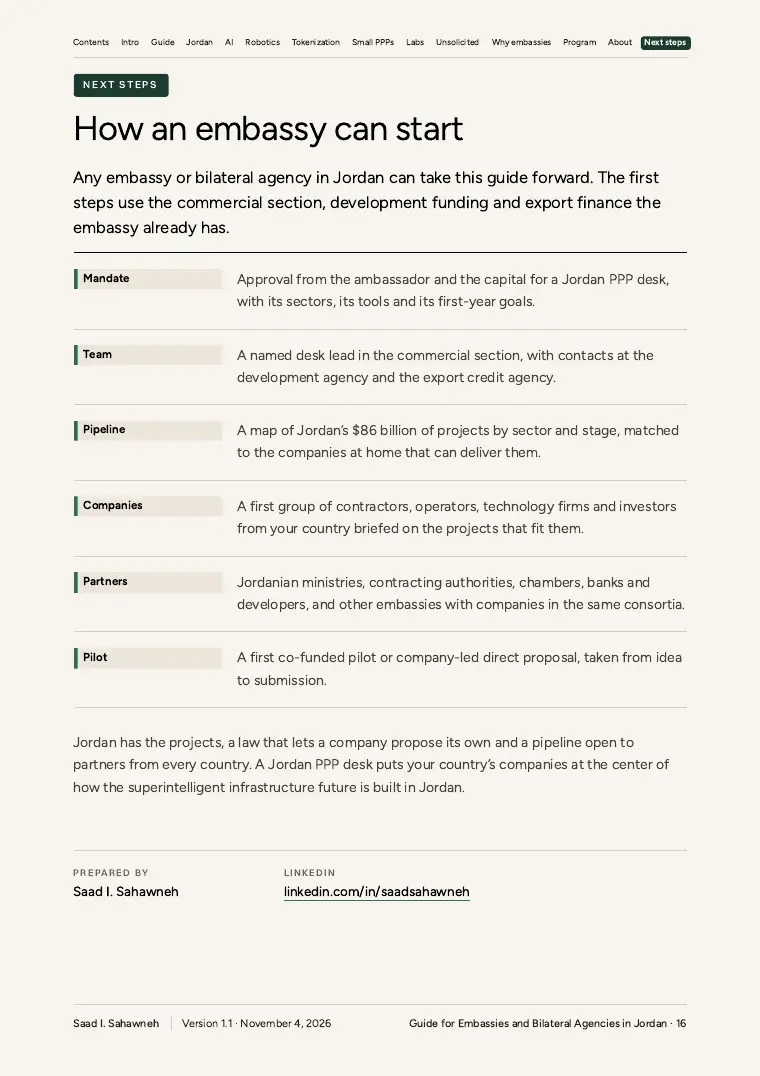
How an embassy can start
Any embassy or bilateral agency in Jordan can take this guide forward. The first steps use the commercial section, development funding and export finance the embassy already has.
01
Mandate
Approval from the ambassador and the capital for a Jordan PPP desk, with its sectors, its tools and its first-year goals.
02
Team
A named desk lead in the commercial section, with contacts at the development agency and the export credit agency.
03
Pipeline
A map of Jordan’s $86 billion of projects by sector and stage, matched to the companies at home that can deliver them.
04
Companies
A first group of contractors, operators, technology firms and investors from your country briefed on the projects that fit them.
05
Partners
Jordanian ministries, contracting authorities, chambers, banks and developers, and other embassies with companies in the same consortia.
06
Pilot
A first co-funded pilot or company-led direct proposal, taken from idea to submission.
Jordan has the projects, a law that lets a company propose its own and a pipeline open to partners from every country. A Jordan PPP desk puts your country’s companies at the center of how the superintelligent infrastructure future is built in Jordan.
The full document
Inside this guide
Seventeen pages and thirteen chapters, from the case for a PPP program to the first steps, written for embassies and bilateral agencies in Jordan.
- 17
- pages
- 13
- chapters
- 3
- technologies
- 6
- first steps
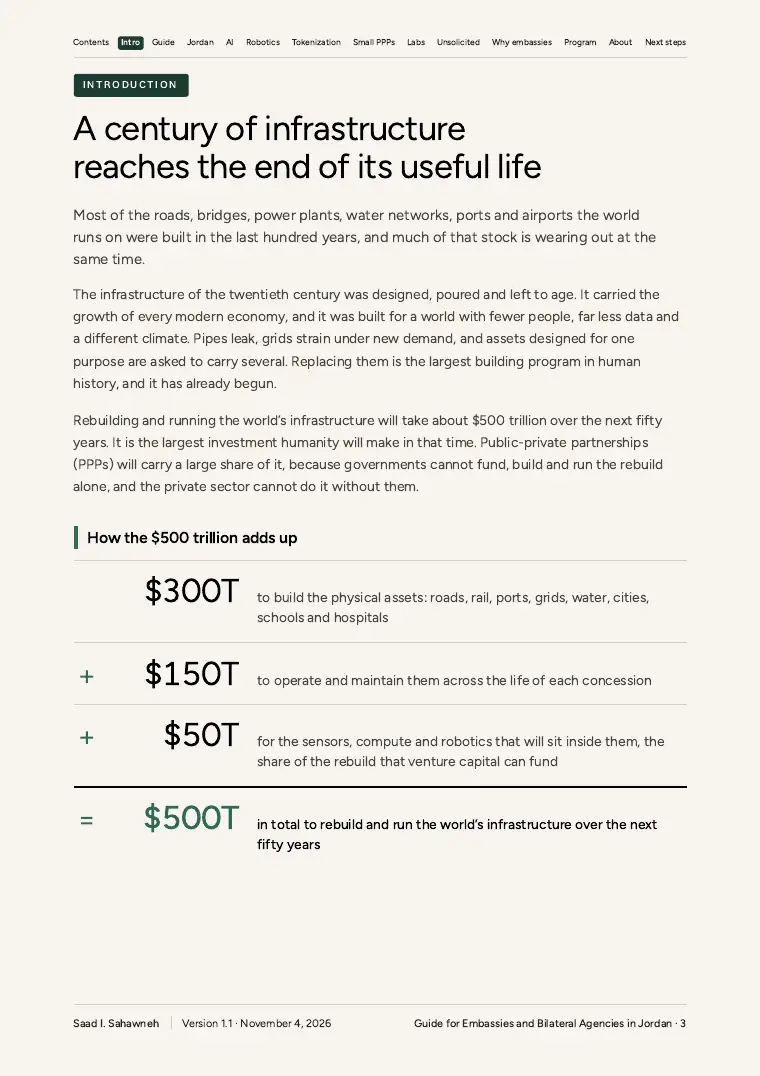
01Introduction
Why a century of infrastructure needs rebuilding, and the $500 trillion it will take.
Page 3 of 17
02The guide
Bring your country’s companies to the $500 trillion PPP infrastructure opportunity
Page 5 of 17
03Jordan and Aqaba
An $86 billion pipeline to start with
Page 6 of 17
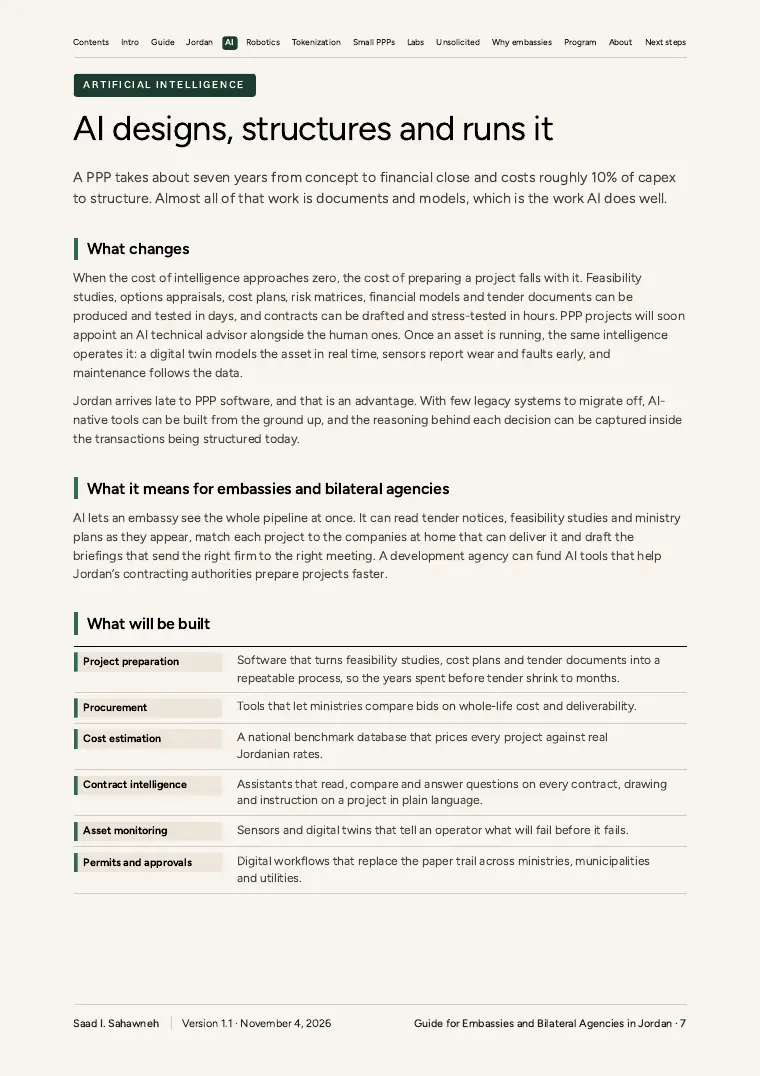
04Artificial intelligence
How AI designs, structures and runs PPP projects, and what it means for embassies and bilateral agencies.
Page 7 of 17
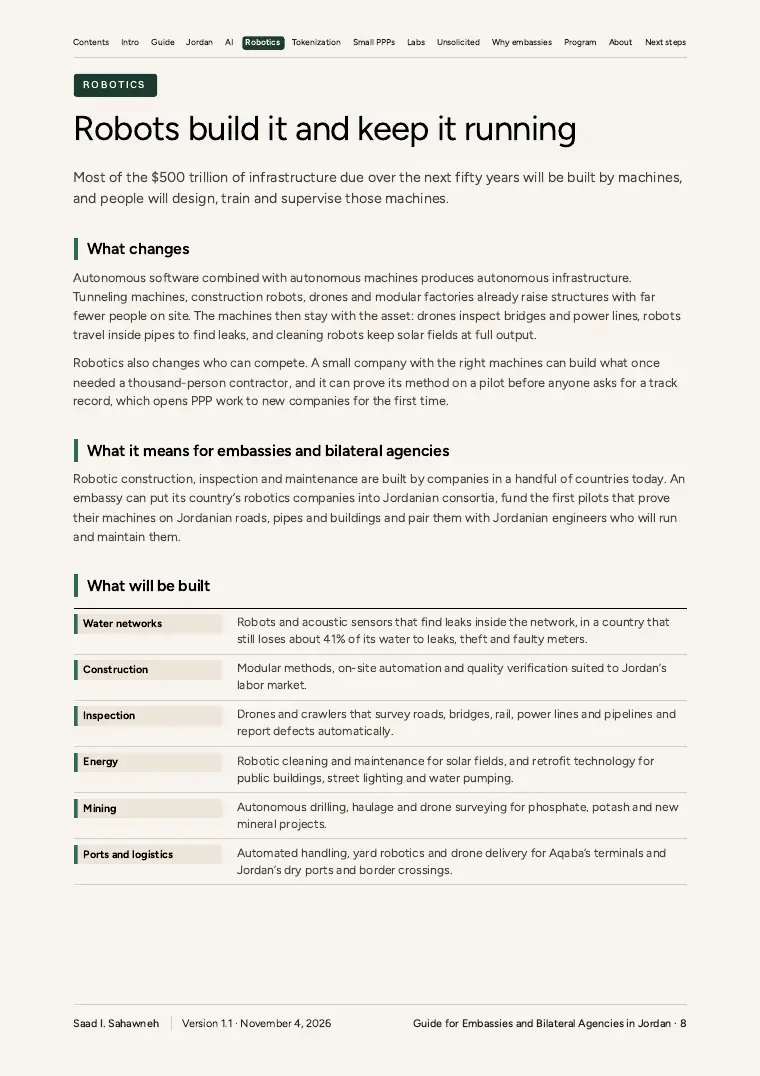
05Robotics
How robots build infrastructure and keep it running, and what that means for embassies and bilateral agencies.
Page 8 of 17
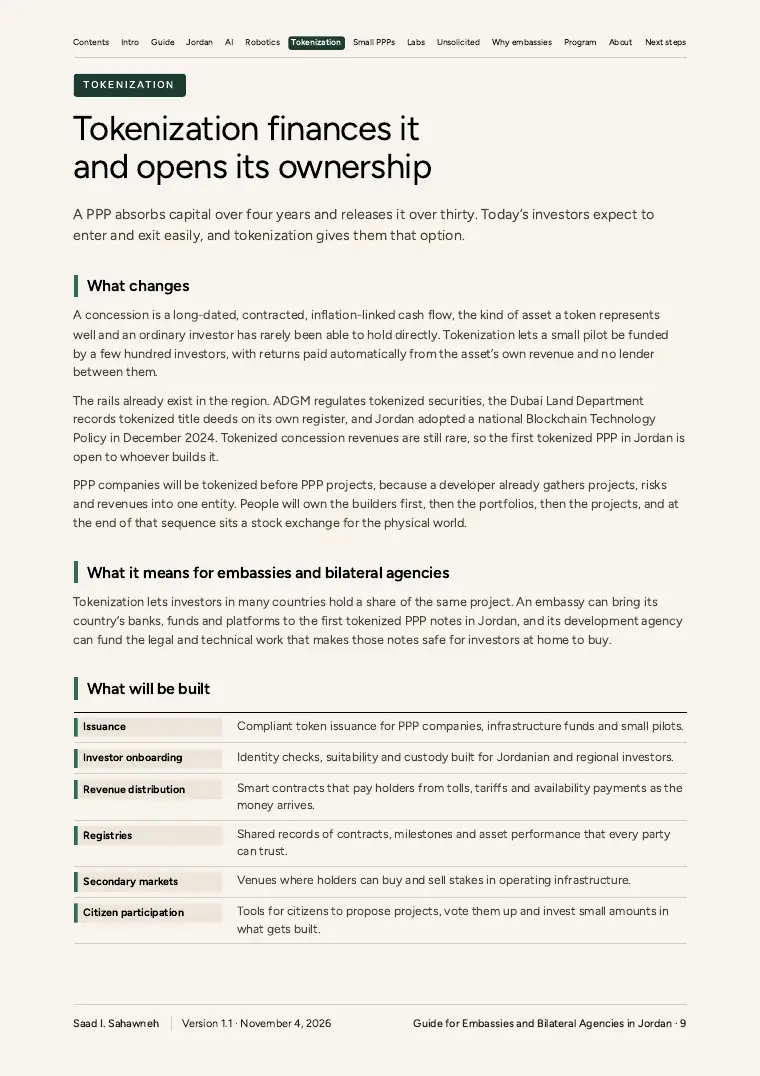
06Tokenization
How tokenization funds projects from their own revenue, and the role it opens for embassies and bilateral agencies.
Page 9 of 17
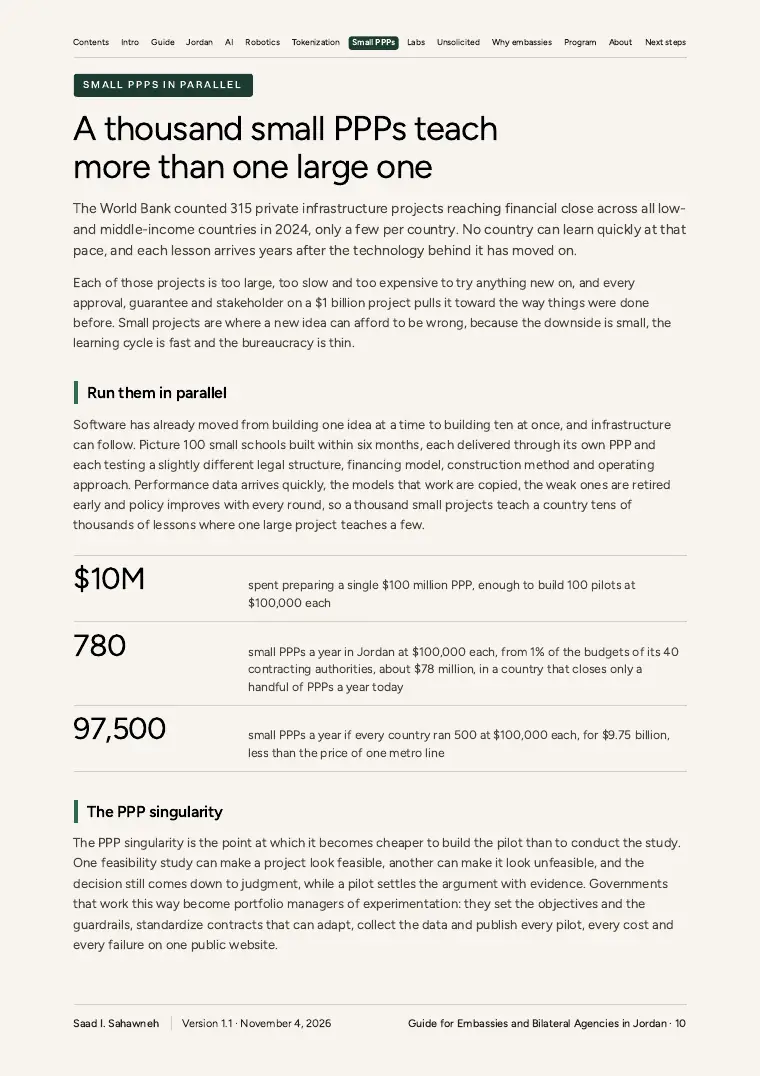
07Small PPPs in parallel
Why many small PPPs teach a country faster than a few large ones.
Page 10 of 17
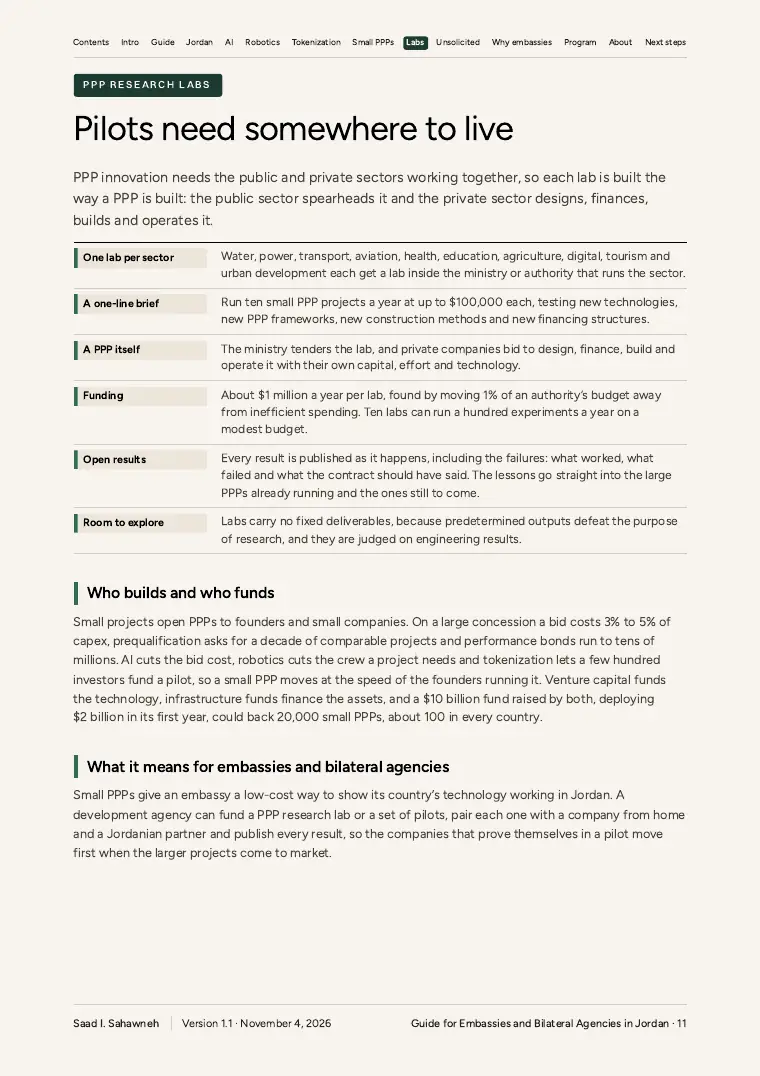
08PPP research labs
A lab in each sector, running ten small PPP projects a year.
Page 11 of 17
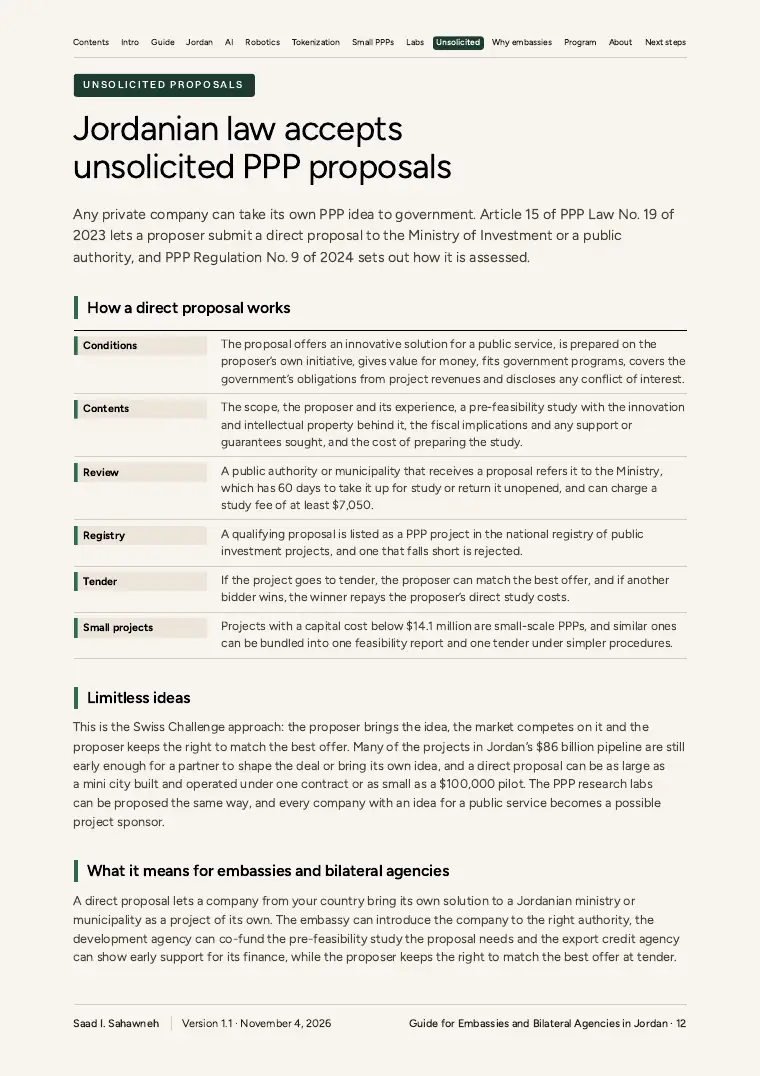
09Unsolicited proposals
How Jordan’s PPP law accepts direct proposals from private companies.
Page 12 of 17
10Why embassies and bilateral agencies
Embassies turn bilateral relations into projects that last for decades
Page 13 of 17
11The program
The desk can sit inside the embassy’s commercial section, with a PPP lead at its center and named contacts at the development agency and the export credit agency.
Page 14 of 17
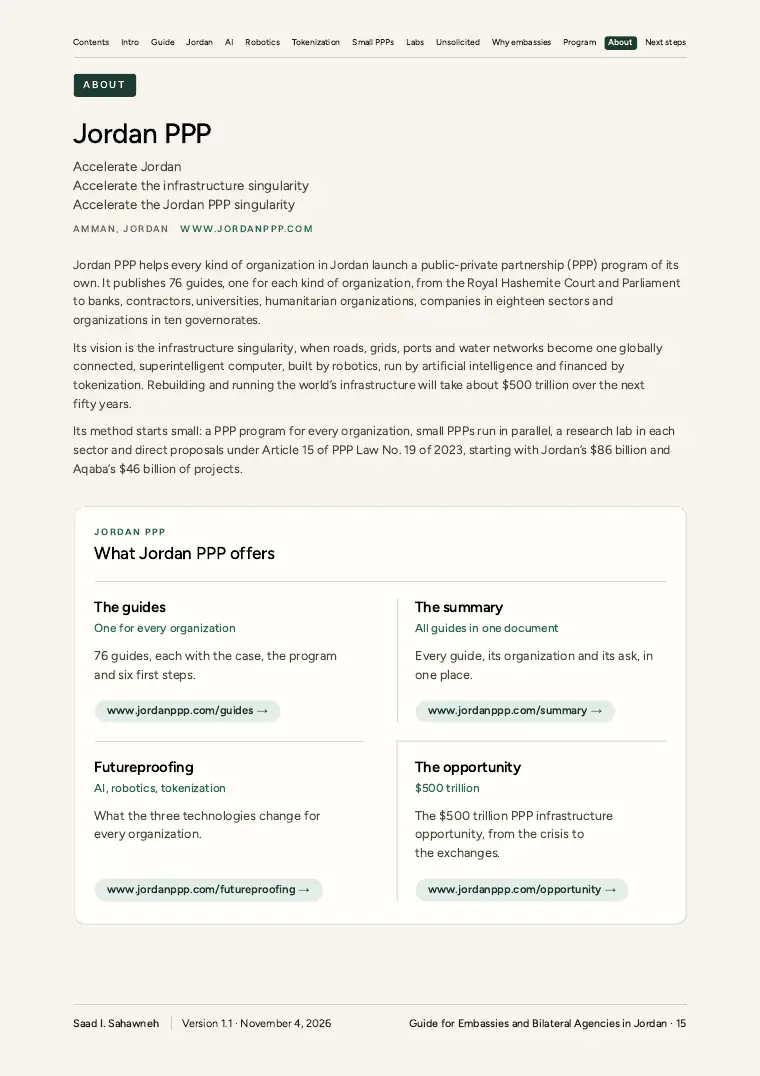
12About
About Jordan PPP and what it offers.
Page 15 of 17
13Next steps
How an embassy can start: six first steps.
Page 16 of 17
Questions
Questions about the guide for Embassies and Bilateral Agencies in Jordan
- What does the guide for Embassies and Bilateral Agencies in Jordan propose?
- Your embassy launches a Jordan PPP desk that brings your country’s companies, development funding and export credit to public-private partnership (PPP) projects, from the first feasibility study to the signed concession.
- Why should embassies and bilateral agencies in Jordan launch a PPP program?
- Embassies turn bilateral relations into projects that last for decades. A PPP runs for twenty or thirty years, and the companies inside it stay in the country for all of that time. An embassy that places its companies in Jordan’s first concessions builds a commercial relationship that outlasts every posting.
- Which PPP projects can embassies and bilateral agencies in Jordan take part in?
- Jordan has about $86 billion of PPP and infrastructure projects in development, $46 billion of them anchored in Aqaba. Many of them will need foreign technology, preparation funding and export finance to reach the market. An embassy that brings its companies into one Jordanian concession gives them a reference they can carry to the next project across the region.
- How can embassies and bilateral agencies in Jordan start a PPP program?
- Any embassy or bilateral agency in Jordan can take this guide forward. The first steps use the commercial section, development funding and export finance the embassy already has. The guide sets out six first steps: mandate, team, pipeline, companies, partners and pilot.
- What does a PPP program give embassies and bilateral agencies in Jordan?
- The embassy gains contracts for its companies that run for decades, a steady flow of exports in equipment and services and a lasting place in the infrastructure of a country it already supports. Every concession its companies win becomes a reference for the next one in Jordan and across the region.
- Is the guide for Embassies and Bilateral Agencies in Jordan free?
- Yes. It is free to read on this page and free to download as a 17-page PDF, with the case for a PPP program, Jordan’s pipeline, the role of AI, robotics and tokenization, the program and six first steps.
Guide 8 of 76
Browse all 76 guides