· 12 min read
Jordan 2100
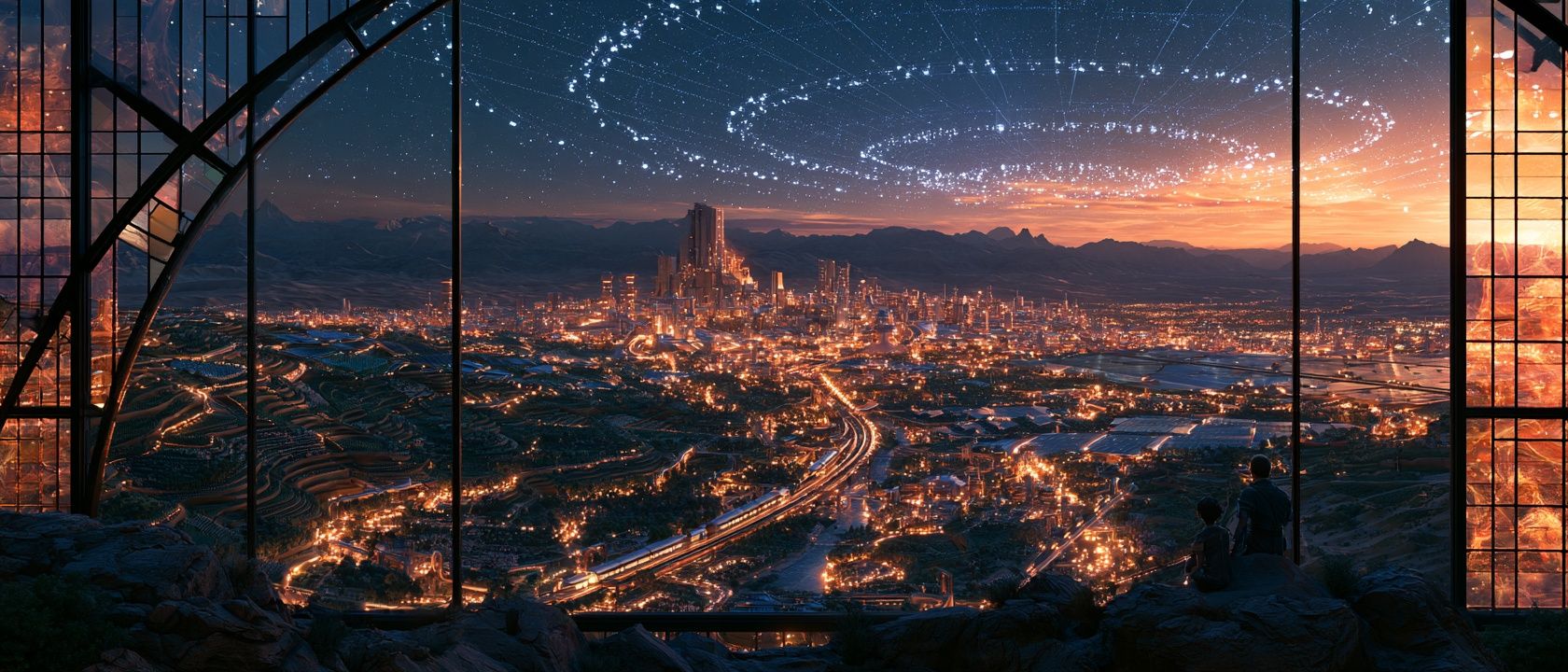
A picture of Jordan in the year 2100, with infrastructure that reports on itself, one machine run by EarthOS, a school in every child’s own questions and no poverty at all.
It is a spring morning in 2100, and a girl in Aqaba is waking up. Her house has already checked the weather, the sea and the power for the day, and it tells her which of her friends are awake. Nobody in her family has ever worried about rent, food, medicine or school fees, and neither has anyone she knows. This is a picture of the Jordan that a century of building could produce.
The post is a vision, written in the present tense so it is easy to picture. It grows from the plan this site describes: PPPs (public-private partnerships, projects where a government and a company share the work, the money and the risk) build the roads, plants and networks, and then sensors, digital ownership, AI and robots join them until one shared system runs everything. The road to the singularity lays out the five stages.
Everything below is a goal, described as if it had already happened. Each part follows from the one before it, so the picture starts with the ground under people’s feet and ends with how people live on top of it.
The infrastructure
Every road, pipe, wire, rail line and building in Jordan reports on itself. A pipe under Irbid knows when a seal is wearing thin, and a robot replaces it a week before it would leak. A bridge feels the weight of every truck and tells its owner when a bolt needs attention. Repairs happen early, so they are small and cheap, and people rarely see a road closed for emergency work.
Water comes from solar-powered desalination plants on the Red Sea and travels almost without loss, which matters in one of the driest countries on Earth. Used water is cleaned and sent back to the fields and the cities, so every drop is used several times. Sun and wind supply all of the country’s electricity, and large batteries hold the extra for the night.
Fast electric trains join Aqaba, Amman and the northern cities, and a journey that once took half a day takes a short ride. Self-driving vehicles share the streets, so cities have far fewer cars and far more parks. Ports and freight lines run with machines doing the lifting, and people work in the control rooms and the design studios.
New buildings are made of local materials and printed or assembled by robots in days. They make their own power from the sun, collect their own water from the air and the roof, and stay cool in summer with very little energy. When a building reaches the end of its life, its parts are taken apart and used again.
The computer
All of this infrastructure works as one machine. The sensors are its senses, the cables and wireless links are its nerves, the processors are its brain and the power plants are its heart. In 2026 the idea was called the world’s biggest $500 trillion computer, and by 2100 it is simply how a country works.
The machine heals itself. When a part fails, the system routes around it at once and sends a robot to fix it, so most people never notice a breakdown. A power line goes down in a storm, and the electricity finds another path in less time than it takes to blink.
Jordan’s part of the machine is joined to every other country’s part. A fix found in Jordan helps the whole planet, and a fix found anywhere helps Jordan, which means a good idea has to be invented only once.
The software
EarthOS is the software that runs the machine. People in every country wrote it together, and every country runs its own copy. When a storm crosses the region, EarthOS moves water into storage, closes valves, reroutes trains and tells people what to expect, all before the first drop falls.
Every person also has an AI helper that knows them well. It works as a doctor, a lawyer, a tutor and a planner, speaks Arabic, English or any other language, and works for its owner alone. It answers a question about a contract or a rash or a tax form in the time it takes to ask.
Ownership is digital too. Every plant, bridge and rail line is split into tiny shares through tokenization, which means ownership of a thing is divided into small digital pieces that anyone can hold. Every family in Jordan owns a share of the country’s infrastructure, and the income from it arrives every month.
The software follows rules that everyone can read. It shows who owns each asset, what each one earns and how each decision was made. Anyone in the country can look at the record, and so can anyone in the world.
Education
School begins with the child’s own questions. An AI tutor knows what each child understands and what is still hard, and it teaches at that child’s pace. A child who loves rockets gets a maths lesson built from rockets, and a child who is stuck on fractions gets the next explanation until it clicks.
Teachers spend their days with small groups, coaching, listening and helping children learn to work together. They know each child as a person, and they spot the one who is quiet, tired or worried long before a test could show it.
Every school is also a small lab. Children measure their own school’s water, power and air, and they run projects of the kind the PPP pyramid calls a Nano PPP. A student in Karak and a student in Tokyo take the same courses and often build things together. A fifteen-year-old in Jordan can finish a real project that a company in another country then copies.
Learning never stops at the end of school. Adults return to study whenever they like, free of charge, to learn a new trade or a new science. A grandmother in Ajloun takes a course in marine biology because she is curious, and the AI tutor adjusts to her pace in the same way it did for her granddaughter.
Poverty is gone
Poverty ended in Jordan the way a leak ends, because someone fixed the cause. Three changes did it. Robots and AI made it cheap to build and run everything people need, so food, water, power, housing and transport cost very little. Every citizen owns a share of the country’s infrastructure and receives income from it. Health care and education are free for everyone.
Every person in Jordan has food, a safe home, clean water, light, medicine and a place at school. A family that has a bad year, with an illness or a lost job or a failed harvest, is supported at once by the system, so one piece of bad luck never grows into a lifetime of hardship.
Children learn about poverty in history class, in the same lesson as plagues and famines. The lesson ends with a question: why did it take so long, when the tools were nearly all there? Their answer is that people first had to decide to build the system, and then had to build it, one project at a time.
Food and farming
Farms in Jordan are small, clean and very productive. Sensors in the soil tell each plant how much water and food it needs, and drones and robots do the weeding and harvesting. Crops grow in sunlit greenhouses powered by solar panels, with water drawn from the sea and cleaned on site.
Jordan grows far more of its own food than in 2026, and it sends the extra to its neighbors. Olive oil, dates, tomatoes and herbs still taste like Jordan, because farmers keep the old varieties and the machines help protect them. A grower in the Jordan Valley sells directly to a family in Amman, and both can see exactly where the food came from.
Cities, villages and homes
Amman, Irbid, Zarqa, Aqaba and the villages all offer the same services: fast links, clean water, good schools and doctors. A family can live in a village in Ajloun and work on a project in any city in the world. The country feels like one connected neighborhood.
Streets belong to people. Vehicles run quietly and drive themselves, so there is room for trees, markets and playgrounds where parking used to be. Buildings keep the character of the old stone houses, and the new ones are built to the same human scale.
Housing is affordable, because building a home is quick and cheap and every family owns a share of the country’s infrastructure. Young people can set up their first home at the age they choose, without a decade of saving.
Work and money
Robots build, inspect and repair, so people spend their time on what they choose. Some design new projects, some teach and care for others, some farm for the pleasure of good food, and some make music, films and research. Work is something people do because they want to, and a week looks different for every person.
Money still exists, and it moves quickly and clearly. The monthly income from the infrastructure shares covers the basics for everyone, and extra income comes from what a person builds, creates or sells. Starting a company takes a day, and a small team can serve customers around the world from a village.
Health
Health care is early and quiet. Sensors watch the water and the air, so an outbreak is spotted in its first days and stopped before it spreads. An AI doctor reviews each person’s health every day and suggests small changes long before a problem becomes serious.
Hospitals use robots in surgery, and specialists in any country can join a case at once. A child in a remote village gets the same quality of care as a child in the capital. People in Jordan live longer and spend more of those years in good health.
Culture and identity
Jordan in 2100 is still unmistakably Jordan. Arabic is the language of the street, the school and the song, and every child also grows up with several other languages thanks to the AI helper in their pocket. Families still gather around a long meal, and hospitality is still the first rule of every home.
Heritage is protected better than ever. Sensors in Petra, Jerash, Umm Qais and the desert castles track every crack, every change in the weather and every footstep, and robots repair the stone with the same methods the builders used. Visitors walk through places that look just as they did two thousand years ago.
Free time is full of culture. Jordanian musicians, filmmakers, writers and game makers reach the whole world, and the AI helper translates their work into any language the moment it is released. A song from Amman can top the charts in Seoul by the end of the week.
Society and how decisions are made
The villages and the cities have the same services, so a young person can live anywhere in Jordan and still do the best work in the world. Many families who left for other countries in the twentieth century have come home, because home now offers the best of both places.
Decisions use the same facts for everyone, because the sensors share them openly. Citizens can see how every project is spending its money and what it delivers. A town that wants a new water plant, a school or a park can read the same numbers the government reads, and can put its own proposal on the table.
People trust each other more, because the record is open and the results are plain to see. Disagreements still happen, and they are settled with facts that everyone can check.
Nature
Because everything is measured, nature gets looked after. The Dead Sea has stopped shrinking, Wadi Rum stays quiet and wild, and the Red Sea coral reefs near Aqaba are healthy. The machine counts the cost of harming a place, and that cost is rarely worth paying.
Green corridors link the cities, and the birds that cross Jordan on their way between Europe and Africa find clean water and safe places to rest. Solar farms sit on land that was already used, and the desert beyond them is left alone.
Jordan and the world
People call Jordan the country that showed how it was done. It started early, with a PPP law passed in 2023, and it began with small projects, then climbed ten times at a time. Visitors come to Aqaba and Amman to see what a country looks like when its infrastructure works as one system.
Jordan sells what it learned. Its engineers, planners and teachers help other countries build their own version, and what they find on those projects flows back into EarthOS and helps everyone. A country that was once short of water is known around the world for how well it looks after it.
A day in the life, 2100
Back in Aqaba, the girl walks to school along a shaded street. She stops at the market, where a farmer from the Jordan Valley hands her a bag of dates and her helper pays with a share of her monthly income. At school she and her class test the air near the harbor with sensors they built the week before, and she sends the results to a classmate in Chile who is doing the same thing at her port.
After lunch she rides the train to Amman to see her grandmother, who is taking a course in astronomy. They watch the evening light fall on the hills, and her grandmother tells her what the street looked like when she was a girl, with traffic jams and water cuts and a long wait at every clinic. The girl listens politely, because it sounds like a story from a very long time ago.
How Jordan gets from here to there
$86B
of PPP and infrastructure projects in development in Jordan today, including $46 billion in Aqaba, the base this whole picture grows from
Every project in that pipeline can build the first stage and plan for the next four. The five stages are build it, sense it, tokenize it, automate it and connect it, and each one rests on the one before. The road to the singularity shows how they fit together.
Small projects come first, because a project that costs little can be built, measured and fixed again and again, and each one teaches the next. Article 15 of Jordan’s PPP Law lets any private company take its own PPP idea to the government directly, so a team can start today.
If you run a company, a school or a town, pick the stage that fits your organization and begin with one small project. The futureproofing guide shows where each kind of organization can start, and the small PPPs guide shows how to run the first one.