What this organization guide is for
Your organization launches a PPP program that turns Ma’an’s solar, mining, transport and tourism projects into public-private partnerships (PPPs) it can prepare, bid for, build, finance or operate, starting with the governorate it already works in.
The case
Ma’an’s organizations can build the place they work in
Ma’an has grown around a few large mines, solar plants and the visitors who come to Petra, and most of the governorate’s organizations have watched those deals from the outside. The projects of the next fifty years will be prepared, built and run by many organizations at once, and the ones that start their own programs now will own a share of the governorate they work in. This guide invites organizations in Ma’an to launch a PPP program, starting with the projects at home.
The guide
Bring Ma’an into the $500 trillion PPP infrastructure opportunity
Your organization opens a dedicated PPP program, a team and a set of offers that take part in Ma’an’s energy, mining, transport, water, tourism and urban projects, starting with its place in Jordan’s $86 billion of projects.
01
A Ma’an PPP team
A dedicated team that knows how PPPs are prepared, procured and financed follows every project in Ma’an from the first market sounding and decides early where the organization can prepare, bid, build, finance or operate.
02
A place in the governorate’s consortiums
Municipalities, solar and mining suppliers, contractors, hotels in Wadi Musa and local investors join the consortiums that bid for Ma’an’s projects, bringing the land, the operating knowledge and the local workforce that international partners need.
03
Projects across the desert and Petra
The solar plants of the Ma’an Development Area, the phosphate mines at Eshidiya, the Desert Highway and Petra all depend on water, power, roads and housing. An organization that understands those links can shape projects that serve several of them at once.
04
Ma’an-led direct proposals
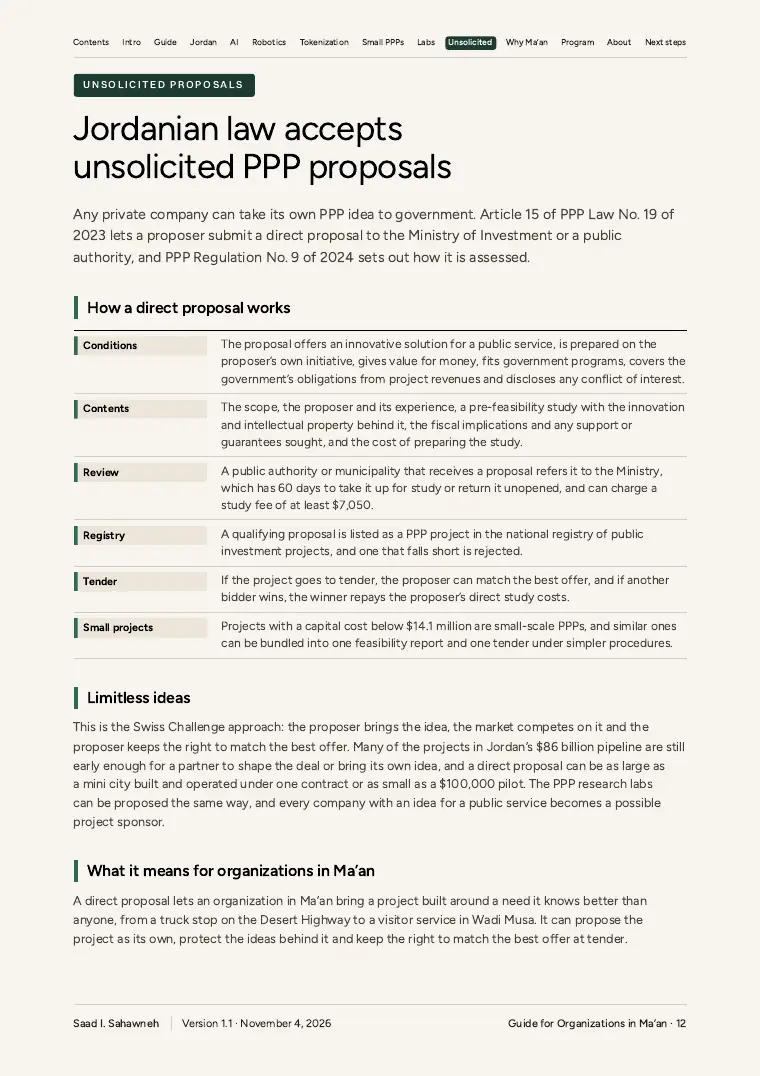
Jordan’s PPP Law No. 19 of 2023 accepts direct private proposals under Article 15. An organization in Ma’an can design a project around a need it sees every day, such as a truck stop, a solar pumping plant, a Petra visitor shuttle or a water reuse plant, and propose it with partners who finance and build it.
05
Pilots as small-scale PPPs
PPP Regulation No. 9 of 2024 defines small-scale PPPs below $14.1 million, which can be bundled into one feasibility report and one tender. A small concession in Ma’an gives the organization a live asset, a reference and a place in the larger projects that follow.
Why organizations in Ma’an
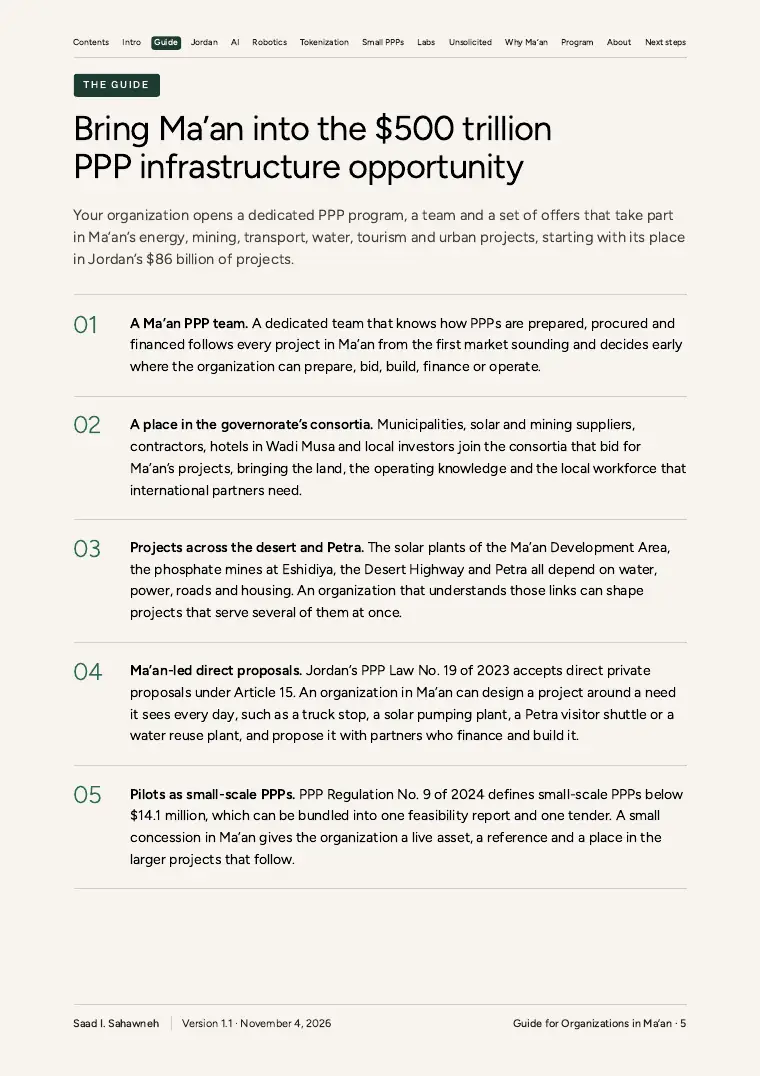
Ma’an’s organizations can build the place they work in
Ma’an holds Petra, the Ma’an Development Area, solar plants such as the 52.5 MW Shams Ma’an and the phosphate mines at Eshidiya. Each new project depends on the organizations already working there, and each one can make them partners in what is built.
Where organizations in Ma’an fit in a PPP
- Preparation
- Local data, land and needs that shape projects the governorate can use and investors can finance.
- Tender
- Places in consortiums beside international developers, contractors and operators.
- Financial close
- Equity, land contributions and local investors beside the banks and funds.
- Operation
- Operators, service firms and a workforce that run the asset in Ma’an for decades.
- Exit
- Stakes that local and regional investors can buy, including tokenized notes.
One governorate, many linked projects
Solar plants and power lines, phosphate mines, the Desert Highway and the route of the historic Hejaz Railway, water networks, the hotels of Wadi Musa and the visitors of Petra all sit inside one governorate in Ma’an. A project in one of them changes the demand for the others, which gives organizations that see the whole governorate an advantage in shaping the next one.
Why a program, and why now
The consortiums for Jordan’s next projects are forming now. A program gives an organization in Ma’an a team, a pipeline and the partners to act on it, and the organizations that join the first projects will help set the standards the rest of the governorate follows.

Futureproofing
Futureproof Organizations in Ma’an for the infrastructure singularity
This free 18-page guide shows how, with small PPPs in parallel, PPP research labs, artificial intelligence, robotics, tokenization and six first steps.
Jordan and Aqaba
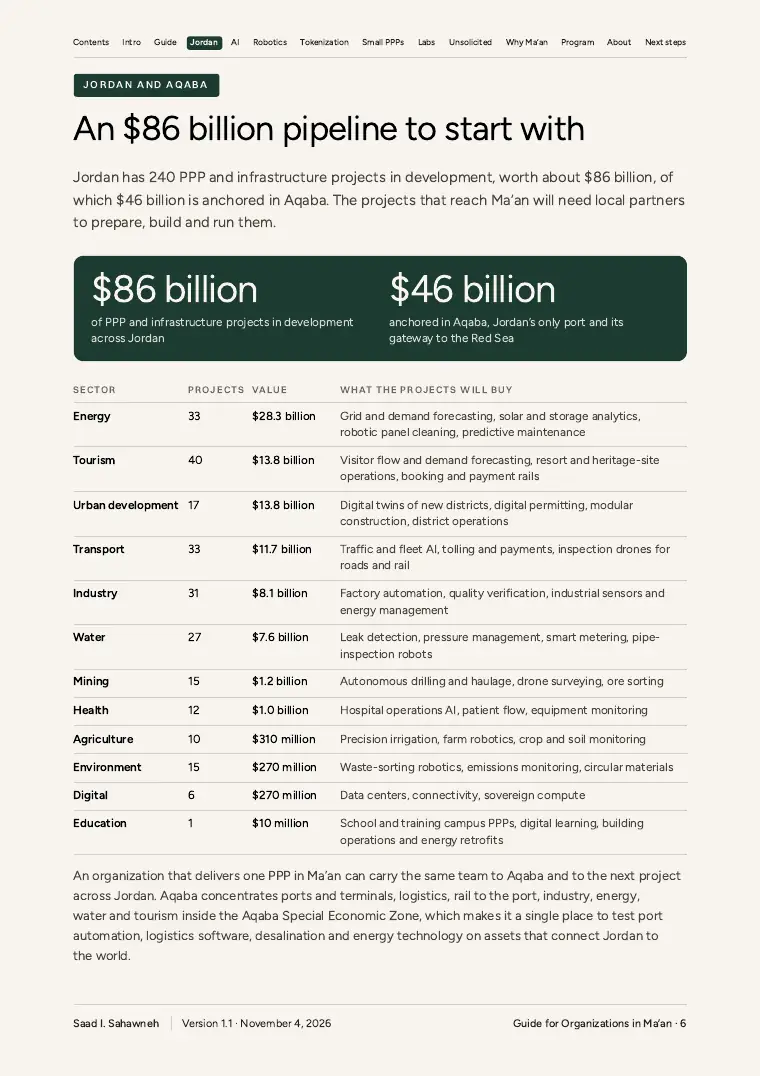
An $86 billion pipeline to start with
The projects that reach Ma’an will need local partners to prepare, build and run them. An organization that delivers one PPP in Ma’an can carry the same team to Aqaba and to the next project across Jordan.
- $86B
- of PPP and infrastructure projects in development in Jordan
- $46B
- of them anchored in Aqaba

Artificial intelligence
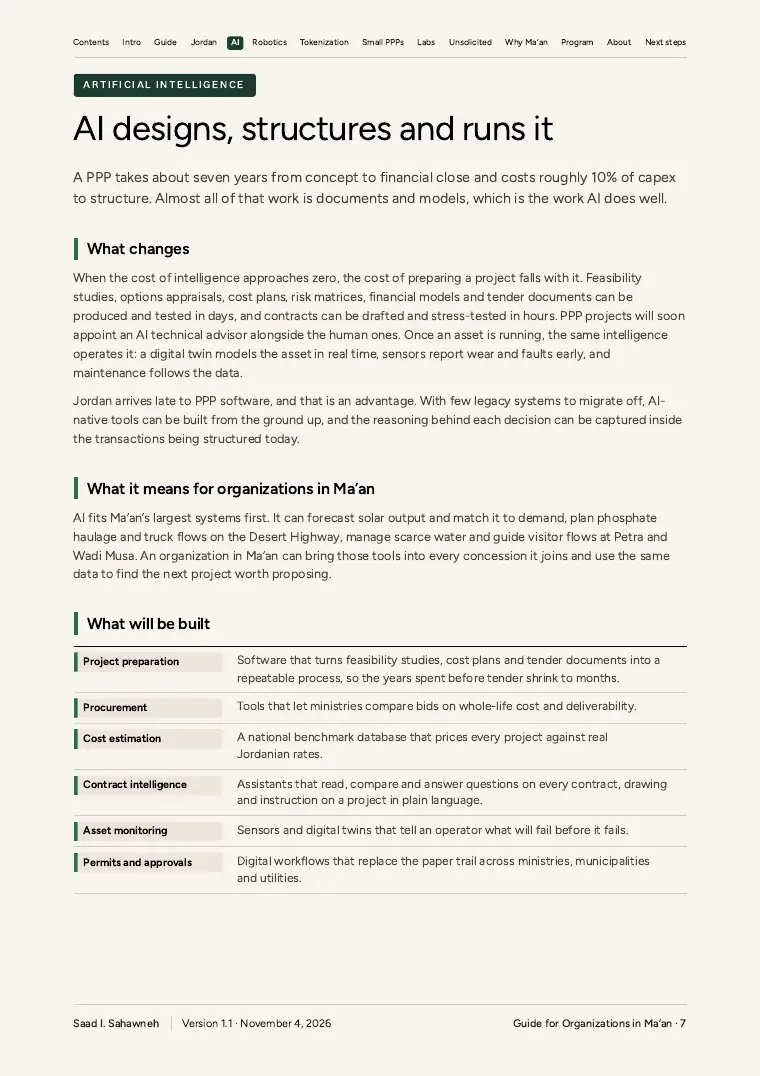
AI fits Ma’an’s largest systems first. It can forecast solar output and match it to demand, plan phosphate haulage and truck flows on the Desert Highway, manage scarce water and guide visitor flows at Petra and Wadi Musa. An organization in Ma’an can bring those tools into every concession it joins and use the same data to find the next project worth proposing.

Robotics
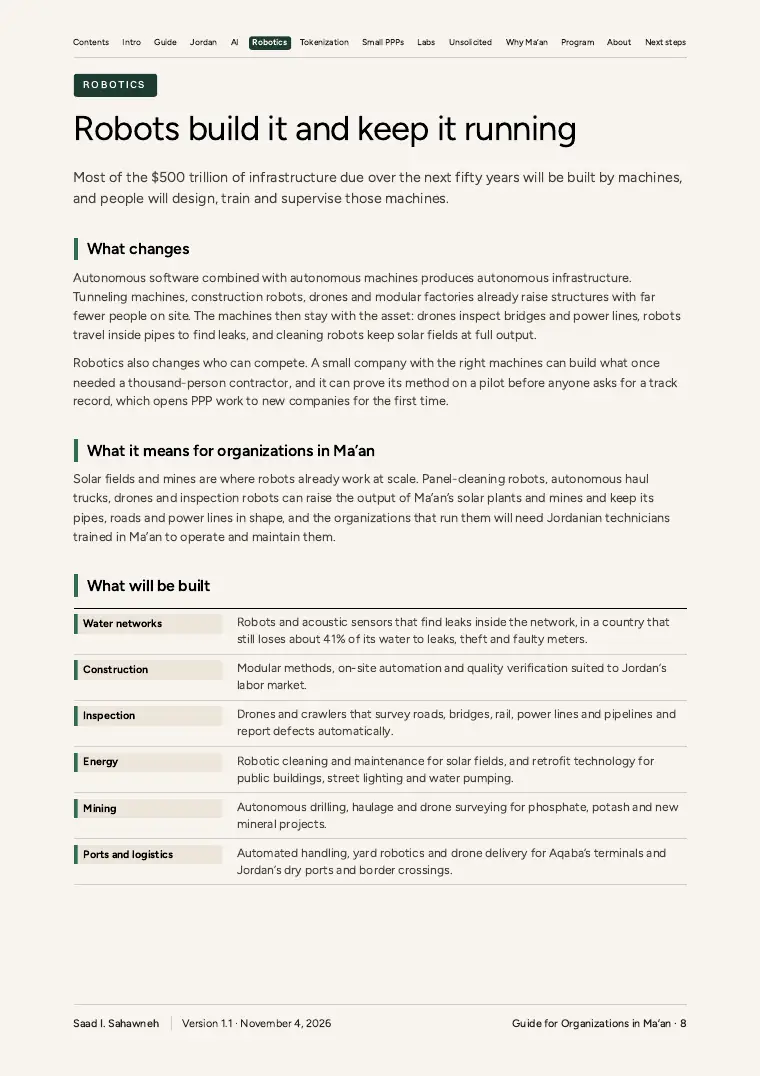
Solar fields and mines are where robots already work at scale. Panel-cleaning robots, autonomous haul trucks, drones and inspection robots can raise the output of Ma’an’s solar plants and mines and keep its pipes, roads and power lines in shape, and the organizations that run them will need Jordanian technicians trained in Ma’an to operate and maintain them.

Tokenization
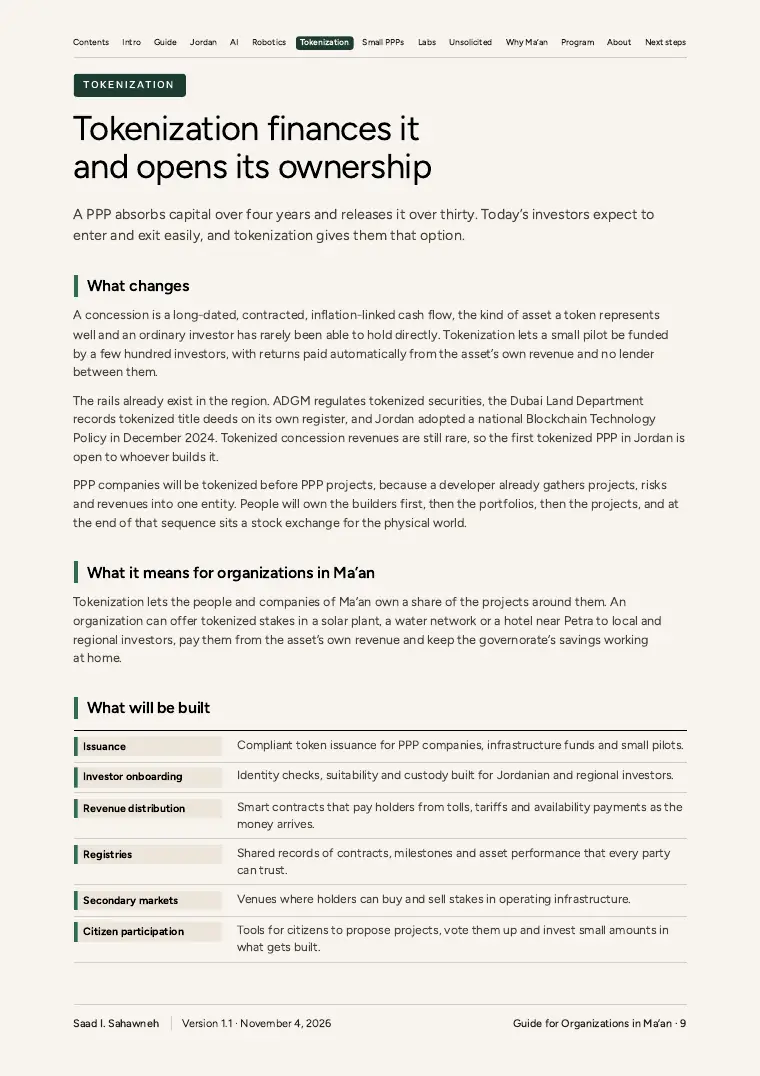
Tokenization lets the people and companies of Ma’an own a share of the projects around them. An organization can offer tokenized stakes in a solar plant, a water network or a hotel near Petra to local and regional investors, pay them from the asset’s own revenue and keep the governorate’s savings working at home.

Small PPPs and research labs
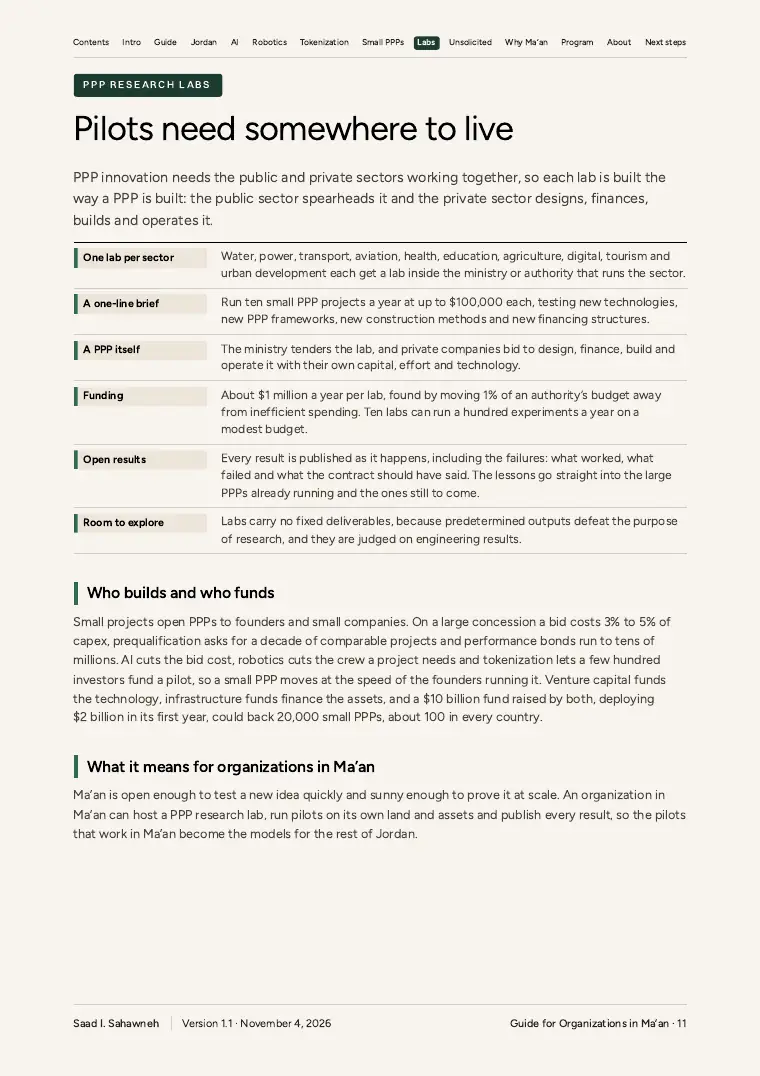
Ma’an is open enough to test a new idea quickly and sunny enough to prove it at scale. An organization in Ma’an can host a PPP research lab, run pilots on its own land and assets and publish every result, so the pilots that work in Ma’an become the models for the rest of Jordan.

Unsolicited proposals
A direct proposal lets an organization in Ma’an bring a project built around a need it knows better than anyone, from a truck stop on the Desert Highway to a visitor service in Wadi Musa. It can propose the project as its own, protect the ideas behind it and keep the right to match the best offer at tender.
The program
How the program could work
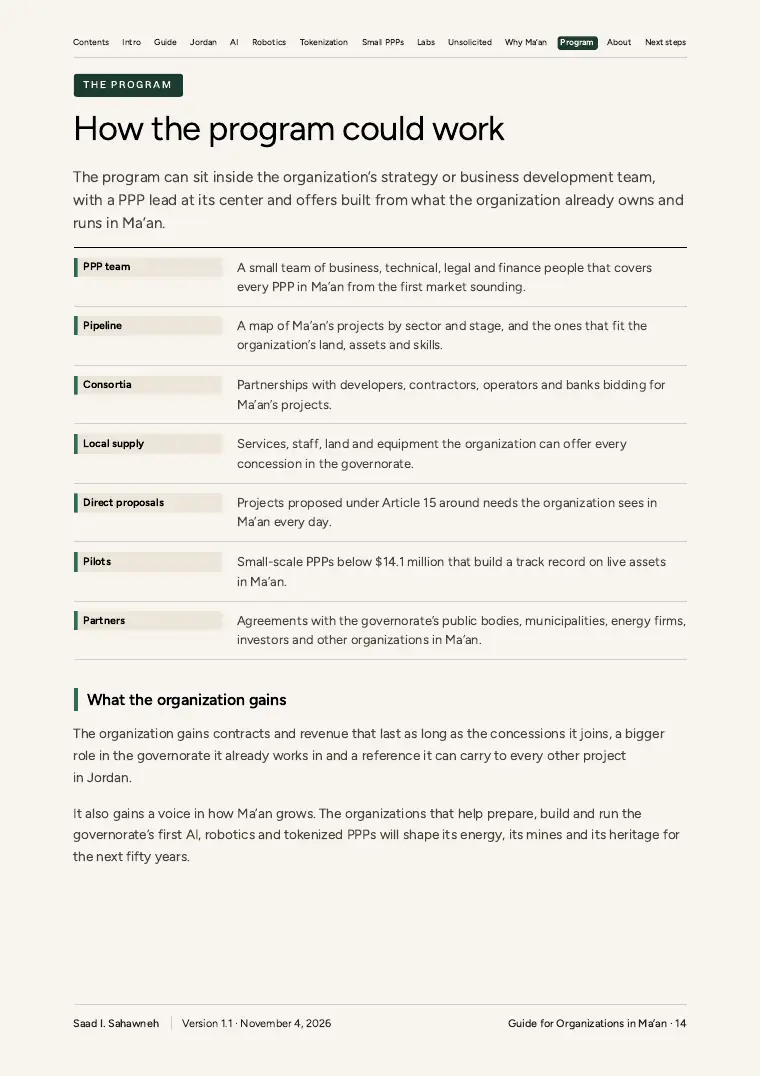
The program can sit inside the organization’s strategy or business development team, with a PPP lead at its center and offers built from what the organization already owns and runs in Ma’an.
- PPP team
- A small team of business, technical, legal and finance people that covers every PPP in Ma’an from the first market sounding.
- Pipeline
- A map of Ma’an’s projects by sector and stage, and the ones that fit the organization’s land, assets and skills.
- Consortia
- Partnerships with developers, contractors, operators and banks bidding for Ma’an’s projects.
- Local supply
- Services, staff, land and equipment the organization can offer every concession in the governorate.
- Direct proposals
- Projects proposed under Article 15 around needs the organization sees in Ma’an every day.
- Pilots
- Small-scale PPPs below $14.1 million that build a track record on live assets in Ma’an.
- Partners
- Agreements with the governorate’s public bodies, municipalities, energy firms, investors and other organizations in Ma’an.
What the organization gains
The organization gains contracts and revenue that last as long as the concessions it joins, a bigger role in the governorate it already works in and a reference it can carry to every other project in Jordan.
It also gains a voice in how Ma’an grows. The organizations that help prepare, build and run the governorate’s first AI, robotics and tokenized PPPs will shape its energy, its mines and its heritage for the next fifty years.

Next steps
How an organization in Ma’an can start
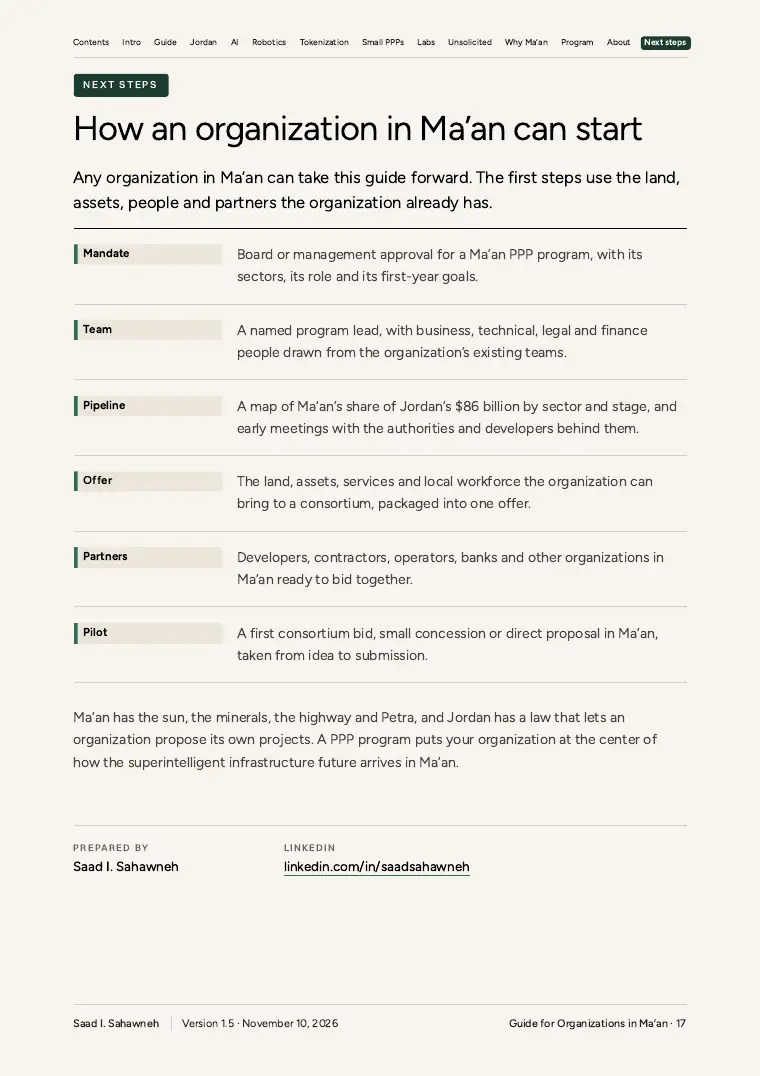
Any organization in Ma’an can take this guide forward. The first steps use the land, assets, people and partners the organization already has.
01
Mandate
Board or management approval for a Ma’an PPP program, with its sectors, its role and its first-year goals.
02
Team
A named program lead, with business, technical, legal and finance people drawn from the organization’s existing teams.
03
Pipeline
A map of Ma’an’s share of Jordan’s $86 billion by sector and stage, and early meetings with the authorities and developers behind them.
04
Offer
The land, assets, services and local workforce the organization can bring to a consortium, packaged into one offer.
05
Partners
Developers, contractors, operators, banks and other organizations in Ma’an ready to bid together.
06
Pilot
A first consortium bid, small concession or direct proposal in Ma’an, taken from idea to submission.
Ma’an has the sun, the minerals, the highway and Petra, and Jordan has a law that lets an organization propose its own projects. A PPP program puts your organization at the center of how the superintelligent infrastructure future arrives in Ma’an.
The full document
Inside this guide
Eighteen pages and fourteen chapters, from the case for a PPP program to the first steps, written for organizations in Ma’an.
- 18
- pages
- 14
- chapters
- 3
- technologies
- 6
- first steps
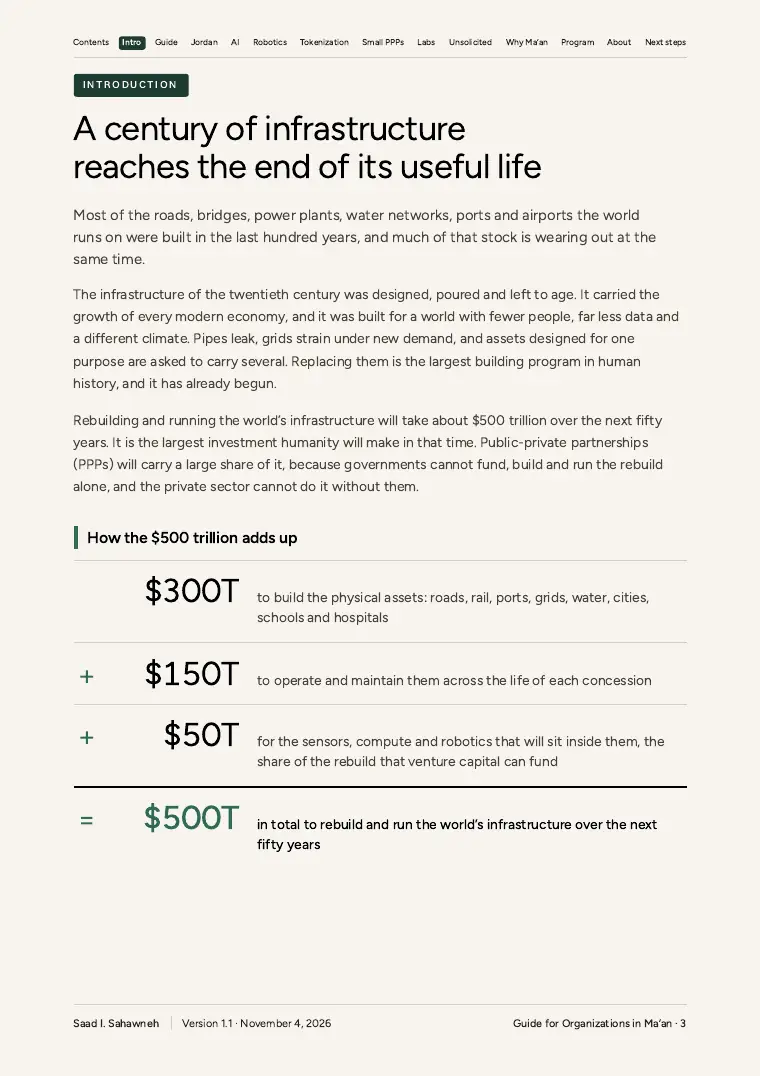
01Introduction
Why a century of infrastructure needs rebuilding, and the $500 trillion it will take.
Page 3 of 18
02The guide
Bring Ma’an into the $500 trillion PPP infrastructure opportunity
Page 5 of 18
03Jordan and Aqaba
An $86 billion pipeline to start with
Page 6 of 18
04Sector guides
The sectors closest to organizations in Ma’an, each with its own guide.
Page 7 of 18
05Artificial intelligence
How AI designs, structures and runs PPP projects, and what it means for organizations in Ma’an.
Page 8 of 18
06Robotics
How robots build infrastructure and keep it running, and what that means for organizations in Ma’an.
Page 9 of 18
07Tokenization
How tokenization funds projects from their own revenue, and the role it opens for organizations in Ma’an.
Page 10 of 18
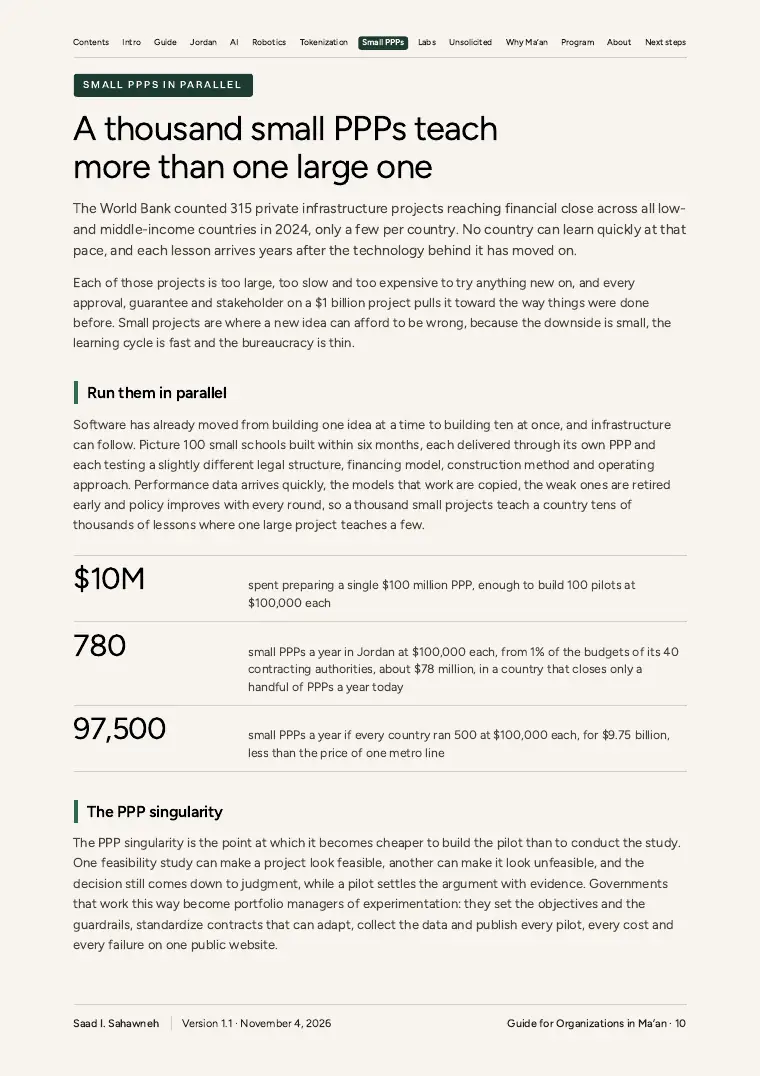
08Small PPPs in parallel
Why many small PPPs teach a country faster than a few large ones.
Page 11 of 18
09PPP research labs
A lab in each sector, running ten small PPP projects a year.
Page 12 of 18
10Unsolicited proposals
How Jordan’s PPP law accepts direct proposals from private companies.
Page 13 of 18
11Why organizations in Ma’an
Ma’an’s organizations can build the place they work in
Page 14 of 18
12The program
The program can sit inside the organization’s strategy or business development team, with a PPP lead at its center and offers built from what the organization already owns and runs in Ma’an.
Page 15 of 18
13About
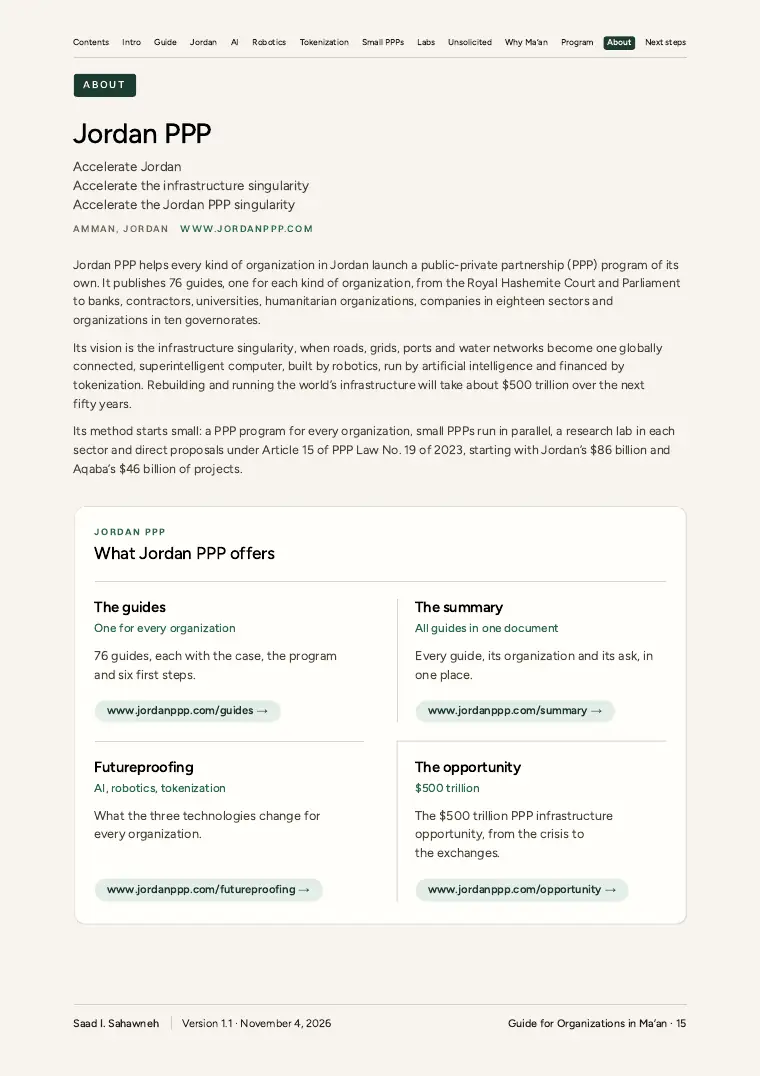
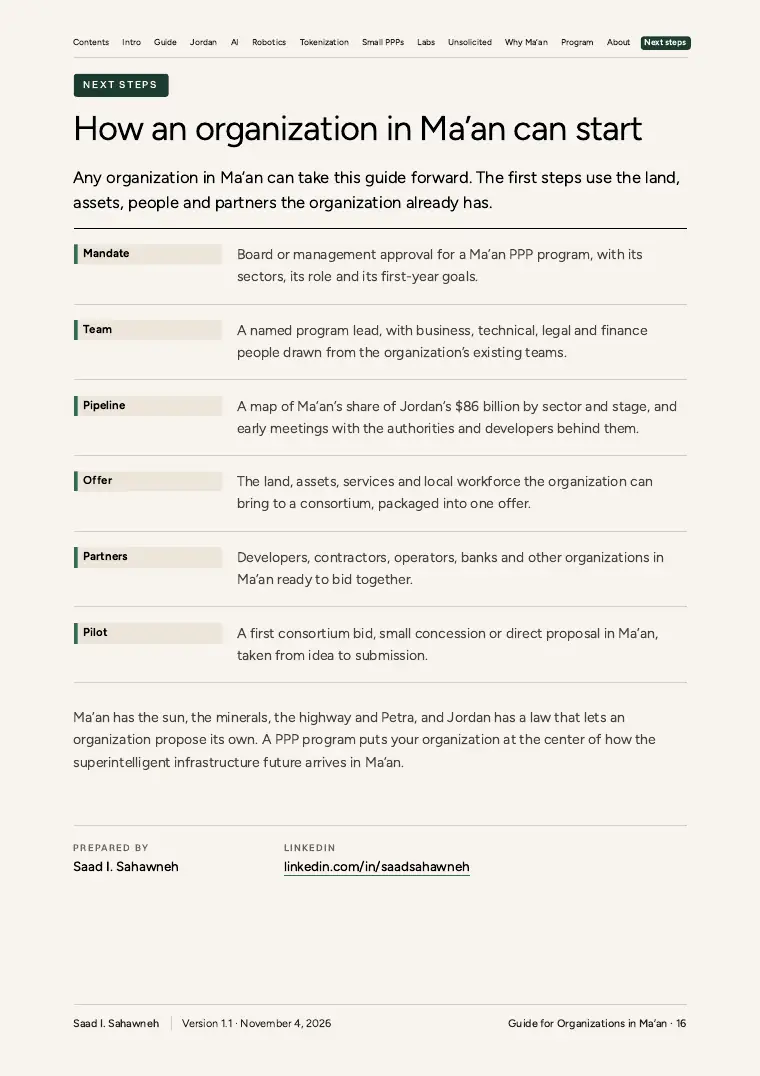
About Jordan PPP and what it offers.
Page 16 of 18
14Next steps
How an organization in Ma’an can start: six first steps.
Page 17 of 18
Questions
Questions about the organization guide for Organizations in Ma’an
- What does the organization guide for Organizations in Ma’an propose?
- Your organization launches a PPP program that turns Ma’an’s solar, mining, transport and tourism projects into public-private partnerships (PPPs) it can prepare, bid for, build, finance or operate, starting with the governorate it already works in.
- Why should organizations in Ma’an launch a PPP program?
- Ma’an’s organizations can build the place they work in. Ma’an holds Petra, the Ma’an Development Area, solar plants such as the 52.5 MW Shams Ma’an and the phosphate mines at Eshidiya. Each new project depends on the organizations already working there, and each one can make them partners in what is built.
- Which PPP projects can organizations in Ma’an take part in?
- Jordan has about $86 billion of PPP and infrastructure projects in development, $46 billion of them anchored in Aqaba. The projects that reach Ma’an will need local partners to prepare, build and run them. An organization that delivers one PPP in Ma’an can carry the same team to Aqaba and to the next project across Jordan.
- How can organizations in Ma’an start a PPP program?
- Any organization in Ma’an can take this guide forward. The first steps use the land, assets, people and partners the organization already has. The organization guide sets out six first steps: mandate, team, pipeline, offer, partners and pilot.
- What does a PPP program give organizations in Ma’an?
- The organization gains contracts and revenue that last as long as the concessions it joins, a bigger role in the governorate it already works in and a reference it can carry to every other project in Jordan.
- Is the organization guide for Organizations in Ma’an free?
- Yes. It is free to read on this page and free to download as an 18-page PDF, with the case for a PPP program, Jordan’s pipeline, the role of AI, robotics and tokenization, the program and six first steps.
Sector guides
The sectors closest to Ma’an
Jordan’s $86 billion is spread across 23 sectors. Each sector guide lists every project in it and shows how to take part.
 Tourism$13.8bnPetra (UNESCO 1985, about 1.1 million visitors in 2019) and Shobak Castle56 projects
 Mining and Minerals$1.2bnEshidiya phosphate mine, about 73% of national phosphate output29 projects
 Solar Power$326mMa’an Development Area solar park: 10 projects, 170 MW, incl. Shams Ma’an 52.5 MW18 projects
 Wind Power$186mFujeij (89 MW), Al Rajef (86 MW) and Shobak (45 MW) wind farms10 projects
 Fertilizers and Chemicals$6.5bnEshidiya phosphoric acid plants, incl. the JPMC and Transpet deal14 projects
 Transport$8.1bnAqaba Railway Corporation and the $2.5bn Etihad Rail line from Shidiya to Aqaba32 projects
 Manufacturing$2.4bnMa’an Industrial Park and Development Area; Udhruh factory creating 400 jobs38 projects
 Agriculture and Food$400mFarm investments in Shobak, Mudawwarah, Ras Al-Naqab and Muhammadiyeh28 projects
 Education and Skills$7mAl-Hussein Bin Talal University12 projects
 Water$6.7bnDisi-Mudawwara well field feeding the Disi conveyance to Amman29 projects
 Storage and Grids$1.4bnMa’an 400/132/33 kV substation and Ma’an PV 132/33 kV substation, both being expanded25 projects
 Circular Economy$189mMa’an dumpsite and the Al-Husseinieh Transfer Station22 projects
Guide 21 of 96
Browse all 96 organization guides