What this organization guide is for
Your firm launches a PPP practice to advise governments, sponsors, lenders and contractors on public-private partnership (PPP) projects and on the AI, robotics and tokenization inside them.
The case
Law firms write the contracts that hold a PPP together
A PPP is held together by contracts that run for decades, and every party appoints counsel: the government, the sponsors, the lenders, the contractors and the operator. The projects of the next fifty years will add data, machines and digital assets to those contracts. This guide invites law firms in Jordan to launch a PPP practice, starting with the projects at home.
The guide
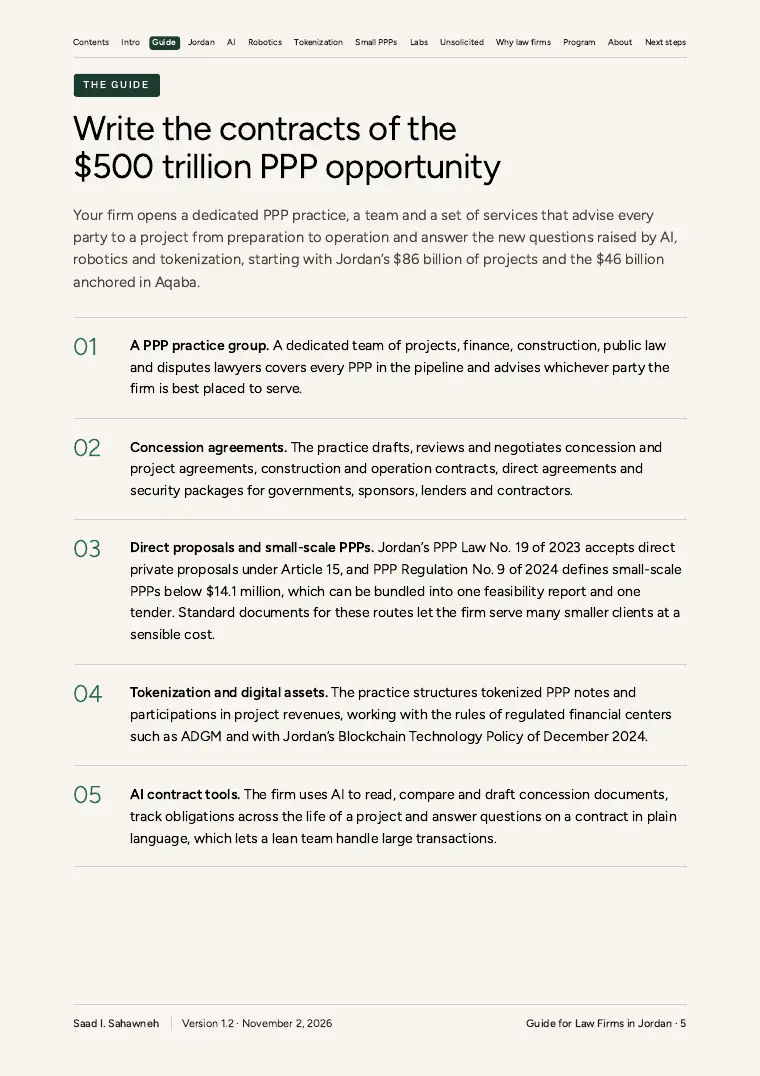
Write the contracts of the $500 trillion PPP opportunity
Your firm opens a dedicated PPP practice, a team and a set of services that advise every party to a project from preparation to operation and answer the new questions raised by AI, robotics and tokenization, starting with Jordan’s $86 billion of projects and the $46 billion anchored in Aqaba.
01
A PPP practice group
A dedicated team of projects, finance, construction, public law and disputes lawyers covers every PPP in the pipeline and advises whichever party the firm is best placed to serve.
02
Concession agreements
The practice drafts, reviews and negotiates concession and project agreements, construction and operation contracts, direct agreements and security packages for governments, sponsors, lenders and contractors.
03
Direct proposals and small-scale PPPs
Jordan’s PPP Law No. 19 of 2023 accepts direct private proposals under Article 15, and PPP Regulation No. 9 of 2024 defines small-scale PPPs below $14.1 million, which can be bundled into one feasibility report and one tender. Standard documents for these routes let the firm serve many smaller clients at a sensible cost.
04
Tokenization and digital assets
The practice structures tokenized PPP notes and participations in project revenues, working with the rules of regulated financial centers such as ADGM and with Jordan’s Blockchain Technology Policy of December 2024.
05
AI contract tools
The firm uses AI to read, compare and draft concession documents, track obligations across the life of a project and answer questions on a contract in plain language, which lets a lean team handle large transactions.
Why law firms
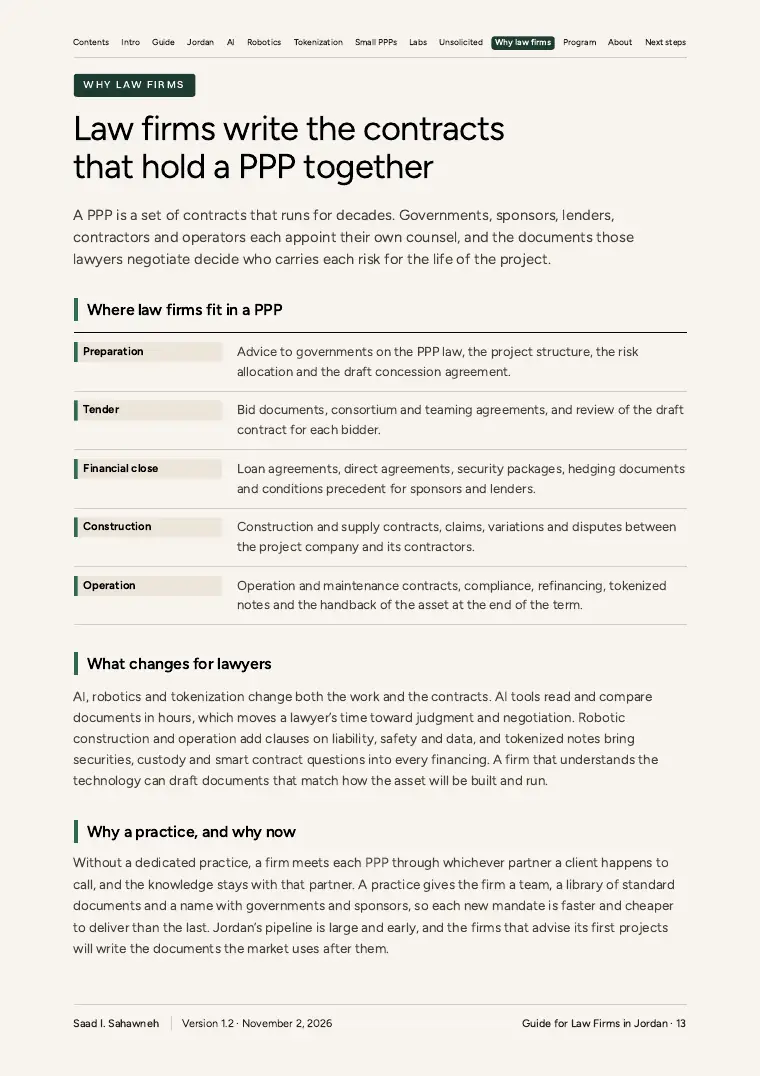
Law firms write the contracts that hold a PPP together
A PPP is a set of contracts that runs for decades. Governments, sponsors, lenders, contractors and operators each appoint their own counsel, and the documents those lawyers negotiate decide who carries each risk for the life of the project.
Where law firms fit in a PPP
- Preparation
- Advice to governments on the PPP law, the project structure, the risk allocation and the draft concession agreement.
- Tender
- Bid documents, consortium and teaming agreements, and review of the draft contract for each bidder.
- Financial close
- Loan agreements, direct agreements, security packages, hedging documents and conditions precedent for sponsors and lenders.
- Construction
- Construction and supply contracts, claims, variations and disputes between the project company and its contractors.
- Operation
- Operation and maintenance contracts, compliance, refinancing, tokenized notes and the handback of the asset at the end of the term.
What changes for lawyers
AI, robotics and tokenization change both the work and the contracts. AI tools read and compare documents in hours, which moves a lawyer’s time toward judgment and negotiation. Robotic construction and operation add clauses on liability, safety and data, and tokenized notes bring securities, custody and smart contract questions into every financing. A firm that understands the technology can draft documents that match how the asset will be built and run.
Why a practice, and why now
Without a dedicated practice, a firm meets each PPP through whichever partner a client happens to call, and the knowledge stays with that partner. A practice gives the firm a team, a library of standard documents and a name with governments and sponsors, so each new mandate is faster and cheaper to deliver than the last. Jordan’s pipeline is large and early, and the firms that advise its first projects will write the documents the market uses after them.

Futureproofing
Futureproof Law Firms in Jordan for the infrastructure singularity
This free 18-page guide shows how, with small PPPs in parallel, PPP research labs, artificial intelligence, robotics, tokenization and six first steps.

Jordan and Aqaba
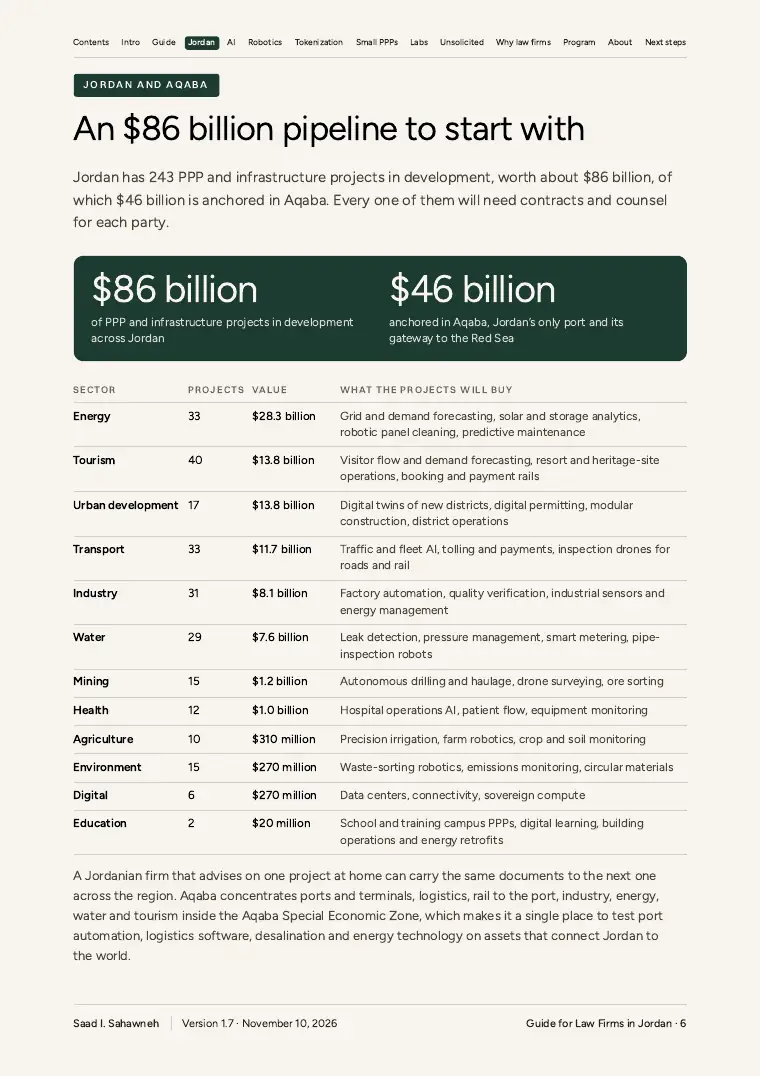
An $86 billion pipeline to start with
Every one of them will need contracts and counsel for each party. A Jordanian firm that advises on one project at home can carry the same documents to the next one across the region.
- $86B
- of PPP and infrastructure projects in development in Jordan
- $46B
- of them anchored in Aqaba

Artificial intelligence
AI changes how a PPP practice works. A concession agreement and its schedules can be read, compared against similar deals and checked for gaps in hours, and obligations can be tracked automatically for the life of the contract. A firm that builds these tools into its practice can advise on more projects with a smaller team and offer clients fixed prices for standard work.

Robotics
Robotics brings new clauses into PPP contracts. Autonomous machines on site and in operation raise questions of liability, insurance, safety approvals and data ownership. Contracts will need to set who answers when a drone, a crawler or an automated system fails, and a firm that drafts these clauses can use them across every project it advises.

Tokenization
Tokenization needs lawyers at every step. Each issue of tokenized PPP notes requires a legal structure, a regulated venue, investor disclosures, security over the project’s revenues and smart contracts that match the legal documents. A firm that builds this practice early can advise issuers, banks and governments on the first tokenized PPPs in the region.

Small PPPs and research labs
Each lab is a working test of contract design. Every pilot shows what the contract should have said, and a firm that drafts and reviews small PPPs builds the standard, adaptable templates Jordan needs to run hundreds of projects a year, along with the know-how for tokenized and technology-heavy concessions.

Unsolicited proposals
Direct proposals are legal work from the first page: the conditions under Article 15 and PPP Regulation No. 9 of 2024, the intellectual property in the idea, the conflict-of-interest disclosure and the proposer’s rights at tender. A firm that guides proposers through them becomes the first call for every company with an idea for government.
The program
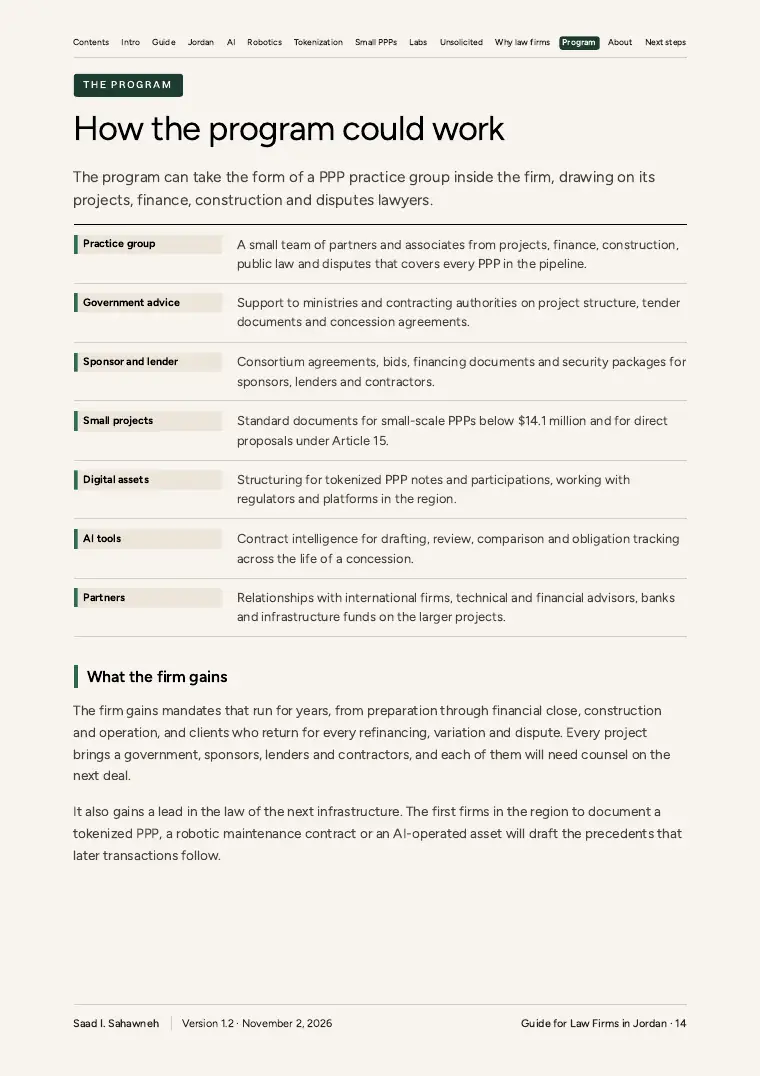
How the program could work
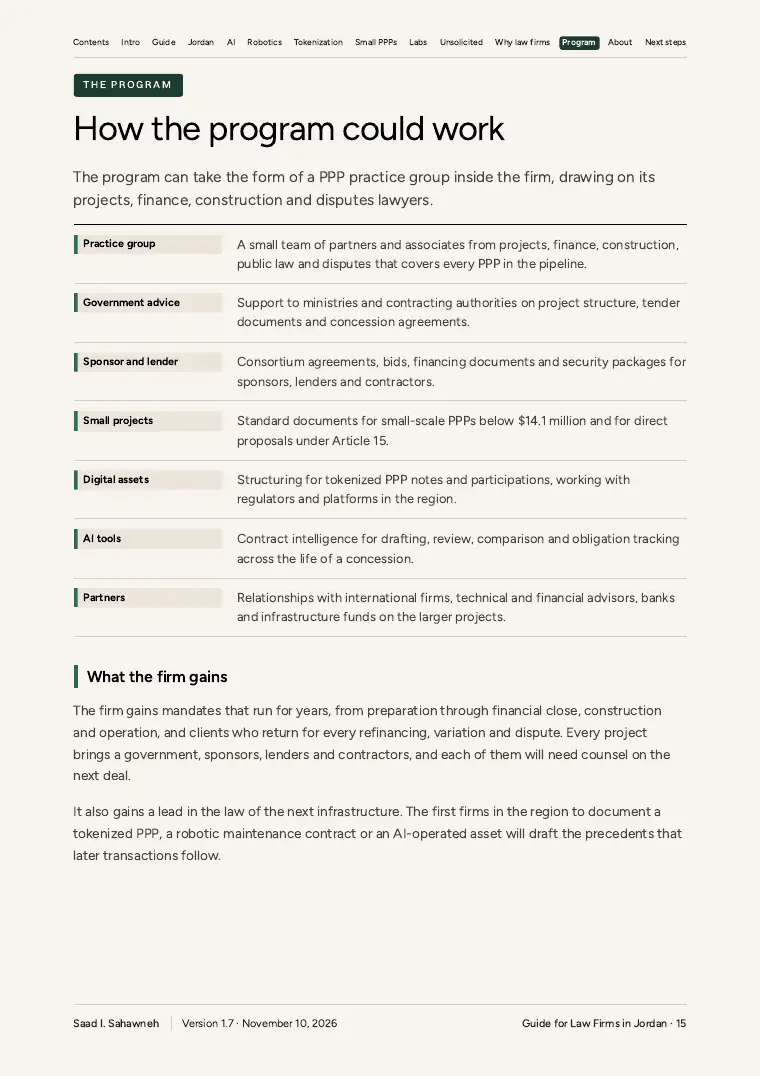
The program can take the form of a PPP practice group inside the firm, drawing on its projects, finance, construction and disputes lawyers.
- Practice group
- A small team of partners and associates from projects, finance, construction, public law and disputes that covers every PPP in the pipeline.
- Government advice
- Support to ministries and contracting authorities on project structure, tender documents and concession agreements.
- Sponsor and lender
- Consortium agreements, bids, financing documents and security packages for sponsors, lenders and contractors.
- Small projects
- Standard documents for small-scale PPPs below $14.1 million and for direct proposals under Article 15.
- Digital assets
- Structuring for tokenized PPP notes and participations, working with regulators and platforms in the region.
- AI tools
- Contract intelligence for drafting, review, comparison and obligation tracking across the life of a concession.
- Partners
- Relationships with international firms, technical and financial advisors, banks and infrastructure funds on the larger projects.
What the firm gains
The firm gains mandates that run for years, from preparation through financial close, construction and operation, and clients who return for every refinancing, variation and dispute. Every project brings a government, sponsors, lenders and contractors, and each of them will need counsel on the next deal.
It also gains a lead in the law of the next infrastructure. The first firms in the region to document a tokenized PPP, a robotic maintenance contract or an AI-operated asset will draft the precedents that later transactions follow.

Next steps
How a law firm can start
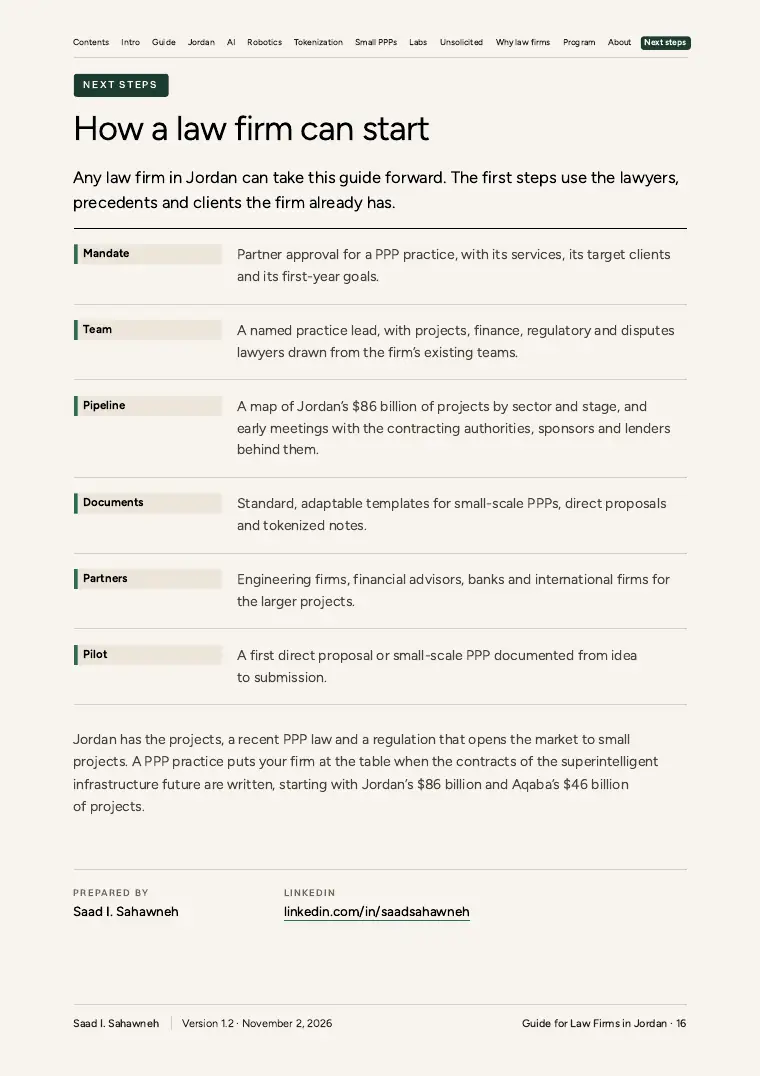
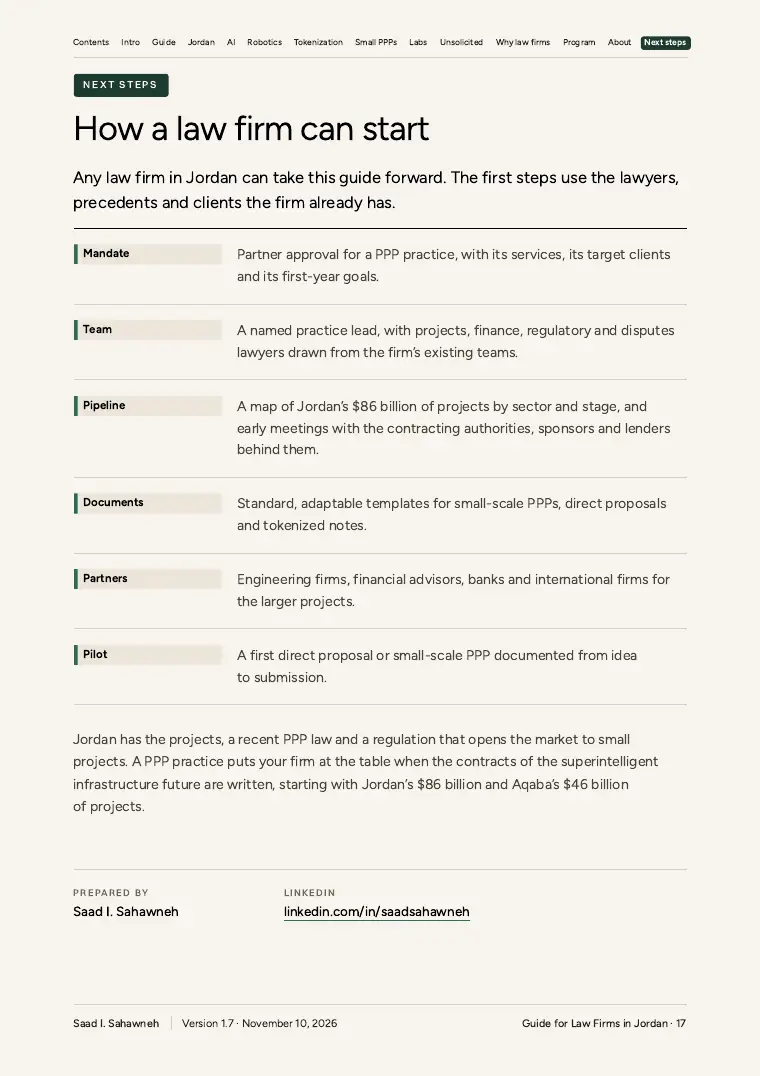
Any law firm in Jordan can take this guide forward. The first steps use the lawyers, precedents and clients the firm already has.
01
Mandate
Partner approval for a PPP practice, with its services, its target clients and its first-year goals.
02
Team
A named practice lead, with projects, finance, regulatory and disputes lawyers drawn from the firm’s existing teams.
03
Pipeline
A map of Jordan’s $86 billion of projects by sector and stage, and early meetings with the contracting authorities, sponsors and lenders behind them.
04
Documents
Standard, adaptable templates for small-scale PPPs, direct proposals and tokenized notes.
05
Partners
Engineering firms, financial advisors, banks and international firms for the larger projects.
06
Pilot
A first direct proposal or small-scale PPP documented from idea to submission.
Jordan has the projects, a recent PPP law and a regulation that opens the market to small projects. A PPP practice puts your firm at the table when the contracts of the superintelligent infrastructure future are written, starting with Jordan’s $86 billion and Aqaba’s $46 billion of projects.
The full document
Inside this guide
Eighteen pages and fourteen chapters, from the case for a PPP program to the first steps, written for law firms in Jordan.
- 18
- pages
- 14
- chapters
- 3
- technologies
- 6
- first steps
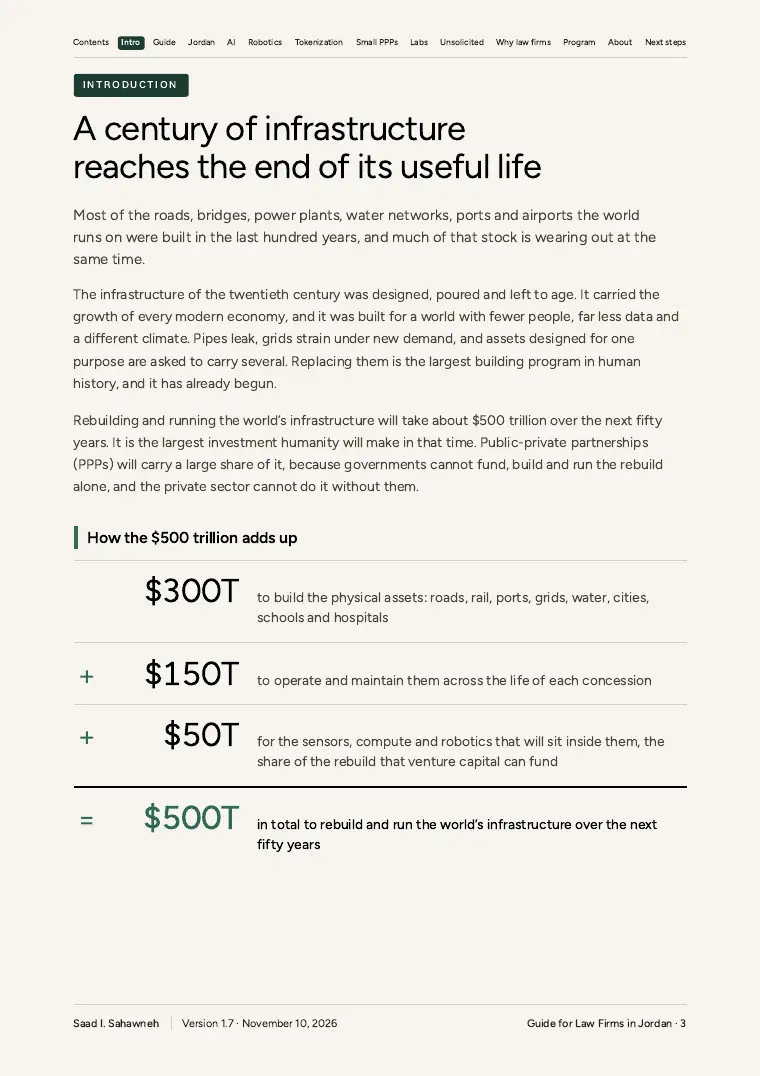
01Introduction
Why a century of infrastructure needs rebuilding, and the $500 trillion it will take.
Page 3 of 18
02The guide
Write the contracts of the $500 trillion PPP opportunity
Page 5 of 18
03Jordan and Aqaba
An $86 billion pipeline to start with
Page 6 of 18
04Sector guides
The sectors closest to law firms, each with its own guide.
Page 7 of 18
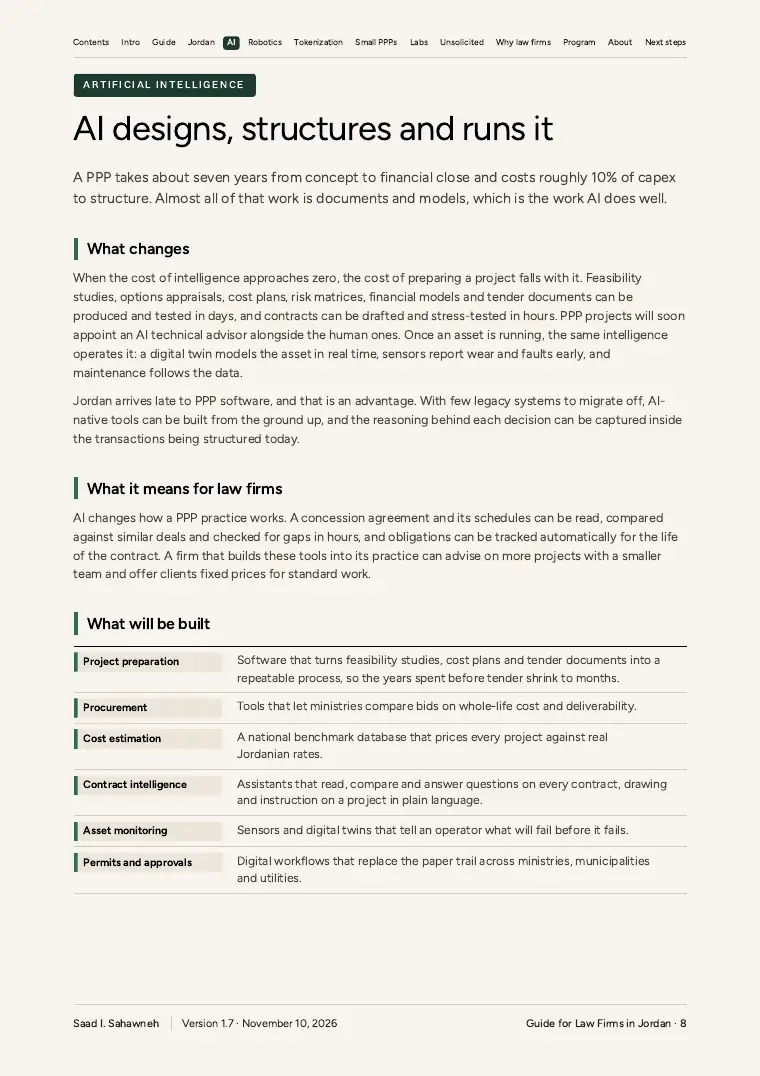
05Artificial intelligence
How AI designs, structures and runs PPP projects, and what it means for law firms.
Page 8 of 18
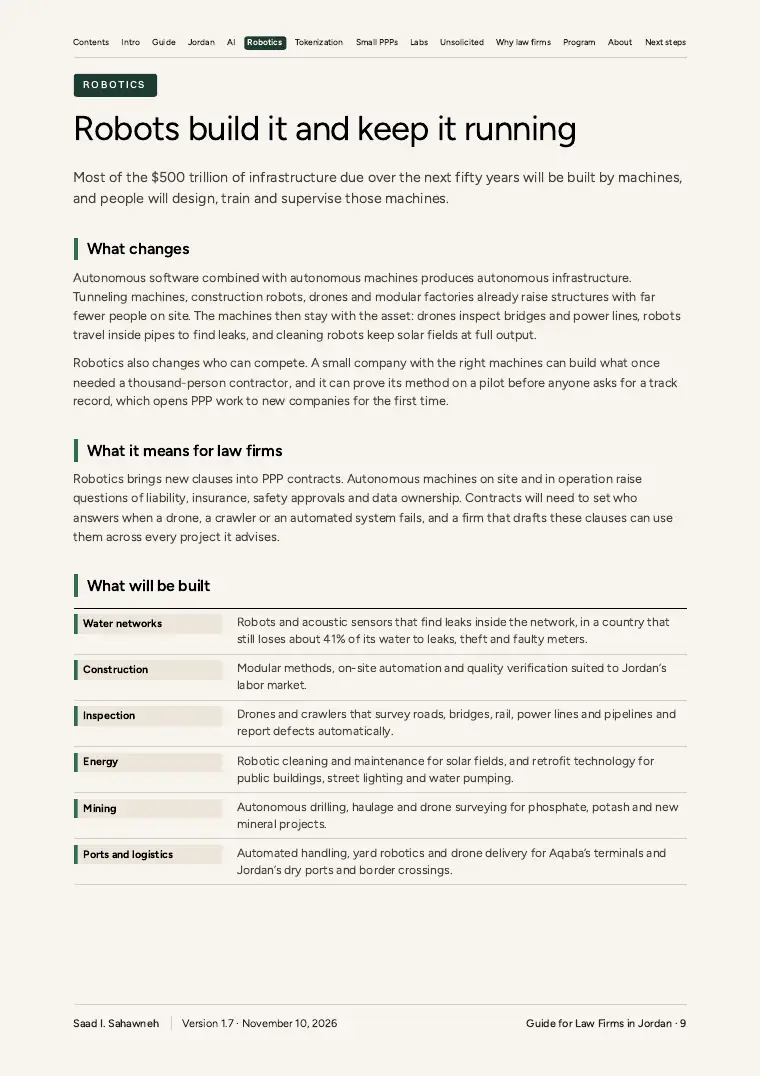
06Robotics
How robots build infrastructure and keep it running, and what that means for law firms.
Page 9 of 18
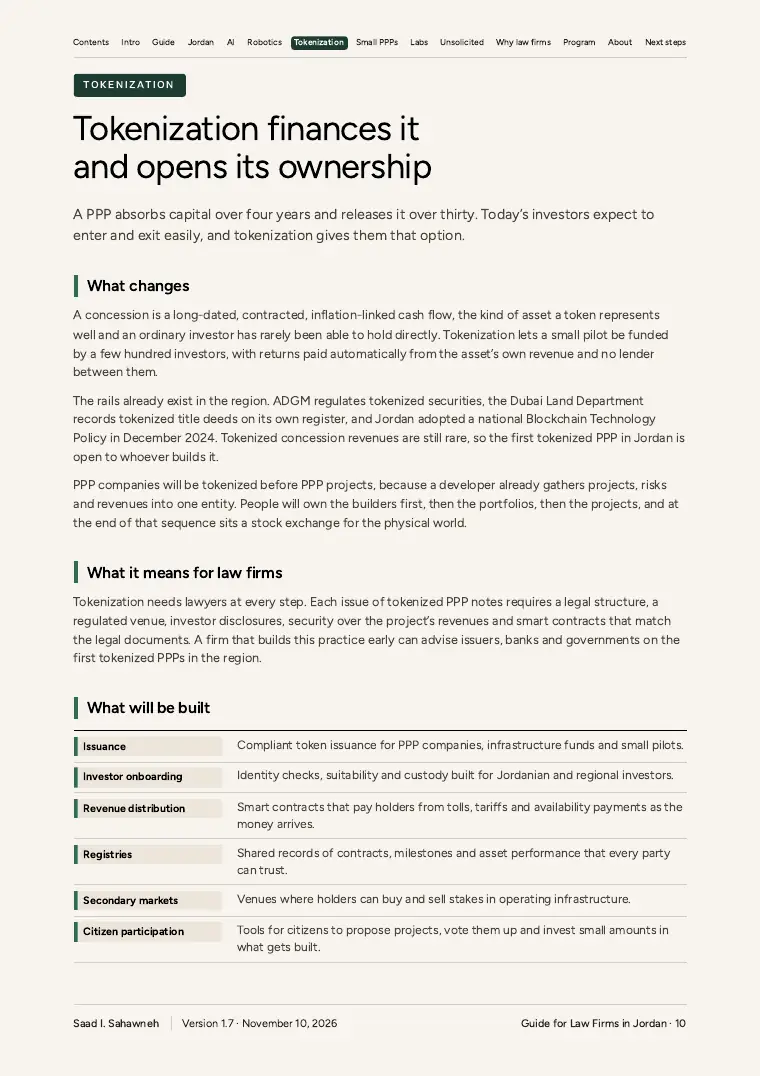
07Tokenization
How tokenization funds projects from their own revenue, and the role it opens for law firms.
Page 10 of 18
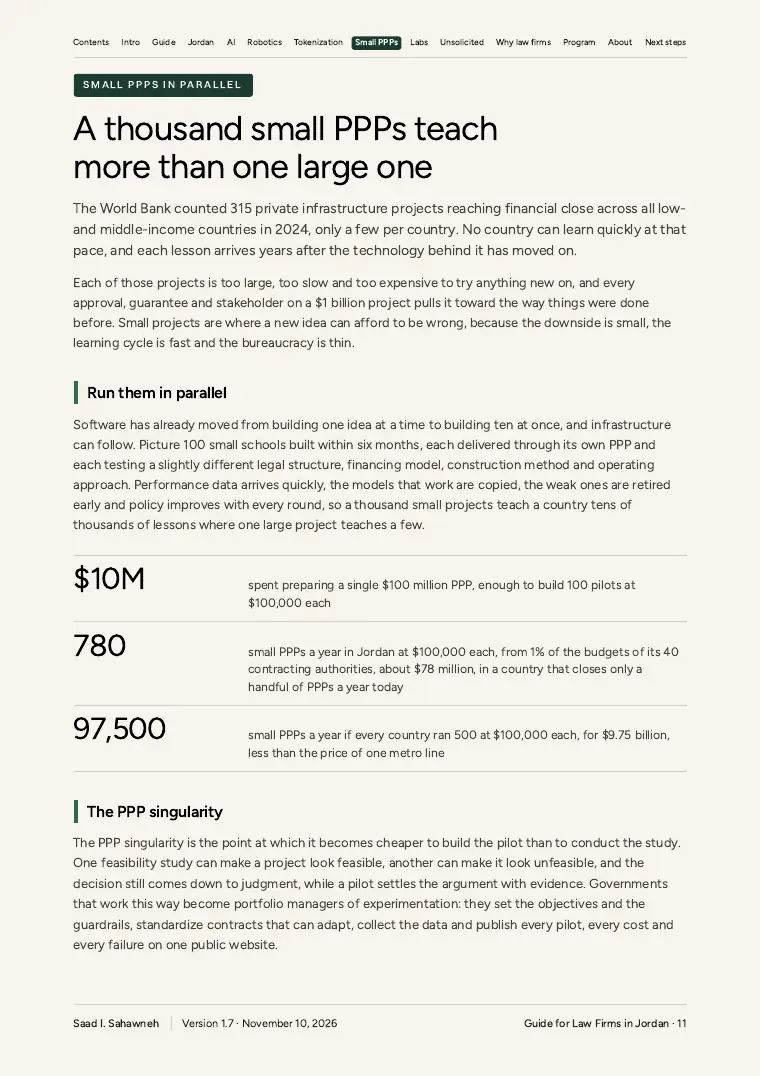
08Small PPPs in parallel
Why many small PPPs teach a country faster than a few large ones.
Page 11 of 18
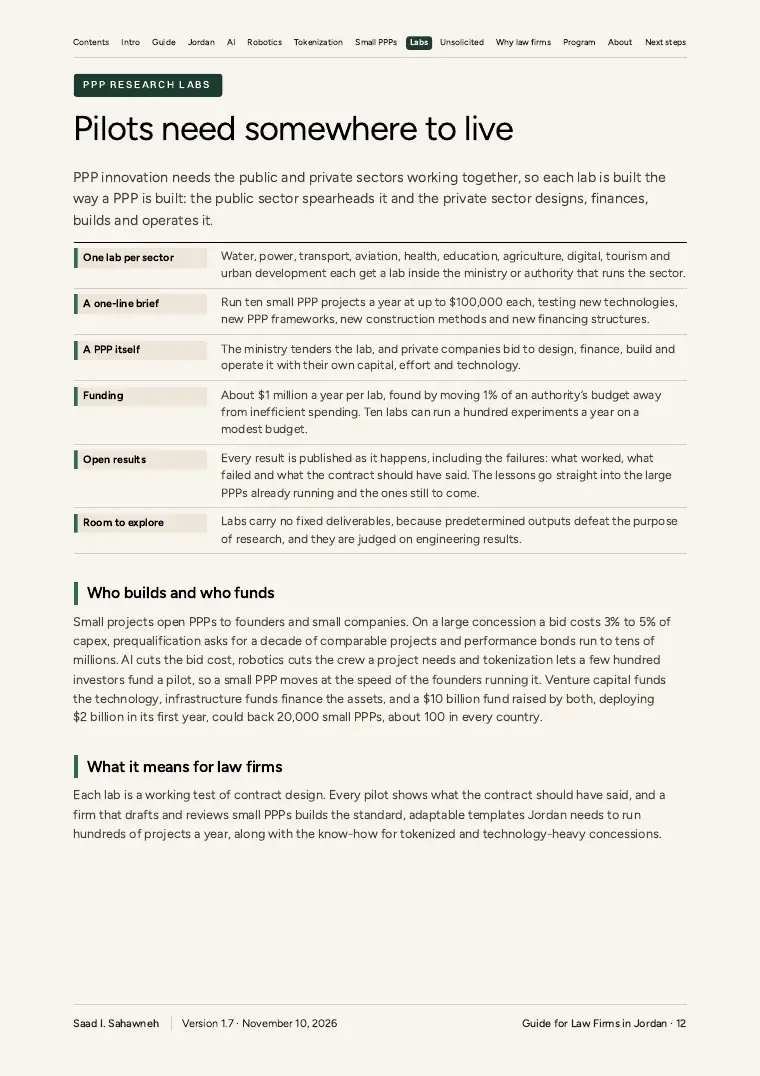
09PPP research labs
A lab in each sector, running ten small PPP projects a year.
Page 12 of 18
10Unsolicited proposals
How Jordan’s PPP law accepts direct proposals from private companies.
Page 13 of 18
11Why law firms
Law firms write the contracts that hold a PPP together
Page 14 of 18
12The program
The program can take the form of a PPP practice group inside the firm, drawing on its projects, finance, construction and disputes lawyers.
Page 15 of 18
13About
About Jordan PPP and what it offers.
Page 16 of 18
14Next steps
How a law firm can start: six first steps.
Page 17 of 18
Questions
Questions about the organization guide for Law Firms in Jordan
- What does the organization guide for Law Firms in Jordan propose?
- Your firm launches a PPP practice to advise governments, sponsors, lenders and contractors on public-private partnership (PPP) projects and on the AI, robotics and tokenization inside them.
- Why should law firms in Jordan launch a PPP program?
- Law firms write the contracts that hold a PPP together. A PPP is a set of contracts that runs for decades. Governments, sponsors, lenders, contractors and operators each appoint their own counsel, and the documents those lawyers negotiate decide who carries each risk for the life of the project.
- Which PPP projects can law firms in Jordan take part in?
- Jordan has about $86 billion of PPP and infrastructure projects in development, $46 billion of them anchored in Aqaba. Every one of them will need contracts and counsel for each party. A Jordanian firm that advises on one project at home can carry the same documents to the next one across the region.
- How can law firms in Jordan start a PPP program?
- Any law firm in Jordan can take this guide forward. The first steps use the lawyers, precedents and clients the firm already has. The organization guide sets out six first steps: mandate, team, pipeline, documents, partners and pilot.
- What does a PPP program give law firms in Jordan?
- The firm gains mandates that run for years, from preparation through financial close, construction and operation, and clients who return for every refinancing, variation and dispute. Every project brings a government, sponsors, lenders and contractors, and each of them will need counsel on the next deal.
- Is the organization guide for Law Firms in Jordan free?
- Yes. It is free to read on this page and free to download as an 18-page PDF, with the case for a PPP program, Jordan’s pipeline, the role of AI, robotics and tokenization, the program and six first steps.
Sector guides
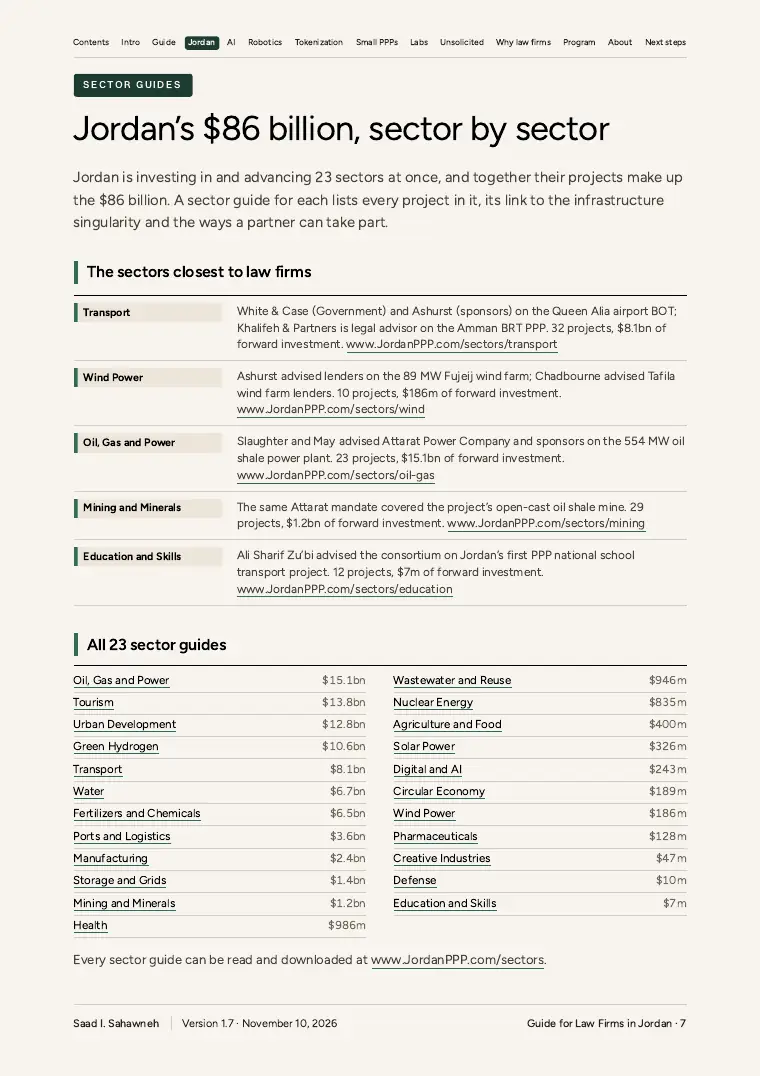
The sectors closest to law firms
Jordan’s $86 billion is spread across 23 sectors. Each sector guide lists every project in it and shows how to take part.
Law firms work on projects in every sector. These are the sectors where we found a named mandate in Jordan.
 Transport$8.1bnWhite & Case (Government) and Ashurst (sponsors) on the Queen Alia airport BOT; Khalifeh & Partners is legal advisor on the Amman BRT PPP32 projects
 Wind Power$186mAshurst advised lenders on the 89 MW Fujeij wind farm; Chadbourne advised Tafila wind farm lenders10 projects
 Oil, Gas and Power$15.1bnSlaughter and May advised Attarat Power Company and sponsors on the 554 MW oil shale power plant23 projects
 Mining and Minerals$1.2bnThe same Attarat mandate covered the project’s open-cast oil shale mine29 projects
 Education and Skills$7mAli Sharif Zu’bi advised the consortium on Jordan’s first PPP national school transport project12 projects
 Solar Power$326mWhite & Case advised IFC and other lenders on seven Jordan solar projects, including Arabia One and Shamsuna18 projects
 Water$6.7bnObeidat Lawyers represented the sponsors of the Disi Water Conveyance System, awarded to Gama Enerji in 200929 projects
 Wastewater and Reuse$946mLatham & Watkins advised lenders and Freshfields advised sponsors on the Kherbet al-Samra wastewater plant, Jordan’s first PPP20 projects
 Storage and Grids$1.4bnKhalifeh & Partners advised IDECO on the power purchase agreement for the Badiya project, Jordan’s first utility-scale storage25 projects
 Ports and Logistics$3.6bnAli Sharif Zu’bi acted as legal counsel on the Aqaba Port Railway, a 360 km line linking phosphate and potash mines to the port23 projects
 Digital and AI$243mMcCarthy Tétrault acted for the Government of Jordan on the privatization of Jordan Telecommunications Company19 projects
 Circular Economy$189mKhalifeh & Partners worked on the construction and operation of a Medical and Industrial Waste Treatment Plant in Jordan22 projects
 Agriculture and Food$400mKhalifeh & Partners worked on the construction of a new slaughterhouse in Amman28 projects
Guide 43 of 96
Browse all 96 organization guides