Singularity
EarthOS
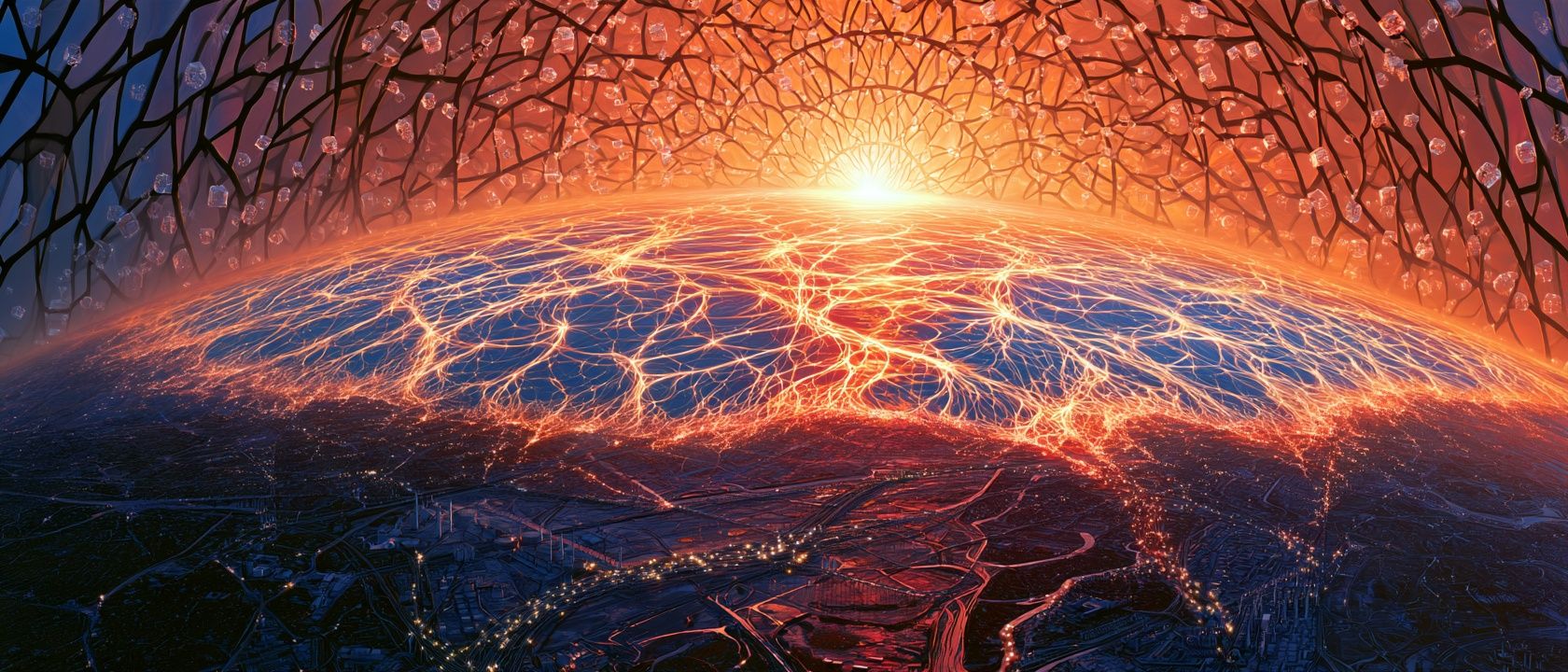
The shared AI software that will run the world’s biggest $500 trillion computer. The world’s infrastructure and its sensors are the hardware, EarthOS is the software, and tokenization manages it all.
Three layers
Hardware, software and the layer that manages it all
Every computer is built in layers. The planet’s computer has three, and EarthOS sits in the middle, joining the physical world below to the accounts above.
Layer 02 · The AI software
EarthOS
An artificial intelligence reads every sensor at once, keeps a living map of the whole planet and decides, second by second, where power, water, goods and people should flow. It runs on the data centers that act as the machine’s processors and gives orders to the robots that build and repair.
- A living map of the Earth
- Scheduling for power, water and traffic
- Drivers for every kind of asset
- Apps that anyone can write
In Jordan
New data centers in Aqaba and at the Al-Risha gas field would give Jordan processors of its own to run its part of EarthOS.
Artificial intelligenceWhat it does
Every job of an operating system, at the size of the planet
Look inside any operating system and you find the same handful of jobs. EarthOS does each one for every road, pipe, power line and port on Earth.
01
One living map
On a laptop
The kernel knows the state of every device at every moment.
On EarthOS
A digital twin of the Earth holds a copy of every pipe, pole and road that changes the instant the real one does.
02
Who goes first
On a laptop
The scheduler decides which program gets the processor next.
On EarthOS
EarthOS decides which city gets power at the evening peak, which ship docks first at Aqaba and which field gets water before the afternoon heat.
03
Power and water for later
On a laptop
Memory keeps what the computer needs for later.
On EarthOS
Batteries, reservoirs and dams hold power and water for the night and the summer, and noon sunlight can be stored as water pumped uphill at Al-Mujib.
04
Every asset plugs in
On a laptop
A driver teaches the computer how to use a new printer.
On EarthOS
Every kind of asset gets a driver, so a new solar farm, wind farm or water plant joins the machine on its first day.
05
Anyone can build on it
On a laptop
Anyone can write an app for a phone.
On EarthOS
A farmer’s app waters each row of a field, a city’s app warns every street before a flood, and a school’s app shows what its roof made today.
06
One lesson, every asset
On a laptop
Each software update makes the laptop a little better.
On EarthOS
A fix found in a pipe in Amman can protect a pipe in Jakarta by the next morning.
07
Safe by design
On a laptop
Permissions decide who may open which file.
On EarthOS
EarthOS decides who may see which data and change which setting, and it keeps a single fault from spreading.
08
It keeps the books
On a laptop
A log records what the computer did and when.
On EarthOS
Tokenization records every action, owner and payment in one shared record that everyone can check.
Wired into space
EarthOS runs on the ground and in the sky
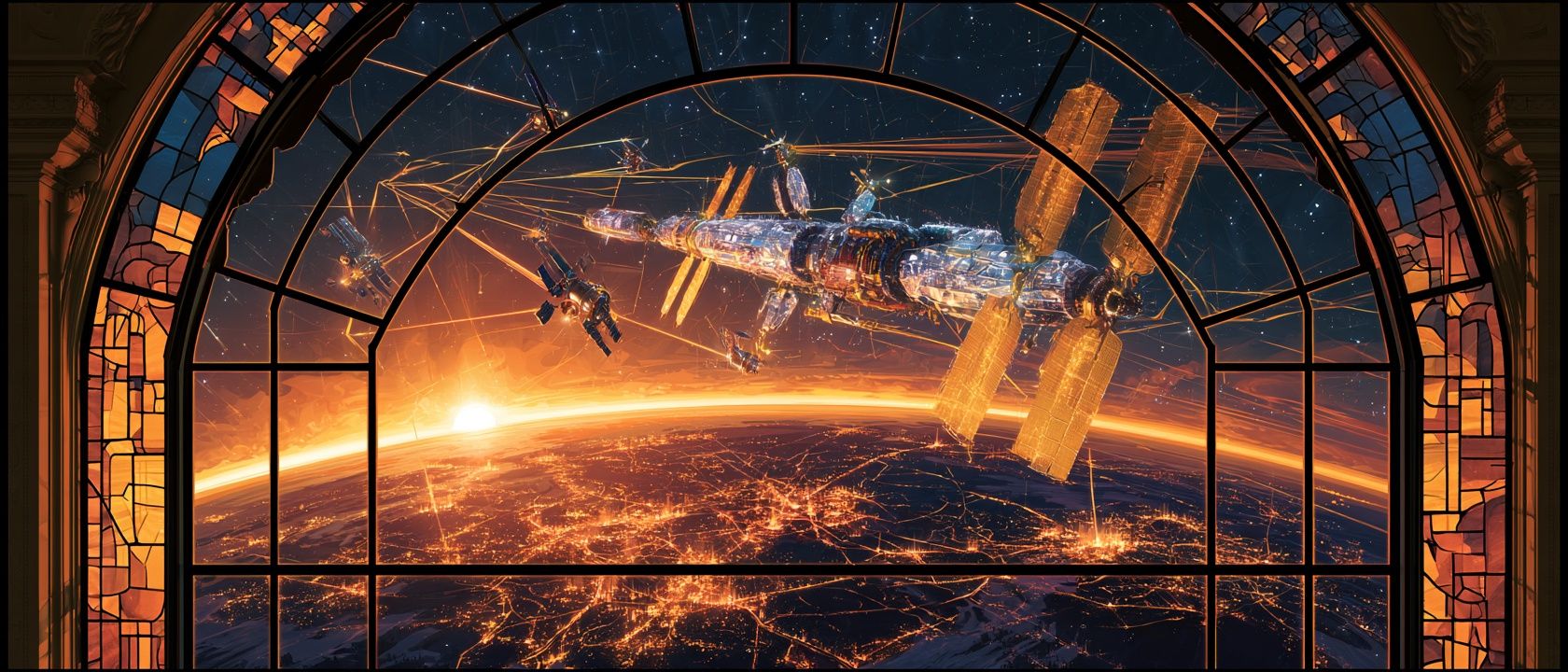
Picture the night sky over Wadi Rum in the 2050s. Long glowing stations with wide golden solar wings drift silently among the stars, each one a data center thinking for the planet below. Beams of laser light join them to thousands of smaller satellites, which pass their answers down to the trains, the pumps and a phone in a tent in the desert. EarthOS sends each job to wherever the sun is shining and power is cheapest at that moment.
Its eyes
From orbit, satellites watch crops ripen, rivers rise and cities spread their lights across the night. They can spot a leaking pipeline from the patch of green it leaves in the desert and see a storm forming days before it reaches land.
Its long-distance nerves
Internet satellites reach the ships, planes, mines and villages that no cable can, and newer ones talk to each other with beams of laser light through the vacuum of space, where light travels faster than inside glass fiber.
Its processors in orbit
In the right orbit the sun shines almost all the time and heat can be sent away into the cold of space, so data centers are starting to move up there, thinking for the planet below.
Beyond the Earth
The same software can reach the Moon and Mars, running solar farms in orbit and power stations for the first bases on other worlds.
It has already started.
- 16,800
- working satellites circling the EarthKeepTrack, October 2026
- Nov 2025
- Starcloud put an Nvidia H100, one of the chips used to train AI, into orbitNVIDIA
- 2,800
- computing satellites planned in China’s Three-Body Computing Constellation, whose first 12 launched in May 2025Live Science
- 2027
- Google and Planet plan two test satellites to try Google’s AI chips in orbit under Project SuncatcherGoogle
Space is already the next PPP frontier, where governments and companies may one day share the cost of a lunar power station the way they share the cost of a toll road today.
Collaborative
Written by everyone, run by every country
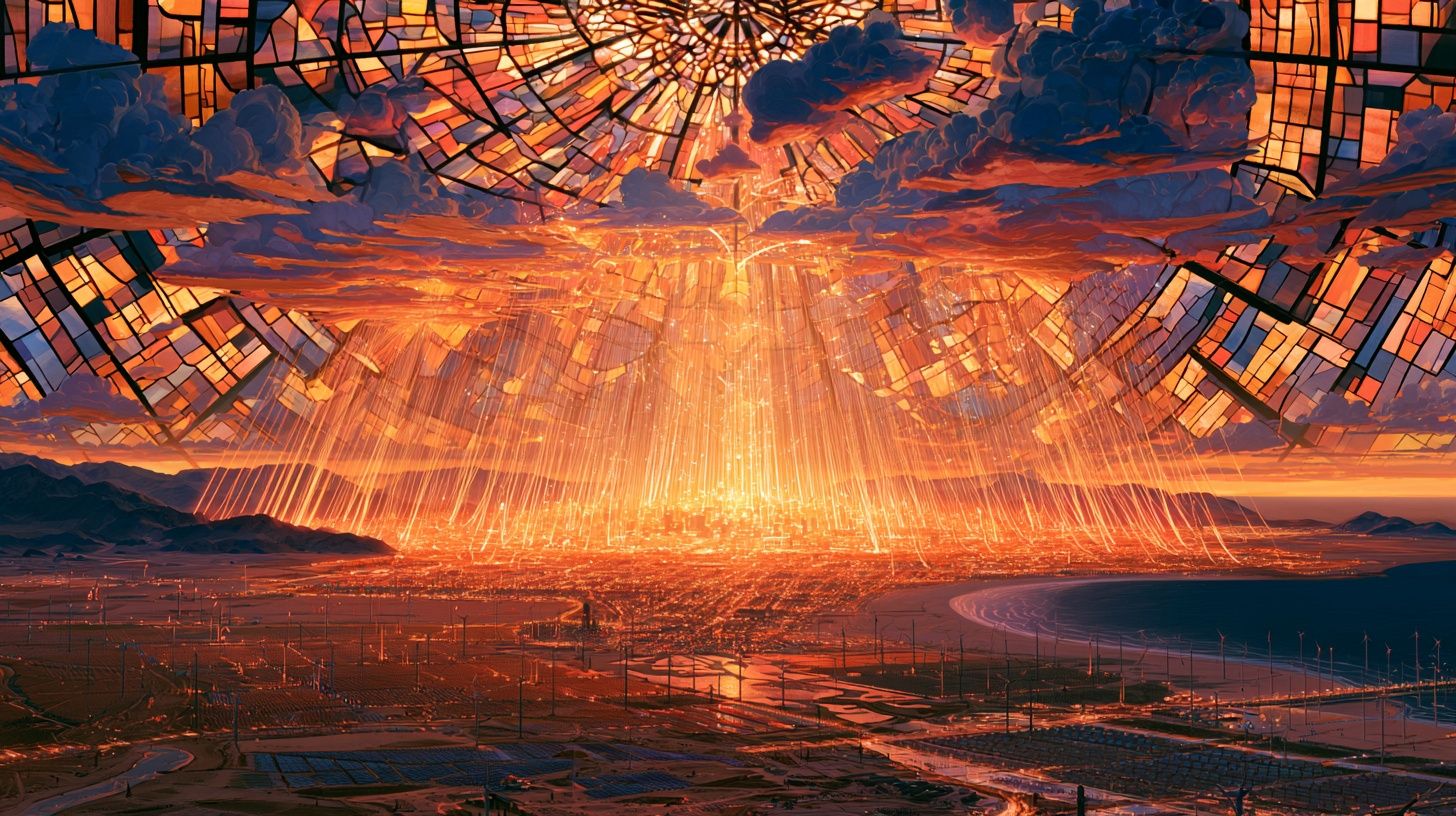
Linux, the free operating system behind most of the internet’s servers, grew from thousands of people adding to the same code. Wikipedia was written by volunteers in hundreds of languages. EarthOS will grow the same way.
Engineers
Engineers write the drivers for the pumps, turbines and bridges they know best.
Cities
Cities write the apps their streets need, from flood warnings to bus timetables.
Universities
Universities test new ideas on small parts of the machine before the world adopts them.
Operators
Operators share what their sensors learn, so every similar asset on Earth gets the lesson.
AI agents
AI agents write and check much of the code themselves, under rules that people set.
Citizens
Citizens own shares in the assets they use and report what they see on their own street.
Each country runs its part of EarthOS on its own soil, keeps its own data and writes its own laws into it. The parts speak one shared language, so power, ships and data cross borders while every country stays in charge of its own ground.
Tokenization
The layer that manages it all
A machine with billions of parts and millions of owners needs a way to keep track of who owns what, who did what and who gets paid. With tokenization, every asset has a token, a digital certificate kept on a shared record called a blockchain.
- Own
- Ownership of a power plant, a railway or a water line can be split into small digital shares that anyone can hold.
- Pay
- When the sensors show a promise was kept, the digital agreement behind the token pays the operator on its own.
- Reward
- A home battery that helps the grid at the evening peak earns its owner money within seconds.
- Record
- Every decision, repair and payment is written into one shared record that owners and governments can check.
- 06:00
Water plant, Aqaba
Delivered the clean water it promised this week
Operator paid
- 09:20
Solar farm, Ma’an
New family shareholders joined
Shares recorded
- 14:05
Water main, Amman
Wall thinning found by its own sensor
Repair robot booked
- 18:40
Home batteries, Irbid
Helped the grid through the evening peak
Families paid
- 19:15
Farm, Jordan Valley
Used less water than planned
Reward sent
- 23:05
Public rule
A new water-saving rule was written in
Approved and recorded
A day on EarthOS
The day the storm came
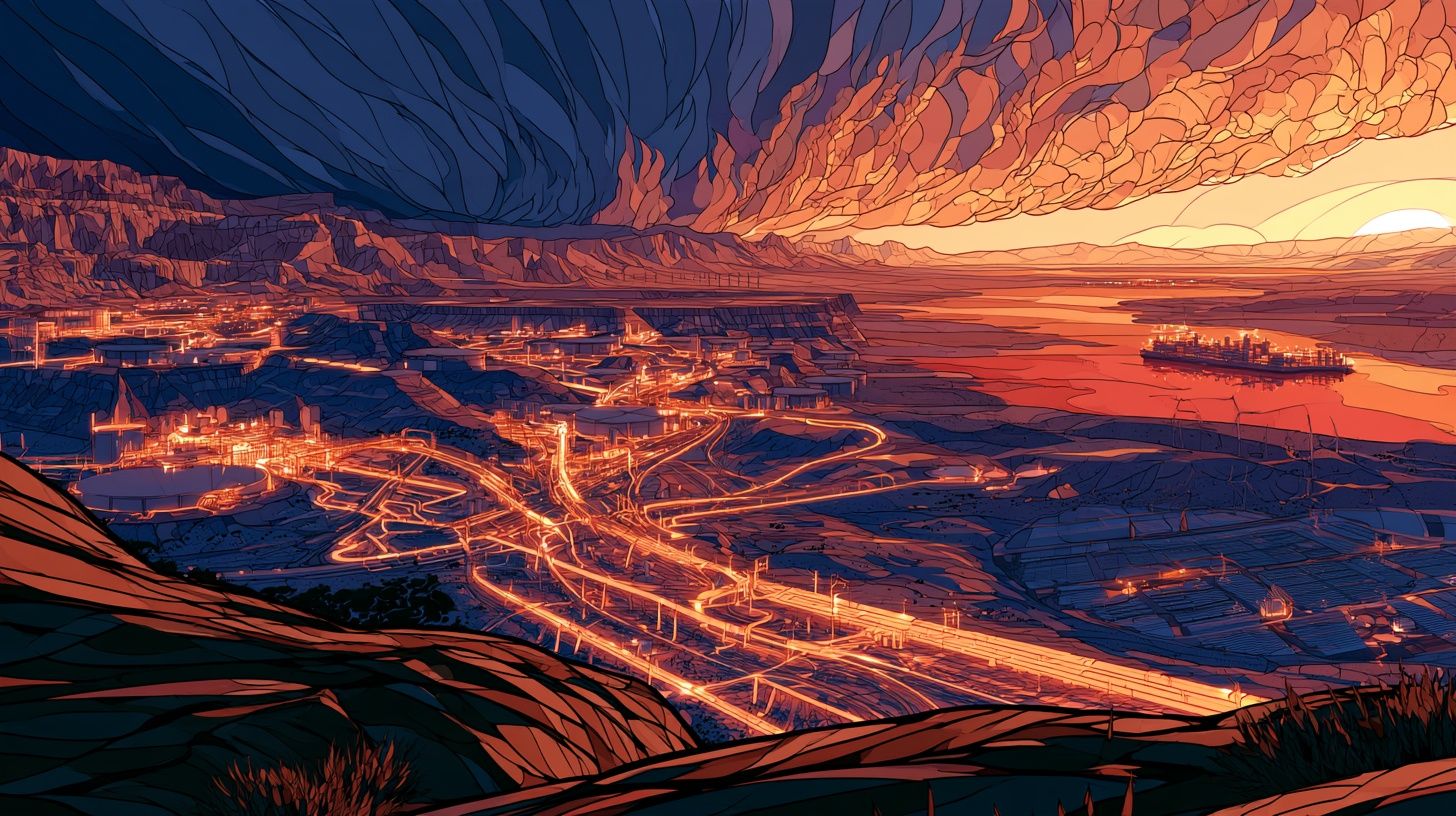
Picture Jordan some time in the 2040s, with a winter storm on the way and EarthOS watching the whole country at once.
Three days out
Satellites, ocean buoys and thousands of weather stations show a winter storm rolling in from the Mediterranean, and EarthOS starts getting the land ready.
Two days out
It lowers the dams of the north so they can catch the flood, tops up the tanks of every town that might lose its water line and moves repair robots to the valleys that flood first.
One day out
Solar farms in the south store all the power they can before the clouds arrive, and the port of Aqaba moves ship arrivals so no crane works in the strongest winds.
The night
Sensors in the wadis feel the water rising and warn every phone downstream. A bridge feels the force of the water and closes itself to traffic, and home batteries feed the grid while the tokens pay every family that helped.
The morning after
The reservoirs are full, the farms downstream have their water for the spring, and people wake up to clear skies, most of them never knowing the machine spent three days protecting them.
The rules it runs by
People stay in charge, and nature has a seat
A machine this powerful has to answer to the people it serves and to the land it sits on.
01
People set the goals
People decide what the machine is for, and the software finds the best way to get there.
02
Laws are written in
Public rules are part of the code, so EarthOS cannot cut a town’s water to save money or send a road through a protected valley.
03
Every country can pause
Each country keeps the power to pause or override its own part of the machine.
04
Privacy from the start
EarthOS needs to know how much water a street uses, and it has no need to see inside any home.
05
Nature has a voice
Rivers, aquifers and forests have sensors of their own, so the machine can slow the pumps before an aquifer runs dry.
06
Everything on the record
Every repair, rule change and payment is written down where people can check what the machine did and why.
In Jordan, As-Samra, the country’s first PPP, already treats about 70% of the country’s wastewater, makes most of its own energy and sends clean water to farms in the Jordan Valley. EarthOS can carry that idea to every city on Earth.
EarthOS in fifty years
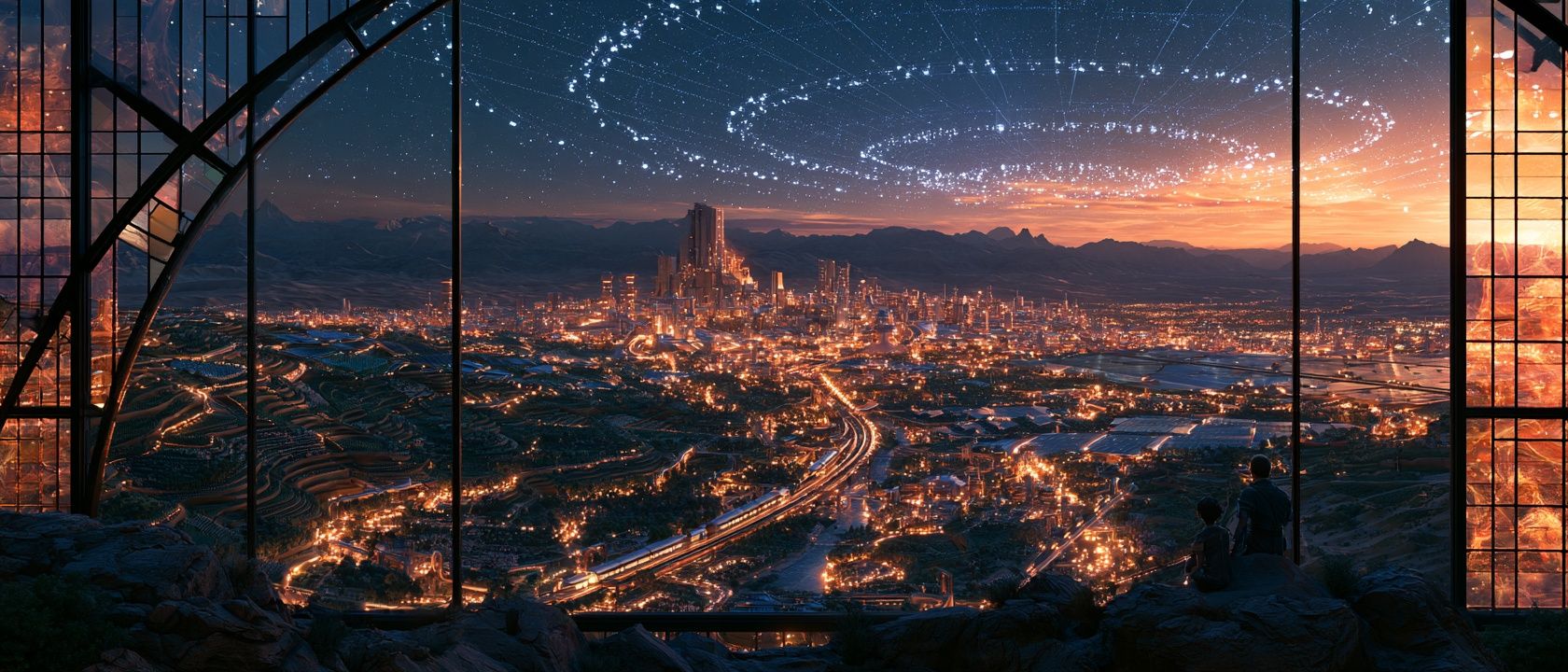
Stand on a hill above Amman in 2076
The valleys that were bare rock are terraced and green. The streets glow softly where people walk and dim where nobody is, a quiet train slides through a park without a timetable, and out in the desert the solar fields shimmer under the moon. Above it all, a ring of satellites watches the crops, the clouds and the coast. EarthOS has become invisible, the way electricity is invisible when you flip a switch.
Five versions, one direction
Like any operating system, EarthOS will arrive in versions, each one joining a wider ring of the world.
EarthOS 1 · 2020s
Islands
Single assets get sensors and software of their own: a smart water meter in one street, a solar farm that reports its own output in another.
EarthOS 2 · 2030s
Cities
Each city’s pipes, roads, buses and street lights share one living map, so traffic lights, pumps and lamps work from the same picture.
EarthOS 3 · 2040s
Countries
Ports, railways, water lines and grids run as one national machine, from the port of Aqaba in the south to the farms of Irbid in the north.
EarthOS 4 · 2050s
The planet
Countries join their parts through one shared language, and power, water and trade are balanced across whole continents as the sun moves around the Earth.
EarthOS 5 · 2070s
It writes itself
Each version designs the next, tests it on a small corner of the world and rolls it out only when it proves safer and cleaner than the last.
2076
A classroom in Aqaba
A girl asks a question out loud and watches her town’s water, power and traffic flow across the classroom wall like a living painting.
2076
An engineer’s drawing table
An engineer describes a new bridge in plain words, and EarthOS designs it, tests it against a hundred years of storms and sends it to the robots that will print it.
2076
Under the streets of Amman
Small robots move along the pipes like blood cells through a vein, sealing cracks long before anyone could see them.
2076
A farm in the Jordan Valley
A farmer rarely thinks about the machine at all, because his water arrives at the right hour every day.
When each version of EarthOS designs the next one, the network starts improving itself faster than anyone can direct it. That moment is the infrastructure singularity.
Inevitable
Six forces are already pulling EarthOS into the world
EarthOS can sound like science fiction. Every piece of it is already arriving, and each of these forces grows stronger every year.
- 01
Every large network gets one
Telephone calls were once joined by hand at switchboards until automatic exchanges took over. Air traffic and power grids are run by control systems that watch every plane and every second of supply and demand. Each time a network grew too large to run by hand, software took over the routine work, and the planet’s infrastructure is the largest network of all.
- 02
Too complex to run by hand
A grid that once had a few large power plants now has millions of rooftop solar panels, home batteries and electric cars, each switching on and off at its own moment. Only software can balance that many parts at once, and water, traffic and trade are going the same way.
- 03
The parts keep getting cheaper
Sensors keep getting smaller and cheaper, artificial intelligence gets more capable every year, and satellites now watch every corner of the planet.
- 04
The world has to rebuild anyway
Much of last century’s infrastructure is wearing out at the same time. Every new pipe, road and power line can be laid with sensors inside, because adding them on the day it is built costs little and adding them later costs a great deal.
- 05
Once one place does it, the rest follow
When one city finds its water leaks in hours and another still finds them in months, the second city changes. The first countries on EarthOS will save so much water, power and money that the others will join, the way every country joined the internet.
- 06
The planet is asking for it
Hotter summers, drier rivers and stronger storms leave less room for waste. A world heading toward ten billion people needs every drop of water and every kilowatt used wisely, and that takes a machine that sees everything at once.
EarthOS will be built by all of us, one project at a time, and there is room for everyone to take part. Every road, pipe and power line built from today can carry a piece of it, so start with one project, add its sensors and share what it learns, and you are already building EarthOS.
Where it starts
The software inside the $500 trillion
Rebuilding and running the world’s infrastructure will take about $500 trillion over the next fifty years. EarthOS lives in the last $50 trillion, the part that turns concrete and steel into one machine that builds, senses, thinks and heals itself.
- $300T
- to build
- $150T
- to operate and maintain
- $50T
- for the sensors, computing and robots where EarthOS lives
EarthOS can start in Jordan. The country has $86 billion of PPP and infrastructure projects in development, including $46 billion in Aqaba, and many of them are parts of the machine: ports, railways, water lines, power links and data centers. Article 15 of Jordan’s PPP Law lets any private company take its own PPP idea to the government directly.
Questions
Questions about EarthOS
- What is EarthOS?
- EarthOS is the shared AI software that will run the world’s biggest $500 trillion computer, the world’s infrastructure joined into one machine. Roads, pipes, power plants, ports and their sensors are the hardware. EarthOS is the software that reads every sensor and decides where power, water, goods and people should flow. Tokenization manages it all by keeping track of who owns, runs and is owed what.
- Who writes EarthOS?
- Everyone who builds and uses the machine. Engineers write drivers for the assets they know, cities write apps for their streets, universities test new ideas, operators share what their sensors learn and AI agents write and check code under rules that people set. Linux and Wikipedia grew the same way, from thousands of people adding to the same work.
- What does tokenization do in EarthOS?
- Every asset has a token, a digital certificate on a shared record called a blockchain, that says who owns it, who runs it, what it promised and what it is owed. Ownership can be split into small shares, operators are paid automatically when the sensors show a promise was kept, households are rewarded for helping the grid, and every decision is recorded where it can be checked.
- What will EarthOS look like in fifty years?
- Almost invisible, the way electricity is invisible when you flip a switch. By the 2070s EarthOS is expected to run whole continents as one machine and to write most of its own code, with each version designing and testing the next. People will talk to it in plain words, robots will repair pipes from the inside, and trains and water will arrive when they are needed.
- Why is EarthOS inevitable?
- Every large network, from telephones to air traffic to power grids, ended up run by software once it grew too large to run by hand. Today’s grids already hold millions of solar panels, batteries and electric cars, sensors and AI keep getting cheaper and better, the world has to rebuild its ageing infrastructure anyway, and the first places to run this way will save so much water, power and money that the rest will follow.
- How is EarthOS connected to space?
- Satellites are its eyes and its long-distance nerves. About 16,800 working satellites circle the Earth, watching crops, rivers, storms and cities and carrying data where no cable reaches. Data centers are starting to move into orbit, where the sun shines almost all the time: Starcloud put an Nvidia H100 into orbit in November 2025, China launched the first 12 satellites of its Three-Body Computing Constellation in May 2025, and Google plans two test satellites with Planet by early 2027.
- Who controls EarthOS?
- People do. Each country runs its own part of EarthOS on its own soil, keeps its own data, writes its own laws into it and can pause or override it. The parts speak a shared language, so power, ships and data can cross borders while every country stays in charge of its own ground.
- How does EarthOS fit into the $500 trillion infrastructure rebuild?
- Rebuilding and running the world’s infrastructure will take about $500 trillion over the next fifty years: $300 trillion to build, $150 trillion to operate and maintain and $50 trillion for the sensors, computing and robots inside the assets. EarthOS lives in that last $50 trillion and carries the world toward the infrastructure singularity.
- Where can EarthOS start?
- In Jordan. The country has $86 billion of PPP and infrastructure projects in development, including $46 billion in Aqaba, and many of them are parts of the machine: ports, railways, water lines, power links and data centers. Article 15 of Jordan’s PPP Law lets any private company take its own PPP idea to the government directly.
New guide
The golden age of PPPs in Jordan
All 23 sector guides and all 96 organization guides in one free guide to Jordan’s $86 billion.
Presentations
Book a Jordan PPP presentation for your organization
We give it online worldwide, or in person in Jordan, on the days and at the times that suit your team.
Book a presentation