Skip to content
Jordan PPP
Stained-glass illustration in blue glass of a robot and towers at the dawn of the infrastructure singularity

Sector guide 22 of 22 · Version 1.1

Education and Skills in Jordan

Learning at the speed of intelligence for a young country.

Share
$7m
forward investment in its own projects
12
projects in this guide
6
in or linked to Aqaba

The sector today

Education and Skills in Jordan

Jordan's greatest resource is its people. The country built its economy on educated engineers, doctors, teachers and programmers who work at home and across the region. The challenge now is turning that strength into jobs: unemployment among Jordanians stood at 21.0% in the second quarter of 2026, and it is highest among the young.

Schools and training are changing quickly. The Ministry of Education has opened its national AI learning assistant, Siraj, to students, with about 266,000 accounts and 60,000 teachers trained by February 2026. Vocational BTEC courses run in 362 schools across 14 sectors under a partnership with Pearson extended to 2031.

Private partners are now part of the system. Jordan's first PPP for school transport began in 2026, a vocational hub in Aqaba trains workers for the zone's industries, and factory branches are opening in the governorates. This guide sets out where the sector stands, the projects in the Jordan PPP project register, and the opportunities it opens as infrastructure moves towards the singularity.

21.0%
Unemployment among Jordanians in the second quarter of 2026, down from 21.3% a year earlier.
266,000
Students with accounts on Siraj, the national AI learning assistant, by February 2026, with 60,000 teachers trained.
9,000
Students riding free school buses under Jordan's first school transport PPP, at 61 schools in the south.
362
Schools teaching vocational BTEC courses in 14 sectors, under a partnership extended to 2031.

The singularity

Skills are the currency of the singularity

The infrastructure singularity is the point where roads, grids, ports and water networks become one connected, intelligent system, built by robotics, run by artificial intelligence and financed by tokenization. Someone has to design, direct, repair and improve that system, and every one of those people needs new skills.

Artificial intelligence
Gives every student a patient tutor in Arabic and English, helps teachers plan and assess, and matches trainees to the jobs that need them.
Robotics
Trainees learn on the robots, drones and automated machines that will build and run infrastructure, and become the technicians who maintain them.
Tokenization
Certificates and skills recorded as verifiable digital credentials follow each learner from job to job, and tokenized stakes can finance schools and training hubs.
Simulation
Virtual sites, plants and vehicles let people practise dangerous or costly tasks safely, from crane operation to electrical work.
Lifelong learning
As machines change jobs every few years, learning becomes a service people use throughout their working lives, delivered online and in local hubs.

Flagship projects

The projects that lead the sector

  • Under way · Karak, Tafilah, Ma'an and Aqaba

    National School Transport Project

    Jordan's first PPP for school transport, in which a private consortium runs free buses for public school students. The first phase launched with the 2026/27 school year, serving 61 schools, about 9,000 students and 900 staff, with tracked buses and a parent app, and a gradual rollout to other governorates is planned.

  • Delivered · Aqaba

    Aqaba National Vocational Training Hub

    A hub for 240 trainees with eight workshops and 15 six-month programmes, inaugurated by the Crown Prince in June 2025 and run by the National Company for Training and Employment. It trains young people for Aqaba's industries and joined UNESCO's UNEVOC network in May 2026.

  • Pipeline · Governorates

    Production Units in the Governorates

    A royal initiative run by the Ministry of Labour that places factory branches in areas of high unemployment, with ready buildings, income tax cut to 5% and wage support in the first year. Invest Jordan targets 35 units and more than 9,500 jobs, and new branches were signed through 2026.

  • Pipeline · Ajloun

    Culinary Academy

    A cooking school on an 81,038 m² plot in Anjara, listed on Invest Jordan in 2024 to train chefs and staff for hotels and restaurants. It links skills to the tourism projects growing in Ajloun and across the country, and gives young people in the north a route into hospitality careers.

  • Pipeline · Nationwide

    Efficient Cooling in Jordanian Schools

    A national program to make cooling in public schools more efficient and sustainable, listed as an investment opportunity with the Ministry of Education and the Ministry of Energy. Hotter summers make comfortable classrooms a condition for learning, and the program suits energy service and solar partnerships.

Every project

12 projects in Jordan’s pipeline

Values in US dollars; * estimated where no figure has been published. Rows in grey sit in another sector and connect to this one.

ProjectLocationStageValue
Culinary AcademyAnjara, Ajloun GovernoratePipeline$7m*
Aqaba National Vocational Training Hub (ANVT)AqabaDelivered$7.5m*
Kingdom University Hospital (Kingdom Health Project)Airport Road, Ghamadan areaUnder way$400m
Aqaba Marine Life Museum & Research CenterAqabaPipeline$81m
National School Transport ProjectPhase 1: KarakUnder way$60m*
Al Yamaniyeh Creative & Tech DistrictAqabaUnder way$24m
Efficient Cooling in Jordanian SchoolsPublic schools nationwidePipeline$20m*
Garment Manufacturing & Tailoring FactorySafawi, Mafraq GovernorateOpen opportunity$10m*
Al-Hussein Youth Camp / Al-SarouAl-SarouPipeline$10m*
North Rahma Irrigation Project (Operation & Management)RahmaOpen opportunity$9m*
Production Units in the Governorates (Vocational & Technical Training)Various governoratesPipeline$8m*
Aqaba Filming & Media HubAqabaPipeline$6m*

AI, robotics and tokenization

What changes for education and skills in Jordan

Artificial intelligence

AI can give every student in Jordan a tutor and every teacher an assistant. The national Siraj platform has started that work in schools, and the same approach can reach vocational trainees, job seekers and workers who need new skills. For partners it means building Arabic learning tools, assessment and career matching that connect what students learn with the jobs Jordan's projects will create.

What can be built

  • Arabic AI tutors. Tutors that teach mathematics, science, languages and coding in Arabic and adapt to each student's pace.
  • Teacher assistants. Tools that plan lessons, mark work and flag students who need help, giving teachers more time to teach.
  • Skills matching. Platforms that match trainees and graduates to jobs on Jordan's projects and recommend the courses they need.
  • Smart school operations. AI that plans bus routes, cooling, energy and maintenance across hundreds of schools at once.

More on artificial intelligence

Robotics

Robotics changes both what is taught and how schools are run. Vocational hubs can train technicians on the robots, drones and automated machines that will build and run infrastructure, and universities can host robotics labs with industry. Robotic and modular construction can add classrooms and workshops quickly, and sensors and robots can keep school buildings, cooling and solar systems working through the year.

What can be built

  • Robotics academies. Training centers where young people learn to install, program and repair industrial robots and drones.
  • Construction trades. Workshops that teach robotic bricklaying, 3D printing and modular assembly to the next generation of builders.
  • Modular classrooms. Classrooms and workshops built off site and installed within weeks where schools are crowded.
  • Maintenance robots. Robots and sensors that clean, inspect and maintain school buildings, cooling and solar systems.
More on robotics

Tokenization

Tokenization can finance learning and prove it. Training hubs, academies and student housing earn steady payments under PPP contracts, and tokenized stakes can open that income to Jordanian savers, the diaspora and impact investors. Skills and certificates recorded as digital credentials let graduates prove what they can do to employers in Jordan and abroad, and let training providers be paid for the results they deliver.

What can be built

  • Digital credentials. Certificates and skills recorded securely so that employers in Jordan and abroad can verify them instantly.
  • Training hub tokens. Stakes in vocational hubs and academies that pay holders from fees and employer contracts.
  • Outcome-based finance. Tokens that pay investors when trainees find and keep jobs, linking the money to results.
  • Diaspora education funds. Pooled tokens that let Jordanians abroad finance schools, scholarships and training at home.
More on tokenization

Start small, or bring your own idea

Small PPPs and unsolicited proposals

Small PPPs and research labs

Small PPPs suit education because school services are spread across hundreds of sites and can be bundled. An education lab could test ideas with pilots of about $100,000 each, such as solar-powered cooling in a handful of southern classrooms, an AI tutor for one subject in one education directorate, or a robotics workshop for trainees at the Aqaba hub. Pilots that work can grow into small-scale PPP tenders below US$14.1 million.

How it works

Unsolicited proposals under Article 15

A company can propose an education project of its own design under Article 15 of PPP Law No. 19 of 2023. Ideas include a school cooling and solar concession paid from energy savings, a network of AI and robotics labs run in public schools, a vocational academy for a growing industry such as logistics or hospitality, or student and trainee housing in Aqaba, built and operated by the company.

How it works

New industries

What the sector can create

  1. 01Arabic AI tutoringTutors, tests and teaching tools built in Jordan for Arabic-speaking students across the region.
  2. 02Robotics and automation trainingAcademies that train technicians to install, run and repair robots, drones and automated plants.
  3. 03Simulation trainingVirtual reality and simulators for construction, energy, logistics and health, sold to employers across the region.
  4. 04Verified digital credentialsSkills records on secure digital ledgers, trusted by employers in Jordan and abroad.
  5. 05School servicesPrivate operators that run transport, energy, cooling and maintenance for schools under performance contracts.
  6. 06Remote skilled workJordanian engineers, designers and analysts serving clients worldwide from local hubs, trained for AI-era roles.

Opportunities

Where partners come in

School transport
Join the next phases of the school transport project as operators, bus suppliers or technology partners as it extends to other governorates.
Training hubs
Build and operate vocational hubs and academies, such as the Culinary Academy in Ajloun, with industry partners that hire their graduates.
Factory branches
Open a production unit in the governorates with ready buildings, 5% income tax and first-year wage support.
Direct proposals
Propose a project under Article 15 of PPP Law No. 19 of 2023, such as school solar and cooling or digital learning labs.
Small-scale PPPs
Regulation No. 9 of 2024 allows small-scale PPPs below about US$14.1 million to be bundled into one tender, which suits upgrades across many schools.
Investment and ownership
Finance schools and training through development banks, impact funds and tokenized stakes that open ownership to more investors.
Stained-glass illustration in blue glass of a city of towers under a rising arch

The road to the singularity

  1. 2026School transport PPP launched in the south; Siraj opened to students; the Aqaba hub joins UNESCO's UNEVOC network.
  2. 2030School transport extends to more governorates; BTEC partnership runs to 2031; training hubs serve every major industry.
  3. 2035Every student has an AI tutor; schools are cooled and powered by efficient solar systems that private partners run.
  4. 2040Simulators and robots are standard in vocational training; skills are recorded as digital credentials trusted abroad.
  5. 2050Learning is continuous and personal, and Jordan exports skills, teaching tools and trained talent to the region.

Jordan's future rests on what its people can learn and how fast they can learn it. The projects in this guide are the first steps towards a country where every young person can train for the work the coming economy will create.

Guides for organizations

Launch a PPP program of your own

The guides closest to education and skills in Jordan, each showing one kind of organization how to launch a PPP program, with six first steps.

  • Economic sectors

    Education Companies

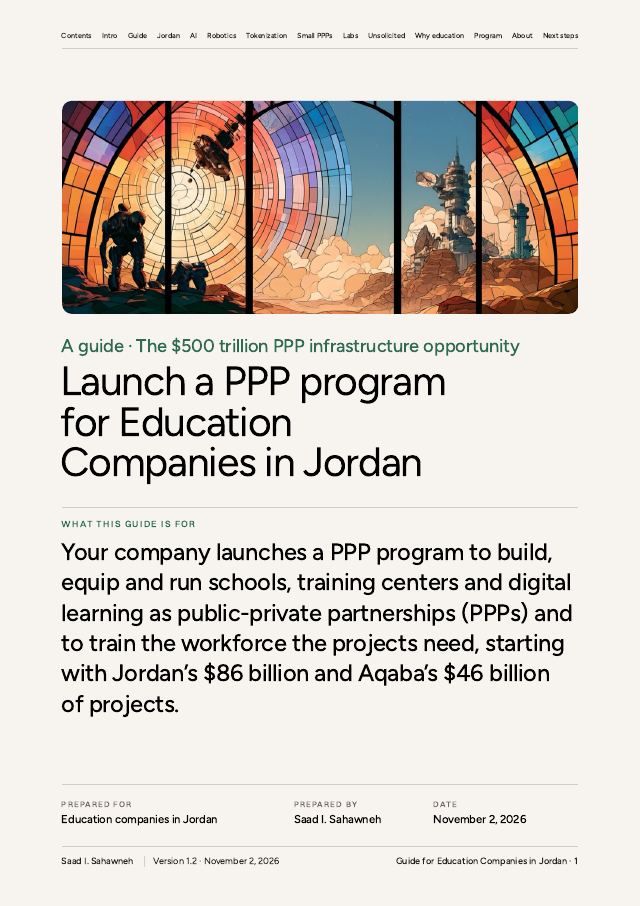
    Your company launches a PPP program to build, equip and run schools, training centers and digital learning as public-private partnerships (PPPs) and to train the workforce the projects need.

  • Technology and knowledge

    Universities

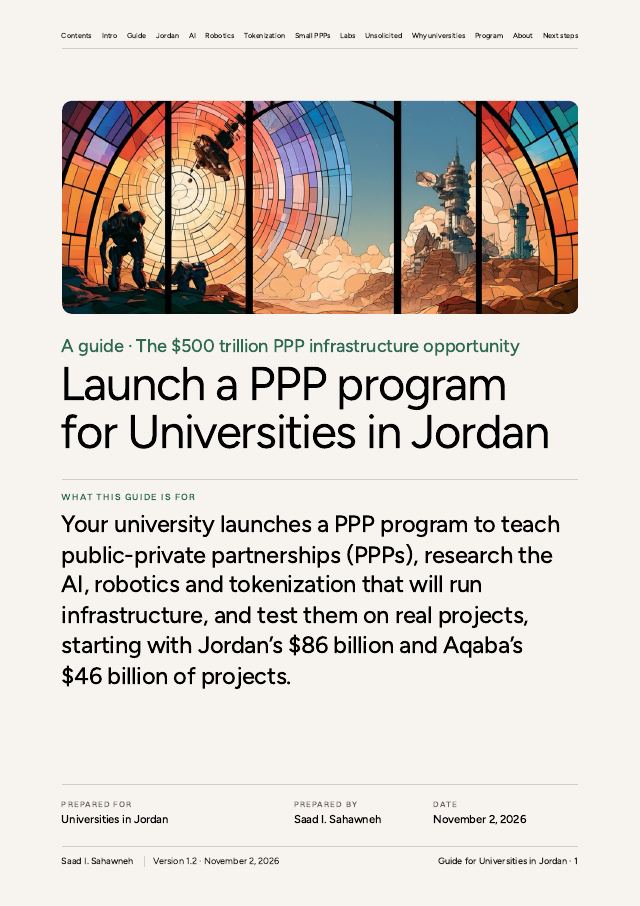
    Your university launches a PPP program to teach public-private partnerships (PPPs), research the AI, robotics and tokenization that will run infrastructure, and test them on real projects.

  • Technology and knowledge

    Vocational Training Providers

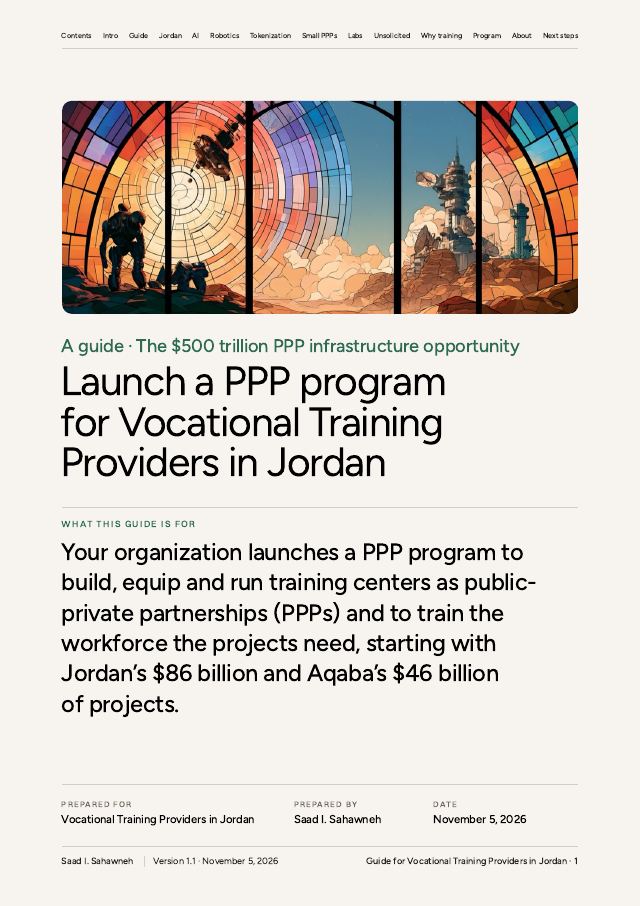
    Your organization launches a PPP program to build, equip and run training centers as public-private partnerships (PPPs) and to train the workforce the projects need.

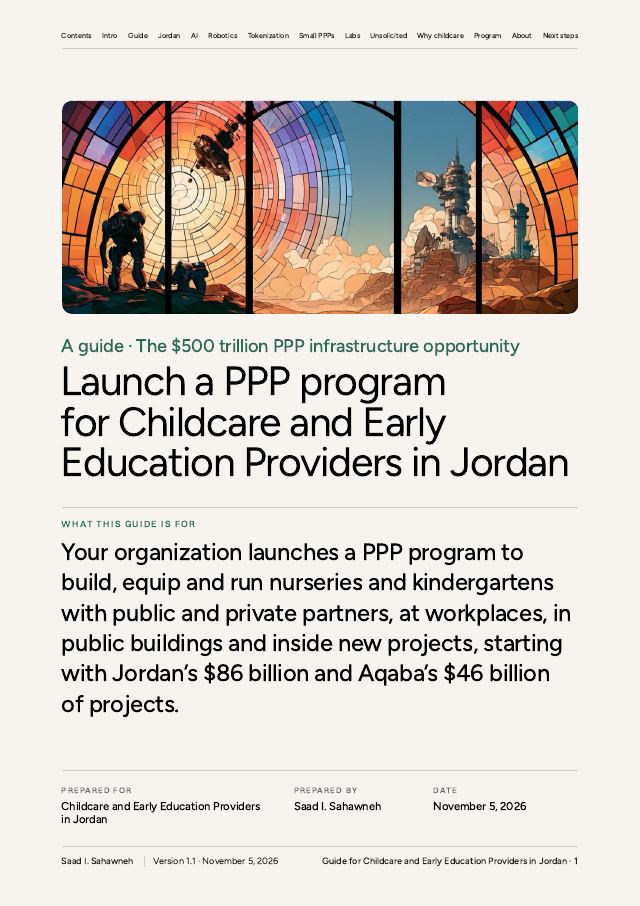
  • Your organization launches a PPP program to build, equip and run nurseries and kindergartens with public and private partners, at workplaces, in public buildings and inside new projects.

See every guide and sector on one map