Skip to content
Jordan PPP
Stained-glass illustration in blue glass of a robot and towers at the dawn of the infrastructure singularity

Sector guide 03 of 22 · Version 1.1

Urban Development in Jordan

New cities and renewed centers designed to run on intelligence.

Share
$12.8bn
forward investment in its own projects
30
projects in this guide
12
in or linked to Aqaba

The sector today

Urban Development in Jordan

Most Jordanians live in cities, and Amman, Zarqa and Irbid have grown faster than their roads, housing and services. The answer now under way is a new city east of the capital, renewed downtowns, new business districts in Amman and Aqaba, and courts, stadiums and estates in the governorates.

The largest step is Amra City, a 25-year plan on 500,000 dunums with room for more than a million people, which will rely on public-private partnerships rather than land sales. In Amman, The Abdali Phase Two began infrastructure works in January 2026 for more than 1.2 million m² of new space, and Amman Vision signed agreements with Saudi Arabia's Sumou Holding for a district on the Abdoun Corridor.

The next phase builds cities as connected systems, with one utility network, transit from day one and digital services for every resident. This guide sets out where the sector stands, the projects in the Jordan PPP project register, and the opportunities it opens as infrastructure moves towards the singularity.

500 km²
Area set aside for Amra City, planned over 25 years with a first phase of about 40 km².
1m+
People Amra City is planned to house, easing pressure on Amman and Zarqa.
46,000
Seats in the Al-Hussein Bin Abdullah II stadium, the first major work under way at Amra City.
1.2m m²
Built-up area planned in The Abdali Phase Two in central Amman, larger than the first phase.

The singularity

Cities are the operating system of the singularity

The infrastructure singularity is the point where roads, grids, ports and water networks become one connected, intelligent system, built by robotics, run by artificial intelligence and financed by tokenization. Cities are where all of those networks meet, and where people feel the result in time, cost and quality of life.

Artificial intelligence
Designs master plans, tests thousands of layouts for light, heat and traffic, and runs buildings, lighting and utilities in real time. AI also speeds up permits and planning approvals.
Robotics
3D printing, prefabricated modules and site robots build homes and offices faster and with less waste, which matters most for affordable housing.
Tokenization
Districts, buildings and leases earn rent for decades. Tokenized ownership lets residents and investors abroad hold shares in the city's growth.
Digital twins
A live model of every street, pipe and building lets planners test a decision before it is built and operators fix faults before residents notice.
Shared utilities
One company and one bill for power, water and gas, as planned at Amra, turn a city's networks into a single service run as efficiently as possible.

Flagship projects

The projects that lead the sector

  • Under way · East of Amman

    Amra City

    A 25-year new city on 500,000 dunums for more than a million people, with sports, entertainment, exhibition, government and housing districts and one utility company. Stadium excavation began in June 2026, prequalification for its main contract closed in October, and first-phase venues are due between 2027 and 2029.

  • Pipeline · Aqaba

    Al Doum Sustainable Housing

    An affordable, energy-efficient housing development for middle-income families, with 915 villas and 8,000 apartments on about 2.6 million m² for around 43,000 residents. It is listed on Invest Jordan as an open opportunity for developers.

  • Pipeline · Aqaba

    North Business District

    Aqaba's new business district opposite the ASEZA headquarters, offered by the Aqaba Development Corporation as 107 serviced plots of 2,000 to 10,000 m² on about 704,000 m², for offices, shops, hotels and services. Investors including Markazia Toyota have signed for plots.

  • Under way · Amman

    The Abdali Phase Two

    The second phase of the urban regeneration project in central Amman. Infrastructure works began in January 2026 under a contract of more than JD21 million, opening plots for more than 1.2 million m² of offices, homes, hotels and shops.

  • Under way · Amman

    King Hussein Business Park Phase 2

    Infrastructure for phases two to four began in May 2025, and developers signed during 2026 for towers, commercial centers and a multi-use complex. Plans include data storage and medical simulation facilities and a hotel.

  • Under way · Irbid

    Irbid City Center Redevelopment

    A phased renewal of Irbid's historic center that links old markets, heritage houses and Tell Irbid through a 24-dunum park, pedestrian routes and parking. The municipality reported about 40% progress across all phases in September 2026.

Every project

30 projects in Jordan’s pipeline

Values in US dollars; * estimated where no figure has been published. Rows in grey sit in another sector and connect to this one.

ProjectLocationStageValue
Amra CityAmman GovernorateUnder way$10bn
Al Doum, Sustainable Housing DevelopmentAqabaPipeline$1.2bn*
North Business DistrictAqabaPipeline$670m*
Al Quwaysimah Urban DevelopmentAl-Qweismeh, AmmanPipeline$250m*
King Hussein Business Park, Phase 2King Hussein Business ParkUnder way$150m*
Miras Mixed-Use Project (Zarqa East City)King Abdullah Bin Abdul Aziz CityUnder way$100m
Irbid City Center RedevelopmentDowntown Irbid: Tell IrbidUnder way$100m*
Abdoun Corridor Mixed-Use DevelopmentAbdoun Corridor, AmmanPipeline$100m*
Residential Quarter, AbdounAbdounPipeline$50m*
Commercial Services on the Al-Harraneh-Omari Toll RoadAl-Harraneh-Omari toll roadPipeline$40m*
The Abdali Phase TwoAbdali, central AmmanUnder way$30m
Irbid Development Zone InfrastructureIrbid Development Zone, IrbidUnder way$23m
Abu Nusair Commercial ComplexNear the Applied Science University rounPipeline$20m*
Aqaba Palace of JusticeAqaba, Aqaba GovernoratePipeline$9.5m
Tafilah Palace of JusticeTafilah, Tafilah GovernoratePipeline$9.5m
Aqaba Youth City StadiumAqaba Youth City, AqabaUnder way$5.6m
Marsa ZayedAqaba waterfrontUnder way$10bn
Al Quwairah International Industrial Estate (QIIE)Al Quweira, AqabaUnder way$1bn
Amman-Zarqa Gas Distribution Network ProjectAmman and ZarqaPipeline$550m
Hotels Boulevard & Mixed-Use Retail ComplexCentral AqabaPipeline$180m*
Amman Logistics and Industrial City (ALIC)South of AmmanPipeline$167m*
Aqaba Medical ComplexAqabaPipeline$106m
Amman LED Street Lighting (GAM)AmmanUnder way$50m
Al Yamaniyeh Creative & Tech DistrictAqabaUnder way$24m
Aqaba City ParkAqabaUnder way$15m*
Karak City Revitalization & Cable CarKarak city: castleUnder way$14m
Amman Cable Car (Teleferic)Downtown Amman: Jabal Al-QalaaUnder way$11m
Ayla Oasis / Marina VillageAqabaDelivered$1.4bn*
Zarqa Green Industrial Estate (Phase 1)Zarqa, about 30 km from AmmanDelivered$49m
The Fountain Mall (Aqaba)Central AqabaDelivered$15m*

AI, robotics and tokenization

What changes for urban development in Jordan

Artificial intelligence

AI lets Jordan plan and run its cities as systems. At Amra City, models can test thousands of layouts for heat, light, traffic and utility demand before a road is built. In Amman and Irbid, digital permits and AI review can shorten approvals, and in finished districts the same tools can run lighting, cooling, water and waste by demand, keeping service costs low for residents.

What can be built

  • Generative master plans. Tools that design and compare district layouts for density, shade, walking distance and utility cost within hours.
  • Digital permits. AI review of building drawings against the codes, so municipalities can approve compliant projects in days.
  • District operations. One platform that runs street lighting, cooling, water and waste collection across a district by live demand.
  • Housing demand models. Forecasts of who needs homes, where and at what price, guiding affordable schemes such as Al Doum.
More on artificial intelligence

Robotics

Robotics can make Jordan's new districts faster and cheaper to build. Prefabricated modules and 3D-printed walls can deliver affordable homes at Al Doum and Amra in a fraction of the usual time, and site robots can lay blocks, tie rebar and survey progress every day. Once districts open, robots can clean streets, inspect facades and maintain parks and utility tunnels at night.

What can be built

  • Housing factories. Plants in Jordan that make prefabricated rooms and panels for affordable housing, assembled on site within weeks.
  • 3D printing. Printers that build walls and small civic buildings from local concrete and recycled stone waste.
  • Site robotics. Robots and drones that lay blocks, tie rebar and scan progress against the digital model every day.
  • City maintenance. Robotic street cleaning, facade inspection and utility tunnel patrols that keep districts in shape around the clock.
More on robotics

Tokenization

Buildings and districts earn rent for decades, which suits tokenized ownership. Tokenized stakes in a mixed-use district, an affordable housing scheme or Amra's utility company could let residents, savers and Jordanians abroad own part of the city they live in and receive their share of rent and service fees. Tokenized land and title records can also make property transactions faster and more transparent.

What can be built

  • Fractional buildings. Shares in offices, shops and apartments that pay holders a portion of the rent as it is collected.
  • Rent-to-own housing. Tokens that let families buy their home a share at a time through their monthly payments.
  • Utility company stakes. Ownership in a district's integrated utility, paid from the single bill for power, water and gas.
  • Digital title. Land and property records held as tokens, so sales, mortgages and transfers settle quickly and transparently.
More on tokenization

Start small, or bring your own idea

Small PPPs and unsolicited proposals

Small PPPs and research labs

Small PPPs suit urban development, because a street, a block or a public building can be renewed and measured in months. An urban research lab inside the Greater Amman Municipality or the Jordan Company for Developing Cities and Facilities could run $100,000 pilots such as a 3D-printed bus shelter, AI permit review for one district, or smart lighting and sensors on one street, then carry the results into Amra and other large districts.

How it works

Unsolicited proposals under Article 15

Companies in urban development see where land sits idle and where services are missing. Under Article 15 a company could propose affordable rent-to-own housing on state land, a mixed-use hub around a BRT station, a renewed downtown market, a district cooling and utility company for a business park, or a civic complex of courts and offices for a governorate, and keep the right to match the best offer at tender.

How it works

New industries

What the sector can create

  1. 01Industrialized constructionFactories that make prefabricated and 3D-printed homes and building parts for Amra, Aqaba and markets across the region.
  2. 02City operating platformsSoftware that runs a city's utilities, transit, permits and services as one system, built in Jordan and sold abroad.
  3. 03Integrated utility companiesSingle operators that sell power, water, cooling and gas to a whole district under one contract and one bill.
  4. 04Green building materialsLow-carbon cement, insulation and glass made from Jordan's silica, limestone and recycled waste.
  5. 05Tokenized real estatePlatforms that let residents, savers and investors abroad own fractions of buildings and districts and share their rent.
  6. 06Urban data servicesDigital twins and AI planning tools that help municipalities, developers and insurers plan and run districts.

Opportunities

Where partners come in

Amra components
Bid for the stadium, venues, utilities, housing and other Amra City components as the Jordan Company for Developing Cities and Facilities tenders them.
Direct proposals
Propose a project under Article 15 of PPP Law No. 19 of 2023, such as a mixed-use district, affordable housing or a civic complex.
Small-scale PPPs
Regulation No. 9 of 2024 allows small-scale PPPs below about US$14.1 million, which suits courts, markets, parking and public buildings.
Land partnerships
Develop plots in Aqaba's business district, The Abdali, King Hussein Business Park and Amman Vision's districts under long-term agreements.
Investment incentives
Use the Investment Environment Law, the development zones and the Aqaba Special Economic Zone for housing, offices and industry.
Investment and ownership
Finance districts through real estate funds, development banks and tokenized stakes that open ownership to more investors.
Stained-glass illustration in blue glass of a city of towers under a rising arch

The road to the singularity

  1. 2026Amra City works begin with the stadium; The Abdali Phase Two infrastructure is under way; Aqaba's business district fills with investors.
  2. 2030Amra's first venues are open; new courts and civic buildings serve the governorates; affordable housing rises in Aqaba.
  3. 2035Amra has its first residents, transit and one utility network; downtown Amman and Irbid are renewed.
  4. 2040AI and digital twins run Jordan's main cities; robots build most new homes faster and at lower cost.
  5. 2050Amra and the renewed cities are intelligent, low-carbon places, and Jordan exports its model for building cities to the region.

Jordan's cities carry most of its people and most of its economy. The projects in the Jordan PPP project register are the first steps towards cities designed as single systems, where homes, work, transport and utilities serve every resident through intelligence.

Guides for organizations

Launch a PPP program of your own

The guides closest to urban development in Jordan, each showing one kind of organization how to launch a PPP program, with six first steps.

  • Developers and builders

    Real Estate Developers

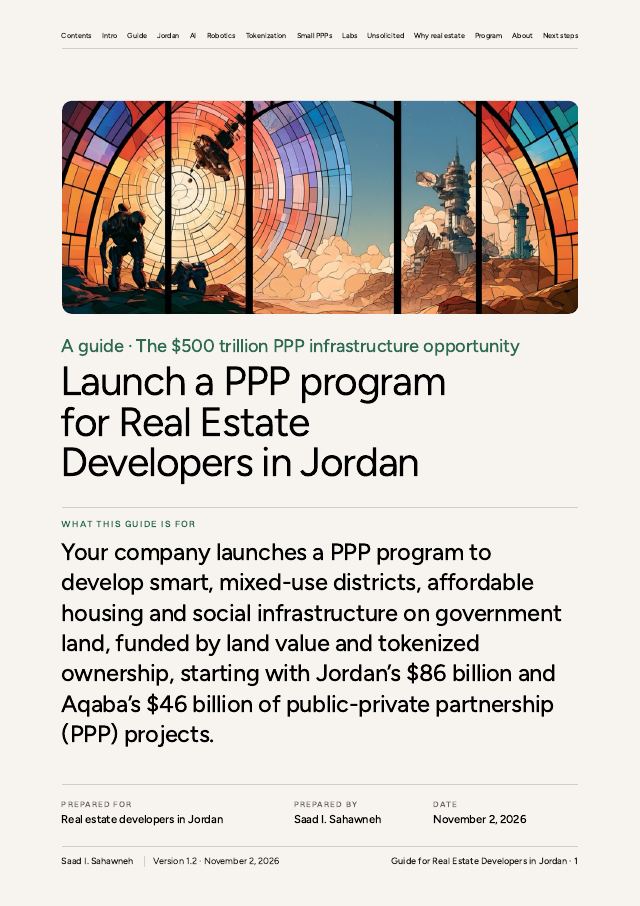
    Your company launches a PPP program to develop smart, mixed-use districts, affordable housing and social infrastructure on government land, funded by land value and tokenized ownership.

  • Developers and builders

    Affordable Housing Developers

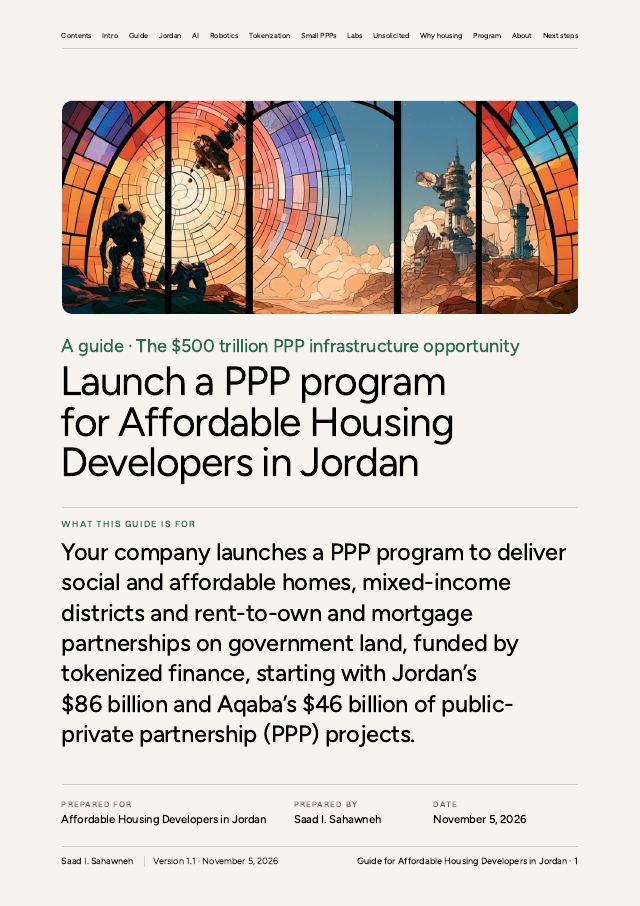
    Your company launches a PPP program to deliver social and affordable homes, mixed-income districts and rent-to-own and mortgage partnerships on government land, funded by tokenized finance.

  • Public sector

    Municipalities

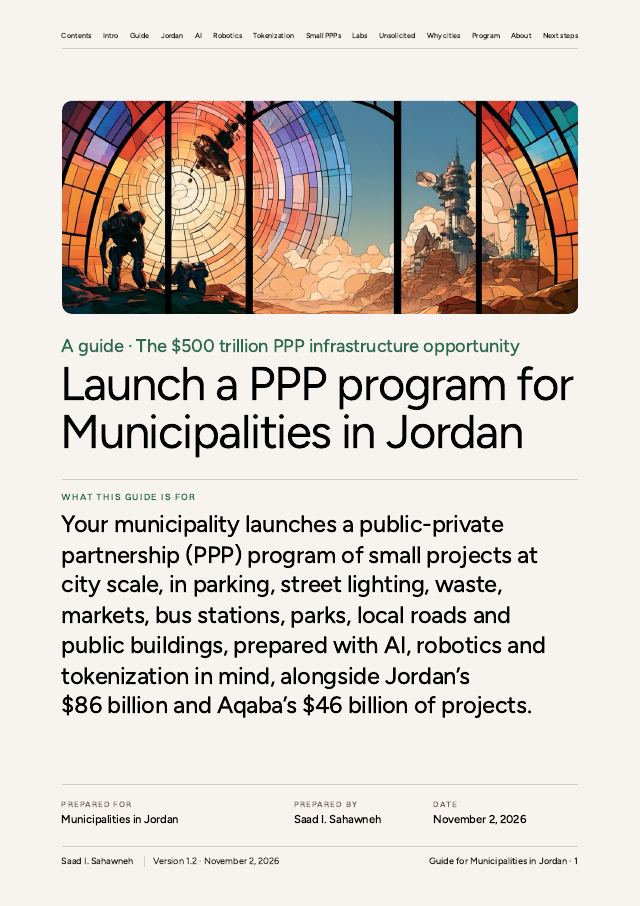
    Your municipality launches a public-private partnership (PPP) program of small projects at city scale, in parking, street lighting, waste, markets, bus stations, parks, local roads and public buildings, prepared with AI, robotics and tokenization in mind.

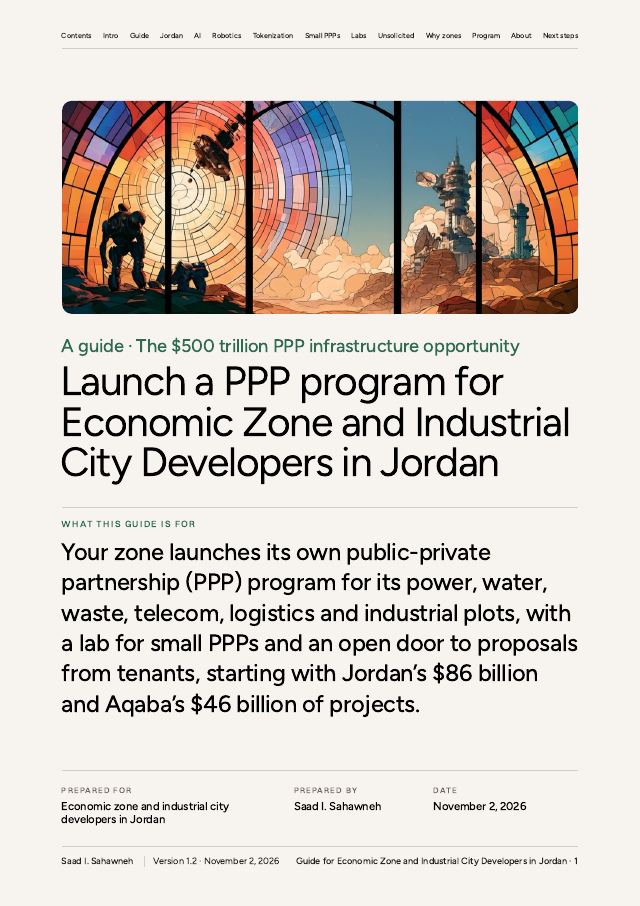
  • Your zone launches its own public-private partnership (PPP) program for its power, water, waste, telecom, logistics and industrial plots, with a lab for small PPPs and an open door to proposals from tenants.

  • Developers and builders

    Contractors

    Your company launches a PPP development arm that moves it from builder to developer and equity partner in public-private partnership (PPP) projects, with robotics and modular construction as its edge.

See every guide and sector on one map