What this organization guide is for
Your municipality or service launches a public-private partnership (PPP) program for the water, waste, roads, power and emergency infrastructure that host communities and refugees share, built to keep working in a crisis.
The case
Host communities carry pressure their services were never built for
Many Jordanian towns, especially in the north, have taken in large refugee populations, and their water, waste, roads and schools now serve far more people than they were built for. Emergency services must protect them all through heat, floods and fires. Small PPPs let a municipality or service add capacity with a private partner that invests, builds and operates, and resilience can be written into every contract. This guide invites host municipalities and emergency services to launch a PPP program, starting with the projects at home.
The guide
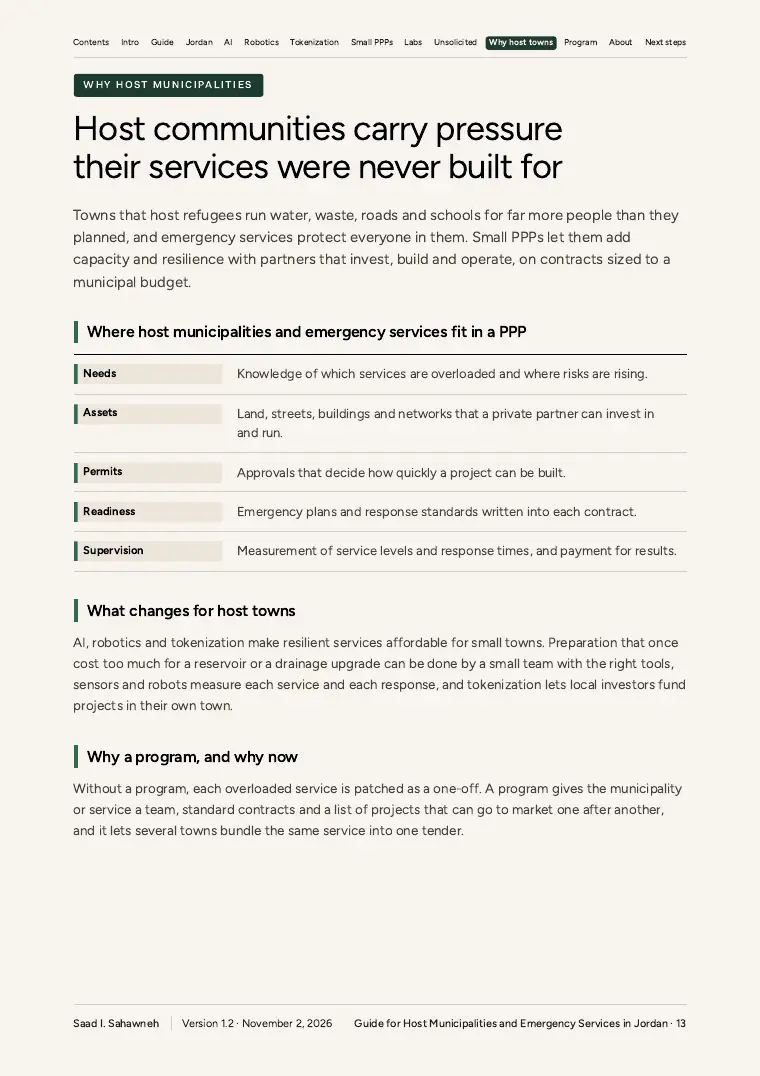
Build resilient infrastructure for the communities that host Jordan’s refugees
Your municipality or service launches a dedicated PPP program, with a small team, a list of projects that add capacity and resilience and a set of standard contracts, so host communities get the services their growth requires, beside Jordan’s $86 billion of projects and the $46 billion anchored in Aqaba.
01
A resilience PPP team
A small team that knows how PPPs are prepared, tendered and supervised turns the pressure on local services into projects that private partners can finance, build and operate, and it plans each one to keep working in an emergency.
02
Small PPPs for shared services
Water storage and networks, waste collection and sorting, local roads, street lighting, solar power for public buildings and emergency shelters can each be delivered as a small PPP, with a partner paid for the service it delivers.
03
Emergency readiness
Early-warning sensors, backup power, fire and flood response equipment and emergency communications can be delivered and maintained by private partners under contracts that pay for readiness and response times.
04
Bundled projects
PPP Regulation No. 9 of 2024 defines small-scale PPPs below $14.1 million, which can be bundled into one feasibility report and one tender. Several host towns can bring the same service to market as one project.
05
A resilience lab
The municipality or service backs a PPP research lab with a one-line brief to run ten small PPP projects a year at up to $100,000 each, such as flood sensors, drone fire monitoring or solar backup for clinics, and it publishes every result, including the failures.
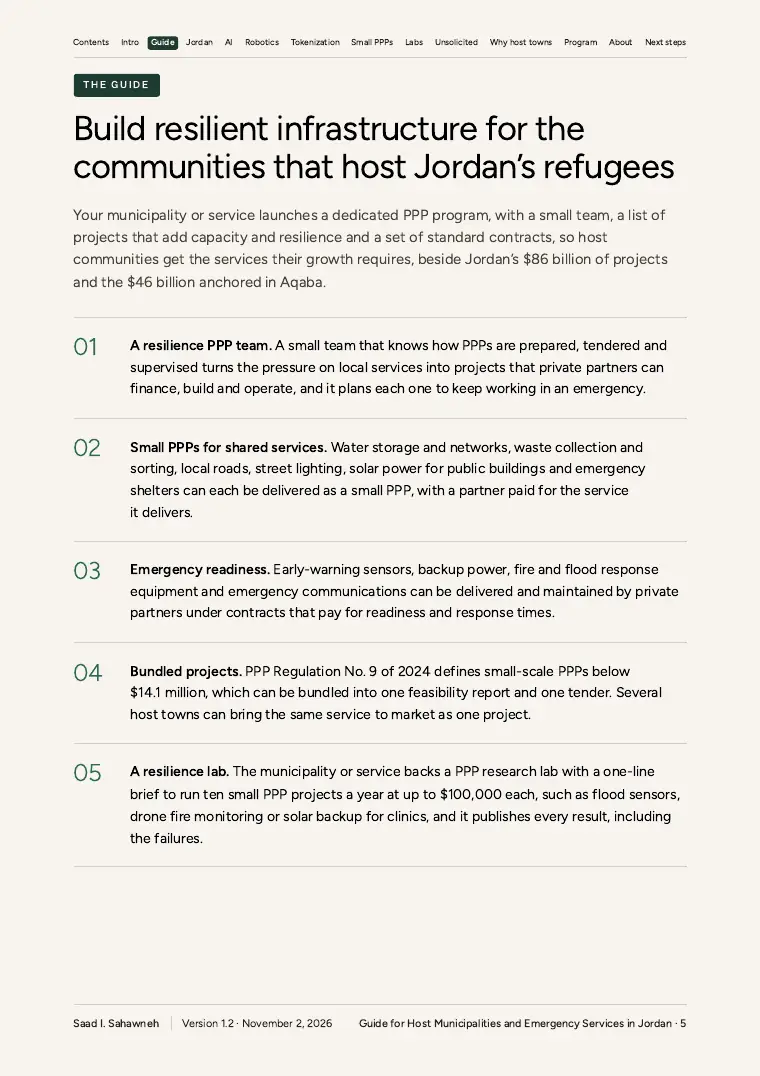
Why host municipalities and emergency services
Host communities carry pressure their services were never built for
Towns that host refugees run water, waste, roads and schools for far more people than they planned, and emergency services protect everyone in them. Small PPPs let them add capacity and resilience with partners that invest, build and operate, on contracts sized to a municipal budget.
Where host municipalities and emergency services fit in a PPP
- Needs
- Knowledge of which services are overloaded and where risks are rising.
- Assets
- Land, streets, buildings and networks that a private partner can invest in and run.
- Permits
- Approvals that decide how quickly a project can be built.
- Readiness
- Emergency plans and response standards written into each contract.
- Supervision
- Measurement of service levels and response times, and payment for results.
What changes for host towns
AI, robotics and tokenization make resilient services affordable for small towns. Preparation that once cost too much for a reservoir or a drainage upgrade can be done by a small team with the right tools, sensors and robots measure each service and each response, and tokenization lets local investors fund projects in their own town.
Why a program, and why now
Without a program, each overloaded service is patched as a one-off. A program gives the municipality or service a team, standard contracts and a list of projects that can go to market one after another, and it lets several towns bundle the same service into one tender.

Futureproofing
Futureproof Host Municipalities and Emergency Services in Jordan for the infrastructure singularity
This free 18-page guide shows how, with small PPPs in parallel, PPP research labs, artificial intelligence, robotics, tokenization and six first steps.

Jordan and Aqaba
An $86 billion pipeline to start with
Many of them will be built in or near the towns that host refugees and will rely on their streets, permits and emergency services. A resilient service proven in one host town can be repeated across the country, and the next municipality can adopt the same contract.
- $86B
- of PPP and infrastructure projects in development in Jordan
- $46B
- of them anchored in Aqaba

Artificial intelligence
AI lets a small municipal or emergency team see pressure building before it becomes a crisis. It can forecast water and waste demand as populations change, model flood and heat risk street by street, draft feasibility reports and compare bids. Once services are running, sensors and AI show where systems are failing and guide responders to where they are needed first.

Robotics
Robotics keeps services running when people are stretched. Drones survey damage after floods and watch for fires, robots inspect pipes and drains, and automated waste-sorting lines handle the extra load, so small local teams can keep up and every response is recorded.

Tokenization
Tokenization lets residents and the diaspora invest in their town’s resilience. A water reservoir, a solar plant for public buildings or a waste facility that earns a steady payment can raise its capital from many local investors and pay them from its own revenue, with a public registry showing what was built and how it performs.

Small PPPs and research labs
Host towns need many small fixes fast: a reservoir here, a drain there, backup power for a clinic. A resilience lab can test flood sensors, drone fire monitoring or solar backup on a few sites, publish every result and carry what works across every host town, funded by moving 1% of the budget away from inefficient spending.

Unsolicited proposals
Direct proposals bring host towns ideas from companies that already know their streets and services, prepared at their own cost. The Ministry of Investment can charge the proposer a study fee for each review, and a qualifying proposal is listed in the national registry of public investment projects, while the tender still tests the idea against the market: the proposer can match the best offer, and the winning bidder pays the proposer’s direct study costs.
The program
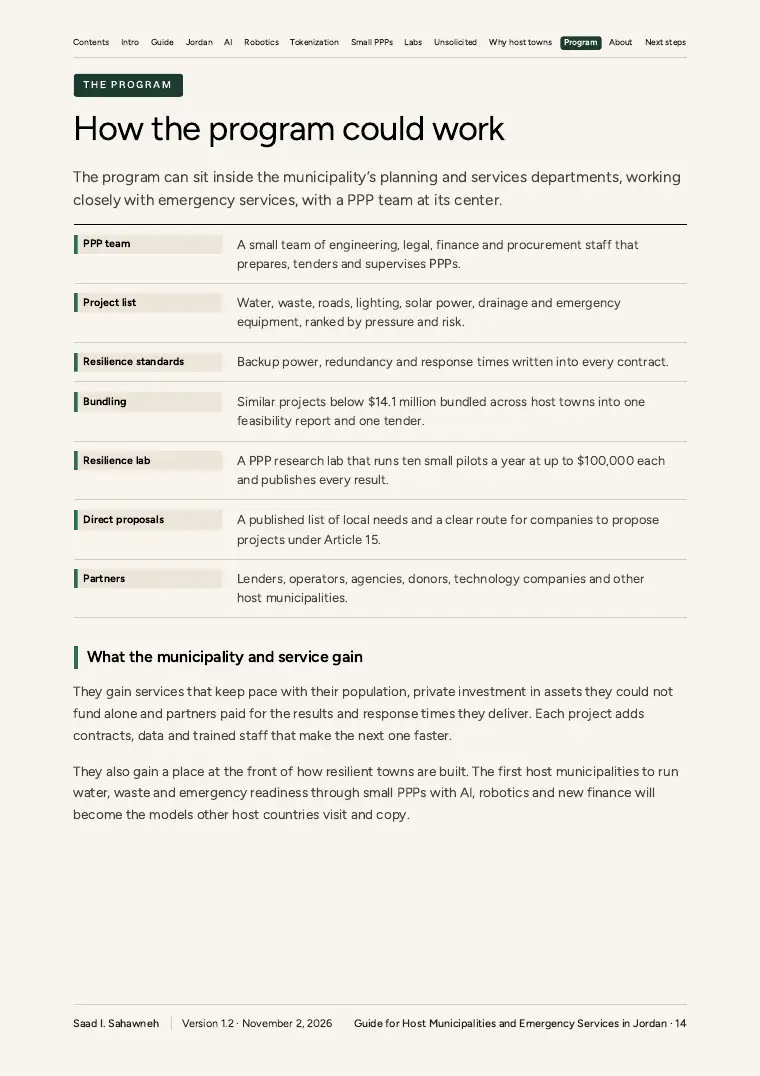
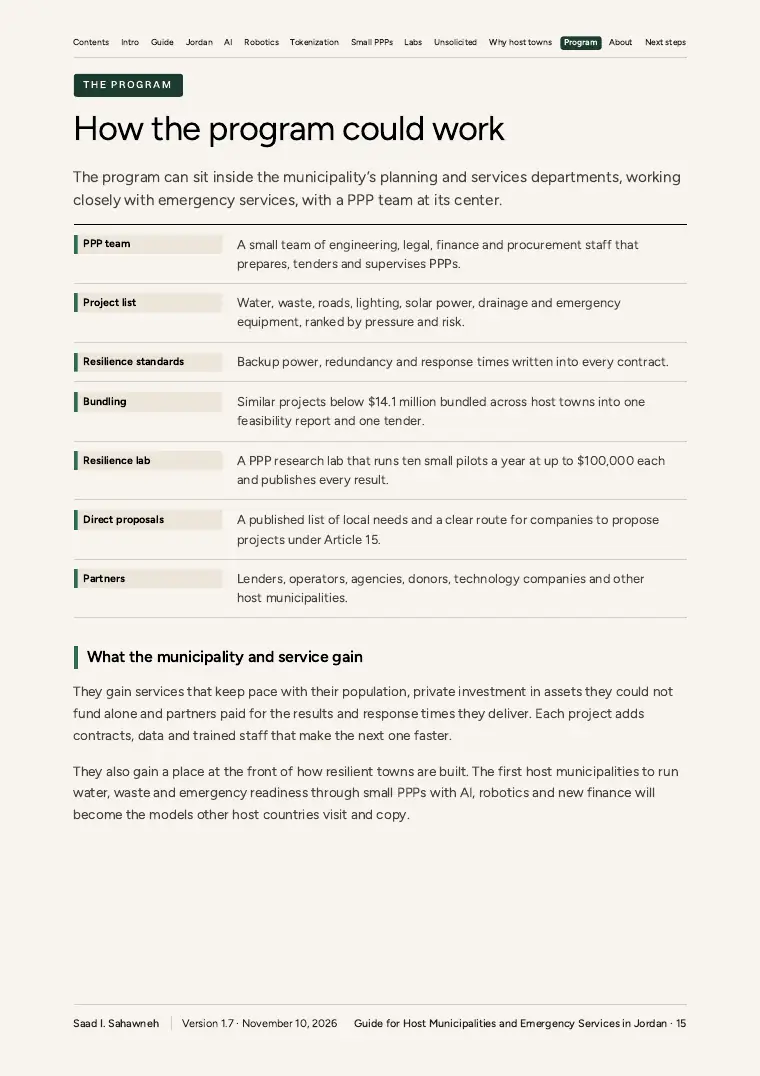
How the program could work
The program can sit inside the municipality’s planning and services departments, working closely with emergency services, with a PPP team at its center.
- PPP team
- A small team of engineering, legal, finance and procurement staff that prepares, tenders and supervises PPPs.
- Project list
- Water, waste, roads, lighting, solar power, drainage and emergency equipment, ranked by pressure and risk.
- Resilience standards
- Backup power, redundancy and response times written into every contract.
- Bundling
- Similar projects below $14.1 million bundled across host towns into one feasibility report and one tender.
- Resilience lab
- A PPP research lab that runs ten small pilots a year at up to $100,000 each and publishes every result.
- Direct proposals
- A published list of local needs and a clear route for companies to propose projects under Article 15.
- Partners
- Lenders, operators, agencies, donors, technology companies and other host municipalities.
What the municipality and service gain
They gain services that keep pace with their population, private investment in assets they could not fund alone and partners paid for the results and response times they deliver. Each project adds contracts, data and trained staff that make the next one faster.
They also gain a place at the front of how resilient towns are built. The first host municipalities to run water, waste and emergency readiness through small PPPs with AI, robotics and new finance will become the models other host countries visit and copy.

Next steps
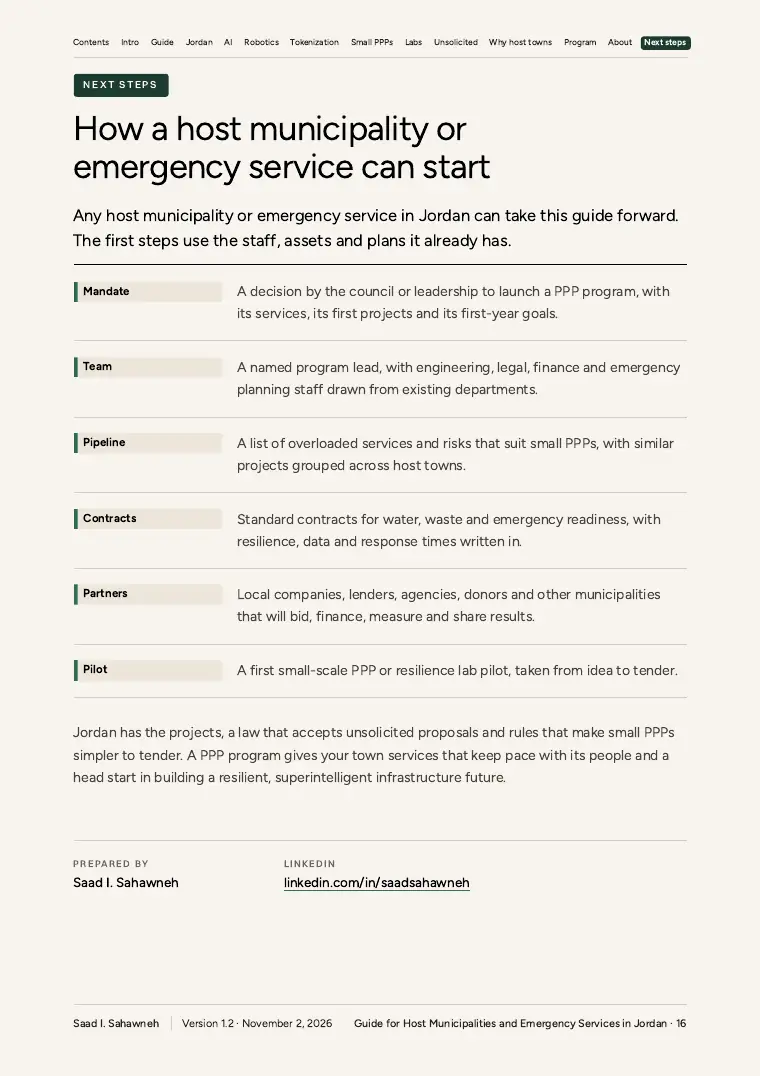
How a host municipality or emergency service can start
Any host municipality or emergency service in Jordan can take this guide forward. The first steps use the staff, assets and plans it already has.
01
Mandate
A decision by the council or leadership to launch a PPP program, with its services, its first projects and its first-year goals.
02
Team
A named program lead, with engineering, legal, finance and emergency planning staff drawn from existing departments.
03
Pipeline
A list of overloaded services and risks that suit small PPPs, with similar projects grouped across host towns.
04
Contracts
Standard contracts for water, waste and emergency readiness, with resilience, data and response times written in.
05
Partners
Local companies, lenders, agencies, donors and other municipalities that will bid, finance, measure and share results.
06
Pilot
A first small-scale PPP or resilience lab pilot, taken from idea to tender.
Jordan has the projects, a law that accepts unsolicited proposals and rules that make small PPPs simpler to tender. A PPP program gives your town services that keep pace with its people and a head start in building a resilient, superintelligent infrastructure future.
The full document
Inside this guide
Eighteen pages and fourteen chapters, from the case for a PPP program to the first steps, written for refugee-hosting municipalities and emergency services in Jordan.
- 18
- pages
- 14
- chapters
- 3
- technologies
- 6
- first steps
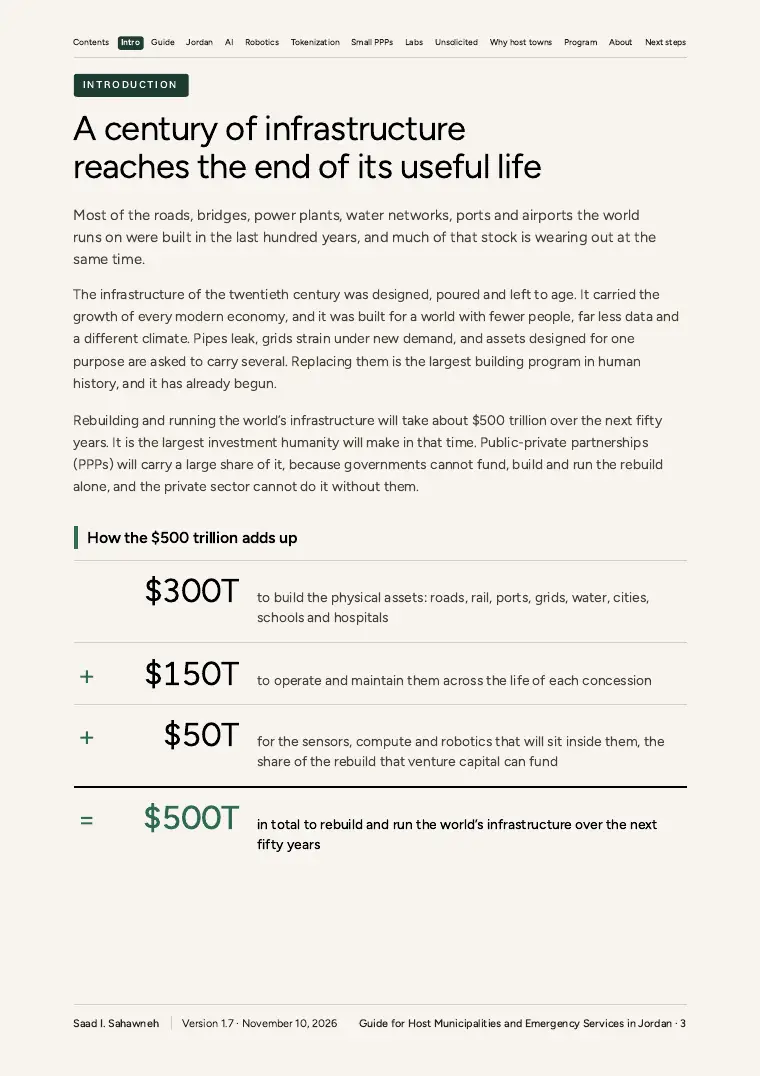
01Introduction
Why a century of infrastructure needs rebuilding, and the $500 trillion it will take.
Page 3 of 18
02The guide
Build resilient infrastructure for the communities that host Jordan’s refugees
Page 5 of 18
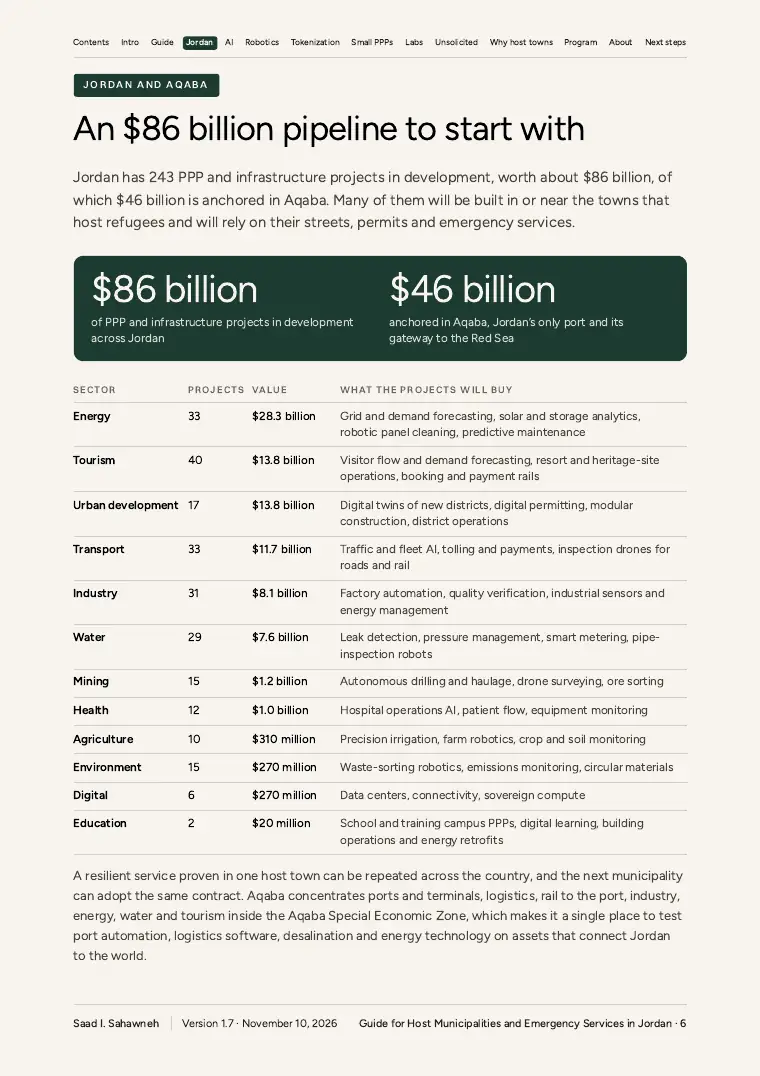
03Jordan and Aqaba
An $86 billion pipeline to start with
Page 6 of 18
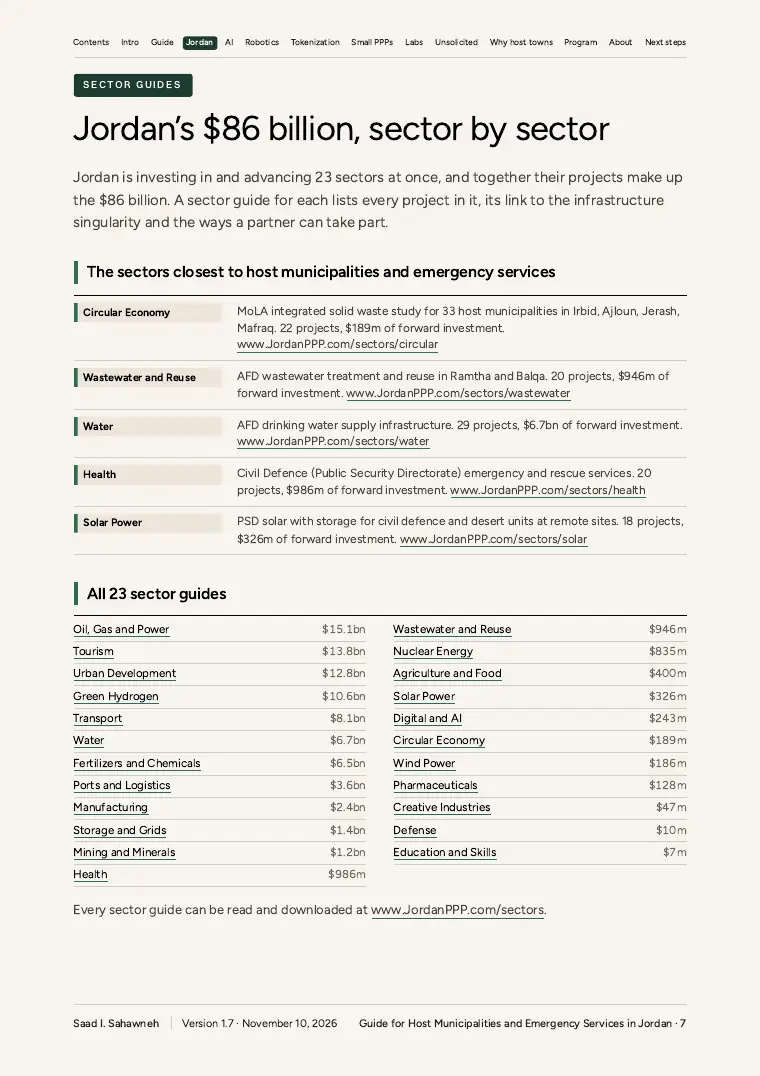
04Sector guides
The sectors closest to host municipalities and emergency services, each with its own guide.
Page 7 of 18
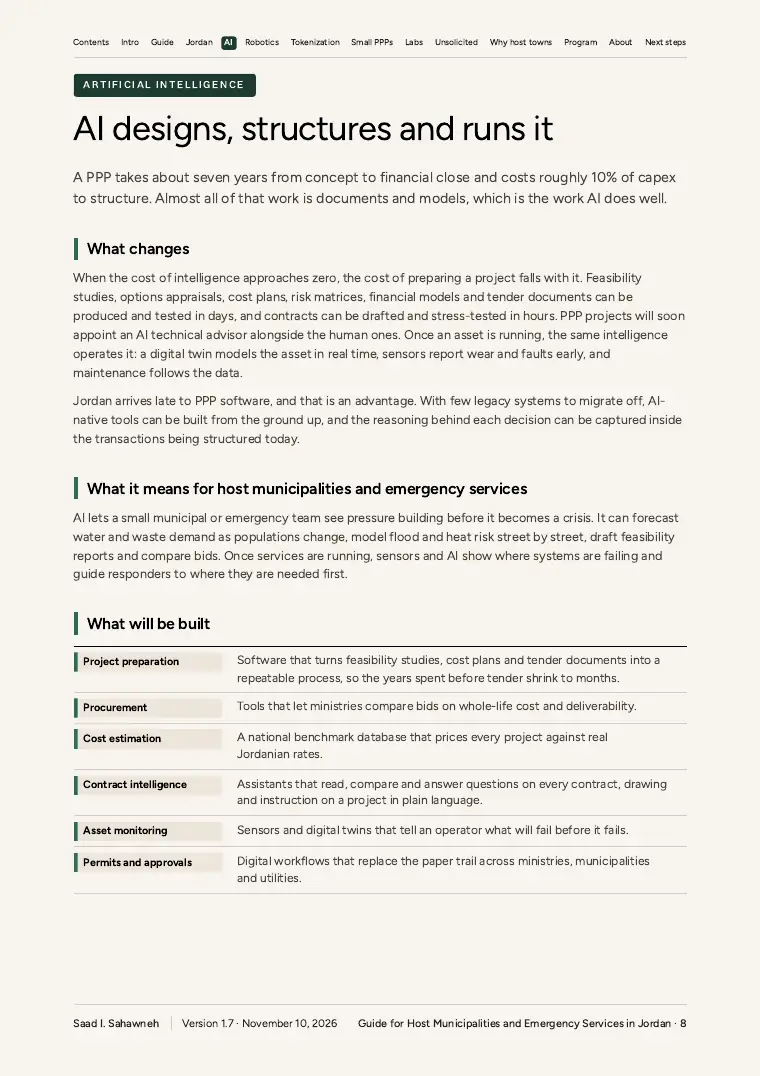
05Artificial intelligence
How AI designs, structures and runs PPP projects, and what it means for host municipalities and emergency services.
Page 8 of 18
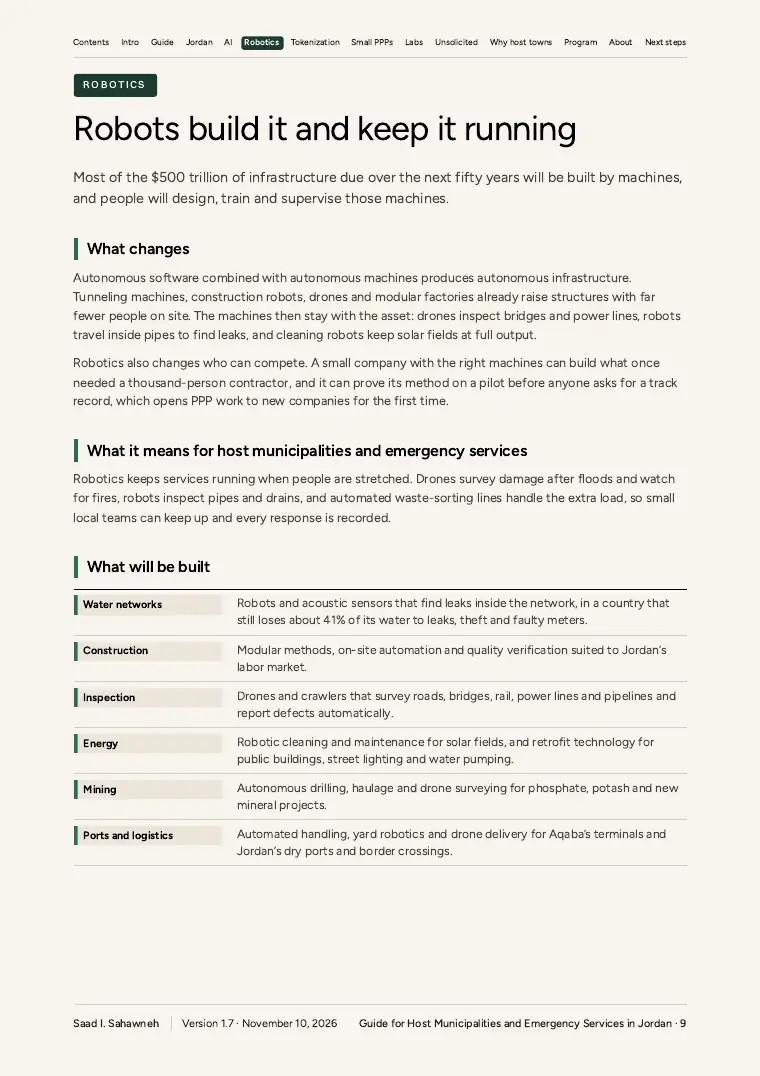
06Robotics
How robots build infrastructure and keep it running, and what that means for host municipalities and emergency services.
Page 9 of 18
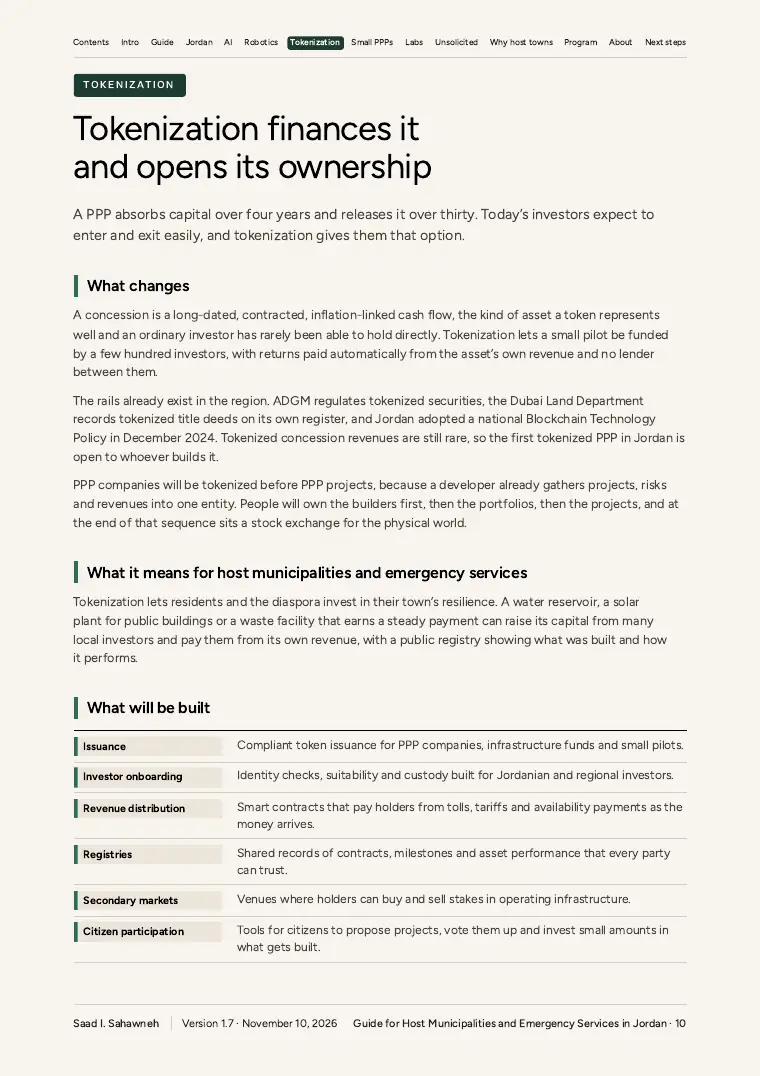
07Tokenization
How tokenization funds projects from their own revenue, and the role it opens for host municipalities and emergency services.
Page 10 of 18
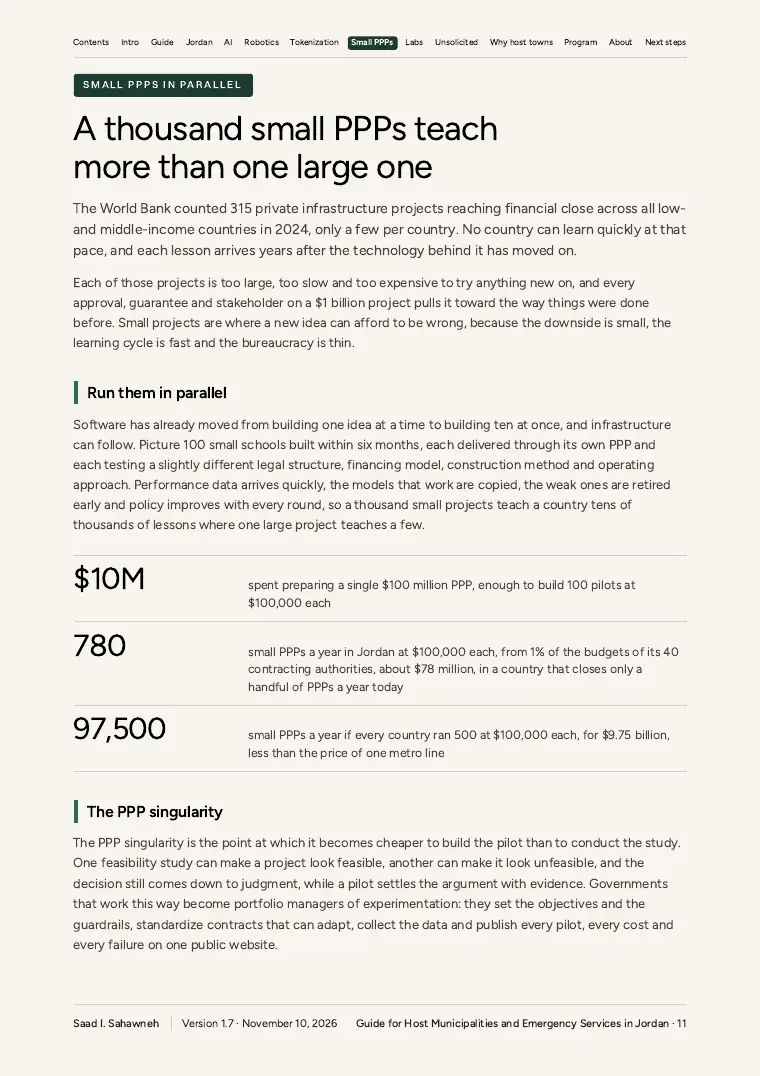
08Small PPPs in parallel
Why many small PPPs teach a country faster than a few large ones.
Page 11 of 18
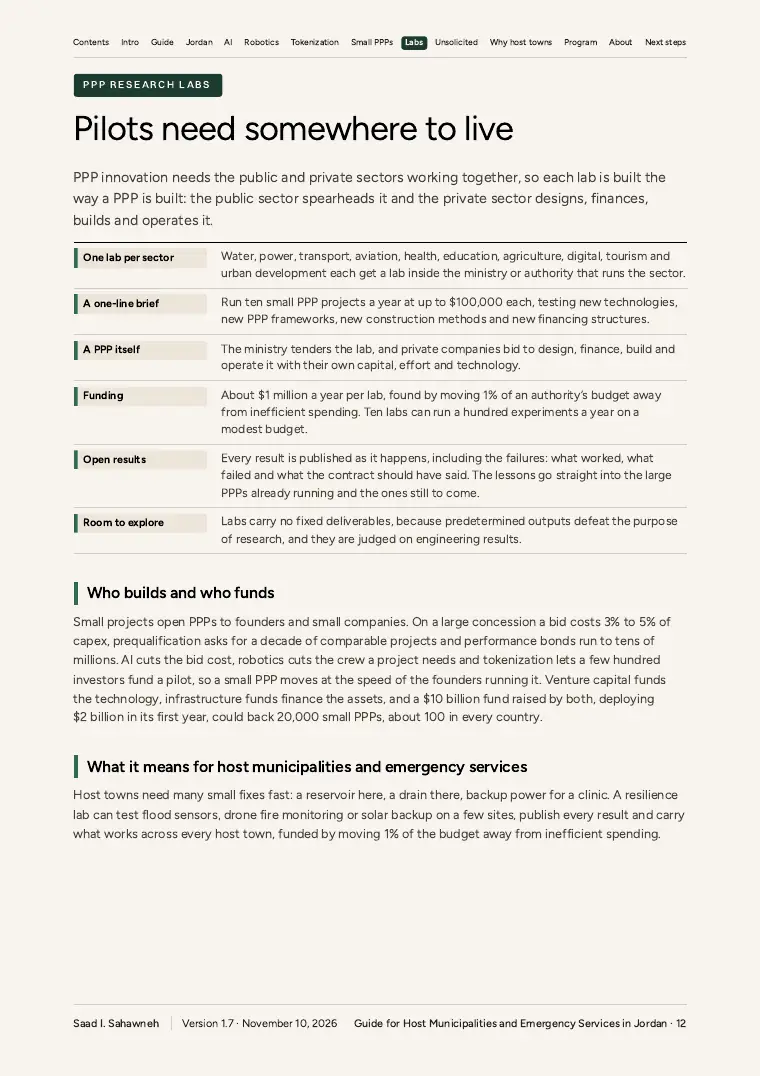
09PPP research labs
A lab in each sector, running ten small PPP projects a year.
Page 12 of 18
10Unsolicited proposals
How Jordan’s PPP law accepts direct proposals from private companies.
Page 13 of 18
11Why host municipalities and emergency services
Host communities carry pressure their services were never built for
Page 14 of 18
12The program
The program can sit inside the municipality’s planning and services departments, working closely with emergency services, with a PPP team at its center.
Page 15 of 18
13About
About Jordan PPP and what it offers.
Page 16 of 18
14Next steps
How a host municipality or emergency service can start: six first steps.
Page 17 of 18
Questions
Questions about the organization guide for Host Municipalities and Emergency Services in Jordan
- What does the organization guide for Host Municipalities and Emergency Services in Jordan propose?
- Your municipality or service launches a public-private partnership (PPP) program for the water, waste, roads, power and emergency infrastructure that host communities and refugees share, built to keep working in a crisis.
- Why should refugee-hosting municipalities and emergency services in Jordan launch a PPP program?
- Host communities carry pressure their services were never built for. Towns that host refugees run water, waste, roads and schools for far more people than they planned, and emergency services protect everyone in them. Small PPPs let them add capacity and resilience with partners that invest, build and operate, on contracts sized to a municipal budget.
- Which PPP projects can refugee-hosting municipalities and emergency services in Jordan take part in?
- Jordan has about $86 billion of PPP and infrastructure projects in development, $46 billion of them anchored in Aqaba. Many of them will be built in or near the towns that host refugees and will rely on their streets, permits and emergency services. A resilient service proven in one host town can be repeated across the country, and the next municipality can adopt the same contract.
- How can refugee-hosting municipalities and emergency services in Jordan start a PPP program?
- Any host municipality or emergency service in Jordan can take this guide forward. The first steps use the staff, assets and plans it already has. The organization guide sets out six first steps: mandate, team, pipeline, contracts, partners and pilot.
- What does a PPP program give refugee-hosting municipalities and emergency services in Jordan?
- They gain services that keep pace with their population, private investment in assets they could not fund alone and partners paid for the results and response times they deliver. Each project adds contracts, data and trained staff that make the next one faster.
- Is the organization guide for Host Municipalities and Emergency Services in Jordan free?
- Yes. It is free to read on this page and free to download as an 18-page PDF, with the case for a PPP program, Jordan’s pipeline, the role of AI, robotics and tokenization, the program and six first steps.
Sector guides
The sectors closest to host municipalities and emergency services
Jordan’s $86 billion is spread across 23 sectors. Each sector guide lists every project in it and shows how to take part.
 Circular Economy$189mMoLA integrated solid waste study for 33 host municipalities in Irbid, Ajloun, Jerash, Mafraq22 projects
 Wastewater and Reuse$946mAFD wastewater treatment and reuse in Ramtha and Balqa20 projects
 Water$6.7bnAFD drinking water supply infrastructure29 projects
 Health$986mCivil Defence (Public Security Directorate) emergency and rescue services20 projects
 Solar Power$326mPSD solar with storage for civil defence and desert units at remote sites18 projects
 Urban Development$12.8bnWorld Bank project funding 16 municipalities in seven governorates: waste, roads, street lighting30 projects
Guide 95 of 96
Browse all 96 organization guides