What this organization guide is for
Your company launches a PPP operations program to bid for operation and maintenance contracts and full concessions in water, power, transport, ports and waste, run with AI and robotics.
The case
Operators decide whether a PPP delivers its service
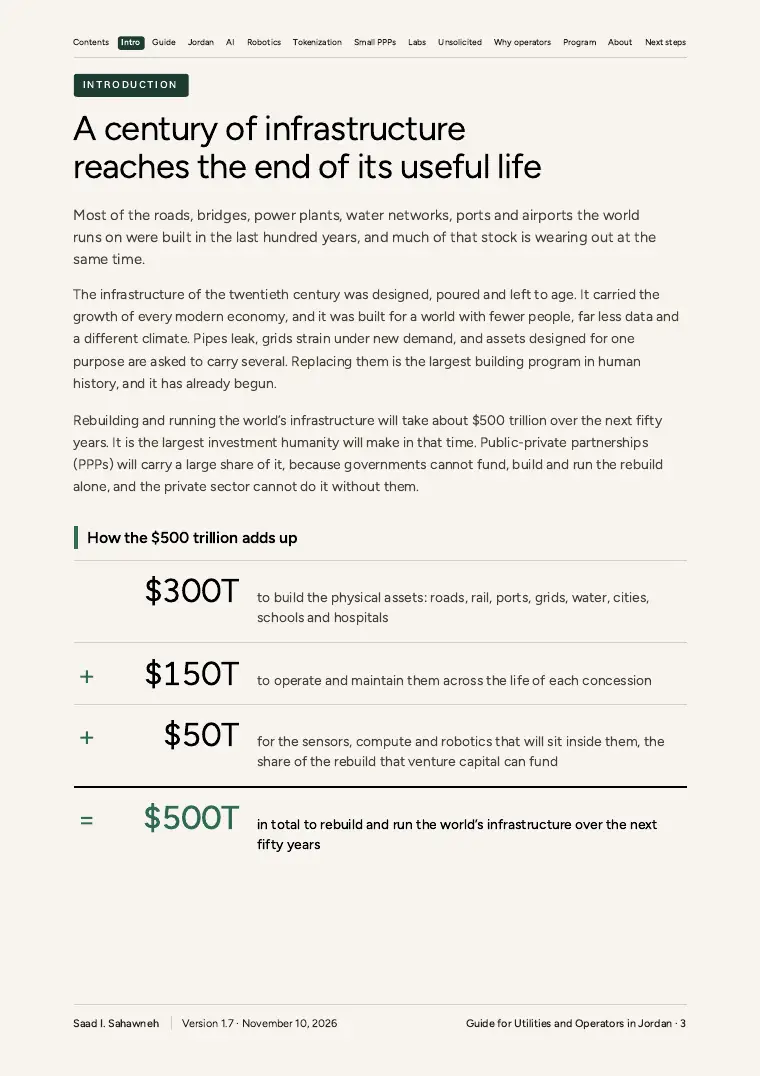
Operation and maintenance accounts for about $150 trillion of the rebuild and runs for the whole life of each concession, long after the builders have left. Operators that build a PPP program now will run the assets of the next fifty years. This guide invites utilities and infrastructure operators in Jordan to launch that program, starting with the projects at home.
The guide
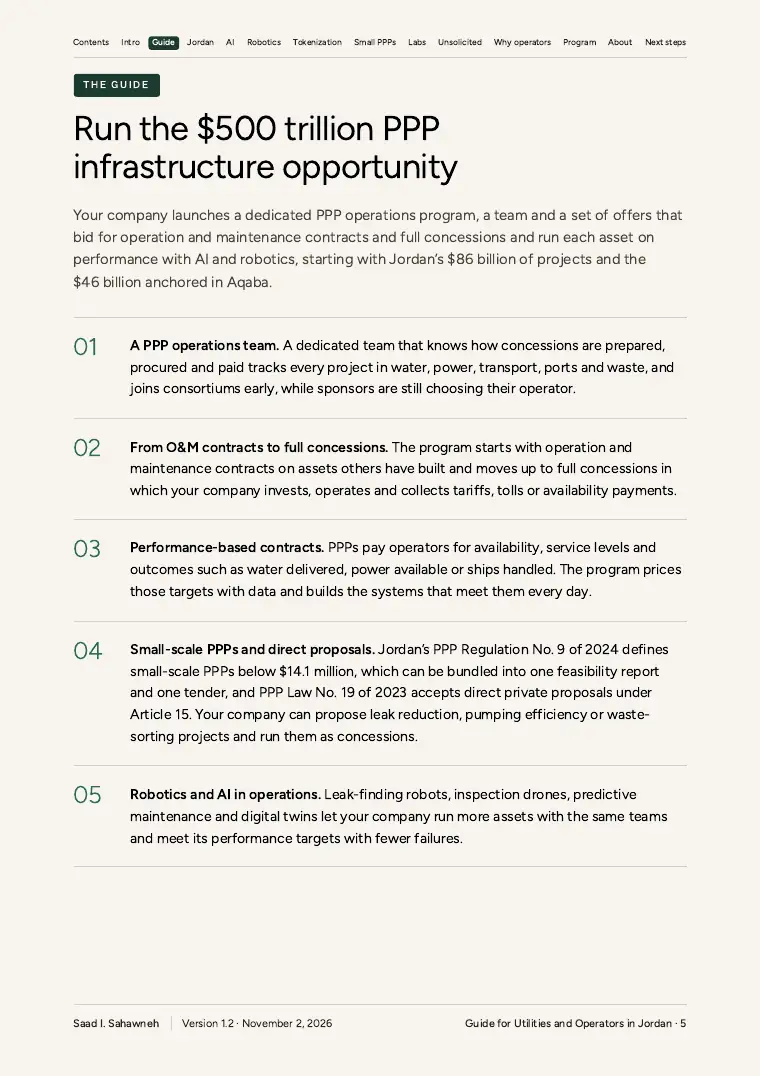
Run the $500 trillion PPP infrastructure opportunity
Your company launches a dedicated PPP operations program, a team and a set of offers that bid for operation and maintenance contracts and full concessions and run each asset on performance with AI and robotics, starting with Jordan’s $86 billion of projects and the $46 billion anchored in Aqaba.
01
A PPP operations team
A dedicated team that knows how concessions are prepared, procured and paid tracks every project in water, power, transport, ports and waste, and joins consortiums early, while sponsors are still choosing their operator.
02
From O&M contracts to full concessions
The program starts with operation and maintenance contracts on assets others have built and moves up to full concessions in which your company invests, operates and collects tariffs, tolls or availability payments.
03
Performance-based contracts
PPPs pay operators for availability, service levels and outcomes such as water delivered, power available or ships handled. The program prices those targets with data and builds the systems that meet them every day.
04
Small-scale PPPs and direct proposals
Jordan’s PPP Regulation No. 9 of 2024 defines small-scale PPPs below $14.1 million, which can be bundled into one feasibility report and one tender, and PPP Law No. 19 of 2023 accepts direct private proposals under Article 15. Your company can propose leak reduction, pumping efficiency or waste-sorting projects and run them as concessions.
05
Robotics and AI in operations
Leak-finding robots, inspection drones, predictive maintenance and digital twins let your company run more assets with the same teams and meet its performance targets with fewer failures.
Why operators
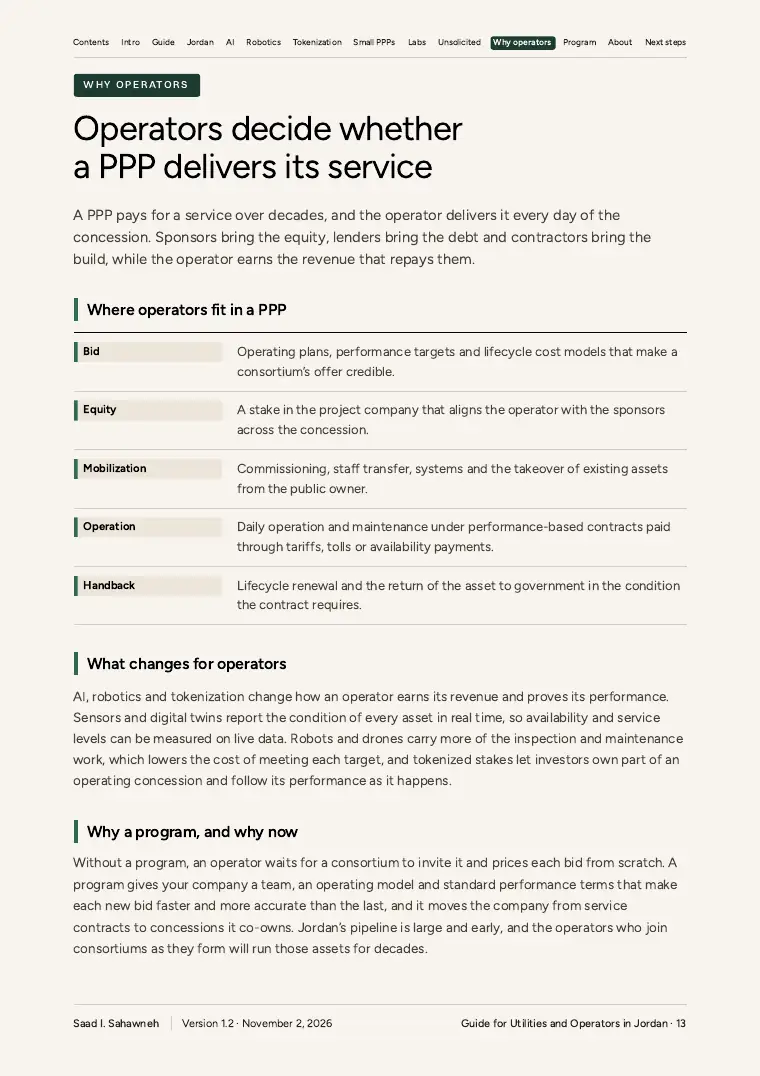
Operators decide whether a PPP delivers its service
A PPP pays for a service over decades, and the operator delivers it every day of the concession. Sponsors bring the equity, lenders bring the debt and contractors bring the build, while the operator earns the revenue that repays them.
Where operators fit in a PPP
- Bid
- Operating plans, performance targets and lifecycle cost models that make a consortium’s offer credible.
- Equity
- A stake in the project company that aligns the operator with the sponsors across the concession.
- Mobilization
- Commissioning, staff transfer, systems and the takeover of existing assets from the public owner.
- Operation
- Daily operation and maintenance under performance-based contracts paid through tariffs, tolls or availability payments.
- Handback
- Lifecycle renewal and the return of the asset to government in the condition the contract requires.
What changes for operators
AI, robotics and tokenization change how an operator earns its revenue and proves its performance. Sensors and digital twins report the condition of every asset in real time, so availability and service levels can be measured on live data. Robots and drones carry more of the inspection and maintenance work, which lowers the cost of meeting each target, and tokenized stakes let investors own part of an operating concession and follow its performance as it happens.
Why a program, and why now
Without a program, an operator waits for a consortium to invite it and prices each bid from scratch. A program gives your company a team, an operating model and standard performance terms that make each new bid faster and more accurate than the last, and it moves the company from service contracts to concessions it co-owns. Jordan’s pipeline is large and early, and the operators who join consortiums as they form will run those assets for decades.

Futureproofing
Futureproof Utilities and Operators in Jordan for the infrastructure singularity
This free 18-page guide shows how, with small PPPs in parallel, PPP research labs, artificial intelligence, robotics, tokenization and six first steps.

Jordan and Aqaba
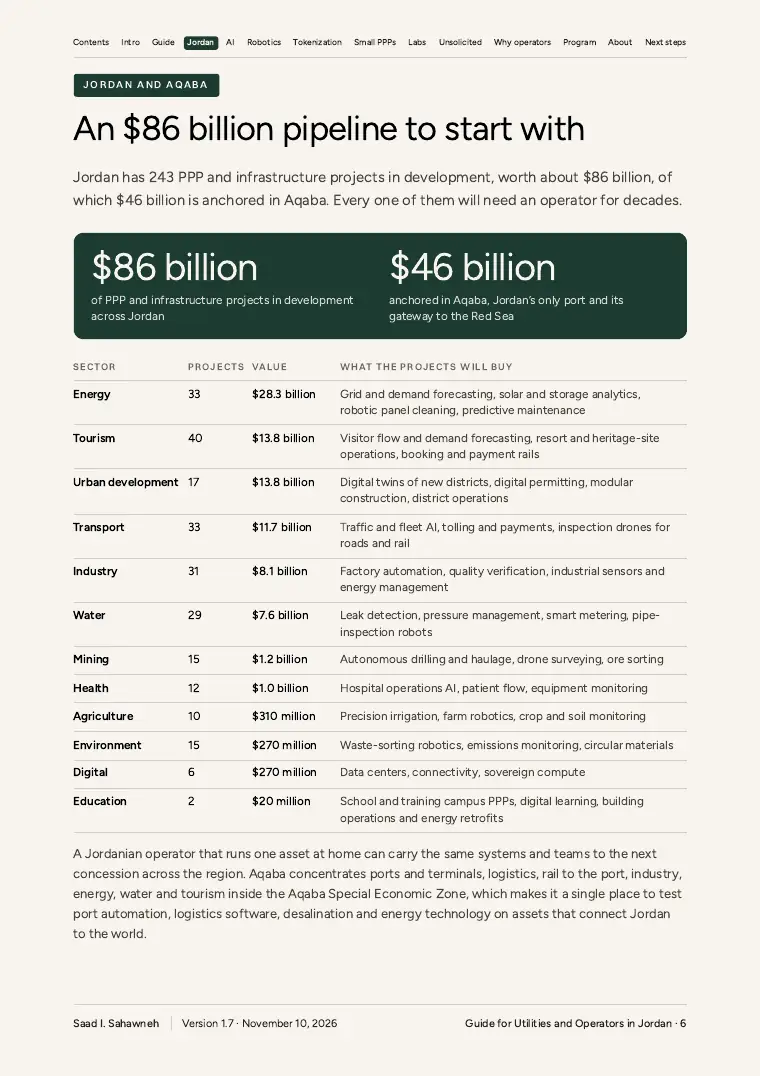
An $86 billion pipeline to start with
Every one of them will need an operator for decades. A Jordanian operator that runs one asset at home can carry the same systems and teams to the next concession across the region.
- $86B
- of PPP and infrastructure projects in development in Jordan
- $46B
- of them anchored in Aqaba

Artificial intelligence
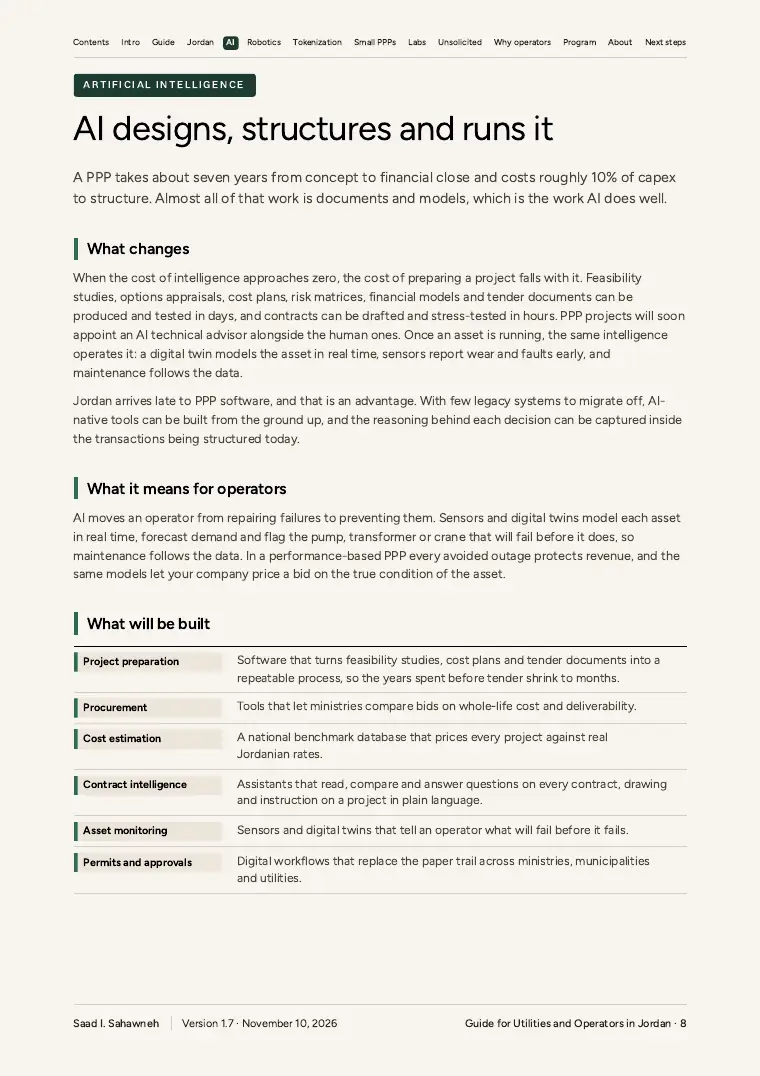
AI moves an operator from repairing failures to preventing them. Sensors and digital twins model each asset in real time, forecast demand and flag the pump, transformer or crane that will fail before it does, so maintenance follows the data. In a performance-based PPP every avoided outage protects revenue, and the same models let your company price a bid on the true condition of the asset.

Robotics
Robotics lets an operator hand more of the dangerous and repetitive work to machines. Pipe robots locate leaks from inside the network, drones survey power lines, roads and port cranes, and automated lines sort waste, so a small team can maintain a large network and still meet its performance targets.

Tokenization
An operating asset with a performance record suits tokenization best. Your company can offer tokenized stakes in the concessions it runs, pay holders from tariffs and availability payments as they arrive, and publish live performance data to a shared registry, which gives investors and the contracting authority one record of how the asset performs.

Small PPPs and research labs
Small PPPs let an operator test new ways to run assets at low risk, from sensors and digital twins to robotic maintenance and new service contracts. Every pilot leaves behind operating data that sharpens the operator’s pricing, and an operator that runs labs sees the next generation of assets before they reach tender.

Unsolicited proposals
An operator knows better than anyone where an asset loses water, power or time. A direct proposal lets it turn that knowledge into a performance contract or a full concession of its own design, and keep the right to match the best offer if the project goes to tender.
The program
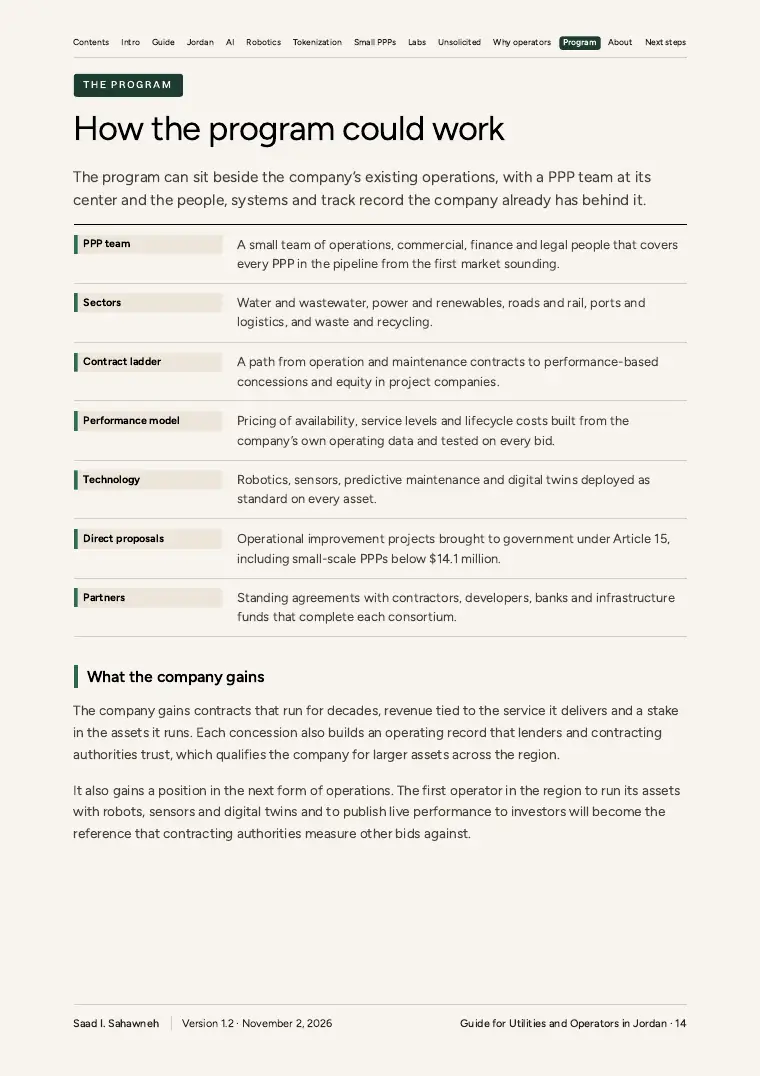
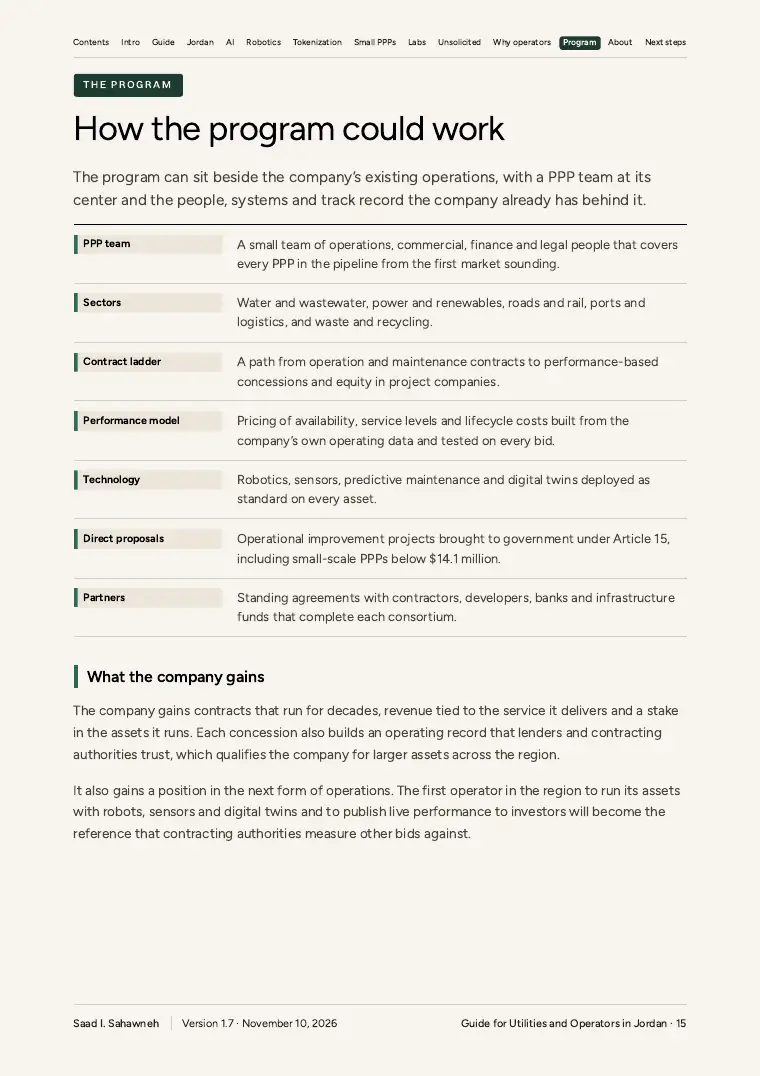
How the program could work
The program can sit beside the company’s existing operations, with a PPP team at its center and the people, systems and track record the company already has behind it.
- PPP team
- A small team of operations, commercial, finance and legal people that covers every PPP in the pipeline from the first market sounding.
- Sectors
- Water and wastewater, power and renewables, roads and rail, ports and logistics, and waste and recycling.
- Contract ladder
- A path from operation and maintenance contracts to performance-based concessions and equity in project companies.
- Performance model
- Pricing of availability, service levels and lifecycle costs built from the company’s own operating data and tested on every bid.
- Technology
- Robotics, sensors, predictive maintenance and digital twins deployed as standard on every asset.
- Direct proposals
- Operational improvement projects brought to government under Article 15, including small-scale PPPs below $14.1 million.
- Partners
- Standing agreements with contractors, developers, banks and infrastructure funds that complete each consortium.
What the company gains
The company gains contracts that run for decades, revenue tied to the service it delivers and a stake in the assets it runs. Each concession also builds an operating record that lenders and contracting authorities trust, which qualifies the company for larger assets across the region.
It also gains a position in the next form of operations. The first operator in the region to run its assets with robots, sensors and digital twins and to publish live performance to investors will become the reference that contracting authorities measure other bids against.

Next steps
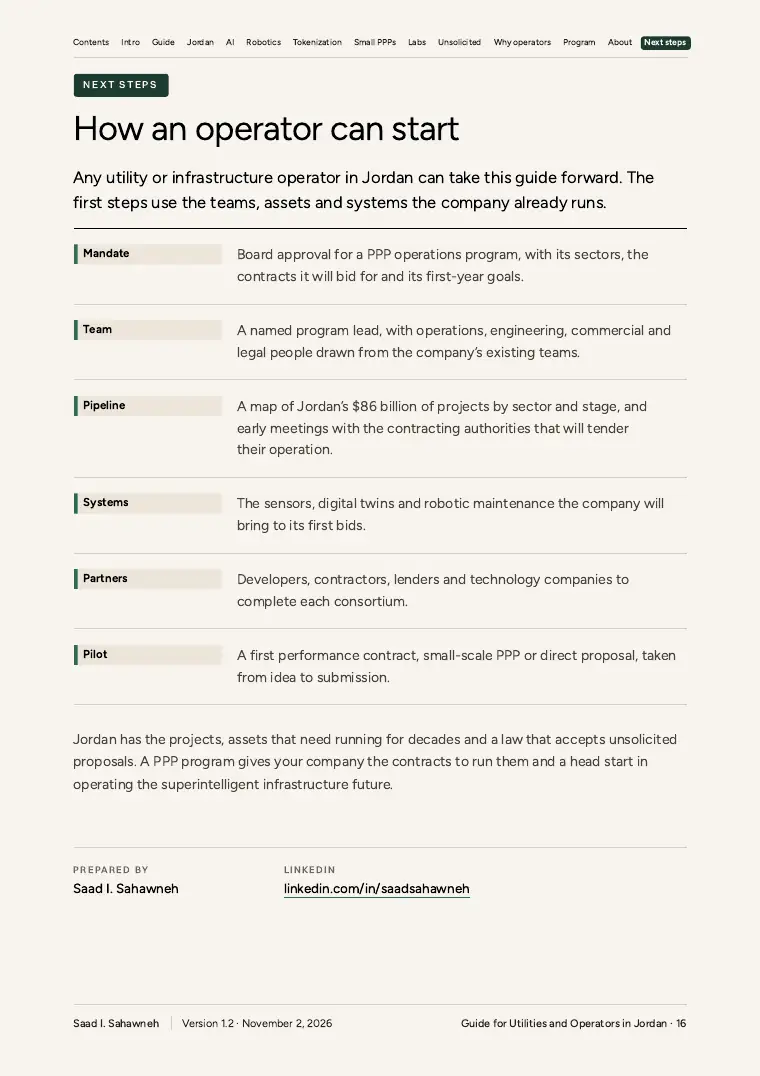
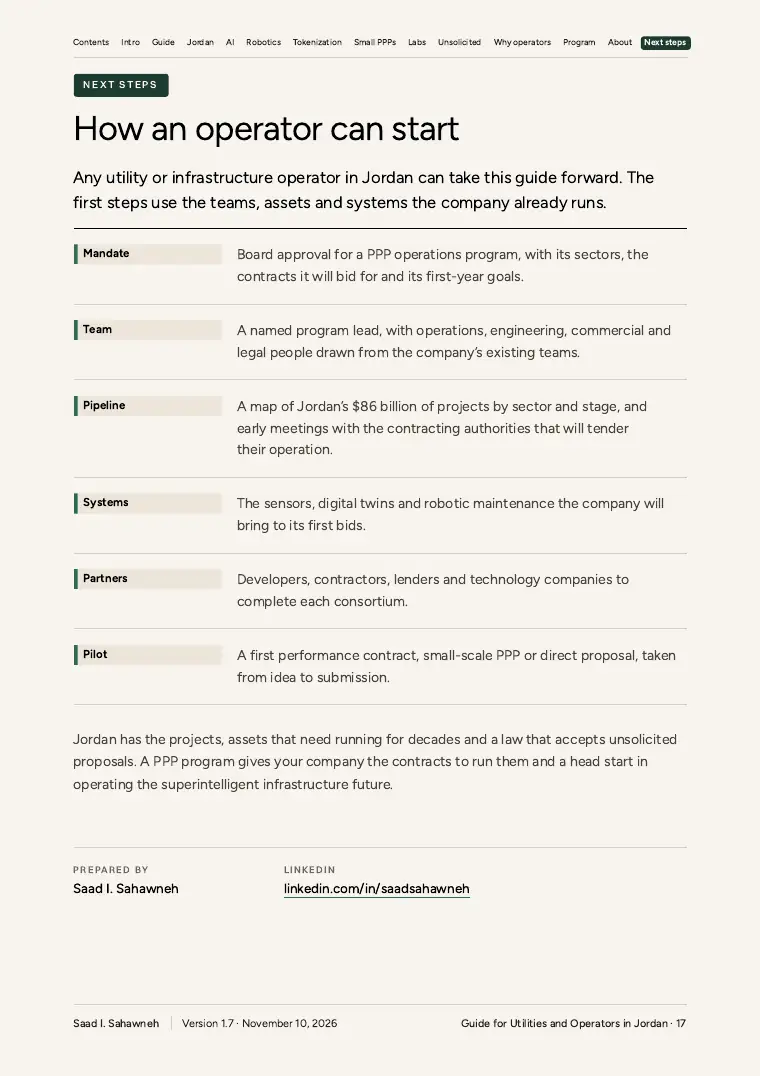
How an operator can start
Any utility or infrastructure operator in Jordan can take this guide forward. The first steps use the teams, assets and systems the company already runs.
01
Mandate
Board approval for a PPP operations program, with its sectors, the contracts it will bid for and its first-year goals.
02
Team
A named program lead, with operations, engineering, commercial and legal people drawn from the company’s existing teams.
03
Pipeline
A map of Jordan’s $86 billion of projects by sector and stage, and early meetings with the contracting authorities that will tender their operation.
04
Systems
The sensors, digital twins and robotic maintenance the company will bring to its first bids.
05
Partners
Developers, contractors, lenders and technology companies to complete each consortium.
06
Pilot
A first performance contract, small-scale PPP or direct proposal, taken from idea to submission.
Jordan has the projects, assets that need running for decades and a law that accepts unsolicited proposals. A PPP program gives your company the contracts to run them and a head start in operating the superintelligent infrastructure future.
The full document
Inside this guide
Eighteen pages and fourteen chapters, from the case for a PPP program to the first steps, written for utilities and infrastructure operators in Jordan.
- 18
- pages
- 14
- chapters
- 3
- technologies
- 6
- first steps
01Introduction
Why a century of infrastructure needs rebuilding, and the $500 trillion it will take.
Page 3 of 18
02The guide
Run the $500 trillion PPP infrastructure opportunity
Page 5 of 18
03Jordan and Aqaba
An $86 billion pipeline to start with
Page 6 of 18
04Sector guides
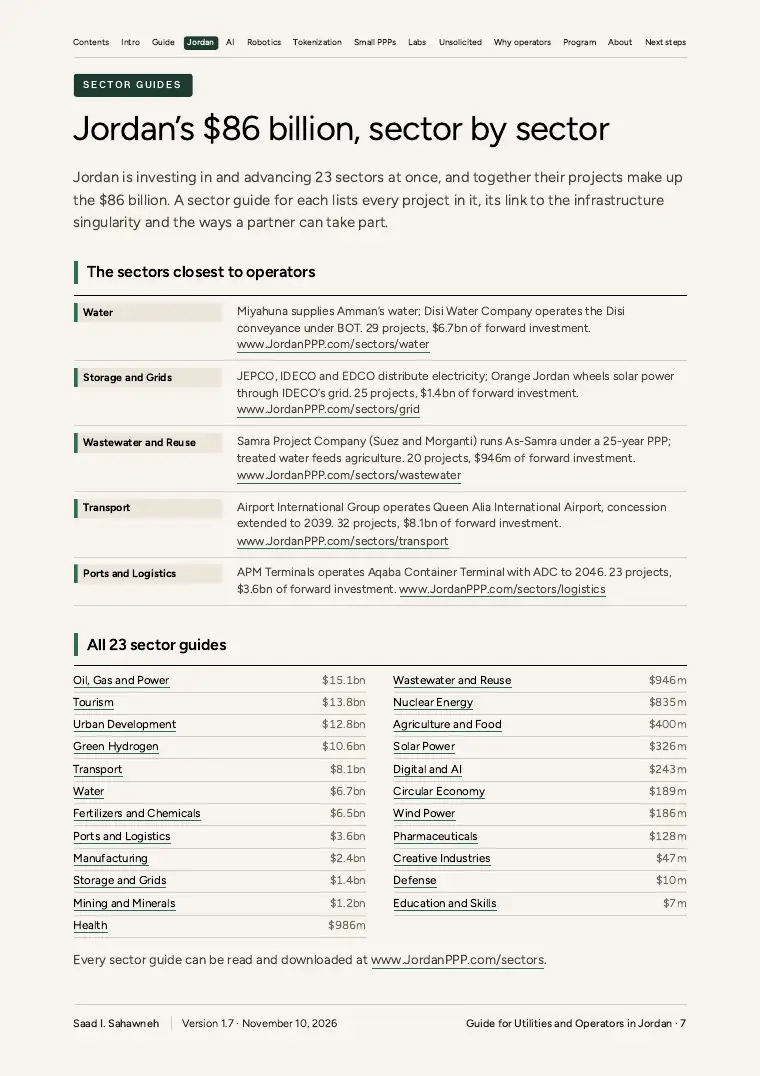
The sectors closest to operators, each with its own guide.
Page 7 of 18
05Artificial intelligence
How AI designs, structures and runs PPP projects, and what it means for operators.
Page 8 of 18
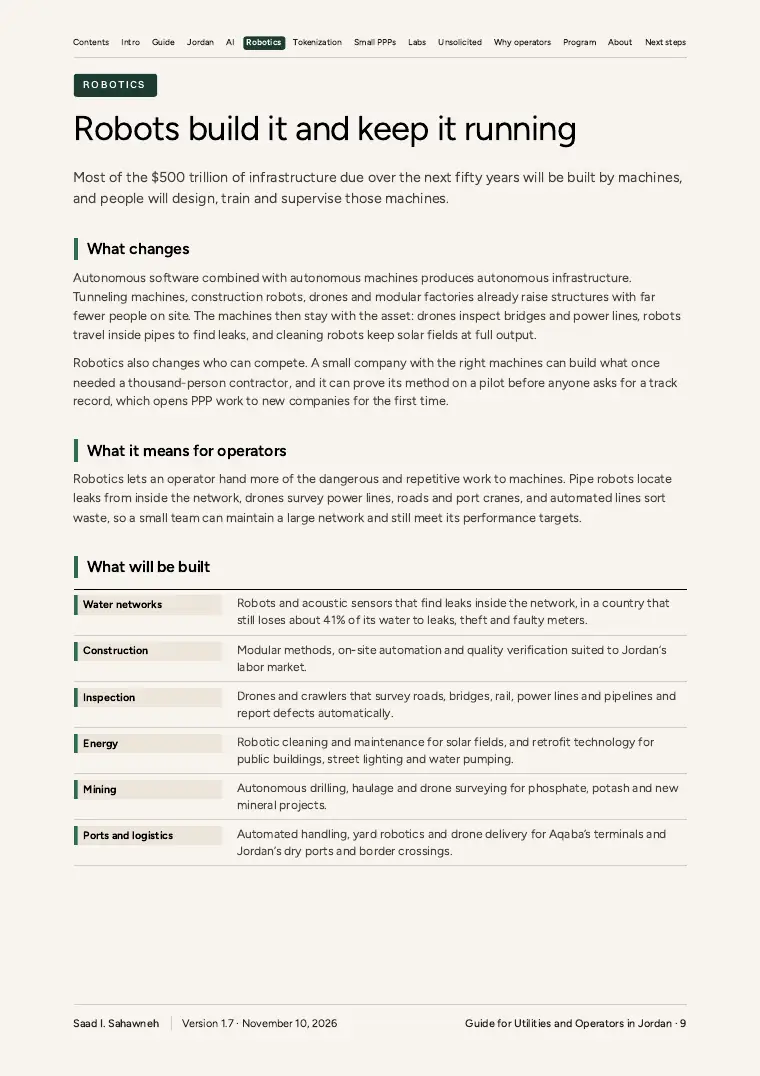
06Robotics
How robots build infrastructure and keep it running, and what that means for operators.
Page 9 of 18
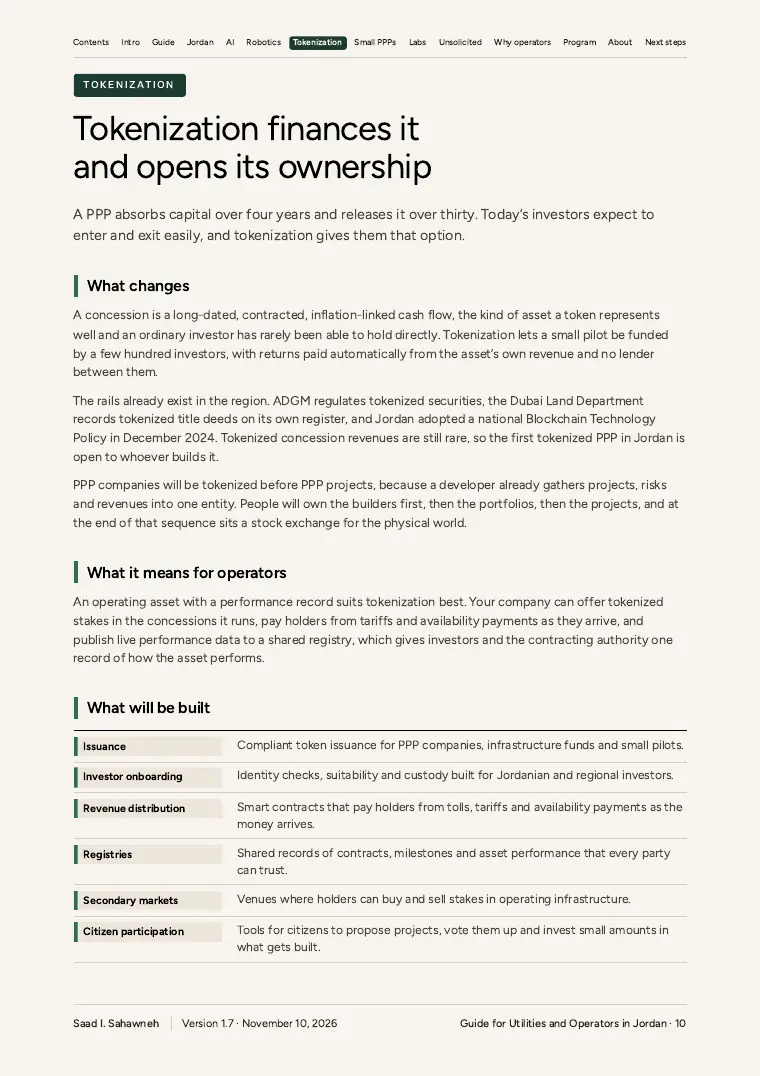
07Tokenization
How tokenization funds projects from their own revenue, and the role it opens for operators.
Page 10 of 18
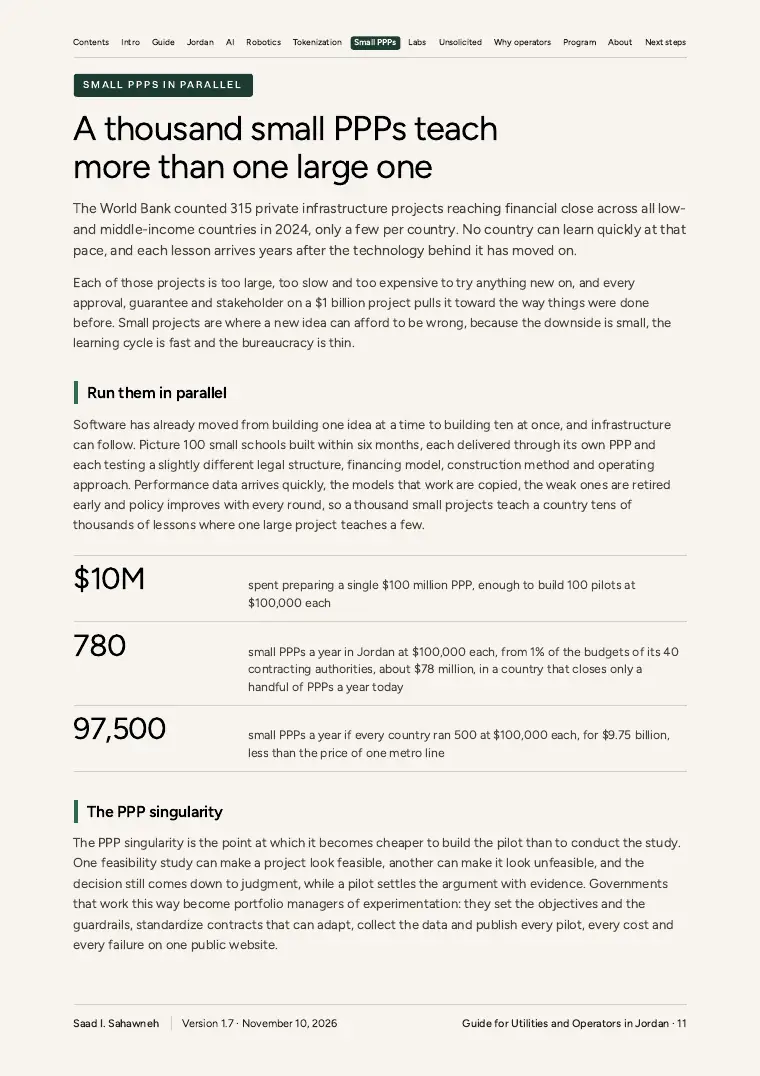
08Small PPPs in parallel
Why many small PPPs teach a country faster than a few large ones.
Page 11 of 18
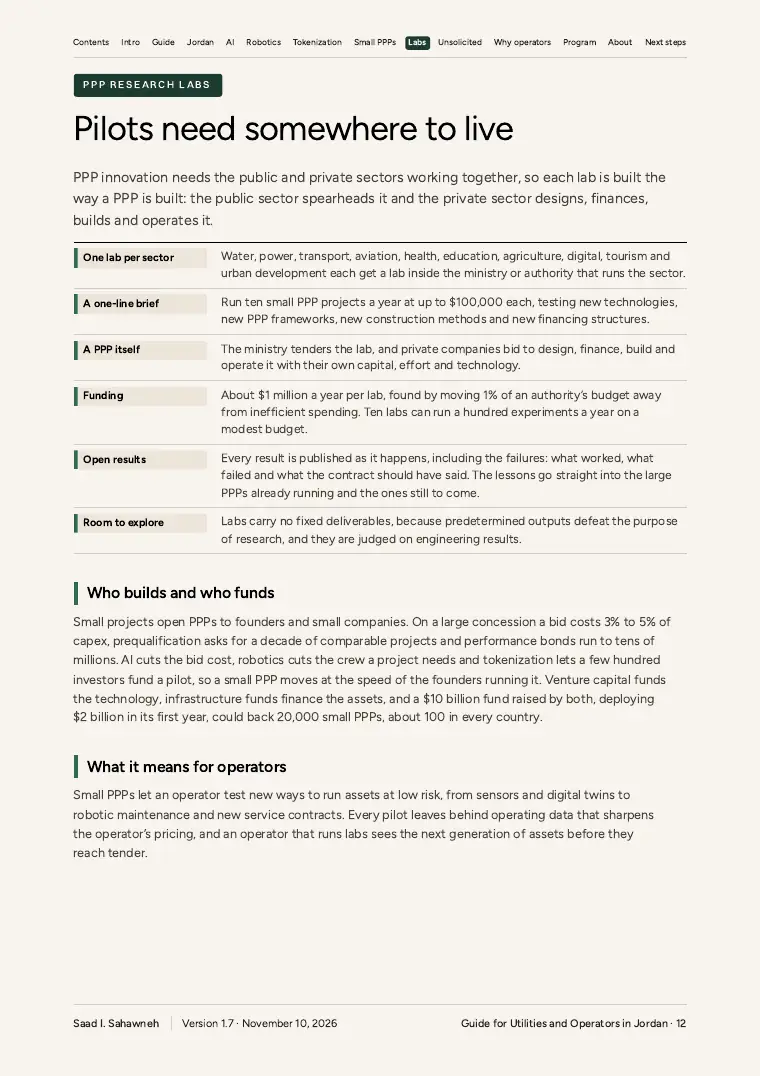
09PPP research labs
A lab in each sector, running ten small PPP projects a year.
Page 12 of 18
10Unsolicited proposals
How Jordan’s PPP law accepts direct proposals from private companies.
Page 13 of 18
11Why operators
Operators decide whether a PPP delivers its service
Page 14 of 18
12The program
The program can sit beside the company’s existing operations, with a PPP team at its center and the people, systems and track record the company already has behind it.
Page 15 of 18
13About
About Jordan PPP and what it offers.
Page 16 of 18
14Next steps
How an operator can start: six first steps.
Page 17 of 18
Questions
Questions about the organization guide for Utilities and Operators in Jordan
- What does the organization guide for Utilities and Operators in Jordan propose?
- Your company launches a PPP operations program to bid for operation and maintenance contracts and full concessions in water, power, transport, ports and waste, run with AI and robotics.
- Why should utilities and infrastructure operators in Jordan launch a PPP program?
- Operators decide whether a PPP delivers its service. A PPP pays for a service over decades, and the operator delivers it every day of the concession. Sponsors bring the equity, lenders bring the debt and contractors bring the build, while the operator earns the revenue that repays them.
- Which PPP projects can utilities and infrastructure operators in Jordan take part in?
- Jordan has about $86 billion of PPP and infrastructure projects in development, $46 billion of them anchored in Aqaba. Every one of them will need an operator for decades. A Jordanian operator that runs one asset at home can carry the same systems and teams to the next concession across the region.
- How can utilities and infrastructure operators in Jordan start a PPP program?
- Any utility or infrastructure operator in Jordan can take this guide forward. The first steps use the teams, assets and systems the company already runs. The organization guide sets out six first steps: mandate, team, pipeline, systems, partners and pilot.
- What does a PPP program give utilities and infrastructure operators in Jordan?
- The company gains contracts that run for decades, revenue tied to the service it delivers and a stake in the assets it runs. Each concession also builds an operating record that lenders and contracting authorities trust, which qualifies the company for larger assets across the region.
- Is the organization guide for Utilities and Operators in Jordan free?
- Yes. It is free to read on this page and free to download as an 18-page PDF, with the case for a PPP program, Jordan’s pipeline, the role of AI, robotics and tokenization, the program and six first steps.
Sector guides
The sectors closest to utilities and operators
Jordan’s $86 billion is spread across 23 sectors. Each sector guide lists every project in it and shows how to take part.
 Water$6.7bnMiyahuna supplies Amman’s water; Disi Water Company operates the Disi conveyance under BOT29 projects
 Storage and Grids$1.4bnJEPCO, IDECO and EDCO distribute electricity; Orange Jordan wheels solar power through IDECO’s grid25 projects
 Wastewater and Reuse$946mSamra Project Company (Suez and Morganti) runs As-Samra under a 25-year PPP; treated water feeds agriculture20 projects
 Transport$8.1bnAirport International Group operates Queen Alia International Airport, concession extended to 203932 projects
 Ports and Logistics$3.6bnAPM Terminals operates Aqaba Container Terminal with ADC to 204623 projects
 Circular Economy$189mPrivate firms took over Amman waste collection; Al Ghabawi landfill gas covers about 45% of GAM’s electricity22 projects
 Oil, Gas and Power$15.1bnAES (with QEWC) operates the Amman East power plant23 projects
 Solar Power$326mFirst Solar provides long-term O&M for Shams Ma’an; Kawar Energy runs O&M on Orange Jordan’s solar farms18 projects
 Wind Power$186mKEPCO owns and operates the 89 MW Fujeij wind farm10 projects
Guide 46 of 96
Browse all 96 organization guides