What this organization guide is for
Your ministry or authority launches its own public-private partnership (PPP) program, with a research lab that runs small PPPs in parallel, an open door to direct proposals from the private sector and a pipeline of projects prepared for AI, robotics and tokenization.
The case
Contracting authorities decide which projects reach the market
Every PPP begins with a public need and a ministry or authority that decides to meet it with a partner. Contracting authorities choose which projects go to market, how they are prepared and what the contracts reward, so the way they work sets the pace for everyone else. This guide invites ministries and public authorities in Jordan to launch a PPP program of their own, starting with the projects at home.
The guide
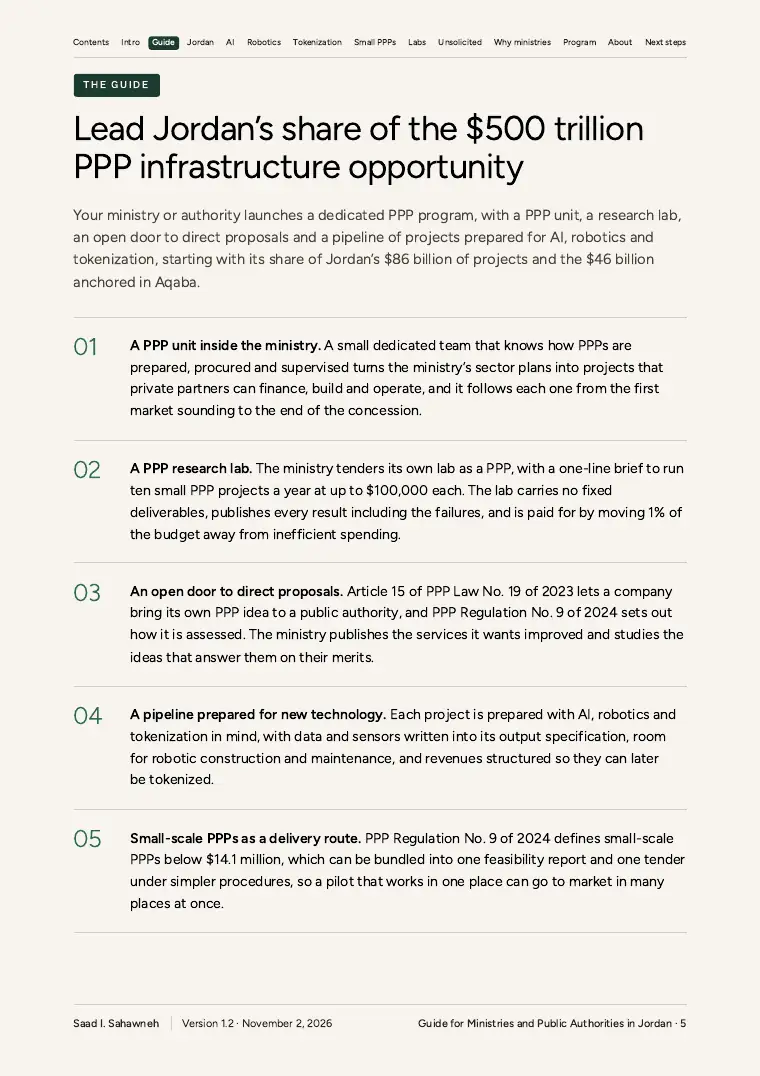
Lead Jordan’s share of the $500 trillion PPP infrastructure opportunity
Your ministry or authority launches a dedicated PPP program, with a PPP unit, a research lab, an open door to direct proposals and a pipeline of projects prepared for AI, robotics and tokenization, starting with its share of Jordan’s $86 billion of projects and the $46 billion anchored in Aqaba.
01
A PPP unit inside the ministry
A small dedicated team that knows how PPPs are prepared, procured and supervised turns the ministry’s sector plans into projects that private partners can finance, build and operate, and it follows each one from the first market sounding to the end of the concession.
02
A PPP research lab
The ministry tenders its own lab as a PPP, with a one-line brief to run ten small PPP projects a year at up to $100,000 each. The lab carries no fixed deliverables, publishes every result including the failures, and is paid for by moving 1% of the budget away from inefficient spending.
03
An open door to direct proposals
Article 15 of PPP Law No. 19 of 2023 lets a company bring its own PPP idea to a public authority, and PPP Regulation No. 9 of 2024 sets out how it is assessed. The ministry publishes the services it wants improved and studies the ideas that answer them on their merits.
04
A pipeline prepared for new technology
Each project is prepared with AI, robotics and tokenization in mind, with data and sensors written into its output specification, room for robotic construction and maintenance, and revenues structured so they can later be tokenized.
05
Small-scale PPPs as a delivery route
PPP Regulation No. 9 of 2024 defines small-scale PPPs below $14.1 million, which can be bundled into one feasibility report and one tender under simpler procedures, so a pilot that works in one place can go to market in many places at once.
Why ministries and public authorities
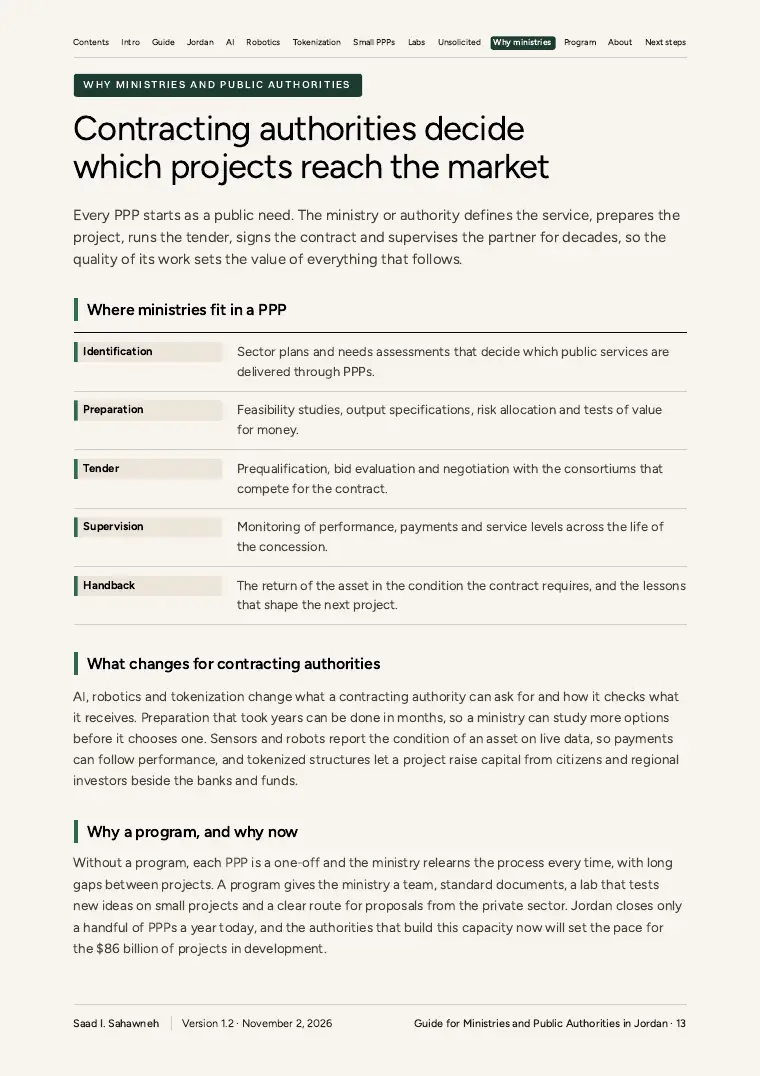
Contracting authorities decide which projects reach the market
Every PPP starts as a public need. The ministry or authority defines the service, prepares the project, runs the tender, signs the contract and supervises the partner for decades, so the quality of its work sets the value of everything that follows.
Where ministries fit in a PPP
- Identification
- Sector plans and needs assessments that decide which public services are delivered through PPPs.
- Preparation
- Feasibility studies, output specifications, risk allocation and tests of value for money.
- Tender
- Prequalification, bid evaluation and negotiation with the consortiums that compete for the contract.
- Supervision
- Monitoring of performance, payments and service levels across the life of the concession.
- Handback
- The return of the asset in the condition the contract requires, and the lessons that shape the next project.
What changes for contracting authorities
AI, robotics and tokenization change what a contracting authority can ask for and how it checks what it receives. Preparation that took years can be done in months, so a ministry can study more options before it chooses one. Sensors and robots report the condition of an asset on live data, so payments can follow performance, and tokenized structures let a project raise capital from citizens and regional investors beside the banks and funds.
Why a program, and why now
Without a program, each PPP is a one-off and the ministry relearns the process every time, with long gaps between projects. A program gives the ministry a team, standard documents, a lab that tests new ideas on small projects and a clear route for proposals from the private sector. Jordan closes only a handful of PPPs a year today, and the authorities that build this capacity now will set the pace for the $86 billion of projects in development.

Futureproofing
Futureproof Ministries and Public Authorities in Jordan for the infrastructure singularity
This free 18-page guide shows how, with small PPPs in parallel, PPP research labs, artificial intelligence, robotics, tokenization and six first steps.

Jordan and Aqaba
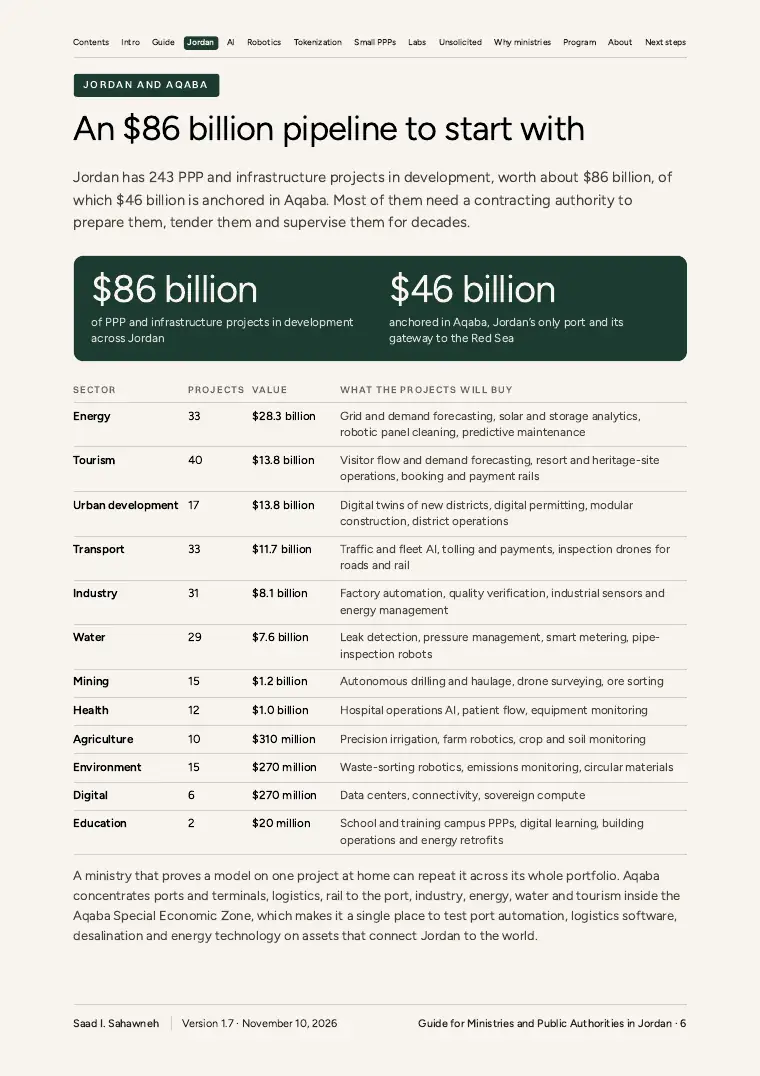
An $86 billion pipeline to start with
Most of them need a contracting authority to prepare them, tender them and supervise them for decades. A ministry that proves a model on one project at home can repeat it across its whole portfolio.
- $86B
- of PPP and infrastructure projects in development in Jordan
- $46B
- of them anchored in Aqaba

Artificial intelligence
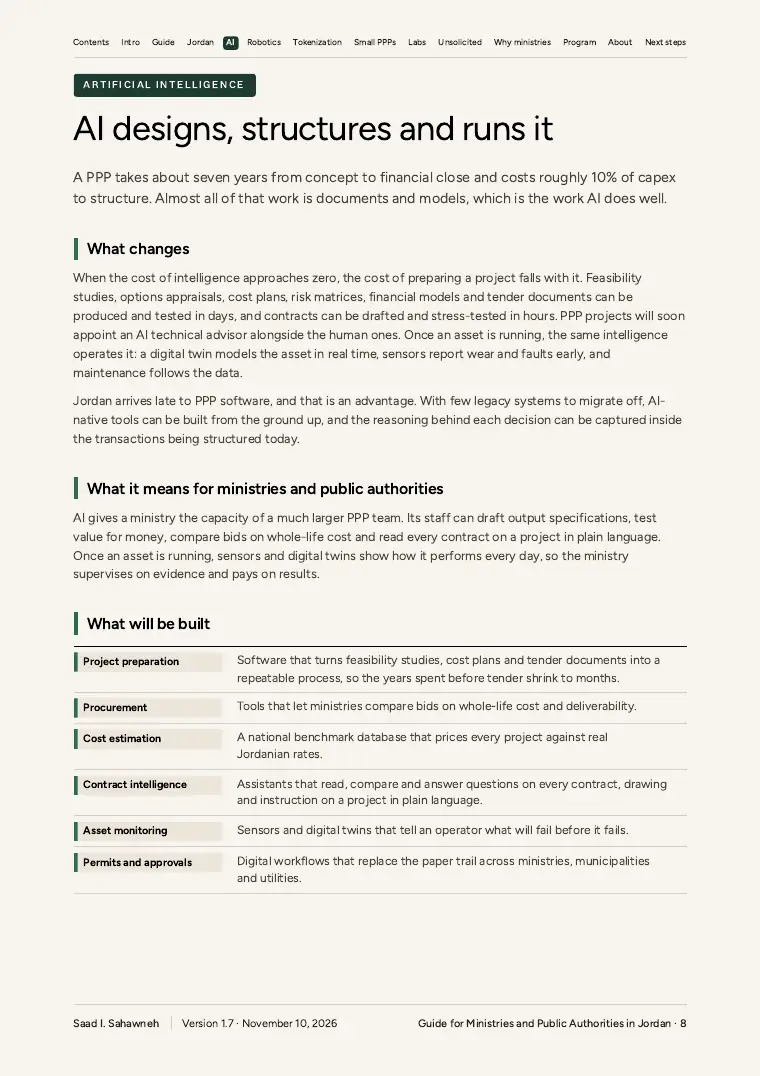
AI gives a ministry the capacity of a much larger PPP team. Its staff can draft output specifications, test value for money, compare bids on whole-life cost and read every contract on a project in plain language. Once an asset is running, sensors and digital twins show how it performs every day, so the ministry supervises on evidence and pays on results.

Robotics
Robotics changes what a ministry can ask for in a tender. Output specifications can require drone inspection, robotic leak detection and automated maintenance records, so performance is measured by machines and reported as data. A ministry that writes these requirements into its contracts receives assets that cost less to supervise and fail less often.

Tokenization
Tokenization gives a ministry a new way to finance projects and to share them with citizens. A project company can raise part of its capital from a few hundred investors and pay them from the asset’s own revenue, and a public registry can record contracts, milestones and payments for everyone to see, so Jordanians can own part of what is built for them.

Small PPPs and research labs
The lab sits inside the ministry, and the ministry writes its one-line brief. A small team can tender the lab as a PPP, set its guardrails, collect the data from each pilot and carry what works into the large projects in the pipeline, and every published result, including the failures, teaches the other contracting authorities as well.

Unsolicited proposals
Direct proposals bring a ministry ideas from companies that have already done the thinking at their own cost. The Ministry of Investment can charge the proposer a study fee for each review, and a qualifying proposal is listed in the national registry of public investment projects, while the tender still tests the idea against the market: the proposer can match the best offer, and the winning bidder pays the proposer’s direct study costs. A ministry that publishes the needs it wants solved receives proposals aimed at them.
The program
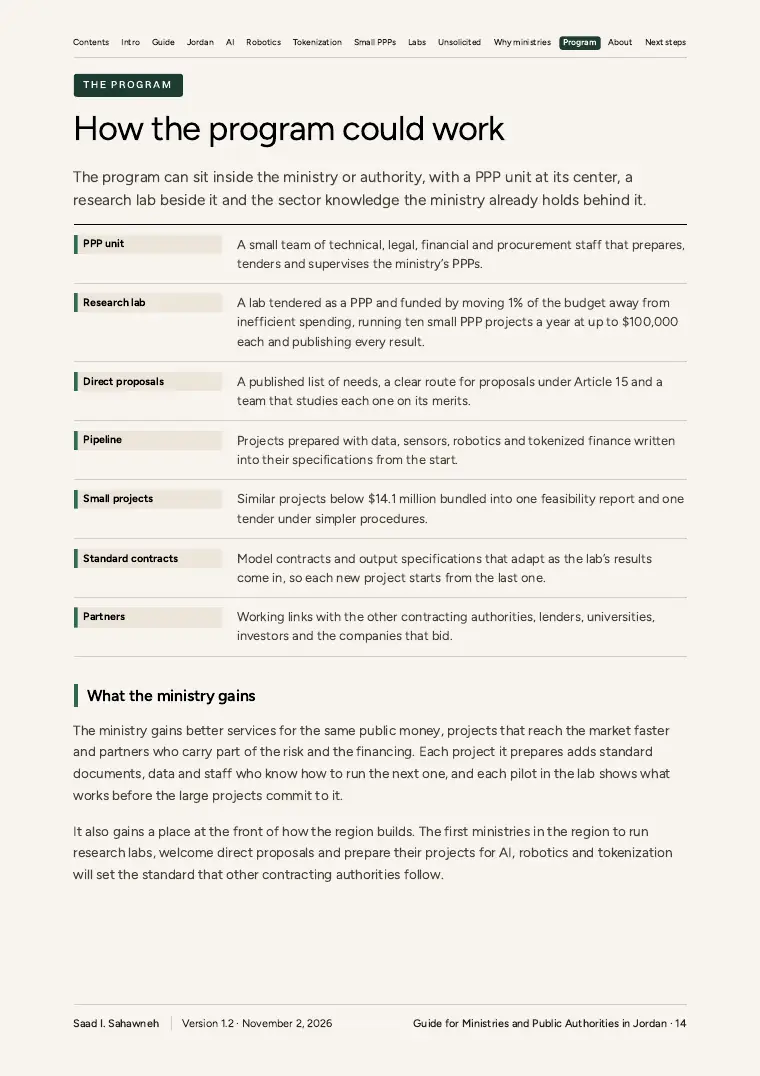
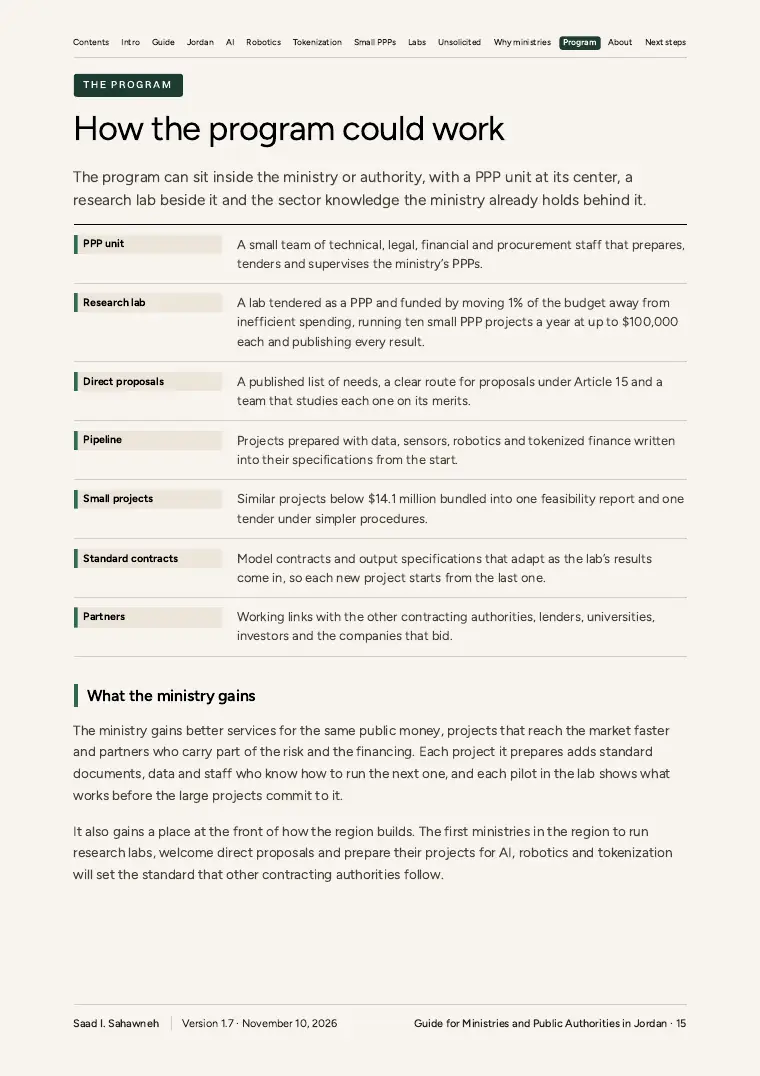
How the program could work
The program can sit inside the ministry or authority, with a PPP unit at its center, a research lab beside it and the sector knowledge the ministry already holds behind it.
- PPP unit
- A small team of technical, legal, financial and procurement staff that prepares, tenders and supervises the ministry’s PPPs.
- Research lab
- A lab tendered as a PPP and funded by moving 1% of the budget away from inefficient spending, running ten small PPP projects a year at up to $100,000 each and publishing every result.
- Direct proposals
- A published list of needs, a clear route for proposals under Article 15 and a team that studies each one on its merits.
- Pipeline
- Projects prepared with data, sensors, robotics and tokenized finance written into their specifications from the start.
- Small projects
- Similar projects below $14.1 million bundled into one feasibility report and one tender under simpler procedures.
- Standard contracts
- Model contracts and output specifications that adapt as the lab’s results come in, so each new project starts from the last one.
- Partners
- Working links with the other contracting authorities, lenders, universities, investors and the companies that bid.
What the ministry gains
The ministry gains better services for the same public money, projects that reach the market faster and partners who carry part of the risk and the financing. Each project it prepares adds standard documents, data and staff who know how to run the next one, and each pilot in the lab shows what works before the large projects commit to it.
It also gains a place at the front of how the region builds. The first ministries in the region to run research labs, welcome direct proposals and prepare their projects for AI, robotics and tokenization will set the standard that other contracting authorities follow.

Next steps
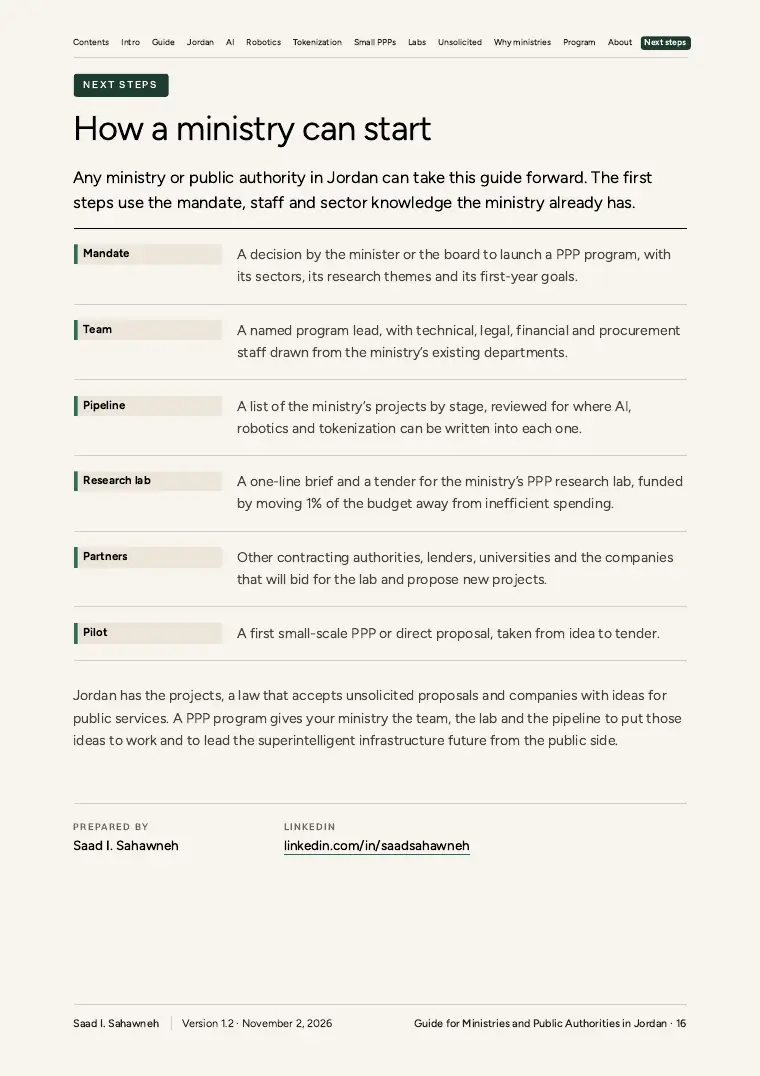
How a ministry can start
Any ministry or public authority in Jordan can take this guide forward. The first steps use the mandate, staff and sector knowledge the ministry already has.
01
Mandate
A decision by the minister or the board to launch a PPP program, with its sectors, its research themes and its first-year goals.
02
Team
A named program lead, with technical, legal, financial and procurement staff drawn from the ministry’s existing departments.
03
Pipeline
A list of the ministry’s projects by stage, reviewed for where AI, robotics and tokenization can be written into each one.
04
Research lab
A one-line brief and a tender for the ministry’s PPP research lab, funded by moving 1% of the budget away from inefficient spending.
05
Partners
Other contracting authorities, lenders, universities and the companies that will bid for the lab and propose new projects.
06
Pilot
A first small-scale PPP or direct proposal, taken from idea to tender.
Jordan has the projects, a law that accepts unsolicited proposals and companies with ideas for public services. A PPP program gives your ministry the team, the lab and the pipeline to put those ideas to work and to lead the superintelligent infrastructure future from the public side.
The full document
Inside this guide
Eighteen pages and fourteen chapters, from the case for a PPP program to the first steps, written for ministries and public authorities in Jordan.
- 18
- pages
- 14
- chapters
- 3
- technologies
- 6
- first steps
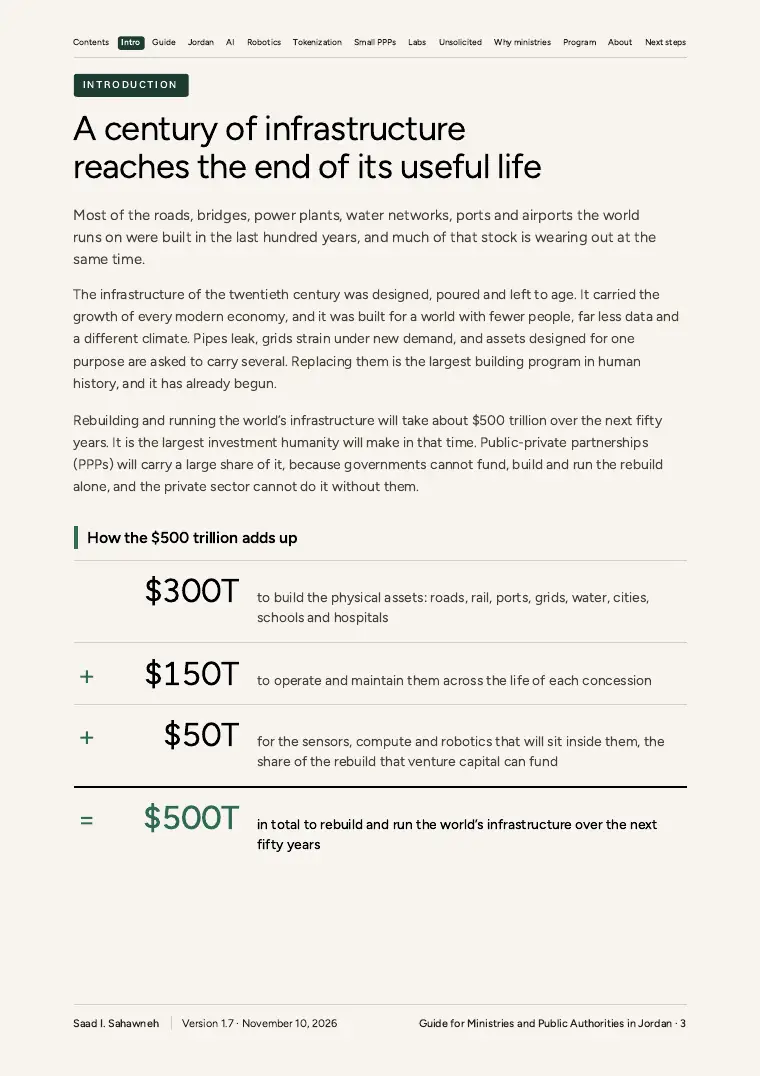
01Introduction
Why a century of infrastructure needs rebuilding, and the $500 trillion it will take.
Page 3 of 18
02The guide
Lead Jordan’s share of the $500 trillion PPP infrastructure opportunity
Page 5 of 18
03Jordan and Aqaba
An $86 billion pipeline to start with
Page 6 of 18
04Sector guides
The sectors closest to ministries and public authorities, each with its own guide.
Page 7 of 18
05Artificial intelligence
How AI designs, structures and runs PPP projects, and what it means for ministries and public authorities.
Page 8 of 18
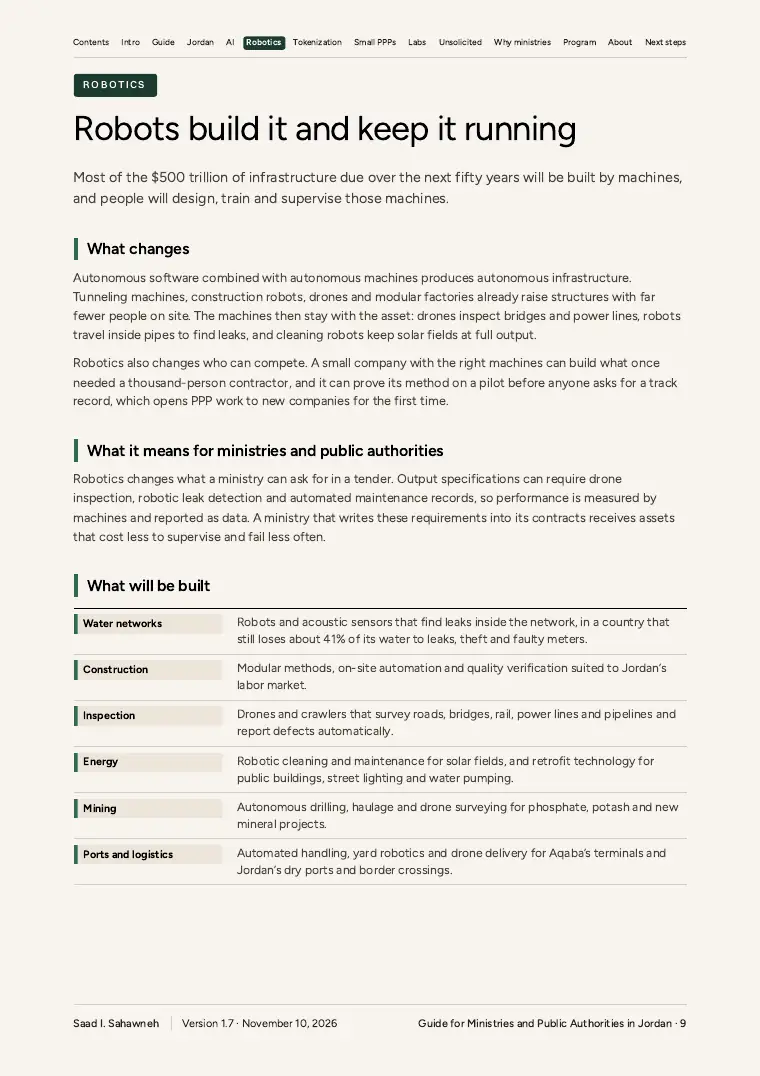
06Robotics
How robots build infrastructure and keep it running, and what that means for ministries and public authorities.
Page 9 of 18
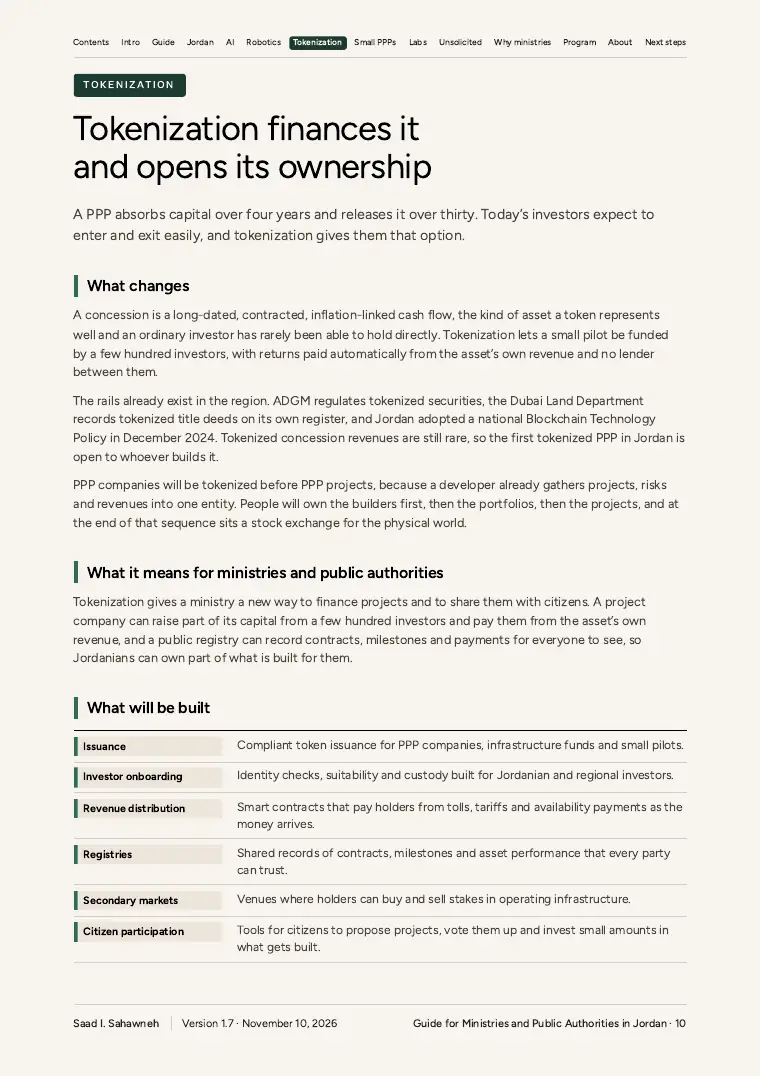
07Tokenization
How tokenization funds projects from their own revenue, and the role it opens for ministries and public authorities.
Page 10 of 18
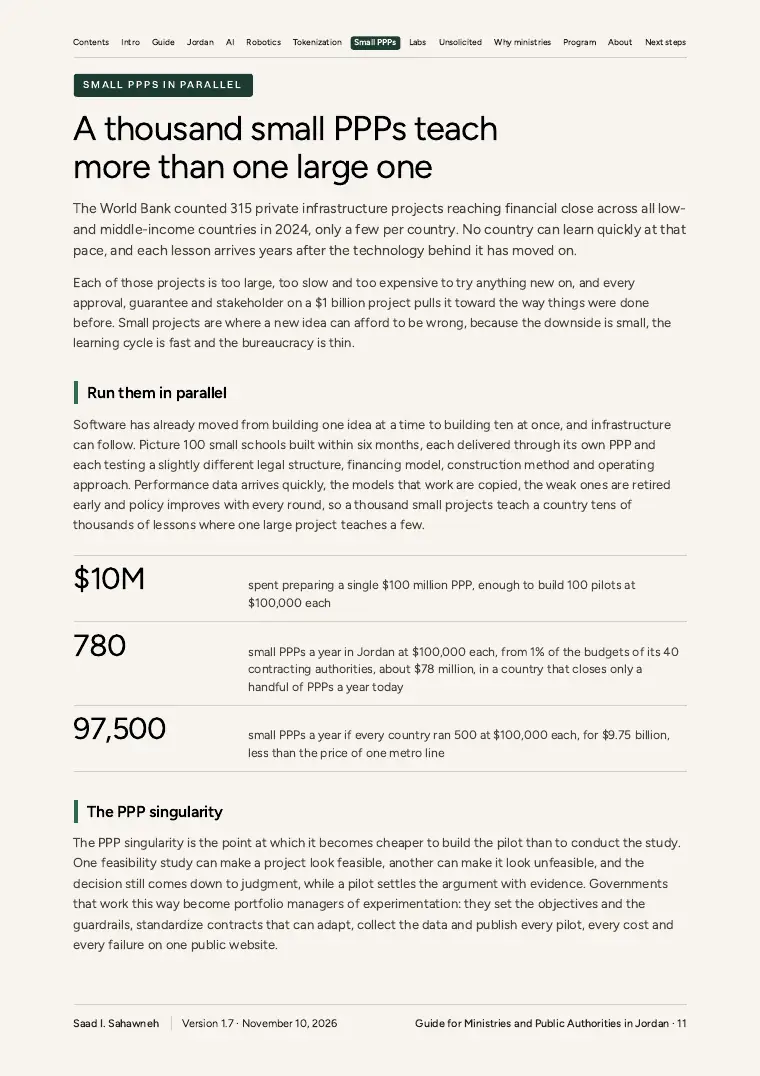
08Small PPPs in parallel
Why many small PPPs teach a country faster than a few large ones.
Page 11 of 18
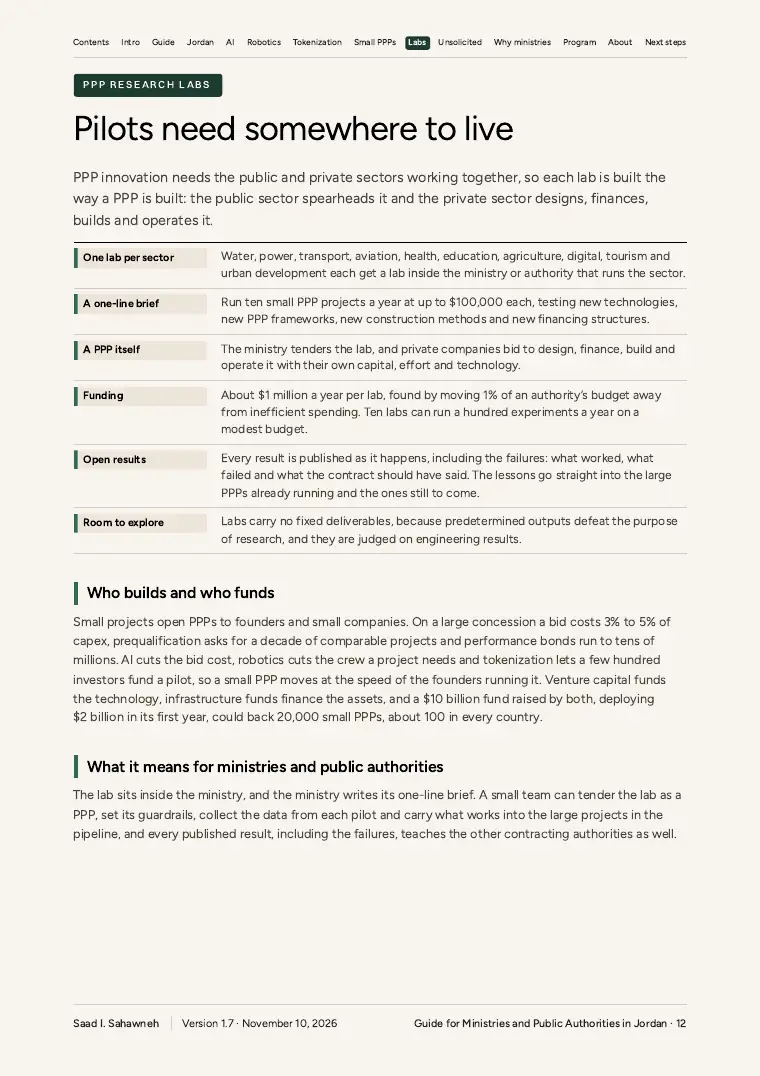
09PPP research labs
A lab in each sector, running ten small PPP projects a year.
Page 12 of 18
10Unsolicited proposals
How Jordan’s PPP law accepts direct proposals from private companies.
Page 13 of 18
11Why ministries and public authorities
Contracting authorities decide which projects reach the market
Page 14 of 18
12The program
The program can sit inside the ministry or authority, with a PPP unit at its center, a research lab beside it and the sector knowledge the ministry already holds behind it.
Page 15 of 18
13About
About Jordan PPP and what it offers.
Page 16 of 18
14Next steps
How a ministry can start: six first steps.
Page 17 of 18
Questions
Questions about the organization guide for Ministries and Public Authorities in Jordan
- What does the organization guide for Ministries and Public Authorities in Jordan propose?
- Your ministry or authority launches its own public-private partnership (PPP) program, with a research lab that runs small PPPs in parallel, an open door to direct proposals from the private sector and a pipeline of projects prepared for AI, robotics and tokenization.
- Why should ministries and public authorities in Jordan launch a PPP program?
- Contracting authorities decide which projects reach the market. Every PPP starts as a public need. The ministry or authority defines the service, prepares the project, runs the tender, signs the contract and supervises the partner for decades, so the quality of its work sets the value of everything that follows.
- Which PPP projects can ministries and public authorities in Jordan take part in?
- Jordan has about $86 billion of PPP and infrastructure projects in development, $46 billion of them anchored in Aqaba. Most of them need a contracting authority to prepare them, tender them and supervise them for decades. A ministry that proves a model on one project at home can repeat it across its whole portfolio.
- How can ministries and public authorities in Jordan start a PPP program?
- Any ministry or public authority in Jordan can take this guide forward. The first steps use the mandate, staff and sector knowledge the ministry already has. The organization guide sets out six first steps: mandate, team, pipeline, research lab, partners and pilot.
- What does a PPP program give ministries and public authorities in Jordan?
- The ministry gains better services for the same public money, projects that reach the market faster and partners who carry part of the risk and the financing. Each project it prepares adds standard documents, data and staff who know how to run the next one, and each pilot in the lab shows what works before the large projects commit to it.
- Is the organization guide for Ministries and Public Authorities in Jordan free?
- Yes. It is free to read on this page and free to download as an 18-page PDF, with the case for a PPP program, Jordan’s pipeline, the role of AI, robotics and tokenization, the program and six first steps.
Sector guides
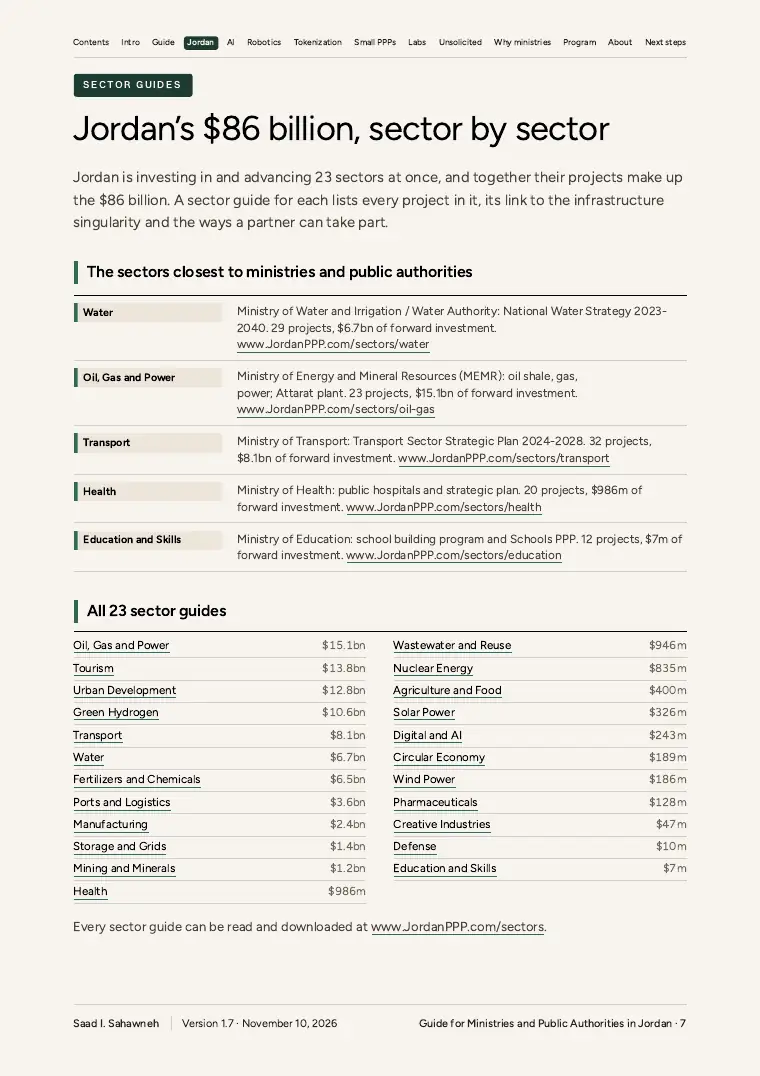
All 23 sectors run through ministries and public authorities
Jordan’s $86 billion is spread across 23 sectors. Each sector guide lists every project in it and shows how to take part.
 Water$6.7bnMinistry of Water and Irrigation / Water Authority: National Water Strategy 2023-204029 projects
 Oil, Gas and Power$15.1bnMinistry of Energy and Mineral Resources (MEMR): oil shale, gas, power; Attarat plant23 projects
 Transport$8.1bnMinistry of Transport: Transport Sector Strategic Plan 2024-202832 projects
 Health$986mMinistry of Health: public hospitals and strategic plan20 projects
 Education and Skills$7mMinistry of Education: school building program and Schools PPP12 projects
 Tourism$13.8bnMinistry of Tourism and Antiquities and Department of Antiquities56 projects
 Wastewater and Reuse$946mMWI Water Sector Policy for Wastewater Management and Reuse 202320 projects
 Solar Power$326mMEMR 200 MW solar PV direct-proposal round (2025)18 projects
 Green Hydrogen$10.6bnMEMR green hydrogen and ammonia MoUs and land agreements in Aqaba12 projects
 Mining and Minerals$1.2bnMEMR mineral resources and Natural Resources Directorate29 projects
 Agriculture and Food$400mMinistry of Agriculture: national agricultural plan and food security28 projects
 Digital and AI$243mMinistry of Digital Economy and Entrepreneurship: AI Strategy 2023-202719 projects
 Manufacturing$2.4bnMinistry of Industry, Trade and Supply: Industrial Policy 2024-202838 projects
 Fertilizers and Chemicals$6.5bnMinistry of Industry, Trade and Supply: chemical industries strategy 2027-202914 projects
 Ports and Logistics$3.6bnMinistry of Transport: regional logistics hub strategy23 projects
 Urban Development$12.8bnMinistry of Public Works and Housing / Housing and Urban Development Corporation30 projects
 Circular Economy$189mMinistry of Environment (Waste Management Framework Law) and Ministry of Local Administration22 projects
 Pharmaceuticals$128mJordan Food and Drug Administration: drug registration and GMP inspection10 projects
 Storage and Grids$1.4bnMinistry of Investment PPP Unit: pumped-water electricity storage tender25 projects
 Nuclear Energy$835mJordan Atomic Energy Commission: nuclear program, JRTR reactor, uranium6 projects
 Wind Power$186mEnergy and Minerals Regulatory Commission: generation licences for wind and solar10 projects
 Creative Industries$47mRoyal Film Commission, autonomous public body for the film industry14 projects
 Defense$10mMinistry of Investment lists UAV and components manufacturing at Al-Dhlail9 projects
Guide 4 of 96
Browse all 96 organization guides