Skip to content
Jordan PPP
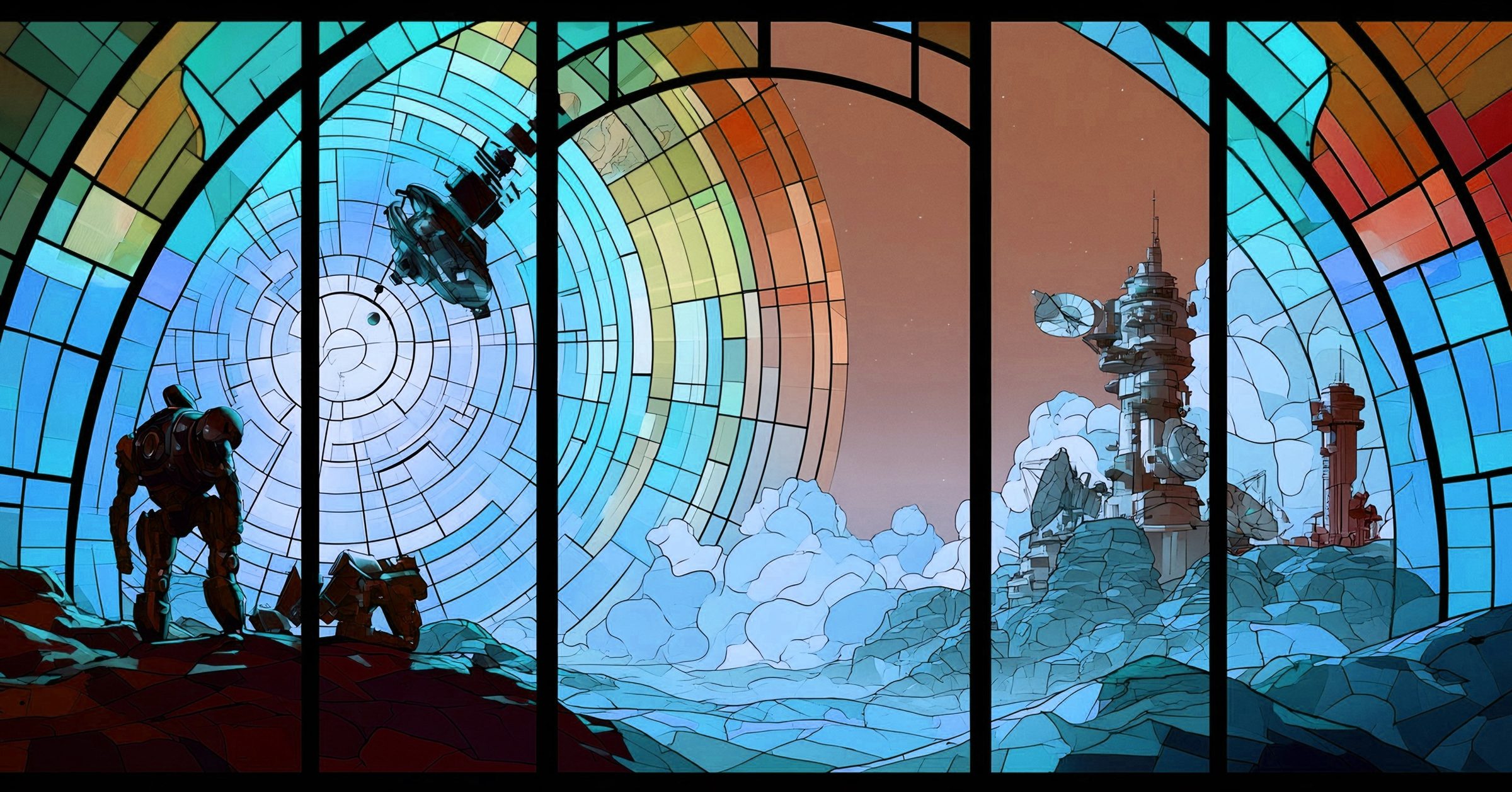
Stained-glass illustration in blue glass of a robot and towers at the dawn of the infrastructure singularity

Sector guide 09 of 22 · Version 1.1

Manufacturing in Jordan

Factories that learn, built where three continents meet.

Share
$2.4bn
forward investment in its own projects
38
projects in this guide
5
in or linked to Aqaba

The sector today

Manufacturing in Jordan

Manufacturing is the largest productive sector in Jordan's economy. It produced 16.6% of GDP in the first quarter of 2026, and industry as a whole drove about 40% of the country's growth. Industrial exports reached about US$12.5 billion in 2025, sold to more than 140 markets.

The base is broad. Chemicals and fertilizers, engineering goods and textiles each exported more than US$2.4 billion in 2025, food and pharmaceuticals add strong export lines, and more than 21% of the workforce is employed in the sector. Free trade agreements with the United States, Canada, Europe, the United Kingdom, Singapore and Arab countries give Jordanian factories duty-free access to many of the world's largest markets, and 14 development zones offer land, utilities and a 5% income tax rate.

The next phase is more advanced. In 2026 the Ministry of Investment offered investors plants for chip packaging, circuit boards, batteries and drone components, and electric vehicle and battery materials plants were prepared for the Jordan-EU Investment Conference. This guide sets out where the sector stands, the projects in the Jordan PPP project register, and the opportunities it opens as infrastructure moves towards the singularity.

$12.5bn
Jordan's industrial exports in 2025, up about 10% on 2024, according to Invest Jordan.
16.6%
Share of Jordan's GDP produced by manufacturing in the first quarter of 2026, the largest of any sector.
140+
Export markets reached by Jordanian industry, supported by free trade agreements with the US, Europe and the Arab world.
14
Development zones offering serviced land, a 5% income tax rate and exemptions on equipment and inputs.

The singularity

The factory becomes the machine that learns

The infrastructure singularity is the point where roads, grids, ports and water networks become one connected, intelligent system, built by robotics, run by artificial intelligence and financed by tokenization. Every part of that system has to be made somewhere, and the factories that make it are becoming intelligent systems themselves.

Artificial intelligence
Designs products, plans production and inspects every part with cameras, so a plant in Zarqa or Al-Dhlail can match the quality of the best factories in the world and adjust to new orders within hours.
Robotics
Robots weld, assemble, paint and move materials around the clock, lowering the cost of making complex products in Jordan and freeing engineers to run many lines at once.
Tokenization
Industrial estates, ready-built factories and long-term supply contracts produce steady income. Tokenized stakes let more investors own part of a plant and share in its output.
Compute hardware
Chips, circuit boards, antennas and batteries are the physical layer of artificial intelligence. Packaging and testing them in Jordan puts the country inside the supply chain of the singularity.
Materials
Jordan's silica, basalt, copper and phosphate by-products can feed glass, cables, fibres and battery materials made in its own industrial zones.

Flagship projects

The projects that lead the sector

  • Under way · Al Quweira, Aqaba

    Al Quwairah International Industrial Estate

    A 1.8 million m² estate north of Aqaba developed under a 2013 joint development agreement with ASEZA and the Aqaba Development Corporation. Phase 1 infrastructure is complete, and a natural gas station opened in July 2026 to supply factories with lower-cost energy.

  • Under way · Al-Qatrana, Karak

    Al-Qatrana Chinese Industrial Cluster

    A cluster led by China's Jinsheng International Group, with about US$830 million invested since 2022. The Prime Minister inaugurated six factories in May 2026 and directed that the site become a development zone, with land set aside for about 40 plants.

  • Pipeline · Al-Dhlail

    Semiconductor Manufacturing

    A back-end line to assemble, test and package chips in the Industrial Gate Free Zone. It leads a set of priority opportunities offered by the Ministry of Investment in February 2026, alongside circuit boards, batteries, antennas and drone components.

  • Pipeline · Quweira, Aqaba

    Welspun Perma-Pipe Steel Pipe Plant

    A spiral steel pipe and coating plant approved by the Cabinet in August 2026, with half of its output for the National Water Carrier and about 420 jobs. Welspun's board approved up to US$125 million in October 2026, shared about equally with Perma-Pipe.

  • Open opportunity · Development zone

    Electric Vehicle Assembly Plant

    A proposed plant to assemble up to 15,000 electric cars a year from imported kits, starting with small urban models and adding compact crossovers. It is one of the opportunities prepared for the Jordan-EU Investment Conference on November 19, 2026.

  • Delivered · Zarqa

    Zarqa Green Industrial Estate

    Jordan's first green industrial estate, with a JD35 million first phase of serviced plots and ready-built factories, solar power, EV charging and recycling. The full estate targets about 530 companies and more than 21,000 jobs.

Every project

38 projects in Jordan’s pipeline

Values in US dollars; * estimated where no figure has been published. Rows in grey sit in another sector and connect to this one.

ProjectLocationStageValue
Al Quwairah International Industrial Estate (QIIE)Al Quweira, AqabaUnder way$1bn
Al-Qatrana Chinese Industrial Cluster (Jinsheng International)Al-QatranaUnder way$830m
Semiconductor ManufacturingIndustrial Gate Free ZonePipeline$200m*
Welspun-Perma-Pipe Steel Pipe Plant (Quweira)Quweira Industrial Zone, ASEZAPipeline$125m
Automotive Wire Harness Manufacturing PlantIndustrial estate in Amman GovernorateOpen opportunity$55m*
Metal Forging FacilityIndustrial Gate Free ZonePipeline$40m*
Metal Casting FacilityIndustrial Gate Free ZonePipeline$40m*
Electric Vehicle Assembly PlantDesignated development zone in JordanOpen opportunity$29m*
Vanadium Battery Materials Manufacturing PlantJIEC industrial estate, JordanOpen opportunity$29m*
Applied Plastic Industries Non-Woven ExpansionJordanUnder way$20m
Printed Circuit Boards (PCBs) Manufacturing FacilityIndustrial Gate Free ZonePipeline$15m*
Batteries for Wireless & Electronic DevicesIndustrial Gate Free ZonePipeline$10m*
UAV & Components ManufacturingIndustrial Gate Free ZonePipeline$10m*
Garment Factory (Wadi Musa)Wadi MusaOpen opportunity$10m*
Garment Manufacturing & Tailoring FactorySafawi, Mafraq GovernorateOpen opportunity$10m*
Production Units in the Governorates (Vocational & Technical Training)Various governoratesPipeline$8m*
Communication Antennas & RF CablesIndustrial Gate Free ZonePipeline$8m*
Zarqa Green Industrial Estate (Phase 1)Zarqa, about 30 km from AmmanDelivered$49m
Aqaba-Amman Water Desalination & Conveyance Project (AAWDCP)Aqaba to AmmanAwarded$5.8bn
Silica SandSouthern Jordan: Ras En NaqbPipeline$200m*
Amman Logistics and Industrial City (ALIC)South of AmmanPipeline$167m*
Aqaba-Ma'an Dry Port & Development ZoneMa'an Development Zone, Ma'anPipeline$150m*
Investing in Basalt (Tall Burma)Tall BurmaPipeline$120m*
Al-Shams 100 MW Industrial Solar PlantAl-Madouna area, AmmanUnder way$99m*
Muwaqqar & Al-Rawda Industrial Cities Gas Supply LinesAl-MuwaqqarUnder way$70m
Eco-Industrial Park, Ba'oun Development AreaBa'oun, Ajloun GovernoratePipeline$60m*
Basalt Exploration & Industrial Products (Harrat Ash Sham)Harrat Ash Sham basalt plateau, Mafraq aOpen opportunity$40m*
Advanced Data Center (Al-Dhlail Free Zone)Industrial Gate Free ZonePipeline$40m*
Neonatal Incubator Manufacturing PlantIndustrial development zone in JordanOpen opportunity$29m*
Jordan Methanol Manufacturing PlantIndustrial zone in JordanOpen opportunity$29m*
Biosimilar Fill-Finish Manufacturing PlantJIEC industrial zoneOpen opportunity$29m*
Oncology API Manufacturing PlantDevelopment zone in JordanOpen opportunity$29m*
Al Muwaqqar Food Processing ComplexAl Muwaqqar Industrial EstateAwarded$28m
Irbid Development Zone InfrastructureIrbid Development Zone, IrbidUnder way$23m
Southern Ghor Agro-Industrial Development Zone (Ghor Al-Mazra'a & Al-Haditha)Ghor Al-Mazra'a and Al-Haditha, SouthernUnder way$20m
Circular Footwear Design (Plastic & Leather Waste)AmmanOpen opportunity$10m*
Rainwater Harvesting in Industrial EstatesBalqa, Madaba, Tafilah, ZarqaOpen opportunity$10m*
Sahab Industrial Wastewater Treatment PlantKing Abdullah II Industrial City, Sahab,Pipeline$8.5m

AI, robotics and tokenization

What changes for Jordan's manufacturing sector

Artificial intelligence

In Jordan's factories AI turns production data into decisions. Vision systems inspect every part, models plan production across shifts and suppliers, and predictive maintenance keeps lines running. For export plants it means meeting the quality and traceability that buyers in the United States and Europe require at lower cost, and for the estates it means one model that plans power, gas, water and logistics for every tenant.

What can be built

  • Quality vision. Camera inspection that checks every weld, garment, circuit board or casting on the line and records the result for export buyers.
  • Production planning. AI that schedules orders, materials and machines across one plant or a group of plants sharing an estate.
  • Estate digital twin. A live model of an industrial estate's power, gas, water and traffic, used to plan new tenants and cut utility costs.
  • Generative design. Tools that design lighter parts, molds and packaging, ready for casting, forging or 3D printing in Jordan.
More on artificial intelligence

Robotics

Robotics lets Jordanian plants compete on precision and speed as well as cost. Welding cells, pick-and-place lines and automated warehouses raise output per worker, and collaborative robots let small factories automate one step at a time. The same machines open products that need clean, exact assembly, such as circuit boards, chip packages, battery packs and drone parts, which the Al-Dhlail free zone now offers to investors.

What can be built

  • Robotic welding. Automated cells for steel pipe, structures and vehicle frames, starting with the water carrier and rail programs.
  • Electronics assembly. Surface-mount and test lines for circuit boards, antennas and chip packages in the free zones.
  • Automated warehouses. Robotic storage and picking that serves several factories from one shared building in an estate.
  • Additive manufacturing. 3D printing centers making spare parts, tooling and short runs on demand for industry and builders.
More on robotics

Tokenization

A factory on a long lease, a ready-built unit in an estate or a long-term contract to supply pipe or cable pays a steady income, which is what tokenization suits. Industrial estates and plants in Jordan could offer tokenized stakes to investors at home and abroad, paid from rent and sales, so a new production line is financed by many small holders as well as by banks.

What can be built

  • Ready-built factories. Tokenized ownership of standard factory units in development zones, paid from the rent that tenants pay.
  • Supply contracts. Tokens backed by long-term contracts to supply pipe, cable or components to national projects.
  • Equipment finance. Machines and robots financed by tokens and repaid from the output they produce.
  • Estate utilities. Shared solar, gas and water reuse inside an estate, owned through tokens and paid by every tenant.
More on tokenization

Start small, or bring your own idea

Small PPPs and unsolicited proposals

Small PPPs and research labs

A manufacturing research lab, hosted by the Ministry of Industry, Trade and Supply with JIEC, would test new methods inside working estates. Pilots of about $100,000 each could include a robotic welding cell for pipe fittings, an AI vision station shared by the garment and food plants of a governorate production unit, and a rooftop solar and battery microgrid on a ready-built factory, each measured and published within a year.

How it works

Unsolicited proposals under Article 15

A manufacturer can bring its own project to government under Article 15. Examples include a shared gas, solar and water reuse utility for an industrial estate, a robotic maintenance center for public bus and rail fleets, a plant making pipes and fittings for municipal water networks under a long-term supply PPP, and ready-built factory units in a governorate development zone leased to new tenants.

How it works

New industries

What the sector can create

  1. 01Chip packaging and testingBack-end semiconductor lines and circuit board plants that serve the region's electronics, telecom and data center builders.
  2. 02Electric vehicles and batteriesAssembly of electric cars, buses and light vehicles, with battery packs and wire harnesses made in the same zones.
  3. 03Drones and autonomous systemsAirframes, motors and control systems for drones used in farming, inspection, logistics and security.
  4. 04Robotic micro-factoriesSmall automated plants and 3D printing centers that make parts on demand for industry, hospitals and builders.
  5. 05Advanced materialsBasalt fibre, rock wool, specialty glass and vanadium battery materials made from Jordan's own minerals and by-products.
  6. 06Infrastructure componentsPipes, cables, transformers, sensors and modular units for the water, energy and transport projects of the region.

Opportunities

Where partners come in

Listed opportunities
Take up the plants offered on Invest Jordan and at the Jordan-EU Investment Conference, from chips and batteries to electric vehicles and wire harnesses.
Development zones
Build in JIEC estates, free zones or the Aqaba Special Economic Zone and use the incentives of the Investment Environment Law.
Direct proposals
Propose shared industrial infrastructure under Article 15 of PPP Law No. 19 of 2023, such as gas, solar, water reuse or logistics for an estate.
Small-scale PPPs
Regulation No. 9 of 2024 allows small-scale PPPs below about US$14.1 million, which suits ready-built factories and production units in the governorates.
Supply to major projects
Make pipes, cables, steel and components locally for the National Water Carrier, the rail network and new power plants.
Investment and ownership
Finance estates and plants through development banks, industrial funds and tokenized stakes that open ownership to more investors.
Stained-glass illustration in blue glass of a city of towers under a rising arch

The road to the singularity

  1. 2026Chip, battery and drone plants offered to investors; Qatrana becomes a development zone; Zarqa's green estate opens to tenants.
  2. 2030Jordan packages chips, assembles electric vehicles and makes pipe for the National Water Carrier in its own zones.
  3. 2035Most new plants run on solar and gas at lower cost; AI plans production across the industrial estates.
  4. 2040Robotic factories make parts on demand for the region's infrastructure, built and maintained with little manual work.
  5. 2050Jordan is a regional workshop for the singularity, exporting chips, machines, materials and the know-how to run them.

Jordan already makes and sells to more than 140 markets. The projects in this guide are the first steps towards factories that learn, and towards a country that builds the hardware of the coming economy.

Guides for organizations

Launch a PPP program of your own

The guides closest to Jordan's manufacturing sector, each showing one kind of organization how to launch a PPP program, with six first steps.

  • Economic sectors

    Manufacturing Companies

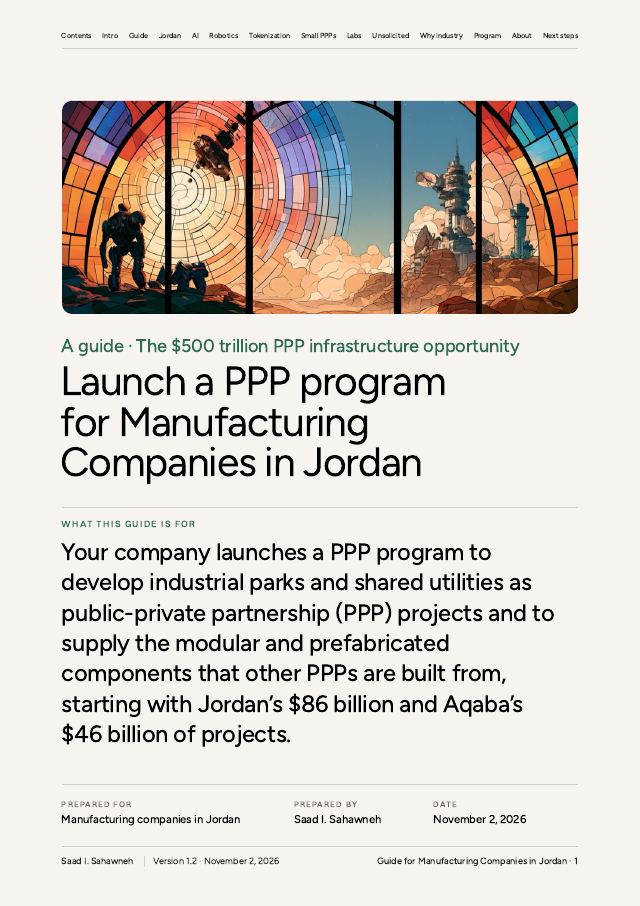
    Your company launches a PPP program to develop industrial parks and shared utilities as public-private partnership (PPP) projects and to supply the modular and prefabricated components that other PPPs are built from.

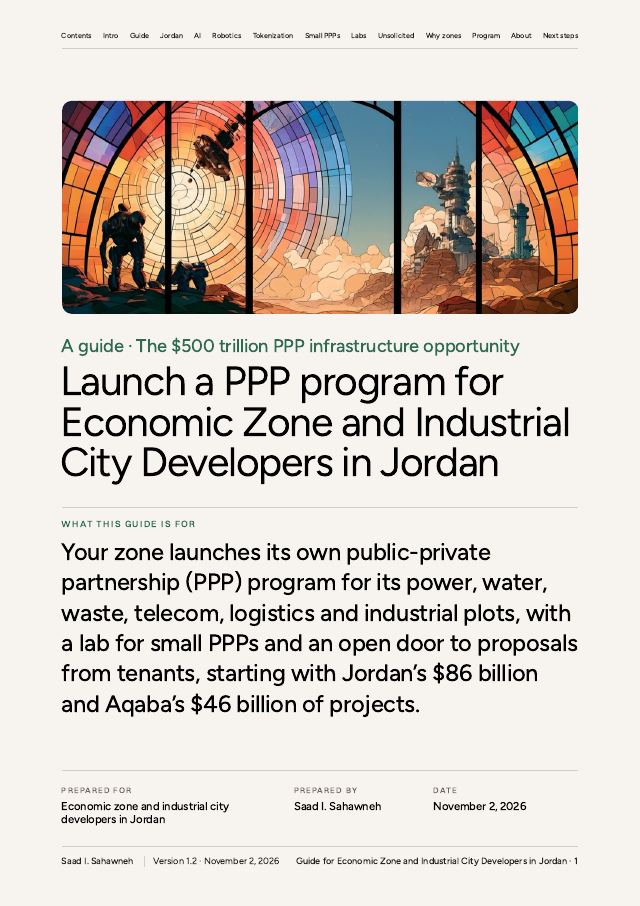
  • Your zone launches its own public-private partnership (PPP) program for its power, water, waste, telecom, logistics and industrial plots, with a lab for small PPPs and an open door to proposals from tenants.

  • Technology and knowledge

    Robotics Companies

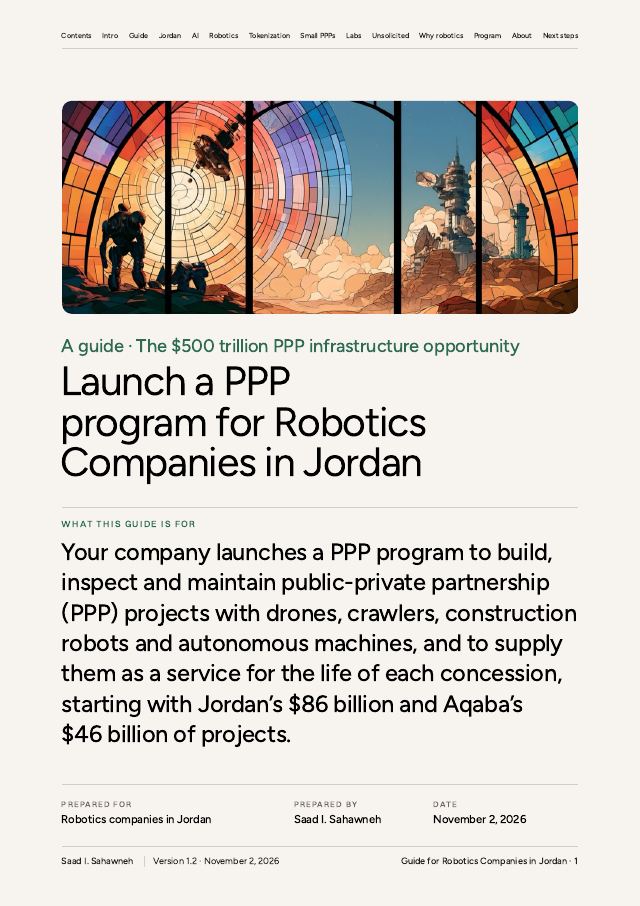
    Your company launches a PPP program to build, inspect and maintain public-private partnership (PPP) projects with drones, crawlers, construction robots and autonomous machines, and to supply them as a service for the life of each concession.

  • Technology and knowledge

    Technology Companies

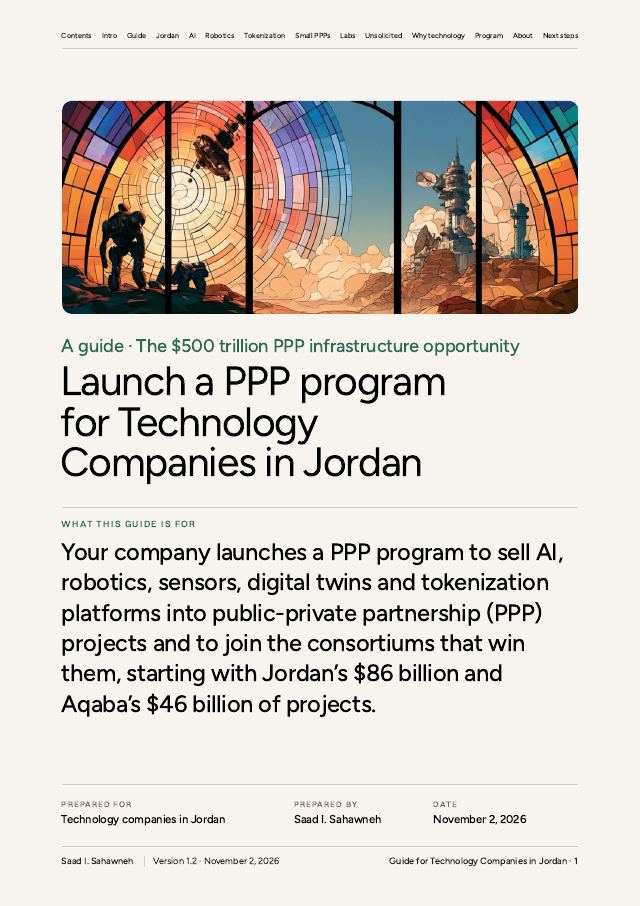
    Your company launches a PPP program to sell AI, robotics, sensors, digital twins and tokenization platforms into public-private partnership (PPP) projects and to join the consortiums that win them.

See every guide and sector on one map