Skip to content
Jordan PPP
Stained-glass illustration in blue glass of a robot and towers at the dawn of the infrastructure singularity

Sector guide 18 of 22 · Version 1.1

Circular Economy in Jordan

Waste as the raw material of a self-renewing country.

Share
$189m
forward investment in its own projects
22
projects in this guide
1
in or linked to Aqaba

The sector today

Circular Economy in Jordan

Jordan produces at least 10,000 tonnes of solid waste every day, about half of it in Amman, and most of it still goes to landfill. For a country with few natural resources and scarce water, that waste is one of the largest untapped stocks of energy, metals, plastics, nutrients and building materials it has.

The shift has started. Gas from the Ghabawi landfill east of Amman has supplied power to the city for years, and an EBRD, EU and Green Climate Fund package approved in December 2025 is capping a full cell to capture more. In Irbid, a EUR 40 million EU grant is turning Jordan's second-largest landfill into an engineered site with leachate treatment and gas capture.

The next phase is recovery at scale. Producer responsibility rules, sorting plants and a new list of investment opportunities are turning waste into biochar, fish feed, bricks, recovered metals and power. This guide sets out where the sector stands, the projects in the Jordan PPP project register, and the opportunities it opens as infrastructure moves towards the singularity.

10,000 t
Solid waste produced across Jordan every day, about half of it in Amman, according to the Ministry of Environment.
6.28 MW
Power capacity from landfill gas at Ghabawi after a fourth engine was installed in 2026, covering about 55% of GAM's electricity bills.
150,000 t
Carbon dioxide a year that the Ghabawi landfill upgrades financed in 2025 are expected to avoid.
EUR 40m
EU grant rebuilding the Al-Ekaider landfill in Irbid, which receives about 1,500 tonnes of waste a day.

The singularity

Waste is the mine of the singularity

The infrastructure singularity is the point where roads, grids, ports and water networks become one connected, intelligent system, built by robotics, run by artificial intelligence and financed by tokenization. A system that builds at that scale needs materials, and the cheapest mine a city has is the waste it already collects.

Artificial intelligence
Recognises materials on sorting lines, plans collection routes from bin sensors and tracks every tonne from kerb to recycler, so the value in waste can be measured and traded.
Robotics
Sorting robots pick plastics, metals and electronics faster and more safely than hand sorting, and dismantle panels and devices for parts.
Tokenization
Landfill gas plants, recycling lines and verified carbon savings produce steady revenue. Tokenized stakes and credits let more investors own a share.
Materials
Recovered metals, glass, silicon and aggregates feed the solar plants, data centers and buildings of the next decades.
Energy
Methane from landfills, digesters and sewage becomes power and heat, and efficient street lighting cuts what municipalities spend on electricity.

Flagship projects

The projects that lead the sector

  • Under way · Irbid

    Al-Ekaider Landfill Rehabilitation

    The EU-funded rebuilding of Jordan's second-largest landfill, which serves 33 municipalities in Irbid, Jerash, Ajloun and Mafraq. New sanitary cells over more than 200 dunums, leachate treatment and gas capture replace the old dump. The first engineered cell was handed over in September 2026, with completion expected in May 2027.

  • Under way · Ghabawi, east of Amman

    Ghabawi Landfill Gas to Energy

    Greater Amman Municipality captures landfill methane to make power. Cell 5, filled with about 6.7 million tonnes of waste by 2023, is being capped and connected with EBRD, Green Climate Fund and EU support, and a fourth engine installed from July 2026 lifts capacity to 6.28 MW.

  • Pipeline · Amman

    GAM Waste-to-X

    A Greater Amman Municipality opportunity listed on Invest Jordan for material recovery facilities and waste-to-energy and waste-to-product projects that cut the volume sent to landfill and lower emissions. It is the largest circular project in the Jordan PPP project register, at about US$50 million.

  • Delivered · Ghabawi

    Ghabawi Material Recovery Facility

    Amman's only official material recovery facility, sorting about 600 tonnes of mixed waste a day next to the Ghabawi landfill. A private operator runs it under a 15-year build-operate-transfer contract, after which it passes to the municipality, a model for the next generation of sorting plants.

  • Open opportunity · Sahab

    Stone-Cutting Slurry Reuse

    The expansion of an existing slurry recycling plant in Sahab Industrial City. Three more filter presses would raise processing from 900 to 1,710 cubic metres a day, recovering water and solids, and a new line would turn the solids into bricks and curbstones.

  • Under way · Amman

    Amman LED Street Lighting

    Under a 2017 agreement, an investor replaced Amman's street lights with LEDs and is paid over eight years, cutting the energy they use by about half. About 125,000 units were changed by 2021, and 32,500 smart units on main streets and in tunnels are now being linked to a central control system.

Every project

22 projects in Jordan’s pipeline

Values in US dollars; * estimated where no figure has been published. Rows in grey sit in another sector and connect to this one.

ProjectLocationStageValue
GAM Waste-to-XAmmanPipeline$50m*
Al-Ekaider Landfill RehabilitationAl-Ekaider landfillUnder way$49m
Ghabawi Landfill LFG-to-Energy (Cells 4 & 5)GhabawiUnder way$13m
Circular Footwear Design (Plastic & Leather Waste)AmmanOpen opportunity$10m*
Agricultural Waste to BiocharAmmanOpen opportunity$10m*
Food Waste to Fish FeedJerash, MafraqOpen opportunity$10m*
Biogas from Organic WasteBalqaOpen opportunity$10m*
Solar PV Module Recycling & ReuseAjlounOpen opportunity$10m*
Stone-Cutting Slurry ReuseSahab Industrial City, AmmanOpen opportunity$10m*
E-Waste Refurbishing & Raw Material RecoveryZarqaOpen opportunity$10m*
Food Factory Waste to Animal FeedJordanOpen opportunity$7m*
Tadweer Material Recovery Facility (Ghabawi MRF)GhabawiDelivered$40m*
Amman LED Street Lighting (GAM)AmmanUnder way$50m
Jerash and Kufranja Wastewater Biogas Power ProjectWastewater treatment plants at West JeraPipeline$34m
Zibar Wastewater Project (Olive-Mill Waste-to-Value)Near Irbid cityPipeline$15m*
EV Charging Station & Maintenance CenterBalqaOpen opportunity$10m*
Rainwater Harvesting in Industrial EstatesBalqa, Madaba, Tafilah, ZarqaOpen opportunity$10m*
Greywater ReuseBalqaOpen opportunity$10m*
South Jordan Street Lighting (KbW)14 villages, southern JordanUnder way$9m*
Sahab Industrial Wastewater Treatment PlantKing Abdullah II Industrial City, Sahab,Pipeline$8.5m
As-Samra Wastewater Treatment Plant (Phases 1 & 2)As-SamraDelivered$374m*
Zarqa Green Industrial Estate (Phase 1)Zarqa, about 30 km from AmmanDelivered$49m

AI, robotics and tokenization

What changes for Jordan's circular economy

Artificial intelligence

Much of the value in Jordan's waste is lost because it is mixed and unmeasured. AI can change that. Cameras on sorting lines identify plastics, metals and paper as they pass, sensors in bins and trucks show where waste is produced, and models predict landfill gas yields and leachate. Municipalities can then pay partners by the tonne recovered and follow every tonne from collection to recycler.

What can be built

  • Smart sorting. Camera and AI systems on sorting lines at Ghabawi and new facilities that grade every material stream as it passes.
  • Collection routing. Bin and truck sensors with AI routing that cut fuel use and missed pickups across municipalities.
  • Landfill gas forecasting. Models that predict methane yields at Ghabawi and Al-Ekaider and schedule gas engines for the most power.
  • Waste tracking. A digital record of every tonne from source to recycler, the basis for fair producer responsibility fees.

More on artificial intelligence

Robotics

Sorting waste by hand is slow, dirty and dangerous. Robotic arms guided by AI can pick plastics, metals and cartons from moving belts at high speed, while dismantling robots take apart old phones, laptops and solar panels for their parts. Jordan's e-waste, slurry and solar recycling opportunities suit this automation, and the same machines can serve sorting plants across the region.

What can be built

  • Robotic picking. AI-guided arms on sorting lines in Amman, Irbid and Zarqa that recover more material at higher purity.
  • Device dismantling. Robots that take apart phones, laptops and screens at e-waste plants for reuse and metal recovery.
  • Panel recycling. Automated lines that separate glass, aluminium, silicon and silver from retired solar panels for new uses.
  • Landfill operations. Autonomous compactors and survey drones that map landfill cells, find gas leaks and monitor leachate.
More on robotics

Tokenization

Circular projects earn several revenue streams at once: gate fees, power sales, recovered materials and carbon credits. Each can be measured and recorded, which suits tokens well. Tokenized stakes in a landfill gas plant or a sorting facility would let Jordanian savers and investors share in its income, and verified carbon savings from Ghabawi and Al-Ekaider could be issued as traceable credits.

What can be built

  • Plant stakes. Tokenized shares in landfill gas, biogas and sorting plants, paid from gate fees and power sales.
  • Carbon credits. Traceable credits for methane captured and waste diverted from landfill, verified by sensors on site.
  • Material passports. Digital records of recovered metals and plastics that prove their origin and grade to buyers.
  • Producer credits. Tradable recycling credits that help producers and importers meet their packaging obligations.
More on tokenization

Start small, or bring your own idea

Small PPPs and unsolicited proposals

Small PPPs and research labs

Small PPPs below about US$14.1 million fit most circular projects, which start at the scale of one market, one factory or one landfill cell. A circular lab, led by the Ministry of Environment or a municipality with private partners, could run $100,000 pilots such as a biogas digester at a vegetable market, an AI sorting module at a transfer station, or a solar panel repair line, and publish the results.

How it works

Unsolicited proposals under Article 15

A company that sees value in a waste stream can propose the project itself under Article 15. Ideas include a regional biogas plant for slaughterhouse and market waste, a sorting and composting concession for a joint services council, construction waste recycling for Amman, gas capture at another municipal landfill, and a smart LED street lighting program paid from the energy savings.

How it works

New industries

What the sector can create

  1. 01Urban miningRecovering copper, aluminium, precious metals and rare materials from old electronics, cables and batteries for local factories and export.
  2. 02Solar and battery recyclingTaking apart retired panels and batteries to recover glass, silicon, silver and lithium for new plants across the region.
  3. 03Biogas and biomethaneDigesters at markets, slaughterhouses, farms and treatment plants making gas for power, heat and transport.
  4. 04Biochar and soil carbonTurning farm and organic waste into biochar that improves dry soils, holds water and stores carbon with verified credits.
  5. 05Circular building materialsBricks, curbstones and aggregates made from stone slurry, demolition waste and recovered glass for Jordan's construction boom.
  6. 06Robotic sorting servicesJordanian companies that design, run and maintain AI sorting lines for municipalities and industrial estates across the region.

Opportunities

Where partners come in

Municipal PPPs
Partner with Greater Amman Municipality and joint services councils on sorting plants, waste-to-energy and landfill gas, alone or in consortiums with lenders.
Direct proposals
Propose a project under Article 15 of PPP Law No. 19 of 2023, such as a regional biogas plant or an energy-efficient lighting program for municipalities.
Small-scale PPPs
Regulation No. 9 of 2024 allows small-scale PPPs below about US$14.1 million, which suits digesters, sorting lines and transfer stations.
Listed opportunities
Take up Ministry of Investment opportunities in biochar, biogas, fish feed, animal feed, footwear, e-waste and solar panel recycling, with Investment Environment Law incentives.
Producer responsibility
Build the collection and recycling networks that producers and importers need to meet their packaging obligations.
Investment and ownership
Finance plants through infrastructure funds, development banks, carbon credits and tokenized stakes that open ownership to more investors.
Stained-glass illustration in blue glass of a city of towers under a rising arch

The road to the singularity

  1. 2026Ghabawi adds a fourth gas engine; Al-Ekaider's first engineered cell opens; circular opportunities offered to investors.
  2. 2030Packaging producer responsibility covers most of the market; biogas, biochar and slurry plants are running.
  3. 2035AI sorting lines serve every large city; solar panels and batteries are recycled at home; landfill gas powers municipalities.
  4. 2040Robots sort and dismantle most waste; recovered materials feed Jordan's factories and construction.
  5. 2050Waste is a raw material: Jordan recovers almost everything it uses and exports recycled materials and know-how.

Jordan has few mines and little water, yet its cities produce thousands of tonnes of materials every day. The projects in this guide are the first steps towards a country that recovers that value and builds its future from it.

Guides for organizations

Launch a PPP program of your own

The guides closest to Jordan's circular economy, each showing one kind of organization how to launch a PPP program, with six first steps.

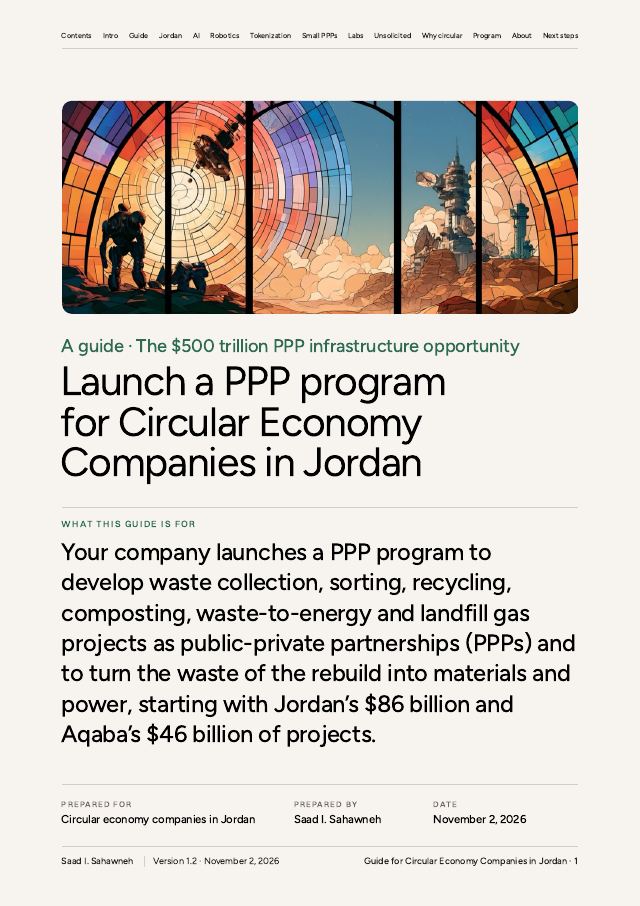
  • Your company launches a PPP program to develop waste collection, sorting, recycling, composting, waste-to-energy and landfill gas projects as public-private partnerships (PPPs) and to turn the waste of the rebuild into materials and power.

  • Economic sectors

    Green Economy Companies

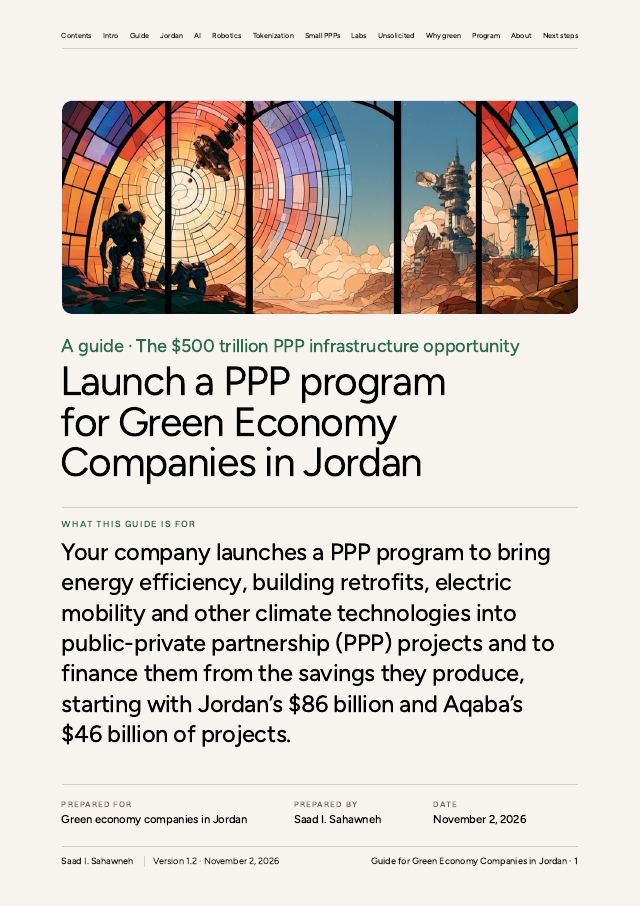
    Your company launches a PPP program to bring energy efficiency, building retrofits, electric mobility and other climate technologies into public-private partnership (PPP) projects and to finance them from the savings they produce.

  • Public sector

    Municipalities

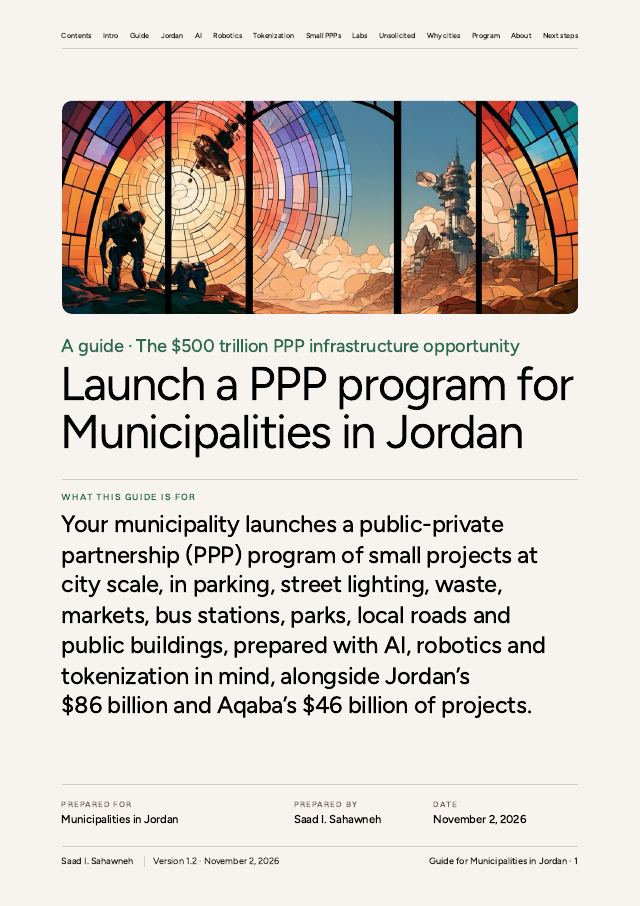
    Your municipality launches a public-private partnership (PPP) program of small projects at city scale, in parking, street lighting, waste, markets, bus stations, parks, local roads and public buildings, prepared with AI, robotics and tokenization in mind.

  • Operators and services

    Utilities and Operators

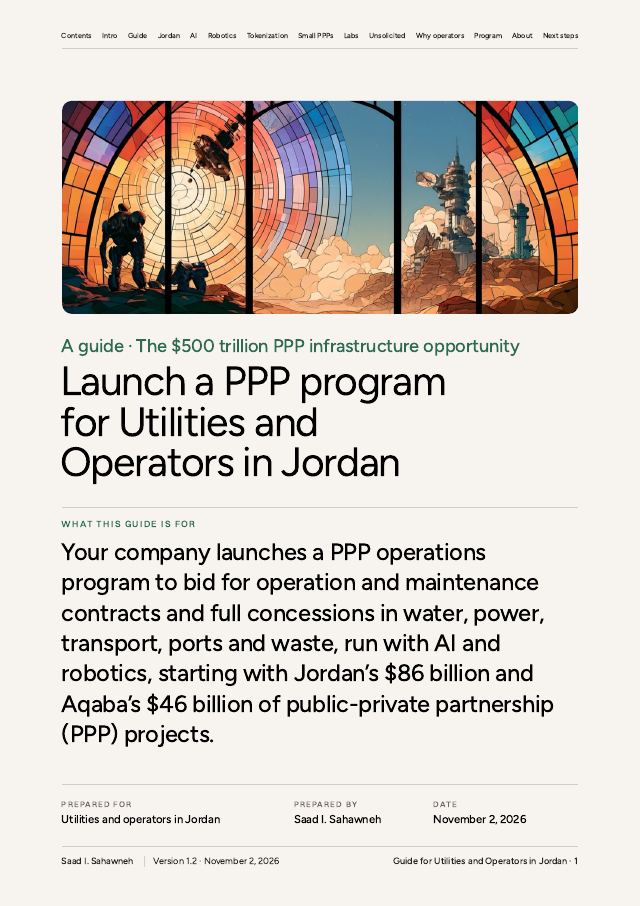
    Your company launches a PPP operations program to bid for operation and maintenance contracts and full concessions in water, power, transport, ports and waste, run with AI and robotics.

See every guide and sector on one map