What this organization guide is for
Your company launches a PPP development arm that moves it from builder to developer and equity partner in public-private partnership (PPP) projects, with robotics and modular construction as its edge.
The case
Contractors turn a PPP contract into a working asset
Construction absorbs most of the capital spent on a typical PPP, and the builder usually hands the asset over at completion while the sponsors keep the decades of revenue that follow. Contractors that build a development arm now will share in that revenue on the projects of the next fifty years. This guide invites contractors in Jordan to build one, starting with the projects at home.
The guide
Build and own the $500 trillion PPP infrastructure opportunity
Your company launches a PPP development arm, a team with its own mandate and capital that bids for projects as a developer and equity partner, delivers them as the EPC contractor and stays on through operation, starting with Jordan’s $86 billion of projects and the $46 billion anchored in Aqaba.
01
A development arm
A dedicated team with its own mandate, a budget for bid costs and a pool of equity takes stakes in project companies, so your company earns a return across the life of each concession on top of the margin on the build.
02
EPC plus O&M
The arm pairs your construction business with an operation and maintenance capability, in-house or through a partner, so each bid gives the contracting authority one team accountable for the design, the build and the asset’s performance over decades.
03
Small-scale PPPs and direct proposals
Jordan’s PPP Regulation No. 9 of 2024 defines small-scale PPPs below $14.1 million, which can be bundled into one feasibility report and one tender, and PPP Law No. 19 of 2023 accepts direct private proposals under Article 15. Your company can bring its own projects to government and grow a portfolio of small concessions it builds and runs.
04
Robotics and modular construction as the edge
Modular factories, construction robots and drones let your company build faster and to a more certain cost, which lowers the construction risk that sponsors and lenders price into every bid.
05
Partners for capital
Infrastructure funds and banks bring most of the equity and debt in a PPP. Standing partnerships with them let your company join a consortium with a small equity share and grow it as each project reaches operation.
Why contractors
Contractors turn a PPP contract into a working asset
A PPP is paid for by the service an asset delivers, so the project earns nothing until the asset is built. Sponsors bring the equity and lenders bring the debt, while the contractor carries the build, its schedule and its cost.
Where contractors fit in a PPP
- Bid
- Cost plans, construction schedules, methods and price certainty that make a consortium’s bid credible to the contracting authority and its lenders.
- Equity
- A minority stake in the project company that aligns the builder with the sponsors and earns a return across the concession.
- Construction
- A fixed-price, date-certain EPC contract with performance guarantees, backed by the contractor’s supply chain and subcontractors.
- Operation
- Operation and maintenance contracts, lifecycle works and handback, which keep the builder’s people and machines on the asset for decades.
- Exit
- Sale of the construction-phase stake to long-term investors once the asset is earning, which releases equity for the next bid.
What changes for contractors
AI, robotics and tokenization change what a contractor can offer a consortium and what it can own. AI tools price and schedule a bid in days, robotic and modular methods narrow the gap between the price in the bid and the asset as built, and site sensors carry the builder’s data into operation. Tokenized stakes let a contractor hold equity in a project and recycle it from each finished asset into the next bid.
Why a development arm, and why now
Without a development arm, a contractor waits for sponsors to choose it and competes on price for the build alone. A development arm lets your company shape projects, bring its own proposals and sit in the consortium from the first market sounding, when the terms of the build are set. Jordan’s pipeline is large and early, and the contractors who join consortiums as they form will build and co-own the projects that follow.

Futureproofing
Futureproof Contractors in Jordan for the infrastructure singularity
This free 18-page guide shows how, with small PPPs in parallel, PPP research labs, artificial intelligence, robotics, tokenization and six first steps.
Jordan and Aqaba
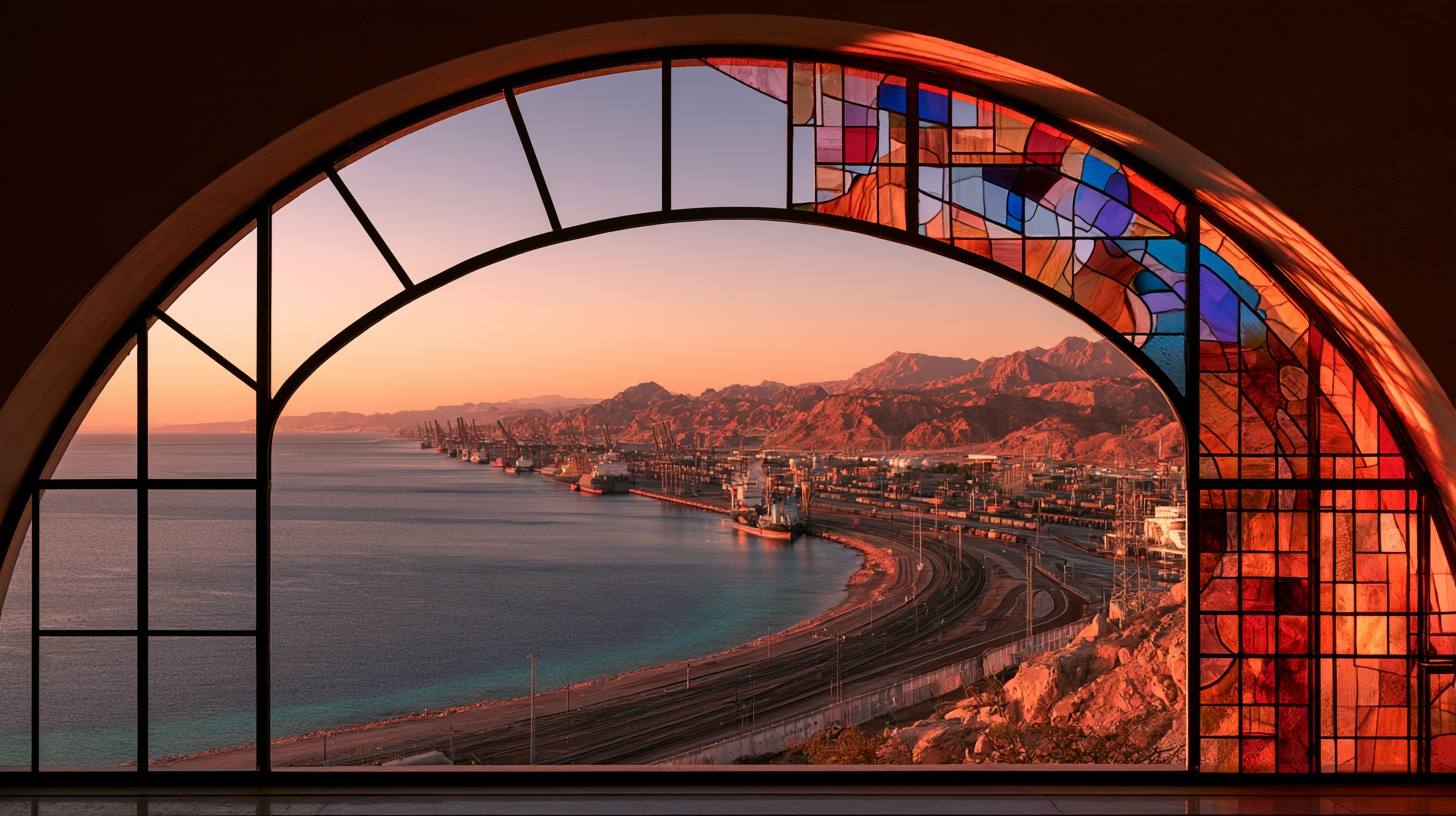
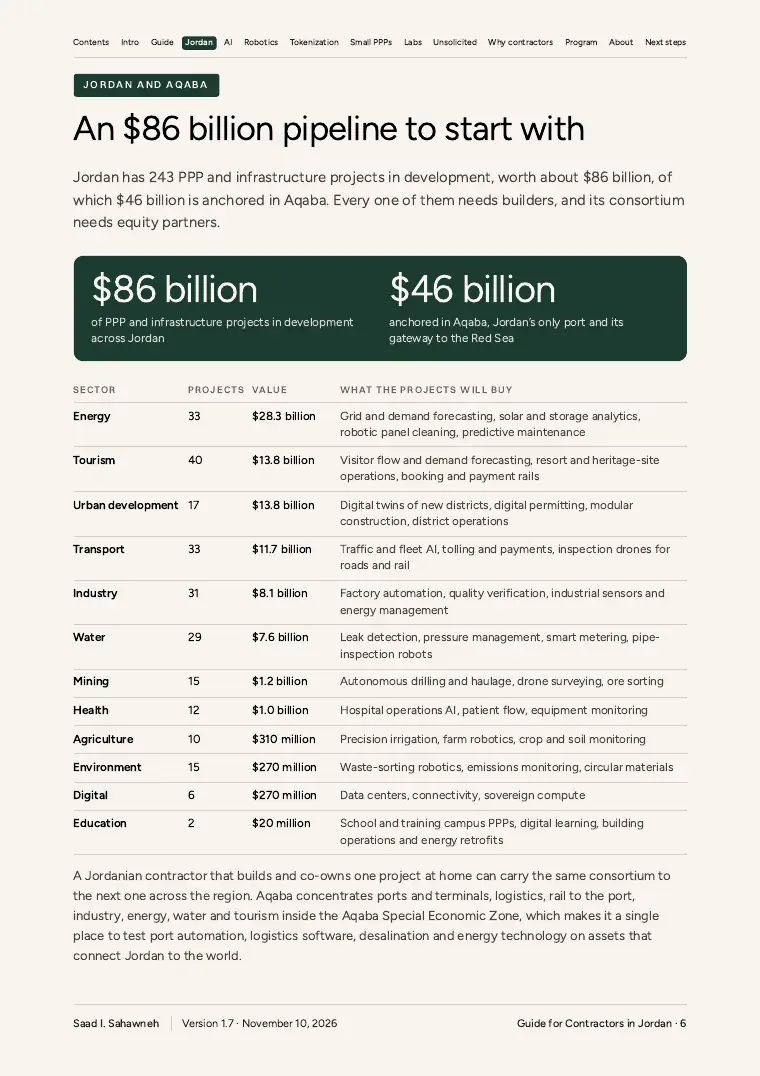
An $86 billion pipeline to start with
Every one of them needs builders, and its consortium needs equity partners. A Jordanian contractor that builds and co-owns one project at home can carry the same consortium to the next one across the region.
- $86B
- of PPP and infrastructure projects in development in Jordan
- $46B
- of them anchored in Aqaba

Artificial intelligence
AI lets a contractor price, plan and bid like a developer. A small team can read a tender and its contract, build a cost plan and a construction schedule, and test a financial model in days, so your company can bid on more projects for less. The same tools track progress on site and, once the asset is running, feed the digital twin that guides its maintenance.

Robotics
Robotics is the edge a contractor brings to a consortium. Construction robots, modular factories and drones shorten the build and make its cost more predictable, which lowers the risk that lenders and sponsors price. The same machines can stay with the asset for inspection and maintenance, which turns a construction contract into an operation and maintenance contract that runs for decades.

Tokenization
Tokenization gives a contractor a new way to fund its equity in a project and to recycle it. Your company can raise its share of a small concession from a wider pool of investors, sell part of its stake in an operating asset as tokens once construction risk has passed, and put the proceeds into the next bid.

Small PPPs and research labs
Small PPPs are the lowest-risk way for a contractor to become a developer. A Jordanian contractor can design, finance, build and operate a pilot with its own crews and equipment, test modular methods and robotics on a live asset and arrive at the large concessions with operating data its competitors only hold on paper.

Unsolicited proposals
A contractor that waits for tenders competes on price for work someone else designed. A direct proposal lets it bring a project it has already costed and planned, lead the consortium as a developer and keep the right to match the best offer if the project goes to tender.
The program
How the program could work
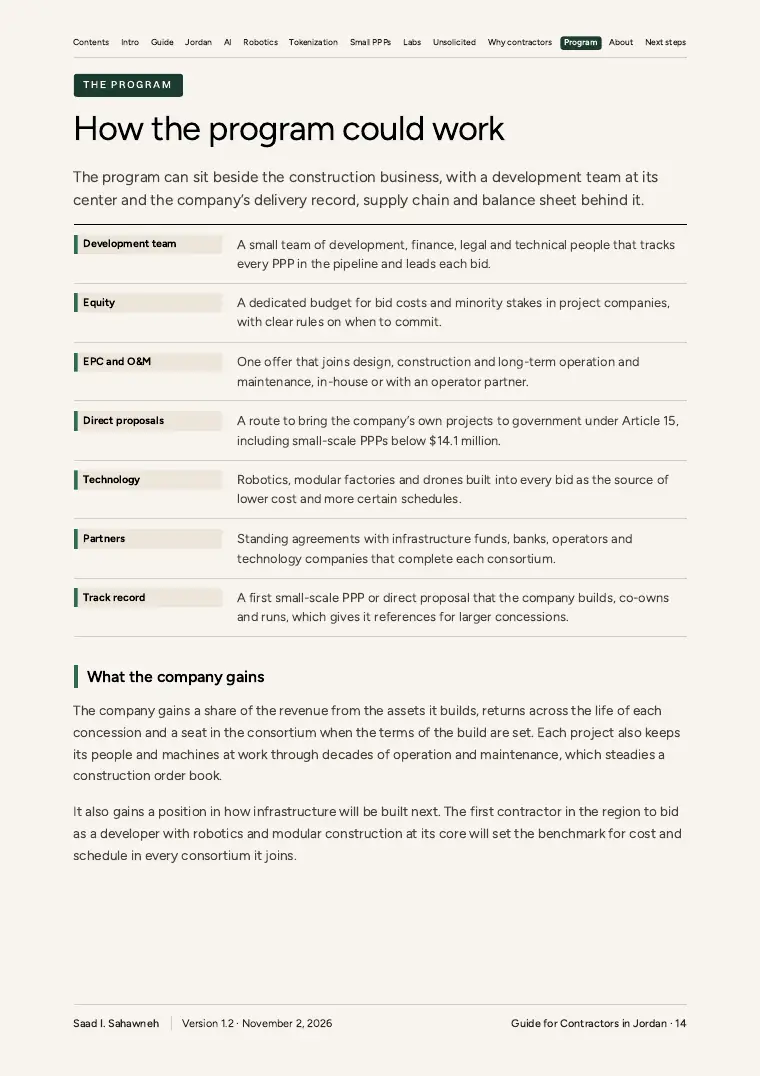
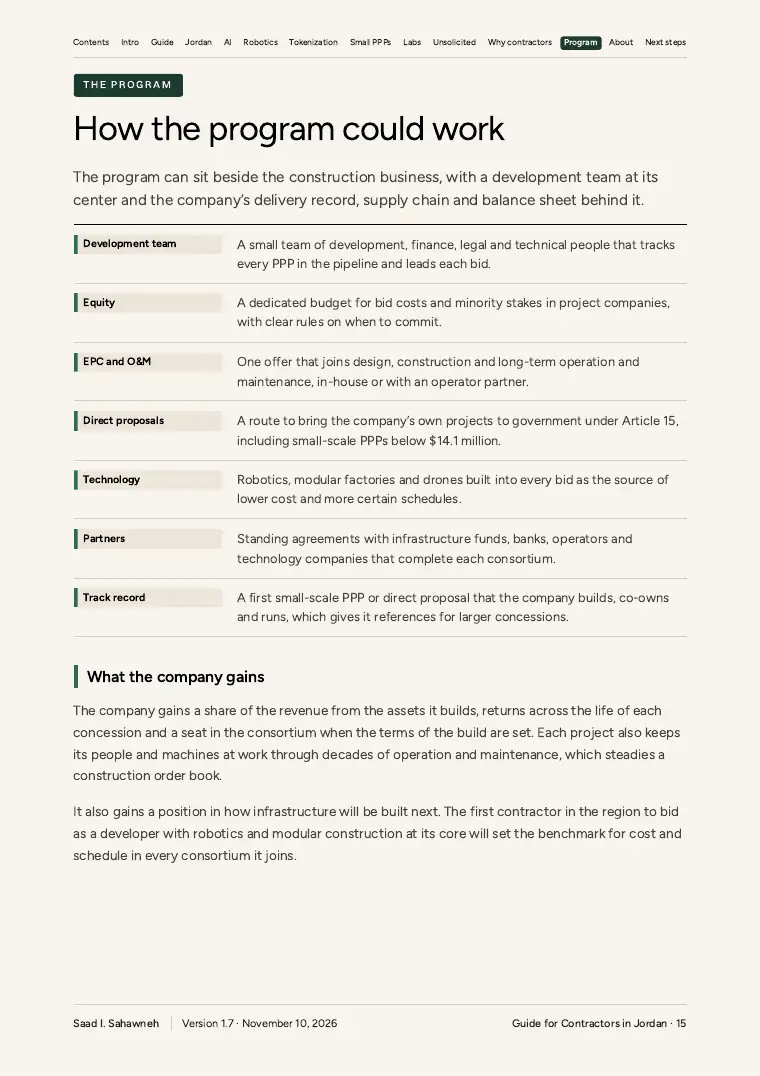
The program can sit beside the construction business, with a development team at its center and the company’s delivery record, supply chain and balance sheet behind it.
- Development team
- A small team of development, finance, legal and technical people that tracks every PPP in the pipeline and leads each bid.
- Equity
- A dedicated budget for bid costs and minority stakes in project companies, with clear rules on when to commit.
- EPC and O&M
- One offer that joins design, construction and long-term operation and maintenance, in-house or with an operator partner.
- Direct proposals
- A route to bring the company’s own projects to government under Article 15, including small-scale PPPs below $14.1 million.
- Technology
- Robotics, modular factories and drones built into every bid as the source of lower cost and more certain schedules.
- Partners
- Standing agreements with infrastructure funds, banks, operators and technology companies that complete each consortium.
- Track record
- A first small-scale PPP or direct proposal that the company builds, co-owns and runs, which gives it references for larger concessions.
What the company gains
The company gains a share of the revenue from the assets it builds, returns across the life of each concession and a seat in the consortium when the terms of the build are set. Each project also keeps its people and machines at work through decades of operation and maintenance, which steadies a construction order book.
It also gains a position in how infrastructure will be built next. The first contractor in the region to bid as a developer with robotics and modular construction at its core will set the benchmark for cost and schedule in every consortium it joins.

Next steps
How a contractor can start
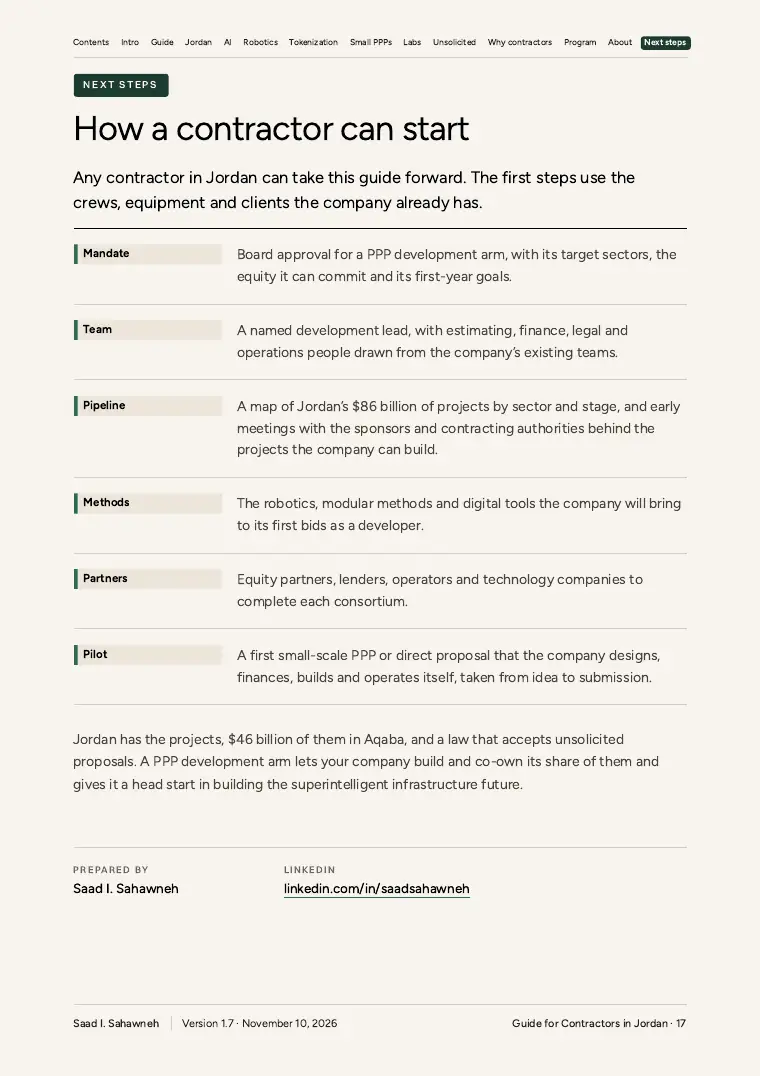
Any contractor in Jordan can take this guide forward. The first steps use the crews, equipment and clients the company already has.
01
Mandate
Board approval for a PPP development arm, with its target sectors, the equity it can commit and its first-year goals.
02
Team
A named development lead, with estimating, finance, legal and operations people drawn from the company’s existing teams.
03
Pipeline
A map of Jordan’s $86 billion of projects by sector and stage, and early meetings with the sponsors and contracting authorities behind the projects the company can build.
04
Methods
The robotics, modular methods and digital tools the company will bring to its first bids as a developer.
05
Partners
Equity partners, lenders, operators and technology companies to complete each consortium.
06
Pilot
A first small-scale PPP or direct proposal that the company designs, finances, builds and operates itself, taken from idea to submission.
Jordan has the projects, $46 billion of them in Aqaba, and a law that accepts unsolicited proposals. A PPP development arm lets your company build and co-own its share of them and gives it a head start in building the superintelligent infrastructure future.
The full document
Inside this guide
Eighteen pages and fourteen chapters, from the case for a PPP program to the first steps, written for contractors in Jordan.
- 18
- pages
- 14
- chapters
- 3
- technologies
- 6
- first steps
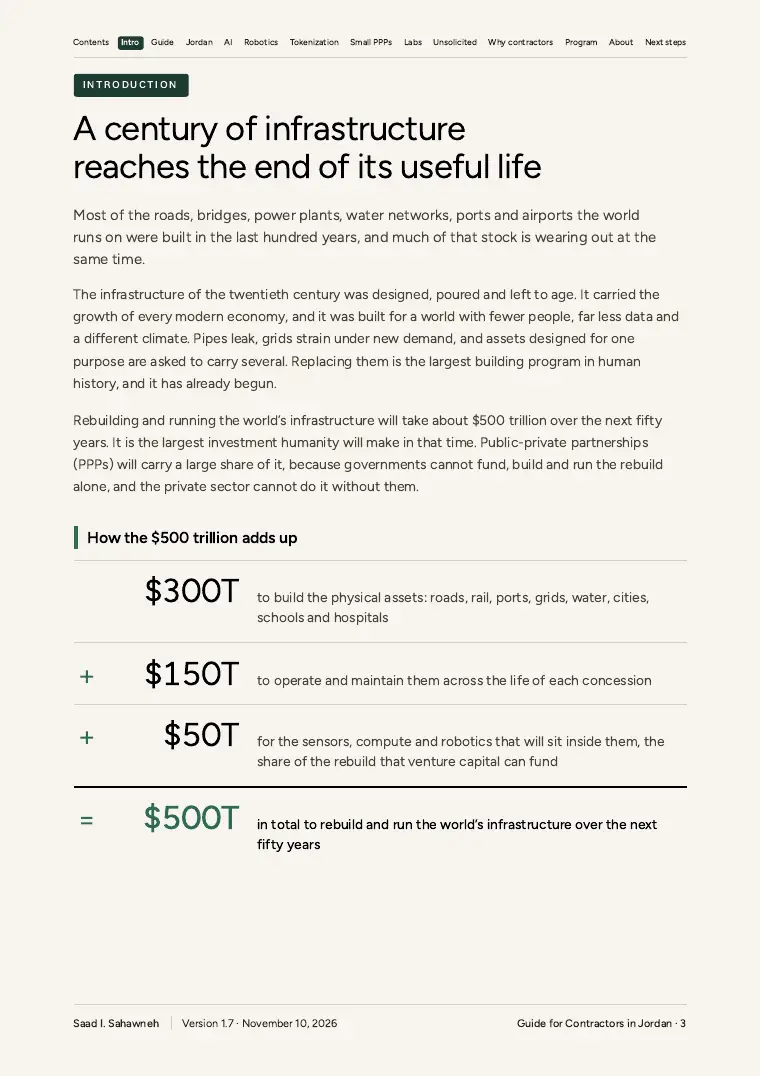
01Introduction
Why a century of infrastructure needs rebuilding, and the $500 trillion it will take.
Page 3 of 18
02The guide
Build and own the $500 trillion PPP infrastructure opportunity
Page 5 of 18
03Jordan and Aqaba
An $86 billion pipeline to start with
Page 6 of 18
04Sector guides
The sectors closest to contractors, each with its own guide.
Page 7 of 18
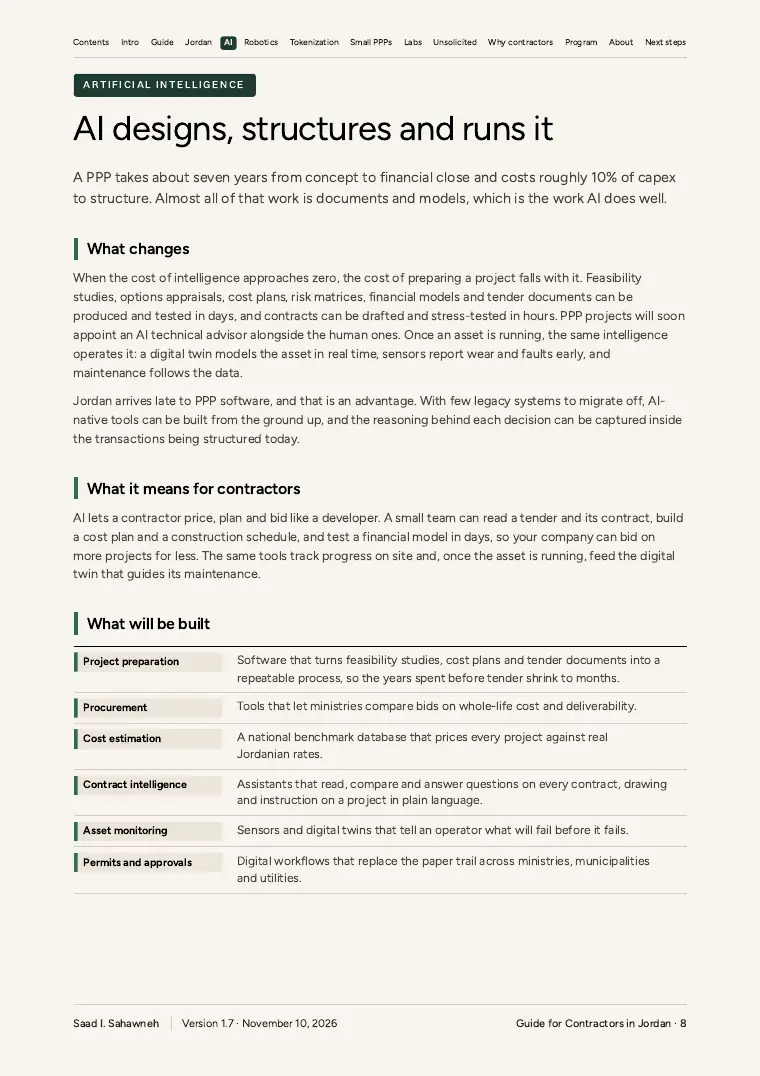
05Artificial intelligence
How AI designs, structures and runs PPP projects, and what it means for contractors.
Page 8 of 18
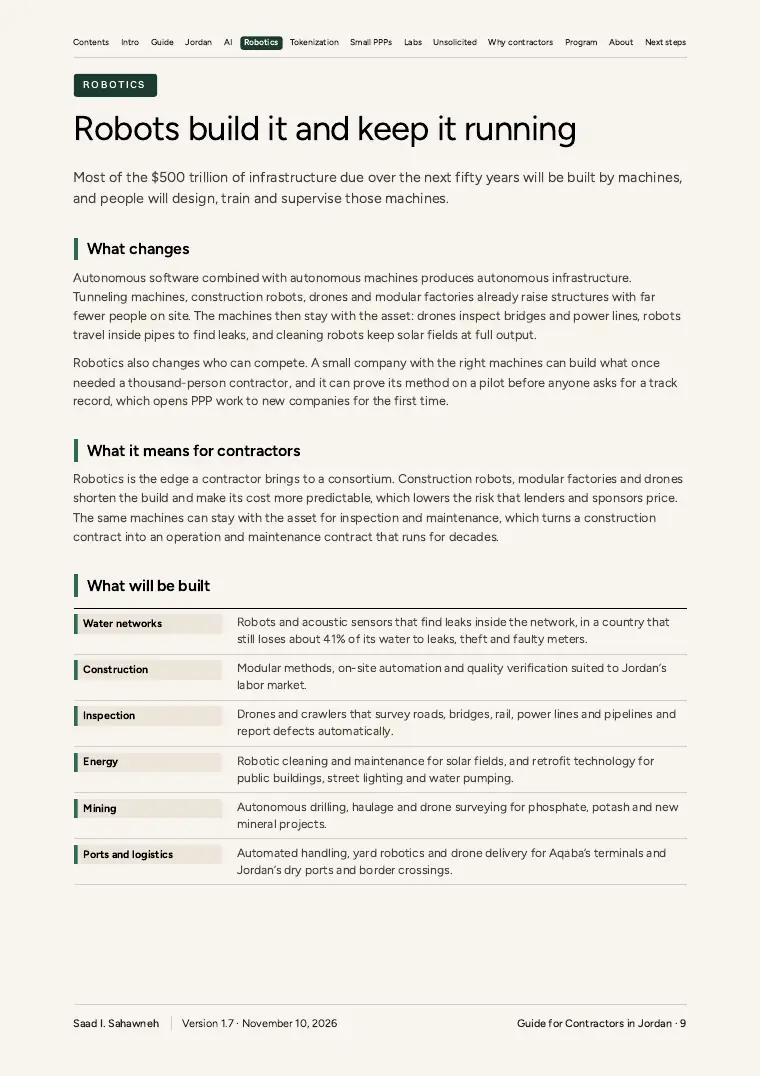
06Robotics
How robots build infrastructure and keep it running, and what that means for contractors.
Page 9 of 18
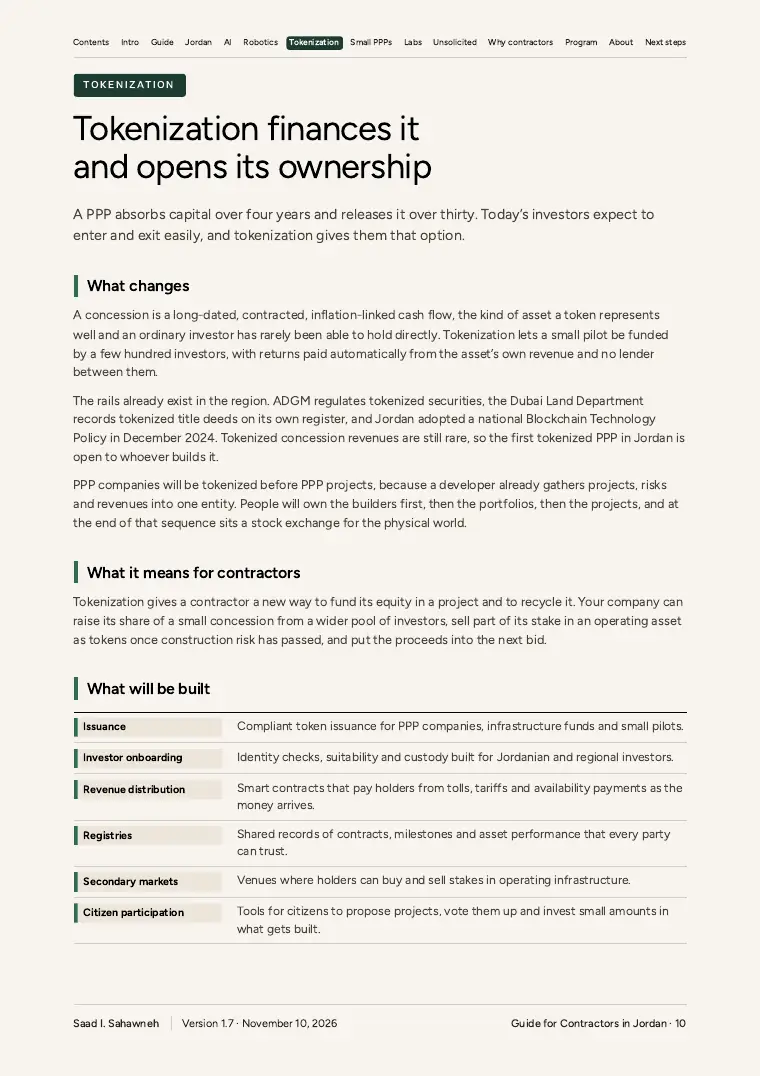
07Tokenization
How tokenization funds projects from their own revenue, and the role it opens for contractors.
Page 10 of 18
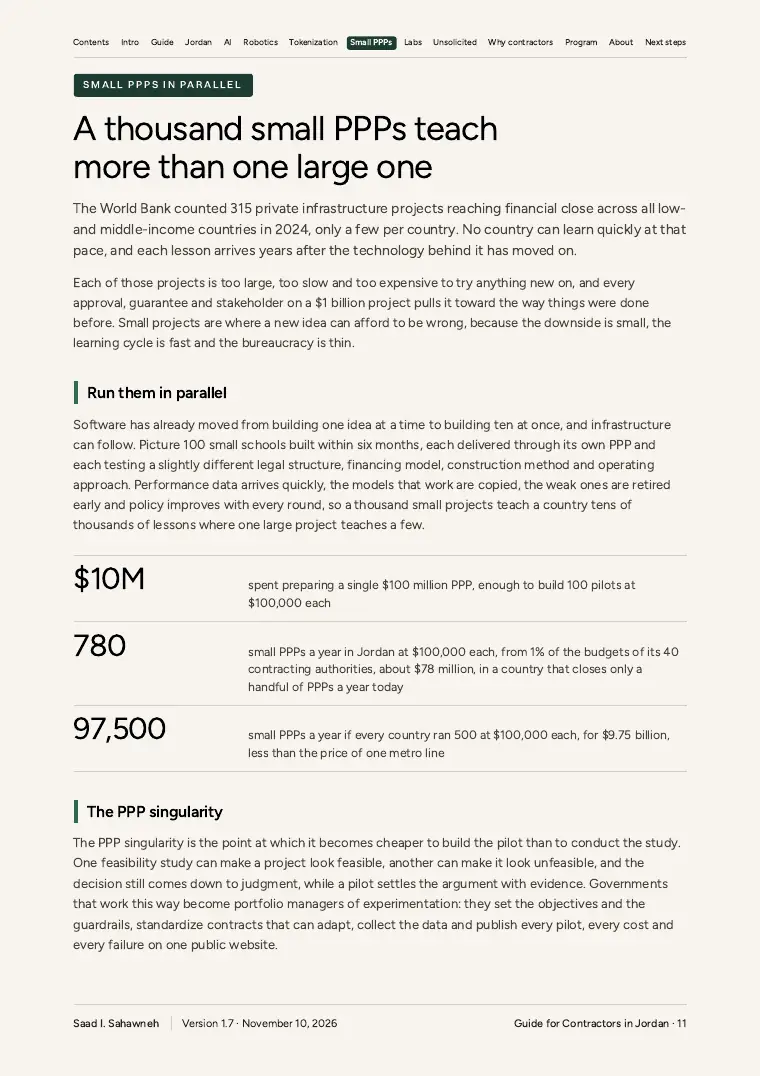
08Small PPPs in parallel
Why many small PPPs teach a country faster than a few large ones.
Page 11 of 18
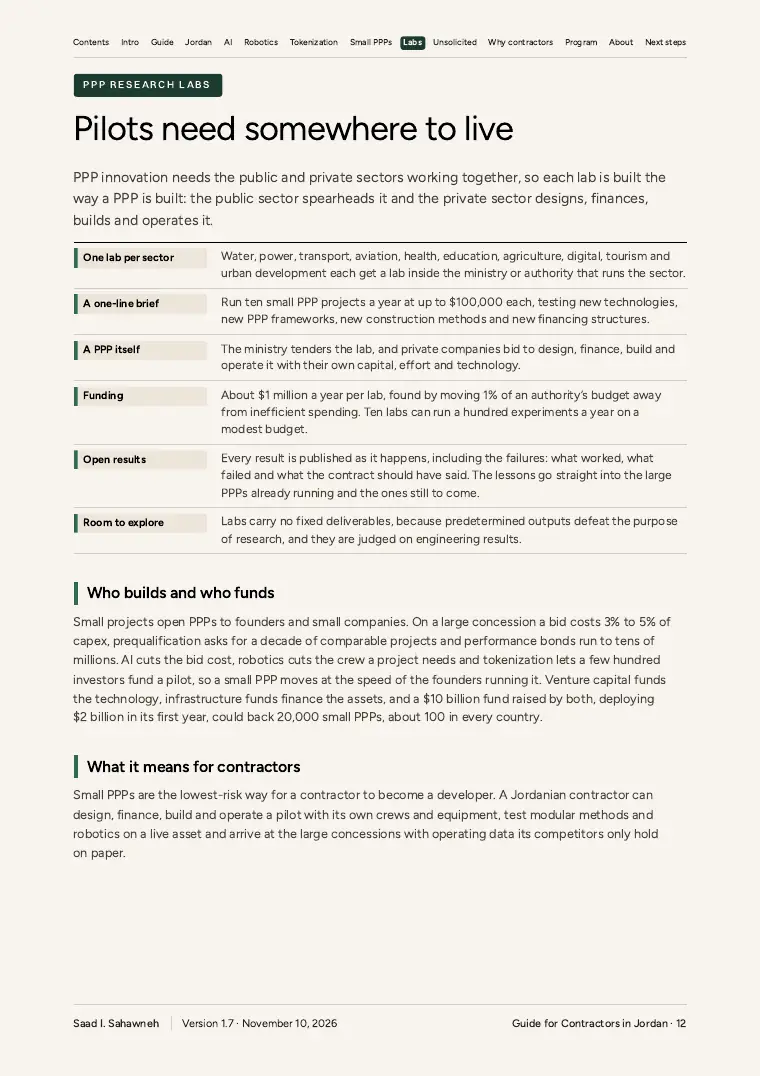
09PPP research labs
A lab in each sector, running ten small PPP projects a year.
Page 12 of 18
10Unsolicited proposals
How Jordan’s PPP law accepts direct proposals from private companies.
Page 13 of 18
11Why contractors
Contractors turn a PPP contract into a working asset
Page 14 of 18
12The program
The program can sit beside the construction business, with a development team at its center and the company’s delivery record, supply chain and balance sheet behind it.
Page 15 of 18
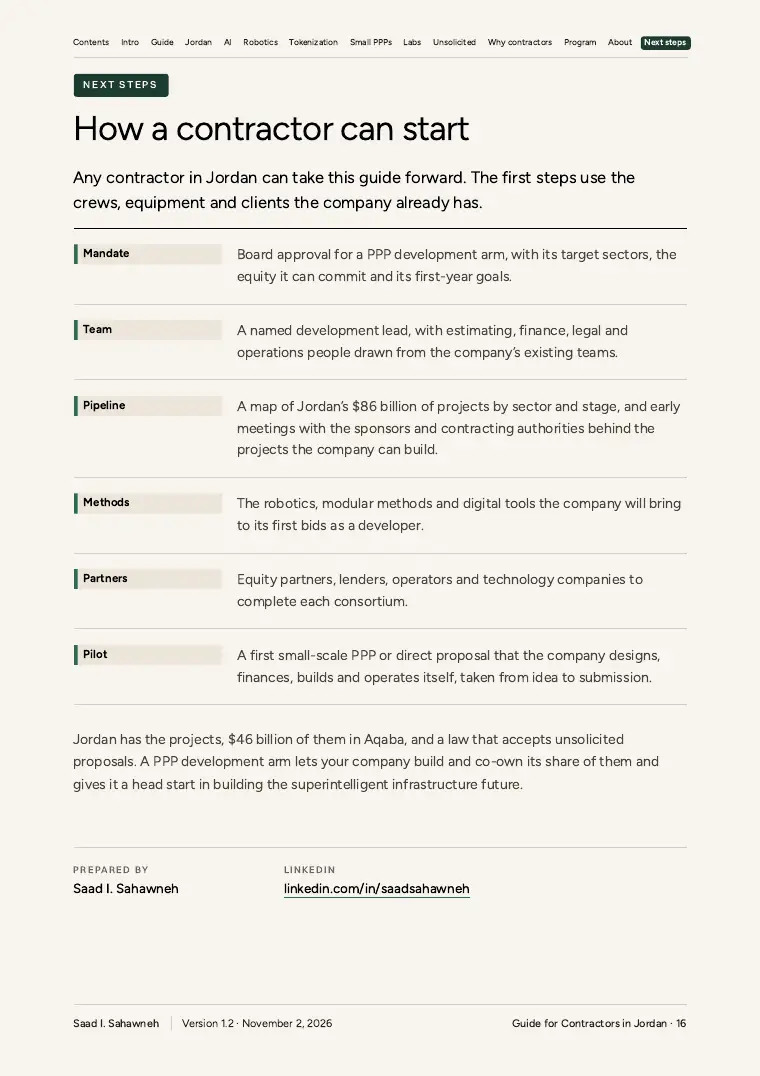
13About
About Jordan PPP and what it offers.
Page 16 of 18
14Next steps
How a contractor can start: six first steps.
Page 17 of 18
Questions
Questions about the organization guide for Contractors in Jordan
- What does the organization guide for Contractors in Jordan propose?
- Your company launches a PPP development arm that moves it from builder to developer and equity partner in public-private partnership (PPP) projects, with robotics and modular construction as its edge.
- Why should contractors in Jordan launch a PPP program?
- Contractors turn a PPP contract into a working asset. A PPP is paid for by the service an asset delivers, so the project earns nothing until the asset is built. Sponsors bring the equity and lenders bring the debt, while the contractor carries the build, its schedule and its cost.
- Which PPP projects can contractors in Jordan take part in?
- Jordan has about $86 billion of PPP and infrastructure projects in development, $46 billion of them anchored in Aqaba. Every one of them needs builders, and its consortium needs equity partners. A Jordanian contractor that builds and co-owns one project at home can carry the same consortium to the next one across the region.
- How can contractors in Jordan start a PPP program?
- Any contractor in Jordan can take this guide forward. The first steps use the crews, equipment and clients the company already has. The organization guide sets out six first steps: mandate, team, pipeline, methods, partners and pilot.
- What does a PPP program give contractors in Jordan?
- The company gains a share of the revenue from the assets it builds, returns across the life of each concession and a seat in the consortium when the terms of the build are set. Each project also keeps its people and machines at work through decades of operation and maintenance, which steadies a construction order book.
- Is the organization guide for Contractors in Jordan free?
- Yes. It is free to read on this page and free to download as an 18-page PDF, with the case for a PPP program, Jordan’s pipeline, the role of AI, robotics and tokenization, the program and six first steps.
Sector guides
The sectors closest to contractors
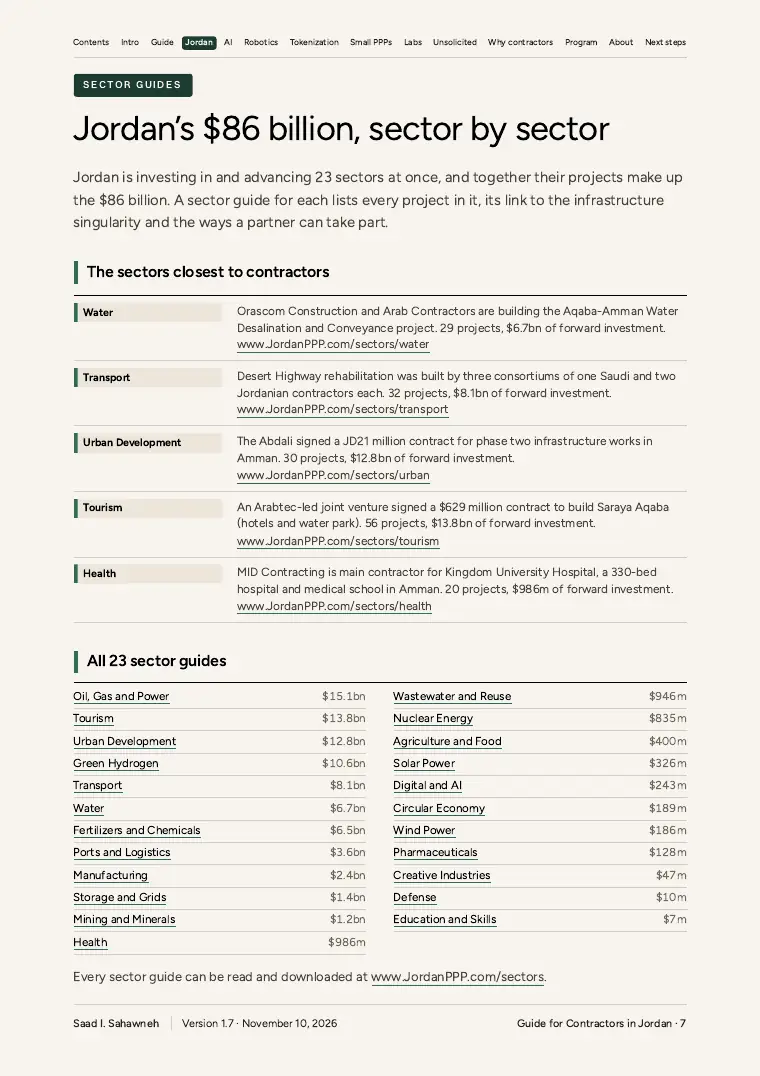
Jordan’s $86 billion is spread across 23 sectors. Each sector guide lists every project in it and shows how to take part.
 Water$6.7bnOrascom Construction and Arab Contractors are building the Aqaba-Amman Water Desalination and Conveyance project29 projects
 Transport$8.1bnDesert Highway rehabilitation was built by three consortiums of one Saudi and two Jordanian contractors each32 projects
 Urban Development$12.8bnThe Abdali signed a JD21 million contract for phase two infrastructure works in Amman30 projects
 Tourism$13.8bnAn Arabtec-led joint venture signed a $629 million contract to build Saraya Aqaba (hotels and water park)56 projects
 Health$986mMID Contracting is main contractor for Kingdom University Hospital, a 330-bed hospital and medical school in Amman20 projects
 Wastewater and Reuse$946mMorganti (Consolidated Contractors Company) built and co-owns the As-Samra wastewater plant expansion with Suez20 projects
 Solar Power$326mWartsila took the EPC for a 52 MWp PV plant for AES and Mitsui; First Solar and TSK built Shams Ma’an and Quweira18 projects
 Oil, Gas and Power$15.1bnGuangdong Power Engineering Corporation was EPC contractor for the 554 MW Attarat oil shale power plant23 projects
 Storage and Grids$1.4bnNEPCO awarded Green Corridor transmission line packages to Indian and Romanian contractors25 projects
 Education and Skills$7mGovernment floated tenders to contractors to build 16 new public schools12 projects
 Manufacturing$2.4bnA local contractor signed a JD4 million deal to build phase four of Al Hassan Industrial Estate38 projects
 Mining and Minerals$1.2bnCOMEDAT, Jordan’s largest phosphate mining contractor, added 50 haul trucks for ore and overburden29 projects
 Circular Economy$189mGAM tendered the construction of Cell 6 at Al Ghabawi landfill as an open works contract (EBRD-financed)22 projects
Guide 39 of 96
Browse all 96 organization guides