Skip to content
Jordan PPP
Stained-glass illustration in blue glass of a robot and towers at the dawn of the infrastructure singularity

Sector guide 04 of 22 · Version 1.1

Green Hydrogen in Jordan

Desert sunlight and wind turned into fuel the world can ship.

Share
$10.6bn
forward investment in its own projects
12
projects in this guide
7
in or linked to Aqaba

The sector today

Green Hydrogen in Jordan

Green hydrogen is made by splitting water with renewable electricity, and most of it is shipped as green ammonia. Jordan has strong sun and wind, open desert land and a Red Sea port, and the government wants Aqaba to become a regional hub for producing and exporting it.

The pipeline is moving from paper to contracts. The Ministry of Energy and Mineral Resources has signed 13 memoranda of understanding with developers, and a Cabinet framework approved in July 2025 set aside an industrial zone in Aqaba for hydrogen plants and desalination. In May 2026 the country signed its first investment agreement, a US$1 billion green ammonia plant at the Port of Aqaba.

The 2025 to 2035 energy strategy targets commercial production by 2030 and about 500,000 tonnes of green hydrogen a year by 2035. This guide sets out the projects in the Jordan PPP project register, the shared infrastructure Aqaba needs, and the opportunities that open as hydrogen becomes one of the fuels of the singularity.

13
Memoranda of understanding signed with green hydrogen developers, six of which had reached land-use agreements by July 2025.
500,000 t
Green hydrogen a year targeted by 2035 in the approved national energy strategy.
$1 billion
Jordan Green Ammonia, the first investment agreement in the sector, signed in May 2026 for a plant at the Port of Aqaba.
2030
Year the energy strategy sets for the start of commercial green hydrogen production in Jordan.

The singularity

Fuel made from light for the singularity

The infrastructure singularity is the point where roads, grids, ports and water networks become one connected, intelligent system, built by robotics, run by artificial intelligence and financed by tokenization. Green hydrogen lets that system store sunlight as a fuel and move it across oceans.

Artificial intelligence
Matches electrolysers to the minute-by-minute output of solar and wind, plans ammonia production around weather and shipping, and predicts maintenance across thousands of cells and kilometres of pipe.
Robotics
Builds solar fields and electrolyser halls in modules, inspects tanks and pipelines, and handles ammonia at the terminal, reducing the risk and cost of large plants in the desert.
Tokenization
A plant sells ammonia under long-term contracts for decades. Tokenized stakes let investors in Jordan and abroad own part of a plant and receive their share of every cargo.
Storage
Hydrogen and ammonia store renewable energy for weeks and seasons, giving a grid run mostly on sunlight and wind a reserve it can call on.
Abundance
When energy costs almost nothing, fertilizer, shipping fuel and steel can be made from air, water and light, cutting the link between growth and imported fuel.

Flagship projects

The projects that lead the sector

  • Awarded · Port of Aqaba

    Jordan Green Ammonia

    A US$1 billion plant by Hynfra and Fidelity Group that will make 100,000 to 120,000 tonnes of green ammonia a year from about 550 MWp of off-grid solar and battery storage. The investment agreement was signed in May 2026 and a land lease with ASEZA followed in June, with financial close targeted in 2027.

  • Pipeline · Aqaba

    H2 Global Energy Aqaba Green Ammonia

    The largest project in the Jordan PPP project register, at about US$6.5 billion: 1 million tonnes of green ammonia a year from up to 5 GW of wind and solar and 1.5 GW of electrolysers. The technical report was submitted in January 2025, with operation targeted for 2030.

  • Pipeline · Jordan

    Green Ammonia Plant (United Energy Group)

    A US$1.155 billion project by China's United Energy Group for 200,000 tonnes of green ammonia a year for export, using off-grid solar and desalinated seawater. Cabinet approved its land-use agreement on June 17, 2026, with operations targeted for November 2030.

  • Pipeline · Jordan

    Masdar Green Hydrogen (1 GW Wind + H2)

    At COP28 in December 2023 Masdar signed agreements for 1 GW of wind with battery storage and a study of a green hydrogen plant near the Port of Aqaba. Talks with the Prime Minister in June 2026 covered a Masdar wind pipeline of 2,000 MW.

  • Pipeline · Aqaba

    Green Hydrogen Common Use Infrastructure

    Shared desalination, ammonia storage and export facilities for every developer in the hub. A business-model study with the EBRD was completed in 2025, and the Cabinet framework allocated an industrial zone in Aqaba for the plants.

Every project

12 projects in Jordan’s pipeline

Values in US dollars; * estimated where no figure has been published. Rows in grey sit in another sector and connect to this one.

ProjectLocationStageValue
H2 Global Energy Aqaba Green Ammonia (1 Mt/yr)AqabaPipeline$6.5bn
Masdar Green Hydrogen (1 GW Wind + H2)JordanPipeline$1.6bn*
Green Ammonia/Hydrogen Plant (United Energy Group, China)JordanPipeline$1.2bn
Jordan Green Ammonia (JGA)AqabaAwarded$1bn
Green Hydrogen Common Use Infrastructure (CUI)JordanPipeline$300m*
Aqaba-Amman Water Desalination & Conveyance Project (AAWDCP)Aqaba to AmmanAwarded$5.8bn
Ammonia & Urea PlantNear the Risha Gas FieldPipeline$1.5bn*
Arab Potash × JPMC Integrated Fertilizer ComplexEshidiyaPipeline$1bn
Battery Energy Storage System (100 MW / 4-Hour)Mafraq GovernoratePipeline$141m
Wind Power Generation Project (100 MW)Mafraq GovernoratePipeline$141m
New Bulk Liquids TerminalSouth PortTendering$63m
Jordan Methanol Manufacturing PlantIndustrial zone in JordanOpen opportunity$29m*

AI, robotics and tokenization

What changes for green hydrogen

Artificial intelligence

For green hydrogen in Jordan, AI decides how much a plant earns. Electrolysers in Aqaba will run on dedicated solar and wind with no grid behind them, so models must forecast every hour of sun and wind, size solar fields, batteries and ammonia tanks, and set production minute by minute. The same tools can schedule cargoes against ship arrivals and test offtake prices during a bid.

What can be built

  • Plant sizing. Software that sizes solar, wind, batteries, electrolysers and ammonia storage for each Aqaba plant from years of weather data.
  • Live dispatch. Control systems that ramp electrolysers with the sun and wind, protecting stack life while keeping ammonia output on contract.
  • Port scheduling. Tools that plan ammonia storage and loading at Aqaba for several producers sharing one terminal and one set of tanks.
  • Certification. Systems that track the renewable power and water behind every tonne, so buyers in Europe and Asia can verify green ammonia.
More on artificial intelligence

Robotics

Green hydrogen plants in Jordan will spread across hundreds of hectares of desert, with solar fields, long power lines, desalination units, electrolyser halls and ammonia tanks. Robots make that scale affordable. They can install and clean panels without water, inspect lines and tanks from the air, and check ammonia systems for leaks, so a small Jordanian team can run a large plant safely in heat and dust.

What can be built

  • Solar construction. Robots that place and fix modules across the solar fields that feed electrolysers, cutting the time to build each plant.
  • Waterless cleaning. Robots that clean panels at night without water, where every litre the plant uses comes from desalinated seawater.
  • Leak inspection. Drones and crawlers that check ammonia pipes, tanks and electrolyser halls for leaks and corrosion, keeping people away from hazards.
  • Modular assembly. Factories that build electrolyser and ammonia units in modules, so plants grow in stages as offtake contracts are signed.
More on robotics

Tokenization

A green ammonia plant sells its product under long contracts in a currency buyers trust, which is the cash flow that tokenization suits. Tokenized stakes in a plant, a shared storage tank or a desalination unit in Aqaba could let Jordanian savers, the diaspora and funds abroad own part of the hub, receive their share of each cargo and see every certified tonne on a shared record.

What can be built

  • Plant stakes. Tokenized equity or notes in a green ammonia plant, paid from each export cargo under its offtake contract.
  • Shared assets. Tokens in the common desalination, storage and terminal assets in Aqaba, paid from the fees that each producer pays.
  • Green certificates. A registry where every certified tonne of green ammonia is issued, traded and retired as a digital certificate.
  • Pilot funding. A small issue that funds a pilot electrolyser or refuelling station, with returns paid to many investors from its output.
More on tokenization

Start small, or bring your own idea

Small PPPs and unsolicited proposals

Small PPPs and research labs

Small PPPs suit hydrogen pilots that prove the technology in Jordan before gigawatt plants are financed. A research lab in Aqaba, set up with ASEZA and a university, could test electrolysers on desalinated seawater, desert heat and dust. Three $100,000 pilots could start it: a containerized electrolyser at a solar plant, a hydrogen refuelling unit for port equipment, and a sensor network that measures sun and wind at candidate sites.

How it works

Unsolicited proposals under Article 15

A company can bring direct proposals under Article 15 for the parts of the hub that no single developer will build alone: a shared ammonia tank or loading line at the bulk liquids terminal, a desalination unit sized for several hydrogen plants, a refuelling station for port trucks and buses, or green ammonia supplied under contract to Jordan's fertilizer plants in place of imported ammonia.

How it works

New industries

What the sector can create

  1. 01Green ammonia exportsCargoes of ammonia made from desert sunlight and wind, shipped from Aqaba to Europe and Asia for fertilizers, power stations and ships.
  2. 02Green fertilizersNitrogen fertilizers made from green ammonia, combined with Jordan's potash and phosphate into low-carbon blends for export.
  3. 03Shipping fuelAmmonia and methanol supplied to vessels at Aqaba, positioning the port as a refuelling stop on the Red Sea route.
  4. 04Green steel and materialsHydrogen used to reduce iron and make building materials, opening a heavy industry that Jordan does not have today.
  5. 05Electrolyser servicesJordanian companies that assemble, install, run and repair electrolyser stacks for the region's hydrogen projects.
  6. 06Hydrogen mobilityTrucks, buses and port equipment running on hydrogen along the Aqaba to Amman corridor and inside the port.

Opportunities

Where partners come in

Developer pathway
Enter through a memorandum with the Ministry of Energy and Mineral Resources, then feasibility studies, a land-use agreement and an investment agreement under the Cabinet framework.
Shared infrastructure
Build, finance or run the common desalination units, ammonia storage and export terminals in Aqaba as partnerships that serve every developer.
Direct proposals
Propose projects under Article 15 of PPP Law No. 19 of 2023, such as hydrogen buses, port equipment or a pilot electrolyser at a public facility.
Small-scale PPPs
Regulation No. 9 of 2024 covers PPPs below about US$14.1 million, which suits pilot plants, fuelling stations and training centers.
Supply and construction
Supply electrolysers, solar and wind equipment, desalination, storage and engineering to the plants now moving from studies to construction.
Offtake and finance
Sign long-term ammonia purchase contracts, or finance plants through development banks, export credit agencies, funds and tokenized stakes.
Stained-glass illustration in blue glass of a city of towers under a rising arch

The road to the singularity

  1. 2026The first investment agreement is signed and Aqaba land is leased; land-use agreements and shared-infrastructure planning move ahead.
  2. 2030Commercial production starts, as the energy strategy targets, and the first green ammonia plants ship from Aqaba.
  3. 2035Output reaches about 500,000 tonnes of green hydrogen a year, with shared terminals and desalination serving several plants.
  4. 2040AI runs gigawatts of electrolysers in step with sun and wind; Aqaba refuels ships and supplies green fertilizer and steel plants.
  5. 2050Jordan exports sunlight as molecules, and hydrogen powers its industry, transport and seasonal energy storage.

Green hydrogen lets Jordan export its sunlight and wind as fuel. The projects in this guide are the first steps towards an Aqaba that sends energy to the world as reliably as it once received it.

Guides for organizations

Launch a PPP program of your own

The guides closest to green hydrogen, each showing one kind of organization how to launch a PPP program, with six first steps.

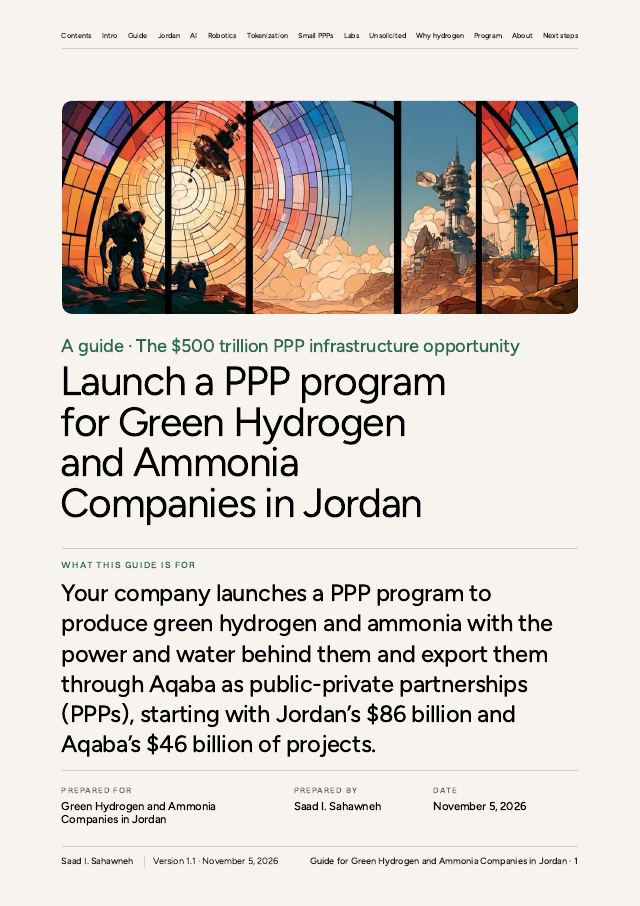
  • Your company launches a PPP program to produce green hydrogen and ammonia with the power and water behind them and export them through Aqaba as public-private partnerships (PPPs).

  • Economic sectors

    Energy Developers

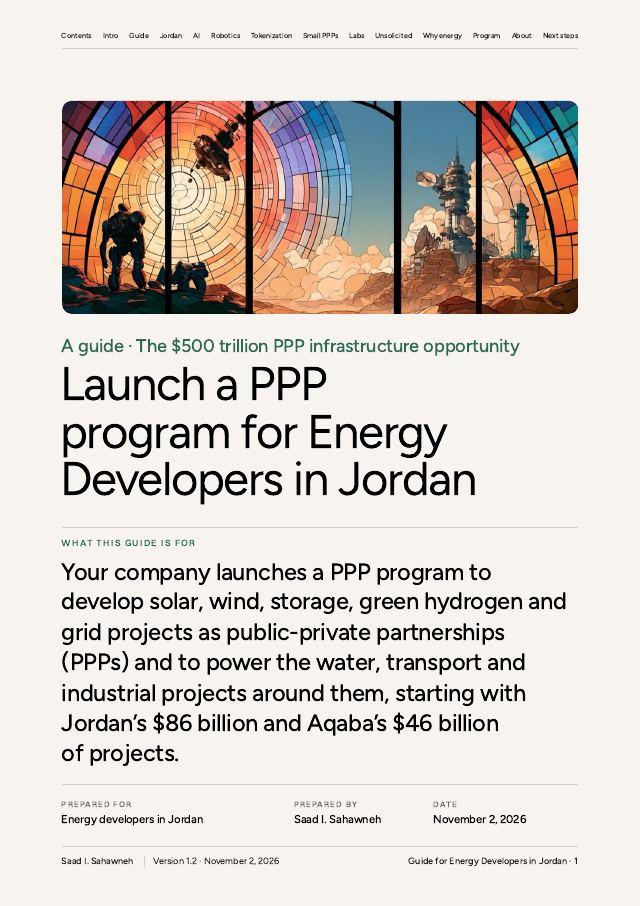
    Your company launches a PPP program to develop solar, wind, storage, green hydrogen and grid projects as public-private partnerships (PPPs) and to power the water, transport and industrial projects around them.

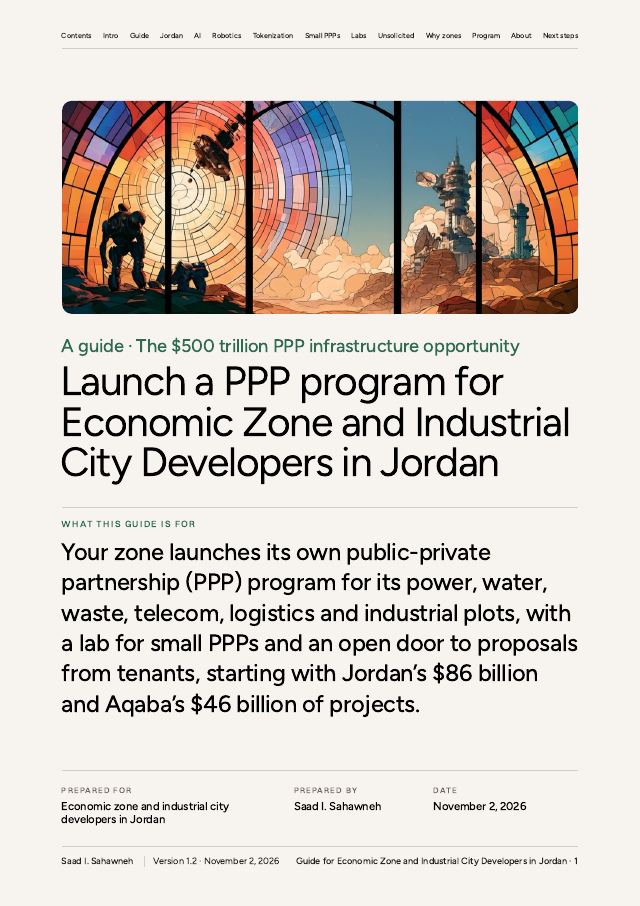
  • Your zone launches its own public-private partnership (PPP) program for its power, water, waste, telecom, logistics and industrial plots, with a lab for small PPPs and an open door to proposals from tenants.

  • Operators and services

    Maritime and Shipping Companies

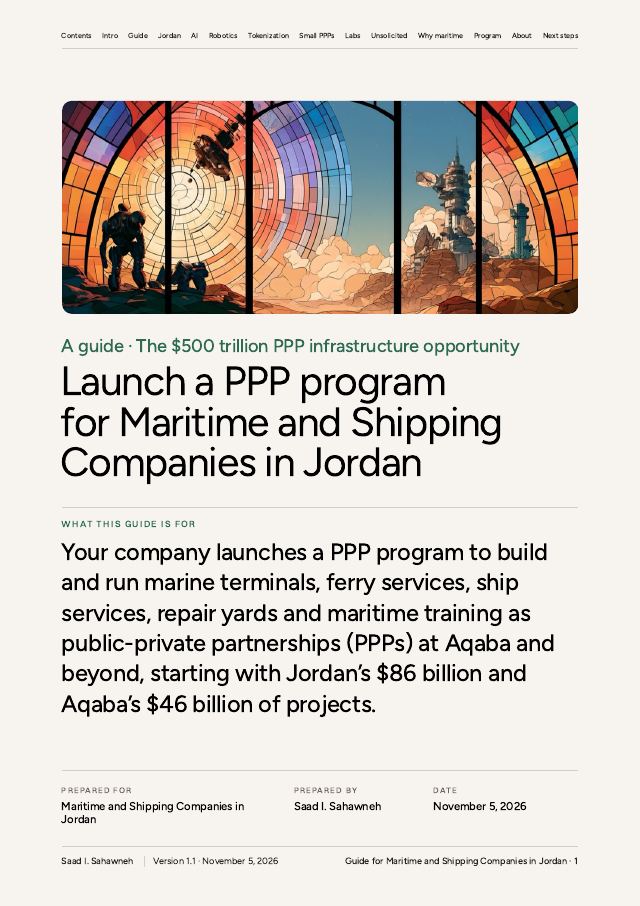
    Your company launches a PPP program to build and run marine terminals, ferry services, ship services, repair yards and maritime training as public-private partnerships (PPPs) at Aqaba and beyond.

See every guide and sector on one map