What this organization guide is for
Your zone launches its own public-private partnership (PPP) program for its power, water, waste, telecom, logistics and industrial plots, with a lab for small PPPs and an open door to proposals from tenants.
The case
Zone developers hold the land, networks and tenants a PPP needs
Factories, warehouses and data centers choose where to locate by the cost and reliability of power, water, land and logistics, and zones compete on exactly those services. Zone and industrial city developers that deliver them through PPPs can expand faster, share the investment with private partners and offer tenants better infrastructure at known prices. This guide invites economic zone and industrial city developers in Jordan to launch a PPP program of their own, starting with the projects at home.
The guide
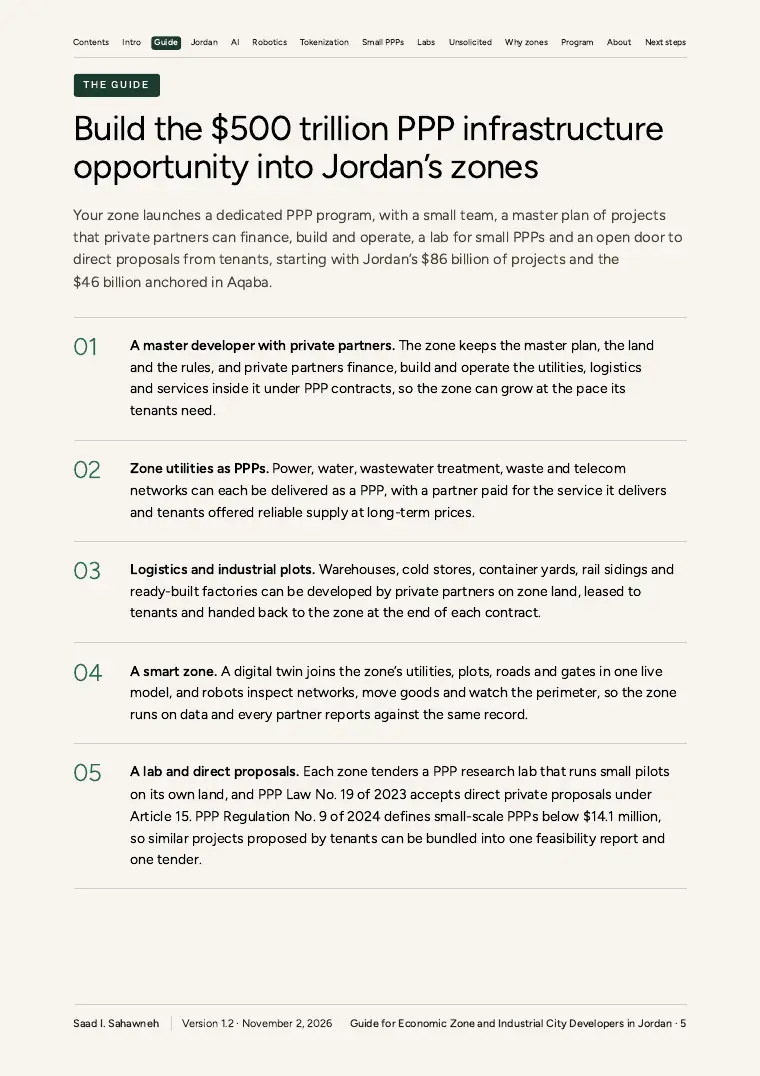
Build the $500 trillion PPP infrastructure opportunity into Jordan’s zones
Your zone launches a dedicated PPP program, with a small team, a master plan of projects that private partners can finance, build and operate, a lab for small PPPs and an open door to direct proposals from tenants, starting with Jordan’s $86 billion of projects and the $46 billion anchored in Aqaba.
01
A master developer with private partners
The zone keeps the master plan, the land and the rules, and private partners finance, build and operate the utilities, logistics and services inside it under PPP contracts, so the zone can grow at the pace its tenants need.
02
Zone utilities as PPPs
Power, water, wastewater treatment, waste and telecom networks can each be delivered as a PPP, with a partner paid for the service it delivers and tenants offered reliable supply at long-term prices.
03
Logistics and industrial plots
Warehouses, cold stores, container yards, rail sidings and ready-built factories can be developed by private partners on zone land, leased to tenants and handed back to the zone at the end of each contract.
04
A smart zone
A digital twin joins the zone’s utilities, plots, roads and gates in one live model, and robots inspect networks, move goods and watch the perimeter, so the zone runs on data and every partner reports against the same record.
05
A lab and direct proposals
Each zone tenders a PPP research lab that runs small pilots on its own land, and PPP Law No. 19 of 2023 accepts direct private proposals under Article 15. PPP Regulation No. 9 of 2024 defines small-scale PPPs below $14.1 million, so similar projects proposed by tenants can be bundled into one feasibility report and one tender.
Why economic zone and industrial city developers
Zone developers hold the land, networks and tenants a PPP needs
A PPP needs land, utilities, approvals and customers, and a zone developer controls or coordinates all four inside its boundary. That makes a zone one of the fastest places in a country to prepare a PPP, test a new technology on live assets and offer the result to tenants who are already there.
Where zone developers fit in a PPP
- Land
- Serviced plots and corridors that a partner can lease for a utility, a logistics park or a factory.
- Utilities
- Power, water, wastewater, waste and telecom networks that tenants need from their first day.
- Approvals
- Permits and approvals inside the zone, often through one window, that decide how quickly a partner can build.
- Demand
- Tenants whose contracts give a utility or logistics partner known customers and revenue.
- Supervision
- Measurement of service levels across the zone and payment to each partner for the results it delivers.
What changes for zone developers
AI, robotics and tokenization change how a zone is planned, run and financed. A digital twin shows the whole zone on live data, so utilities expand ahead of demand and faults are fixed before tenants notice. Robots inspect networks, move goods and watch gates around the clock, and tokenized stakes let tenants and regional investors finance the next phase of the zone from the revenue of the last.
Why a program, and why now
Without a program, a zone builds each network and warehouse from its own budget or signs one-off contracts, and growth waits on capital. A program gives the zone a team, standard contracts, a lab that tests new ideas on its own land and a clear route for proposals from tenants and partners. Jordan’s pipeline is large and early, and the zones that prepare their projects now will host the industries that grow around it.
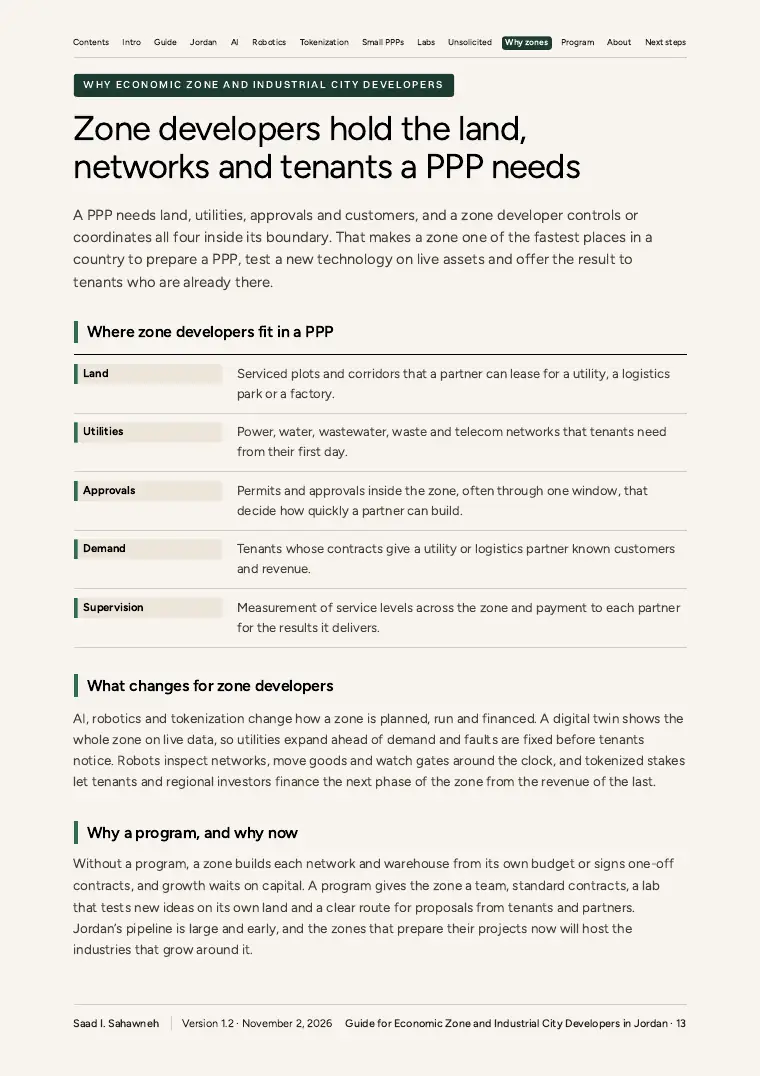

Futureproofing
Futureproof Economic Zone and Industrial City Developers in Jordan for the infrastructure singularity
This free 18-page guide shows how, with small PPPs in parallel, PPP research labs, artificial intelligence, robotics, tokenization and six first steps.
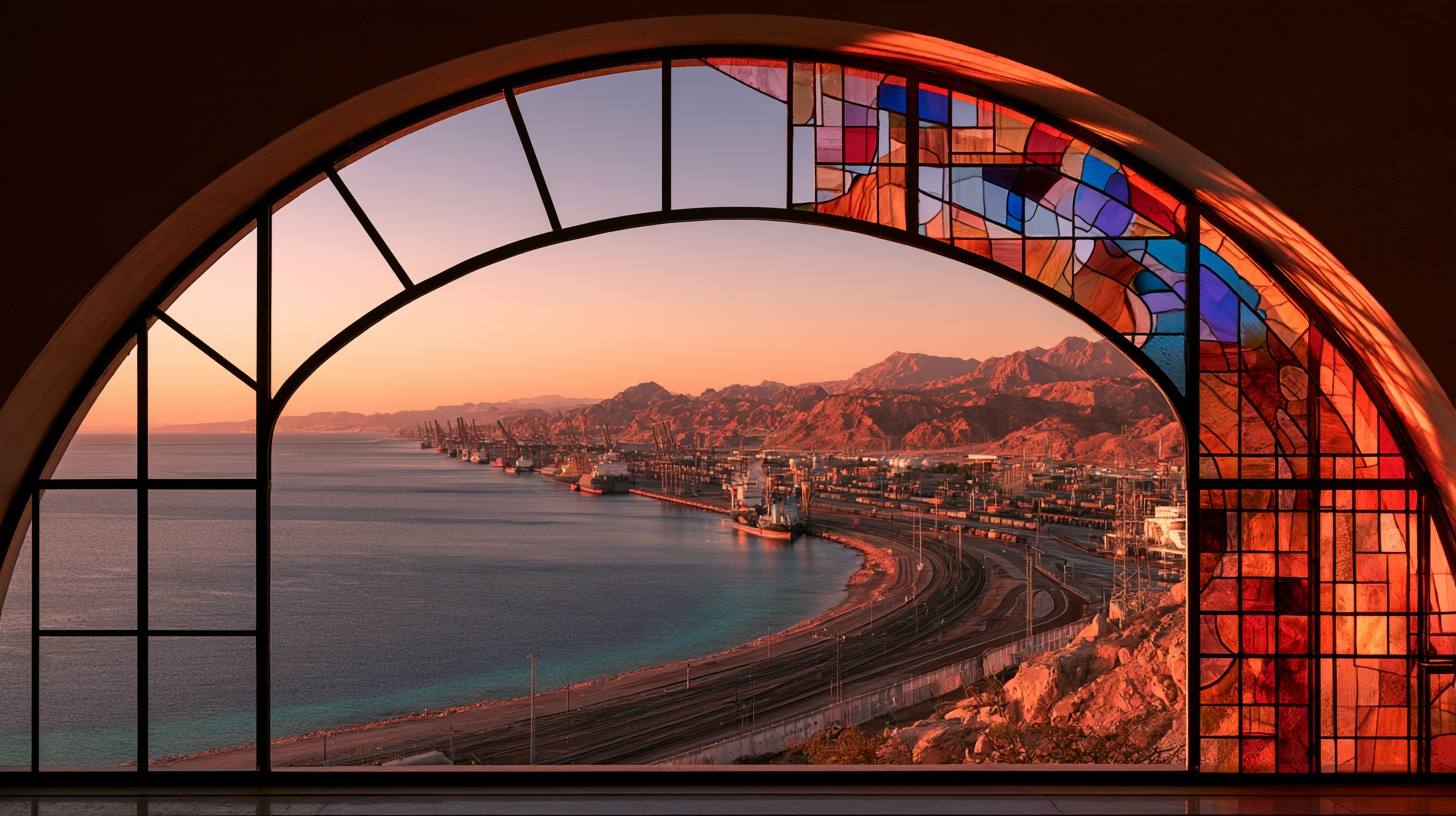
Jordan and Aqaba
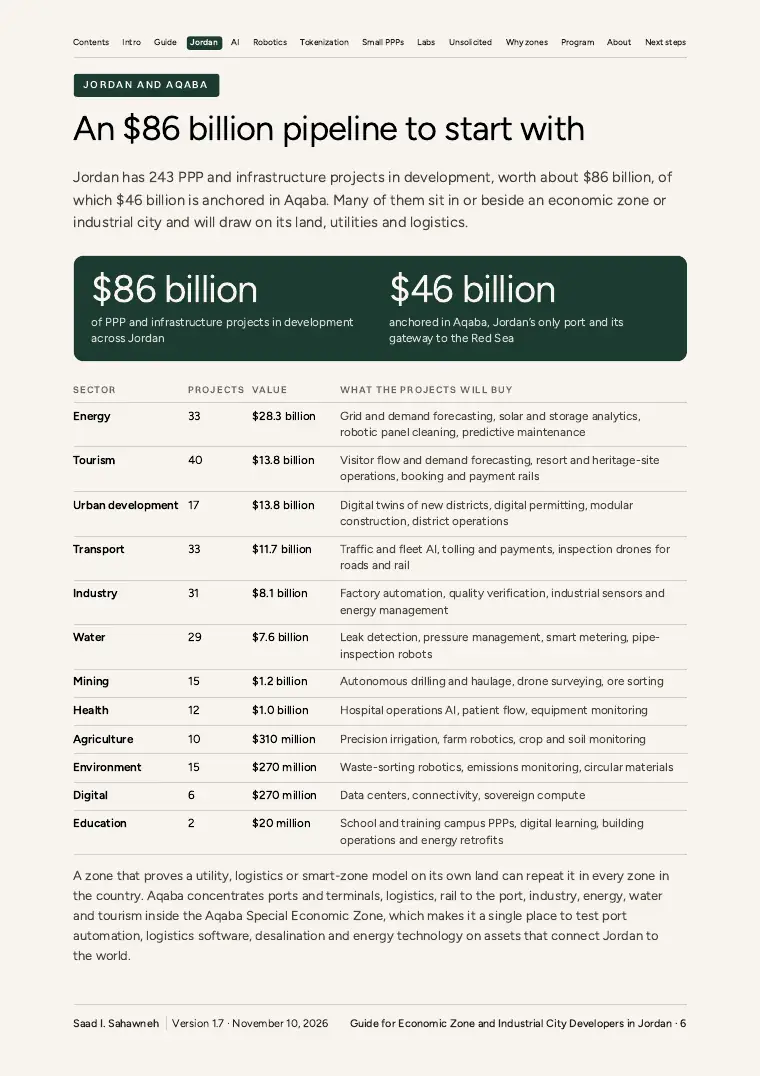
An $86 billion pipeline to start with
Many of them sit in or beside an economic zone or industrial city and will draw on its land, utilities and logistics. A zone that proves a utility, logistics or smart-zone model on its own land can repeat it in every zone in the country.
- $86B
- of PPP and infrastructure projects in development in Jordan
- $46B
- of them anchored in Aqaba

Artificial intelligence
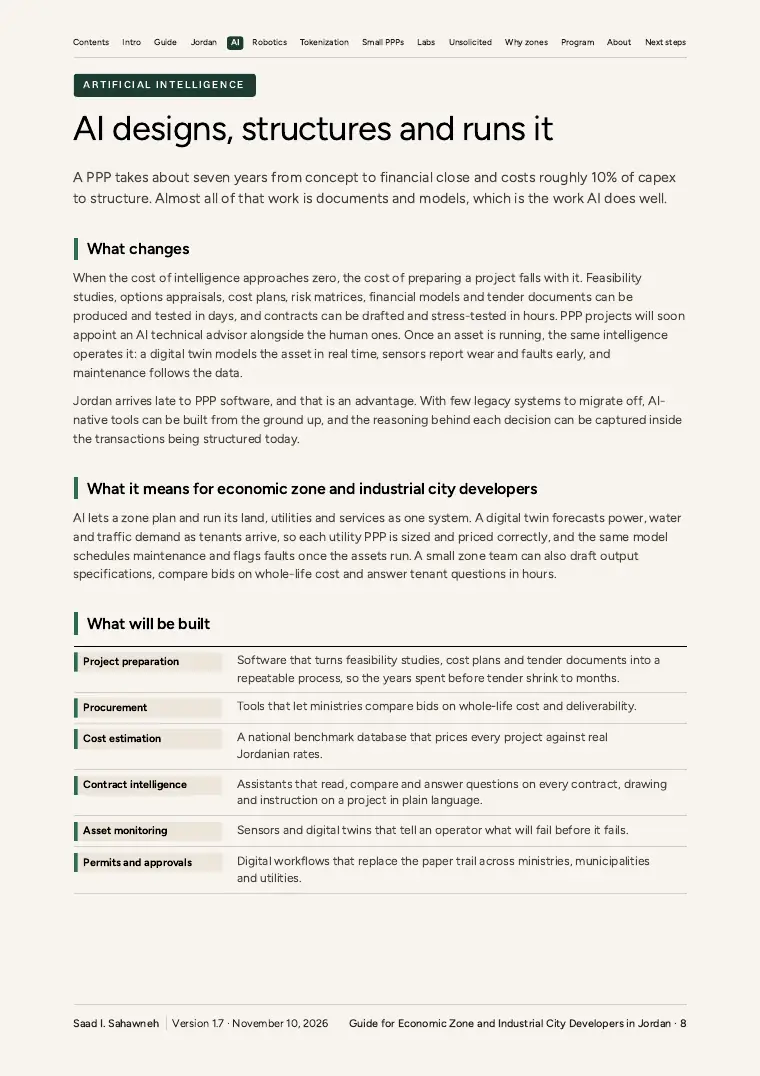
AI lets a zone plan and run its land, utilities and services as one system. A digital twin forecasts power, water and traffic demand as tenants arrive, so each utility PPP is sized and priced correctly, and the same model schedules maintenance and flags faults once the assets run. A small zone team can also draft output specifications, compare bids on whole-life cost and answer tenant questions in hours.

Robotics
Robotics lowers the cost of running a zone and raises what it offers tenants. Automated warehouses and yards move goods around the clock, drones and crawlers inspect pipes, substations and roads and report defects automatically, and robotic patrols watch gates and perimeters, so a zone can serve more tenants with a small operations team.

Tokenization
Zone infrastructure suits tokenization, because utilities and leased plots earn contracted revenue from known tenants. A zone developer can tokenize stakes in its power, water or logistics assets, pay holders from tenant charges as they arrive and publish each asset’s performance to a shared registry, so tenants, workers and regional investors can own part of the zone they work in.
Small PPPs and research labs
A zone suits a PPP research lab, because it holds land, networks and tenants willing to try new services in one place. Each zone can tender its own lab, pilot new utilities, logistics robots and smart-zone tools on its own plots and offer what works to every tenant, while the published failures teach the other zones as well.

Unsolicited proposals
Direct proposals turn tenants and partners into a source of projects. A manufacturer that needs steady power, a logistics company that sees room for a cold store or a rail siding, or a utility partner with a better treatment plant can bring its idea forward under Article 15 at its own cost. The tender still tests the idea against the market, where the proposer can match the best offer, and a zone that publishes the services it wants improved receives proposals aimed at them.
The program
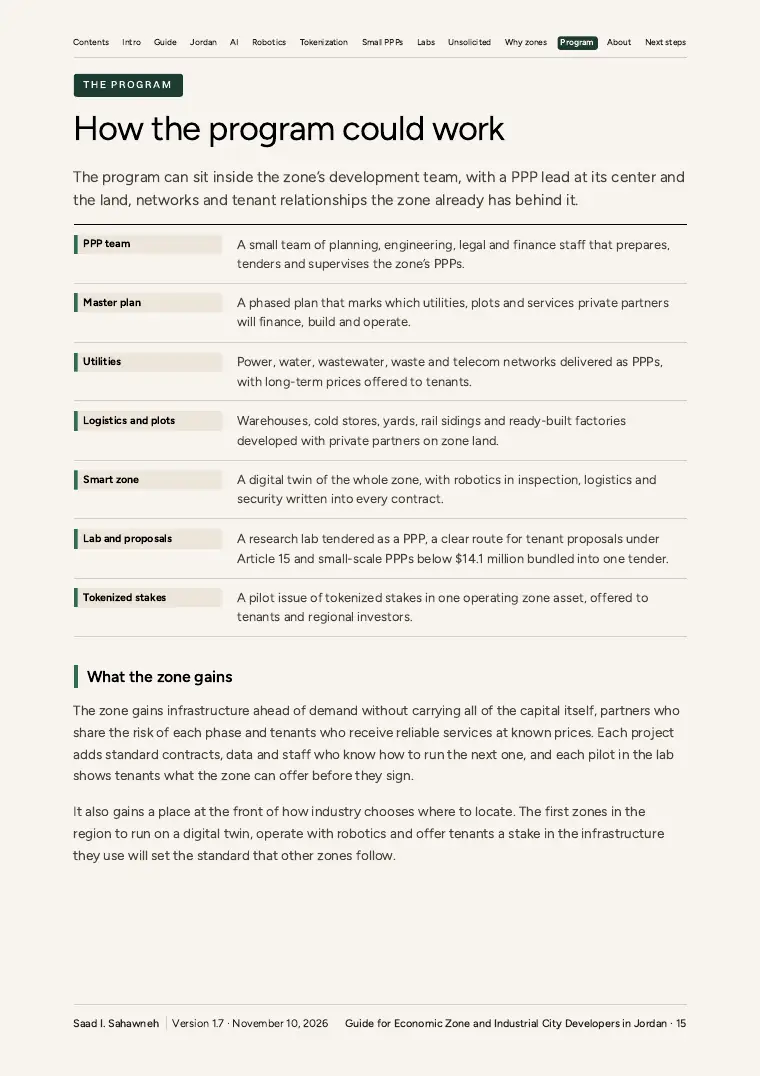
How the program could work
The program can sit inside the zone’s development team, with a PPP lead at its center and the land, networks and tenant relationships the zone already has behind it.
- PPP team
- A small team of planning, engineering, legal and finance staff that prepares, tenders and supervises the zone’s PPPs.
- Master plan
- A phased plan that marks which utilities, plots and services private partners will finance, build and operate.
- Utilities
- Power, water, wastewater, waste and telecom networks delivered as PPPs, with long-term prices offered to tenants.
- Logistics and plots
- Warehouses, cold stores, yards, rail sidings and ready-built factories developed with private partners on zone land.
- Smart zone
- A digital twin of the whole zone, with robotics in inspection, logistics and security written into every contract.
- Lab and proposals
- A research lab tendered as a PPP, a clear route for tenant proposals under Article 15 and small-scale PPPs below $14.1 million bundled into one tender.
- Tokenized stakes
- A pilot issue of tokenized stakes in one operating zone asset, offered to tenants and regional investors.
What the zone gains
The zone gains infrastructure ahead of demand without carrying all of the capital itself, partners who share the risk of each phase and tenants who receive reliable services at known prices. Each project adds standard contracts, data and staff who know how to run the next one, and each pilot in the lab shows tenants what the zone can offer before they sign.
It also gains a place at the front of how industry chooses where to locate. The first zones in the region to run on a digital twin, operate with robotics and offer tenants a stake in the infrastructure they use will set the standard that other zones follow.

Next steps
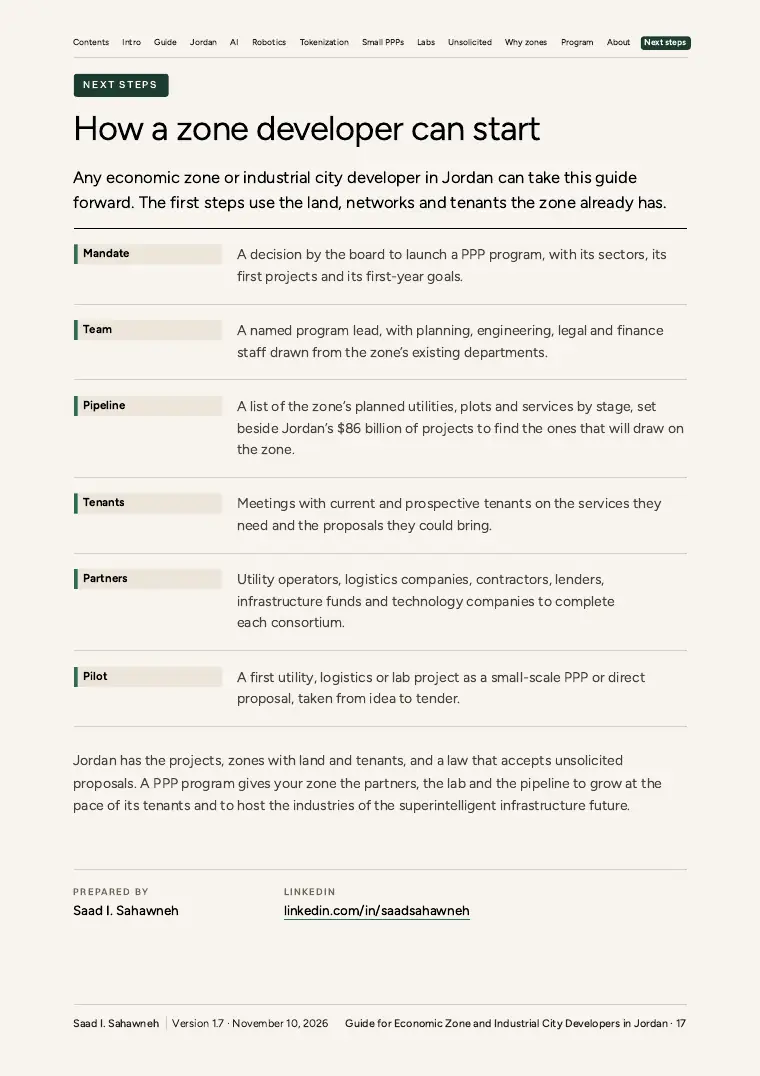
How a zone developer can start
Any economic zone or industrial city developer in Jordan can take this guide forward. The first steps use the land, networks and tenants the zone already has.
01
Mandate
A decision by the board to launch a PPP program, with its sectors, its first projects and its first-year goals.
02
Team
A named program lead, with planning, engineering, legal and finance staff drawn from the zone’s existing departments.
03
Pipeline
A list of the zone’s planned utilities, plots and services by stage, set beside Jordan’s $86 billion of projects to find the ones that will draw on the zone.
04
Tenants
Meetings with current and prospective tenants on the services they need and the proposals they could bring.
05
Partners
Utility operators, logistics companies, contractors, lenders, infrastructure funds and technology companies to complete each consortium.
06
Pilot
A first utility, logistics or lab project as a small-scale PPP or direct proposal, taken from idea to tender.
Jordan has the projects, zones with land and tenants, and a law that accepts unsolicited proposals. A PPP program gives your zone the partners, the lab and the pipeline to grow at the pace of its tenants and to host the industries of the superintelligent infrastructure future.
The full document
Inside this guide
Eighteen pages and fourteen chapters, from the case for a PPP program to the first steps, written for economic zone and industrial city developers in Jordan.
- 18
- pages
- 14
- chapters
- 3
- technologies
- 6
- first steps
01Introduction
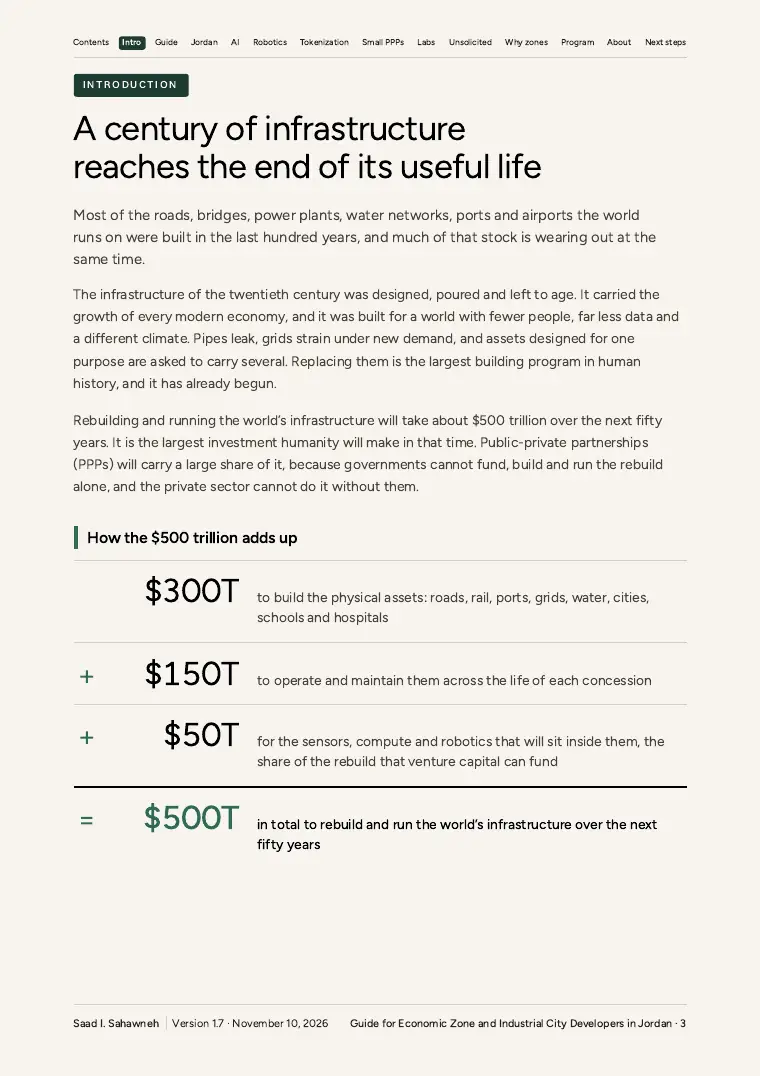
Why a century of infrastructure needs rebuilding, and the $500 trillion it will take.
Page 3 of 18
02The guide
Build the $500 trillion PPP infrastructure opportunity into Jordan’s zones
Page 5 of 18
03Jordan and Aqaba
An $86 billion pipeline to start with
Page 6 of 18
04Sector guides
The sectors closest to economic zone and industrial city developers, each with its own guide.
Page 7 of 18
05Artificial intelligence
How AI designs, structures and runs PPP projects, and what it means for economic zone and industrial city developers.
Page 8 of 18
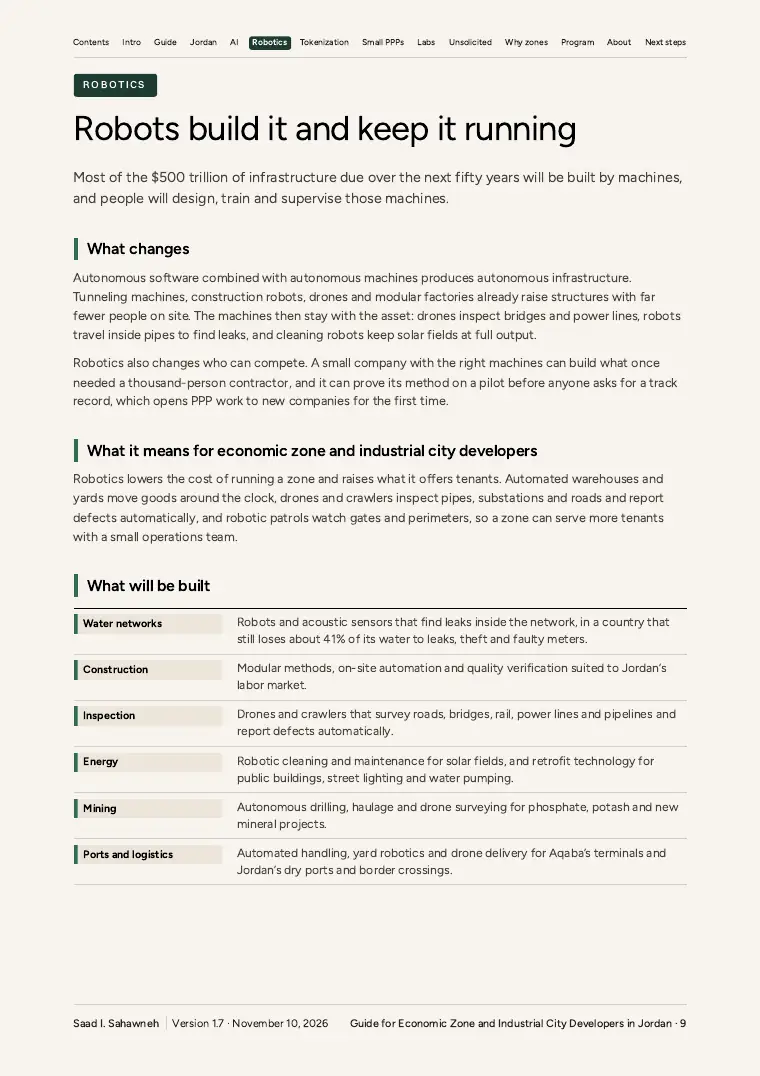
06Robotics
How robots build infrastructure and keep it running, and what that means for economic zone and industrial city developers.
Page 9 of 18
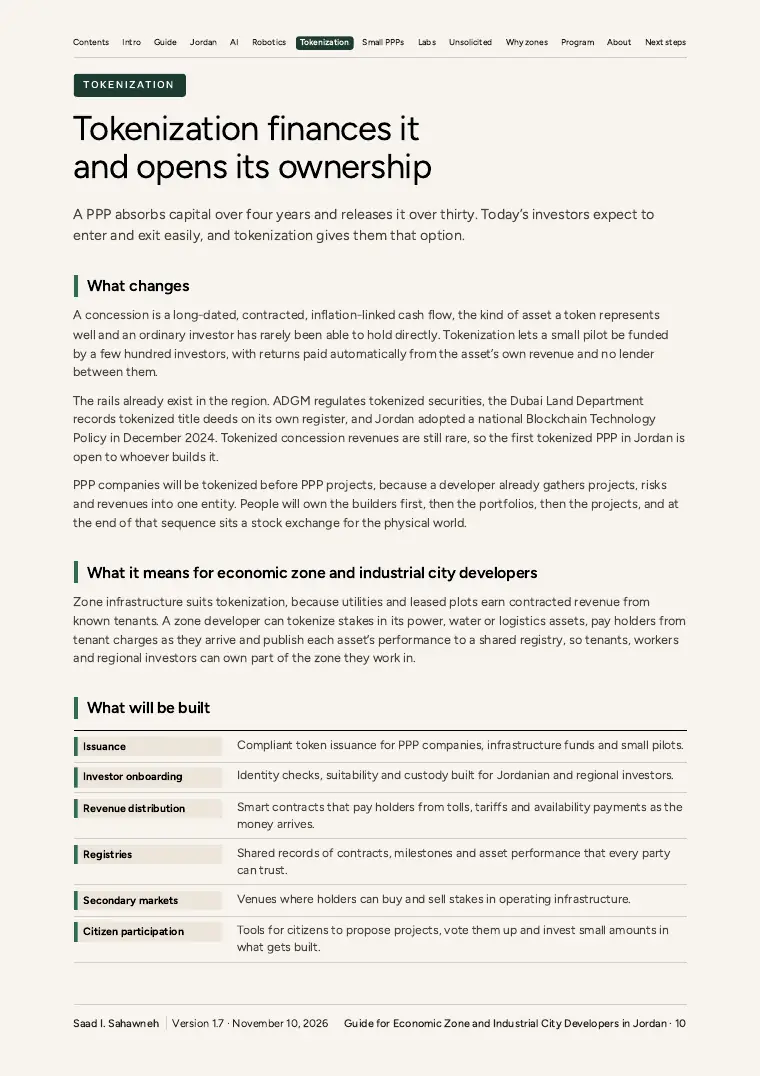
07Tokenization
How tokenization funds projects from their own revenue, and the role it opens for economic zone and industrial city developers.
Page 10 of 18
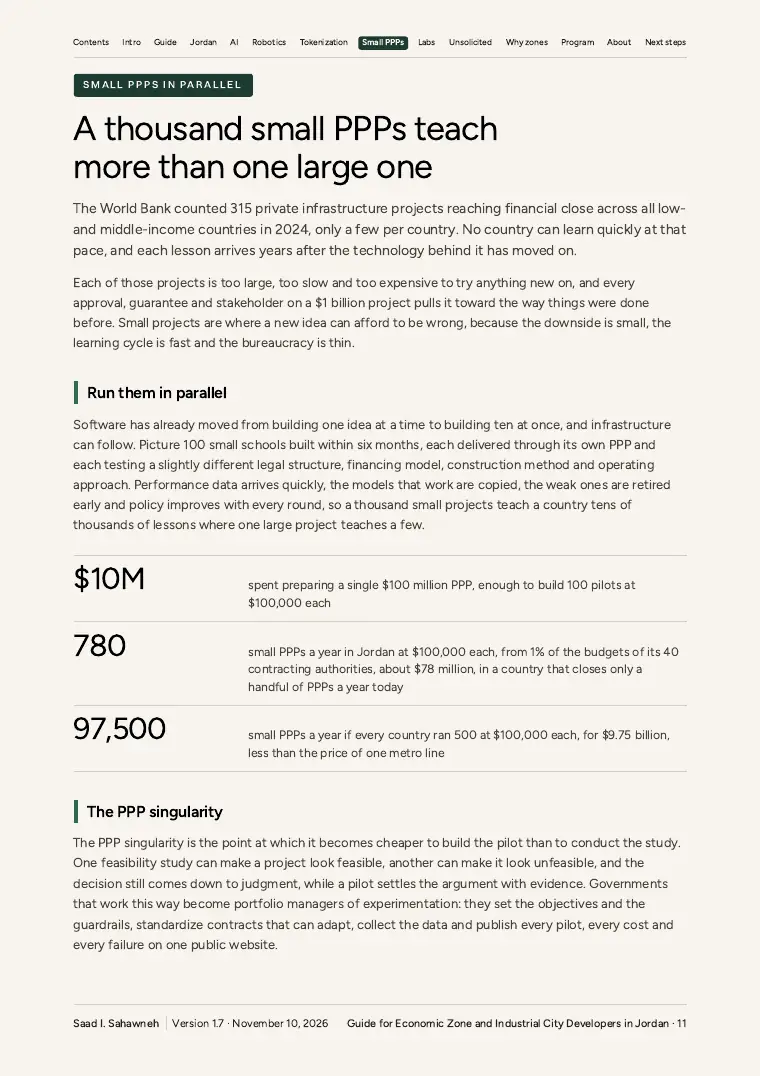
08Small PPPs in parallel
Why many small PPPs teach a country faster than a few large ones.
Page 11 of 18
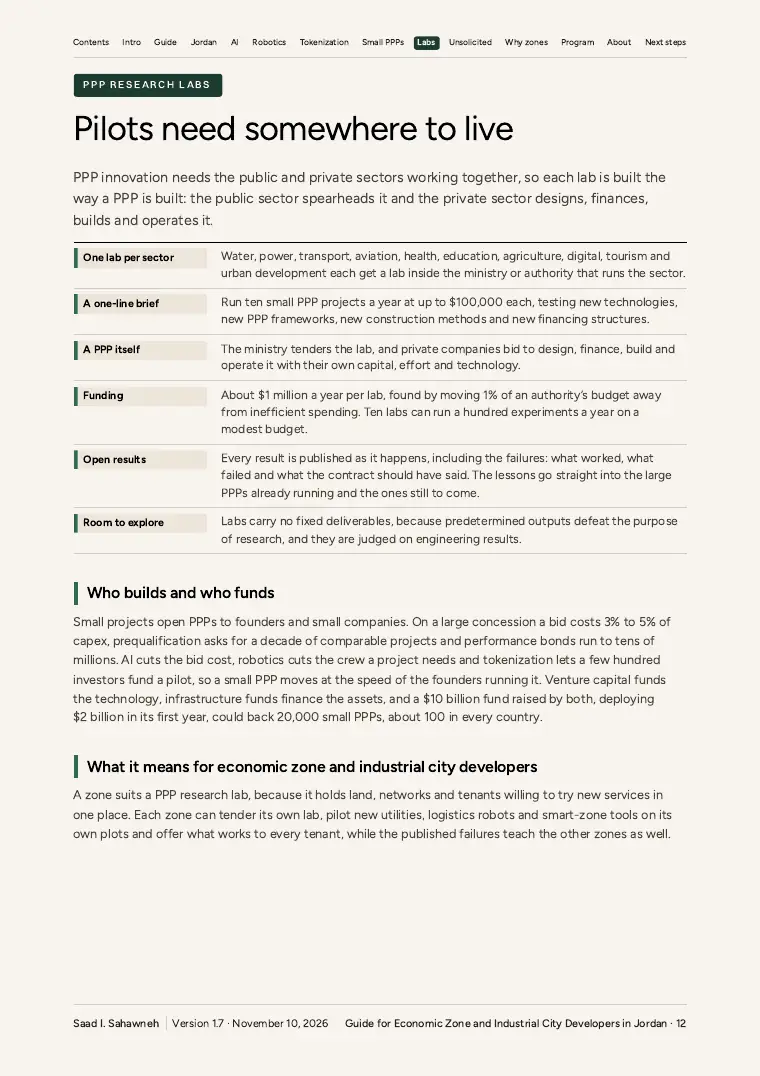
09PPP research labs
A lab in each sector, running ten small PPP projects a year.
Page 12 of 18
10Unsolicited proposals
How Jordan’s PPP law accepts direct proposals from private companies.
Page 13 of 18
11Why economic zone and industrial city developers
Zone developers hold the land, networks and tenants a PPP needs
Page 14 of 18
12The program
The program can sit inside the zone’s development team, with a PPP lead at its center and the land, networks and tenant relationships the zone already has behind it.
Page 15 of 18
13About
About Jordan PPP and what it offers.
Page 16 of 18
14Next steps
How a zone developer can start: six first steps.
Page 17 of 18
Questions
Questions about the organization guide for Economic Zone and Industrial City Developers in Jordan
- What does the organization guide for Economic Zone and Industrial City Developers in Jordan propose?
- Your zone launches its own public-private partnership (PPP) program for its power, water, waste, telecom, logistics and industrial plots, with a lab for small PPPs and an open door to proposals from tenants.
- Why should economic zone and industrial city developers in Jordan launch a PPP program?
- Zone developers hold the land, networks and tenants a PPP needs. A PPP needs land, utilities, approvals and customers, and a zone developer controls or coordinates all four inside its boundary. That makes a zone one of the fastest places in a country to prepare a PPP, test a new technology on live assets and offer the result to tenants who are already there.
- Which PPP projects can economic zone and industrial city developers in Jordan take part in?
- Jordan has about $86 billion of PPP and infrastructure projects in development, $46 billion of them anchored in Aqaba. Many of them sit in or beside an economic zone or industrial city and will draw on its land, utilities and logistics. A zone that proves a utility, logistics or smart-zone model on its own land can repeat it in every zone in the country.
- How can economic zone and industrial city developers in Jordan start a PPP program?
- Any economic zone or industrial city developer in Jordan can take this guide forward. The first steps use the land, networks and tenants the zone already has. The organization guide sets out six first steps: mandate, team, pipeline, tenants, partners and pilot.
- What does a PPP program give economic zone and industrial city developers in Jordan?
- The zone gains infrastructure ahead of demand without carrying all of the capital itself, partners who share the risk of each phase and tenants who receive reliable services at known prices. Each project adds standard contracts, data and staff who know how to run the next one, and each pilot in the lab shows tenants what the zone can offer before they sign.
- Is the organization guide for Economic Zone and Industrial City Developers in Jordan free?
- Yes. It is free to read on this page and free to download as an 18-page PDF, with the case for a PPP program, Jordan’s pipeline, the role of AI, robotics and tokenization, the program and six first steps.
Sector guides
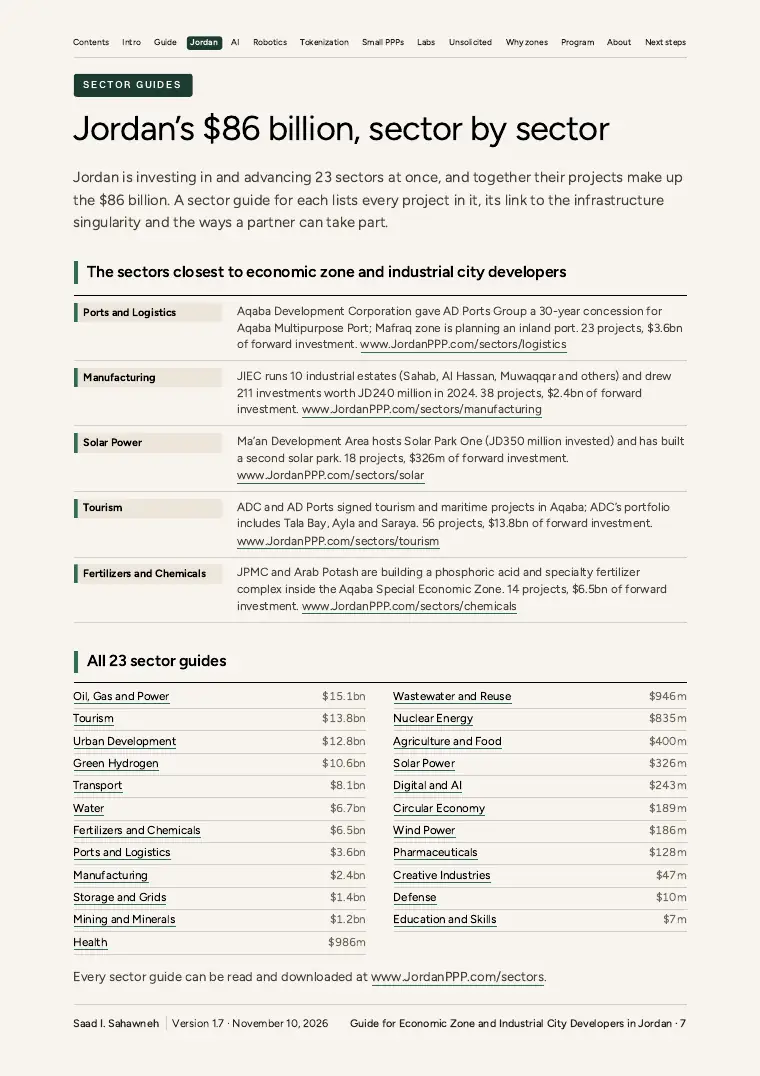
The sectors closest to economic zone and industrial city developers
Jordan’s $86 billion is spread across 23 sectors. Each sector guide lists every project in it and shows how to take part.
 Ports and Logistics$3.6bnAqaba Development Corporation gave AD Ports Group a 30-year concession for Aqaba Multipurpose Port; Mafraq zone is planning an inland port23 projects
 Manufacturing$2.4bnJIEC runs 10 industrial estates (Sahab, Al Hassan, Muwaqqar and others) and drew 211 investments worth JD240 million in 202438 projects
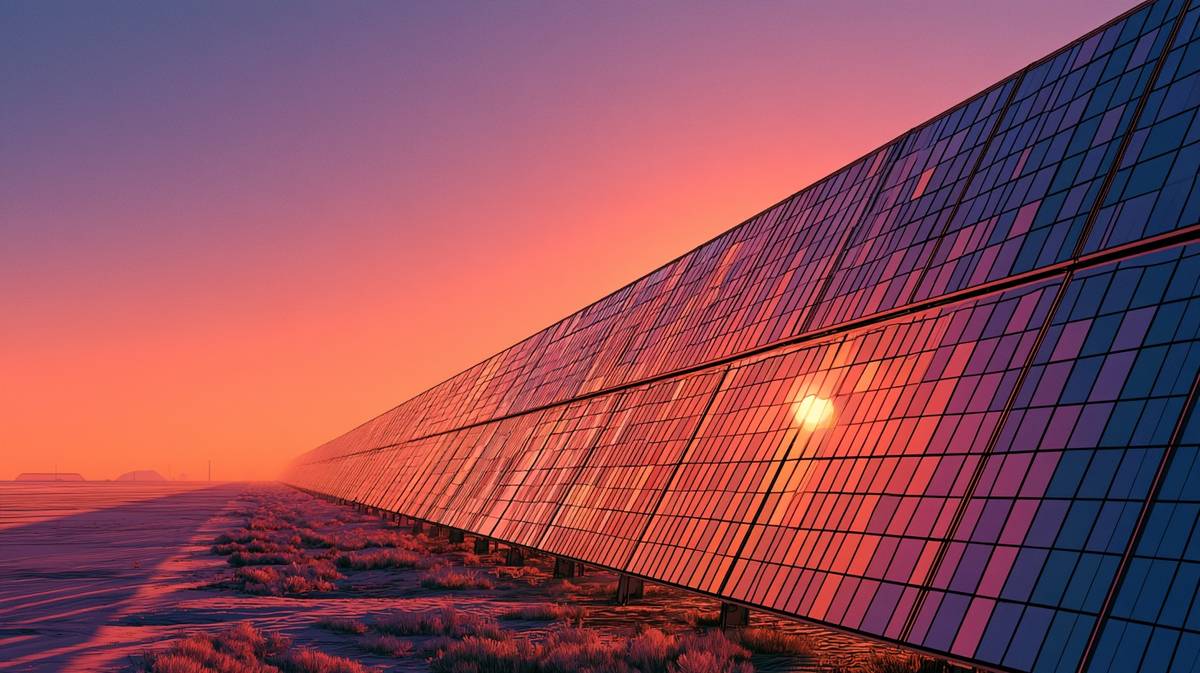 Solar Power$326mMa’an Development Area hosts Solar Park One (JD350 million invested) and has built a second solar park18 projects
 Tourism$13.8bnADC and AD Ports signed tourism and maritime projects in Aqaba; ADC’s portfolio includes Tala Bay, Ayla and Saraya56 projects
 Fertilizers and Chemicals$6.5bnJPMC and Arab Potash are building a phosphoric acid and specialty fertilizer complex inside the Aqaba Special Economic Zone14 projects
 Green Hydrogen$10.6bnASEZA and ADC allocated Aqaba land to Jordan Green Ammonia for green hydrogen and ammonia production12 projects
 Agriculture and Food$400mAl Muwaqqar Industrial Estate (JIEC) signed a JD10 million food manufacturing investment28 projects
 Pharmaceuticals$128mJIEC’s Al Salt Industrial Estate attracted a new pharmaceutical manufacturing investment10 projects
 Health$986mIrbid Development Area targets healthcare, pharmaceuticals and research beside JUST and King Abdullah University Hospital20 projects
 Digital and AI$243mIrbid Development Zone is building infrastructure and an international call center for IT and outsourcing investors19 projects
 Circular Economy$189mJIEC’s Zarqa Industrial City is planned as Jordan’s first eco-industrial zone22 projects
 Urban Development$12.8bnMa’an Development Company is master developer of a 9 km2 area with a residential community, industrial park and skills center30 projects
 Defense$10mDefense industrial park in Mafraq and the Industrial Gate zone at Al-Dhlail, both tied to JODDB9 projects
Guide 38 of 96
Browse all 96 organization guides