What this organization guide is for
Your institution launches a Jordan acceleration window for public-private partnerships (PPPs) that prepares projects, lends and guarantees beside private capital and backs small-scale pilots and tokenized notes.
The case
Development finance carries a market’s first PPPs to financial close
In emerging markets, development finance often decides whether a PPP reaches the market at all, because it pays for preparation, carries the risks commercial lenders avoid and brings private capital in behind it. Institutions that open a dedicated window now will shape how the rebuild is prepared and financed in the countries that need it most. This guide invites development finance institutions in Jordan to launch that window, starting with the projects at home.
The guide
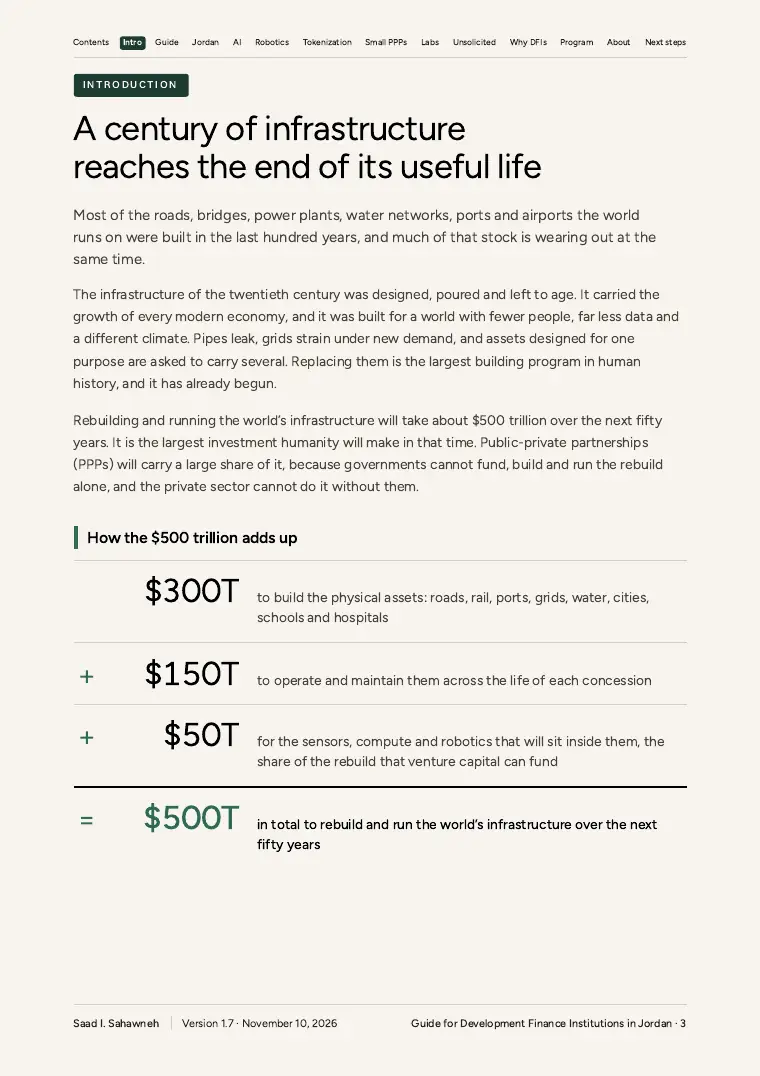
Accelerate Jordan’s share of the $500 trillion PPP infrastructure opportunity
Your institution launches a dedicated Jordan PPP acceleration window, with a team and a set of instruments that prepare projects, lend and guarantee beside private capital and fund the small pilots and new structures that commercial investors will follow, starting with Jordan’s $86 billion of projects and the $46 billion anchored in Aqaba.
01
Project preparation
A preparation facility pays for the feasibility studies, transaction advisors and market soundings that turn a public need into a bankable PPP. Technical assistance gives the PPP Unit and the contracting authorities the staff, tools and standard documents to prepare the next project themselves.
02
Loans, guarantees and risk cover
Senior and concessional loans, partial risk and credit guarantees and political risk cover sit beside commercial lenders on each project, so banks and investors take the risks they can price and the window carries the ones they cannot yet price.
03
Blended and first-loss finance
Concessional and first-loss tranches make the first projects in a new sector or structure investable for private capital. The same tools can anchor the first tokenized PPP notes in Jordan, where a small first-loss layer brings many investors in behind it.
04
Small-scale PPPs and research labs
Jordan’s PPP Regulation No. 9 of 2024 defines small-scale PPPs below $14.1 million, which can be bundled into one feasibility report and one tender, and PPP Law No. 19 of 2023 accepts direct private proposals under Article 15. The window funds bundled pilots and the PPP research labs that test new technology, contracts and finance before the large projects adopt them.
05
Lending in dinars
Tolls, tariffs and availability payments are paid in dinars. Dinar loans, guarantees on dinar bonds and partnerships with Jordanian banks let each project borrow in the currency it earns and bring Jordanian savings into its finance.
Why development finance institutions
Development finance carries a market’s first PPPs to financial close
In an emerging market, the first PPPs in a sector rarely close on commercial capital alone. Development finance institutions pay for preparation, lend for longer tenors, guarantee the risks private lenders avoid and bring the standards that later deals copy, so each project they back makes the next one easier to finance.
Where development finance fits in a PPP
- Preparation
- Preparation funding, transaction advice and technical assistance that turn a public need into a bankable tender.
- Tender
- Financing terms offered to bidders, which show the contracting authority that a project can be financed.
- Financial close
- Senior and concessional loans, guarantees, political risk cover and blended tranches beside the commercial lenders.
- Operation
- Monitoring of performance, environmental and social standards and the development results each project delivers.
- Exit
- Sales of loans and stakes to commercial investors, dinar bonds and sukuk, and tokenized notes that recycle capital into new projects.
What changes for development finance
AI, robotics and tokenization change how development capital is deployed. AI cuts the cost of preparing and appraising a project, so a preparation facility can carry more projects to market. Robotic construction and inspection lower the risks a long-term lender carries, and tokenized notes let a small concessional layer bring many private investors into a project, which makes each unit of development capital go further.
Why a window, and why now
Without a dedicated window, each Jordanian project is prepared and financed as a one-off, and the lessons from one rarely reach the next. A window gives the institution a team, a preparation facility, standard instruments and a working link to the PPP Unit and the contracting authorities, so each project moves faster than the last. Jordan’s pipeline is large and early, and preparation will decide how much of it reaches the market.

Futureproofing
Futureproof Development Finance Institutions in Jordan for the infrastructure singularity
This free 18-page guide shows how, with small PPPs in parallel, PPP research labs, artificial intelligence, robotics, tokenization and six first steps.
Jordan and Aqaba
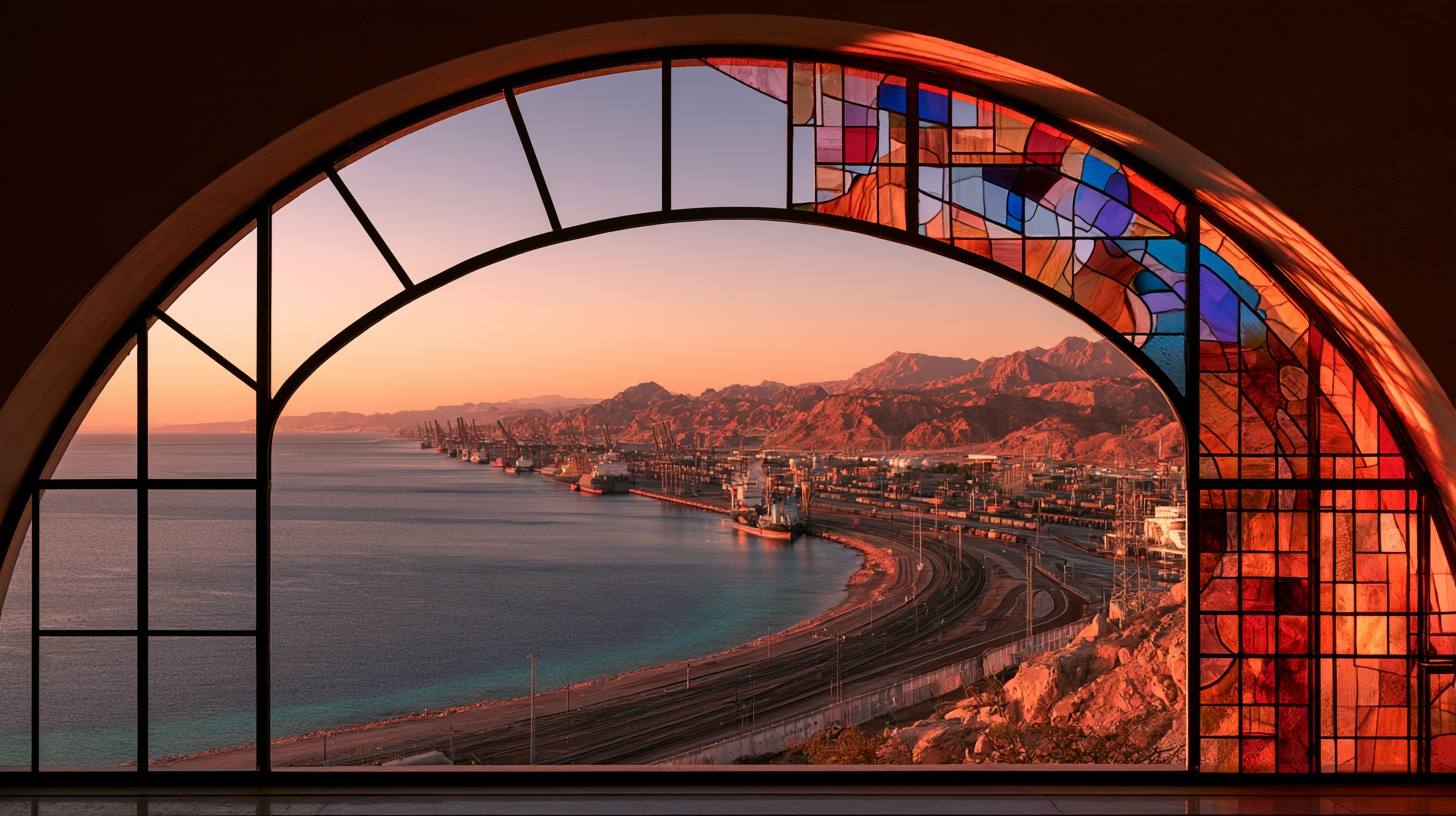
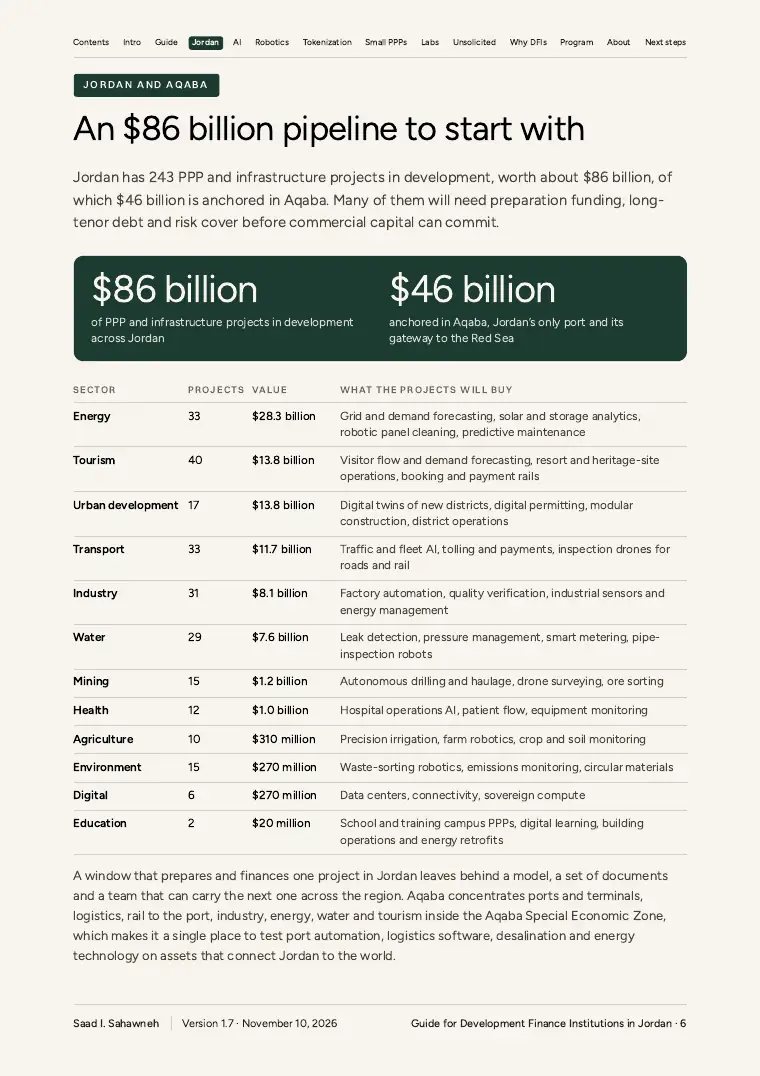
An $86 billion pipeline to start with
Many of them will need preparation funding, long-tenor debt and risk cover before commercial capital can commit. A window that prepares and finances one project in Jordan leaves behind a model, a set of documents and a team that can carry the next one across the region.
- $86B
- of PPP and infrastructure projects in development in Jordan
- $46B
- of them anchored in Aqaba

Artificial intelligence
AI lets a development finance institution prepare and appraise more projects with the same team. Feasibility studies, environmental and social reviews, financial models and contracts can be drafted, tested and compared in days, so preparation funding goes further and appraisal moves faster. Once a project is running, sensors and digital twins report its performance and its development results on live data, which makes monitoring cheaper and results easier to prove.

Robotics
Robotics lowers the construction and maintenance risk that a development lender carries for the life of a loan. Robotic construction keeps projects closer to schedule, and drones and crawlers inspect roads, pipes and power lines and report defects automatically, which gives the lender and the public an independent record of how each asset performs. Technical assistance can train the Jordanian technicians who run and repair the machines, so the skills stay in the country.

Tokenization
Tokenization opens infrastructure to many more investors, and development finance can make the first issues safe enough to buy. A development finance institution can anchor the first tokenized PPP notes in Jordan with a first-loss tranche or a guarantee, fund the legal and technical work behind them and publish each project’s performance to a shared registry, so later issues can follow with less support.

Small PPPs and research labs
Small PPPs give development finance a way to test new technology, contracts and financing structures on real assets at low cost. A development finance institution can fund the labs and their pilots through grants or concessional tranches, require every result to be published and carry what works into the large loans and guarantees it plans in Jordan.

Unsolicited proposals
Direct proposals bring development finance institutions projects at their earliest stage, often from Jordanian companies with strong ideas and thin balance sheets. A preparation facility can co-fund the pre-feasibility study a proposal needs, and an early indication of finance or risk cover strengthens its financial case at review. The proposer’s right to match the best offer protects that early work, and bundled small-scale proposals fit a single financing package.
The program
How the program could work
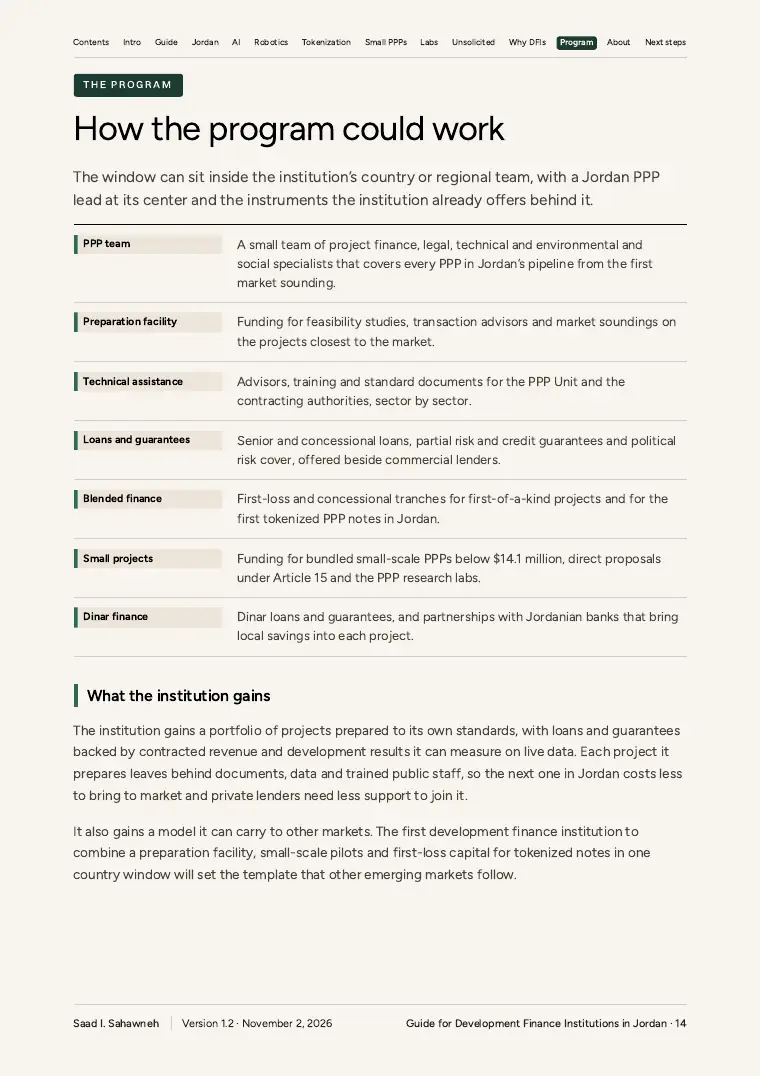
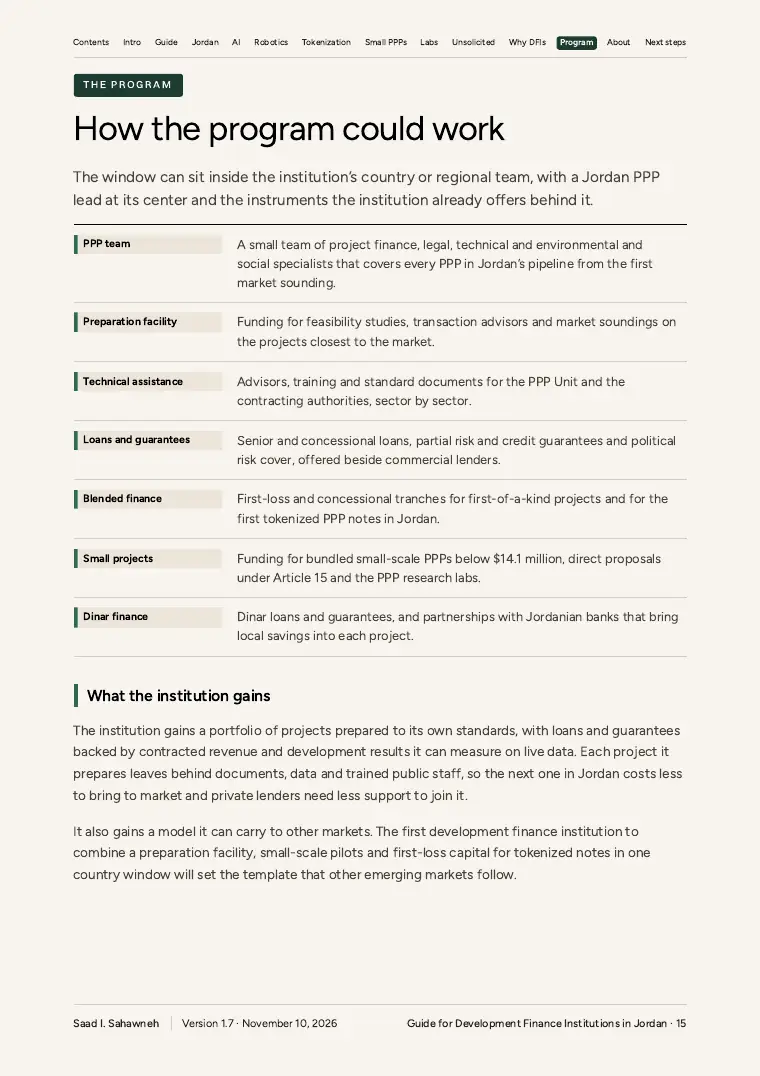
The window can sit inside the institution’s country or regional team, with a Jordan PPP lead at its center and the instruments the institution already offers behind it.
- PPP team
- A small team of project finance, legal, technical and environmental and social specialists that covers every PPP in Jordan’s pipeline from the first market sounding.
- Preparation facility
- Funding for feasibility studies, transaction advisors and market soundings on the projects closest to the market.
- Technical assistance
- Advisors, training and standard documents for the PPP Unit and the contracting authorities, sector by sector.
- Loans and guarantees
- Senior and concessional loans, partial risk and credit guarantees and political risk cover, offered beside commercial lenders.
- Blended finance
- First-loss and concessional tranches for first-of-a-kind projects and for the first tokenized PPP notes in Jordan.
- Small projects
- Funding for bundled small-scale PPPs below $14.1 million, direct proposals under Article 15 and the PPP research labs.
- Dinar finance
- Dinar loans and guarantees, and partnerships with Jordanian banks that bring local savings into each project.
What the institution gains
The institution gains a portfolio of projects prepared to its own standards, with loans and guarantees backed by contracted revenue and development results it can measure on live data. Each project it prepares leaves behind documents, data and trained public staff, so the next one in Jordan costs less to bring to market and private lenders need less support to join it.
It also gains a model it can carry to other markets. The first development finance institution to combine a preparation facility, small-scale pilots and first-loss capital for tokenized notes in one country window will set the template that other emerging markets follow.

Next steps
How a development finance institution can start
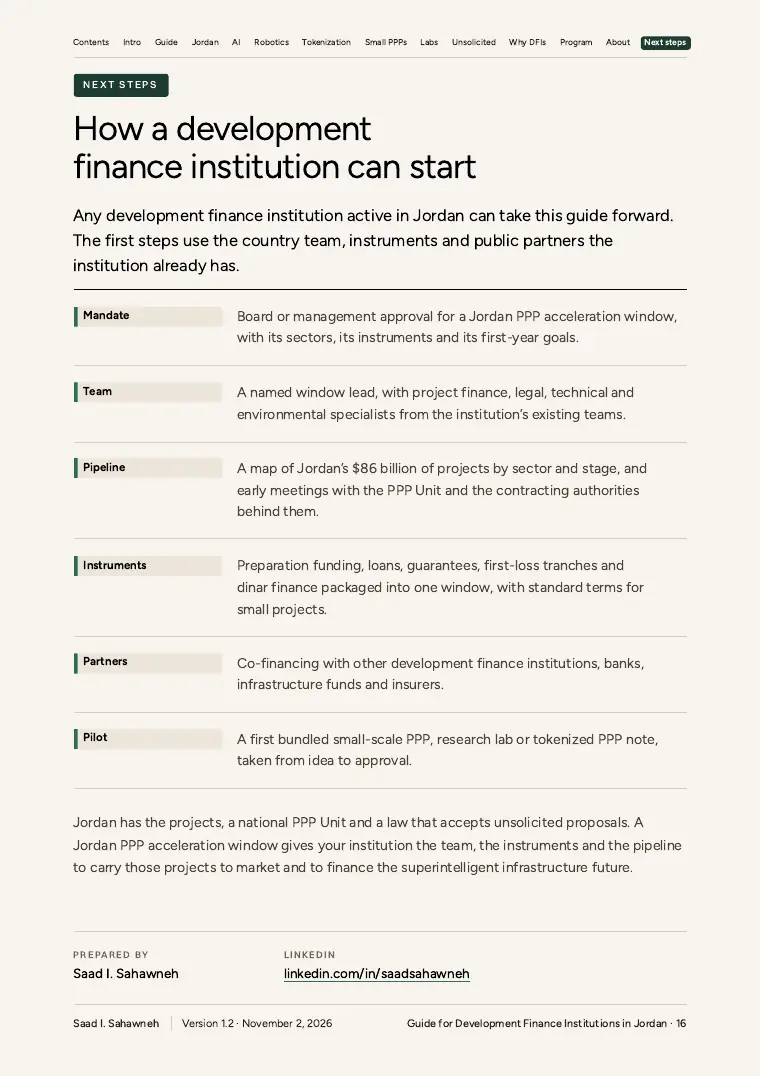
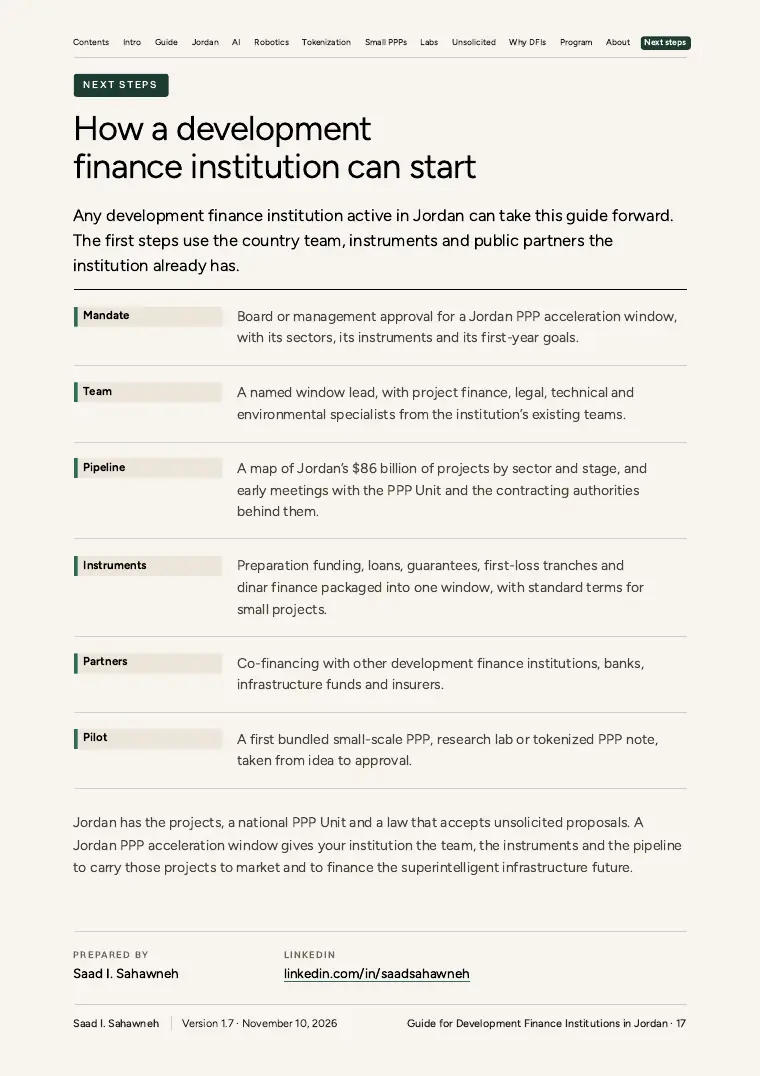
Any development finance institution active in Jordan can take this guide forward. The first steps use the country team, instruments and public partners the institution already has.
01
Mandate
Board or management approval for a Jordan PPP acceleration window, with its sectors, its instruments and its first-year goals.
02
Team
A named window lead, with project finance, legal, technical and environmental specialists from the institution’s existing teams.
03
Pipeline
A map of Jordan’s $86 billion of projects by sector and stage, and early meetings with the PPP Unit and the contracting authorities behind them.
04
Instruments
Preparation funding, loans, guarantees, first-loss tranches and dinar finance packaged into one window, with standard terms for small projects.
05
Partners
Co-financing with other development finance institutions, banks, infrastructure funds and insurers.
06
Pilot
A first bundled small-scale PPP, research lab or tokenized PPP note, taken from idea to approval.
Jordan has the projects, a national PPP Unit and a law that accepts unsolicited proposals. A Jordan PPP acceleration window gives your institution the team, the instruments and the pipeline to carry those projects to market and to finance the superintelligent infrastructure future.
The full document
Inside this guide
Eighteen pages and fourteen chapters, from the case for a PPP program to the first steps, written for development finance institutions in Jordan.
- 18
- pages
- 14
- chapters
- 3
- technologies
- 6
- first steps
01Introduction
Why a century of infrastructure needs rebuilding, and the $500 trillion it will take.
Page 3 of 18
02The guide
Accelerate Jordan’s share of the $500 trillion PPP infrastructure opportunity
Page 5 of 18
03Jordan and Aqaba
An $86 billion pipeline to start with
Page 6 of 18
04Sector guides
The sectors closest to development finance institutions, each with its own guide.
Page 7 of 18
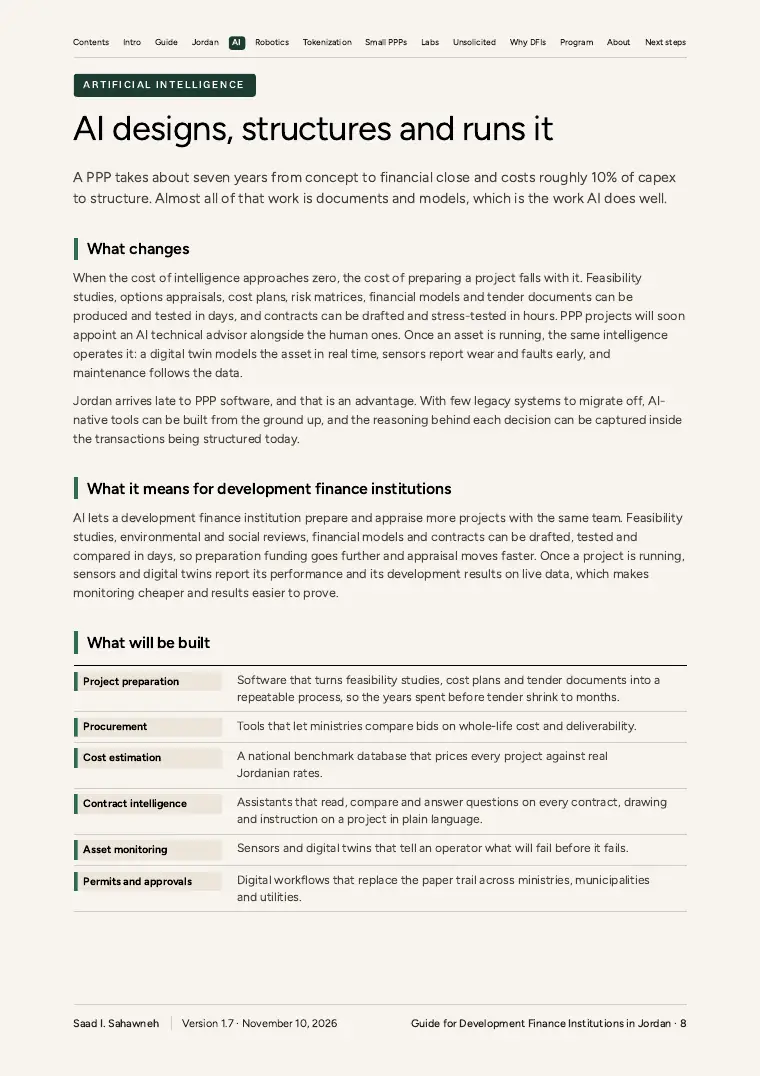
05Artificial intelligence
How AI designs, structures and runs PPP projects, and what it means for development finance institutions.
Page 8 of 18
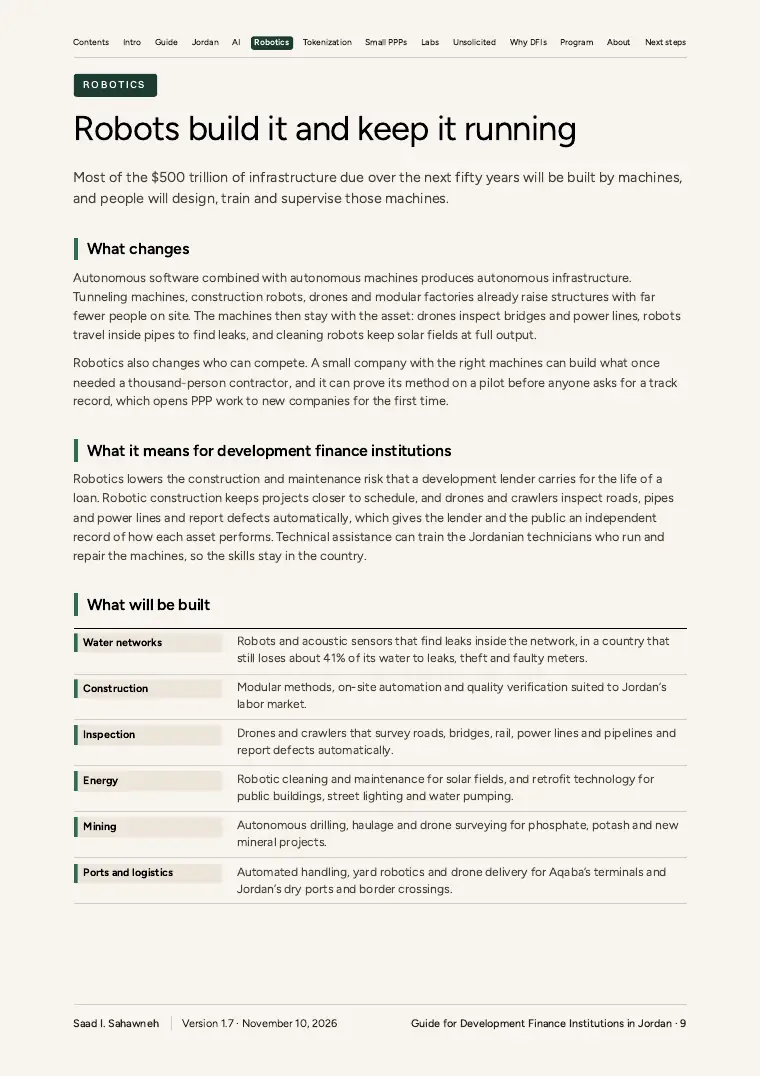
06Robotics
How robots build infrastructure and keep it running, and what that means for development finance institutions.
Page 9 of 18
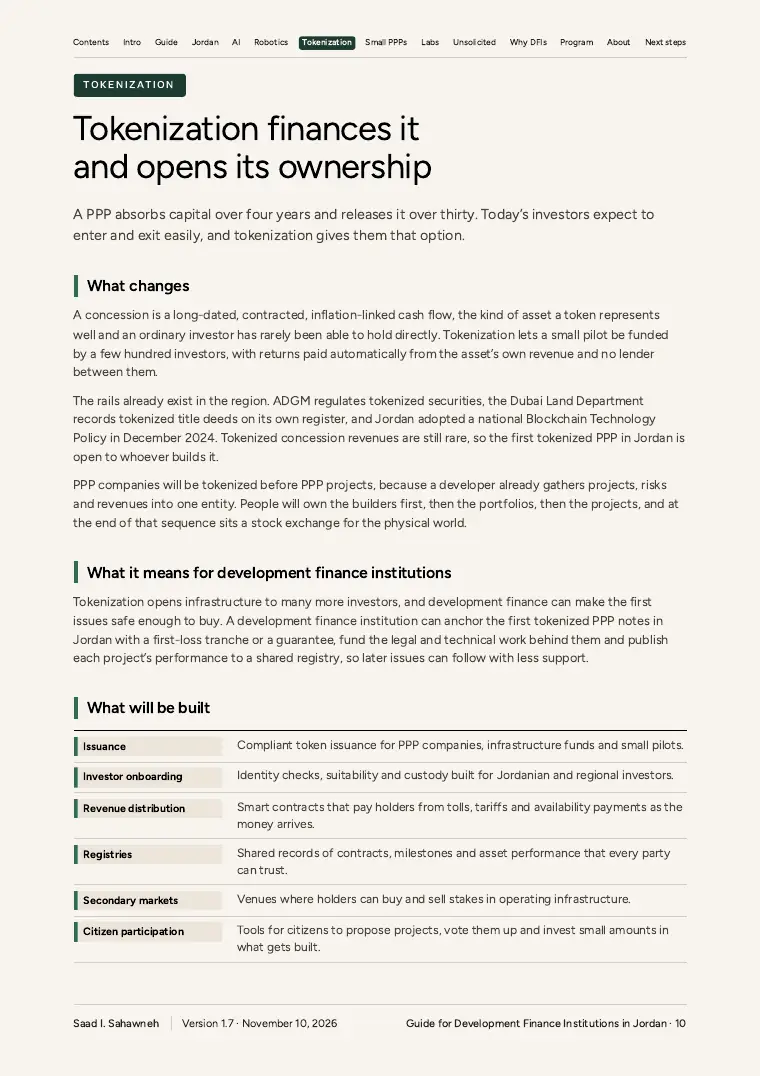
07Tokenization
How tokenization funds projects from their own revenue, and the role it opens for development finance institutions.
Page 10 of 18
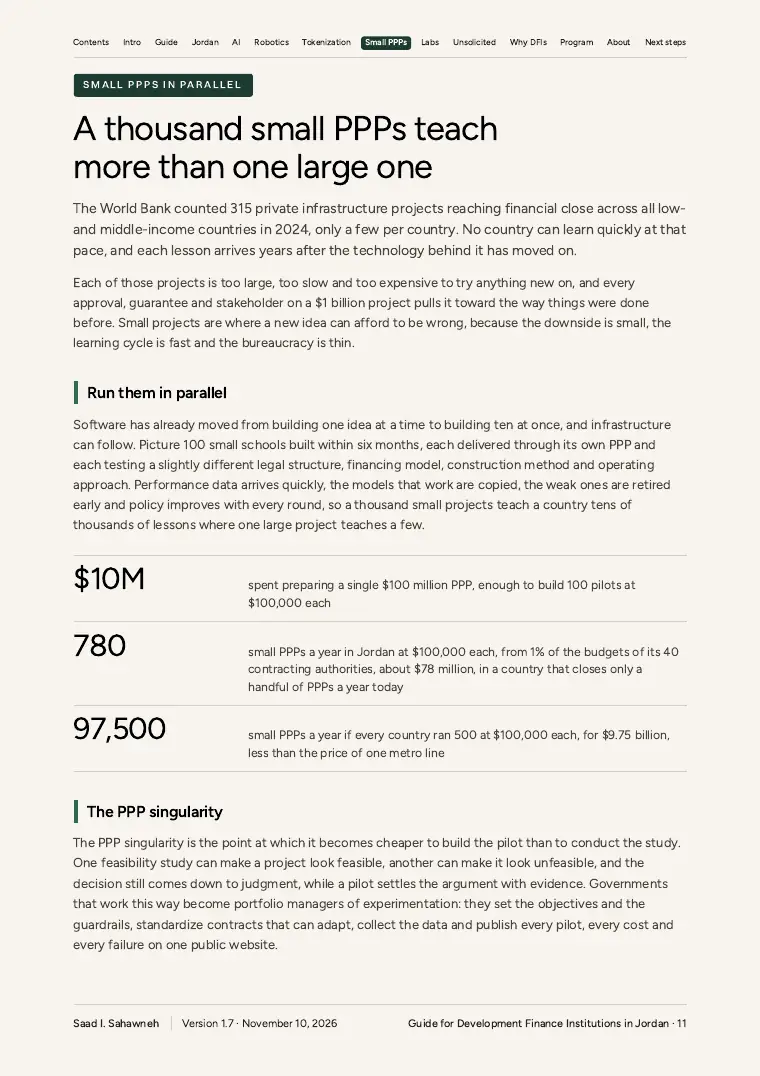
08Small PPPs in parallel
Why many small PPPs teach a country faster than a few large ones.
Page 11 of 18
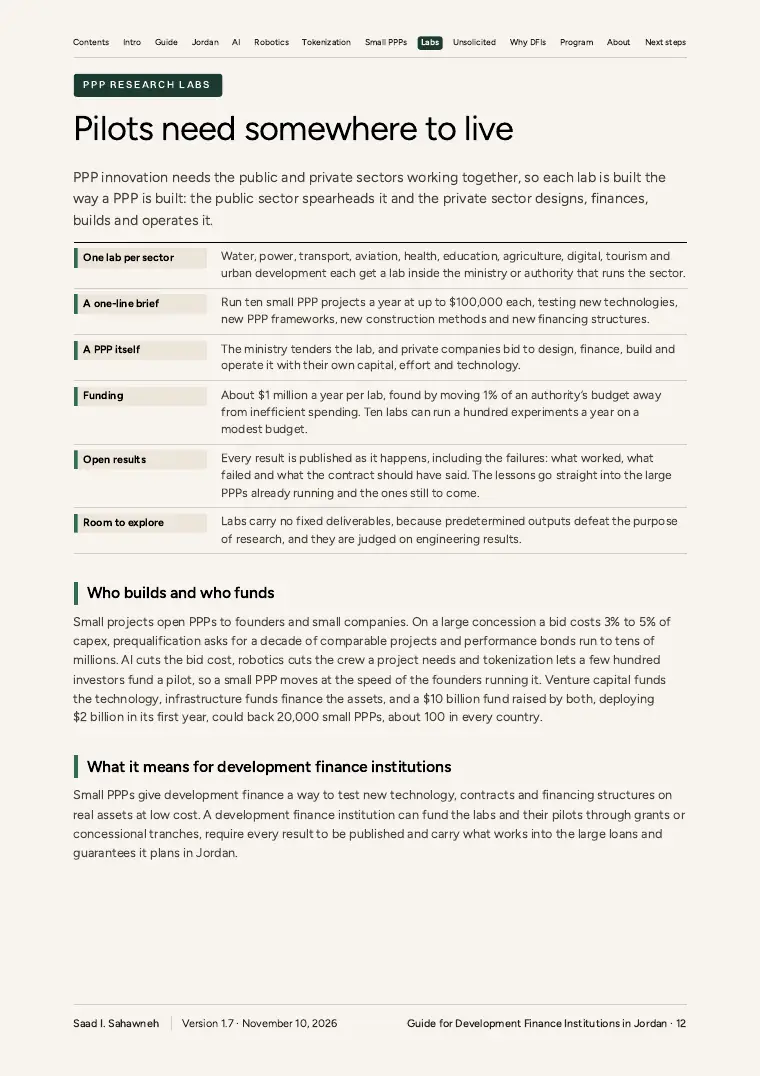
09PPP research labs
A lab in each sector, running ten small PPP projects a year.
Page 12 of 18
10Unsolicited proposals
How Jordan’s PPP law accepts direct proposals from private companies.
Page 13 of 18
11Why development finance institutions
Development finance carries a market’s first PPPs to financial close
Page 14 of 18
12The program
The window can sit inside the institution’s country or regional team, with a Jordan PPP lead at its center and the instruments the institution already offers behind it.
Page 15 of 18
13About
About Jordan PPP and what it offers.
Page 16 of 18
14Next steps
How a development finance institution can start: six first steps.
Page 17 of 18
Questions
Questions about the organization guide for Development Finance Institutions in Jordan
- What does the organization guide for Development Finance Institutions in Jordan propose?
- Your institution launches a Jordan acceleration window for public-private partnerships (PPPs) that prepares projects, lends and guarantees beside private capital and backs small-scale pilots and tokenized notes.
- Why should development finance institutions in Jordan launch a PPP program?
- Development finance carries a market’s first PPPs to financial close. In an emerging market, the first PPPs in a sector rarely close on commercial capital alone. Development finance institutions pay for preparation, lend for longer tenors, guarantee the risks private lenders avoid and bring the standards that later deals copy, so each project they back makes the next one easier to finance.
- Which PPP projects can development finance institutions in Jordan take part in?
- Jordan has about $86 billion of PPP and infrastructure projects in development, $46 billion of them anchored in Aqaba. Many of them will need preparation funding, long-tenor debt and risk cover before commercial capital can commit. A window that prepares and finances one project in Jordan leaves behind a model, a set of documents and a team that can carry the next one across the region.
- How can development finance institutions in Jordan start a PPP program?
- Any development finance institution active in Jordan can take this guide forward. The first steps use the country team, instruments and public partners the institution already has. The organization guide sets out six first steps: mandate, team, pipeline, instruments, partners and pilot.
- What does a PPP program give development finance institutions in Jordan?
- The institution gains a portfolio of projects prepared to its own standards, with loans and guarantees backed by contracted revenue and development results it can measure on live data. Each project it prepares leaves behind documents, data and trained public staff, so the next one in Jordan costs less to bring to market and private lenders need less support to join it.
- Is the organization guide for Development Finance Institutions in Jordan free?
- Yes. It is free to read on this page and free to download as an 18-page PDF, with the case for a PPP program, Jordan’s pipeline, the role of AI, robotics and tokenization, the program and six first steps.
Sector guides
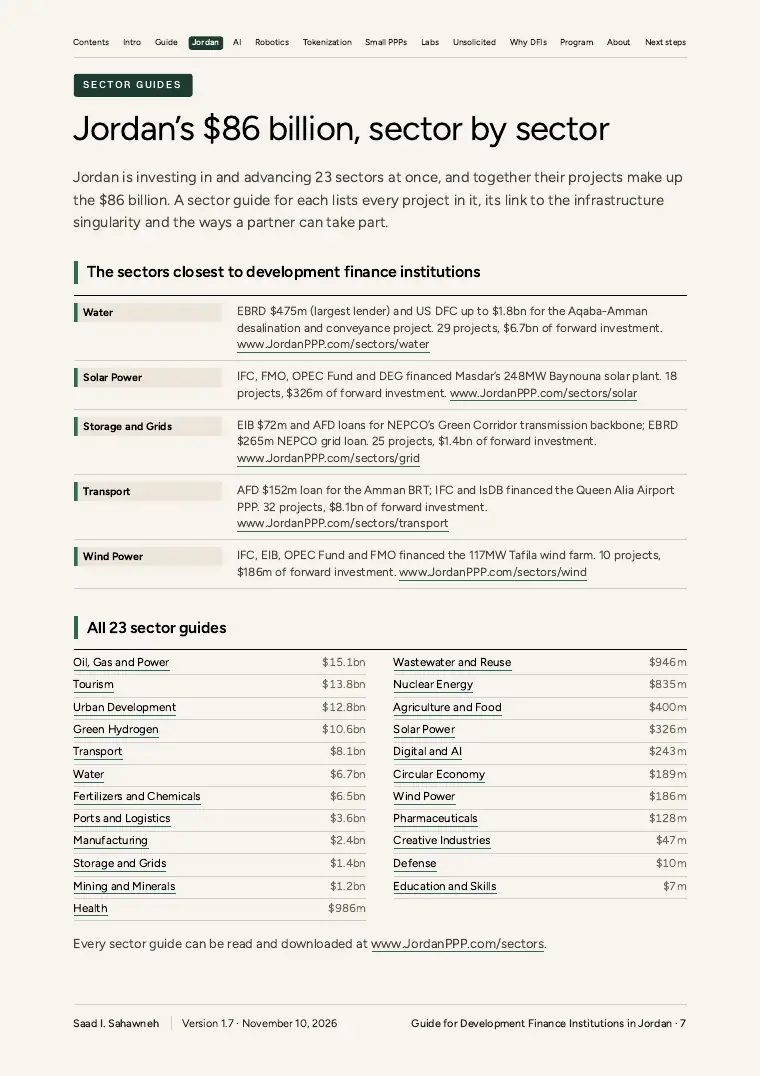
The sectors closest to development finance institutions
Jordan’s $86 billion is spread across 23 sectors. Each sector guide lists every project in it and shows how to take part.
 Water$6.7bnEBRD $475m (largest lender) and US DFC up to $1.8bn for the Aqaba-Amman desalination and conveyance project29 projects
 Solar Power$326mIFC, FMO, OPEC Fund and DEG financed Masdar’s 248MW Baynouna solar plant18 projects
 Storage and Grids$1.4bnEIB $72m and AFD loans for NEPCO’s Green Corridor transmission backbone; EBRD $265m NEPCO grid loan25 projects
 Transport$8.1bnAFD $152m loan for the Amman BRT; IFC and IsDB financed the Queen Alia Airport PPP32 projects
 Wind Power$186mIFC, EIB, OPEC Fund and FMO financed the 117MW Tafila wind farm10 projects
 Health$986mWorld Bank $400m Health Sector Reform Programme (approved by Cabinet 2026)20 projects
 Education and Skills$7mKfW grants for school construction and double-shift schools in refugee-hosting areas12 projects
 Tourism$13.8bnIFC $35.5m and EBRD $35.5m loans to the Ayla development for Marina Village and Pulse Hotel, Aqaba56 projects
 Circular Economy$189mEBRD and EU finance new cells and landfill gas capture at Al Ghabawi, Jordan’s largest landfill22 projects
 Wastewater and Reuse$946mSaudi Fund for Development financing used to rehabilitate sewage networks20 projects
 Urban Development$12.8bnEBRD loan package to Greater Amman Municipality for municipal services30 projects
 Digital and AI$243mWorld Bank $200m Youth, Technology and Jobs project (digital government services, digital skills)19 projects
 Agriculture and Food$400mEBRD’s first Jordan agribusiness loan, about EUR19m to Al Jazeera poultry; EBRD $100m to Almarai incl. its Jordan dairy unit28 projects
 Pharmaceuticals$128mIFC has lent to Hikma since 1987 (e.g. $250m in 2025); EBRD funded Hikma medicine production in Jordan (2014)10 projects
 Mining and Minerals$1.2bnIFC $50m loan to Jordan Phosphate Mines for its Aqaba terminal; EIB loan for phosphate mine expansion29 projects
 Fertilizers and Chemicals$6.5bnEIB loans for the Jordan Bromine plant and the KEMAPCO plant (Arab Potash JV)14 projects
 Ports and Logistics$3.6bnEIB loan to upgrade Aqaba port (container jetty and handling equipment)23 projects
 Manufacturing$2.4bnEIB global loans for industrial projects in Jordan38 projects
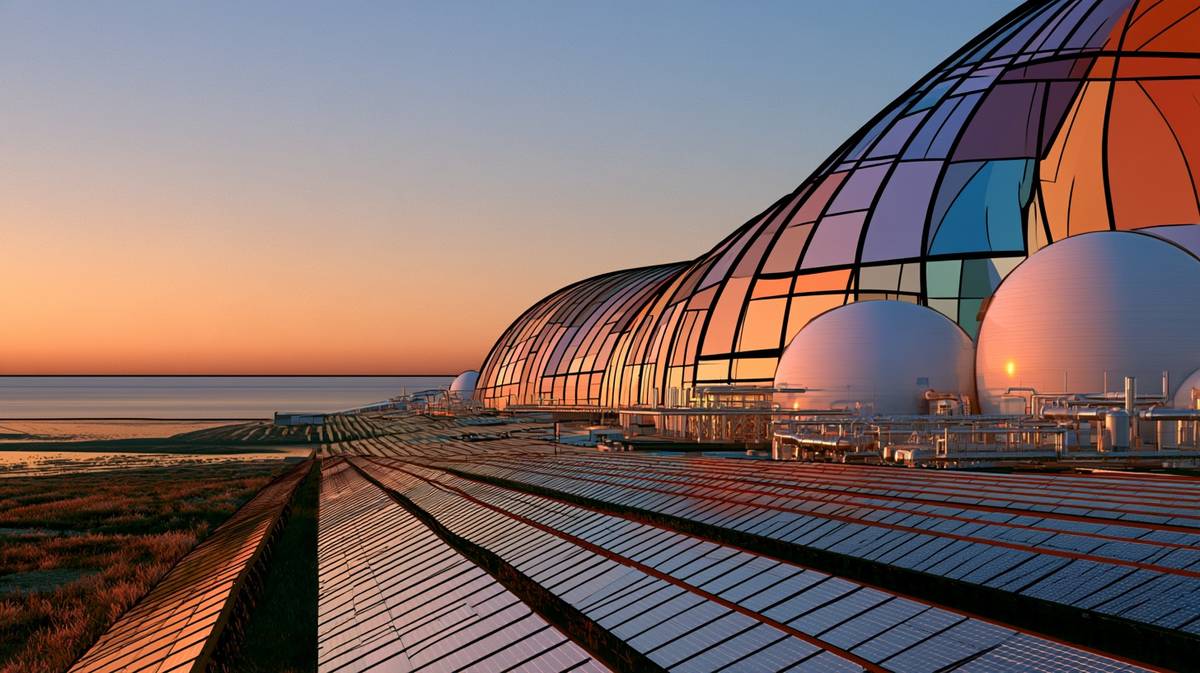 Green Hydrogen$10.6bnEBRD advisory project for green hydrogen common infrastructure in the Aqaba SEZ12 projects
Guide 26 of 96
Browse all 96 organization guides