What this organization guide is for
Your company launches a PPP program that prepares public-private partnership (PPP) projects with AI, runs small-scale PPPs in parallel and brings its own direct proposals to government.
The case
PPP developers carry a project from idea to financial close
A PPP takes about seven years and roughly 10% of its capital cost to reach financial close, and the developer carries that cost and its risk long before any revenue arrives. Developers that build a new kind of program now, with AI preparing the projects, small PPPs running in parallel and ownership opened through tokens, will lead the consortiums of the next fifty years. This guide invites PPP developers in Jordan to launch that program, starting with the projects at home.
The guide
Develop the $500 trillion PPP infrastructure opportunity
Your company launches a dedicated PPP program, a team and a set of tools that prepare projects with AI, run small-scale PPPs in parallel, bring direct proposals to government and open the company’s ownership through tokenization, starting with Jordan’s $86 billion of projects and the $46 billion anchored in Aqaba.
01
AI-native project development
The company prepares feasibility studies, financial models, risk matrices and bid documents with AI, so each project costs less to bid and moves faster to financial close, and the same team can pursue more of the pipeline.
02
Direct proposals as the front door
Jordan’s PPP Law No. 19 of 2023 accepts direct private proposals under Article 15. The company can originate its own projects, shape them before any tender exists and keep the right to match the best offer if a project goes to tender.
03
A portfolio of small-scale PPPs
PPP Regulation No. 9 of 2024 defines small-scale PPPs below $14.1 million, which can be bundled into one feasibility report and one tender. The company can run many of them in parallel on standard terms, test a different structure on each and carry what works into its large bids.
04
Consortiums built around technology
The company brings AI, robotics and sensor partners into each consortium from the first market sounding, beside its contractors, operators and lenders, so the bid prices a lower build cost and a better-run asset.
05
A tokenized developer company
A developer already gathers projects, risks and revenues into one entity, which makes it a natural first issuer of tokenized PPP ownership. The company can open part of its equity or its operating portfolio to regional investors and recycle the capital into new bids.
Why PPP developers
PPP developers carry a project from idea to financial close
A PPP needs someone to originate it, assemble the consortium and carry its cost and risk for years before any revenue arrives. That role falls to the developer, which then holds the equity for the life of the concession.
Where developers fit in a PPP
- Origination
- Identifying the project and shaping it with the contracting authority, or bringing it to government as a direct proposal.
- Consortium
- Choosing the contractor, the operator, the technology partners and the co-investors, and agreeing the terms that bind them.
- Bid
- The financial model, the technical offer and the price, prepared at the developer’s own cost and risk.
- Financial close
- Lender due diligence, permits, land, offtake and the security package that turn a preferred bid into a funded project.
- Ownership
- Equity in the project company through construction and operation, held for the concession or recycled into the next bid.
What changes for developers
AI, robotics and tokenization change the economics of development. AI lowers the cost of preparing and bidding a project, so a developer can pursue more of the pipeline with the same capital. Robotic and modular construction narrow the gap between the price in the bid and the asset as built, which lenders reward. Tokenization lets a developer raise and recycle equity from a wider pool of investors, beginning with the developer company itself.
Why a program, and why now
A developer that bids one large project at a time prepares each from scratch and waits years for the lessons. A program gives your company a repeatable method for preparing projects with AI, a portfolio of small PPPs that test new structures in parallel and a pipeline of its own direct proposals. Jordan’s pipeline is large and early, and the developers that shape projects now will lead the consortiums that build them.

Futureproofing
Futureproof PPP Developers in Jordan for the infrastructure singularity
This free 18-page guide shows how, with small PPPs in parallel, PPP research labs, artificial intelligence, robotics, tokenization and six first steps.
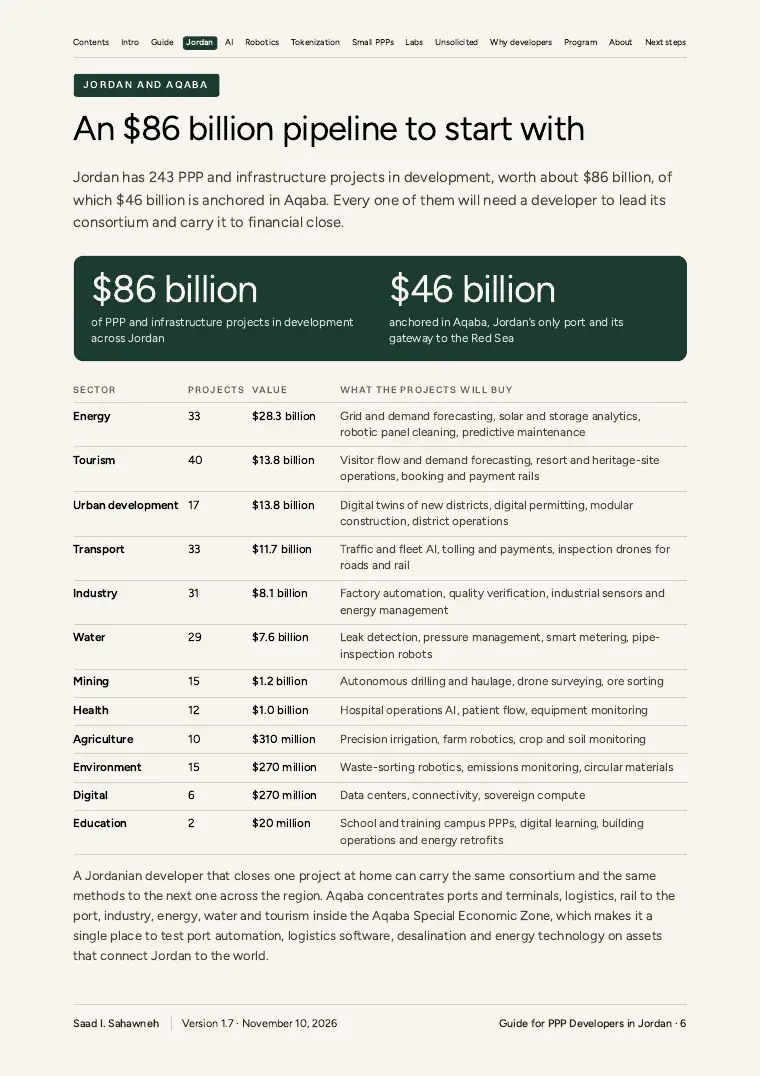
Jordan and Aqaba
An $86 billion pipeline to start with
Every one of them will need a developer to lead its consortium and carry it to financial close. A Jordanian developer that closes one project at home can carry the same consortium and the same methods to the next one across the region.
- $86B
- of PPP and infrastructure projects in development in Jordan
- $46B
- of them anchored in Aqaba

Artificial intelligence
AI cuts the cost and time a developer carries before financial close. A small team can screen the pipeline, read a tender and its draft concession agreement, build and stress-test a financial model and draft a direct proposal in days, so the company can bid on more projects with less development capital at risk. After close, the same models feed the digital twin that the lenders, the operator and the government rely on.

Robotics
Robotics changes the risks a developer prices into each bid. Modular construction, site robots and drones make the cost and schedule of the build more certain, and inspection and maintenance robots lower the operating cost across the concession, so the consortium can offer a lower tariff or availability payment and still repay its lenders on schedule.

Tokenization
Tokenization reaches developers first, because a developer already holds many projects in one company. Your company can tokenize part of its own equity or a portfolio of operating stakes, raise development capital from a wider pool of investors, pay holders from the portfolio’s revenue through smart contracts and recycle the proceeds into the next bid.

Small PPPs and research labs
Small PPPs let a developer test new structures at low risk and learn at the pace of many projects. A Jordanian developer can run a portfolio of lab pilots in parallel, each with a different contract, financing model or technology partner, and carry the structures that work into its large bids with evidence from live assets.

Unsolicited proposals
Origination is where a developer creates the most value, and Article 15 gives it a formal route. A direct proposal lets a developer shape a project before any tender exists, choose its consortium from the start and keep the right to match the best offer at tender, and if another bidder wins, that bidder pays the developer’s direct study costs.
The program
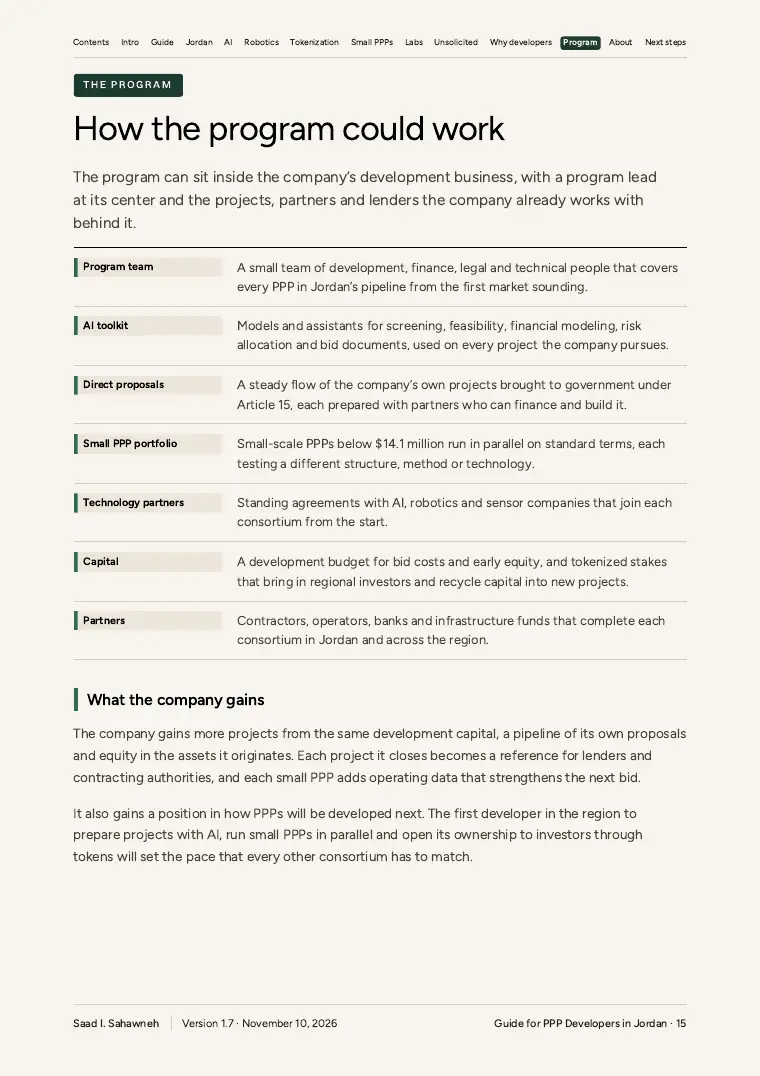
How the program could work
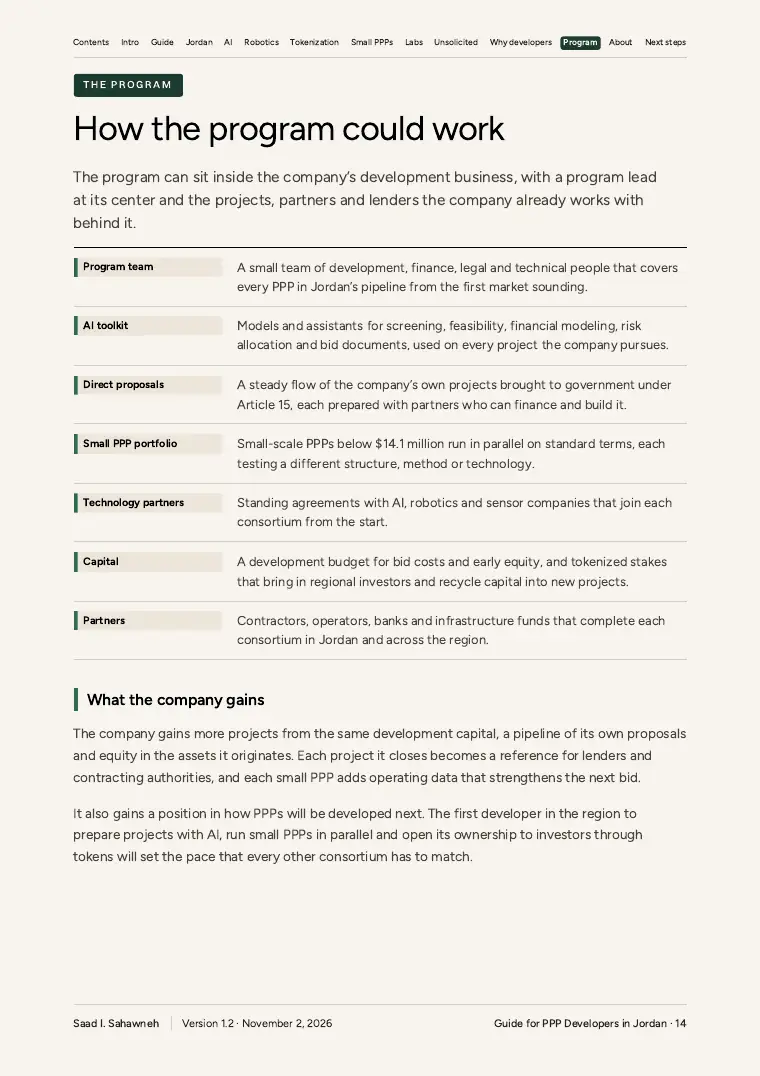
The program can sit inside the company’s development business, with a program lead at its center and the projects, partners and lenders the company already works with behind it.
- Program team
- A small team of development, finance, legal and technical people that covers every PPP in Jordan’s pipeline from the first market sounding.
- AI toolkit
- Models and assistants for screening, feasibility, financial modeling, risk allocation and bid documents, used on every project the company pursues.
- Direct proposals
- A steady flow of the company’s own projects brought to government under Article 15, each prepared with partners who can finance and build it.
- Small PPP portfolio
- Small-scale PPPs below $14.1 million run in parallel on standard terms, each testing a different structure, method or technology.
- Technology partners
- Standing agreements with AI, robotics and sensor companies that join each consortium from the start.
- Capital
- A development budget for bid costs and early equity, and tokenized stakes that bring in regional investors and recycle capital into new projects.
- Partners
- Contractors, operators, banks and infrastructure funds that complete each consortium in Jordan and across the region.
What the company gains
The company gains more projects from the same development capital, a pipeline of its own proposals and equity in the assets it originates. Each project it closes becomes a reference for lenders and contracting authorities, and each small PPP adds operating data that strengthens the next bid.
It also gains a position in how PPPs will be developed next. The first developer in the region to prepare projects with AI, run small PPPs in parallel and open its ownership to investors through tokens will set the pace that every other consortium has to match.

Next steps
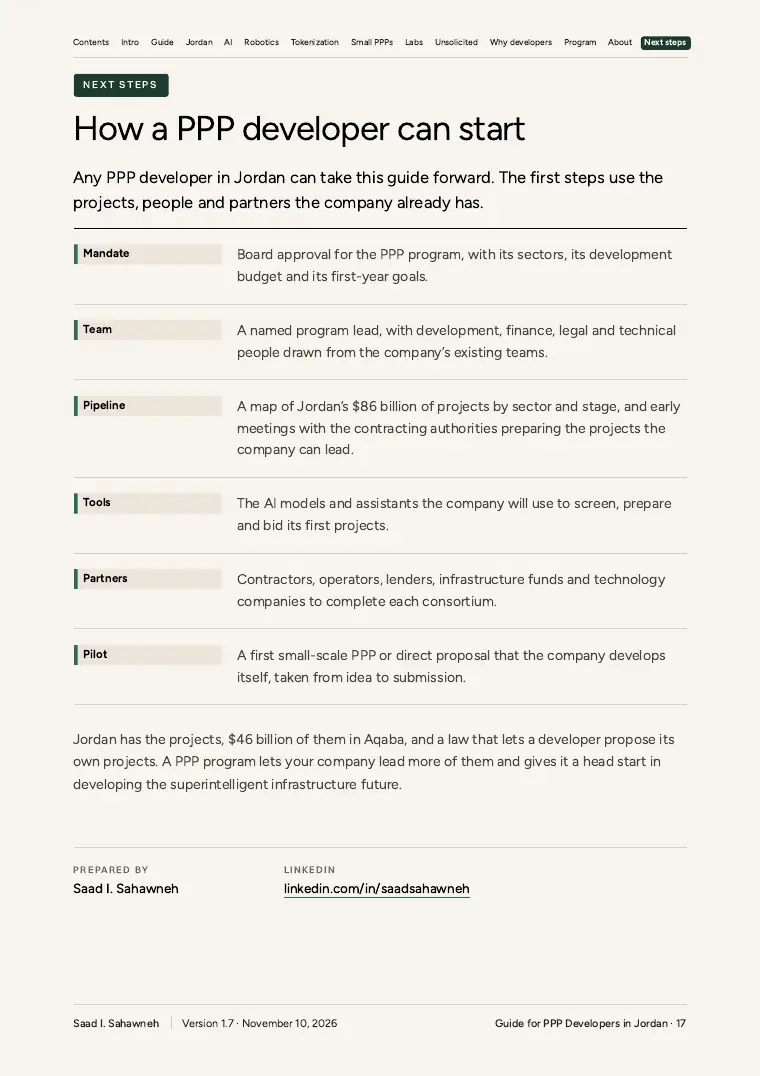
How a PPP developer can start
Any PPP developer in Jordan can take this guide forward. The first steps use the projects, people and partners the company already has.
01
Mandate
Board approval for the PPP program, with its sectors, its development budget and its first-year goals.
02
Team
A named program lead, with development, finance, legal and technical people drawn from the company’s existing teams.
03
Pipeline
A map of Jordan’s $86 billion of projects by sector and stage, and early meetings with the contracting authorities preparing the projects the company can lead.
04
Tools
The AI models and assistants the company will use to screen, prepare and bid its first projects.
05
Partners
Contractors, operators, lenders, infrastructure funds and technology companies to complete each consortium.
06
Pilot
A first small-scale PPP or direct proposal that the company develops itself, taken from idea to submission.
Jordan has the projects, $46 billion of them in Aqaba, and a law that lets a developer propose its own projects. A PPP program lets your company lead more of them and gives it a head start in developing the superintelligent infrastructure future.
The full document
Inside this guide
Eighteen pages and fourteen chapters, from the case for a PPP program to the first steps, written for PPP developers in Jordan.
- 18
- pages
- 14
- chapters
- 3
- technologies
- 6
- first steps
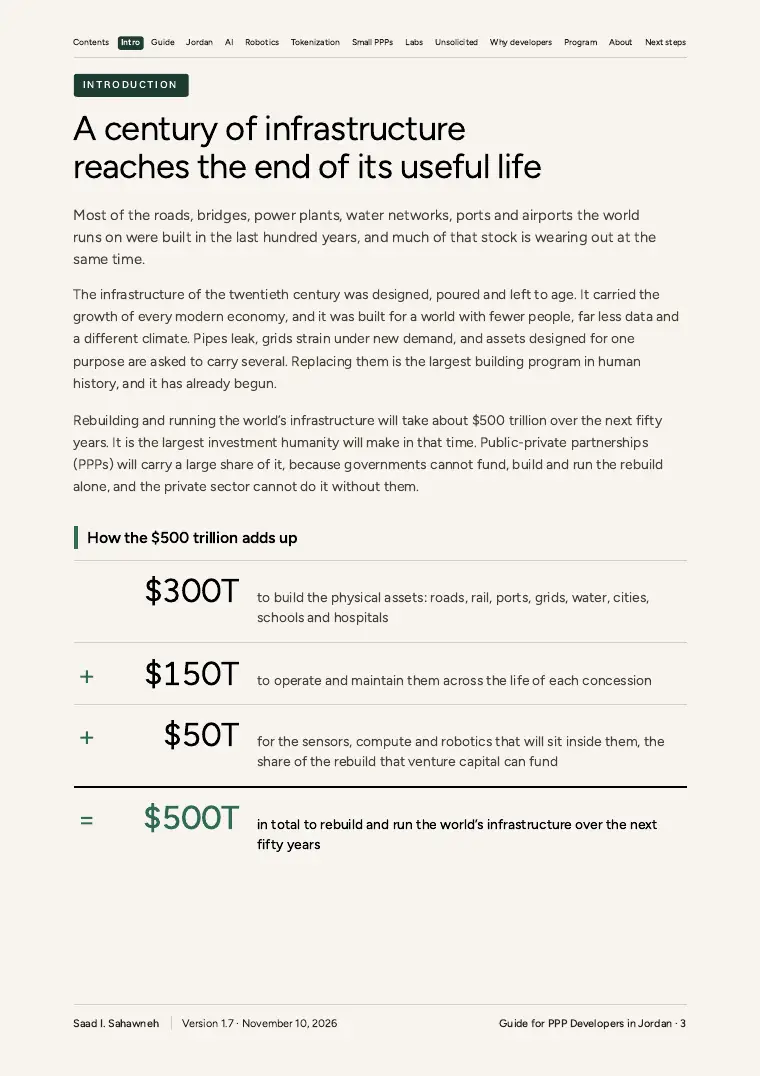
01Introduction
Why a century of infrastructure needs rebuilding, and the $500 trillion it will take.
Page 3 of 18
02The guide
Develop the $500 trillion PPP infrastructure opportunity
Page 5 of 18
03Jordan and Aqaba
An $86 billion pipeline to start with
Page 6 of 18
04Sector guides
The sectors closest to PPP developers, each with its own guide.
Page 7 of 18
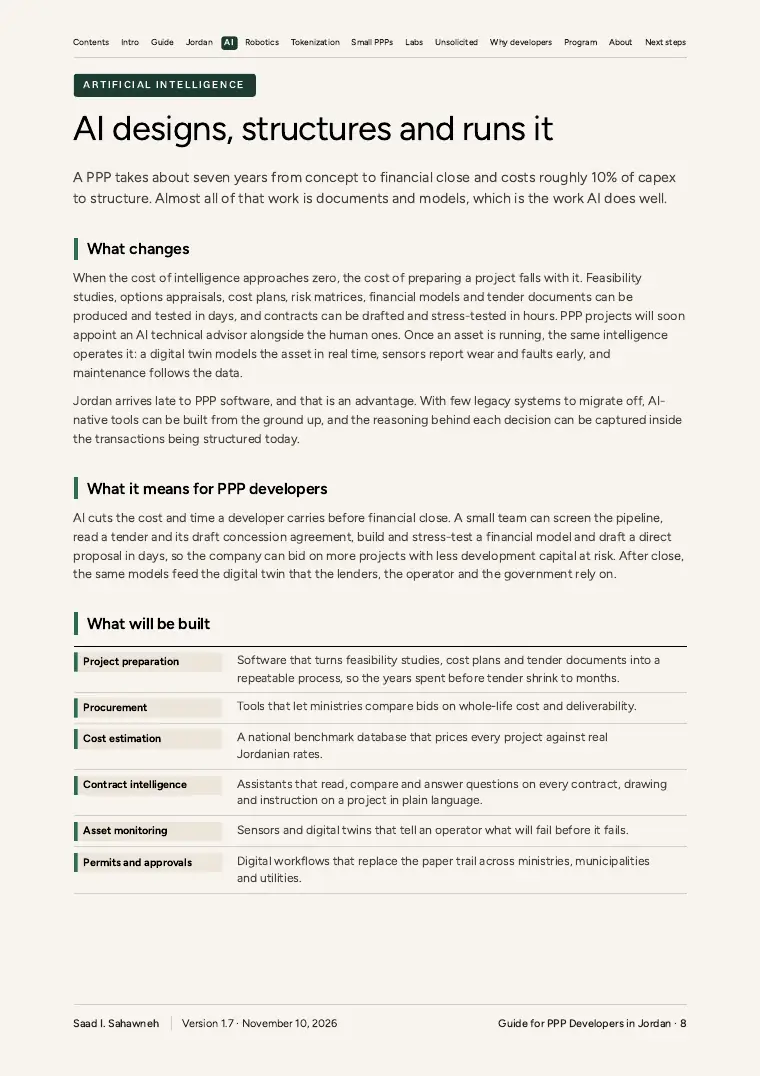
05Artificial intelligence
How AI designs, structures and runs PPP projects, and what it means for PPP developers.
Page 8 of 18
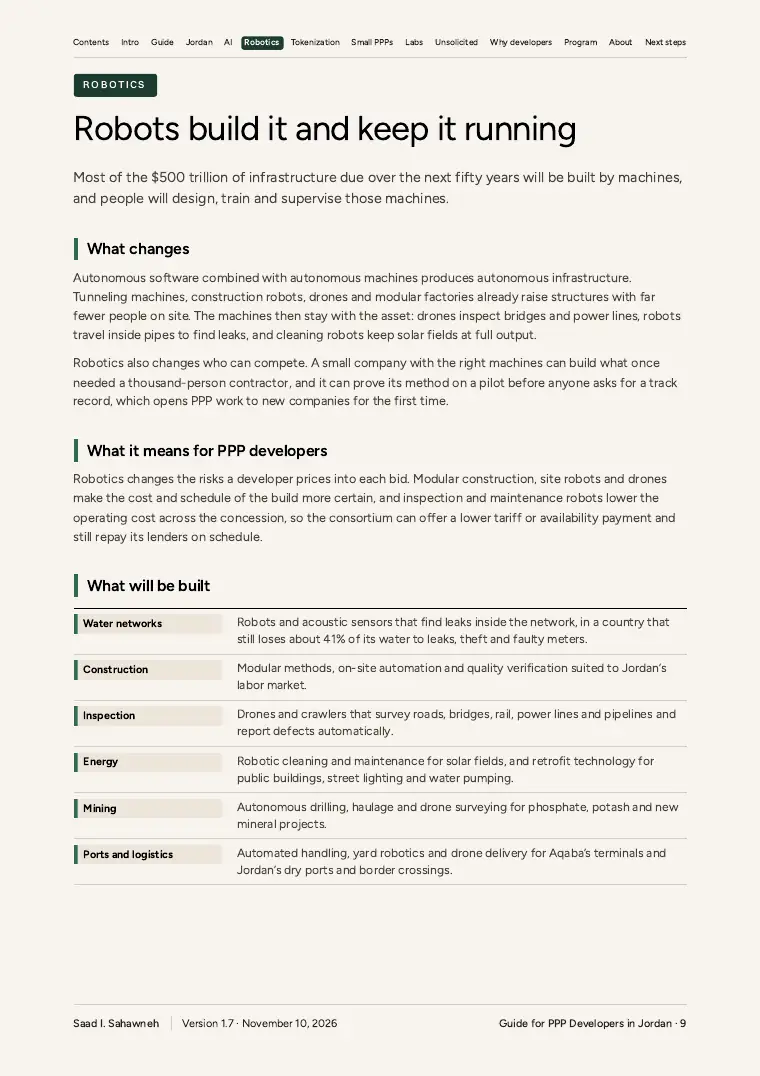
06Robotics
How robots build infrastructure and keep it running, and what that means for PPP developers.
Page 9 of 18
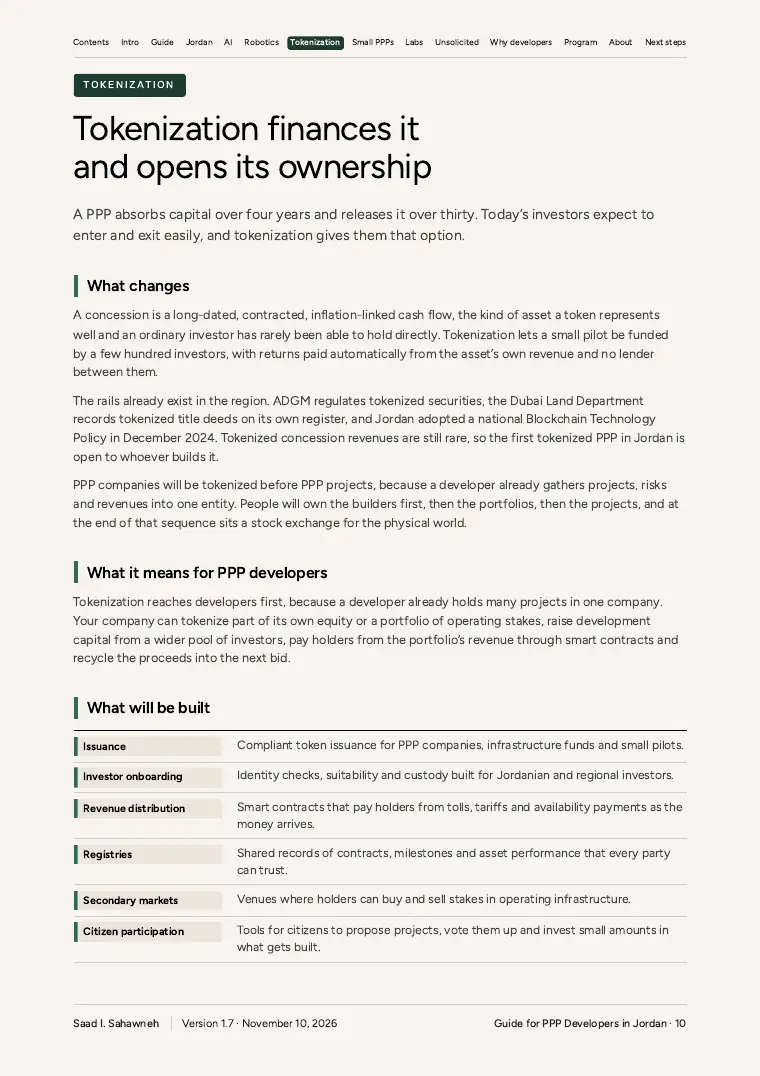
07Tokenization
How tokenization funds projects from their own revenue, and the role it opens for PPP developers.
Page 10 of 18
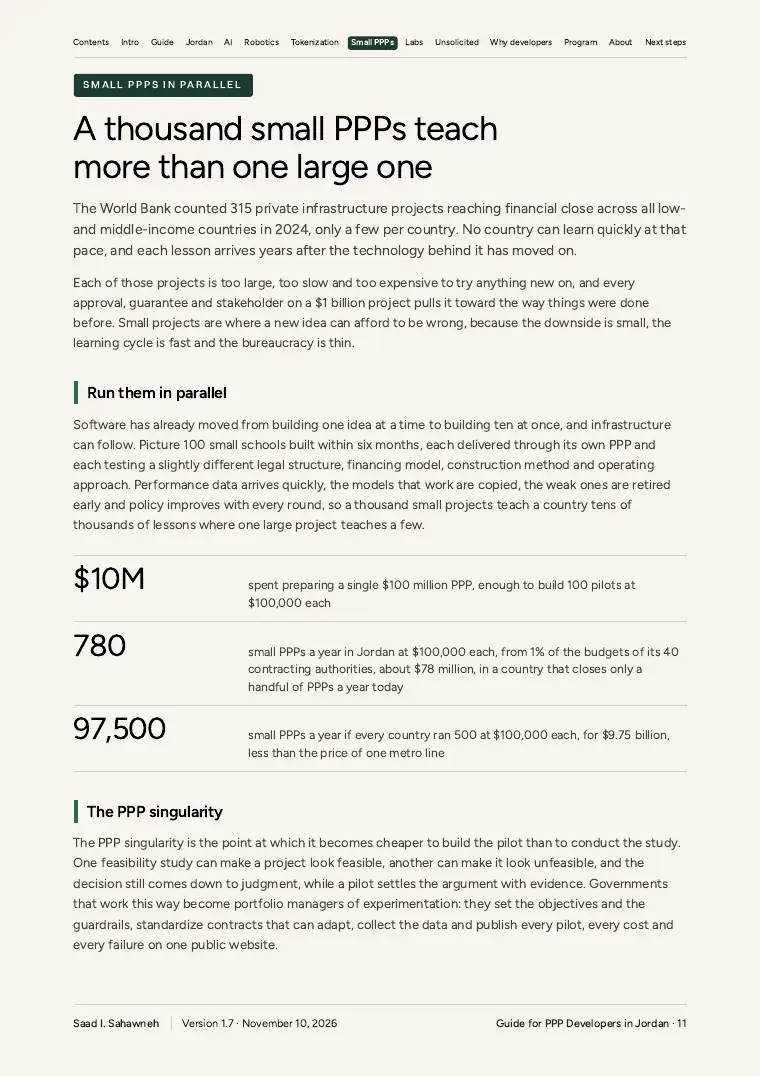
08Small PPPs in parallel
Why many small PPPs teach a country faster than a few large ones.
Page 11 of 18
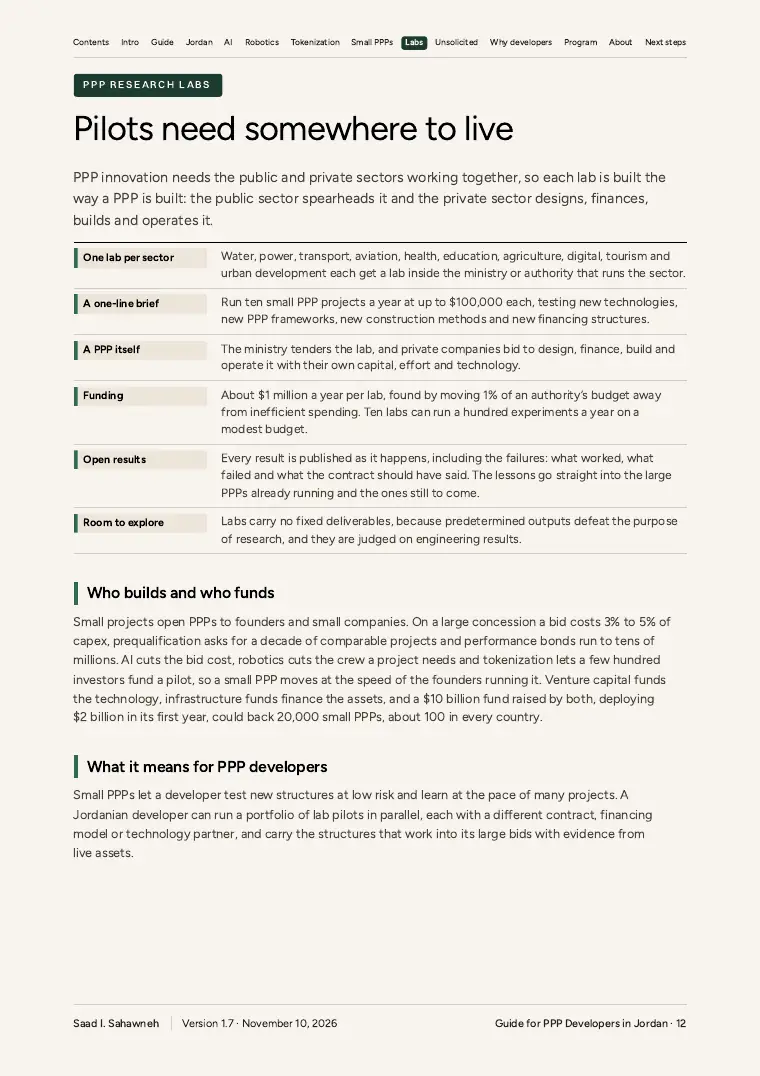
09PPP research labs
A lab in each sector, running ten small PPP projects a year.
Page 12 of 18
10Unsolicited proposals
How Jordan’s PPP law accepts direct proposals from private companies.
Page 13 of 18
11Why PPP developers
PPP developers carry a project from idea to financial close
Page 14 of 18
12The program
The program can sit inside the company’s development business, with a program lead at its center and the projects, partners and lenders the company already works with behind it.
Page 15 of 18
13About
About Jordan PPP and what it offers.
Page 16 of 18
14Next steps
How a PPP developer can start: six first steps.
Page 17 of 18
Questions
Questions about the organization guide for PPP Developers in Jordan
- What does the organization guide for PPP Developers in Jordan propose?
- Your company launches a PPP program that prepares public-private partnership (PPP) projects with AI, runs small-scale PPPs in parallel and brings its own direct proposals to government.
- Why should PPP developers in Jordan launch a PPP program?
- PPP developers carry a project from idea to financial close. A PPP needs someone to originate it, assemble the consortium and carry its cost and risk for years before any revenue arrives. That role falls to the developer, which then holds the equity for the life of the concession.
- Which PPP projects can PPP developers in Jordan take part in?
- Jordan has about $86 billion of PPP and infrastructure projects in development, $46 billion of them anchored in Aqaba. Every one of them will need a developer to lead its consortium and carry it to financial close. A Jordanian developer that closes one project at home can carry the same consortium and the same methods to the next one across the region.
- How can PPP developers in Jordan start a PPP program?
- Any PPP developer in Jordan can take this guide forward. The first steps use the projects, people and partners the company already has. The organization guide sets out six first steps: mandate, team, pipeline, tools, partners and pilot.
- What does a PPP program give PPP developers in Jordan?
- The company gains more projects from the same development capital, a pipeline of its own proposals and equity in the assets it originates. Each project it closes becomes a reference for lenders and contracting authorities, and each small PPP adds operating data that strengthens the next bid.
- Is the organization guide for PPP Developers in Jordan free?
- Yes. It is free to read on this page and free to download as an 18-page PDF, with the case for a PPP program, Jordan’s pipeline, the role of AI, robotics and tokenization, the program and six first steps.
Sector guides
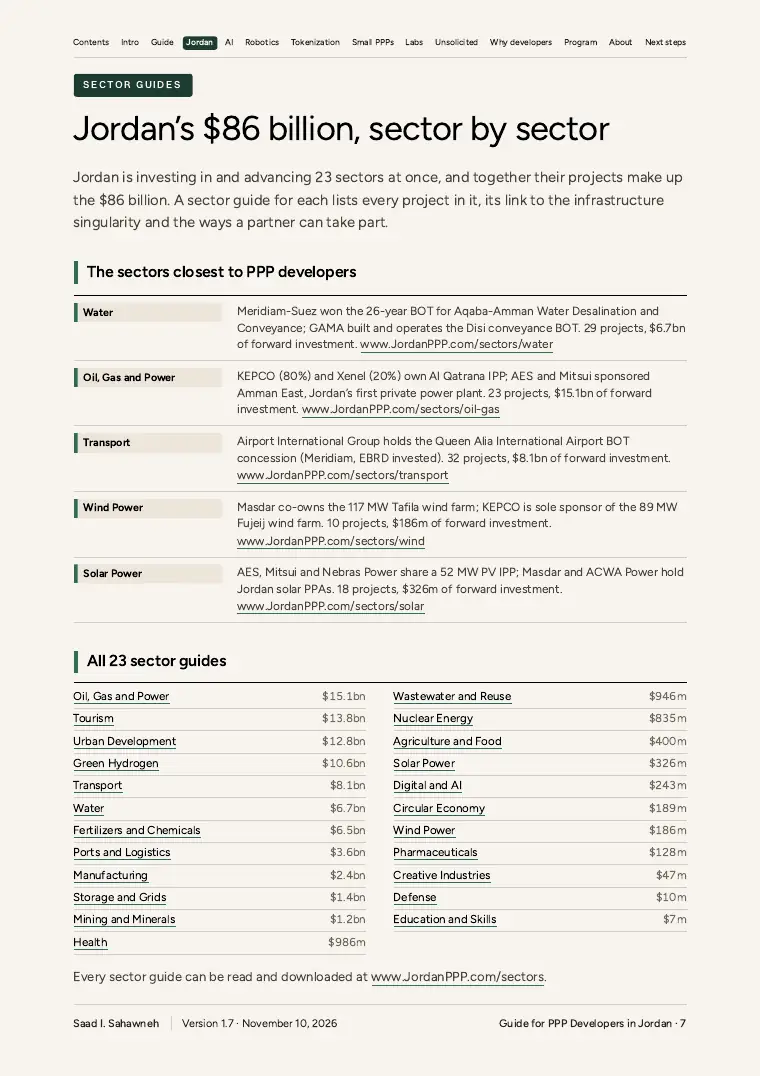
The sectors closest to PPP developers
Jordan’s $86 billion is spread across 23 sectors. Each sector guide lists every project in it and shows how to take part.
 Water$6.7bnMeridiam-Suez won the 26-year BOT for Aqaba-Amman Water Desalination and Conveyance; GAMA built and operates the Disi conveyance BOT29 projects
 Oil, Gas and Power$15.1bnKEPCO (80%) and Xenel (20%) own Al Qatrana IPP; AES and Mitsui sponsored Amman East, Jordan’s first private power plant23 projects
 Transport$8.1bnAirport International Group holds the Queen Alia International Airport BOT concession (Meridiam, EBRD invested)32 projects
 Wind Power$186mMasdar co-owns the 117 MW Tafila wind farm; KEPCO is sole sponsor of the 89 MW Fujeij wind farm10 projects
 Solar Power$326mAES, Mitsui and Nebras Power share a 52 MW PV IPP; Masdar and ACWA Power hold Jordan solar PPAs18 projects
 Wastewater and Reuse$946mSuez, Degremont and Morganti (CCC) developed the As-Samra wastewater BOT and its expansion20 projects
 Ports and Logistics$3.6bnAPM Terminals runs Aqaba Container Terminal with ADC under a concession extended to 204623 projects
 Mining and Minerals$1.2bnYTL Power, Guangdong Yudean and Enefit sponsor Attarat, a 554 MW oil shale plant with its own open-cast mine29 projects
 Green Hydrogen$10.6bnFortescue’s Aqaba green hydrogen framework agreement extended by Cabinet; six developers hold land-use agreements12 projects
 Health$986mKingdom Health: a $400 million hospital in Amman procured as a build-operate-transfer PPP20 projects
 Education and Skills$7mFour bidders (incl. Mowah and Alghanim) prequalified for the Ministry of Education schools package PPP12 projects
 Circular Economy$189mClean Environment runs the Tadweer recycling facility at Al Ghabawi under a PPP; GAM tendered a waste-to-energy DBOT22 projects
 Storage and Grids$1.4bnMEMR is tendering a 100 MWh battery storage IPP with EBRD support (AES signed an earlier 20 MW storage MoU)25 projects
Guide 37 of 96
Browse all 96 organization guides