Skip to content
Jordan PPP
Stained-glass illustration in blue glass of a robot and towers at the dawn of the infrastructure singularity

Sector guide 11 of 22 · Version 1.1

Mining and Minerals in Jordan

The raw materials of the singularity, from the rocks of the south.

Share
$1.2bn
forward investment in its own projects
29
projects in this guide
11
in or linked to Aqaba

The sector today

Mining and Minerals in Jordan

Jordan is built on minerals. It ranks fifth in the world for phosphate reserves, is the Arab world's only potash producer, and its mines and fertilizer plants supply farms across Asia. Mining and mineral industries accounted for about 23% of national exports in 2022.

The two champions are growing. Arab Potash Company produced a record 2.9 million tonnes of potash in 2025, and it has joined JPMC in a new venture for specialty fertilizers. A new 403 km railway will carry phosphate and potash to Aqaba, and the national mining strategy for 2024 to 2033 aims to raise exports from US$1.4 billion to US$5 billion.

The next phase reaches deeper. Jordan signed its first copper mining agreement in 2025, and gold, rare earths, high-purity silica and basalt are now offered to investors. This guide sets out where the sector stands, the projects in the Jordan PPP project register, and the opportunities it opens as infrastructure moves towards the singularity.

#5
Jordan's global rank in phosphate reserves, according to Invest Jordan.
2.9 Mt
Potash produced by Arab Potash Company in 2025, a record and over 21% more than the year before.
$5bn
Mining exports targeted by 2033 in the national mining strategy, up from about $1.4 billion.
403 km
Freight railway now under way to carry about 16 million tonnes of phosphate and potash a year to Aqaba.

The singularity

Minerals are the matter of the singularity

The infrastructure singularity is the point where roads, grids, ports and water networks become one connected, intelligent system, built by robotics, run by artificial intelligence and financed by tokenization. That system is made of minerals: copper wires, silicon chips, rare-earth magnets and the fertilizers that feed the people who build it.

Artificial intelligence
Reads satellite images, geophysics and drill cores to find deposits faster, then plans mines and processing plants that use less energy, water and land.
Robotics
Autonomous drills, haul trucks and sorting machines work in heat and dust, making deep and remote deposits safer and cheaper to mine.
Tokenization
A mine or royalty stream pays out for decades. Tokenized stakes and offtake contracts let more investors finance exploration and share in production.
Materials
Copper, silica, rare earths, vanadium and basalt are the physical inputs of grids, chips, robots, batteries and new building materials.
Food
Phosphate and potash keep the world's farms productive, and precision fertilizers made in Jordan can feed AI-run agriculture.

Flagship projects

The projects that lead the sector

  • Under way · Wadi Araba

    Abu Khashiba Gold and Copper

    Jordan's most advanced new metal project: a 30-year copper agreement over 48 km² south of the Dead Sea, with a separate gold agreement nearby. Drilling is under way, a pilot copper plant is being built and first resource estimates were presented in October 2026.

  • Awarded · Southern Jordan

    Wadi Khaled and Wadi Al-Nuhas Copper Mine

    Jordan's second executive copper agreement, signed in October 2026 over about 78 km² of four valleys. The developer must complete feasibility and environmental studies before mining, which is planned underground to protect the landscape.

  • Open opportunity · Southern Jordan

    Rare Earth Elements

    Exploration for rare earths with tin, zirconium and niobium at several sites in the south. Invest Jordan also lists metal areas at Jabal Bir Tanak, Wadi Imran, Wadi Lubnan and Wadi Mubarak, all close to Aqaba port.

  • Pipeline · Ras En Naqb and Wadi Es Siq

    Silica Sand

    High-purity silica deposits in southern Jordan, close to the Amman to Aqaba highway, for glass, silicon chemicals and ceramics. A concession for a dedicated silica export terminal at Aqaba was tendered in 2026.

  • Open opportunity · Harrat Ash Sham

    Basalt Exploration and Industrial Products

    Basalt from a volcanic plateau of about 11,000 km² in Mafraq and Zarqa, offered for quarrying and processing into rock wool insulation and cast basalt, with continuous basalt fibre as a target product.

  • Under way · Aqaba to Eshidiya

    Aqaba, Al-Shidiyeh and Ma'an Railway

    A US$2.5 billion freight railway of 403 km, developed by the Jordan-UAE Railway Company, to carry phosphate and potash to the port. Ground was broken on October 5, 2026.

Every project

29 projects in Jordan’s pipeline

Values in US dollars; * estimated where no figure has been published. Rows in grey sit in another sector and connect to this one.

ProjectLocationStageValue
Abu Khashiba Gold & CopperAbu Khashiba, Wadi ArabaUnder way$480m
Silica SandSouthern Jordan: Ras En NaqbPipeline$200m*
Investing in Basalt (Tall Burma)Tall BurmaPipeline$120m*
Jabal Bir Tanak11 km east of AqabaPipeline$40m*
Basalt Exploration & Industrial Products (Harrat Ash Sham)Harrat Ash Sham basalt plateau, Mafraq aOpen opportunity$40m*
Phosphate Exploration (Block A3)MafraqOpen opportunity$40m*
Wadi Imran (Zn, Pb, Cu & REEs)7 km east of AqabaPipeline$35m*
Wadi Labnan (Au, Zn, Pb, Cu, REEs, Nb)13 km southeast of AqabaPipeline$35m*
Rare Earth Elements (Southern Jordan)Southern JordanOpen opportunity$35m*
Wadi Khaled and Wadi Al-Nuhas Copper MineSouthern Jordan: Wadi KhaledAwarded$35m*
Fifa Copper Exploration ProjectGhor FifaOpen opportunity$35m*
Wadi Mubarak (Zn, Pb, Nb, Sn & REEs)6 km southeast of AqabaPipeline$30m*
Wadi Shbeikah (Ag, Sn, Zr, Bi & REEs)Aqaba GovernoratePipeline$30m*
Kaolin, Al Disi (Um Sahem-Dabadeeb)Al Disi area: Um Sahem and Dubaydib blocPipeline$30m*
Aqaba-Al-Shidiyeh-Ma'an Railway (Phosphate/Potash Freight)Aqaba to the Eshidiya mines and Ma'an LoUnder way$2.5bn
Arab Potash Potassium Chloride Plant (1 Mt/yr)Dead Sea / Ghor Al-SafiUnder way$1.5bn
Arab Potash × JPMC Integrated Fertilizer ComplexEshidiyaPipeline$1bn
JIFCO Fertilizer ExpansionJIFCO fertilizer complex at Eshidiya, MaTendering$1bn
Jordan Bromine Expansion (APC-Albemarle)Ghor Al-Safi, KarakUnder way$812m
JPMC-Transpet Phosphoric Acid Plant (Aqaba)AqabaPipeline$400m
Shidiya Sulfuric Acid PlantEshidiya areaAwarded$193m
Aqaba-Ma'an Dry Port & Development ZoneMa'an Development Zone, Ma'anPipeline$150m*
Aqaba New Silica TerminalAqabaTendering$40m*
Central Jordan Uranium Project (CJUP)Central JordanPipeline$35m*
Arab Potash 30 MWp Solar Plant (Ghor Al-Safi)Ghor Al-SafiUnder way$30m*
Vanadium Battery Materials Manufacturing PlantJIEC industrial estate, JordanOpen opportunity$29m*
Phosphate-Based Chemicals PlantDevelopment zone in JordanOpen opportunity$29m*
Stone-Cutting Slurry ReuseSahab Industrial City, AmmanOpen opportunity$10m*
Attarat Power Plant (Oil Shale, 554 MW)Attarat Um GhudranDelivered$2.1bn

AI, robotics and tokenization

What changes for Jordan's mining sector

Artificial intelligence

For Jordan's mines AI turns geology into data. Models read satellite images, geophysical surveys and drill cores to target the next copper, gold or rare-earth hole, then plan the mine and its haulage around the result. In processing plants AI tunes grinding, flotation and drying for recovery and energy use, and at the port it schedules trains, stockpiles and ships so bulk exports move without delay.

What can be built

  • Exploration targeting. Models that rank drill targets in Wadi Araba and around Aqaba from survey, drilling and satellite data.
  • Mine planning. AI that plans pits, tunnels and haulage for the lowest cost, water use and surface disturbance.
  • Plant optimization. Control systems that raise recovery and cut energy at phosphate, potash and copper plants.
  • Corridor scheduling. One model that plans trains, stockpiles and ship loading from the mines to Aqaba.

More on artificial intelligence

Robotics

Robotics lets Jordan's mines work in heat, dust and depth with fewer people at risk. Autonomous drills and haul trucks run around the clock, drones survey pits and stockpiles, and sensor-based sorting removes waste rock before it reaches the plant. For the new underground copper mine planned in the south, remote-controlled equipment protects both the workers below and the landscape above.

What can be built

  • Autonomous haulage. Driverless trucks and loaders for phosphate and new copper mines, run from a central control room.
  • Ore sorting. Sensor-based sorting that rejects waste rock early and cuts the water and energy used in processing.
  • Drone surveys. Drones that map pits, stockpiles and exploration areas every day and measure what has moved.
  • Underground automation. Remote drilling and loading for tunnel mines, keeping people away from the rock face.
More on robotics

Tokenization

A mine, a royalty or a long-term offtake contract pays out for decades, which is what tokenization suits. Jordanian exploration companies could raise capital from many small investors through tokenized stakes, and shared assets such as a silica terminal, a rail siding or a solar plant serving a mine could be owned by token holders and paid from handling fees and power sales.

What can be built

  • Exploration stakes. Tokens that fund drilling on licensed areas and convert into shares if a deposit is proven.
  • Royalty streams. Tokenized shares in the royalties paid by a producing mine.
  • Offtake contracts. Tokens backed by long-term sales of phosphate, potash or copper to named buyers.
  • Shared corridor assets. Terminals, sidings and storage owned through tokens and paid from throughput fees.
More on tokenization

Start small, or bring your own idea

Small PPPs and unsolicited proposals

Small PPPs and research labs

A mining research lab, hosted by the Ministry of Energy and Mineral Resources, would test new methods with the phosphate, potash and copper companies. Pilots of about $100,000 each could test sensor-based ore sorting on copper ore from Wadi Araba, AI targeting of one rare-earth exploration area near Aqaba, and daily drone surveys of a phosphate pit and its stockpiles, with every result published for investors.

How it works

Unsolicited proposals under Article 15

A mining company can bring its own project under Article 15. Examples include a rail siding or bulk storage yard on the corridor to Aqaba, water reuse that serves both a mine and nearby towns, a solar plant with storage for a remote mining area, and a shared processing plant for copper ore from several small deposits in the south, paid from tolling fees.

How it works

New industries

What the sector can create

  1. 01Copper cathode and cableRefining ore from Wadi Araba into copper cathode, wire and cable for the region's grids, data centers and electric vehicles.
  2. 02Solar glass and siliconTurning high-purity silica into solar glass, specialty glass and silicon products for panels and electronics.
  3. 03Rare-earth processingSeparating rare earths, niobium and zirconium and making magnets and alloys for motors, robots and wind turbines.
  4. 04Basalt fibre and materialsContinuous basalt fibre, rock wool and cast basalt for insulation, pipes and reinforcement that never rusts.
  5. 05Vanadium batteriesRecovering vanadium from phosphate by-products to make electrolyte for long-duration flow batteries.
  6. 06Precision fertilizersPurified phosphoric acid and water-soluble specialty fertilizers matched to crops by data and AI.

Opportunities

Where partners come in

Exploration areas
Apply for the areas offered by the Ministry of Energy and Mineral Resources and Invest Jordan, from copper and gold to rare earths, silica and kaolin.
Mining agreements
Move from a memorandum of understanding to an executive agreement and concession, alone or with Jordanian partners.
Downstream plants
Build processing plants such as vanadium and basalt products, offered at the Jordan-EU Investment Conference in November 2026.
Infrastructure concessions
Bid for port, rail and terminal concessions, such as the silica export terminal at Aqaba, and supply the new freight railway.
Direct proposals
Propose power, water or logistics for mining areas under Article 15 of PPP Law No. 19 of 2023, or small-scale PPPs below about US$14.1 million.
Investment and ownership
Finance exploration and processing through funds, offtake agreements and tokenized royalty stakes that open ownership to more investors.
Stained-glass illustration in blue glass of a city of towers under a rising arch

The road to the singularity

  1. 2026Second copper agreement signed; railway works begin; rare earths, silica and basalt offered to investors.
  2. 2030Copper flows from Wadi Araba; the railway nears completion; the JPMC and APC complex ships specialty fertilizers.
  3. 2035Mining exports pass the US$5 billion target set for 2033; silica and basalt feed new glass and fibre plants.
  4. 2040AI finds and plans new deposits, and autonomous machines mine and process them with less water and energy.
  5. 2050Jordan supplies copper, silica, rare earths and fertilizers for the region's grids, factories and farms.

Jordan's rocks have fed the world's farms for decades. The projects in this guide are the first steps towards a country that also supplies the metals and materials of an intelligent infrastructure.

Guides for organizations

Launch a PPP program of your own

The guides closest to Jordan's mining sector, each showing one kind of organization how to launch a PPP program, with six first steps.

  • Economic sectors

    Mining Companies

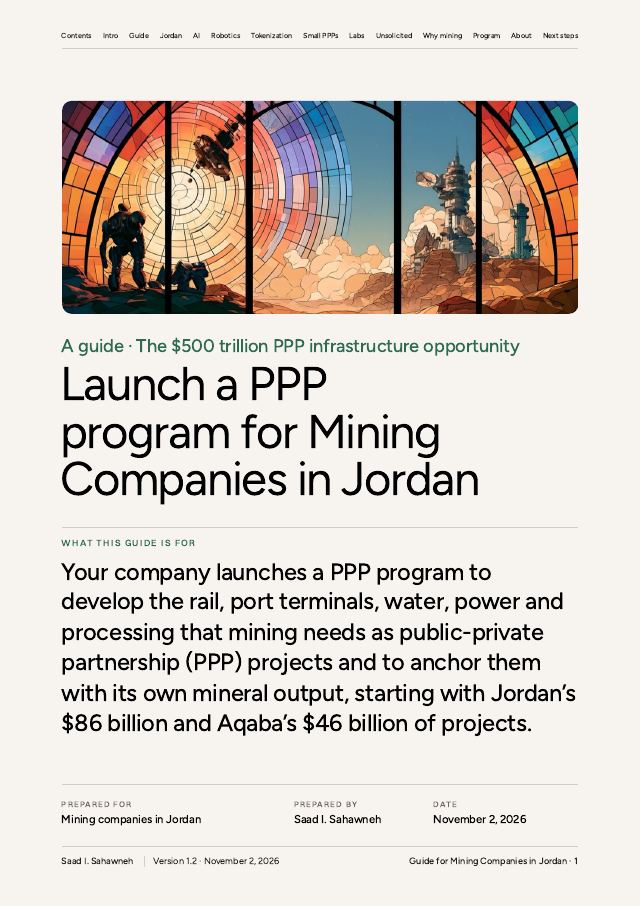
    Your company launches a PPP program to develop the rail, port terminals, water, power and processing that mining needs as public-private partnership (PPP) projects and to anchor them with its own mineral output.

  • Economic sectors

    Manufacturing Companies

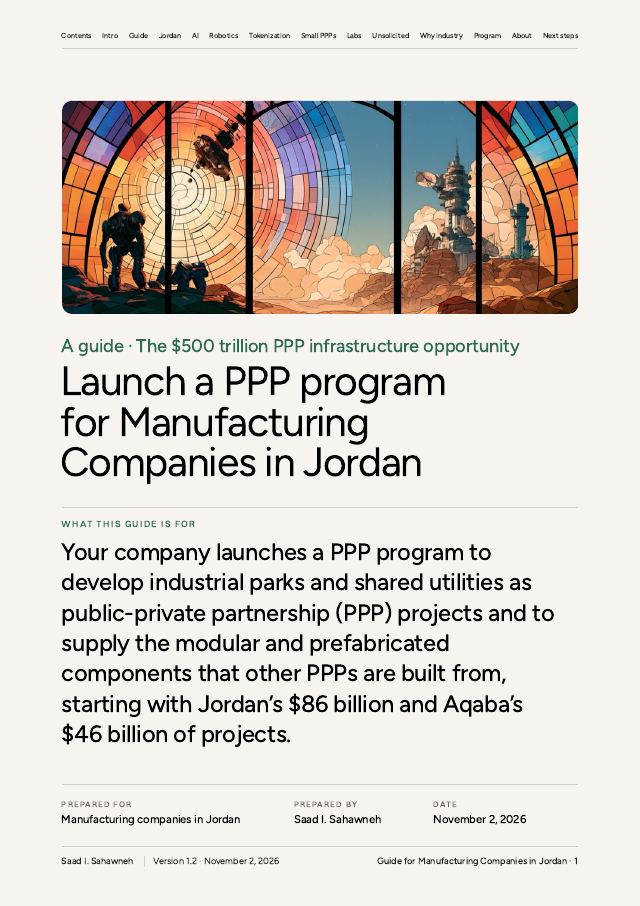
    Your company launches a PPP program to develop industrial parks and shared utilities as public-private partnership (PPP) projects and to supply the modular and prefabricated components that other PPPs are built from.

  • Technology and knowledge

    Robotics Companies

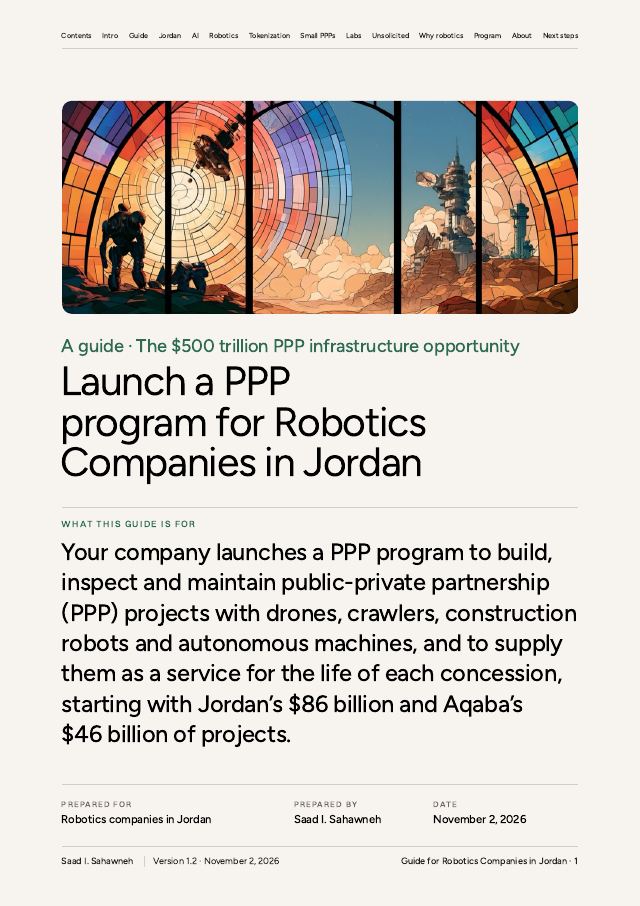
    Your company launches a PPP program to build, inspect and maintain public-private partnership (PPP) projects with drones, crawlers, construction robots and autonomous machines, and to supply them as a service for the life of each concession.

  • Operators and services

    Rail Companies

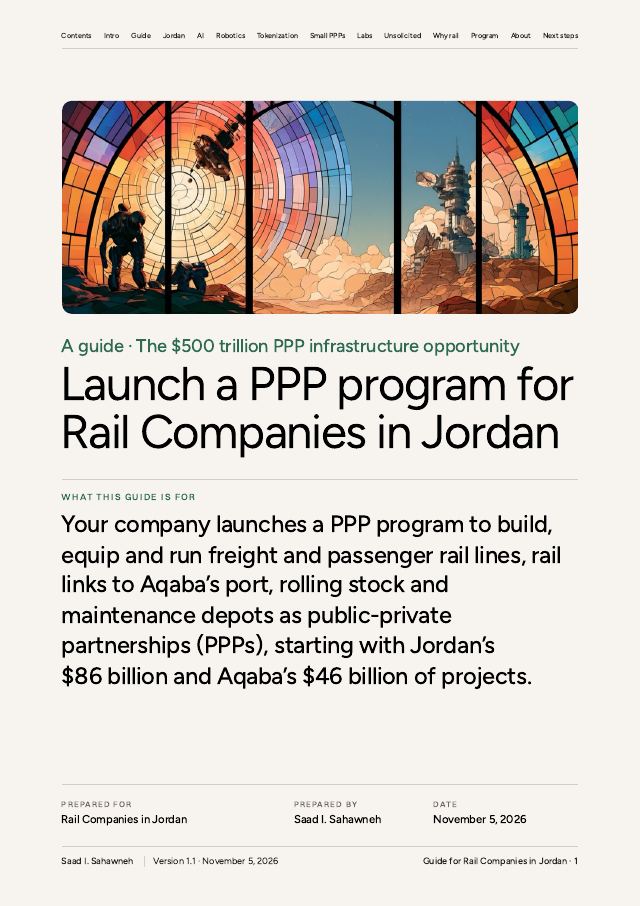
    Your company launches a PPP program to build, equip and run freight and passenger rail lines, rail links to Aqaba’s port, rolling stock and maintenance depots as public-private partnerships (PPPs).

Also part of Jordan's mining sector

See every guide and sector on one map