Skip to content
Jordan PPP
Stained-glass illustration in blue glass of a robot and towers at the dawn of the infrastructure singularity

Sector guide 07 of 22 · Version 1.1

Fertilizers and Chemicals in Jordan

Minerals from the Dead Sea and the desert, refined into the inputs of food and industry.

Share
$6.5bn
forward investment in its own projects
14
projects in this guide
6
in or linked to Aqaba

The sector today

Fertilizers and Chemicals in Jordan

Jordan sits on two of the world's great fertilizer resources: potash in the brines of the Dead Sea and phosphate rock in the southern desert. Arab Potash Company is the only potash producer in the Arab world, and Jordan Phosphate Mines Company extracted more than 12 million tonnes of phosphate in 2025.

Around these minerals the country has built a chemical industry. According to Invest Jordan, chemicals and fertilizers made up 24% of manufacturing output in 2025, with 740 establishments and exports of US$2.4 billion to 125 countries. Jordan Bromine, a joint venture of Arab Potash and Albemarle, is one of the world's largest bromine exporters.

The next phase moves from selling rock and potash to selling acids, specialty fertilizers and chemicals with far more value per tonne. This guide sets out the expansions under way, the projects in the Jordan PPP project register, and the opportunities that open as the sector moves towards the singularity.

24%
Share of Jordan's manufacturing output from the chemicals and fertilizers sector in 2025, per Invest Jordan.
$2.4 billion
Sector exports in 2025, shipped to 125 countries.
$2.2 billion
Untapped export potential that Invest Jordan estimates for the sector.
17.4%
Compound annual growth of the sector's exports from 2019 to 2025.

The singularity

The chemistry of the singularity

The infrastructure singularity is the point where roads, grids, ports and water networks become one connected, intelligent system, built by robotics, run by artificial intelligence and financed by tokenization. Every part of that system, and the food that feeds the people who run it, depends on chemistry.

Artificial intelligence
Controls evaporation ponds, crystallizers and acid plants in real time, designs fertilizer blends for each soil and crop, and searches for new compounds from Jordan's minerals.
Robotics
Autonomous trucks and drills in the phosphate mines, and robots that sample, inspect and maintain plants that handle acids and brines.
Tokenization
Fertilizer and chemical plants sell to global buyers under long contracts. Tokenized stakes and offtake let more investors own part of that trade.
Materials
Bromine, potassium and phosphates are inputs to flame retardants, batteries, electronics and medicines that a computed, electrified world needs in larger volumes.
Abundance
Precise fertilizers, delivered with AI to the plant that needs them, grow more food with less land and water as the world's population peaks.

Flagship projects

The projects that lead the sector

  • Under way · Ghor Al-Safi

    Arab Potash Potassium Chloride Plant (1 Mt/yr)

    A US$1.5 billion plant for 1 million tonnes a year of potassium chloride, the third cold crystallization plant in Arab Potash's Southern Expansion. The construction package was launched in September 2026, and the company targets about 4 million tonnes a year of group capacity by 2029.

  • Pipeline · Eshidiya and Aqaba

    Arab Potash and JPMC Integrated Fertilizer Complex

    A US$1 billion joint venture of JPMC, Arab Potash and the Social Security Investment Fund, incorporated in July 2026. About five plants will make sulfuric, phosphoric and purified phosphoric acid, water-soluble fertilizers and potassium phosphates, with about 700 direct jobs.

  • Tendering · Eshidiya

    JIFCO Fertilizer Expansion

    A US$1 billion expansion with a 1,500 tonne a day phosphoric acid plant, a 4,500 tonne a day sulfuric acid plant and a 36 MW steam turbine, lifting phosphoric acid capacity to about 1 million tonnes a year. The EPC tender was issued in September 2026.

  • Under way · Ghor Al-Safi

    Jordan Bromine Expansion

    A five-year programme by Arab Potash and Albemarle to expand bromine and its derivatives. The NEBO project, about JD40 million, was inaugurated by His Majesty King Abdullah II on June 1, 2026, and the EAGLE and LAVA projects are due by the end of 2026.

  • Awarded · Eshidiya

    Shidiya Sulfuric Acid Plant

    A US$193 million plant for about 900,000 tonnes a year of concentrated sulfuric acid, feeding a phosphoric acid expansion from 330,000 to 550,000 tonnes a year. The EPC agreement was signed in February 2026 with a 30-month build.

  • Pipeline · Risha, Mafraq

    Ammonia and Urea Plant

    A gas-to-ammonia and urea plant near the Risha gas field, listed by the Ministry of Investment in February 2026. Separately, a January 2026 memorandum set aside about 2,000 dunums in the Al Karameh Free Zone for a gas-based ammonia plant.

Every project

14 projects in Jordan’s pipeline

Values in US dollars; * estimated where no figure has been published. Rows in grey sit in another sector and connect to this one.

ProjectLocationStageValue
Ammonia & Urea PlantNear the Risha Gas FieldPipeline$1.5bn*
Arab Potash Potassium Chloride Plant (1 Mt/yr)Dead Sea / Ghor Al-SafiUnder way$1.5bn
Arab Potash × JPMC Integrated Fertilizer ComplexEshidiyaPipeline$1bn
JIFCO Fertilizer ExpansionJIFCO fertilizer complex at Eshidiya, MaTendering$1bn
Jordan Bromine Expansion (APC-Albemarle)Ghor Al-Safi, KarakUnder way$812m
JPMC-Transpet Phosphoric Acid Plant (Aqaba)AqabaPipeline$400m
Shidiya Sulfuric Acid PlantEshidiya areaAwarded$193m
Jordan Methanol Manufacturing PlantIndustrial zone in JordanOpen opportunity$29m*
Phosphate-Based Chemicals PlantDevelopment zone in JordanOpen opportunity$29m*
Aqaba-Al-Shidiyeh-Ma'an Railway (Phosphate/Potash Freight)Aqaba to the Eshidiya mines and Ma'an LoUnder way$2.5bn
Jordan Green Ammonia (JGA)AqabaAwarded$1bn
New Bulk Liquids TerminalSouth PortTendering$63m
Arab Potash 30 MWp Solar Plant (Ghor Al-Safi)Ghor Al-SafiUnder way$30m*
Vanadium Battery Materials Manufacturing PlantJIEC industrial estate, JordanOpen opportunity$29m*

AI, robotics and tokenization

What changes for fertilizers and chemicals

Artificial intelligence

For fertilizers and chemicals in Jordan, AI raises the yield of resources that are already mined. Models can run the Dead Sea evaporation ponds and crystallizers, tune acid plants at Eshidiya for energy and recovery, and predict the quality of each batch. On the sales side, AI can design fertilizer blends for each buyer's soil and crop, which is where specialty products earn their higher price.

What can be built

  • Pond and plant control. Models that manage brine, evaporation and crystallization at the Dead Sea to raise potash and bromine recovery.
  • Acid plant tuning. Control systems that tune sulfuric and phosphoric acid plants for yield, energy recovery and lower emissions.
  • Blend design. Tools that design water-soluble and specialty fertilizers for each customer's crop, soil and climate.
  • Product discovery. AI search for new compounds from bromine, potash and phosphate for batteries, flame retardants and medicines.

More on artificial intelligence

Robotics

Fertilizer and chemical plants in Jordan handle acids, brines, dust and heat, often in remote places such as Ghor Al-Safi and Eshidiya. Robots take people out of the most hazardous work. Autonomous trucks and drills can work the phosphate mines, robots can sample and inspect acid lines and tanks, and drones can survey evaporation ponds and stockpiles, so plants run longer between shutdowns.

What can be built

  • Autonomous mining. Driverless trucks and drills in the phosphate mines that feed the acid and fertilizer plants around Eshidiya.
  • Hazard inspection. Crawlers and drones that inspect acid tanks, scrubbers and pipes for corrosion while the plants keep running.
  • Pond surveys. Drones that map the evaporation ponds at the Dead Sea and measure brine and salt levels across them.
  • Bagging and loading. Robotic bagging, palletizing and ship loading lines for specialty fertilizers at the plants and at Aqaba.
More on robotics

Tokenization

Fertilizer and chemical plants in Jordan sell to buyers in many countries under long contracts, and their output is measured to the tonne. Tokenization could let investors fund a new acid or specialty fertilizer plant in small units and be paid from each shipment, and it could put warehouse receipts and offtake contracts on a shared record that banks and buyers trust.

What can be built

  • Plant notes. Tokenized notes in a new specialty fertilizer or chemical plant, paid from sales under its offtake contracts.
  • Warehouse receipts. Digital receipts for potash and fertilizer stocks at Aqaba that buyers and banks can finance and trade.
  • Traceable products. A record of origin and quality for each lot, so buyers can verify low-carbon and food-grade claims.
  • Shared utilities. Tokens in steam, power and water plants that serve an industrial cluster, paid from the fees each plant pays.
More on tokenization

Start small, or bring your own idea

Small PPPs and unsolicited proposals

Small PPPs and research labs

Small PPPs suit the utilities, test lines and services around Jordan's mineral industry. A research lab with JPMC, Arab Potash and a university could develop new products from phosphate, potash and bromine and test them with farmers and buyers. Three $100,000 pilots could start it: a pilot line for a water-soluble fertilizer, a test to recover rare elements from acid streams, and AI-guided fertilizer trials on farms in the Jordan Valley.

How it works

Unsolicited proposals under Article 15

A company can bring direct proposals under Article 15 for projects around the mineral industry: shared steam, power and water plants for the Eshidiya and Ghor Al-Safi clusters, the reuse of phosphogypsum and other by-products in building materials, effluent treatment and water reuse for chemical plants in industrial estates, or green ammonia supplied under contract to fertilizer producers in place of imports.

How it works

New industries

What the sector can create

  1. 01Specialty fertilizersWater-soluble, controlled-release and crop-specific blends of potash, phosphate and nitrogen, sold at many times the price of bulk products.
  2. 02Battery materialsPurified phosphoric acid for lithium iron phosphate batteries, and bromine for flow batteries and energy storage.
  3. 03Food and pharma gradesHigh-purity phosphates and potassium salts for food processing, water treatment and medicines.
  4. 04Nitrogen from JordanAmmonia and urea made from Risha gas or green hydrogen, completing the potash, phosphate and nitrogen trio at home.
  5. 05Rare elements from phosphateRecovering rare earths, uranium and fluorine compounds from phosphate rock and acid streams.
  6. 06Precision agriculture servicesAI tools and data services that prescribe and deliver Jordanian fertilizers field by field across the region.

Opportunities

Where partners come in

EPC tenders
Bid for the acid plants, crystallizers and fertilizer units that Arab Potash, JPMC and JIFCO are tendering to local and international contractors.
Joint ventures
Bring technology or markets into a partnership with JPMC, Arab Potash or Jordan Bromine for new downstream products.
Open opportunities
Invest in plants listed by the Ministry of Investment, such as methanol, phosphate-based chemicals and ammonia and urea near Risha.
Zones and incentives
Locate in development zones or the Aqaba Special Economic Zone and use Investment Environment Law incentives for new chemical plants.
Shared utilities
Propose power, steam, water and effluent plants for industrial clusters under Article 15 of PPP Law No. 19 of 2023.
Offtake and finance
Sign long-term purchase contracts, or finance expansions through development banks, export credit agencies, funds and tokenized stakes.
Stained-glass illustration in blue glass of a city of towers under a rising arch

The road to the singularity

  1. 2026Potash, bromine and acid expansions are under construction; a potash and phosphate joint venture is formed; JIFCO tenders its expansion.
  2. 2030Potash capacity reaches about 4 million tonnes a year; new acid plants run; the first specialty fertilizers ship from Aqaba.
  3. 2035Ammonia from gas or green hydrogen completes a domestic nitrogen supply; battery-grade phosphates find buyers abroad.
  4. 2040AI runs mines and plants end to end; robots handle hazardous work; Jordan sells materials designed for each customer.
  5. 2050Jordan is a supplier of precise fertilizers and advanced materials, and most of its mineral wealth leaves as finished chemistry.

Potash, phosphate and bromine give Jordan a place in the world's food and materials supply. The projects in this guide are the first steps towards an industry that sells chemistry and knowledge in place of raw rock.

Guides for organizations

Launch a PPP program of your own

The guides closest to fertilizers and chemicals, each showing one kind of organization how to launch a PPP program, with six first steps.

  • Economic sectors

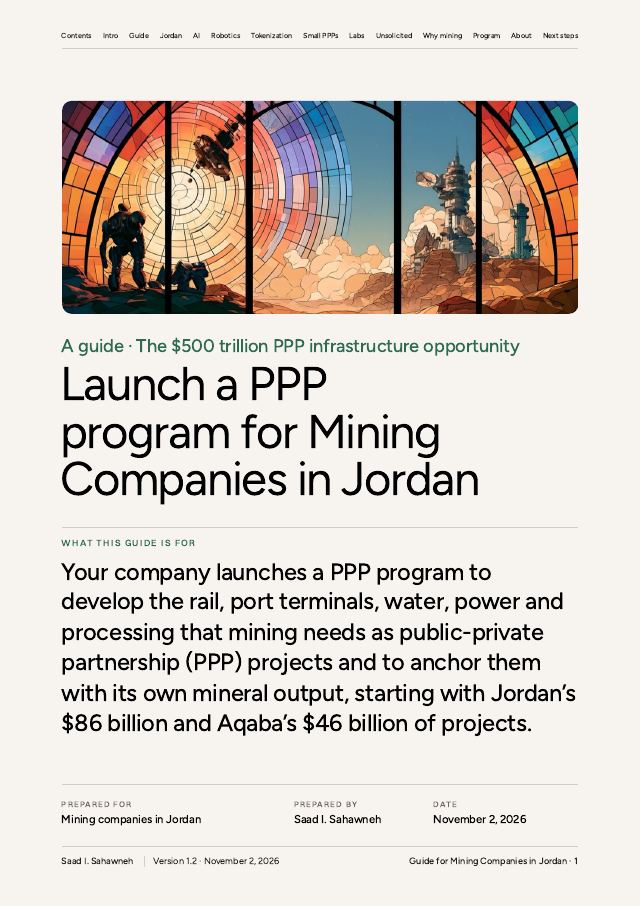
    Mining Companies

    Your company launches a PPP program to develop the rail, port terminals, water, power and processing that mining needs as public-private partnership (PPP) projects and to anchor them with its own mineral output.

  • Economic sectors

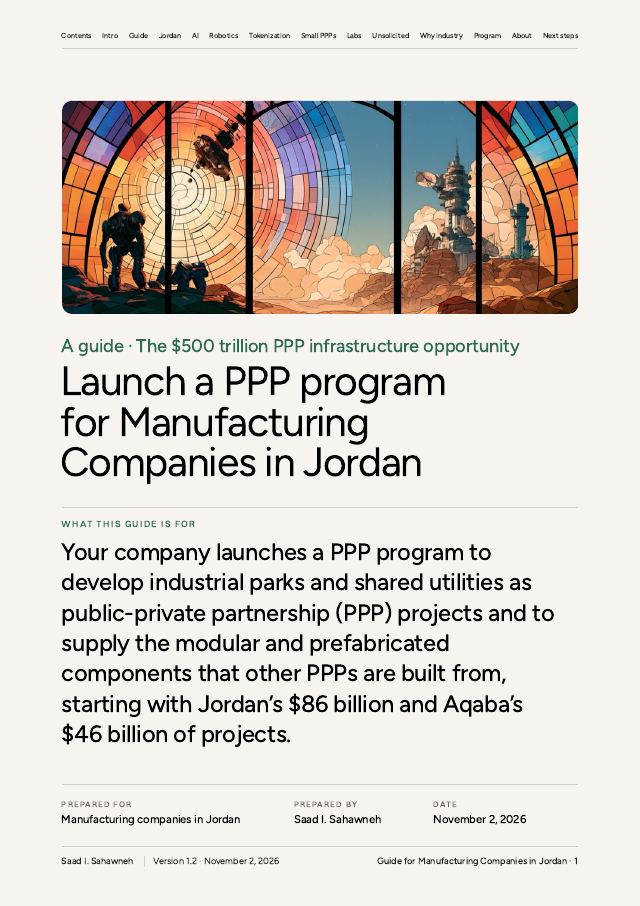
    Manufacturing Companies

    Your company launches a PPP program to develop industrial parks and shared utilities as public-private partnership (PPP) projects and to supply the modular and prefabricated components that other PPPs are built from.

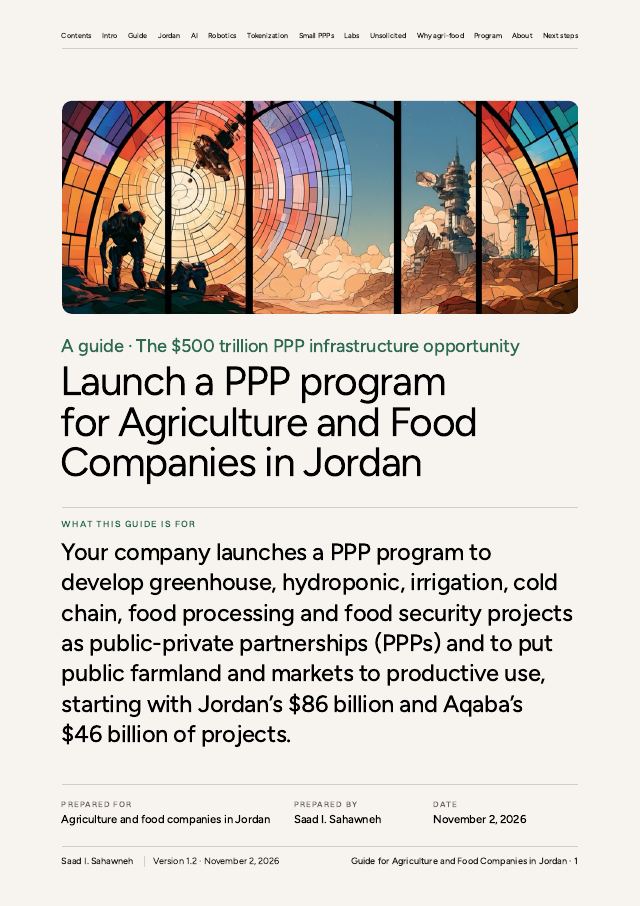
  • Your company launches a PPP program to develop greenhouse, hydroponic, irrigation, cold chain, food processing and food security projects as public-private partnerships (PPPs) and to put public farmland and markets to productive use.

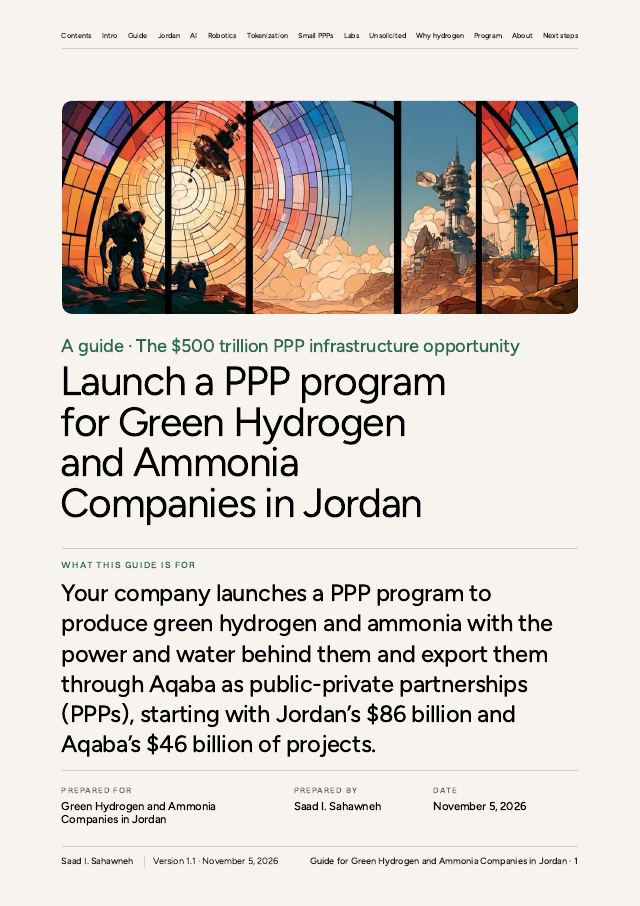
  • Your company launches a PPP program to produce green hydrogen and ammonia with the power and water behind them and export them through Aqaba as public-private partnerships (PPPs).

Also part of fertilizers and chemicals

See every guide and sector on one map