What this organization guide is for
Your firm launches a PPP finance practice that builds financial models, advises governments, bidders and lenders on public-private partnership (PPP) transactions and structures bonds, sukuk and tokenized notes.
The case
Financial advisors build the model every PPP is priced on
Every PPP rests on a financial model that sets the tariff, the payment, the debt and the return, and governments, bidders and lenders each appoint financial advisors to build or test it. The projects of the next fifty years will be modeled with AI and financed through bonds, sukuk and tokenized notes as well as bank loans. This guide invites financial advisory firms in Jordan to launch a PPP finance practice, starting with the projects at home.
The guide
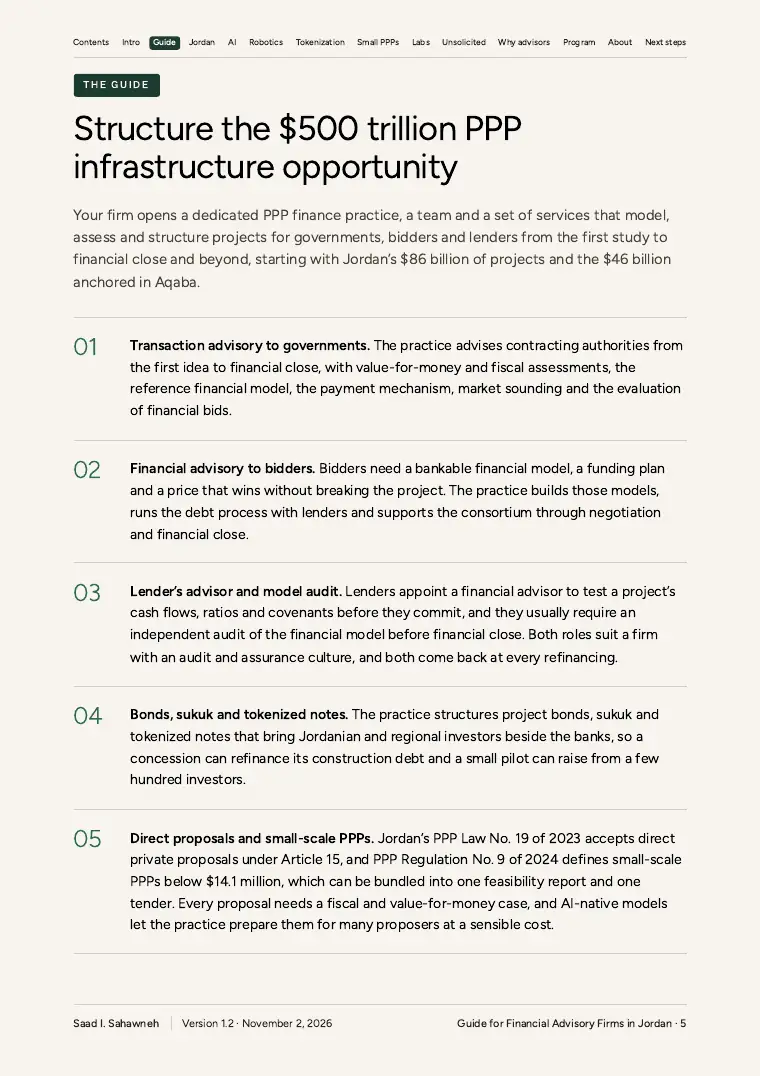
Structure the $500 trillion PPP infrastructure opportunity
Your firm opens a dedicated PPP finance practice, a team and a set of services that model, assess and structure projects for governments, bidders and lenders from the first study to financial close and beyond, starting with Jordan’s $86 billion of projects and the $46 billion anchored in Aqaba.
01
Transaction advisory to governments
The practice advises contracting authorities from the first idea to financial close, with value-for-money and fiscal assessments, the reference financial model, the payment mechanism, market sounding and the evaluation of financial bids.
02
Financial advisory to bidders
Bidders need a bankable financial model, a funding plan and a price that wins without breaking the project. The practice builds those models, runs the debt process with lenders and supports the consortium through negotiation and financial close.
03
Lenders’ advisor and model audit
Lenders appoint a financial advisor to test a project’s cash flows, ratios and covenants before they commit, and they usually require an independent audit of the financial model before financial close. Both roles suit a firm with an audit and assurance culture, and both come back at every refinancing.
04
Bonds, sukuk and tokenized notes
The practice structures project bonds, sukuk and tokenized notes that bring Jordanian and regional investors beside the banks, so a concession can refinance its construction debt and a small pilot can raise from a few hundred investors.
05
Direct proposals and small-scale PPPs
Jordan’s PPP Law No. 19 of 2023 accepts direct private proposals under Article 15, and PPP Regulation No. 9 of 2024 defines small-scale PPPs below $14.1 million, which can be bundled into one feasibility report and one tender. Every proposal needs a fiscal and value-for-money case, and AI-native models let the practice prepare them for many proposers at a sensible cost.
Why financial advisory firms
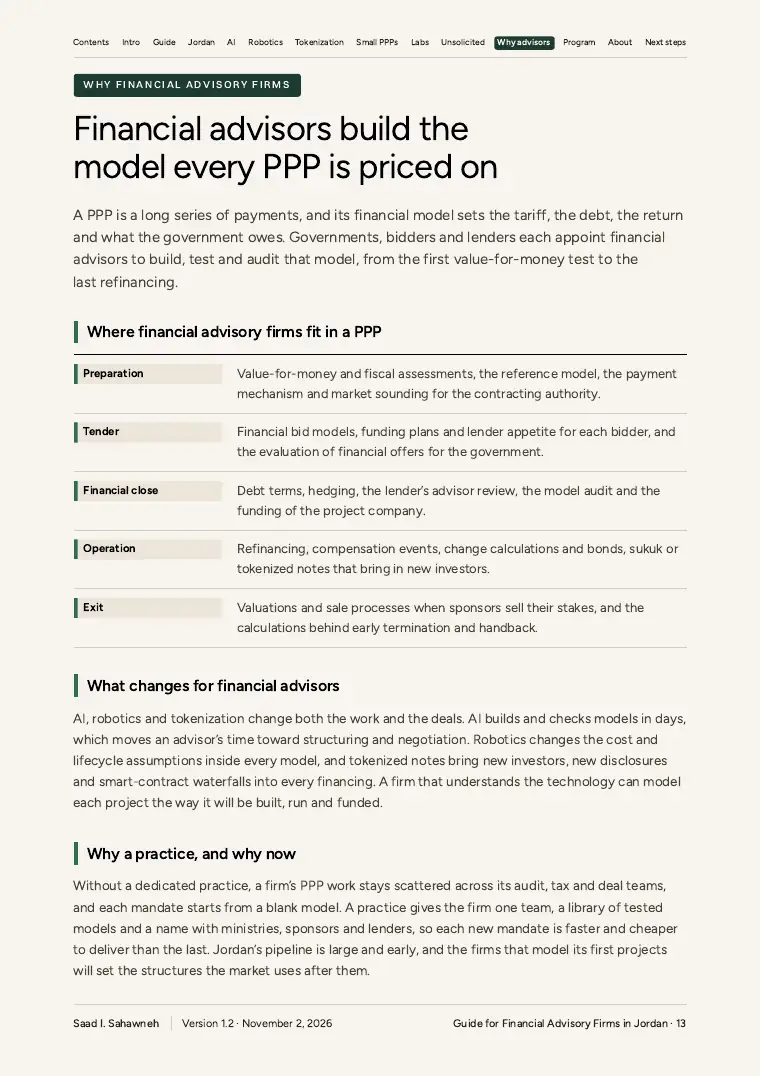
Financial advisors build the model every PPP is priced on
A PPP is a long series of payments, and its financial model sets the tariff, the debt, the return and what the government owes. Governments, bidders and lenders each appoint financial advisors to build, test and audit that model, from the first value-for-money test to the last refinancing.
Where financial advisory firms fit in a PPP
- Preparation
- Value-for-money and fiscal assessments, the reference model, the payment mechanism and market sounding for the contracting authority.
- Tender
- Financial bid models, funding plans and lender appetite for each bidder, and the evaluation of financial offers for the government.
- Financial close
- Debt terms, hedging, the lenders’ advisor review, the model audit and the funding of the project company.
- Operation
- Refinancing, compensation events, change calculations and bonds, sukuk or tokenized notes that bring in new investors.
- Exit
- Valuations and sale processes when sponsors sell their stakes, and the calculations behind early termination and handback.
What changes for financial advisors
AI, robotics and tokenization change both the work and the deals. AI builds and checks models in days, which moves an advisor’s time toward structuring and negotiation. Robotics changes the cost and lifecycle assumptions inside every model, and tokenized notes bring new investors, new disclosures and smart-contract waterfalls into every financing. A firm that understands the technology can model each project the way it will be built, run and funded.
Why a practice, and why now
Without a dedicated practice, a firm’s PPP work stays scattered across its audit, tax and deal teams, and each mandate starts from a blank model. A practice gives the firm one team, a library of tested models and a name with ministries, sponsors and lenders, so each new mandate is faster and cheaper to deliver than the last. Jordan’s pipeline is large and early, and the firms that model its first projects will set the structures the market uses after them.

Futureproofing
Futureproof Financial Advisory Firms in Jordan for the infrastructure singularity
This free 18-page guide shows how, with small PPPs in parallel, PPP research labs, artificial intelligence, robotics, tokenization and six first steps.

Jordan and Aqaba
An $86 billion pipeline to start with
Every one of them will need a financial model, a funding plan and advisors on each side of the table. A Jordanian advisory firm that structures one project at home can carry the same methods and models to the next one across the region.
- $86B
- of PPP and infrastructure projects in development in Jordan
- $46B
- of them anchored in Aqaba

Artificial intelligence
AI changes the economics of financial advice. A model that took weeks to build can be drafted, checked and stress-tested in days, every scenario in a value-for-money or fiscal assessment can be run at once, and a model audit can trace every formula and test every input automatically. A firm that builds these tools into its practice can serve more governments and bidders with the same team and spend its time on judgment and negotiation.

Robotics
Robotics changes the numbers inside the model. Robotic construction and maintenance shift the cost, schedule and lifecycle assumptions that set a project’s price, and sensors give lenders verified data on how an asset performs. A firm that understands these technologies can model their risks and savings with confidence and advise lenders and governments on pricing the first robotic projects in the region.

Tokenization
Tokenized notes need the same discipline as any security: a structure, a financial model investors can trust, disclosures and a payment waterfall that a smart contract can follow. A financial advisory firm can design those structures, audit the models behind them and advise governments and sponsors on which projects suit tokenization.

Small PPPs and research labs
Every lab pilot needs a budget, a funding structure and a record of what each result cost. A financial advisory firm that models small PPPs builds standard, auditable models that Jordan can reuse across hundreds of projects a year, and it can test new financing structures, from tokenized notes to bundled tenders, before they reach a large concession.

Unsolicited proposals
A direct proposal under Article 15 has to show value for money, its fiscal implications and how project revenues cover the government’s obligations, and each of those is a financial question. A firm that prepares these cases for proposers becomes the first call for every company with an idea for government, and it can bring proposals of its own with partners who finance and build them.
The program
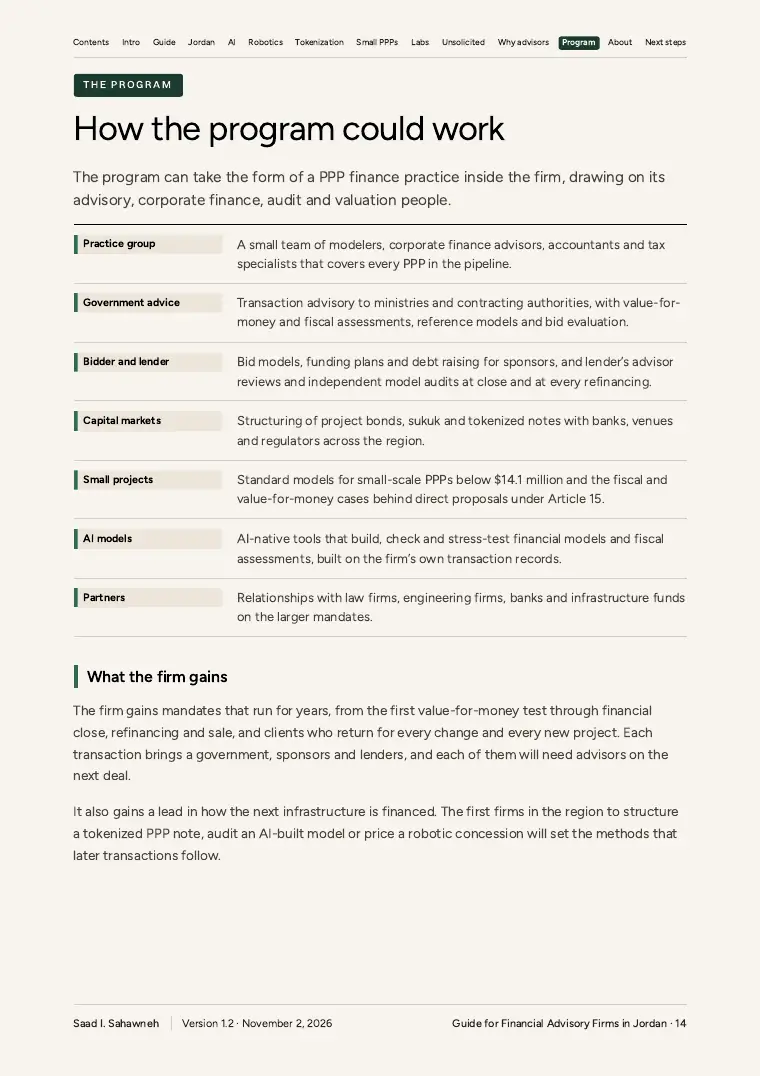
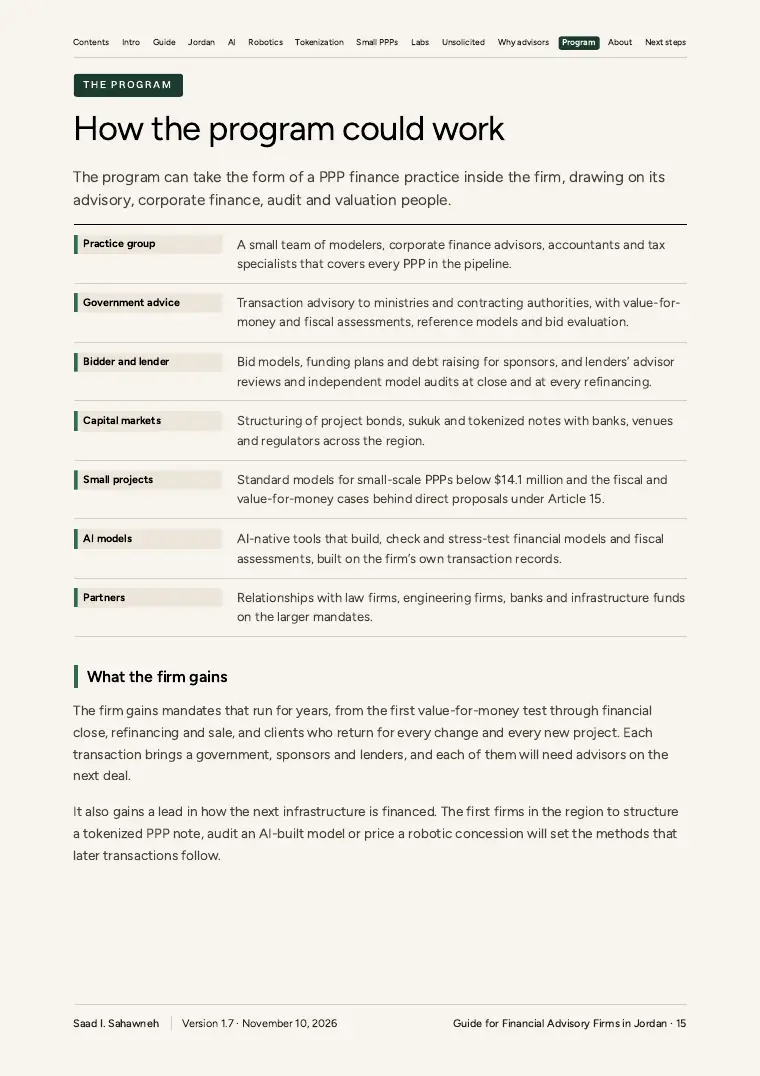
How the program could work
The program can take the form of a PPP finance practice inside the firm, drawing on its advisory, corporate finance, audit and valuation people.
- Practice group
- A small team of modelers, corporate finance advisors, accountants and tax specialists that covers every PPP in the pipeline.
- Government advice
- Transaction advisory to ministries and contracting authorities, with value-for-money and fiscal assessments, reference models and bid evaluation.
- Bidder and lender
- Bid models, funding plans and debt raising for sponsors, and lenders’ advisor reviews and independent model audits at close and at every refinancing.
- Capital markets
- Structuring of project bonds, sukuk and tokenized notes with banks, venues and regulators across the region.
- Small projects
- Standard models for small-scale PPPs below $14.1 million and the fiscal and value-for-money cases behind direct proposals under Article 15.
- AI models
- AI-native tools that build, check and stress-test financial models and fiscal assessments, built on the firm’s own transaction records.
- Partners
- Relationships with law firms, engineering firms, banks and infrastructure funds on the larger mandates.
What the firm gains
The firm gains mandates that run for years, from the first value-for-money test through financial close, refinancing and sale, and clients who return for every change and every new project. Each transaction brings a government, sponsors and lenders, and each of them will need advisors on the next deal.
It also gains a lead in how the next infrastructure is financed. The first firms in the region to structure a tokenized PPP note, audit an AI-built model or price a robotic concession will set the methods that later transactions follow.

Next steps
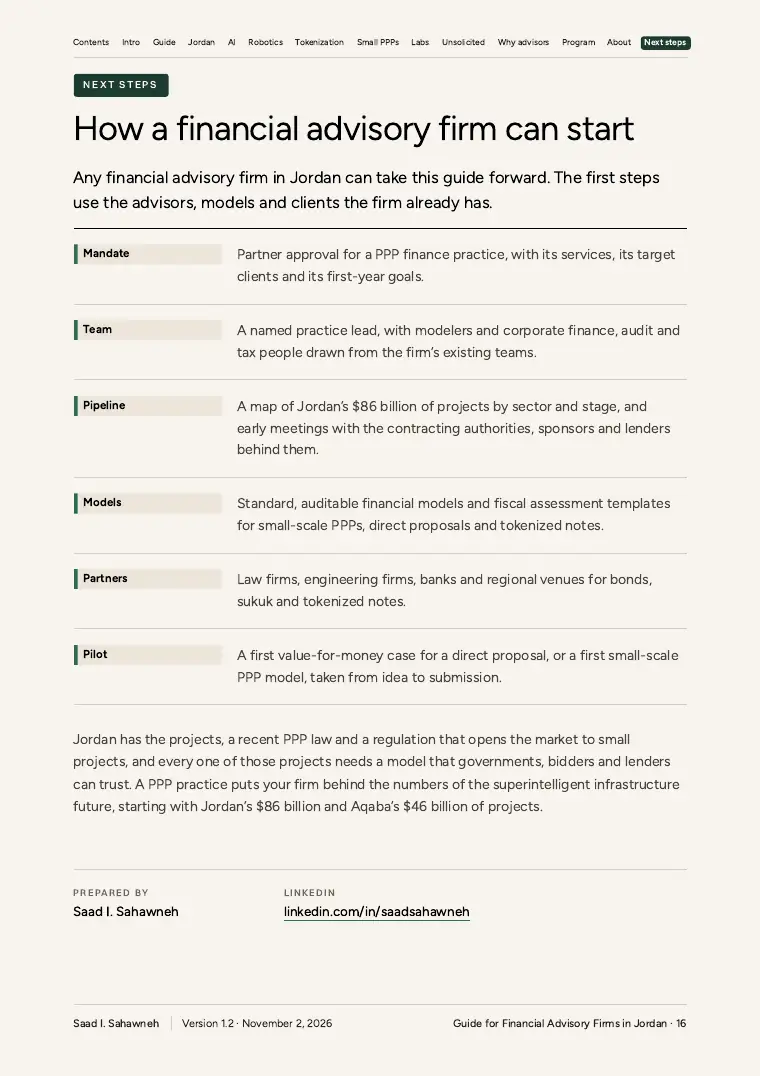
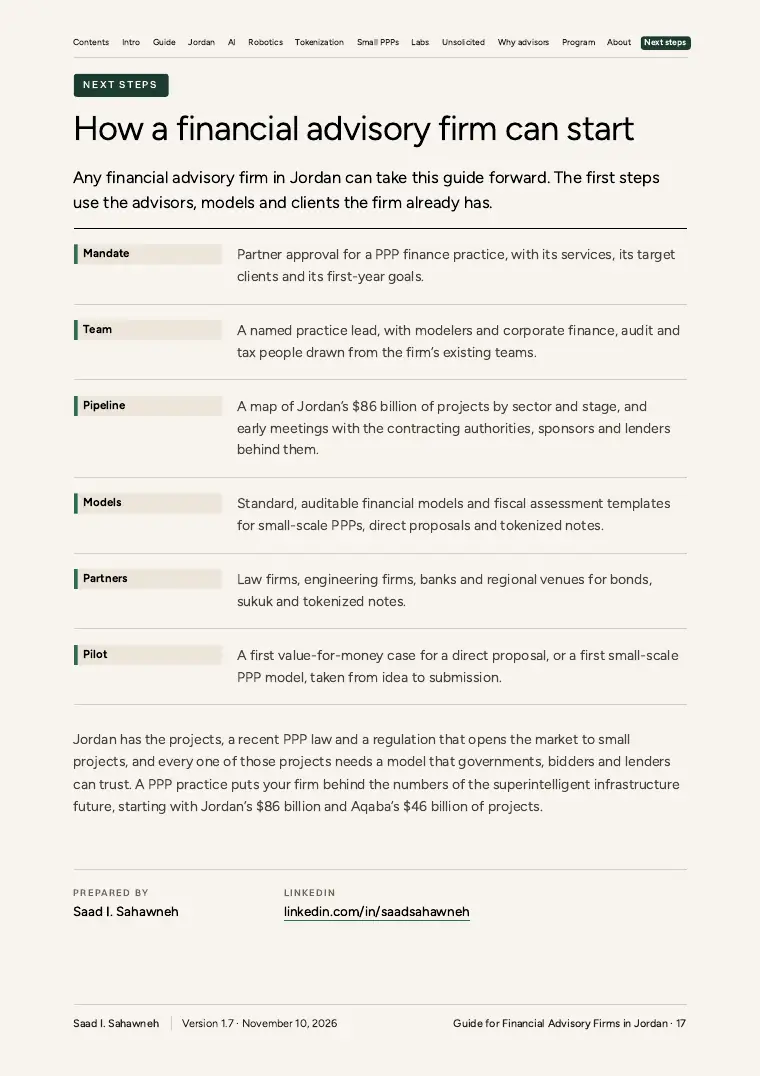
How a financial advisory firm can start
Any financial advisory firm in Jordan can take this guide forward. The first steps use the advisors, models and clients the firm already has.
01
Mandate
Partner approval for a PPP finance practice, with its services, its target clients and its first-year goals.
02
Team
A named practice lead, with modelers and corporate finance, audit and tax people drawn from the firm’s existing teams.
03
Pipeline
A map of Jordan’s $86 billion of projects by sector and stage, and early meetings with the contracting authorities, sponsors and lenders behind them.
04
Models
Standard, auditable financial models and fiscal assessment templates for small-scale PPPs, direct proposals and tokenized notes.
05
Partners
Law firms, engineering firms, banks and regional venues for bonds, sukuk and tokenized notes.
06
Pilot
A first value-for-money case for a direct proposal, or a first small-scale PPP model, taken from idea to submission.
Jordan has the projects, a recent PPP law and a regulation that opens the market to small projects, and every one of those projects needs a model that governments, bidders and lenders can trust. A PPP practice puts your firm behind the numbers of the superintelligent infrastructure future, starting with Jordan’s $86 billion and Aqaba’s $46 billion of projects.
The full document
Inside this guide
Eighteen pages and fourteen chapters, from the case for a PPP program to the first steps, written for financial advisory firms in Jordan.
- 18
- pages
- 14
- chapters
- 3
- technologies
- 6
- first steps
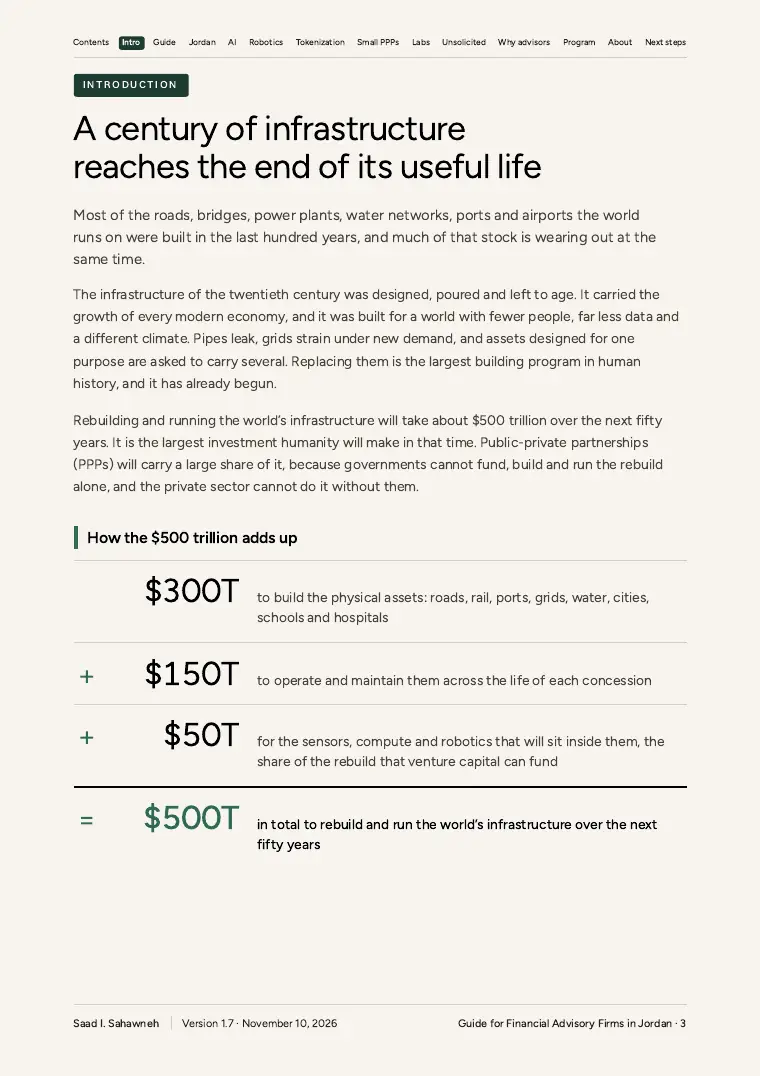
01Introduction
Why a century of infrastructure needs rebuilding, and the $500 trillion it will take.
Page 3 of 18
02The guide
Structure the $500 trillion PPP infrastructure opportunity
Page 5 of 18
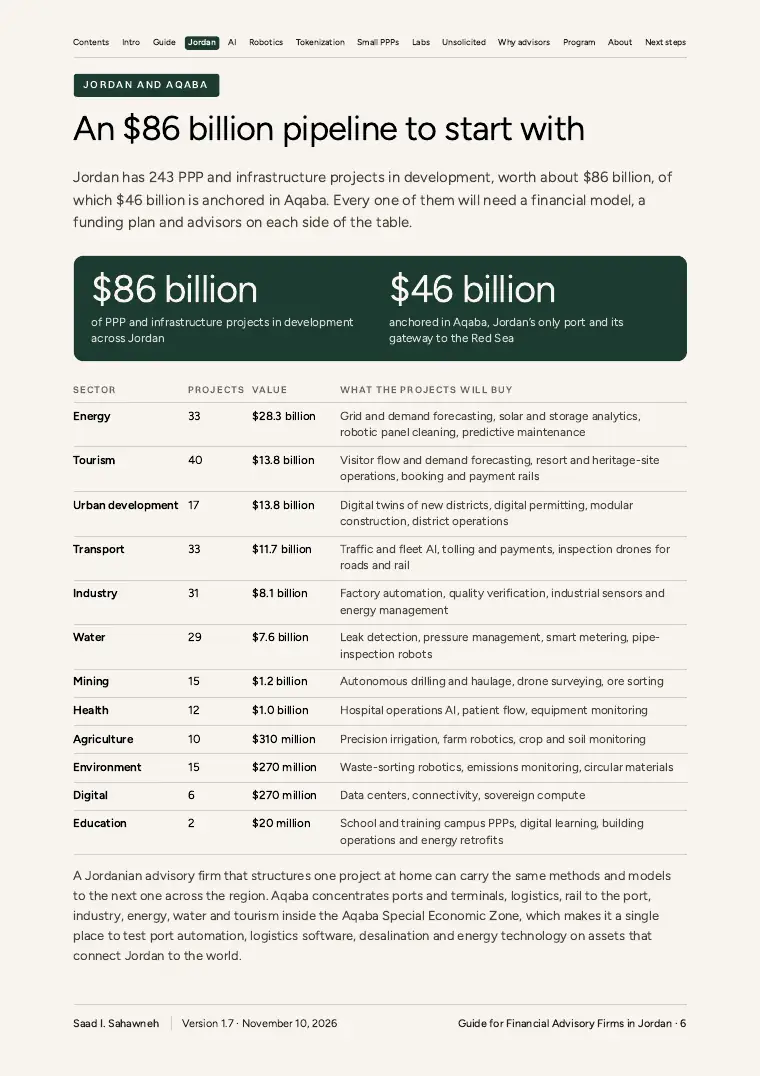
03Jordan and Aqaba
An $86 billion pipeline to start with
Page 6 of 18
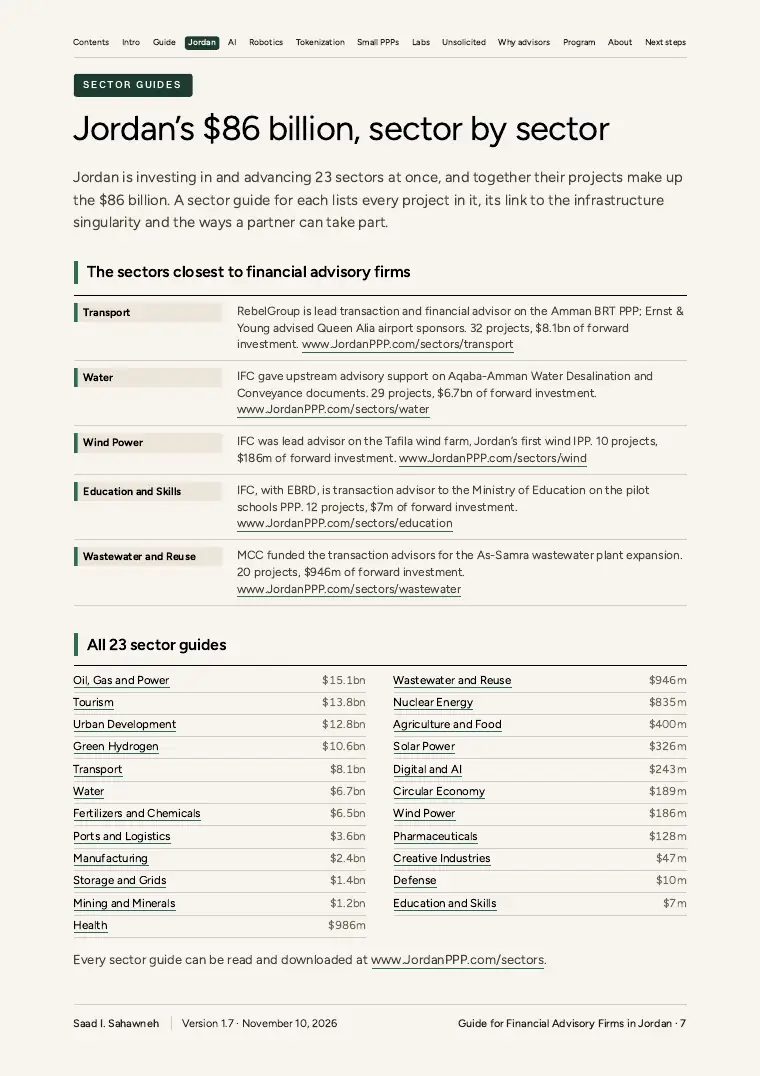
04Sector guides
The sectors closest to financial advisory firms, each with its own guide.
Page 7 of 18
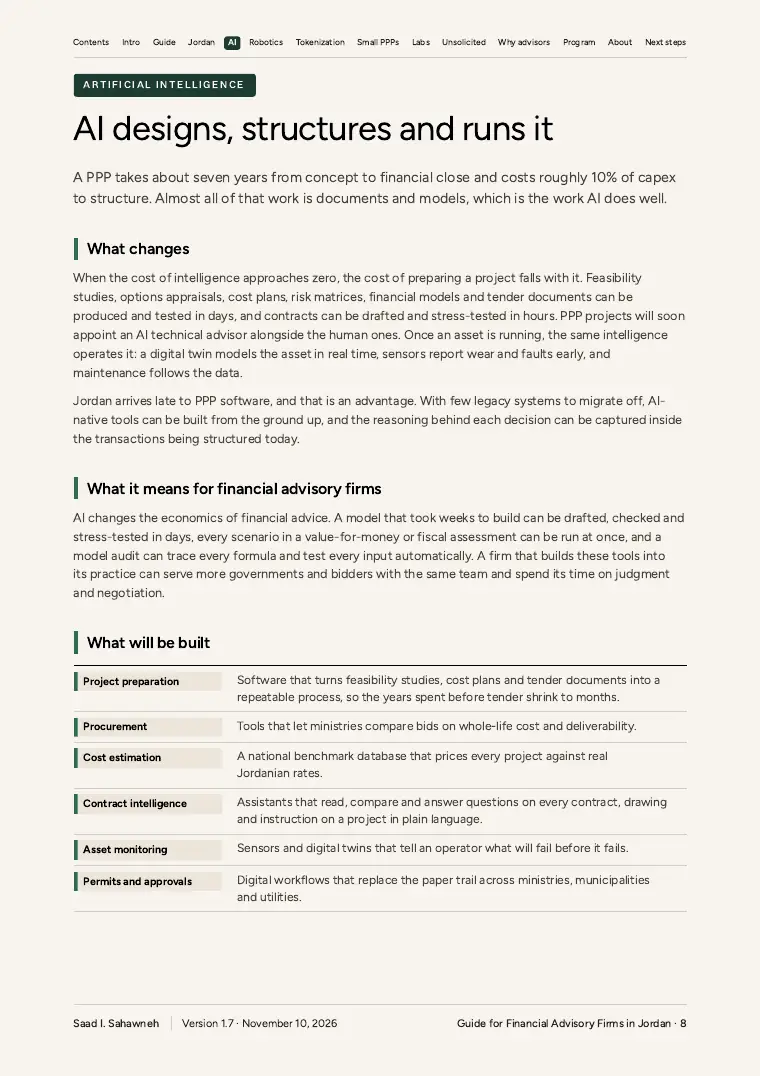
05Artificial intelligence
How AI designs, structures and runs PPP projects, and what it means for financial advisory firms.
Page 8 of 18
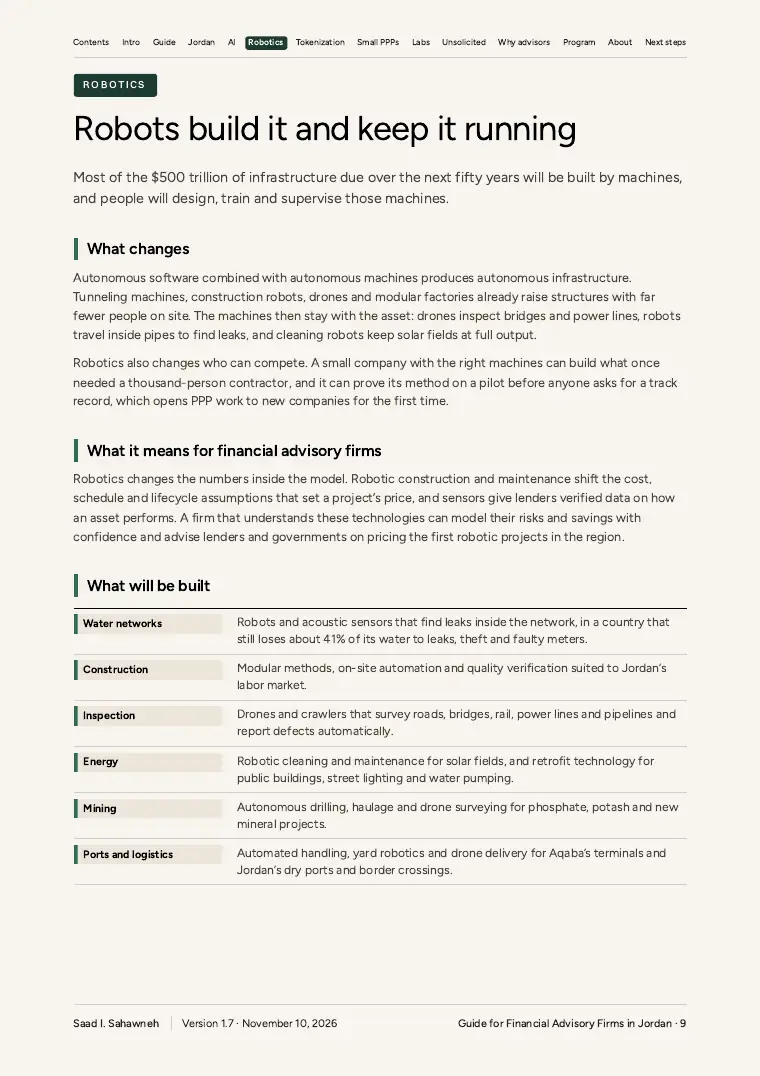
06Robotics
How robots build infrastructure and keep it running, and what that means for financial advisory firms.
Page 9 of 18
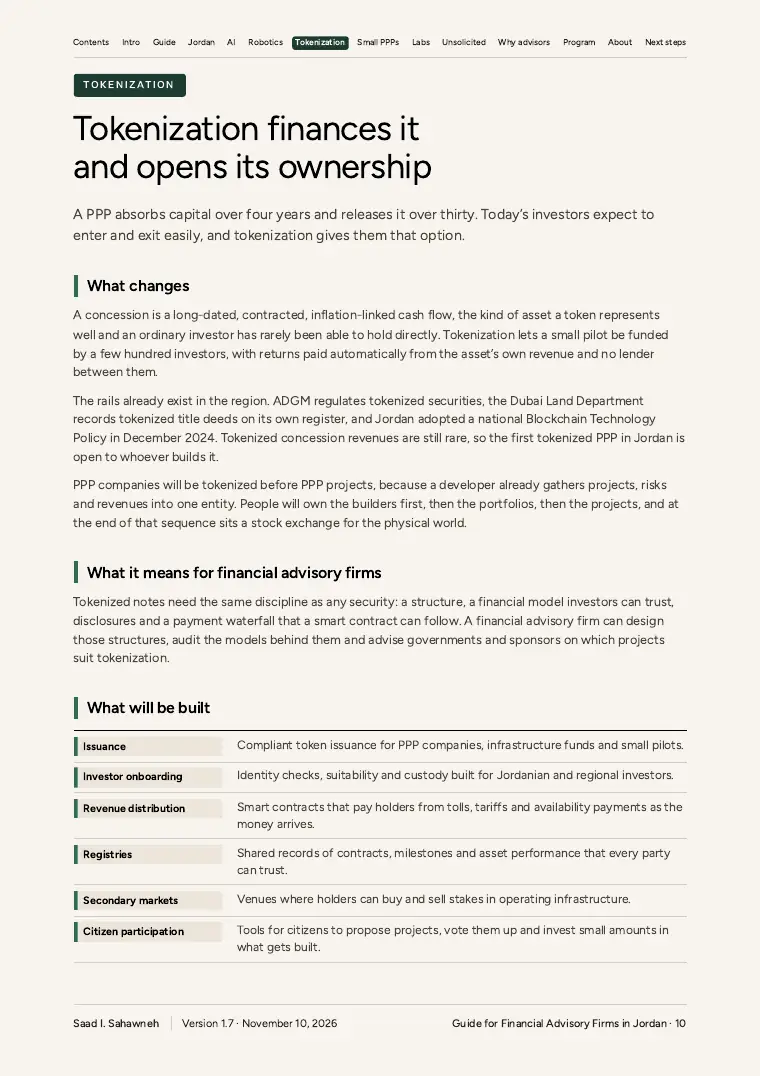
07Tokenization
How tokenization funds projects from their own revenue, and the role it opens for financial advisory firms.
Page 10 of 18
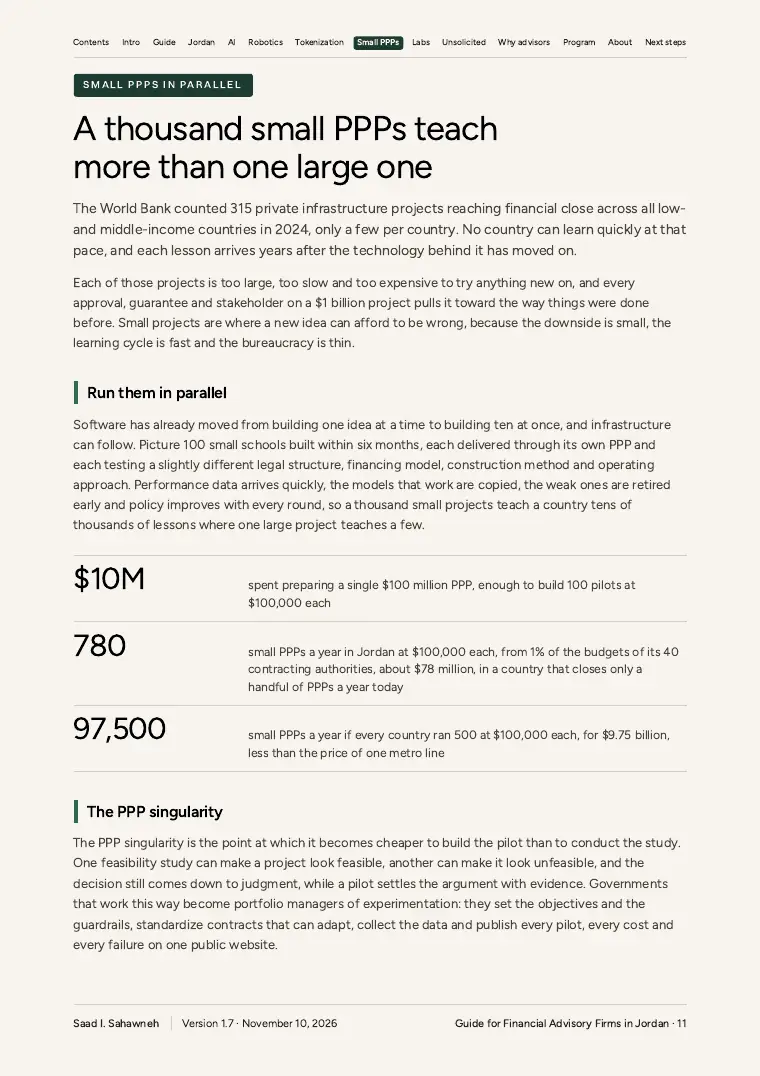
08Small PPPs in parallel
Why many small PPPs teach a country faster than a few large ones.
Page 11 of 18
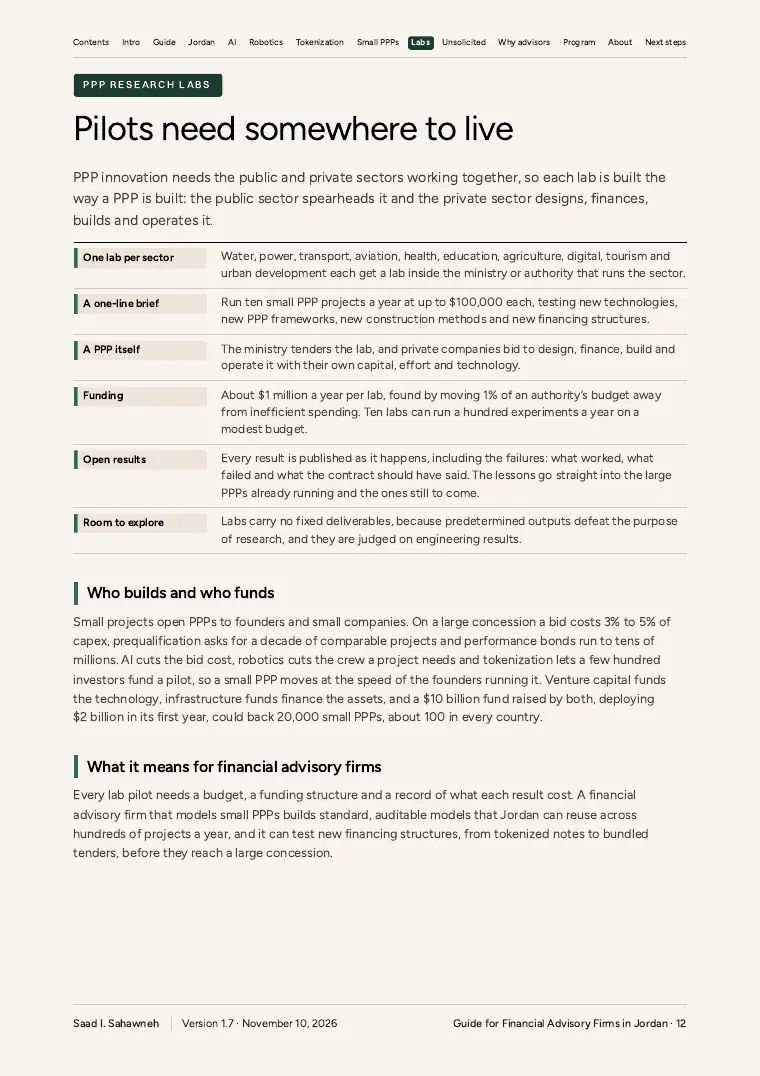
09PPP research labs
A lab in each sector, running ten small PPP projects a year.
Page 12 of 18
10Unsolicited proposals
How Jordan’s PPP law accepts direct proposals from private companies.
Page 13 of 18
11Why financial advisory firms
Financial advisors build the model every PPP is priced on
Page 14 of 18
12The program
The program can take the form of a PPP finance practice inside the firm, drawing on its advisory, corporate finance, audit and valuation people.
Page 15 of 18
13About
About Jordan PPP and what it offers.
Page 16 of 18
14Next steps
How a financial advisory firm can start: six first steps.
Page 17 of 18
Questions
Questions about the organization guide for Financial Advisory Firms in Jordan
- What does the organization guide for Financial Advisory Firms in Jordan propose?
- Your firm launches a PPP finance practice that builds financial models, advises governments, bidders and lenders on public-private partnership (PPP) transactions and structures bonds, sukuk and tokenized notes.
- Why should financial advisory firms in Jordan launch a PPP program?
- Financial advisors build the model every PPP is priced on. A PPP is a long series of payments, and its financial model sets the tariff, the debt, the return and what the government owes. Governments, bidders and lenders each appoint financial advisors to build, test and audit that model, from the first value-for-money test to the last refinancing.
- Which PPP projects can financial advisory firms in Jordan take part in?
- Jordan has about $86 billion of PPP and infrastructure projects in development, $46 billion of them anchored in Aqaba. Every one of them will need a financial model, a funding plan and advisors on each side of the table. A Jordanian advisory firm that structures one project at home can carry the same methods and models to the next one across the region.
- How can financial advisory firms in Jordan start a PPP program?
- Any financial advisory firm in Jordan can take this guide forward. The first steps use the advisors, models and clients the firm already has. The organization guide sets out six first steps: mandate, team, pipeline, models, partners and pilot.
- What does a PPP program give financial advisory firms in Jordan?
- The firm gains mandates that run for years, from the first value-for-money test through financial close, refinancing and sale, and clients who return for every change and every new project. Each transaction brings a government, sponsors and lenders, and each of them will need advisors on the next deal.
- Is the organization guide for Financial Advisory Firms in Jordan free?
- Yes. It is free to read on this page and free to download as an 18-page PDF, with the case for a PPP program, Jordan’s pipeline, the role of AI, robotics and tokenization, the program and six first steps.
Sector guides
The sectors closest to financial advisory firms
Jordan’s $86 billion is spread across 23 sectors. Each sector guide lists every project in it and shows how to take part.
Financial advisors work on projects in every sector. These are the sectors where we found a named mandate in Jordan.
 Transport$8.1bnRebelGroup is lead transaction and financial advisor on the Amman BRT PPP; Ernst & Young advised Queen Alia airport sponsors32 projects
 Water$6.7bnIFC gave upstream advisory support on Aqaba-Amman Water Desalination and Conveyance documents29 projects
 Wind Power$186mIFC was lead advisor on the Tafila wind farm, Jordan’s first wind IPP10 projects
 Education and Skills$7mIFC, with EBRD, is transaction advisor to the Ministry of Education on the pilot schools PPP12 projects
 Wastewater and Reuse$946mMCC funded the transaction advisors for the As-Samra wastewater plant expansion20 projects
 Health$986mIFC’s PPP advisory agreement with Jordan covers health projects20 projects
 Ports and Logistics$3.6bnThe same IFC agreement covers logistics and port PPPs23 projects
 Tourism$13.8bnThe same IFC agreement covers tourism PPPs56 projects
 Digital and AI$243mIFC is Lead Transaction Advisor to the Government of Jordan on the National Broadband Network PPP19 projects
 Oil, Gas and Power$15.1bnRothschild advised the IDB Infrastructure Fund and RBS Corporate Finance advised QEWC on a stake sale in the Amman East power plant23 projects
Guide 44 of 96
Browse all 96 organization guides