What this organization guide is for
Your organization launches a public-private partnership (PPP) program that turns part of its funding into project preparation, payments for results and blended and first-loss finance for small PPPs, so each grant brings private investment into lasting infrastructure.
The case
Donor money can bring the first private investors in
Bilateral aid agencies, multilateral humanitarian funds and private foundations have funded much of Jordan’s response to the refugee crises of the past decades. Most of that money is spent year by year. Used as preparation funding, results payments and first-loss capital, the same money can bring private investors into infrastructure that serves people for decades. This guide invites donors and foundations active in Jordan to launch a PPP program, starting with the projects at home.
The guide
Make every grant go further in Jordan’s share of the $500 trillion PPP opportunity
Your organization launches a dedicated PPP program, with a team and a set of instruments that prepare projects, pay for results and carry the first risks in new structures, so private capital follows into water, energy, education and health, beside Jordan’s $86 billion of projects and the $46 billion anchored in Aqaba.
01
Project preparation
A preparation fund pays for the feasibility studies, transaction advisors and community consultations that turn a humanitarian or development need into a bankable PPP, and technical assistance helps contracting authorities prepare the next one themselves.
02
Payments for results
Part of a grant becomes a long-term payment for services delivered: water supplied, classrooms open, clinics staffed. A private partner invests up front and is paid when the results are measured.
03
Blended and first-loss finance
Concessional and first-loss tranches make the first projects in a new sector investable for private capital. The same tools can anchor the first tokenized PPP notes in Jordan, where a small first-loss layer brings many investors in behind it.
04
Small PPPs and research labs
PPP Regulation No. 9 of 2024 defines small-scale PPPs below $14.1 million, which can be bundled into one feasibility report and one tender. Grants can fund bundled pilots and the PPP research labs that test new technology, contracts and finance before the large projects adopt them.
05
Shared results
Every funded project reports its performance and costs to a shared registry, so donors, the government and investors learn from each one and the next project needs less support.
Why donors and foundations
Donor money can bring the first private investors in
The first PPPs in a sector rarely close on commercial capital alone. Donors and foundations can pay for preparation, carry the risks private investors avoid and pay for results, so each project they back makes the next one easier to finance.
Where donors fit in a PPP
- Preparation
- Funding for studies, advisors and consultations that turn a need into a bankable tender.
- Risk
- First-loss and concessional capital that carries the risks private investors cannot yet price.
- Payments
- Long-term payments for measured results that let a private partner invest up front.
- Standards
- Environmental, social and safeguarding standards that later deals copy.
- Learning
- Published results that let the next project close with less support.
What changes for donors
AI, robotics and tokenization change how far a grant can go. AI cuts the cost of preparing and monitoring projects, robotic construction and inspection lower the risks investors carry, and tokenized notes let a small first-loss layer bring many investors into a project, so each dollar of grant funding unlocks more private capital.
Why a program, and why now
Without a program, each grant is designed and spent on its own and the lessons rarely reach the next one. A program gives the organization a team, a preparation fund, standard instruments and a working link to the contracting authorities, so each project moves faster than the last.

Futureproofing
Futureproof Humanitarian Donors and Foundations in Jordan for the infrastructure singularity
This free 18-page guide shows how, with small PPPs in parallel, PPP research labs, artificial intelligence, robotics, tokenization and six first steps.
Jordan and Aqaba
An $86 billion pipeline to start with
Many will need preparation funding and early risk capital before commercial investors can commit. A project that one donor helps prepare leaves behind documents, data and a model that other donors and investors can follow.
- $86B
- of PPP and infrastructure projects in development in Jordan
- $46B
- of them anchored in Aqaba

Artificial intelligence
AI lets a donor prepare and appraise more projects with the same budget. Feasibility studies, financial models and contracts can be drafted and compared in days, and once a project is running, sensors and digital twins report its results on live data, which makes payments for results simpler to verify and cheaper to monitor.

Robotics
Robotics lowers the cost and risk of building and maintaining the assets donors help fund. Drones and inspection robots check roads, pipes and power lines and report defects automatically, which gives the donor and the public an independent record of how each asset performs, and training can keep the skills in Jordan.

Tokenization
Tokenization opens infrastructure to many more investors, and a donor can make the first issues safe enough to buy. A first-loss tranche or a guarantee from a donor or foundation can anchor the first tokenized PPP notes in Jordan, and a shared registry lets every investor see how each project performs.

Small PPPs and research labs
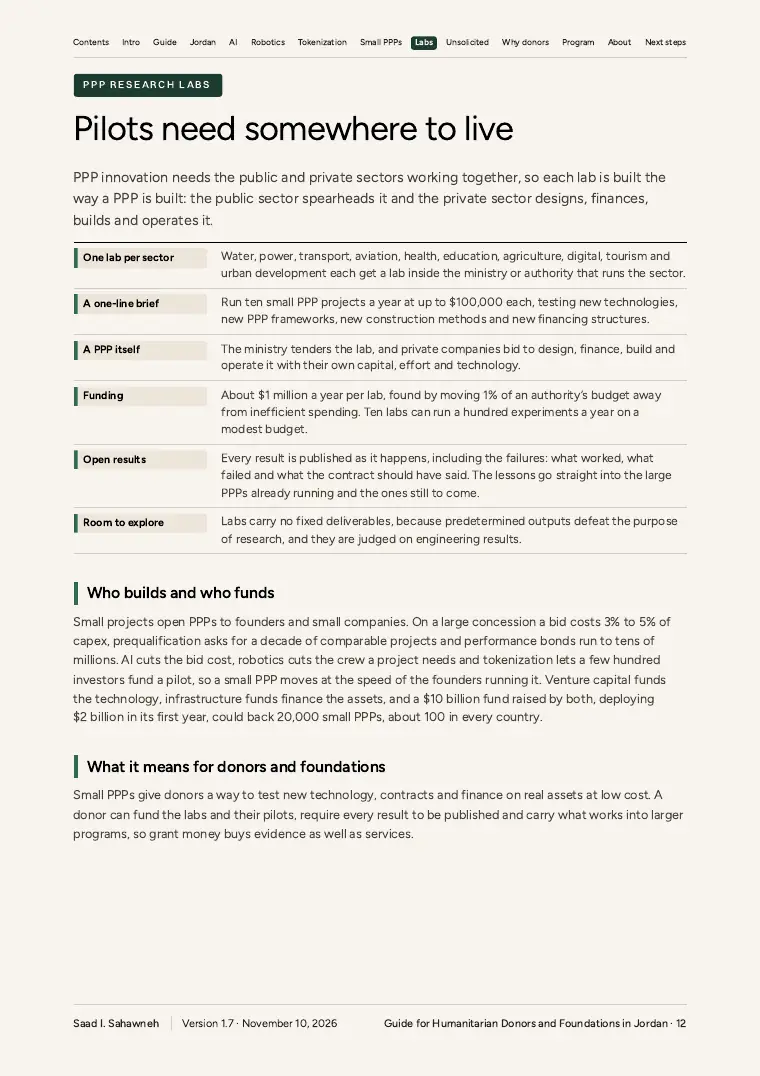
Small PPPs give donors a way to test new technology, contracts and finance on real assets at low cost. A donor can fund the labs and their pilots, require every result to be published and carry what works into larger programs, so grant money buys evidence as well as services.

Unsolicited proposals
Direct proposals bring donors projects at their earliest stage, often from Jordanian companies with strong ideas and thin balance sheets. A preparation fund can co-fund a proposal’s pre-feasibility study, and the proposer can match the best offer at tender.
The program
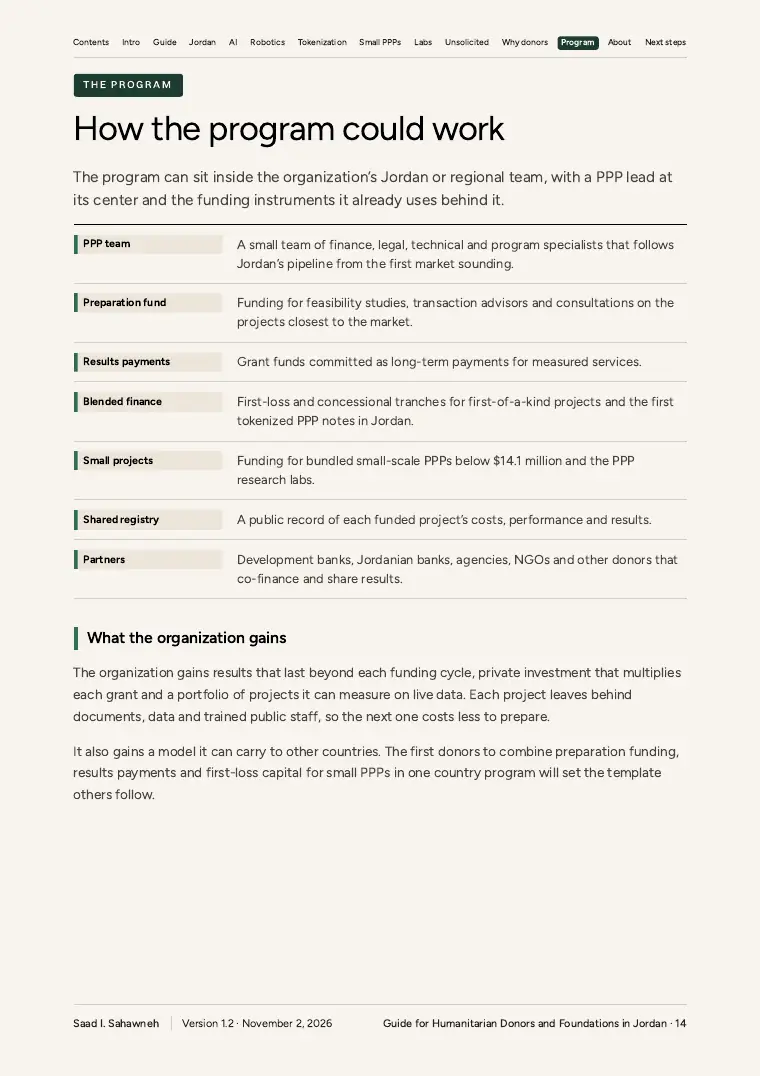
How the program could work
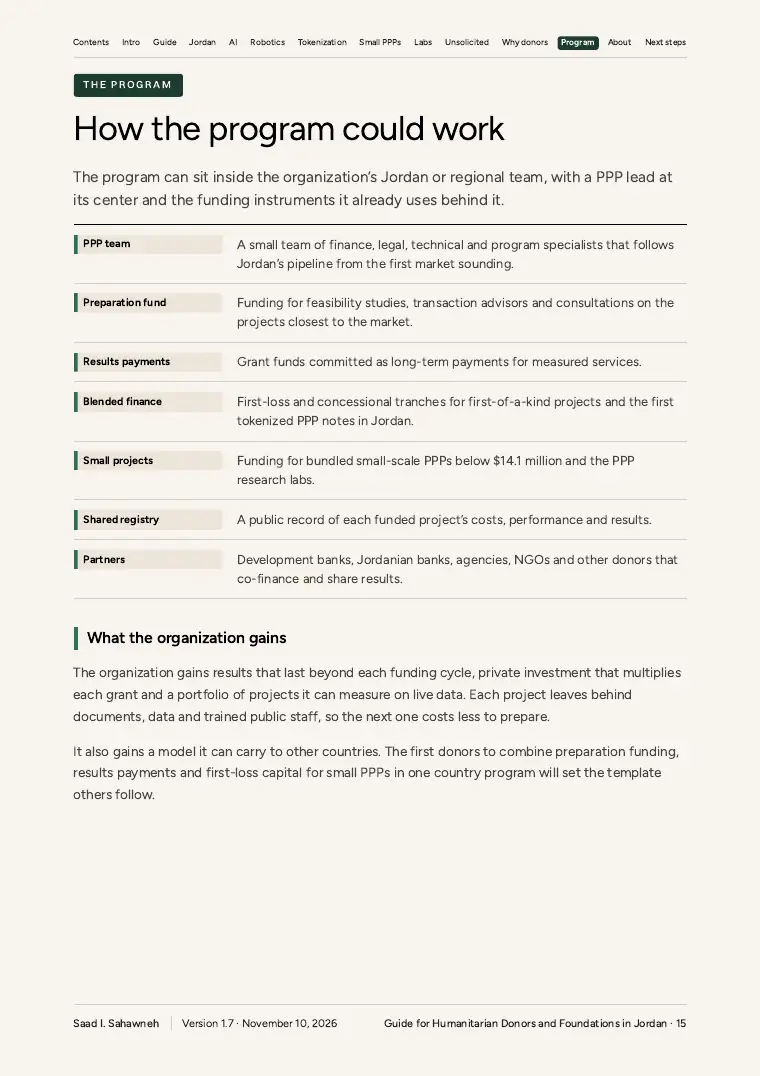
The program can sit inside the organization’s Jordan or regional team, with a PPP lead at its center and the funding instruments it already uses behind it.
- PPP team
- A small team of finance, legal, technical and program specialists that follows Jordan’s pipeline from the first market sounding.
- Preparation fund
- Funding for feasibility studies, transaction advisors and consultations on the projects closest to the market.
- Results payments
- Grant funds committed as long-term payments for measured services.
- Blended finance
- First-loss and concessional tranches for first-of-a-kind projects and the first tokenized PPP notes in Jordan.
- Small projects
- Funding for bundled small-scale PPPs below $14.1 million and the PPP research labs.
- Shared registry
- A public record of each funded project’s costs, performance and results.
- Partners
- Development banks, Jordanian banks, agencies, NGOs and other donors that co-finance and share results.
What the organization gains
The organization gains results that last beyond each funding cycle, private investment that multiplies each grant and a portfolio of projects it can measure on live data. Each project leaves behind documents, data and trained public staff, so the next one costs less to prepare.
It also gains a model it can carry to other countries. The first donors to combine preparation funding, results payments and first-loss capital for small PPPs in one country program will set the template others follow.

Next steps
How a donor or foundation can start
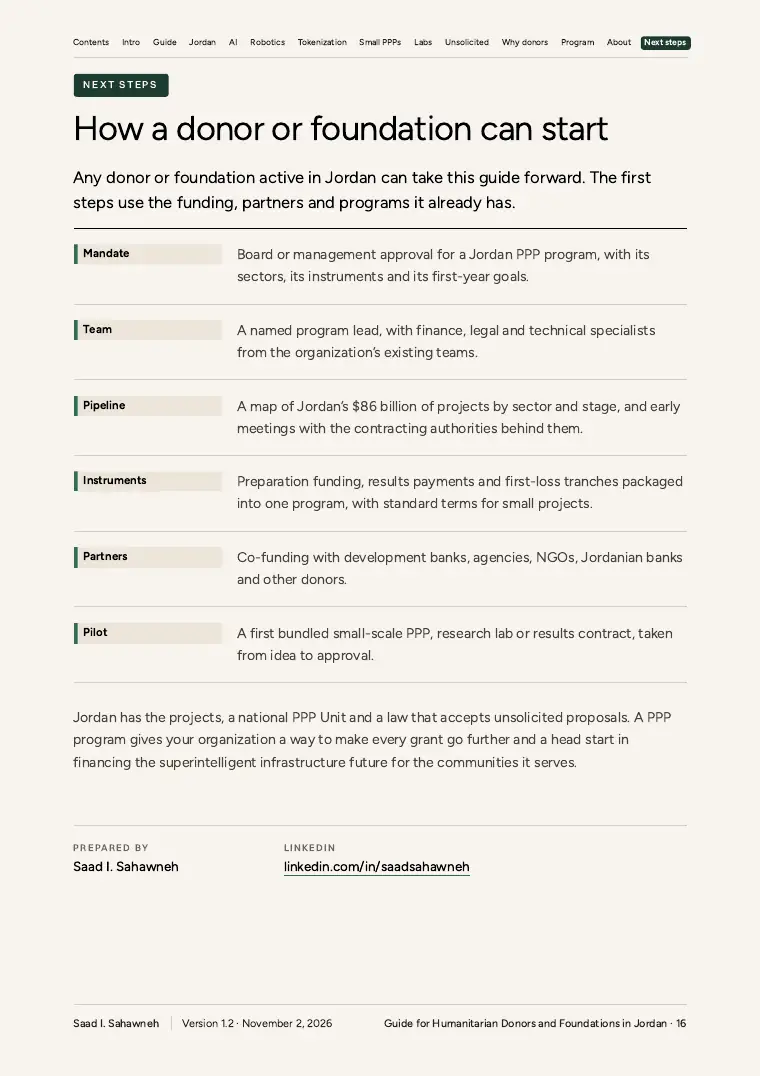
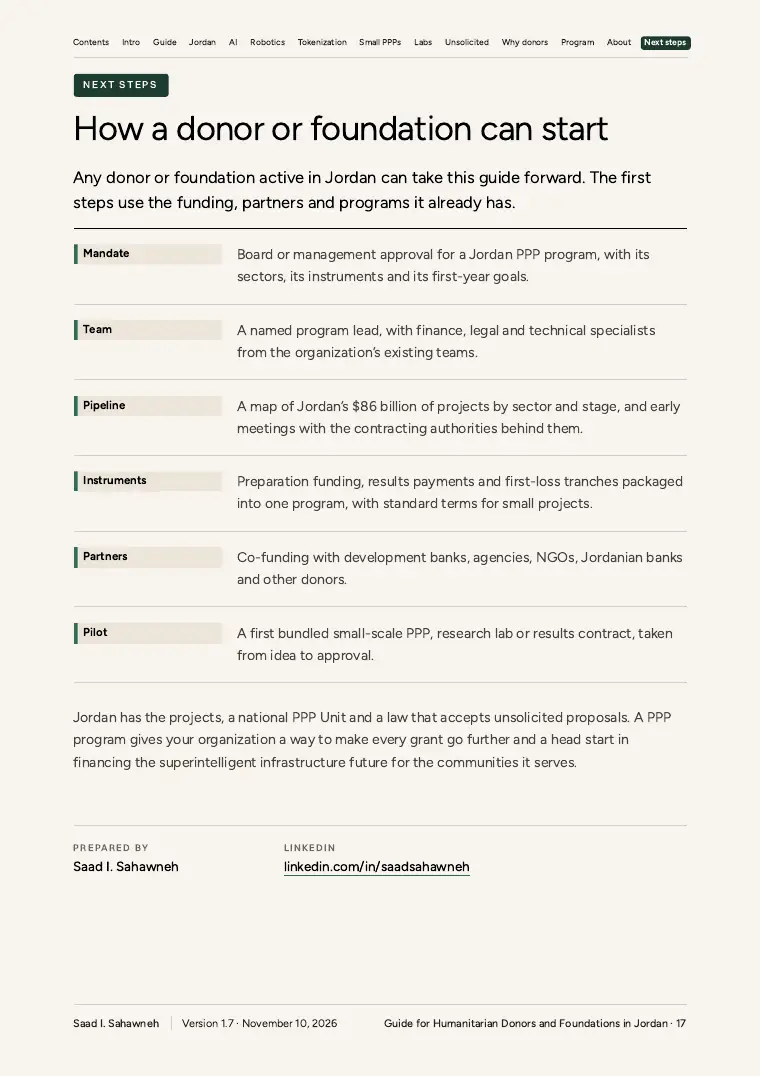
Any donor or foundation active in Jordan can take this guide forward. The first steps use the funding, partners and programs it already has.
01
Mandate
Board or management approval for a Jordan PPP program, with its sectors, its instruments and its first-year goals.
02
Team
A named program lead, with finance, legal and technical specialists from the organization’s existing teams.
03
Pipeline
A map of Jordan’s $86 billion of projects by sector and stage, and early meetings with the contracting authorities behind them.
04
Instruments
Preparation funding, results payments and first-loss tranches packaged into one program, with standard terms for small projects.
05
Partners
Co-funding with development banks, agencies, NGOs, Jordanian banks and other donors.
06
Pilot
A first bundled small-scale PPP, research lab or results contract, taken from idea to approval.
Jordan has the projects, a national PPP Unit and a law that accepts unsolicited proposals. A PPP program gives your organization a way to make every grant go further and a head start in financing the superintelligent infrastructure future for the communities it serves.
The full document
Inside this guide
Eighteen pages and fourteen chapters, from the case for a PPP program to the first steps, written for humanitarian donors and foundations in Jordan.
- 18
- pages
- 14
- chapters
- 3
- technologies
- 6
- first steps
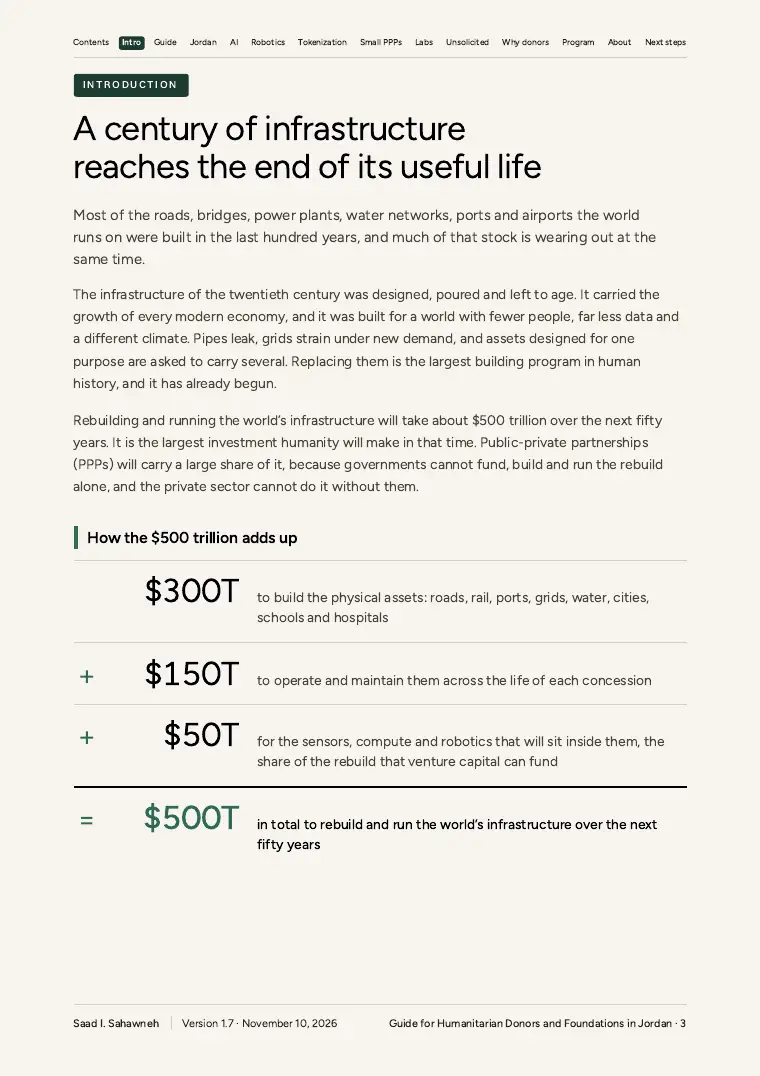
01Introduction
Why a century of infrastructure needs rebuilding, and the $500 trillion it will take.
Page 3 of 18
02The guide
Make every grant go further in Jordan’s share of the $500 trillion PPP opportunity
Page 5 of 18
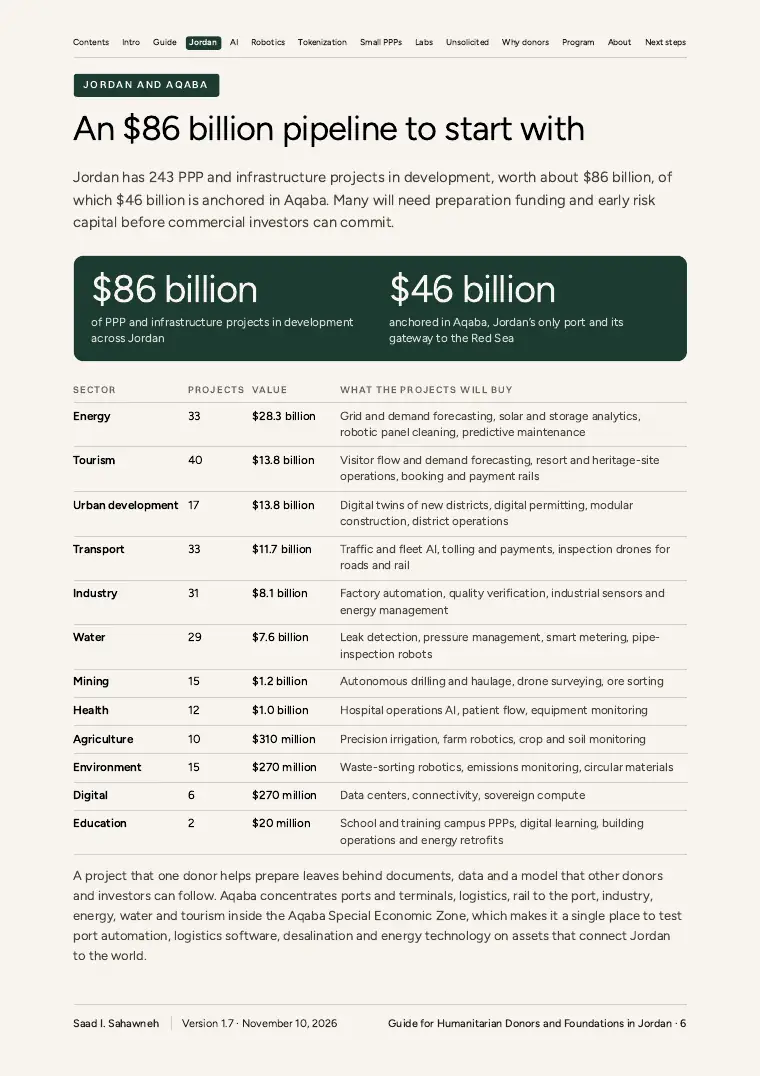
03Jordan and Aqaba
An $86 billion pipeline to start with
Page 6 of 18
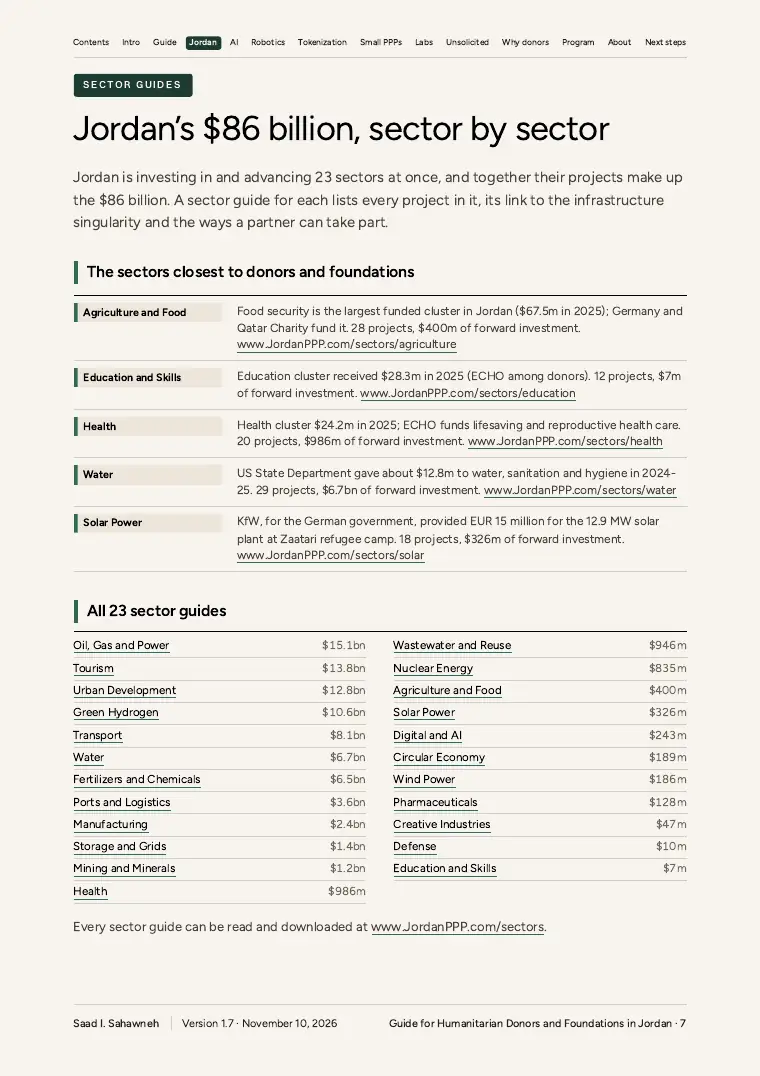
04Sector guides
The sectors closest to donors and foundations, each with its own guide.
Page 7 of 18
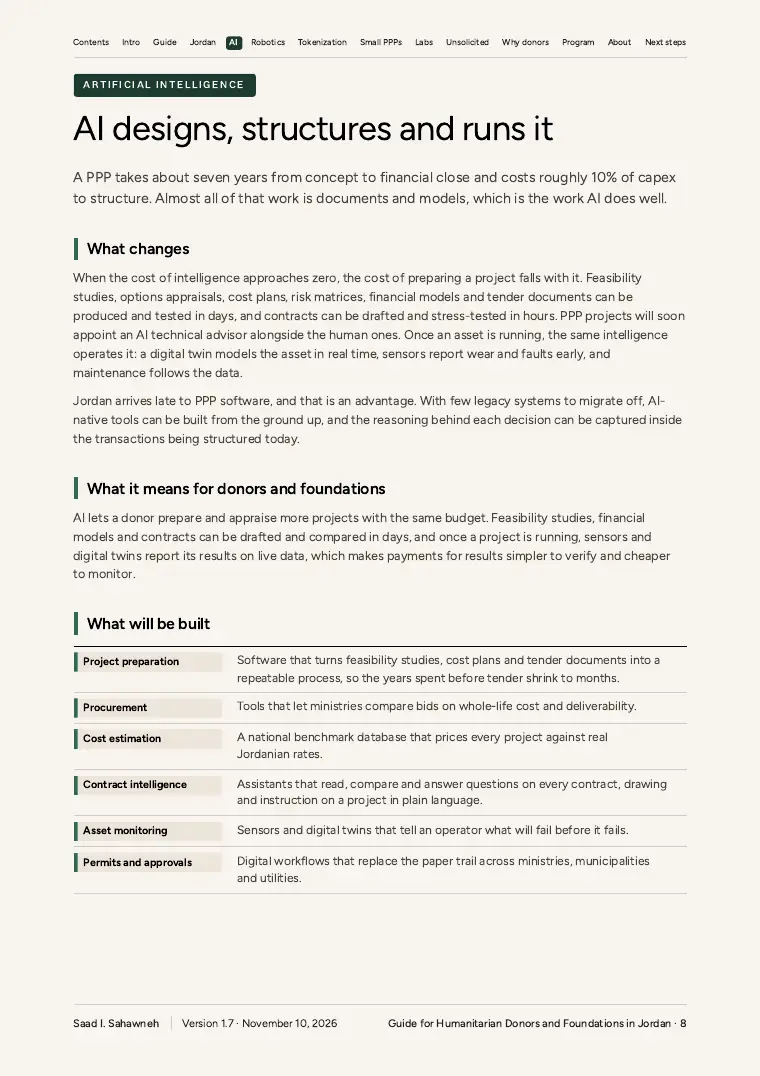
05Artificial intelligence
How AI designs, structures and runs PPP projects, and what it means for donors and foundations.
Page 8 of 18
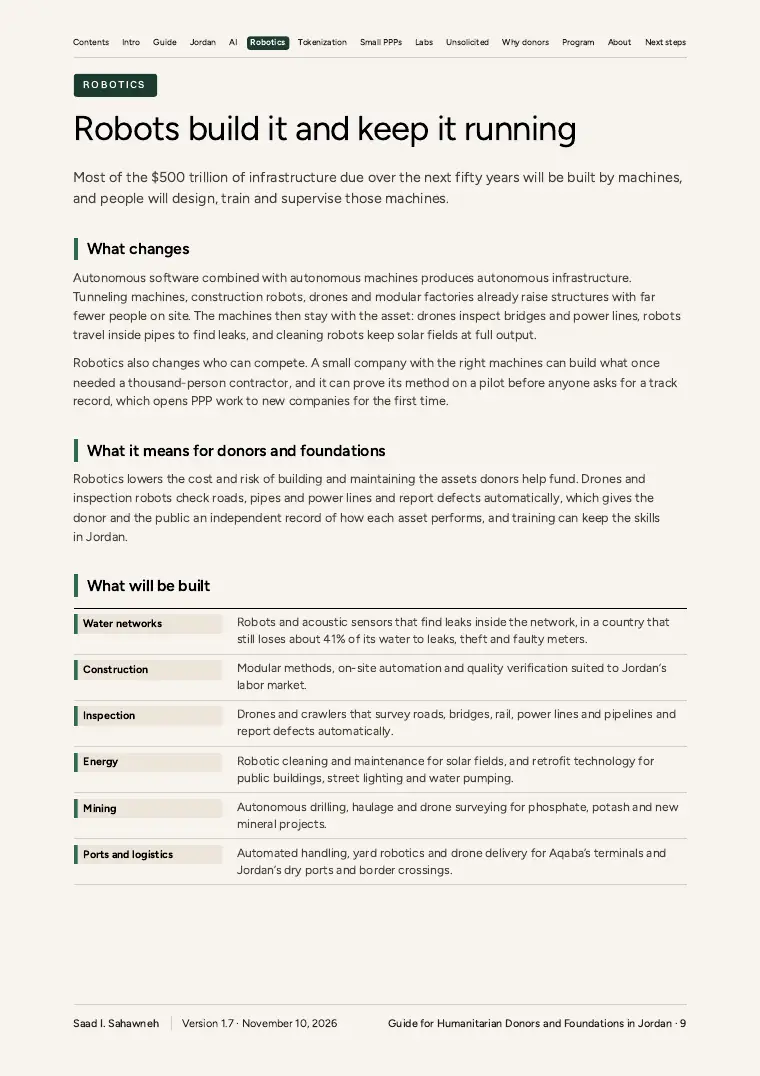
06Robotics
How robots build infrastructure and keep it running, and what that means for donors and foundations.
Page 9 of 18
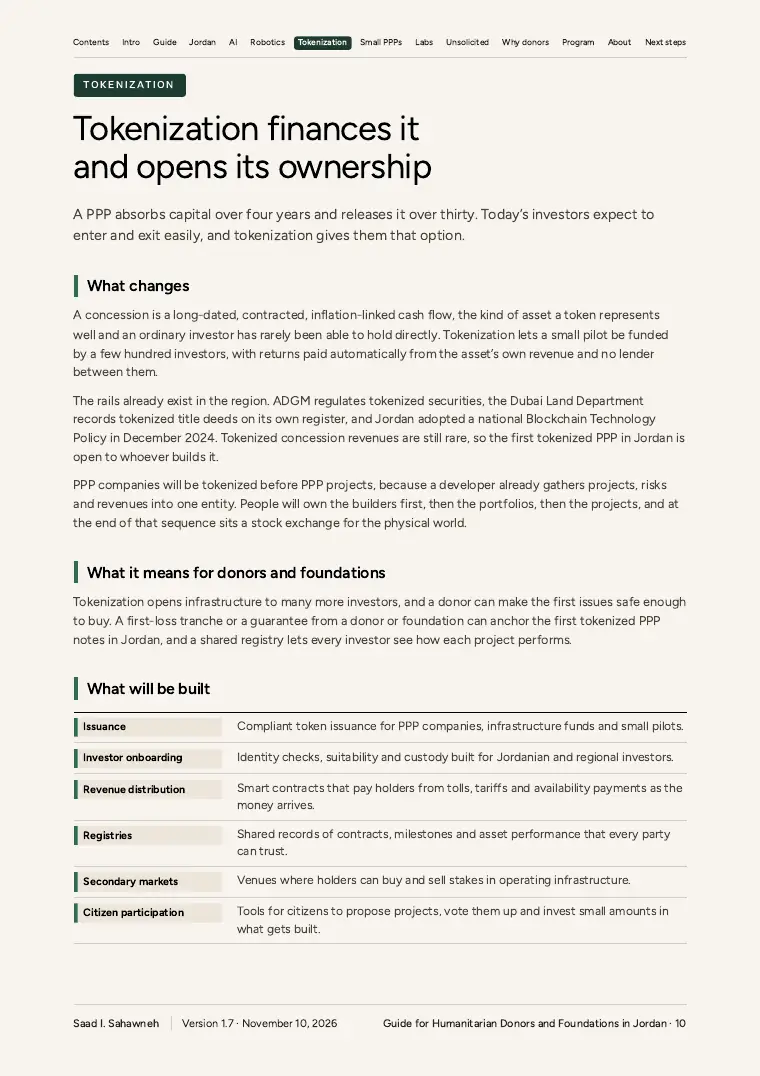
07Tokenization
How tokenization funds projects from their own revenue, and the role it opens for donors and foundations.
Page 10 of 18
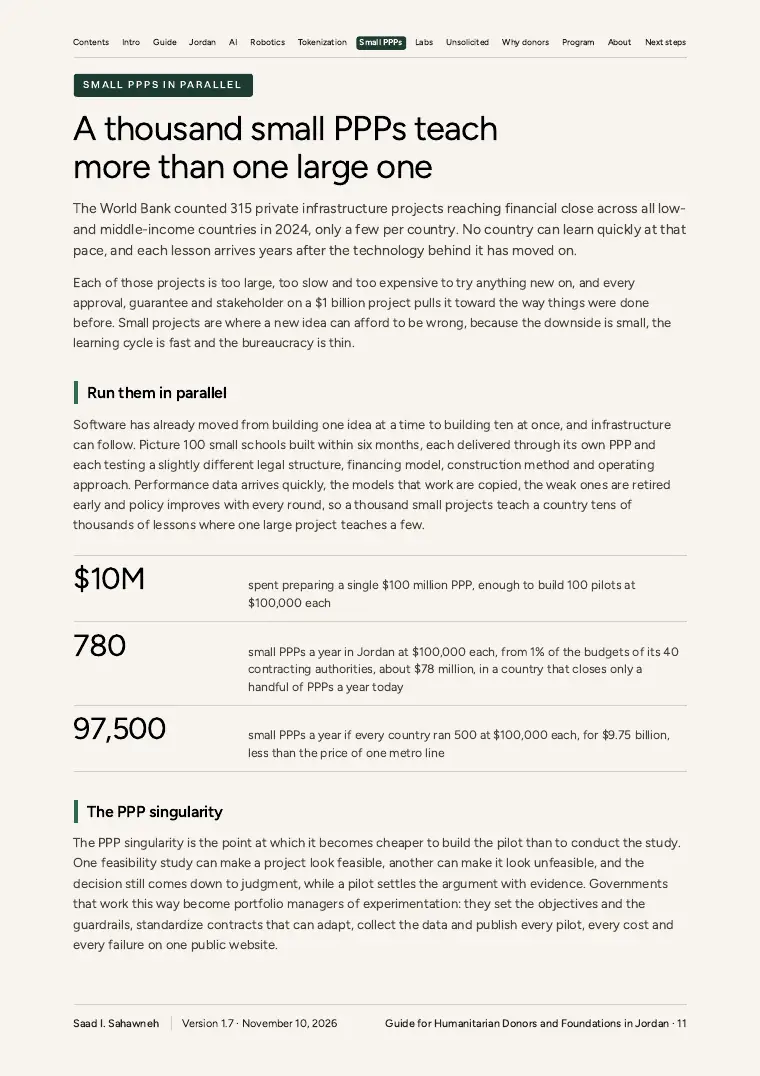
08Small PPPs in parallel
Why many small PPPs teach a country faster than a few large ones.
Page 11 of 18
09PPP research labs
A lab in each sector, running ten small PPP projects a year.
Page 12 of 18
10Unsolicited proposals
How Jordan’s PPP law accepts direct proposals from private companies.
Page 13 of 18
11Why donors and foundations
Donor money can bring the first private investors in
Page 14 of 18
12The program
The program can sit inside the organization’s Jordan or regional team, with a PPP lead at its center and the funding instruments it already uses behind it.
Page 15 of 18
13About
About Jordan PPP and what it offers.
Page 16 of 18
14Next steps
How a donor or foundation can start: six first steps.
Page 17 of 18
Questions
Questions about the organization guide for Humanitarian Donors and Foundations in Jordan
- What does the organization guide for Humanitarian Donors and Foundations in Jordan propose?
- Your organization launches a public-private partnership (PPP) program that turns part of its funding into project preparation, payments for results and blended and first-loss finance for small PPPs, so each grant brings private investment into lasting infrastructure.
- Why should humanitarian donors and foundations in Jordan launch a PPP program?
- Donor money can bring the first private investors in. The first PPPs in a sector rarely close on commercial capital alone. Donors and foundations can pay for preparation, carry the risks private investors avoid and pay for results, so each project they back makes the next one easier to finance.
- Which PPP projects can humanitarian donors and foundations in Jordan take part in?
- Jordan has about $86 billion of PPP and infrastructure projects in development, $46 billion of them anchored in Aqaba. Many will need preparation funding and early risk capital before commercial investors can commit. A project that one donor helps prepare leaves behind documents, data and a model that other donors and investors can follow.
- How can humanitarian donors and foundations in Jordan start a PPP program?
- Any donor or foundation active in Jordan can take this guide forward. The first steps use the funding, partners and programs it already has. The organization guide sets out six first steps: mandate, team, pipeline, instruments, partners and pilot.
- What does a PPP program give humanitarian donors and foundations in Jordan?
- The organization gains results that last beyond each funding cycle, private investment that multiplies each grant and a portfolio of projects it can measure on live data. Each project leaves behind documents, data and trained public staff, so the next one costs less to prepare.
- Is the organization guide for Humanitarian Donors and Foundations in Jordan free?
- Yes. It is free to read on this page and free to download as an 18-page PDF, with the case for a PPP program, Jordan’s pipeline, the role of AI, robotics and tokenization, the program and six first steps.
Sector guides
The sectors closest to humanitarian donors and foundations
Jordan’s $86 billion is spread across 23 sectors. Each sector guide lists every project in it and shows how to take part.
 Agriculture and Food$400mFood security is the largest funded cluster in Jordan ($67.5m in 2025); Germany and Qatar Charity fund it28 projects
 Education and Skills$7mEducation cluster received $28.3m in 2025 (ECHO among donors)12 projects
 Health$986mHealth cluster $24.2m in 2025; ECHO funds lifesaving and reproductive health care20 projects
 Water$6.7bnUS State Department gave about $12.8m to water, sanitation and hygiene in 2024-2529 projects
 Solar Power$326mKfW, for the German government, provided EUR 15 million for the 12.9 MW solar plant at Zaatari refugee camp18 projects
 Circular Economy$189mThe EU funds Oxfam’s €25 million solid waste project for Zaatari and Azraq camps and surrounding host communities22 projects
 Digital and AI$243mWFP’s Building Blocks blockchain system handles monthly cash assistance for refugees in Jordan’s Azraq and Zaatari camps19 projects
 Storage and Grids$1.4bnThe IKEA Foundation funded the UNHCR solar plant at Azraq camp, which feeds unused power into Jordan’s national grid25 projects
 Wastewater and Reuse$946mKfW, on behalf of the German government, supports wastewater disposal and drinking water supply at Zaatari refugee camp20 projects
Guide 93 of 96
Browse all 96 organization guides