· 15 min read
EarthOS
The world’s biggest $500 trillion computer has the hardware. EarthOS is the shared AI software that will run it, written by everyone, with tokenization keeping track of who owns, runs and is owed what.
Open a laptop in a dark room. For a moment the screen glows black and empty, then a logo appears, a thin bar fills from left to right and the machine wakes up. In those few seconds the operating system checks the battery, finds the screen, the keyboard and the Wi-Fi, decides which program gets the processor first and puts every file back where it belongs. Without it, the most powerful chips in the world would sit in the dark doing nothing.
Now picture the night side of the Earth seen from space. Cities glow like clusters of chips. Highways trace thin gold lines between them, ships blink along the sea lanes, and the lights of ports, mines and power plants flicker at the edges of the deserts. That glowing web is the world’s biggest $500 trillion computer, every road, power line, pipe, cable and satellite on Earth slowly joining into one machine. It already has the hardware, and it is still waiting for its operating system. We call that missing piece EarthOS.
Three layers, one machine
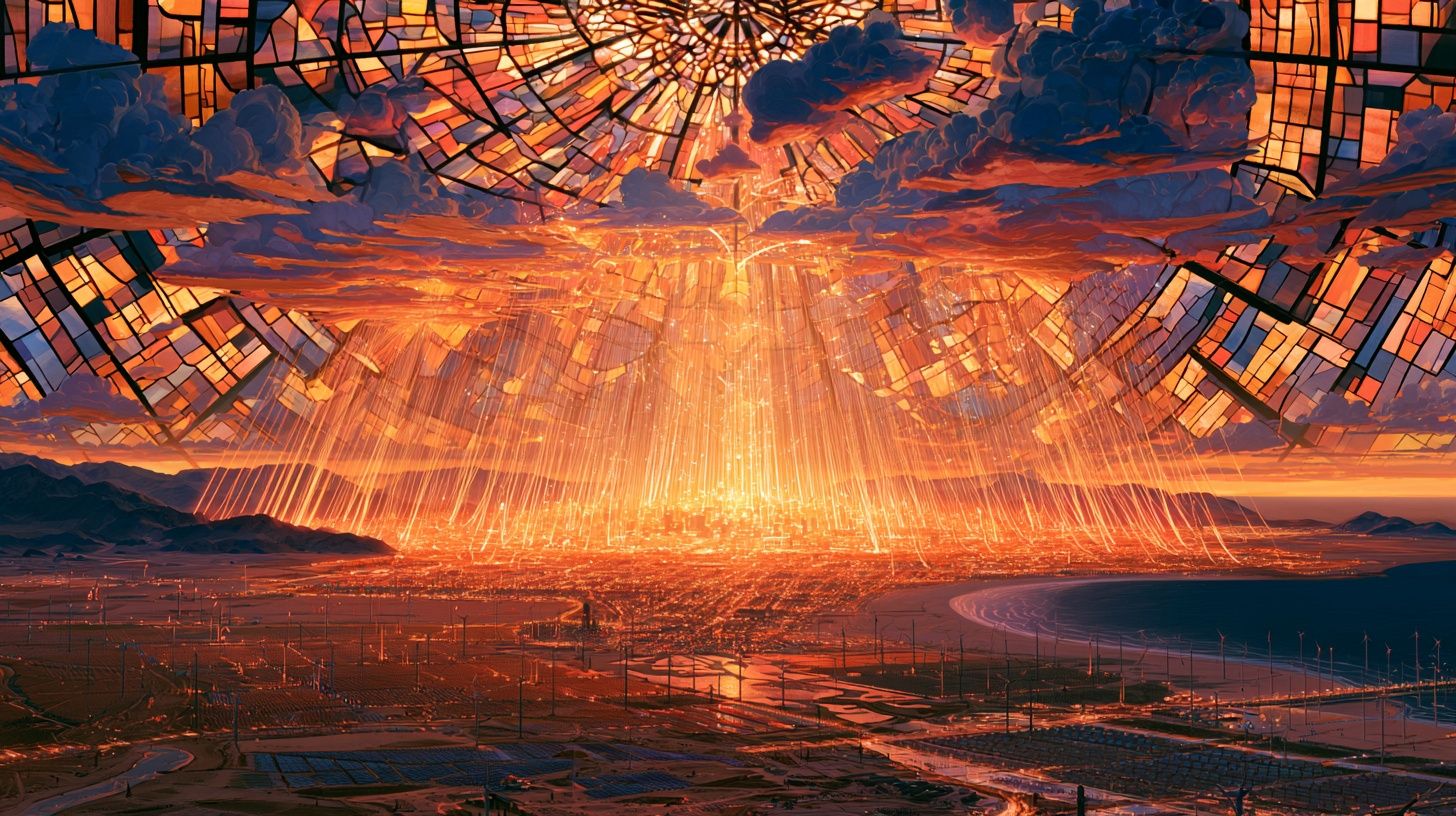
Picture three sheets of glass stacked one above the other, each one glowing with its own pattern of light. Every computer is built in layers like this, and the planet’s computer has three of them.
The hardware is the physical world. The bottom sheet is covered in roads, railways, water mains, power plants, ports, dams, data centers, schools and hospitals, the body of the machine, with satellites circling above it. Tiny points of light are spreading across it: a meter in every pipe, a gauge in every bridge, a camera at every junction and a weather station on every hill. These sensors are the nerves that let concrete and steel feel the weight of a truck, the heat of the sun and the first drop of a leak.
EarthOS is the software. The middle sheet glows with rings of light that pulse outward like ripples on water. This is an artificial intelligence that reads every sensor at once, keeps a living map of the whole planet and decides, second by second, where power, water, goods and people should flow. It runs on the data centers that act as the machine’s processors, and it gives orders to the robots that build, inspect and repair.
Tokenization manages it all. The top sheet is a fine lattice of small glowing squares, one for every asset in the machine, each holding a digital record of who owns it, who runs it, what it promised to deliver and what it is owed. With tokenization, ownership can be split into small digital shares, payments move the moment a job is done, and every change is written into a shared record that nobody can quietly rewrite, so a machine with millions of owners can keep honest accounts.
What an operating system does
Look inside any operating system and you find the same handful of jobs. EarthOS does each of them at the size of the planet.
It keeps one picture of everything. At the heart of every operating system sits the kernel, the part that knows the state of every device at every moment. The heart of EarthOS is a living map of the Earth, sometimes called a digital twin. Zoom in on it and you can watch water moving through a single pipe under a street in Zarqa. Zoom out and you see the whole planet breathing, with power flowing east to west as the sun crosses the sky.
It decides who goes first. A laptop’s scheduler decides which program gets the processor next. EarthOS schedules the planet: which city gets power at the evening peak, which ship docks first at Aqaba, which truck takes which road and which field gets water before the afternoon heat.
It remembers. A computer’s memory holds what it needs for later. EarthOS manages the planet’s memory, the batteries, reservoirs, dams and tanks that hold power and water for the night and the summer. At noon, when the desert sun makes more power than anyone needs, it can pump water uphill into a store like the planned 450 megawatt Al-Mujib plant, and in the evening it lets that water rush back down through the turbines to light the cities.
It speaks to every device. Plug a new printer into a laptop and a small program called a driver teaches the computer how to use it. EarthOS gives every kind of asset a driver of its own, so a new solar farm in Jordan, a wind farm in Morocco or a water plant in Chile can join the machine on its first day.
It runs apps. On a phone, anyone can write an app. On EarthOS, a farmer can open an app that colors each row of her field by how thirsty it is, a city can run an app that warns every street before a flood, and a school can show its students how much power its own roof made that morning.
It updates itself. A laptop gets better every time its software updates. EarthOS learns from every leak it finds and every repair it plans, and it shares each lesson with every similar asset on Earth. A fix discovered in a pipe in Amman can protect a pipe in Jakarta by the next morning.
It keeps the machine safe. An operating system decides who may open which file. EarthOS decides who may see which data and change which setting, and it guards the machine against attacks, mistakes and breakdowns, so a single fault stays small.
Wired into space
Look up on a clear night far from the city and you may see a satellite crossing the stars, a small steady point of light moving faster than any plane. About 16,800 working satellites circle the Earth, according to the KeepTrack catalog in October 2026, and every one of them can be part of EarthOS.
Satellites are its eyes. From orbit they watch crops ripen, rivers rise, ships cross the oceans and cities spread their lights across the night. They can spot a leaking pipeline from the patch of green it leaves in the desert and see a storm forming days before it reaches land.
Satellites are its long-distance nerves. Internet satellites carry data to ships, planes, mines and villages that no cable can reach. Newer satellites talk to each other with beams of laser light, passing messages around the planet through the vacuum of space, where light travels faster than it does inside glass fiber.
Space is where its next processors are going. Data centers on Earth need enormous amounts of power and often a lot of water to stay cool. In the right orbit the sun shines almost all the time, and heat can be sent away into the cold of space, so the first computers built for AI are already going up. Starcloud launched a satellite carrying an Nvidia H100, one of the chips used to train AI, in November 2025. China launched the first 12 satellites of its Three-Body Computing Constellation in May 2025, the start of a planned fleet of about 2,800. Google plans to launch two test satellites with Planet by early 2027 under Project Suncatcher to try its AI chips in orbit.
Picture the night sky over Wadi Rum in the 2050s. Among the stars, long glowing stations with wide golden solar wings drift silently overhead, each one a data center thinking for the planet below. Beams of laser light join them to thousands of smaller satellites, and those satellites pass their answers down to dishes on the ground, to the trains, to the pumps and to a phone in a tent in the desert. EarthOS will run on the ground and in the sky at once, sending each job to wherever the sun is shining and the power is cheapest at that moment.
And then beyond. The same software can reach the Moon and Mars, running solar farms in orbit and the first bases on other worlds. Space is already the next PPP frontier, where governments and companies may one day share the cost of a lunar power station in the same way they share the cost of a toll road today, and PPPs on the Moon are already being imagined.
Written by everyone
Picture millions of threads of light rising from every city, farm, port and solar field on Earth and weaving together in the sky into one great tapestry. That is how EarthOS gets written. No single company or government could write it, and no single company or government should own it.
Much of the most important software of our time was written this way. Linux, the free operating system that runs most of the servers behind the internet, grew from thousands of people adding to the same code. Wikipedia was written by volunteers in hundreds of languages. EarthOS will grow the same way.
Engineers will write the drivers for the pumps, turbines and bridges they know best. Cities will write the apps their streets need. Universities will test new ideas on small parts of the machine before the rest of the world adopts them. Operators will share what their sensors learn, and AI agents will write and check much of the code themselves, under rules that people set.
Each country will run its own part of EarthOS on its own soil, keep its own data and write its own laws into it. The parts will speak a shared language, so a power line can carry electricity across a border and a ship can move from one port to the next while each country stays in charge of its own ground. EarthOS works as one system in the same way the internet does, with thousands of companies and countries owning its parts.
Tokenization manages it all
A machine with billions of parts and millions of owners needs a way to keep track of who owns what, who did what and who gets paid. Tokenization is that way.
Every asset in the machine has a token, a digital certificate kept on a shared record called a blockchain. The token says who owns the asset, who runs it, what it promised to deliver and how well it is doing. When the sensors show that a water plant delivered the clean water it promised this week, the digital agreement behind the token pays the operator on its own, with no invoice and no waiting.
Ownership can be split into tiny shares, so a family in Irbid can own a small piece of the solar farm that powers its street, and a pension fund in Tokyo can own a piece of a railway in Africa. A household that lets its home battery help the grid on a hot evening gets paid in seconds. A farmer who saves water can be rewarded for the water left in the ground.
The shared record also keeps EarthOS honest. Every decision the software makes, every repair it orders and every payment it sends is written down where owners, governments and citizens can check it, so anyone with the right to look can see what the machine did and why.
The day the storm came
Picture a winter storm rolling in from the Mediterranean some time in the 2040s. On the living map it appears as a dark swirl over the sea, three days out. EarthOS reads it from satellites, ocean buoys and thousands of weather stations, and starts getting the land ready.
Two days before the rain, the dams of the north quietly let water out so they can catch the flood, and the tanks of every town that might lose its water line fill to the brim. The solar farms in the south store every spare kilowatt, because the clouds will hide the sun for days. Repair robots roll out to the valleys where the wadis flood first and wait there like fire crews. At the port of Aqaba, ships slow down at sea so no crane has to swing a container in the strongest winds.
On the night of the storm, rain hammers the hills and brown water races down the wadis. Sensors in the stream beds feel it rising and warn every phone downstream before the flood arrives. A bridge feels the force of the water against its legs and closes itself to traffic, its lights turning red one by one. Homes with batteries feed the grid while the wind farms ride out the gusts, and the tokens behind each kilowatt pay every family that helped.
By morning the sky is washed clean. The reservoirs shine full in the sun, the farms downstream have their water for the spring, and people step outside into the bright cold air, most of them never knowing that the machine spent three days protecting them.
EarthOS in fifty years
Today an operating system still looks like a computer, with a screen, a menu and a row of icons. In fifty years EarthOS will be almost invisible, in the way electricity is invisible when you flip a switch. It will be everywhere, and most people will rarely think about it.
Stand on a hill above Amman on a summer night in 2076. The valleys that were bare rock are terraced and green, fed by water that was cleaned, counted and sent exactly where it was needed. The streets glow softly where people walk and dim where nobody is. A quiet train slides through a park without a timetable, because EarthOS sends it the moment enough people are waiting. Under the roads, small robots move along the pipes like blood cells through a vein, sealing cracks long before anyone could see them. Out in the desert, solar fields shimmer under the moon, and the batteries and reservoirs they filled during the day carry the city through the night.
Look up and the sky is part of the machine too. Data centers glide overhead on wings of solar panels, thousands of satellites watch the crops, the clouds and the coastlines, and a power station on the Moon sends its first readings home.
Nobody will open EarthOS the way we open a laptop. A girl in Aqaba will ask a question out loud and watch her town’s water, power and traffic flow across the wall of her classroom like a living painting. An engineer will describe a new bridge in plain words and watch EarthOS design it, test it against a hundred years of storms and send it to the robots that will print it. A farmer in the Jordan Valley will rarely think about the machine at all, because his water arrives at the right hour every day.
By then EarthOS will also write most of its own code. Each version will design the next one, test it on a small corner of the world and roll it out only when it proves safer and cleaner than the last. That is the moment the network starts improving itself faster than anyone can direct it, the moment called the infrastructure singularity.
Why EarthOS is inevitable
EarthOS can sound like science fiction. Every piece of it is already arriving, and the forces pushing it forward grow stronger every year.
Every large network ends up with an operating system. Telephone calls were once joined by hand, by operators pulling cables across a switchboard, until automatic exchanges took over. Air traffic is run by control systems that watch every plane in the sky, and power grids are run from control rooms that balance supply and demand every second. Each time a network grew too large for people to run by hand, software took over the routine work. The planet’s infrastructure is the largest network of all.
The machine is already too complex to run by hand. A power grid once had a few large power plants. Today it has millions of rooftop solar panels, home batteries and electric cars, each switching on and off at its own moment. Only software can balance that many parts at once, and the same is becoming true of water, traffic and trade.
The parts keep getting cheaper and better. Sensors keep getting smaller and cheaper, artificial intelligence gets more capable every year, and satellites now watch every corner of the planet. Each year it costs less to put a sensor in a pipe, while a burst pipe in a growing city costs more.
The world has to rebuild anyway. Much of the infrastructure built in the last century is wearing out at the same time, and the world will spend about $500 trillion over the next fifty years rebuilding and running it. Every new pipe, road and power line can be laid with sensors inside, because adding them on the day it is built costs little and adding them later costs a great deal. The hardware of EarthOS is being installed one project at a time.
Once one place does it, the rest follow. When one city finds its water leaks in hours and another still finds them in months, the second city changes. When one country lights its cities all night from stored sunlight, its neighbors want the same. The first countries to run on EarthOS will save so much water, power and money that the others will join, in the same way every country joined the internet.
The planet is asking for it. Hotter summers, drier rivers and stronger storms leave less room for waste. A world heading toward ten billion people can only live well on one planet if every drop of water and every kilowatt is used wisely, and that takes a machine that sees everything at once.
EarthOS will be built by all of us, one project at a time, and there is room for everyone to take part. Every road, pipe and power line built from today can carry a piece of it, so start with one project, add its sensors and share what it learns, and you are already building EarthOS.
People stay in charge
A machine this powerful has to answer to the people it serves. In EarthOS, people set the goals and the software finds the best way to meet them. Laws and public rules are written into the system, so the software cannot cut a town’s water to save money or send a road through a protected valley. Every country keeps the power to pause or override its part of the machine, and every important decision leaves a record that can be checked.
Privacy is built in from the start. EarthOS needs to know how much water a street uses, and it has no need to know what any single family does at home. Data stays as close as possible to where it was made and is shared only in the form the machine needs.
Running with nature
The oldest operating system on Earth is nature itself. A forest senses light and water, shares food through the roots under the soil, heals after a fire and wastes nothing. EarthOS is designed to learn from it and work with it.
EarthOS counts rivers, aquifers, wetlands and forests as parts of the machine, with sensors of their own and a voice in every decision. It can see an aquifer falling and slow the pumps before it runs dry, and it can bend a new road around the valley that birds and farmers depend on. In Jordan, As-Samra, the country’s first PPP, already treats about 70% of the country’s wastewater, makes most of its own energy and sends clean water to farms in the Jordan Valley. EarthOS can carry that idea to every city on Earth, so the machine gives back more than it takes and restores the ground it sits on.
The software inside the $500 trillion
Rebuilding and running the world’s infrastructure will cost about $500 trillion over the next fifty years: $300 trillion to build, $150 trillion to operate and maintain, and $50 trillion for the sensors, computing and robots inside the assets. That last $50 trillion is where EarthOS lives. It turns a planet of separate projects into one machine that can build, sense, think and heal itself.
A public-private partnership, or PPP, is how the parts get built. In a PPP, a government and private companies agree to build and run a public service together over many years. The government sets the goals and protects the public, and private partners bring money, speed and technology. Each PPP that adds sensors, shares its data and tokenizes its ownership adds one more working part to EarthOS.
Where EarthOS starts
EarthOS can start in Jordan. The country has $86 billion of PPP and infrastructure projects in development, including $46 billion in Aqaba, and many of them are parts of the machine: ports, railways, water lines, power links and data centers. Article 15 of its PPP Law lets any private company take its own PPP idea to the Ministry of Investment or a public authority, so a team building a piece of EarthOS has a direct way in. The mission of Jordan PPP is to build the most advanced PPP system in the world, and www.JordanPPP.com offers 96 organization guides and 23 sector guides for free. Explore EarthOS layer by layer, and to take your team through all of it, book a presentation.