· 7 min read
PPPs on the Moon: Jordan’s Artemis Accords opportunity, from the desert to Aqaba
How lunar power, water and landing pads can run as PPPs, and the opportunity for Jordan as an Artemis Accords signatory with a desert to test the machines.
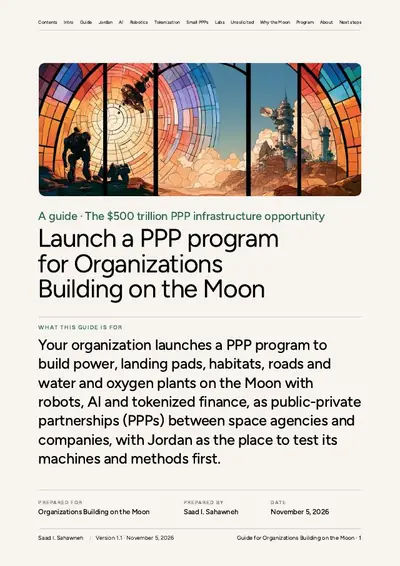
PPPs on the Moon are long service contracts in which private partners build and run lunar power, landing pads, habitats, roads and water and oxygen plants, and space agencies pay for what each asset delivers. Jordan signed the Artemis Accords in April 2026 as the 63rd nation to join them, and its desert gives organizations a place they can propose for testing the machines first. This post draws on the Moon guidePDF, one of the 96 free guides on this site, and shows where Jordan’s $86 billion of projects and the $46 billion anchored in Aqaba fit.
What are PPPs on the Moon?
PPPs on the Moon are partnerships between space agencies and companies to build and run lunar infrastructure under long contracts. Space agencies buy power, water, transport and data as services, and private partners build and operate each asset. The Moon guide proposes Jordan as the place to test the machines and methods first.
Space has mostly been built by governments alone, one mission at a time, while companies supplied the parts. That model has started to change. NASA’s Commercial Lunar Payload Services initiative already buys end-to-end deliveries to the lunar surface from commercial vendors, and power, landing pads, communications and water can follow the same model. The starting guide explains how a PPP works for readers new to the idea.
Why can lunar infrastructure be built and run as PPPs?
Lunar infrastructure suits PPPs because staying on the Moon takes assets that run for decades and services that agencies can buy under long contracts. Those contracts make a lunar asset bankable. Jordan has built with PPPs for more than 20 years and has a law that lets an organization propose its own projects.
- 01Power. NASA and the US Department of Energy plan a lunar surface reactor by 2030 that supplies power regardless of sunlight.
- 02Water and oxygen. NASA confirmed in 2018 that water ice lies in shadowed craters near the Moon’s poles, and robotic plants can turn that ice into drinking water, oxygen and rocket propellant.
- 03Landing pads and roads. Robots can grade the pads and lay the roads, with private partners paid for what each asset delivers.
- 04Habitats. Robots can build shelters from lunar soil, and AI can watch every habitat for leaks and faults.
Organizations can enter at any stage of a lunar PPP. Preparation calls for site, resource and engineering studies, and the tender offers places in consortiums beside space agencies, developers, robotics makers and launch providers. Operation relies on robot fleets, AI and small crews, and at exit long-term and tokenized investors can buy stakes in operating lunar assets.
What does signing the Artemis Accords mean for Jordan?
Jordan signed the Artemis Accords in April 2026 as the 63rd nation to join them, the same month Artemis II carried four astronauts around the Moon. Jordan also brings a desert for testing, engineers and universities, and a PPP law that accepts direct proposals.
63rd
nation to sign the Artemis Accords: Jordan, in April 2026
Jordan launched its first satellite, a CubeSat built by university students, in 2018. Its engineers and universities can supply software, design and training to the agencies and companies that build on the Moon. The first lunar contracts for delivery, power and resources are being written now, and the organizations that join them early will set the standards for what follows. That makes this an opportunity for organizations in Jordan and abroad to prepare today.
How could Jordan’s desert test lunar machines first?
Jordan’s desert offers sand, rock, heat and strong sunlight in which rovers, construction robots and solar power can be tested. A test range there is a proposal for an organization to bring forward, either under Article 15 of PPP Law No. 19 of 2023 or through small-scale PPPs below $14.1 million.
Article 15 of the law, in effect since November 13, 2023, lets a private company take its own PPP idea to the Ministry of Investment or a public authority, and PPP Regulation No. 9 of 2024 sets out how it is studied. An organization can propose a desert test range for lunar rovers, construction robots, dust-tolerant solar panels and habitats, built and run as a PPP and paid by the agencies and companies that test there. It can protect the ideas and technology behind it and keep the right to match the best offer if the project goes to tender. The unsolicited proposals page sets out this route.
$14.1M
the ceiling for small-scale PPPs under PPP Regulation No. 9 of 2024, which can be bundled into one feasibility report and one tender
A robotic construction trial, a solar and battery test bed or a training center at that scale would give an organization a live asset in Jordan and a reference it can carry to the Moon. An organization could also host a PPP research lab in Jordan that tests rovers, construction robots, dust-tolerant solar panels and AI operations in the desert, publish every result and carry the pilots that work into lunar contracts. The small PPPs page explains the method.
An organization that builds and runs one PPP in Jordan’s desert can carry the same team, machines and data to the Moon.
Where do Jordan’s $86 billion and Aqaba’s $46 billion fit?
Jordan has about $86 billion of PPP and infrastructure projects in development, $46 billion of them anchored in Aqaba. Many of them, from desert solar fields to water, mining and robotics, use the same machines and methods that lunar infrastructure will need, so an organization can build its track record on Earth first.
$86B
of PPP and infrastructure projects in development in Jordan, $46 billion of them anchored in Aqaba
Aqaba holds several of the sectors the Moon guide names. It combines a port, industrial land and strong sun, the conditions that green hydrogen and ammonia projects need, and the energy guidePDF places those projects beside the port. The water guidePDF covers desalination with the Red Sea at Aqaba, and the mining guidePDF covers the rail, bulk terminals and storage that carry minerals to export there. These remain projects on Earth, where the same machines can work first. PPP opportunities in Aqaba maps them sector by sector, and the $500 trillion opportunity sets out the wider case.
How do AI, robotics and tokenization work on the Moon?
AI, robotics and tokenization each carry part of a lunar PPP, and Jordan can host the trials. AI runs a lunar base with few people on site, robots build and maintain every asset, and tokenization offers investors stakes paid from the service contracts that space agencies and companies sign.
AI can plan where robots dig and build, balance power and water through the long lunar night and guide machines from Earth while the crew is away. An organization can train and test those systems on Jordanian assets first, where the same models can run solar fields and water networks at home.

Robots will do most of the building and upkeep, from the machines that grade landing pads and lay roads to those that dig ice and build shelters from lunar soil. Organizations can test those machines on Jordan’s desert sand and rock and train Jordanian engineers and technicians to run and repair them.
Tokenization answers the capital question, because lunar infrastructure needs large, patient capital and pays back over decades. An organization can offer stakes in a lunar power plant, a landing pad or a test range in Jordan to investors around the world, so people in Jordan and beyond can own a share of the first infrastructure beyond Earth.
How can an organization in Jordan start, and where does Mars fit?
An organization in Jordan can start with a leadership mandate, a named program lead, a map of lunar services beside Jordan’s $86 billion of projects, a desert test site scoped as a PPP, partners and a first pilot. Mars follows the same path, with the desert around Wadi Rum as the proposed test range.
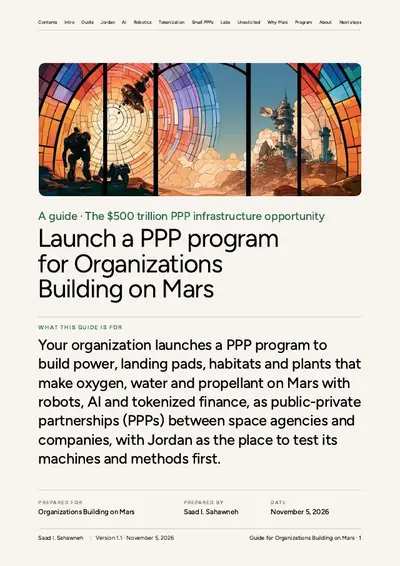
The Mars guidePDF carries the plan one step further. NASA notes that the colors and textures of Wadi Rum closely match those of Mars, and NASA’s MOXIE experiment on the Perseverance rover made 122 grams of oxygen from the Martian air over 16 runs. The partnerships that will build on Mars are being shaped now, through the work on the Moon that comes first.
The technology and knowledge category gathers these guides, the summary of all 96 guides brings the method together in one document, and the Vision page explains how AI, robotics and tokenization bring the infrastructure singularity closer.