
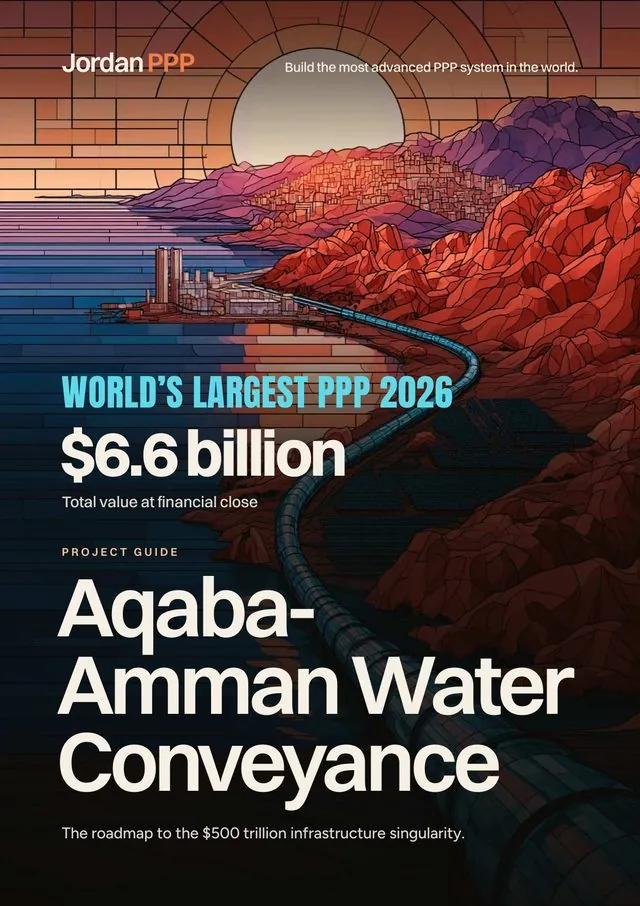
World’s largest PPP 2026
Aqaba-Amman Water Desalination and Conveyance Project
$6.6 billion
Total value at financial close, November 19, 2026
Petra
The project, also called the National Water Carrier, will take water from the Red Sea at Aqaba, turn it into drinking water and pump it about 417 km north to Amman. This guide sets out its history, what will be built, how the deal works, who is paying, where it stands and everyone involved, with a public source for every figure.
At a glance
Who builds it, runs it and pays for it
A private company owned by Meridiam, the Social Security Investment Fund and SUEZ pays for, builds and runs it for 30 years, and the government buys the water. Green Climate Fund
- Buyer of the water
- Ministry of Water and Irrigation, for the Government of Jordan
- The company
- National Carrier Project Company: Meridiam 75%, Social Security Investment Fund 15%, SUEZ 10%
- The deal
- The company pays for, builds and runs the project for 30 years (about four years of building, 26 of operation), then hands it to the government
- Builders
- A group led by VINCI with Orascom, SUEZ, Archirodon and Arab Contractors; the solar plant has its own builder
- Operator
- SUEZ and Orascom run the plant and the pipeline for 26 years
- What is built
- A desalination plant at Aqaba, a buried pipeline to Amman with pumping stations, and a solar plant of about 280 megawatts
- Government backing
- The Ministry of Finance is to guarantee the government’s obligations; the Council of Ministers has approved the guarantee
- Who pays
- The owners, international development banks and funds, Jordanian banks led by Housing Bank with the Social Security Investment Fund, the state budget, and grants and loans from donors to the government
Where it stands
Financial close announced, building from January 7, 2027
On November 19, 2026, the Minister of Water and Irrigation and Meridiam’s chief executive signed a US$6.6 billion agreement to launch the works. Petra
The same day the Deputy Prime Minister said the project had reached financial close. Petra
The ministry says building starts on January 7, 2027 (Ammon News, Arabic), building takes about four years (Orascom), and water pumping is expected by the end of 2030 (Petra).
Inside the guide
79 pages in five parts
The project sits in the design of every Jordan PPP guide: it opens with PPPs and Jordan’s $86 billion, then the project itself, then the hardware with sensors, the software and the infrastructure singularity.
01PPP
- What is a PPP?The starting guide for readers new to PPPs5
- The golden age of PPPs in JordanJordan’s $86 billion in one guide6
- The PPP pyramidNine sizes, from $10,000 to $1 trillion8
- Small PPPs and research labsMany small projects, run in parallel9
- Unsolicited proposalsTake your own PPP idea to government11
02The project
- At a glanceLaunched in November 2026, first water due by the end of 203013
- HistoryFrom the Red Sea-Dead Sea plan to the start of works14
- What will be builtA plant, a pipeline and a solar plant, from the sea to Amman19
- Deal structureHow the deal works and how it came together22
- Who is payingThe lenders, the grants and the government’s share34
- Where it standsFinancial close announced, building from January 7, 202750
- Everyone involvedPublic bodies, builders, funders, advisers and key people52
- Documents and sourcesLender papers, announcements and news reports58
03Hardware
- The $500 trillion computerHow infrastructure becomes one machine62
- RoboticsBuilds the assets and keeps them running63
- SensorsLet the assets see, hear and feel64
04Software
- EarthOSThe software that runs the machine67
- Artificial intelligenceDesigns, structures and runs the assets68
- TokenizationFinances the assets and opens ownership69
05Singularity
- The infrastructure singularityThe $500 trillion rebuild71
- The $500 trillion opportunityAI, robotics and tokenization, converging72
- The road to the singularityFive stages, from a built asset to one machine73
- Futureproof your organizationWhat changes, and where to start74
Look inside
Ten pages from the guide
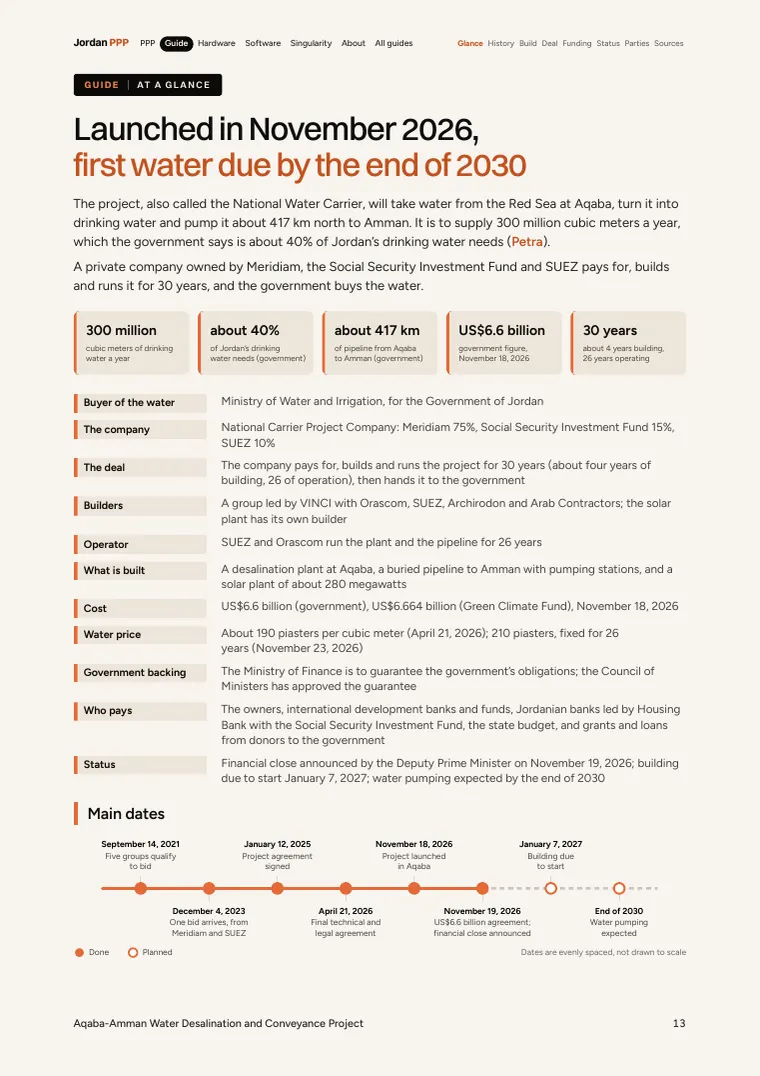
Page 13. At a glance
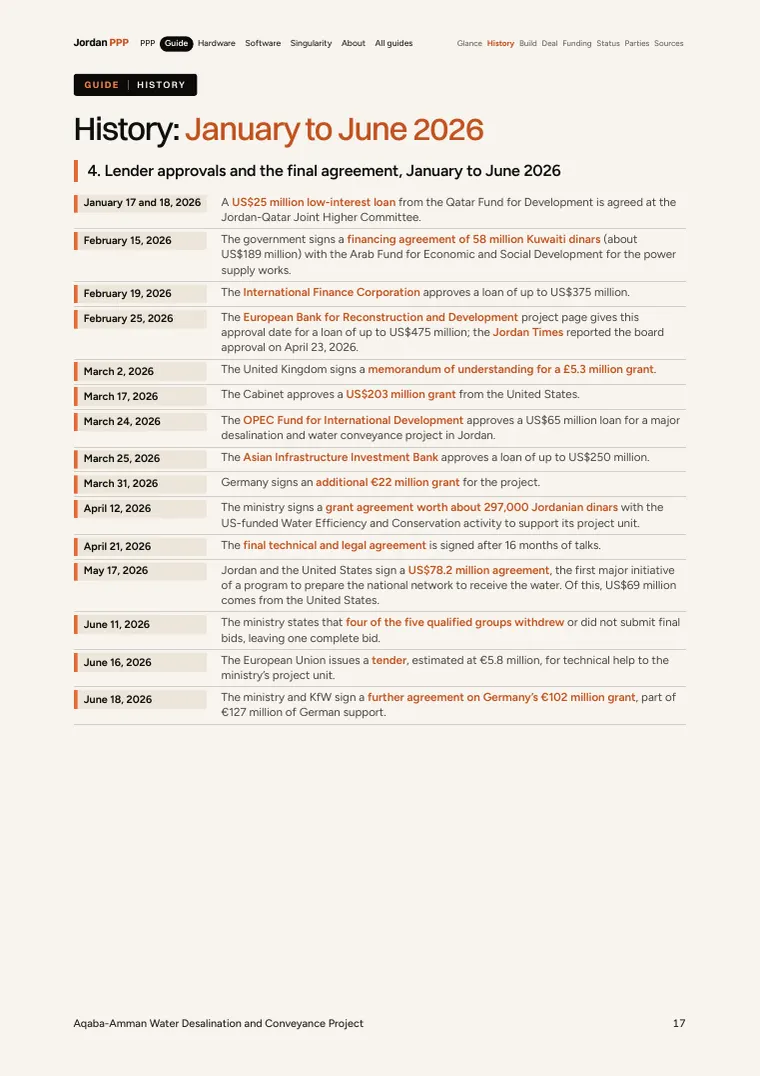
Page 17. History: January to June 2026
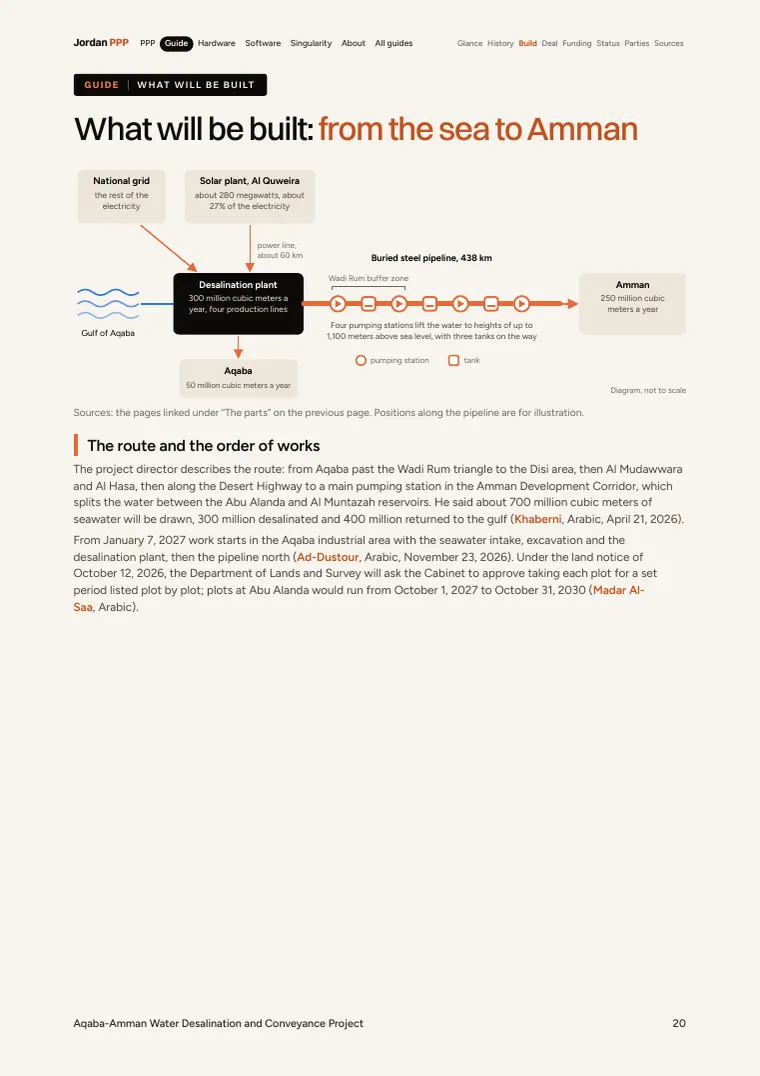
Page 20. What will be built: from the sea to Amman
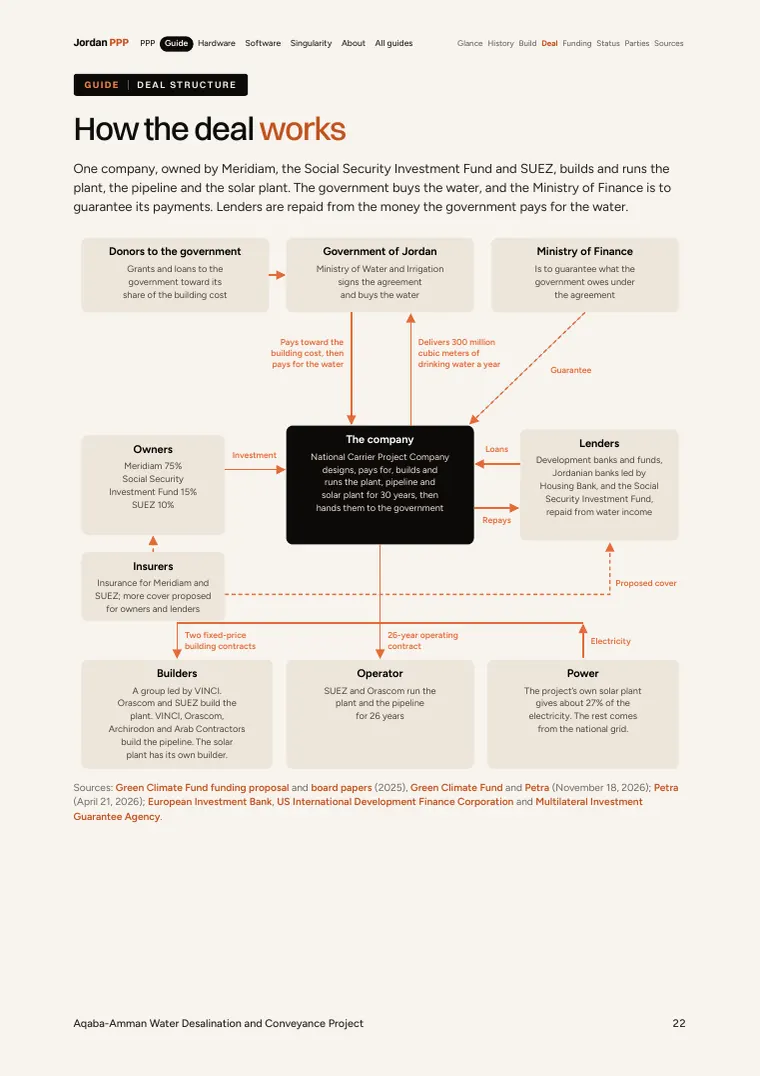
Page 22. How the deal works
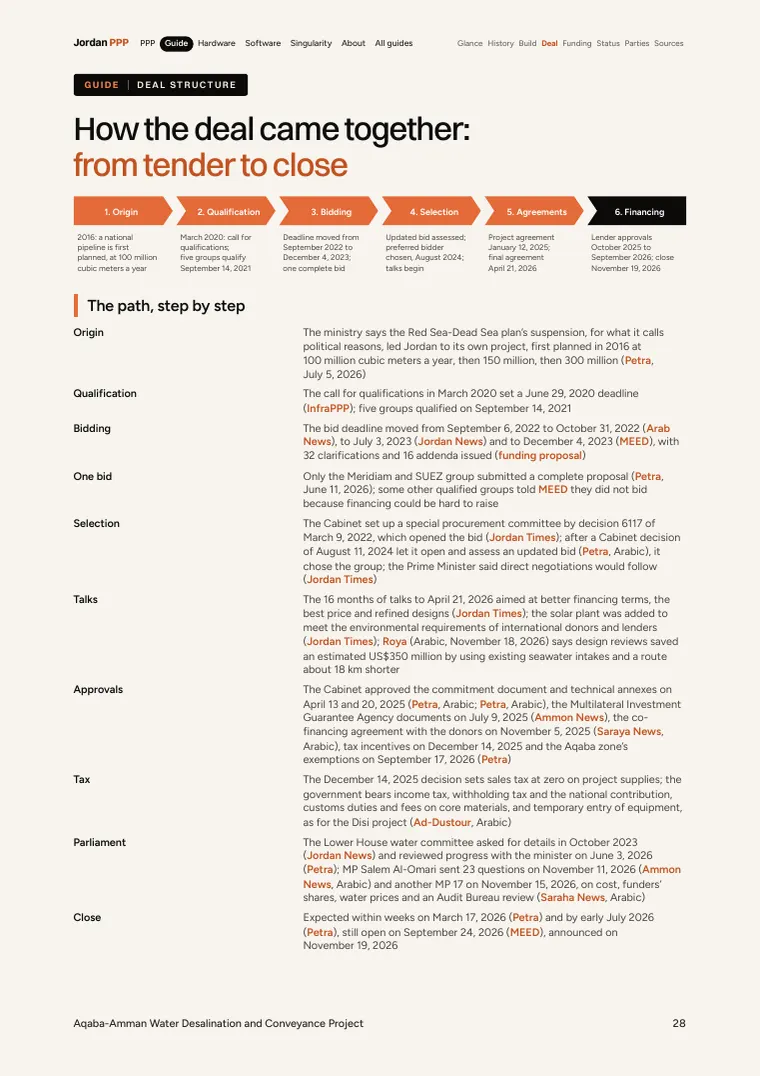
Page 28. How the deal came together: from tender to close
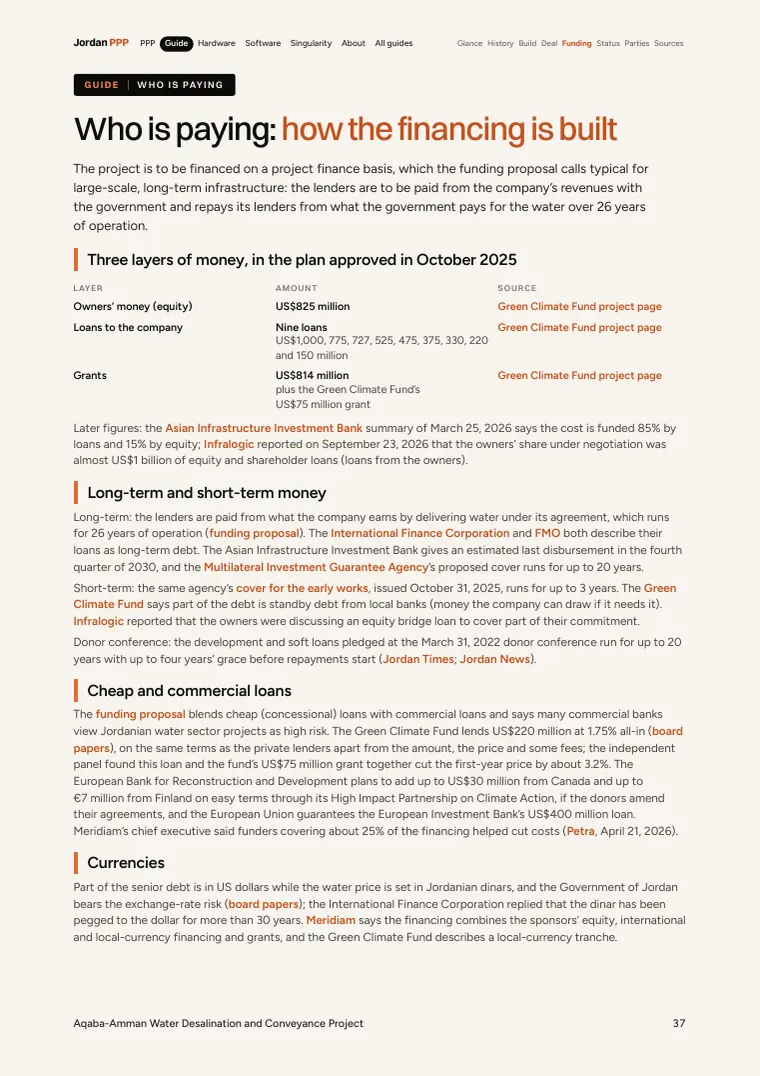
Page 37. Who is paying: how the financing is built
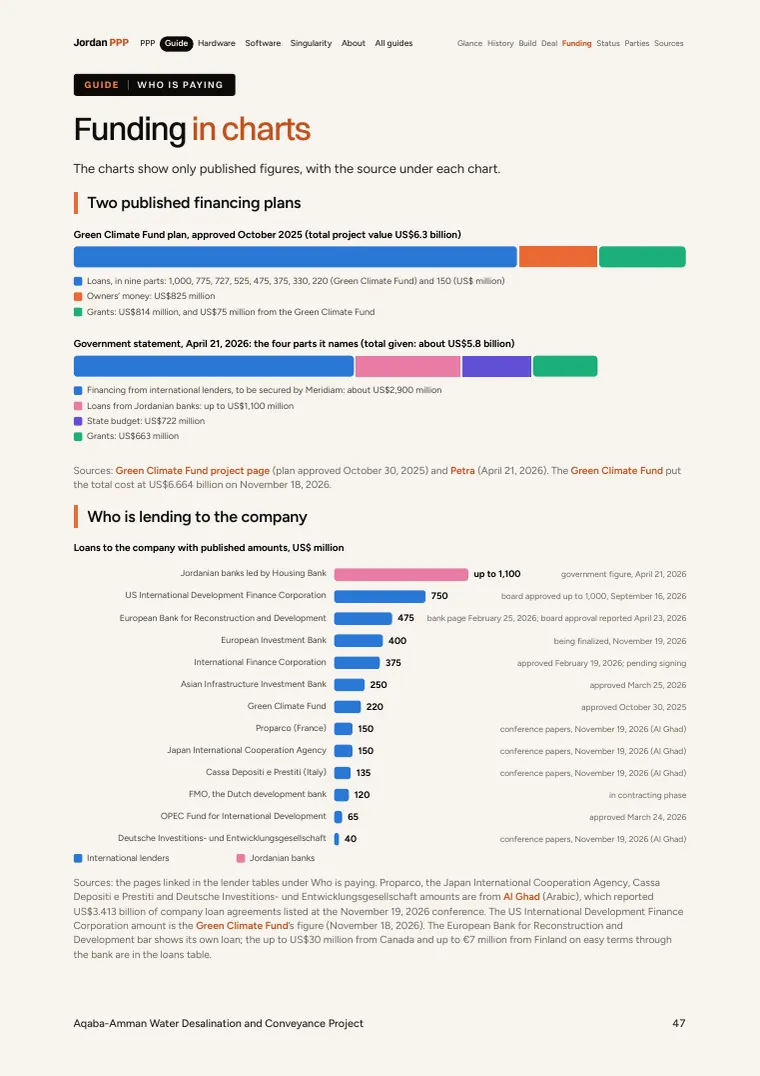
Page 47. Funding in charts
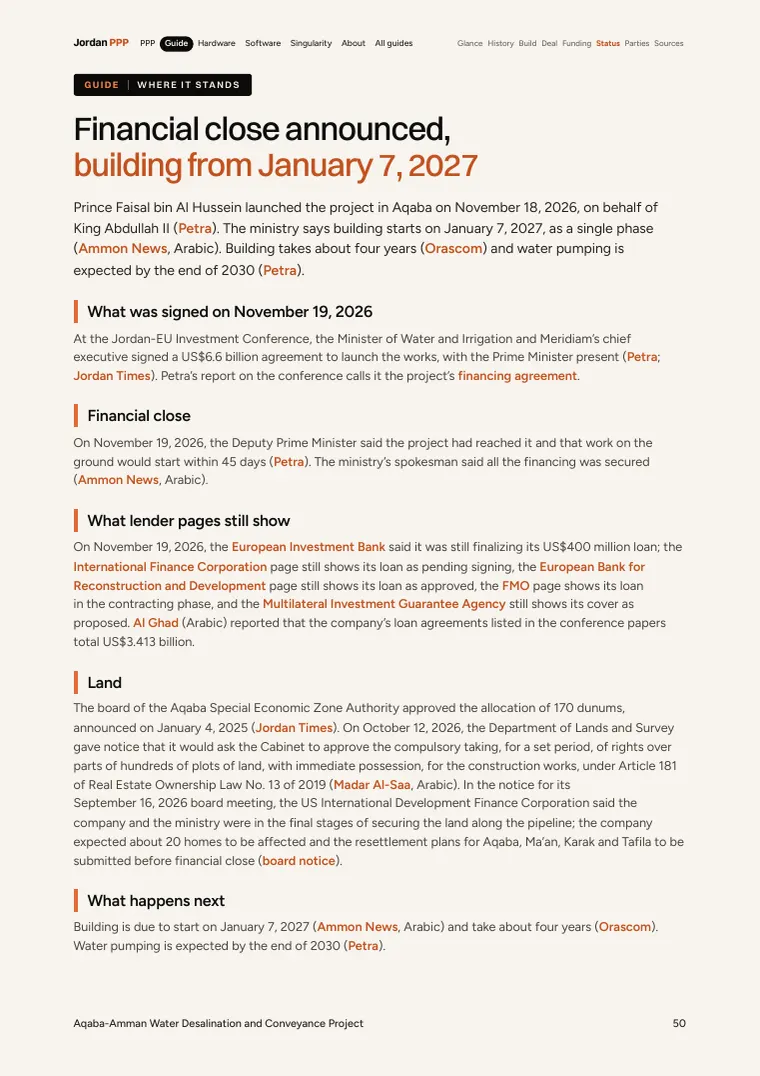
Page 50. Financial close announced, building from January 7, 2027
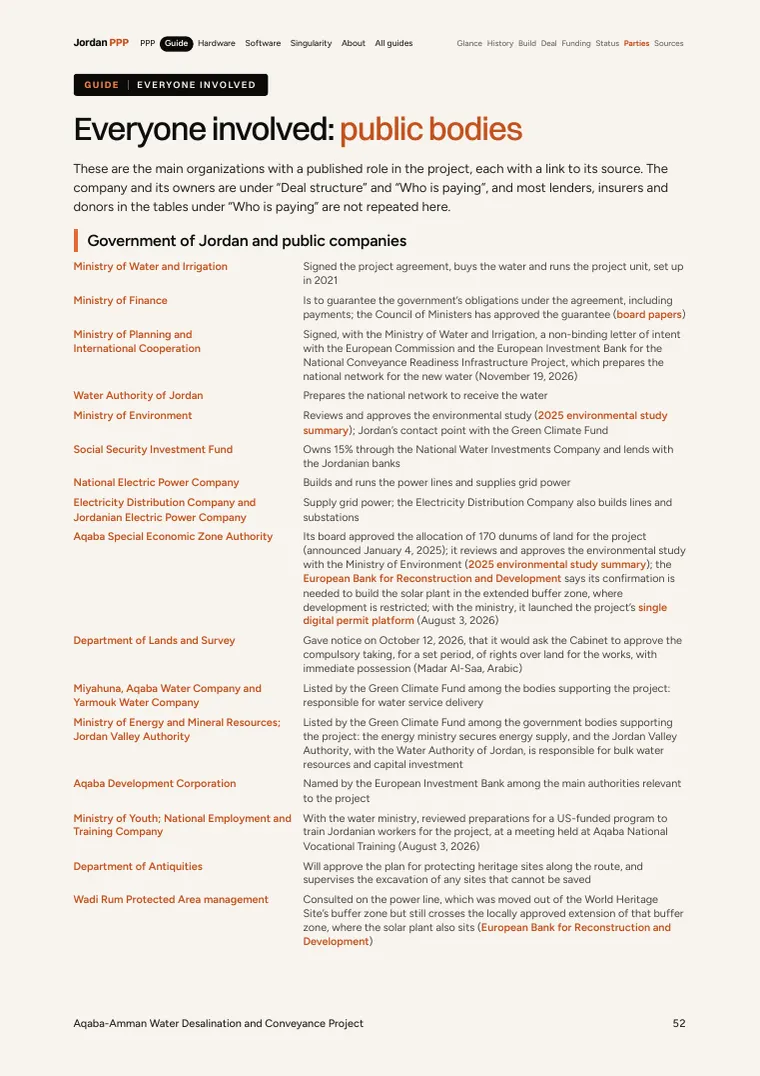
Page 52. Everyone involved: public bodies
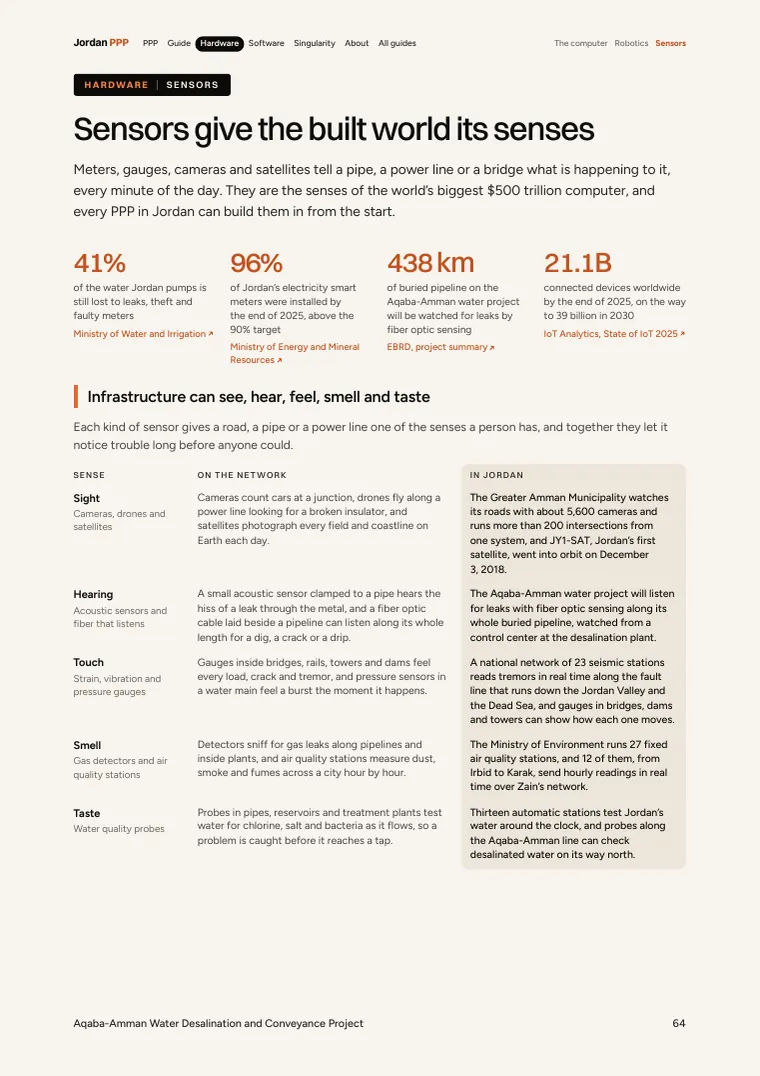
Page 64. Sensors give the built world its senses
Questions
Questions about the Aqaba-Amman water project
- What is the Aqaba-Amman Water Desalination and Conveyance Project?
- The project, also called the National Water Carrier, will take water from the Red Sea at Aqaba, turn it into drinking water and pump it about 417 km north to Amman. It is to supply 300 million cubic meters a year, which the government says is about 40% of Jordan’s drinking water needs.
- What was its value at financial close?
- On November 19, 2026, at the Jordan-EU Investment Conference, the Minister of Water and Irrigation and Meridiam’s chief executive signed a US$6.6 billion agreement to launch the works, and the Deputy Prime Minister said the project had reached financial close.
- Who owns and runs it?
- A private company, the National Carrier Project Company, owned by Meridiam (75%), the Social Security Investment Fund (15%) and SUEZ (10%), pays for, builds and runs the project for 30 years, and the government buys the water. SUEZ and Orascom run the plant and the pipeline for the 26 years of operation.
- When will the water flow?
- The ministry says building starts on January 7, 2027, and building takes about four years. Water pumping is expected by the end of 2030.
- What is in the project guide?
- The project’s history, what will be built, how the deal works and came together, who is paying, where it stands and everyone involved, with a public source for every figure, inside the Jordan PPP guide design: what a PPP is, Jordan’s $86 billion, the hardware with sensors, the software and the infrastructure singularity.
New guide
The golden age of PPPs in Jordan
All 23 sector guides and all 96 organization guides in one free guide to Jordan’s $86 billion.

Presentations
Book a Jordan PPP presentation for your organization
We give it online worldwide, or in person in Jordan, on the days and at the times that suit your team.
Book a presentation