A thousand new Internets per day
The world’s data is growing so fast that power, water and land are becoming the limit, and PPPs are how Jordan can build them in time.
Around 2030, AI could be reading and writing a thousand Internets of text every day. All that data runs on power plants, water, data centers and cables, and public-private partnerships (PPPs) are how Jordan and Aqaba can build them fast enough.
What does a thousand new Internets per day mean?
One Internet here means all the text people have ever put online, about 300 trillion tokens by the count of the research group Epoch AI. A token is a small piece of a word. A thousand new Internets per day means AI handling a thousand times that amount every single day, in Jordan and everywhere else.
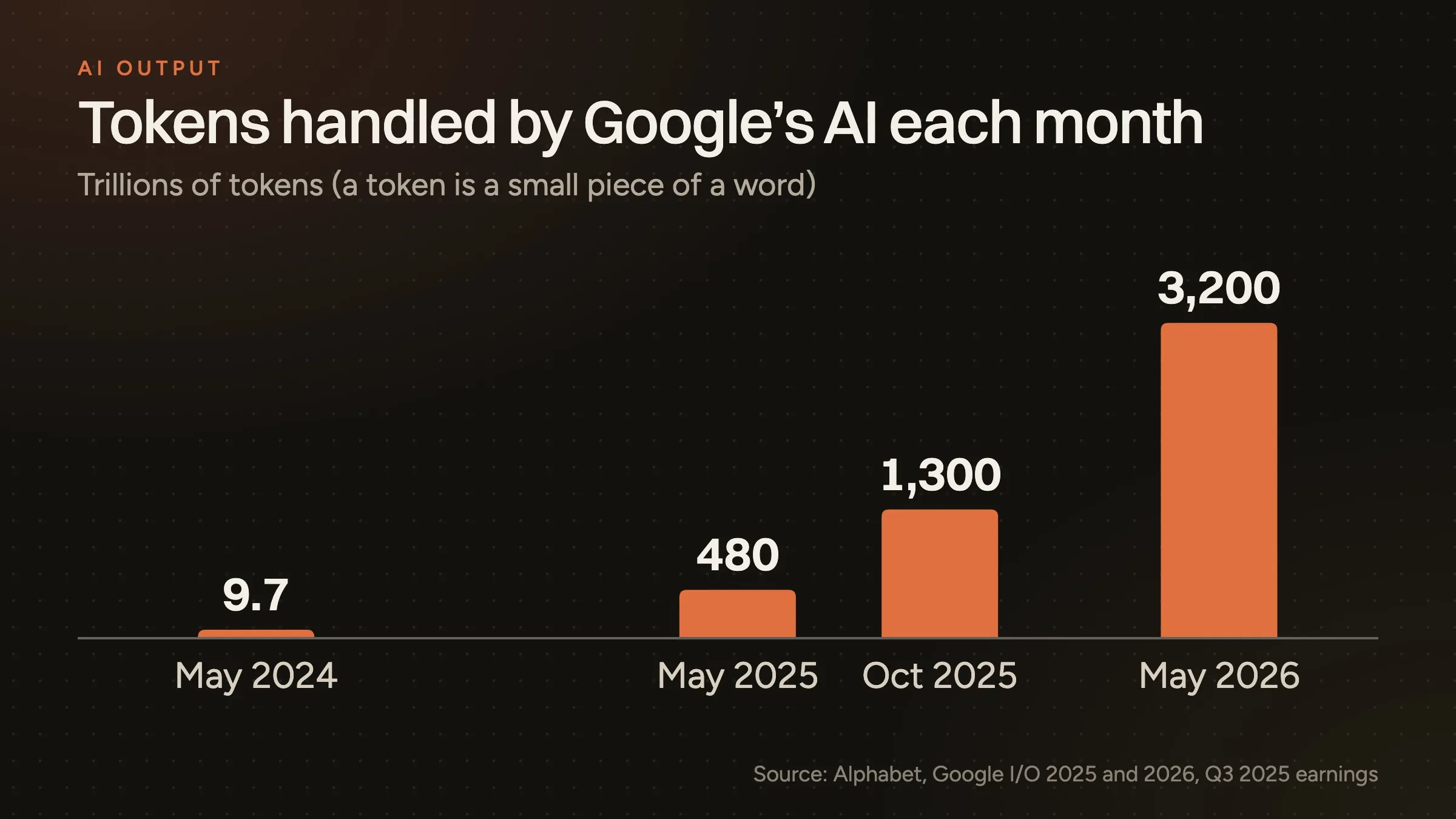
Google gives the clearest numbers. Its AI handled 9.7 trillion tokens a month in May 2024, 480 trillion in May 2025 and 3,200 trillion in May 2026. That last figure is more than a third of an Internet every day, from one company.
Growth was about seven times in the last year alone. If it keeps that pace, Google’s AI by itself will pass a thousand Internets a day around 2030, and every other AI company adds its own on top. The AI topic page shows what that intelligence can do once it runs Jordan’s roads, grids and water networks.
1,000
new Internets of text a day that AI could handle around 2030 if growth holds
How fast is the world’s data growing?
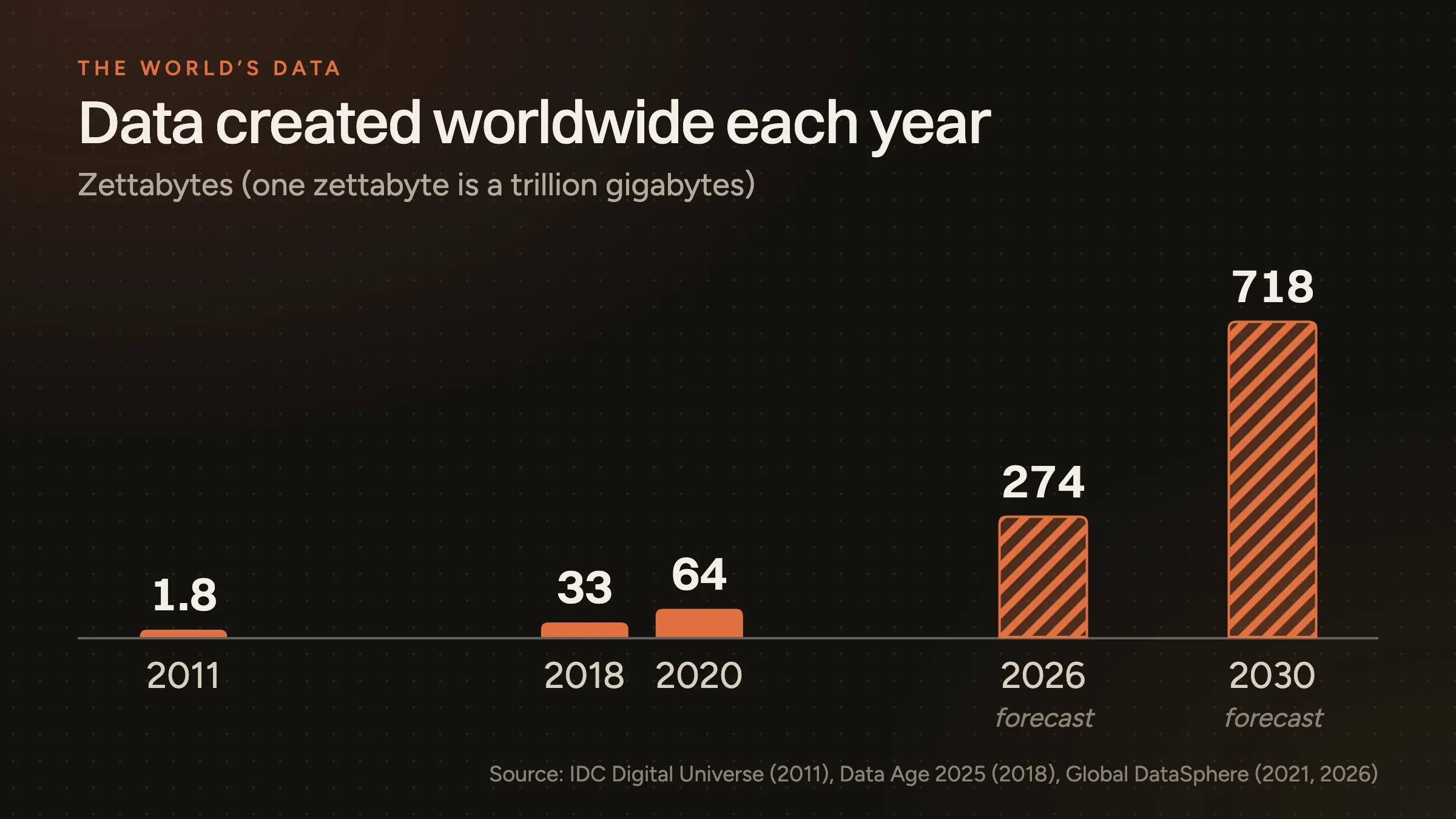
The research firm IDC counts all the data the world creates each year, from video and photos to sensors and messages. It was 1.8 zettabytes in 2011 and 64 zettabytes in 2020. IDC expects 274 zettabytes in 2026 and more than 718 in 2030, and Jordan’s share will grow with it.
A zettabyte is a trillion gigabytes. A phone with 100 gigabytes of storage would need ten billion copies of itself to hold one zettabyte.
Put simply, the data made each year will be about 400 times bigger in 2030 than in 2011. In 2030 alone, the world is expected to create about two zettabytes every day, which is more than the whole of 2011.
Why does more data need more infrastructure?
Every piece of data is made, stored and moved by machines in data centers, and data centers need power, water for cooling, land and fiber. When data grows hundreds of times, the power plants, water plants, grid lines and cables behind it must grow too, in Jordan as much as anywhere.
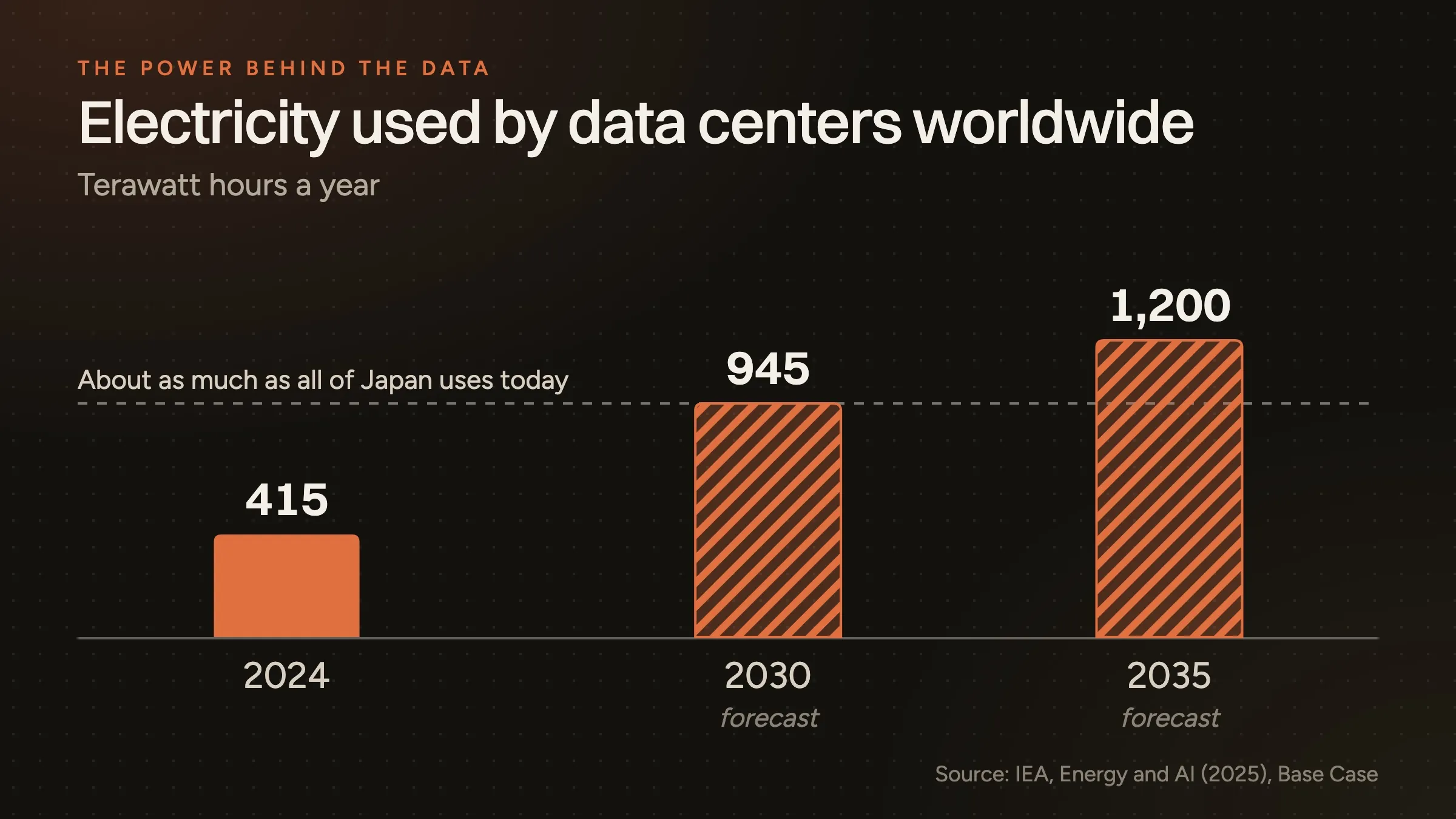
The International Energy Agency says data centers used about 415 terawatt hours of electricity in 2024, around 1.5% of all the electricity the world used. It expects 945 terawatt hours by 2030, a little more than all of Japan uses today, and around 1,200 by 2035.
The money is just as large. McKinsey estimates the world will spend $6.7 trillion on data centers by 2030. About a quarter of that goes to power, cooling and electrical equipment, and another 15% goes to land, materials and building work.
What pressure does this put on governments?
Governments own most of what data needs underneath it: the grid, the water, the land, the permits and the roads. Demand for all of them is rising faster than public budgets and planning teams can move, and Jordan, where water is scarce and most electricity still comes from gas, feels that pressure early.
The International Energy Agency warns that around 20% of planned data center projects worldwide could be delayed because grids cannot connect them in time. A country that cannot add power, water and land quickly will see data centers, and the jobs and investment around them, go somewhere else.
In Jordan, natural gas made 58% of the country’s electricity in 2024 and renewables almost 27%, as the grid sector guide and solar sector guide explain. A proposed AI data center campus at the Al-Risha gas field plans 400 MW of long-term capacity, which shows how much one project can add to demand. Water is harder still, which is why the National Water Carrier will bring 300 million cubic meters a year from the Red Sea at Aqaba to Amman, as the water sector guide sets out.
How do PPPs help governments keep up?
In a PPP, a private company designs, finances, builds and runs a public asset under a long contract, and the government sets the rules and buys the service. Jordan can add power, water and digital infrastructure this way without paying for all of it upfront, while private partners carry much of the risk.
Jordan already knows how this works. The As-Samra wastewater plant, the country’s first PPP, treats about 70% of its wastewater under a 25-year concession. Amman East, Jordan’s first independent power plant, opened in 2009. PPP Law No. 19 of 2023 sets the rules today, and its Article 15 lets any company bring its own unsolicited PPP proposal to government.
The data age needs the same model at a much larger scale:
- 01Power: private partners build solar and wind plants with batteries and sell the power under long contracts.
- 02Grid: companies build and maintain transmission lines and substations under concession, so new data centers connect faster.
- 03Water: desalination and water reuse plants supply cooling water while drinking water stays for people.
- 04Data centers: investors build and run data halls next to cheap power and cables under long leases or concessions.
- 05Fiber and cables: operators lay fiber and subsea links that carry data between Jordan and the region.
PPPs also move at the speed this needs. When AI can plan a project in hours, the slow part becomes the decision and the contract, and a clear PPP program lets a government sign and start many projects at once.
The PPP singularity is the point at which it becomes cheaper to build the pilot than to conduct the study.
Where can Jordan and Aqaba start?
Jordan has $86 billion of PPP and infrastructure projects, and $46 billion of them are anchored in Aqaba, as the opportunity page shows. The data age is a reason to move faster on the power, water and digital projects among them, because each one is now also infrastructure for AI.
$86B
of PPP and infrastructure projects in Jordan, with $46 billion anchored in Aqaba
Aqaba is the natural first place. The Aqaba Digital Hub, Jordan’s largest carrier-neutral data center, lands the subsea cables that link the country to Asia, Africa and Europe, and it is adding a second hall with EBRD and EU support. Aqaba also has the sea for desalination and the sun for solar power, and the digital sector guide lists the data center projects at Al-Risha, Al-Dhlail and Aqaba.
Ministries, energy companies, water operators and data center builders each have a part to play, and the data centers guideDownload the guide shows how a company can launch its own PPP program.