
What this guide is for
Your company launches a PPP program to build and run bus networks, bus rapid transit lines, depots, electric fleets and fare systems as public-private partnerships (PPPs) for decades.
The case
Bus operators carry the daily trips every PPP depends on
Buses have long run on fixed routes, paper tickets and diesel engines, with operators paid by the trip and rarely by the quality of the service. The bus networks of the next fifty years will be electric, planned on live demand and paid for by the service they deliver, and the companies that run them under long contracts will shape how cities move for decades. This guide invites bus and public transport operators in Jordan to launch a PPP program, starting with the projects at home.
The guide
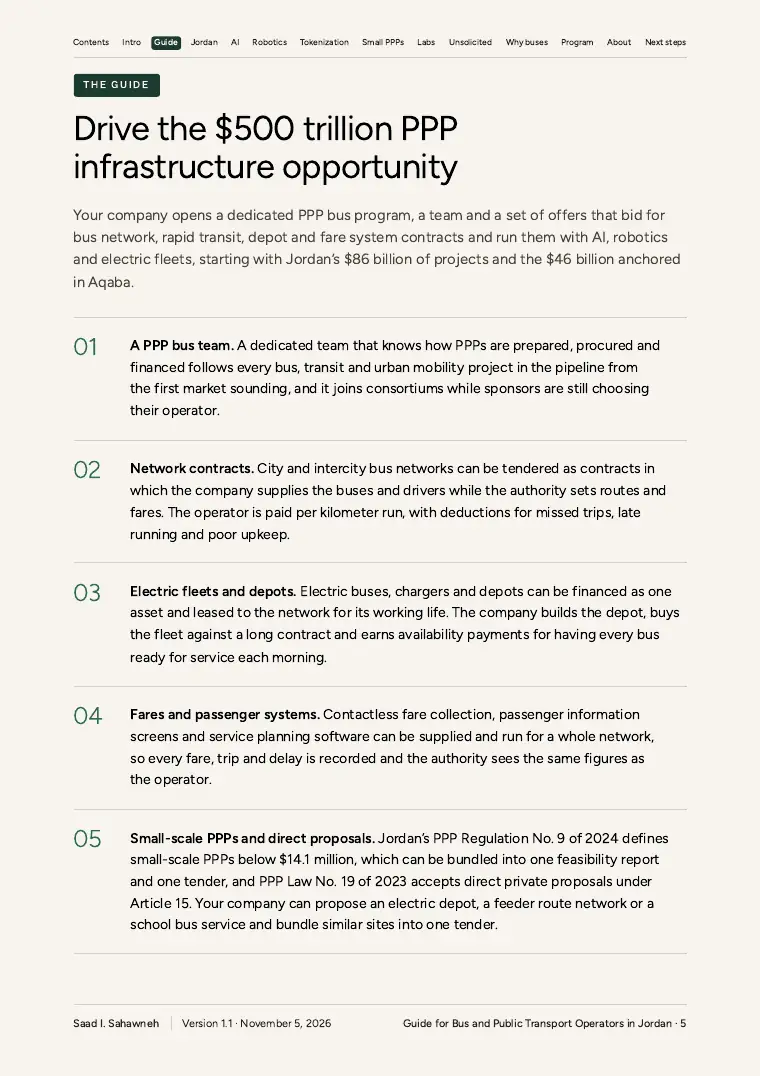
Drive the $500 trillion PPP infrastructure opportunity
Your company opens a dedicated PPP bus program, a team and a set of offers that bid for bus network, rapid transit, depot and fare system contracts and run them with AI, robotics and electric fleets, starting with Jordan’s $86 billion of projects and the $46 billion anchored in Aqaba.
01
A PPP bus team
A dedicated team that knows how PPPs are prepared, procured and financed follows every bus, transit and urban mobility project in the pipeline from the first market sounding, and it joins consortiums while sponsors are still choosing their operator.
02
Network contracts
City and intercity bus networks can be tendered as contracts in which the company supplies the buses and drivers while the authority sets routes and fares. The operator is paid per kilometer run, with deductions for missed trips, late running and poor upkeep.
03
Electric fleets and depots
Electric buses, chargers and depots can be financed as one asset and leased to the network for its working life. The company builds the depot, buys the fleet against a long contract and earns availability payments for having every bus ready for service each morning.
04
Fares and passenger systems
Contactless fare collection, passenger information screens and service planning software can be supplied and run for a whole network, so every fare, trip and delay is recorded and the authority sees the same figures as the operator.
05
Small-scale PPPs and direct proposals
Jordan’s PPP Regulation No. 9 of 2024 defines small-scale PPPs below $14.1 million, which can be bundled into one feasibility report and one tender, and PPP Law No. 19 of 2023 accepts direct private proposals under Article 15. Your company can propose an electric depot, a feeder route network or a school bus service and bundle similar sites into one tender.
Why bus and public transport operators
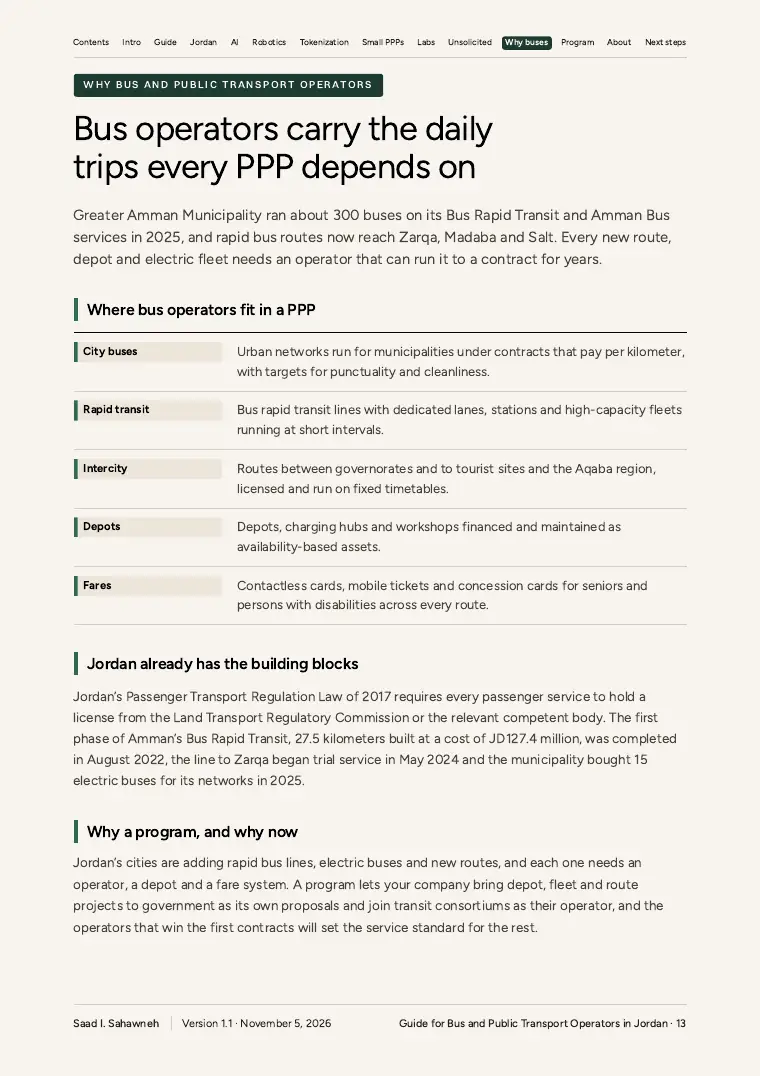
Bus operators carry the daily trips every PPP depends on
Greater Amman Municipality ran about 300 buses on its Bus Rapid Transit and Amman Bus services in 2025, and rapid bus routes now reach Zarqa, Madaba and Salt. Every new route, depot and electric fleet needs an operator that can run it to a contract for years.
Where bus operators fit in a PPP
- City buses
- Urban networks run for municipalities under contracts that pay per kilometer, with targets for punctuality and cleanliness.
- Rapid transit
- Bus rapid transit lines with dedicated lanes, stations and high-capacity fleets running at short intervals.
- Intercity
- Routes between governorates and to tourist sites and the Aqaba region, licensed and run on fixed timetables.
- Depots
- Depots, charging hubs and workshops financed and maintained as availability-based assets.
- Fares
- Contactless cards, mobile tickets and concession cards for seniors and persons with disabilities across every route.
Jordan already has the building blocks
Jordan’s Passenger Transport Regulation Law of 2017 requires every passenger service to hold a license from the Land Transport Regulatory Commission or the relevant competent body. The first phase of Amman’s Bus Rapid Transit, 27.5 kilometers built at a cost of JD127.4 million, was completed in August 2022, the line to Zarqa began trial service in May 2024 and the municipality bought 15 electric buses for its networks in 2025.
Why a program, and why now
Jordan’s cities are adding rapid bus lines, electric buses and new routes, and each one needs an operator, a depot and a fare system. A program lets your company bring depot, fleet and route projects to government as its own proposals and join transit consortiums as their operator, and the operators that win the first contracts will set the service standard for the rest.

Futureproofing
Futureproof Bus and Public Transport Operators in Jordan for the infrastructure singularity
This free 17-page guide shows how, with small PPPs in parallel, PPP research labs, artificial intelligence, robotics, tokenization and six first steps.

Jordan and Aqaba
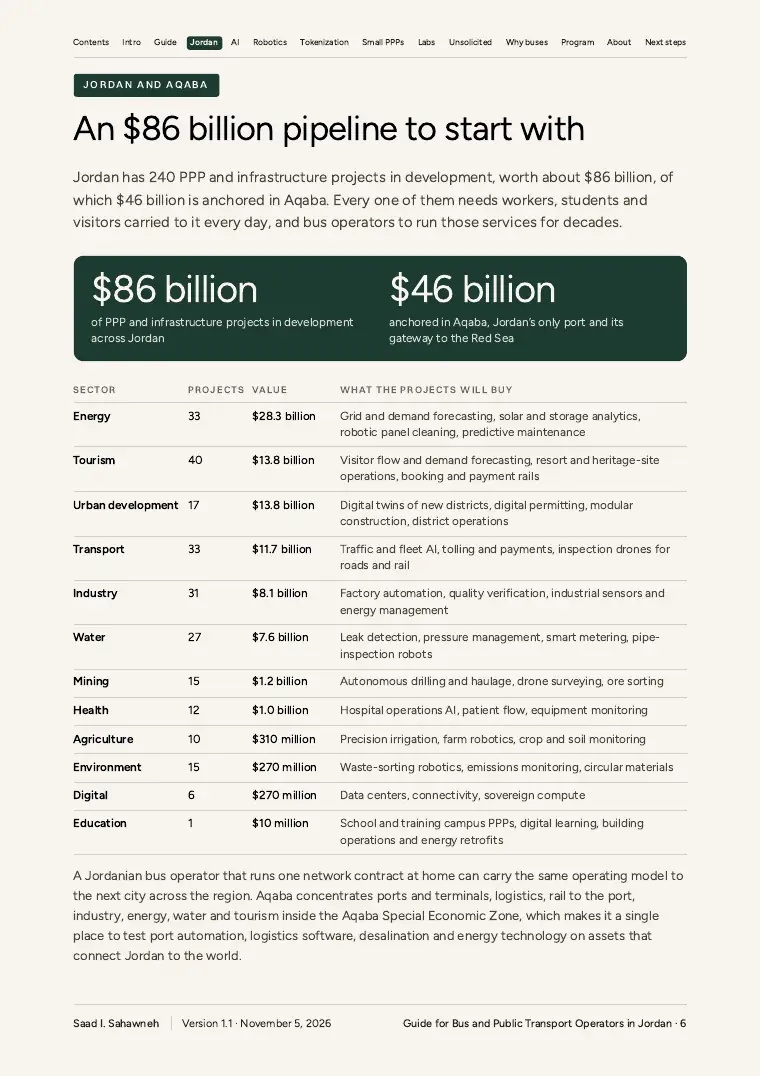
An $86 billion pipeline to start with
Every one of them needs workers, students and visitors carried to it every day, and bus operators to run those services for decades. A Jordanian bus operator that runs one network contract at home can carry the same operating model to the next city across the region.
- $86B
- of PPP and infrastructure projects in development in Jordan
- $46B
- of them anchored in Aqaba

Artificial intelligence
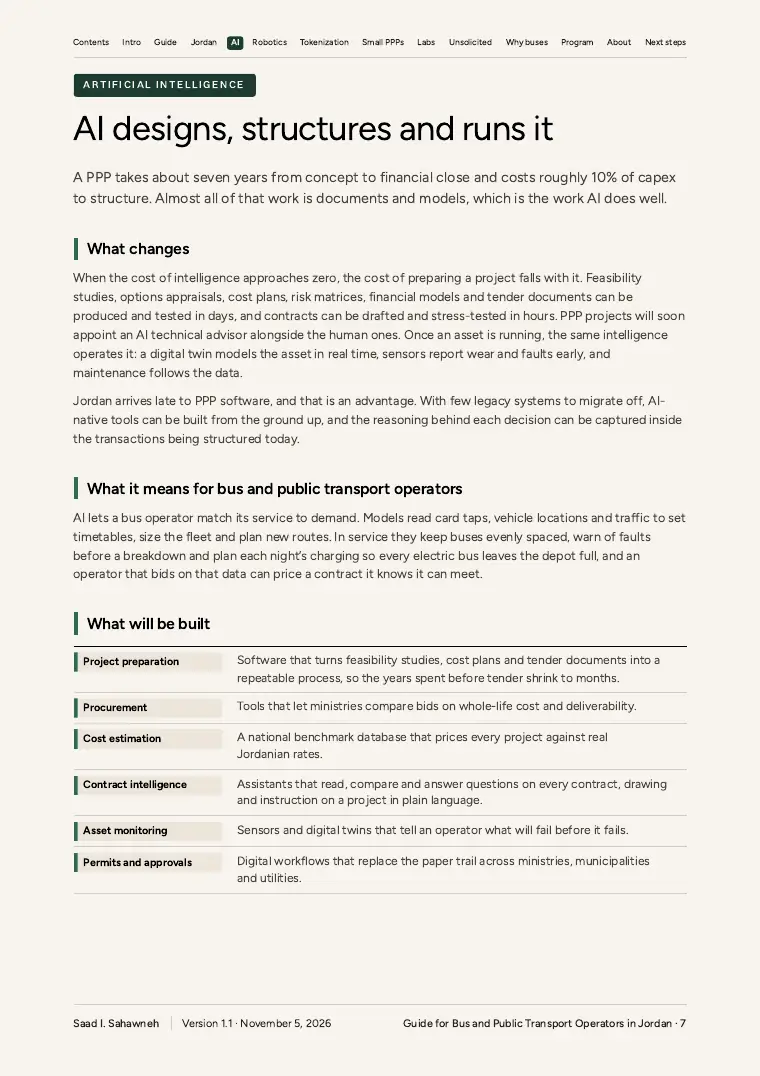
AI lets a bus operator match its service to demand. Models read card taps, vehicle locations and traffic to set timetables, size the fleet and plan new routes. In service they keep buses evenly spaced, warn of faults before a breakdown and plan each night’s charging so every electric bus leaves the depot full, and an operator that bids on that data can price a contract it knows it can meet.

Robotics
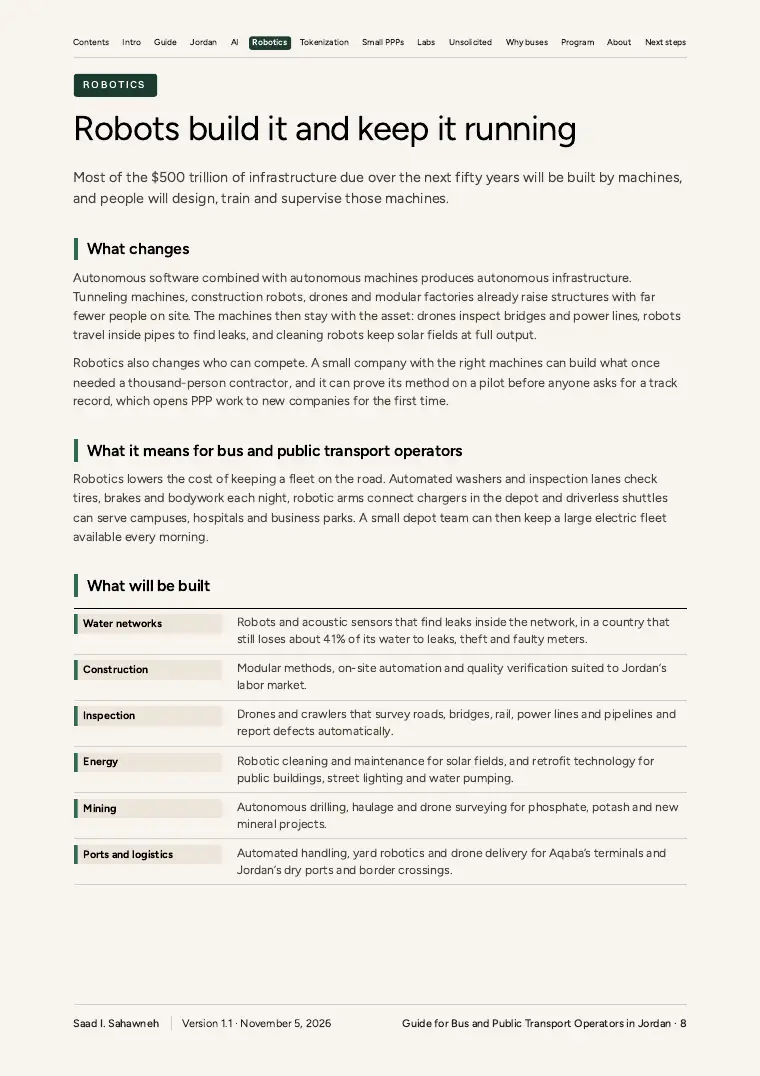
Robotics lowers the cost of keeping a fleet on the road. Automated washers and inspection lanes check tires, brakes and bodywork each night, robotic arms connect chargers in the depot and driverless shuttles can serve campuses, hospitals and business parks. A small depot team can then keep a large electric fleet available every morning.

Tokenization
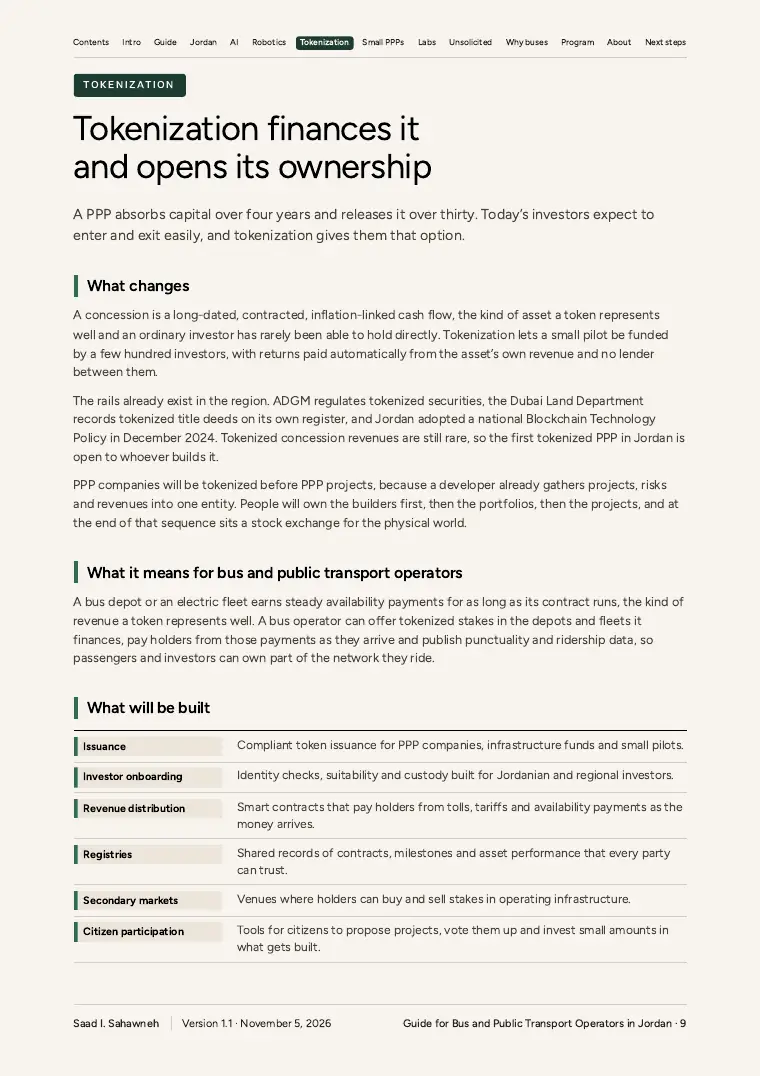
A bus depot or an electric fleet earns steady availability payments for as long as its contract runs, the kind of revenue a token represents well. A bus operator can offer tokenized stakes in the depots and fleets it finances, pay holders from those payments as they arrive and publish punctuality and ridership data, so passengers and investors can own part of the network they ride.

Small PPPs and research labs
An electric depot or a feeder route is a natural small PPP, because it can open quickly and report punctuality, energy use and ridership from its first week. A bus operator can run lab pilots in several towns at once, compare vehicles and charging methods side by side and bring the proven setup into its city-wide bids.

Unsolicited proposals
A bus operator knows which neighborhoods have no service, which routes run full and where passengers wait longest. A direct proposal lets it turn that knowledge into a feeder network, an electric depot or a school bus service of its own design, and keep the right to match the best offer if the project goes to tender.
The program
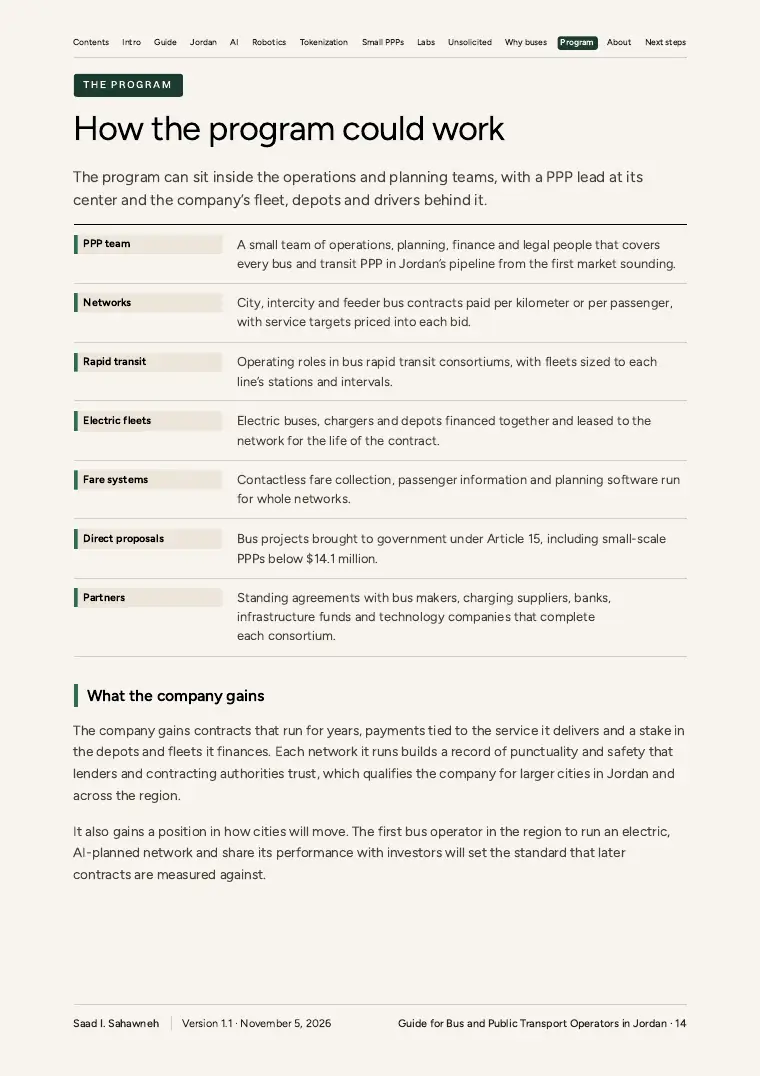
How the program could work
The program can sit inside the operations and planning teams, with a PPP lead at its center and the company’s fleet, depots and drivers behind it.
- PPP team
- A small team of operations, planning, finance and legal people that covers every bus and transit PPP in Jordan’s pipeline from the first market sounding.
- Networks
- City, intercity and feeder bus contracts paid per kilometer or per passenger, with service targets priced into each bid.
- Rapid transit
- Operating roles in bus rapid transit consortiums, with fleets sized to each line’s stations and intervals.
- Electric fleets
- Electric buses, chargers and depots financed together and leased to the network for the life of the contract.
- Fare systems
- Contactless fare collection, passenger information and planning software run for whole networks.
- Direct proposals
- Bus projects brought to government under Article 15, including small-scale PPPs below $14.1 million.
- Partners
- Standing agreements with bus makers, charging suppliers, banks, infrastructure funds and technology companies that complete each consortium.
What the company gains
The company gains contracts that run for years, payments tied to the service it delivers and a stake in the depots and fleets it finances. Each network it runs builds a record of punctuality and safety that lenders and contracting authorities trust, which qualifies the company for larger cities in Jordan and across the region.
It also gains a position in how cities will move. The first bus operator in the region to run an electric, AI-planned network and share its performance with investors will set the standard that later contracts are measured against.

Next steps
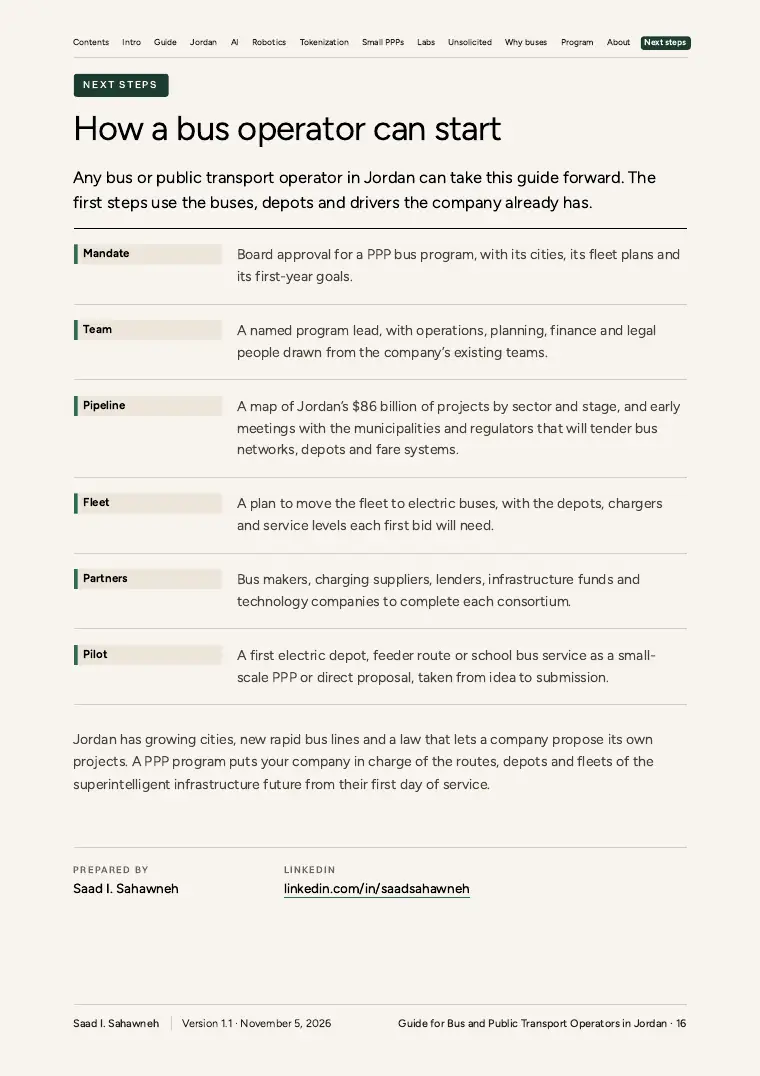
How a bus operator can start
Any bus or public transport operator in Jordan can take this guide forward. The first steps use the buses, depots and drivers the company already has.
01
Mandate
Board approval for a PPP bus program, with its cities, its fleet plans and its first-year goals.
02
Team
A named program lead, with operations, planning, finance and legal people drawn from the company’s existing teams.
03
Pipeline
A map of Jordan’s $86 billion of projects by sector and stage, and early meetings with the municipalities and regulators that will tender bus networks, depots and fare systems.
04
Fleet
A plan to move the fleet to electric buses, with the depots, chargers and service levels each first bid will need.
05
Partners
Bus makers, charging suppliers, lenders, infrastructure funds and technology companies to complete each consortium.
06
Pilot
A first electric depot, feeder route or school bus service as a small-scale PPP or direct proposal, taken from idea to submission.
Jordan has growing cities, new rapid bus lines and a law that lets a company propose its own projects. A PPP program puts your company in charge of the routes, depots and fleets of the superintelligent infrastructure future from their first day of service.
The full document
Inside this guide
Seventeen pages and thirteen chapters, from the case for a PPP program to the first steps, written for bus and public transport operators in Jordan.
- 17
- pages
- 13
- chapters
- 3
- technologies
- 6
- first steps
01Introduction
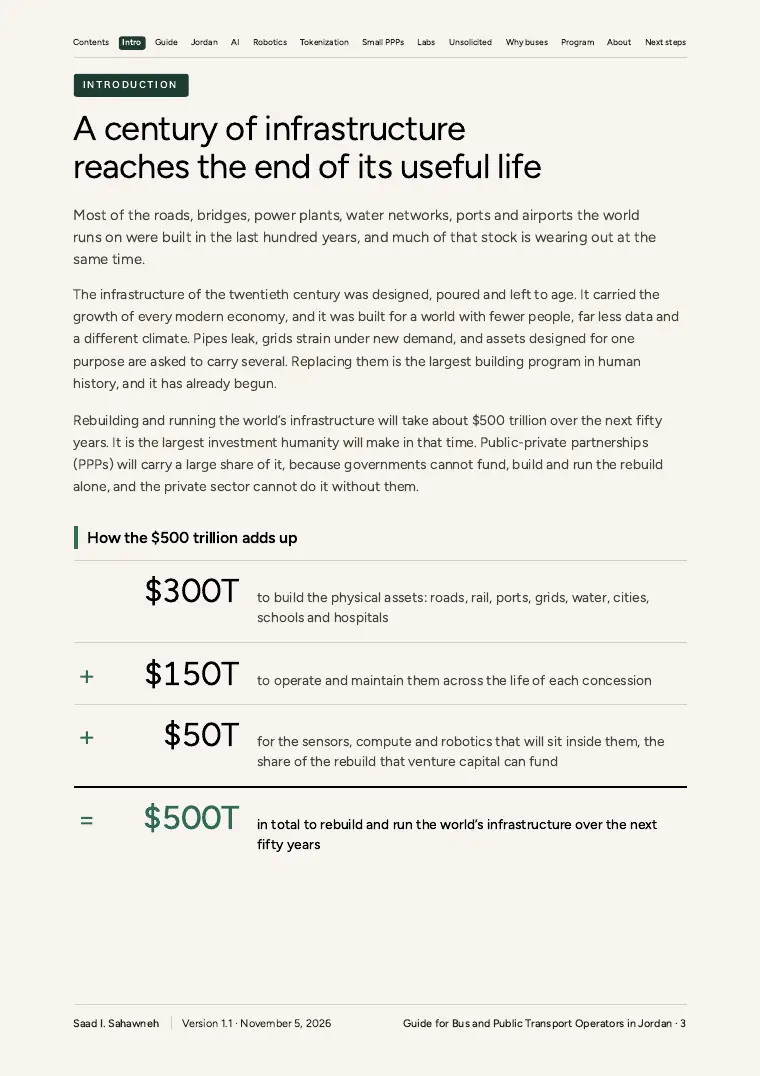
Why a century of infrastructure needs rebuilding, and the $500 trillion it will take.
Page 3 of 17
02The guide
Drive the $500 trillion PPP infrastructure opportunity
Page 5 of 17
03Jordan and Aqaba
An $86 billion pipeline to start with
Page 6 of 17
04Artificial intelligence
How AI designs, structures and runs PPP projects, and what it means for bus and public transport operators.
Page 7 of 17
05Robotics
How robots build infrastructure and keep it running, and what that means for bus and public transport operators.
Page 8 of 17
06Tokenization
How tokenization funds projects from their own revenue, and the role it opens for bus and public transport operators.
Page 9 of 17
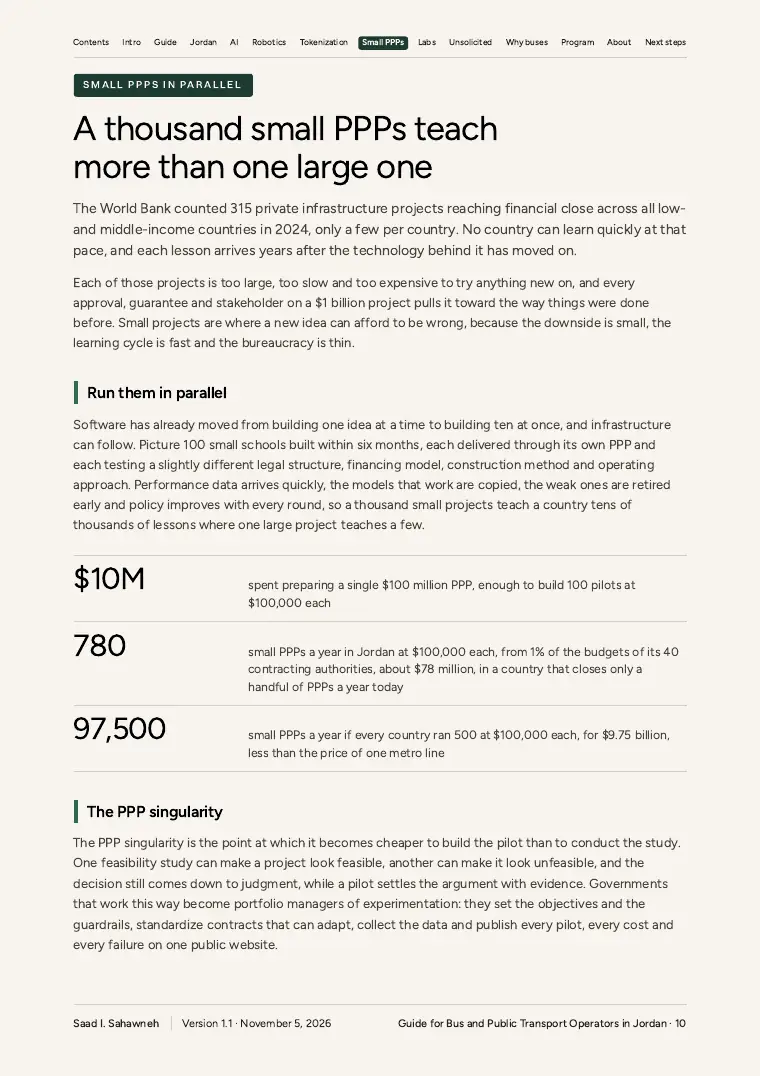
07Small PPPs in parallel
Why many small PPPs teach a country faster than a few large ones.
Page 10 of 17
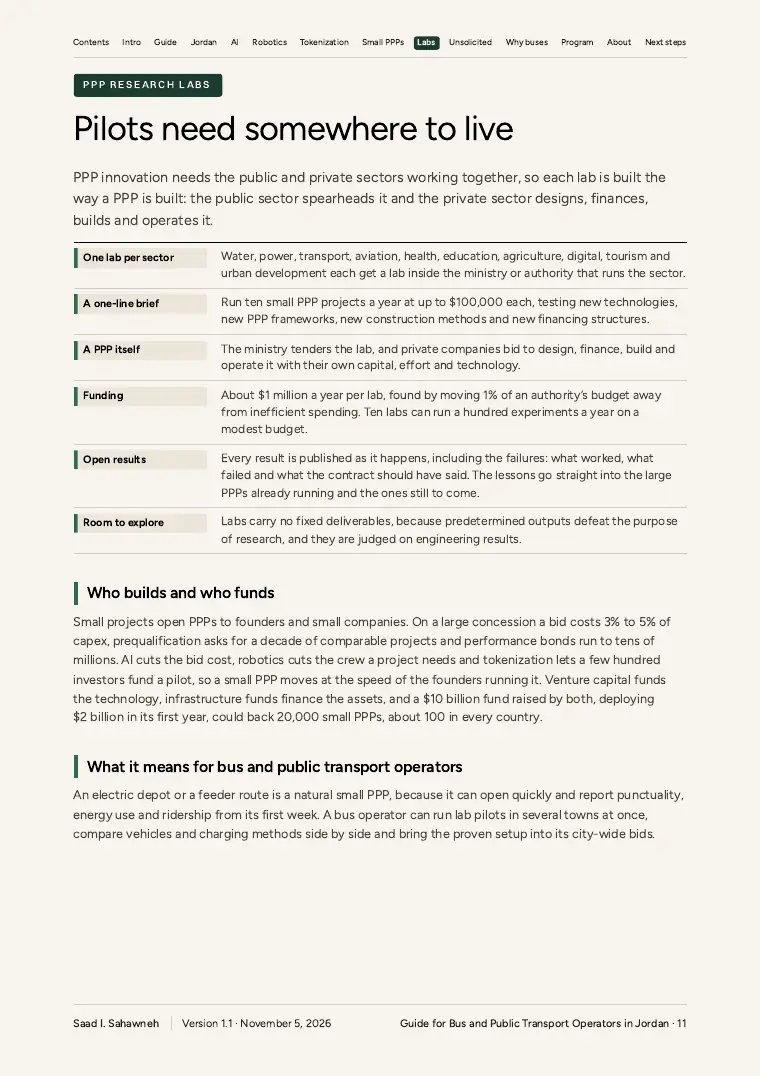
08PPP research labs
A lab in each sector, running ten small PPP projects a year.
Page 11 of 17
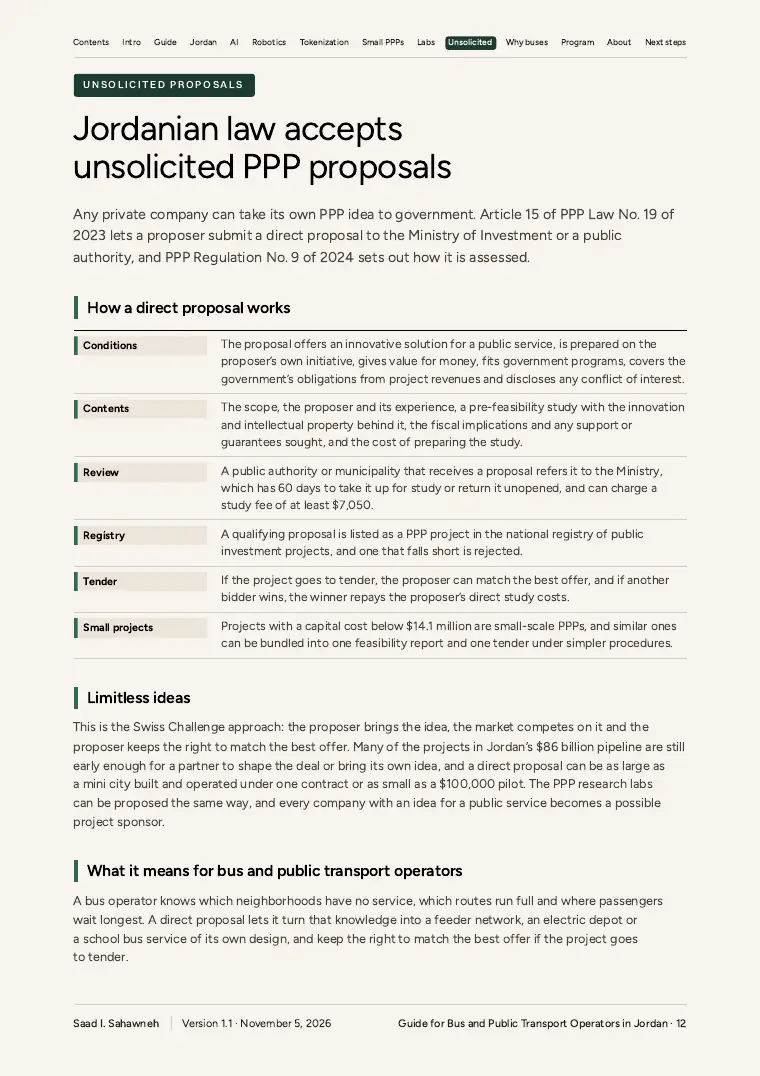
09Unsolicited proposals
How Jordan’s PPP law accepts direct proposals from private companies.
Page 12 of 17
10Why bus and public transport operators
Bus operators carry the daily trips every PPP depends on
Page 13 of 17
11The program
The program can sit inside the operations and planning teams, with a PPP lead at its center and the company’s fleet, depots and drivers behind it.
Page 14 of 17
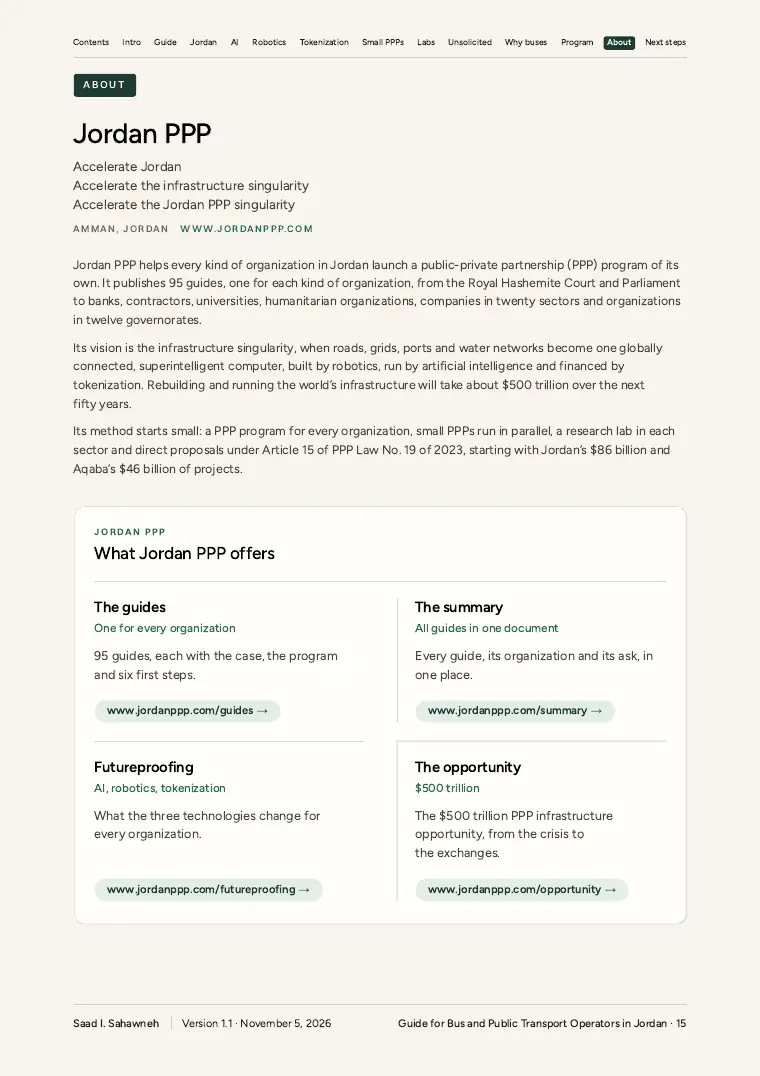
12About
About Jordan PPP and what it offers.
Page 15 of 17
13Next steps
How a bus operator can start: six first steps.
Page 16 of 17
Questions
Questions about the guide for Bus and Public Transport Operators in Jordan
- What does the guide for Bus and Public Transport Operators in Jordan propose?
- Your company launches a PPP program to build and run bus networks, bus rapid transit lines, depots, electric fleets and fare systems as public-private partnerships (PPPs) for decades.
- Why should bus and public transport operators in Jordan launch a PPP program?
- Bus operators carry the daily trips every PPP depends on. Greater Amman Municipality ran about 300 buses on its Bus Rapid Transit and Amman Bus services in 2025, and rapid bus routes now reach Zarqa, Madaba and Salt. Every new route, depot and electric fleet needs an operator that can run it to a contract for years.
- Which PPP projects can bus and public transport operators in Jordan take part in?
- Jordan has about $86 billion of PPP and infrastructure projects in development, $46 billion of them anchored in Aqaba. Every one of them needs workers, students and visitors carried to it every day, and bus operators to run those services for decades. A Jordanian bus operator that runs one network contract at home can carry the same operating model to the next city across the region.
- How can bus and public transport operators in Jordan start a PPP program?
- Any bus or public transport operator in Jordan can take this guide forward. The first steps use the buses, depots and drivers the company already has. The guide sets out six first steps: mandate, team, pipeline, fleet, partners and pilot.
- What does a PPP program give bus and public transport operators in Jordan?
- The company gains contracts that run for years, payments tied to the service it delivers and a stake in the depots and fleets it finances. Each network it runs builds a record of punctuality and safety that lenders and contracting authorities trust, which qualifies the company for larger cities in Jordan and across the region.
- Is the guide for Bus and Public Transport Operators in Jordan free?
- Yes. It is free to read on this page and free to download as a 17-page PDF, with the case for a PPP program, Jordan’s pipeline, the role of AI, robotics and tokenization, the program and six first steps.
Guide 52 of 95
Browse all 95 guides