
What this guide is for
Your organization launches a PPP program to build, equip and run nurseries and kindergartens with public and private partners, at workplaces, in public buildings and inside new projects.
The case
Childcare providers run the care that lets a workforce work
Nurseries and kindergartens are part of the infrastructure a country runs on. They let parents work, they prepare children for school, and they need safe buildings, trained staff and steady funding for decades. The projects of the next fifty years will bring new workplaces, zones and towns, and each will need care close to where families live and work. This guide invites childcare and early education providers in Jordan to launch a PPP program, starting with the projects at home.
The guide
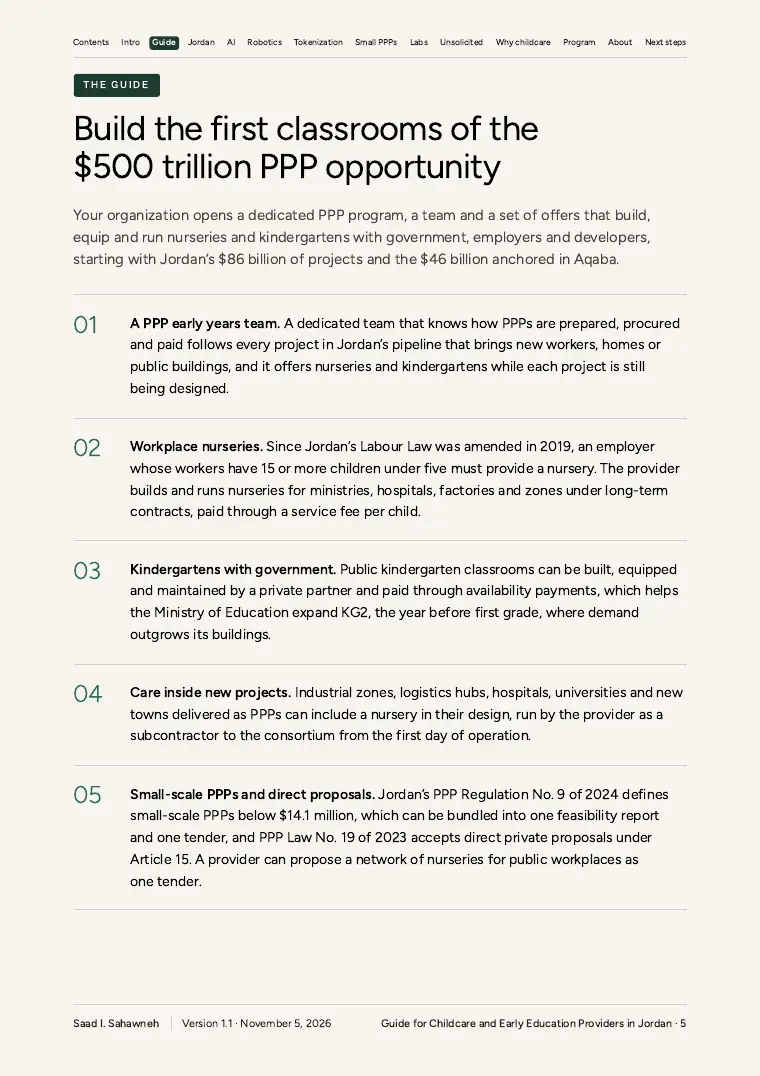
Build the first classrooms of the $500 trillion PPP opportunity
Your organization opens a dedicated PPP program, a team and a set of offers that build, equip and run nurseries and kindergartens with government, employers and developers, starting with Jordan’s $86 billion of projects and the $46 billion anchored in Aqaba.
01
A PPP early years team
A dedicated team that knows how PPPs are prepared, procured and paid follows every project in Jordan’s pipeline that brings new workers, homes or public buildings, and it offers nurseries and kindergartens while each project is still being designed.
02
Workplace nurseries
Since Jordan’s Labour Law was amended in 2019, an employer whose workers have 15 or more children under five must provide a nursery. The provider builds and runs nurseries for ministries, hospitals, factories and zones under long-term contracts, paid through a service fee per child.
03
Kindergartens with government
Public kindergarten classrooms can be built, equipped and maintained by a private partner and paid through availability payments, which helps the Ministry of Education expand KG2, the year before first grade, where demand outgrows its buildings.
04
Care inside new projects
Industrial zones, logistics hubs, hospitals, universities and new towns delivered as PPPs can include a nursery in their design, run by the provider as a subcontractor to the consortium from the first day of operation.
05
Small-scale PPPs and direct proposals
Jordan’s PPP Regulation No. 9 of 2024 defines small-scale PPPs below $14.1 million, which can be bundled into one feasibility report and one tender, and PPP Law No. 19 of 2023 accepts direct private proposals under Article 15. A provider can propose a network of nurseries for public workplaces as one tender.
Why childcare and early education providers
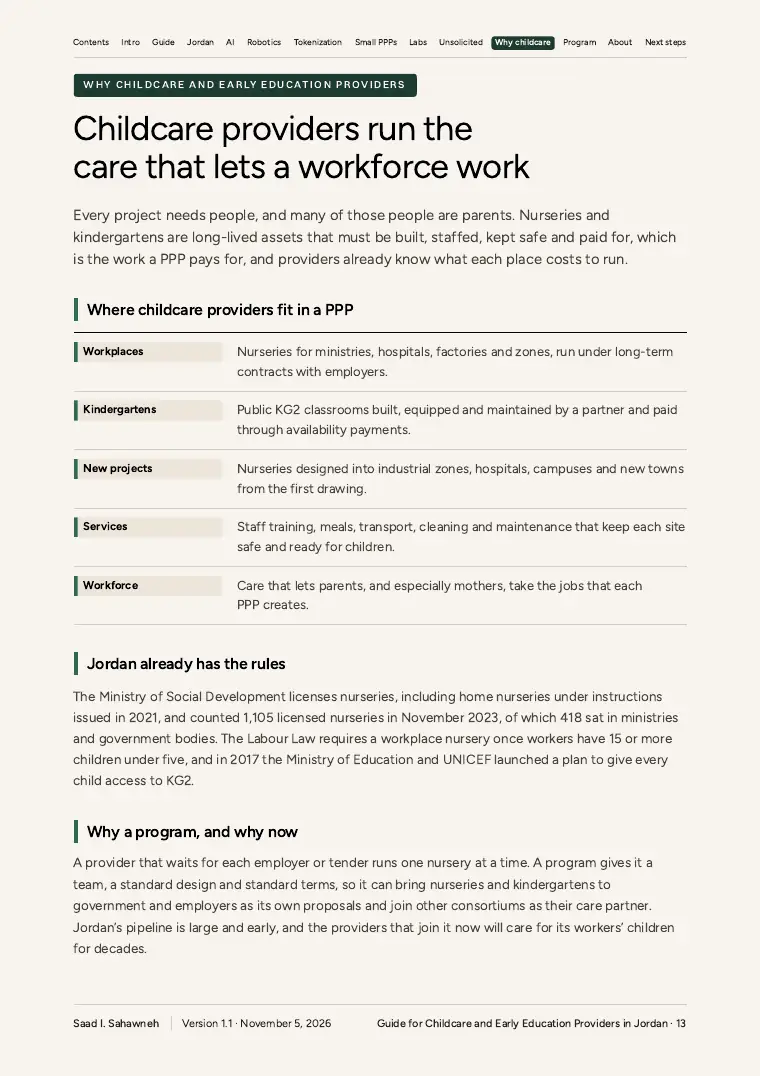
Childcare providers run the care that lets a workforce work
Every project needs people, and many of those people are parents. Nurseries and kindergartens are long-lived assets that must be built, staffed, kept safe and paid for, which is the work a PPP pays for, and providers already know what each place costs to run.
Where childcare providers fit in a PPP
- Workplaces
- Nurseries for ministries, hospitals, factories and zones, run under long-term contracts with employers.
- Kindergartens
- Public KG2 classrooms built, equipped and maintained by a partner and paid through availability payments.
- New projects
- Nurseries designed into industrial zones, hospitals, campuses and new towns from the first drawing.
- Services
- Staff training, meals, transport, cleaning and maintenance that keep each site safe and ready for children.
- Workforce
- Care that lets parents, and especially mothers, take the jobs that each PPP creates.
Jordan already has the rules
The Ministry of Social Development licenses nurseries, including home nurseries under instructions issued in 2021, and counted 1,105 licensed nurseries in November 2023, of which 418 sat in ministries and government bodies. The Labour Law requires a workplace nursery once workers have 15 or more children under five, and in 2017 the Ministry of Education and UNICEF launched a plan to give every child access to KG2.
Why a program, and why now
A provider that waits for each employer or tender runs one nursery at a time. A program gives it a team, a standard design and standard terms, so it can bring nurseries and kindergartens to government and employers as its own proposals and join other consortiums as their care partner. Jordan’s pipeline is large and early, and the providers that join it now will care for its workers’ children for decades.

Futureproofing
Futureproof Childcare and Early Education Providers in Jordan for the infrastructure singularity
This free 17-page guide shows how, with small PPPs in parallel, PPP research labs, artificial intelligence, robotics, tokenization and six first steps.

Jordan and Aqaba
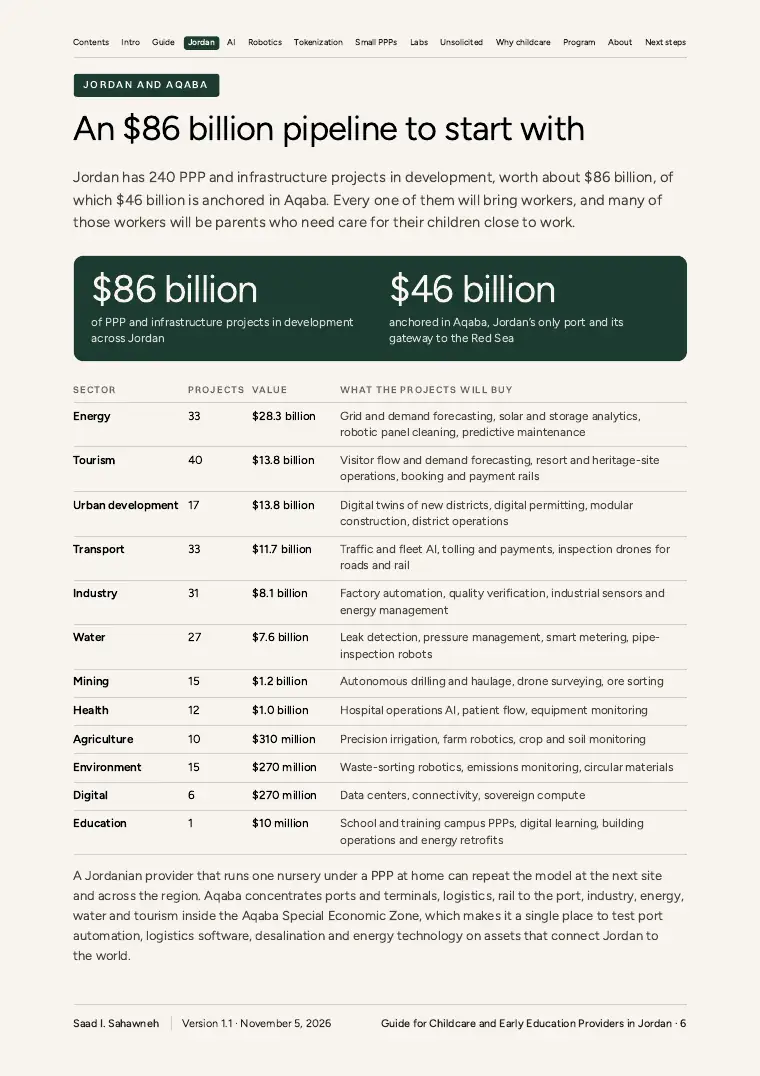
An $86 billion pipeline to start with
Every one of them will bring workers, and many of those workers will be parents who need care for their children close to work. A Jordanian provider that runs one nursery under a PPP at home can repeat the model at the next site and across the region.
- $86B
- of PPP and infrastructure projects in development in Jordan
- $46B
- of them anchored in Aqaba

Artificial intelligence
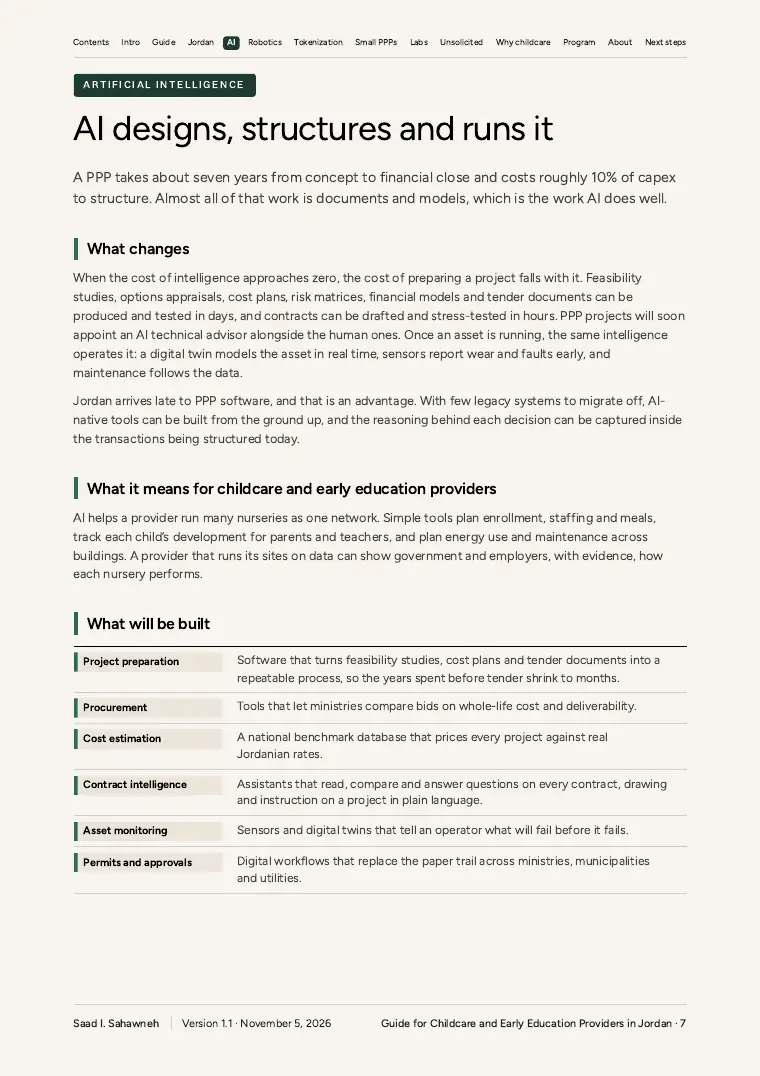
AI helps a provider run many nurseries as one network. Simple tools plan enrolment, staffing and meals, track each child’s development for parents and teachers, and plan energy use and maintenance across buildings. A provider that runs its sites on data can show government and employers, with evidence, how each nursery performs.

Robotics
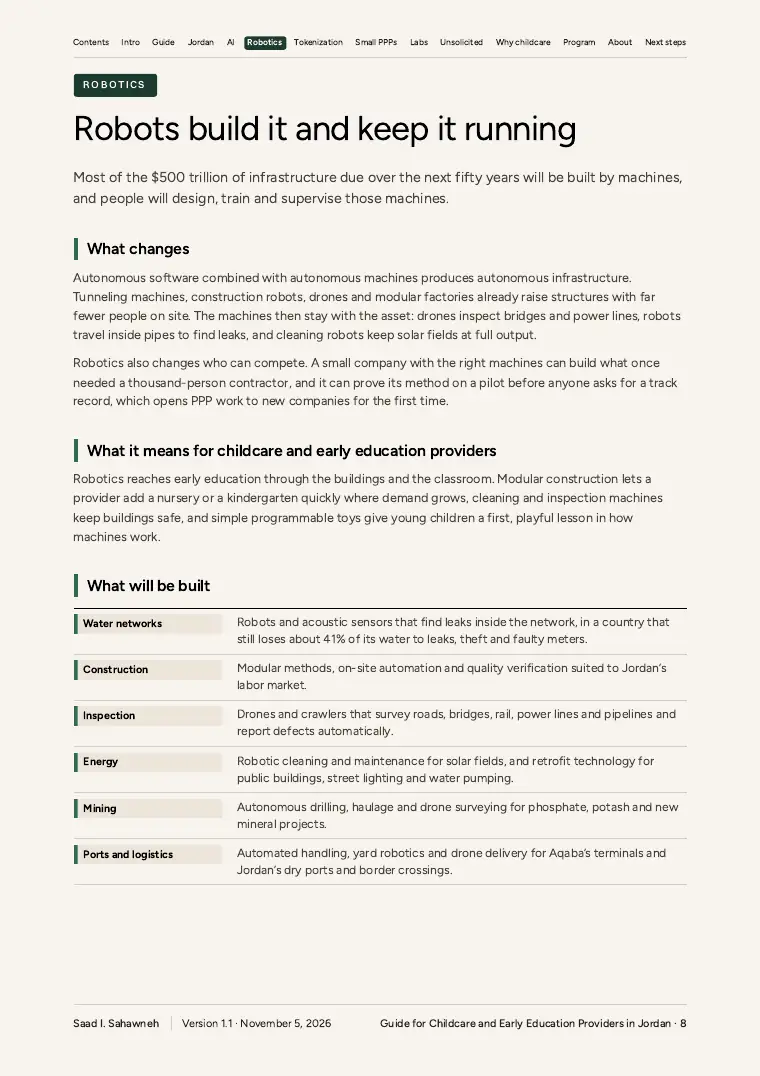
Robotics reaches early education through the buildings and the classroom. Modular construction lets a provider add a nursery or a kindergarten quickly where demand grows, cleaning and inspection machines keep buildings safe, and simple programmable toys give young children a first, playful lesson in how machines work.

Tokenization
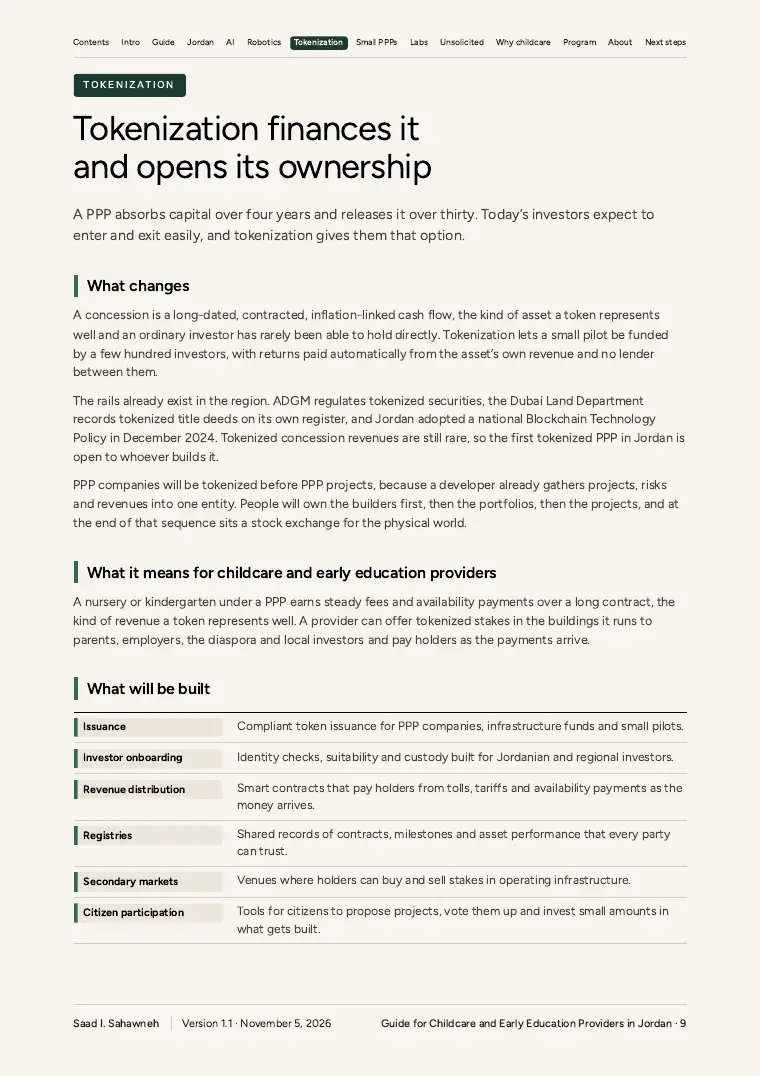
A nursery or kindergarten under a PPP earns steady fees and availability payments over a long contract, the kind of revenue a token represents well. A provider can offer tokenized stakes in the buildings it runs to parents, employers, the diaspora and local investors and pay holders as the payments arrive.

Small PPPs and research labs
Small PPPs suit childcare well, because a nursery or a kindergarten classroom can be built or refitted within months and measured from the first term. A provider can run lab pilots at several workplaces at once, test new designs and tools and carry the best results into larger programs.

Unsolicited proposals
A provider knows where parents wait for places and where workplaces lack care. A direct proposal lets it turn that knowledge into a project of its own design, such as a network of nurseries for public hospitals or a kindergarten block for a crowded district, and keep the right to match the best offer at tender.
The program
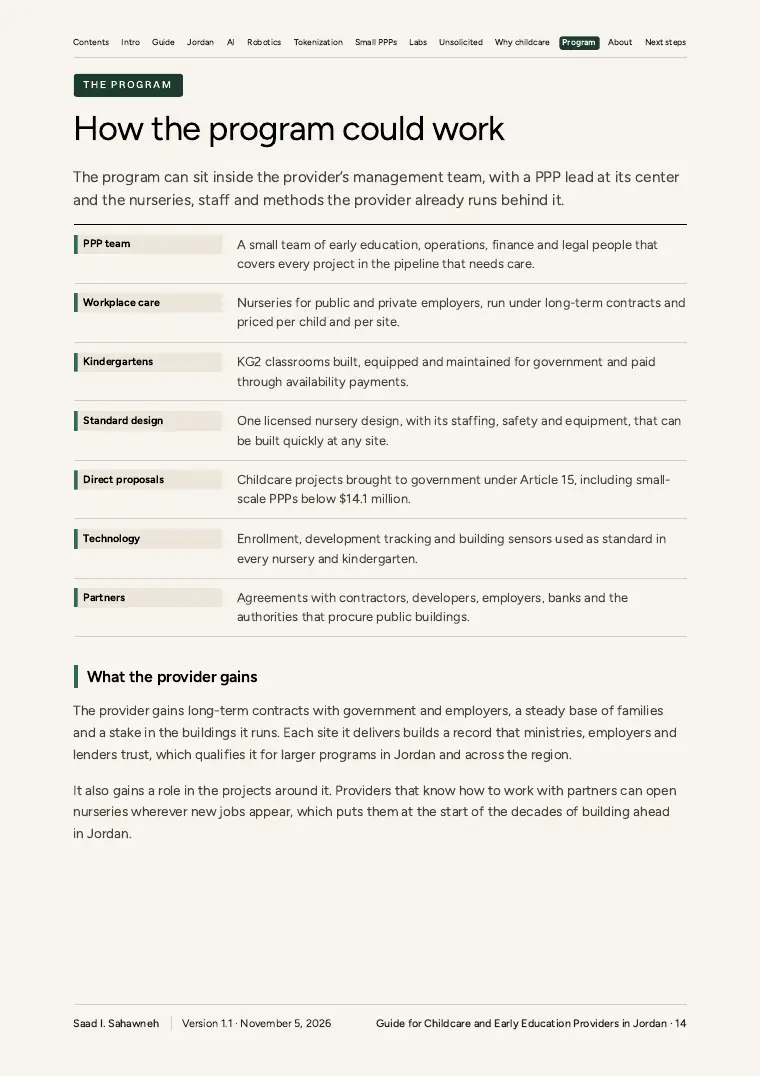
How the program could work
The program can sit inside the provider’s management team, with a PPP lead at its center and the nurseries, staff and methods the provider already runs behind it.
- PPP team
- A small team of early education, operations, finance and legal people that covers every project in the pipeline that needs care.
- Workplace care
- Nurseries for public and private employers, run under long-term contracts and priced per child and per site.
- Kindergartens
- KG2 classrooms built, equipped and maintained for government and paid through availability payments.
- Standard design
- One licensed nursery design, with its staffing, safety and equipment, that can be built quickly at any site.
- Direct proposals
- Childcare projects brought to government under Article 15, including small-scale PPPs below $14.1 million.
- Technology
- Enrolment, development tracking and building sensors used as standard in every nursery and kindergarten.
- Partners
- Agreements with contractors, developers, employers, banks and the authorities that procure public buildings.
What the provider gains
The provider gains long-term contracts with government and employers, a steady base of families and a stake in the buildings it runs. Each site it delivers builds a record that ministries, employers and lenders trust, which qualifies it for larger programs in Jordan and across the region.
It also gains a role in the projects around it. Providers that know how to work with partners can open nurseries wherever new jobs appear, which puts them at the start of the decades of building ahead in Jordan.

Next steps
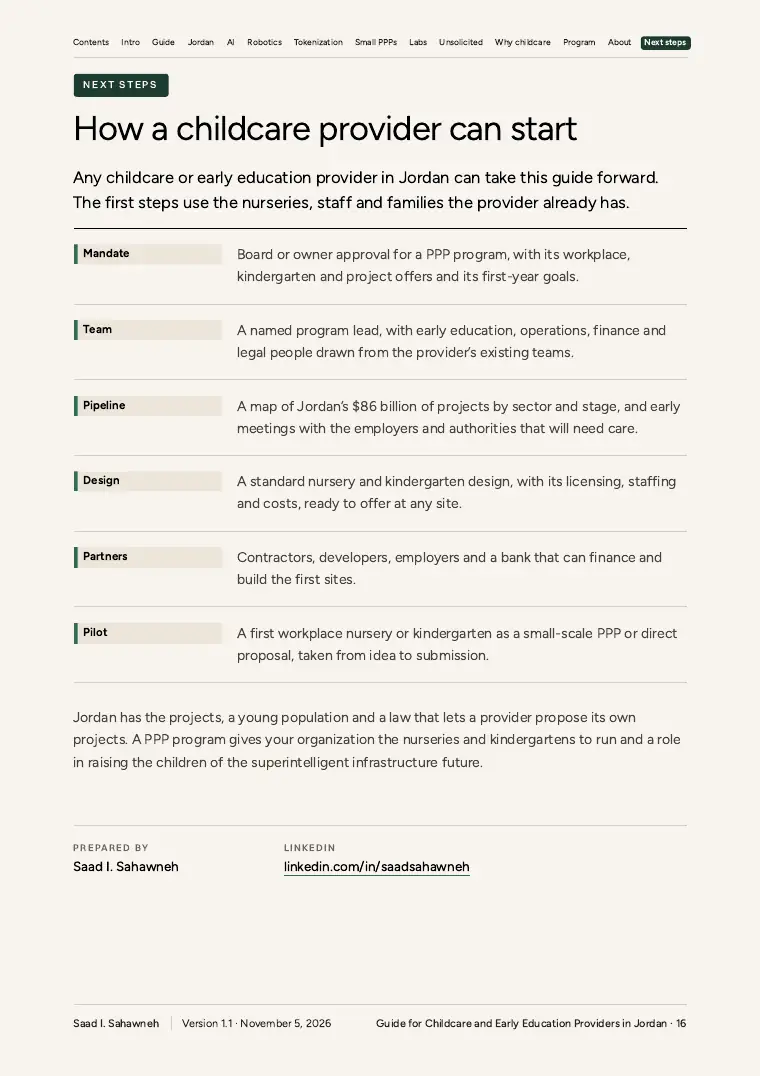
How a childcare provider can start
Any childcare or early education provider in Jordan can take this guide forward. The first steps use the nurseries, staff and families the provider already has.
01
Mandate
Board or owner approval for a PPP program, with its workplace, kindergarten and project offers and its first-year goals.
02
Team
A named program lead, with early education, operations, finance and legal people drawn from the provider’s existing teams.
03
Pipeline
A map of Jordan’s $86 billion of projects by sector and stage, and early meetings with the employers and authorities that will need care.
04
Design
A standard nursery and kindergarten design, with its licensing, staffing and costs, ready to offer at any site.
05
Partners
Contractors, developers, employers and a bank that can finance and build the first sites.
06
Pilot
A first workplace nursery or kindergarten as a small-scale PPP or direct proposal, taken from idea to submission.
Jordan has the projects, a young population and a law that lets a provider propose its own. A PPP program gives your organization the nurseries and kindergartens to run and a role in raising the children of the superintelligent infrastructure future.
The full document
Inside this guide
Seventeen pages and thirteen chapters, from the case for a PPP program to the first steps, written for childcare and early education providers in Jordan.
- 17
- pages
- 13
- chapters
- 3
- technologies
- 6
- first steps
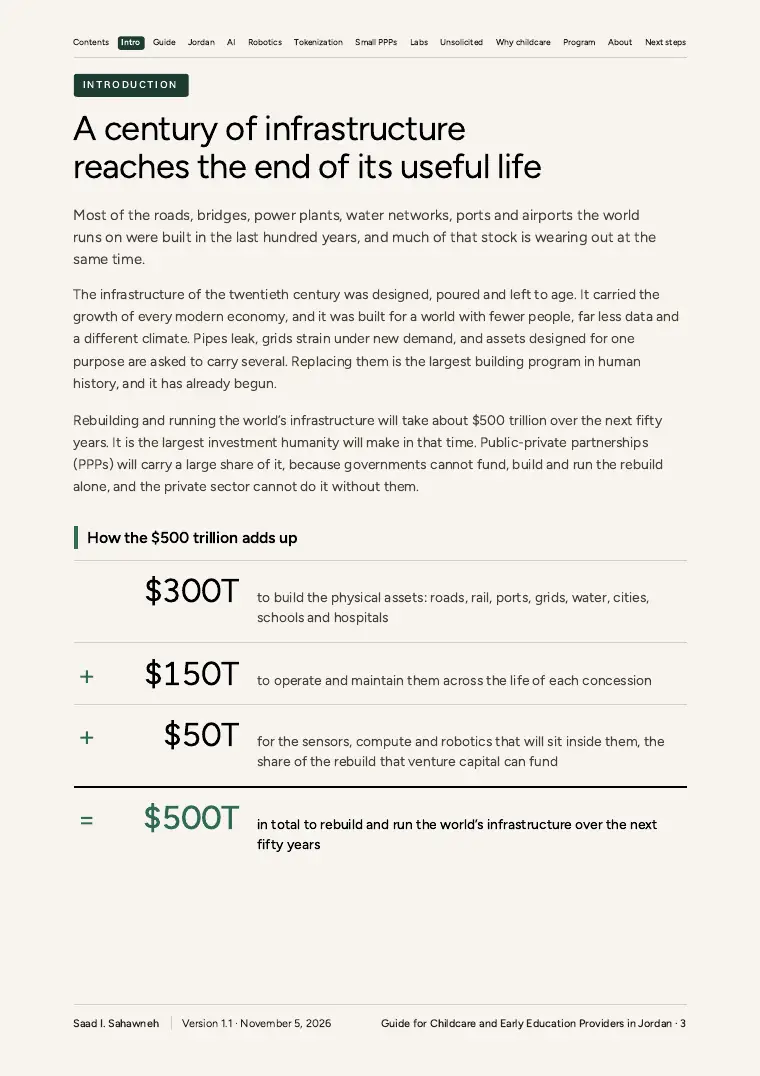
01Introduction
Why a century of infrastructure needs rebuilding, and the $500 trillion it will take.
Page 3 of 17
02The guide
Build the first classrooms of the $500 trillion PPP opportunity
Page 5 of 17
03Jordan and Aqaba
An $86 billion pipeline to start with
Page 6 of 17
04Artificial intelligence
How AI designs, structures and runs PPP projects, and what it means for childcare and early education providers.
Page 7 of 17
05Robotics
How robots build infrastructure and keep it running, and what that means for childcare and early education providers.
Page 8 of 17
06Tokenization
How tokenization funds projects from their own revenue, and the role it opens for childcare and early education providers.
Page 9 of 17
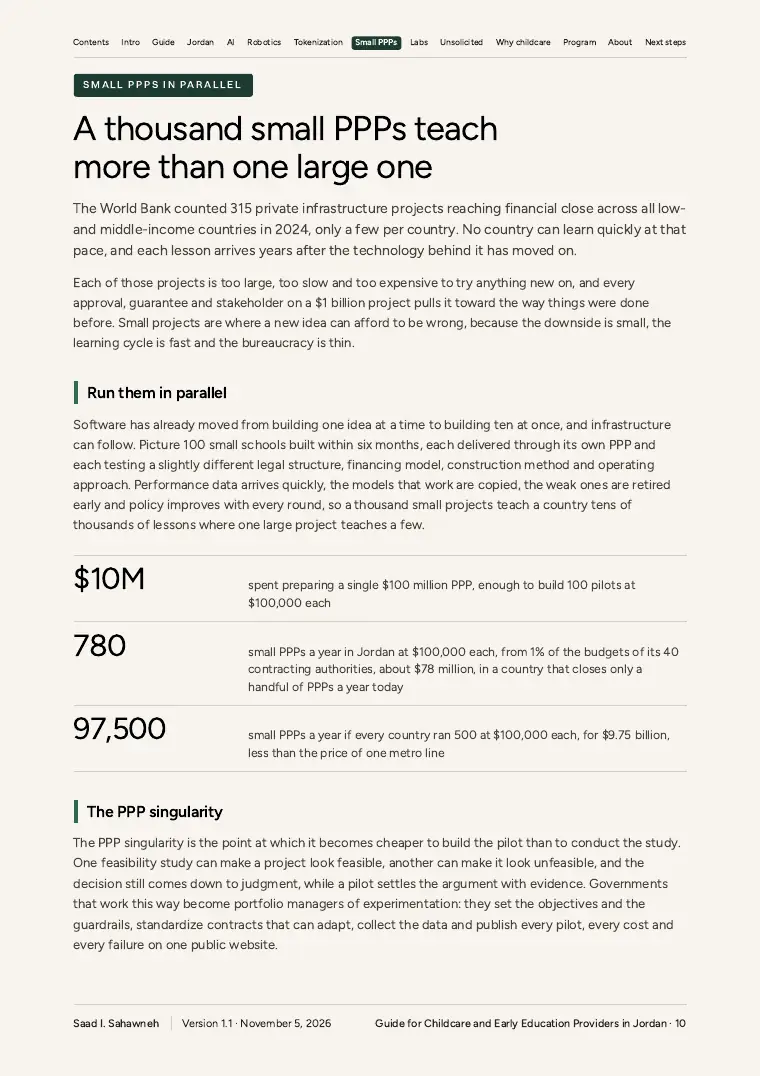
07Small PPPs in parallel
Why many small PPPs teach a country faster than a few large ones.
Page 10 of 17
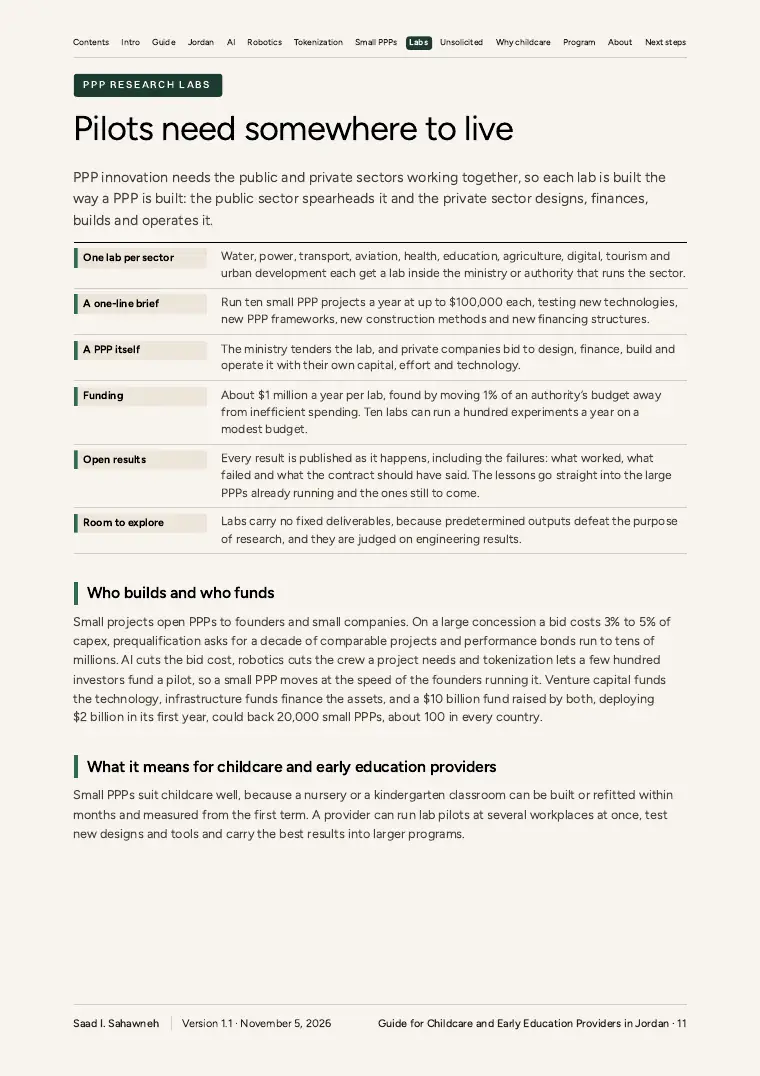
08PPP research labs
A lab in each sector, running ten small PPP projects a year.
Page 11 of 17
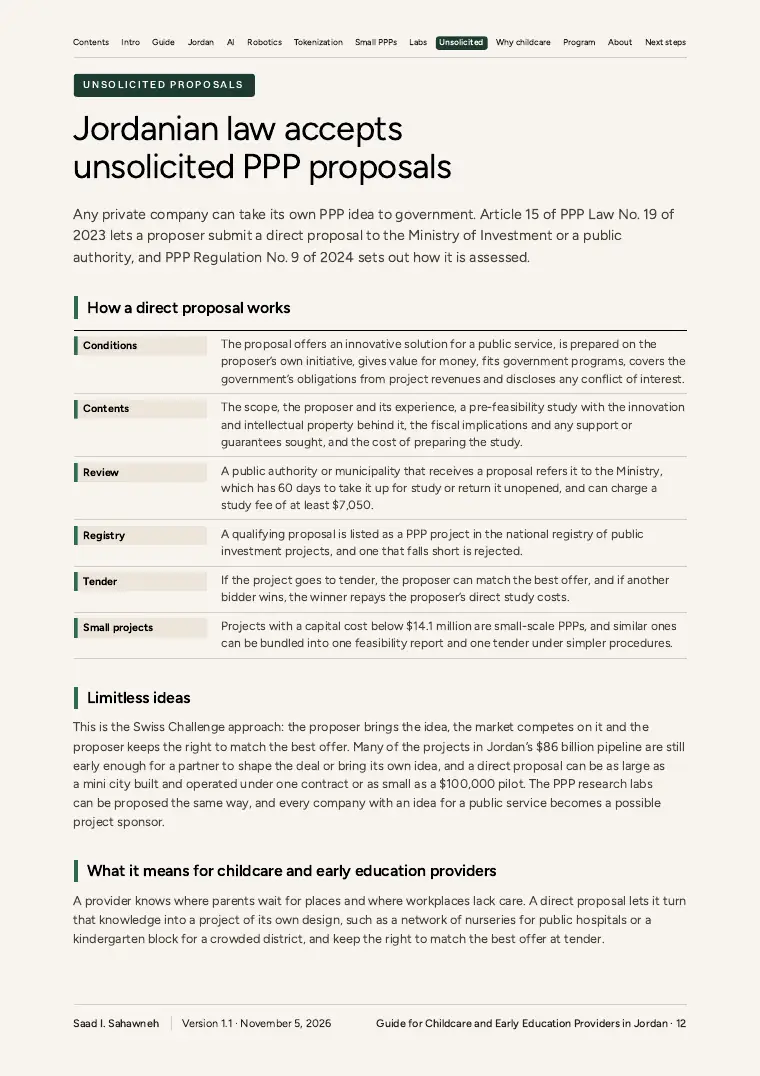
09Unsolicited proposals
How Jordan’s PPP law accepts direct proposals from private companies.
Page 12 of 17
10Why childcare and early education providers
Childcare providers run the care that lets a workforce work
Page 13 of 17
11The program
The program can sit inside the provider’s management team, with a PPP lead at its center and the nurseries, staff and methods the provider already runs behind it.
Page 14 of 17
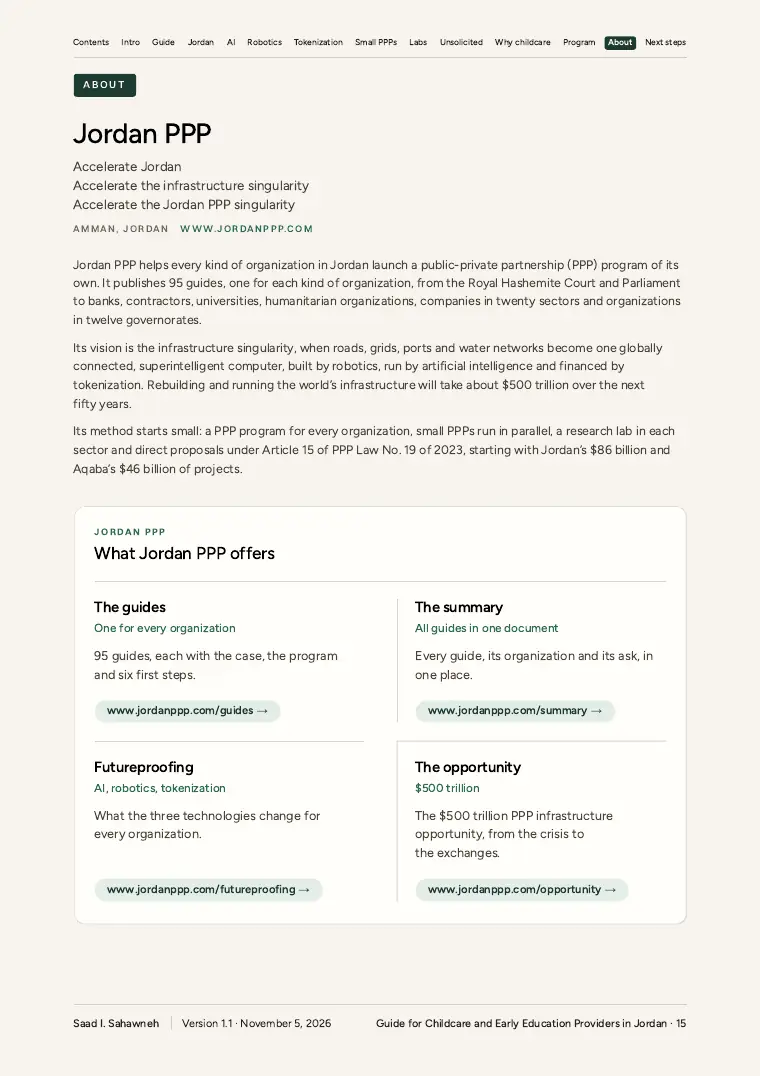
12About
About Jordan PPP and what it offers.
Page 15 of 17
13Next steps
How a childcare provider can start: six first steps.
Page 16 of 17
Questions
Questions about the guide for Childcare and Early Education Providers in Jordan
- What does the guide for Childcare and Early Education Providers in Jordan propose?
- Your organization launches a PPP program to build, equip and run nurseries and kindergartens with public and private partners, at workplaces, in public buildings and inside new projects.
- Why should childcare and early education providers in Jordan launch a PPP program?
- Childcare providers run the care that lets a workforce work. Every project needs people, and many of those people are parents. Nurseries and kindergartens are long-lived assets that must be built, staffed, kept safe and paid for, which is the work a PPP pays for, and providers already know what each place costs to run.
- Which PPP projects can childcare and early education providers in Jordan take part in?
- Jordan has about $86 billion of PPP and infrastructure projects in development, $46 billion of them anchored in Aqaba. Every one of them will bring workers, and many of those workers will be parents who need care for their children close to work. A Jordanian provider that runs one nursery under a PPP at home can repeat the model at the next site and across the region.
- How can childcare and early education providers in Jordan start a PPP program?
- Any childcare or early education provider in Jordan can take this guide forward. The first steps use the nurseries, staff and families the provider already has. The guide sets out six first steps: mandate, team, pipeline, design, partners and pilot.
- What does a PPP program give childcare and early education providers in Jordan?
- The provider gains long-term contracts with government and employers, a steady base of families and a stake in the buildings it runs. Each site it delivers builds a record that ministries, employers and lenders trust, which qualifies it for larger programs in Jordan and across the region.
- Is the guide for Childcare and Early Education Providers in Jordan free?
- Yes. It is free to read on this page and free to download as a 17-page PDF, with the case for a PPP program, Jordan’s pipeline, the role of AI, robotics and tokenization, the program and six first steps.
Guide 68 of 95
Browse all 95 guides