
What this guide is for
Your organization launches a PPP program to build power, landing pads, habitats, roads and water and oxygen plants on the Moon with robots, AI and tokenized finance, as public-private partnerships (PPPs) between space agencies and companies.
The case
The Moon will need power, water and roads before people can stay
Space has mostly been built by governments alone, one mission at a time, while companies supplied the parts. Infrastructure on the Moon will be built and run under long contracts in which space agencies buy power, water, transport and data as services, and the organizations that prepare those partnerships now will own a share of the first economy beyond Earth. This guide invites organizations building on the Moon to launch a PPP program, starting with the projects at home in Jordan.
The guide
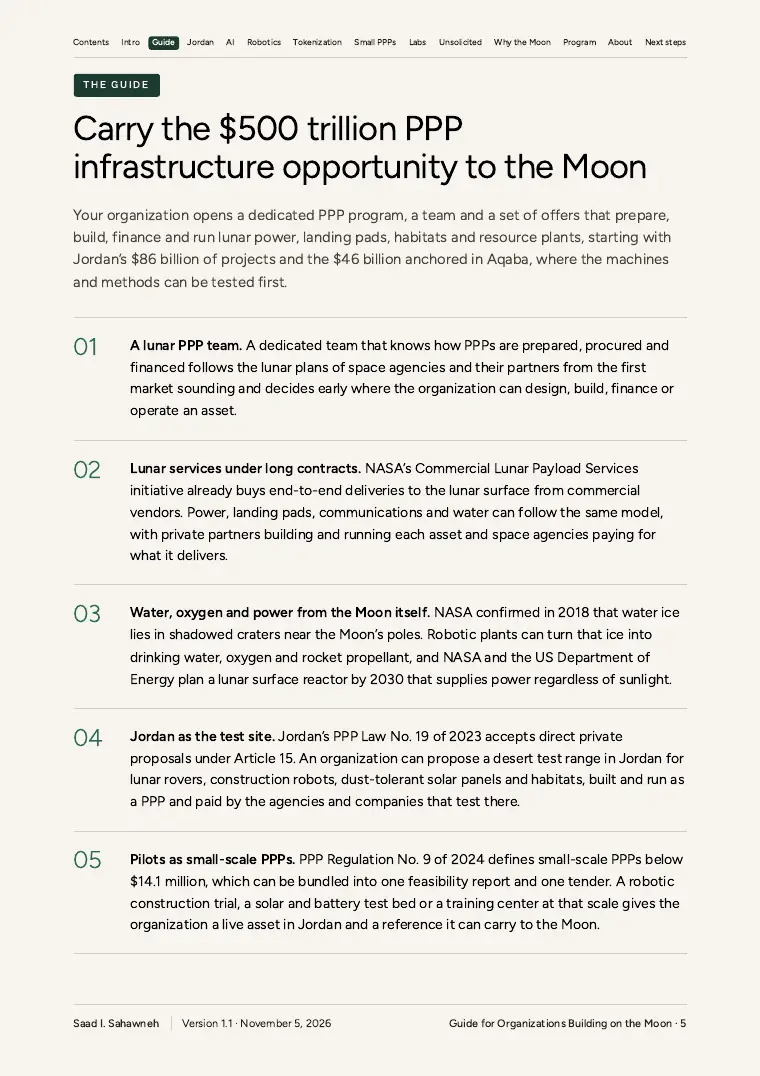
Carry the $500 trillion PPP infrastructure opportunity to the Moon
Your organization opens a dedicated PPP program, a team and a set of offers that prepare, build, finance and run lunar power, landing pads, habitats and resource plants, starting with Jordan’s $86 billion of projects and the $46 billion anchored in Aqaba, where the machines and methods can be tested first.
01
A lunar PPP team
A dedicated team that knows how PPPs are prepared, procured and financed follows the lunar plans of space agencies and their partners from the first market sounding and decides early where the organization can design, build, finance or operate an asset.
02
Lunar services under long contracts
NASA’s Commercial Lunar Payload Services initiative already buys end-to-end deliveries to the lunar surface from commercial vendors. Power, landing pads, communications and water can follow the same model, with private partners building and running each asset and space agencies paying for what it delivers.
03
Water, oxygen and power from the Moon itself
NASA confirmed in 2018 that water ice lies in shadowed craters near the Moon’s poles. Robotic plants can turn that ice into drinking water, oxygen and rocket propellant, and NASA and the US Department of Energy plan a lunar surface reactor by 2030 that supplies power regardless of sunlight.
04
Jordan as the test site
Jordan’s PPP Law No. 19 of 2023 accepts direct private proposals under Article 15. An organization can propose a desert test range in Jordan for lunar rovers, construction robots, dust-tolerant solar panels and habitats, built and run as a PPP and paid by the agencies and companies that test there.
05
Pilots as small-scale PPPs
PPP Regulation No. 9 of 2024 defines small-scale PPPs below $14.1 million, which can be bundled into one feasibility report and one tender. A robotic construction trial, a solar and battery test bed or a training center at that scale gives the organization a live asset in Jordan and a reference it can carry to the Moon.
Why organizations building on the Moon
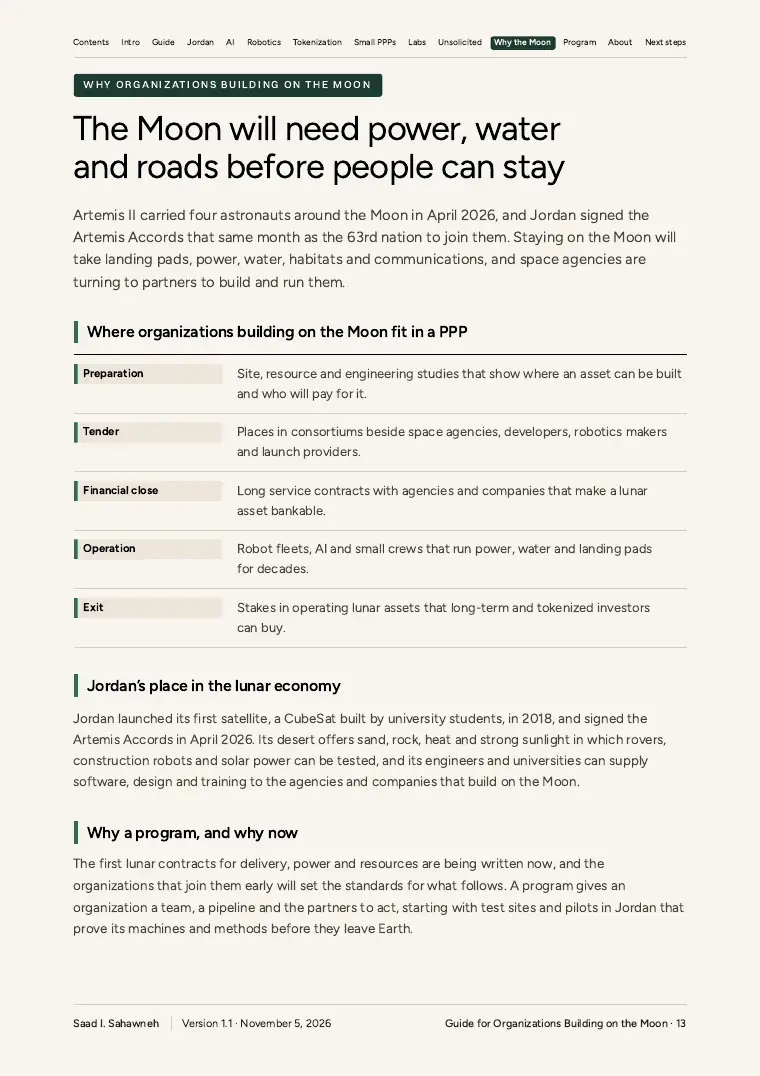
The Moon will need power, water and roads before people can stay
Artemis II carried four astronauts around the Moon in April 2026, and Jordan signed the Artemis Accords that same month as the 63rd nation to join them. Staying on the Moon will take landing pads, power, water, habitats and communications, and space agencies are turning to partners to build and run them.
Where organizations building on the Moon fit in a PPP
- Preparation
- Site, resource and engineering studies that show where an asset can be built and who will pay for it.
- Tender
- Places in consortia beside space agencies, developers, robotics makers and launch providers.
- Financial close
- Long service contracts with agencies and companies that make a lunar asset bankable.
- Operation
- Robot fleets, AI and small crews that run power, water and landing pads for decades.
- Exit
- Stakes in operating lunar assets that long-term and tokenized investors can buy.
Jordan’s place in the lunar economy
Jordan launched its first satellite, a CubeSat built by university students, in 2018, and signed the Artemis Accords in April 2026. Its desert offers sand, rock, heat and strong sunlight in which rovers, construction robots and solar power can be tested, and its engineers and universities can supply software, design and training to the agencies and companies that build on the Moon.
Why a program, and why now
The first lunar contracts for delivery, power and resources are being written now, and the organizations that join them early will set the standards for what follows. A program gives an organization a team, a pipeline and the partners to act, starting with test sites and pilots in Jordan that prove its machines and methods before they leave Earth.

Futureproofing
Futureproof Organizations Building on the Moon for the infrastructure singularity
This free 17-page guide shows how, with small PPPs in parallel, PPP research labs, artificial intelligence, robotics, tokenization and six first steps.
Jordan and Aqaba
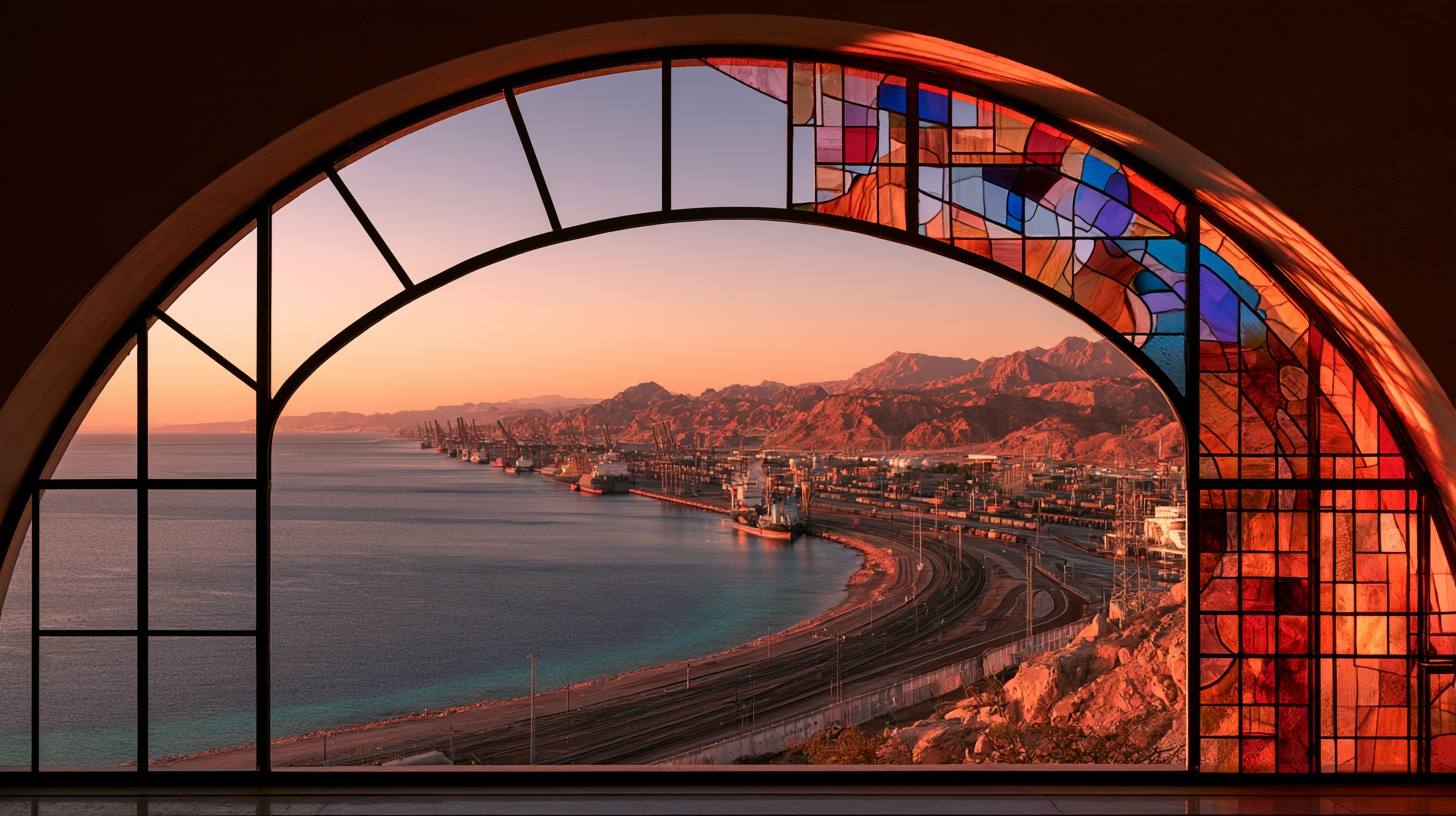
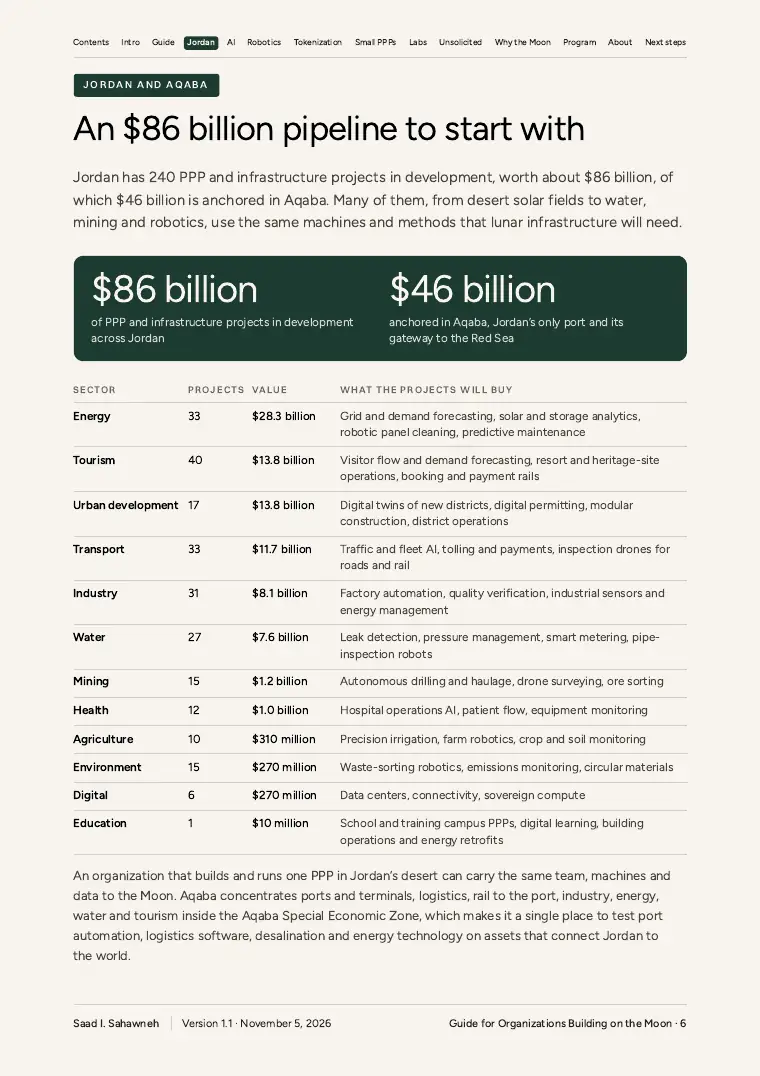
An $86 billion pipeline to start with
Many of them, from desert solar fields to water, mining and robotics, use the same machines and methods that lunar infrastructure will need. An organization that builds and runs one PPP in Jordan’s desert can carry the same team, machines and data to the Moon.
- $86B
- of PPP and infrastructure projects in development in Jordan
- $46B
- of them anchored in Aqaba

Artificial intelligence
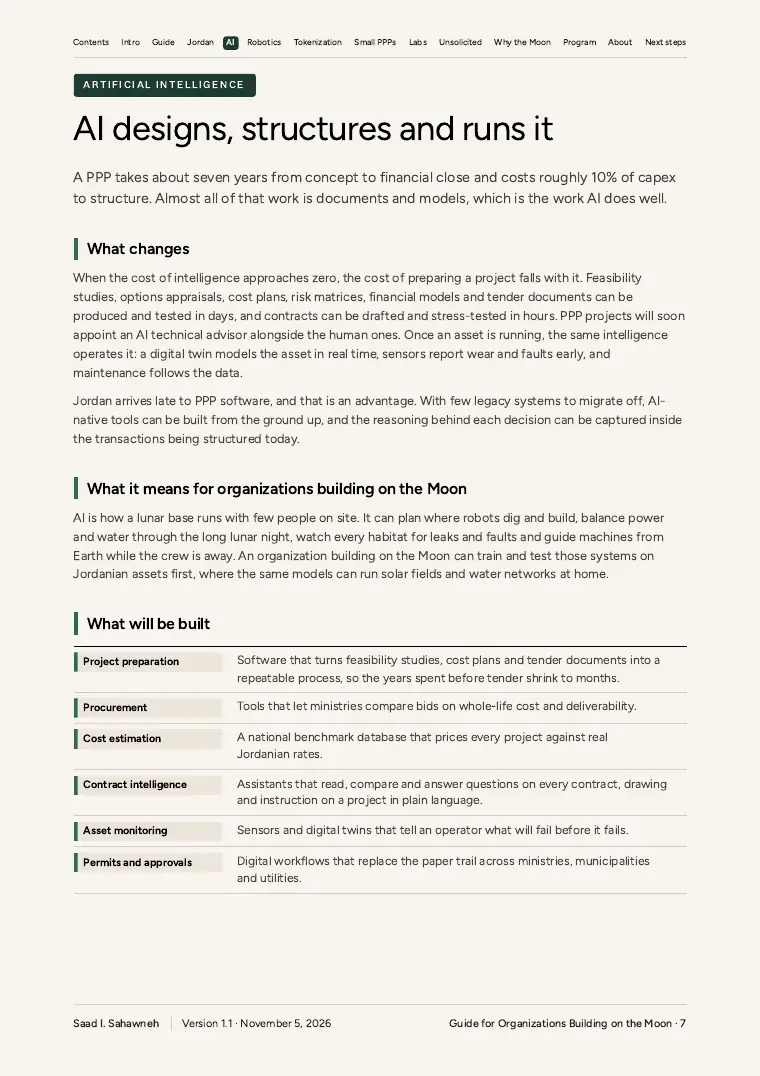
AI is how a lunar base runs with few people on site. It can plan where robots dig and build, balance power and water through the long lunar night, watch every habitat for leaks and faults and guide machines from Earth while the crew is away. An organization building on the Moon can train and test those systems on Jordanian assets first, where the same models can run solar fields and water networks at home.

Robotics
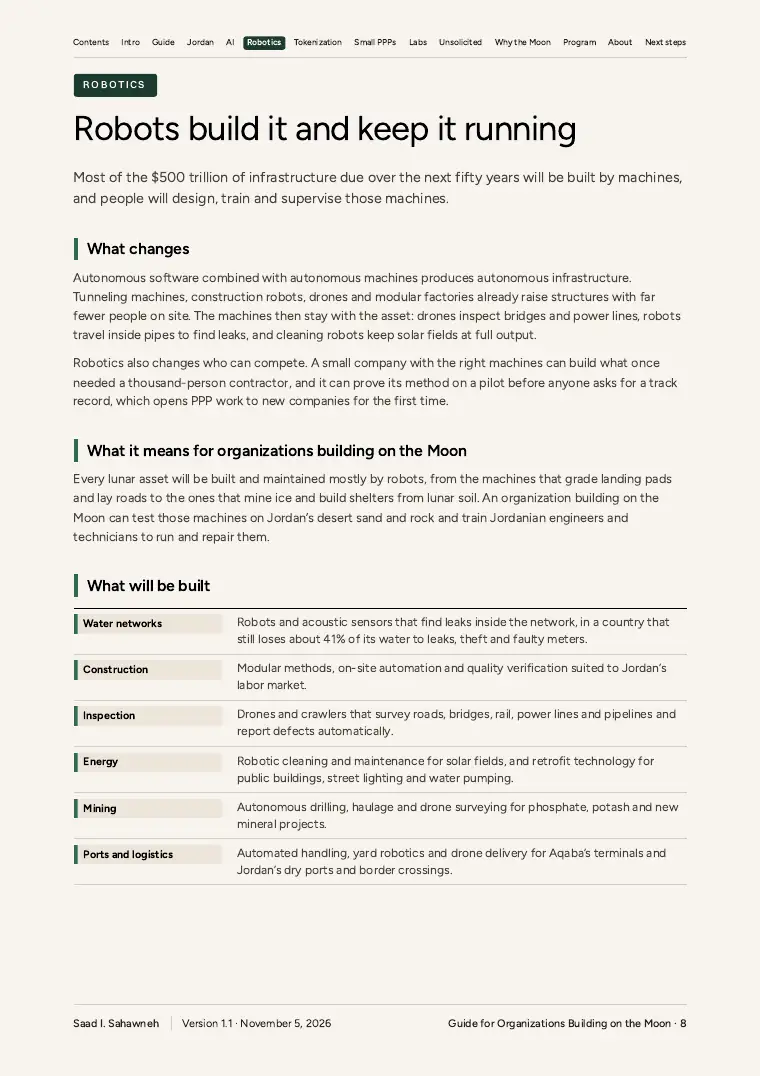
Every lunar asset will be built and maintained mostly by robots, from the machines that grade landing pads and lay roads to the ones that mine ice and build shelters from lunar soil. An organization building on the Moon can test those machines on Jordan’s desert sand and rock and train Jordanian engineers and technicians to run and repair them.

Tokenization
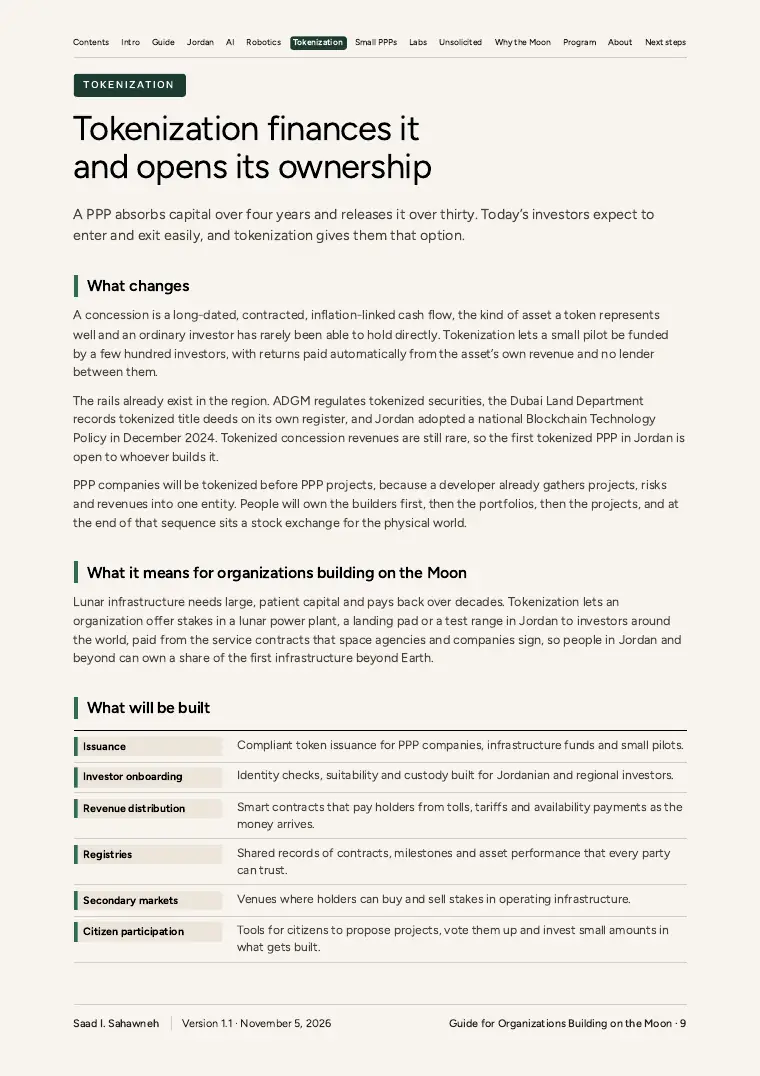
Lunar infrastructure needs large, patient capital and pays back over decades. Tokenization lets an organization offer stakes in a lunar power plant, a landing pad or a test range in Jordan to investors around the world, paid from the service contracts that space agencies and companies sign, so people in Jordan and beyond can own a share of the first infrastructure beyond Earth.

Small PPPs and research labs
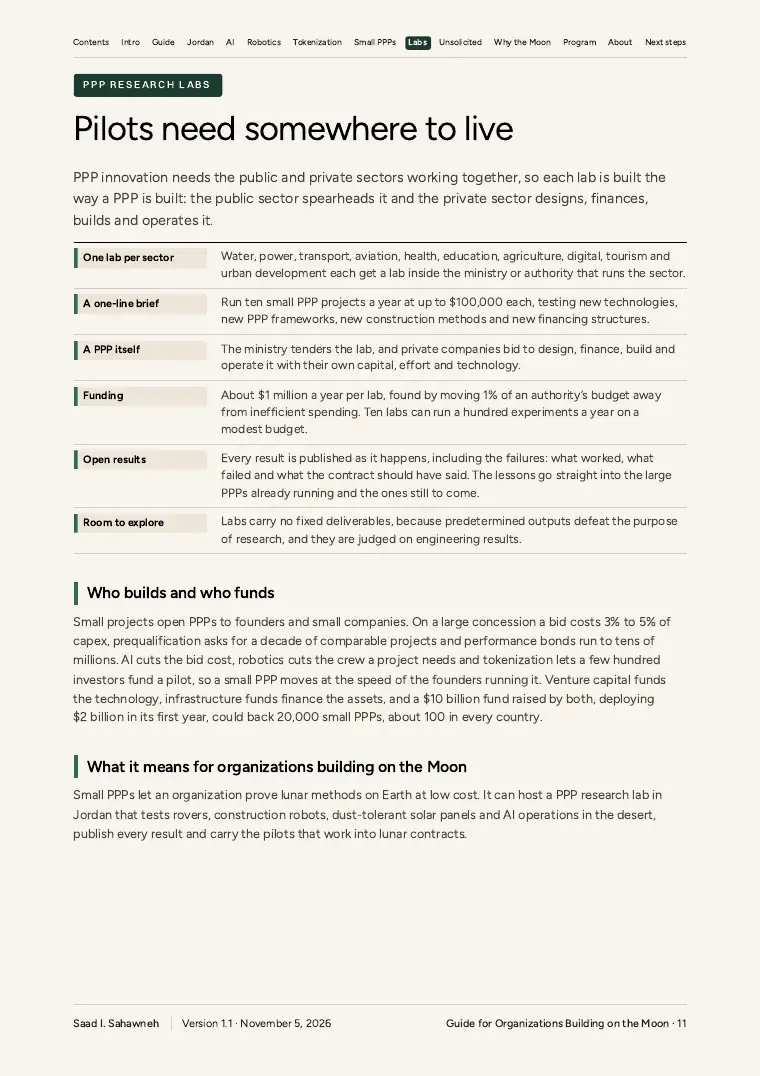
Small PPPs let an organization prove lunar methods on Earth at low cost. It can host a PPP research lab in Jordan that tests rovers, construction robots, dust-tolerant solar panels and AI operations in the desert, publish every result and carry the pilots that work into lunar contracts.

Unsolicited proposals
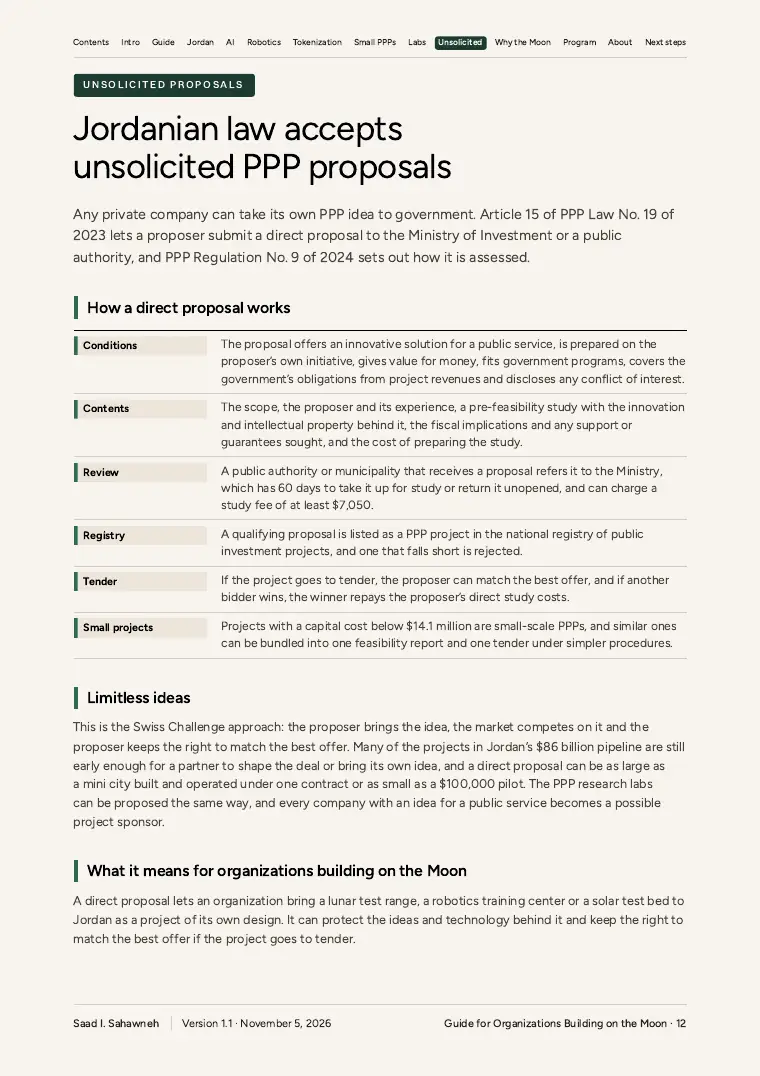
A direct proposal lets an organization bring a lunar test range, a robotics training center or a solar test bed to Jordan as a project of its own design. It can protect the ideas and technology behind it and keep the right to match the best offer if the project goes to tender.
The program
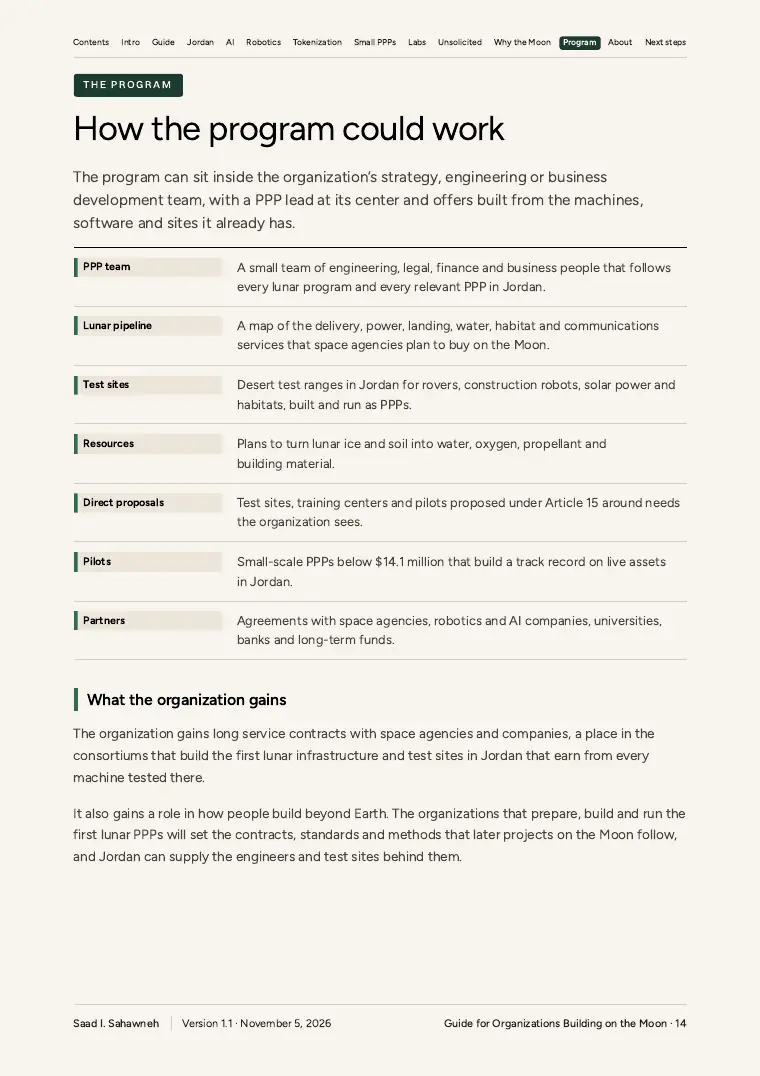
How the program could work
The program can sit inside the organization’s strategy, engineering or business development team, with a PPP lead at its center and offers built from the machines, software and sites it already has.
- PPP team
- A small team of engineering, legal, finance and business people that follows every lunar program and every relevant PPP in Jordan.
- Lunar pipeline
- A map of the delivery, power, landing, water, habitat and communications services that space agencies plan to buy on the Moon.
- Test sites
- Desert test ranges in Jordan for rovers, construction robots, solar power and habitats, built and run as PPPs.
- Resources
- Plans to turn lunar ice and soil into water, oxygen, propellant and building material.
- Direct proposals
- Test sites, training centers and pilots proposed under Article 15 around needs the organization sees.
- Pilots
- Small-scale PPPs below $14.1 million that build a track record on live assets in Jordan.
- Partners
- Agreements with space agencies, robotics and AI companies, universities, banks and long-term funds.
What the organization gains
The organization gains long service contracts with space agencies and companies, a place in the consortia that build the first lunar infrastructure and test sites in Jordan that earn from every machine tested there.
It also gains a role in how people build beyond Earth. The organizations that prepare, build and run the first lunar PPPs will set the contracts, standards and methods that later projects on the Moon follow, and Jordan can supply the engineers and test sites behind them.

Next steps
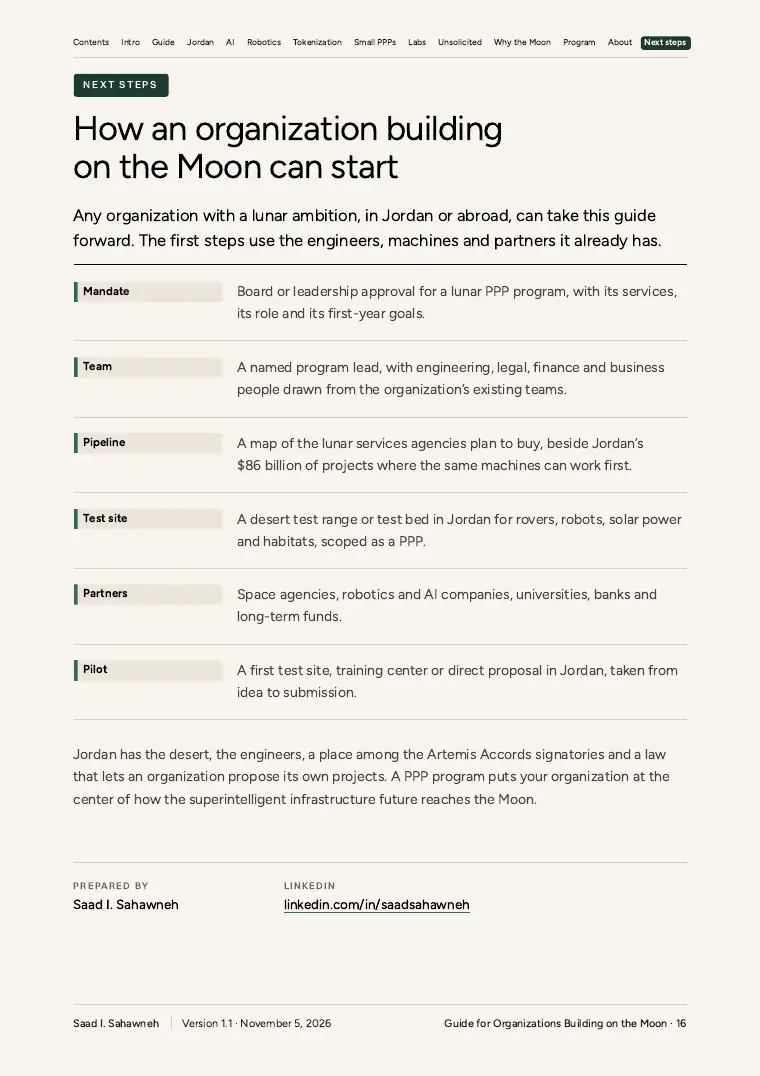
How an organization building on the Moon can start
Any organization with a lunar ambition, in Jordan or abroad, can take this guide forward. The first steps use the engineers, machines and partners it already has.
01
Mandate
Board or leadership approval for a lunar PPP program, with its services, its role and its first-year goals.
02
Team
A named program lead, with engineering, legal, finance and business people drawn from the organization’s existing teams.
03
Pipeline
A map of the lunar services agencies plan to buy, beside Jordan’s $86 billion of projects where the same machines can work first.
04
Test site
A desert test range or test bed in Jordan for rovers, robots, solar power and habitats, scoped as a PPP.
05
Partners
Space agencies, robotics and AI companies, universities, banks and long-term funds.
06
Pilot
A first test site, training center or direct proposal in Jordan, taken from idea to submission.
Jordan has the desert, the engineers, a place among the Artemis Accords signatories and a law that lets an organization propose its own projects. A PPP program puts your organization at the center of how the superintelligent infrastructure future reaches the Moon.
The full document
Inside this guide
Seventeen pages and thirteen chapters, from the case for a PPP program to the first steps, written for organizations building on the Moon.
- 17
- pages
- 13
- chapters
- 3
- technologies
- 6
- first steps
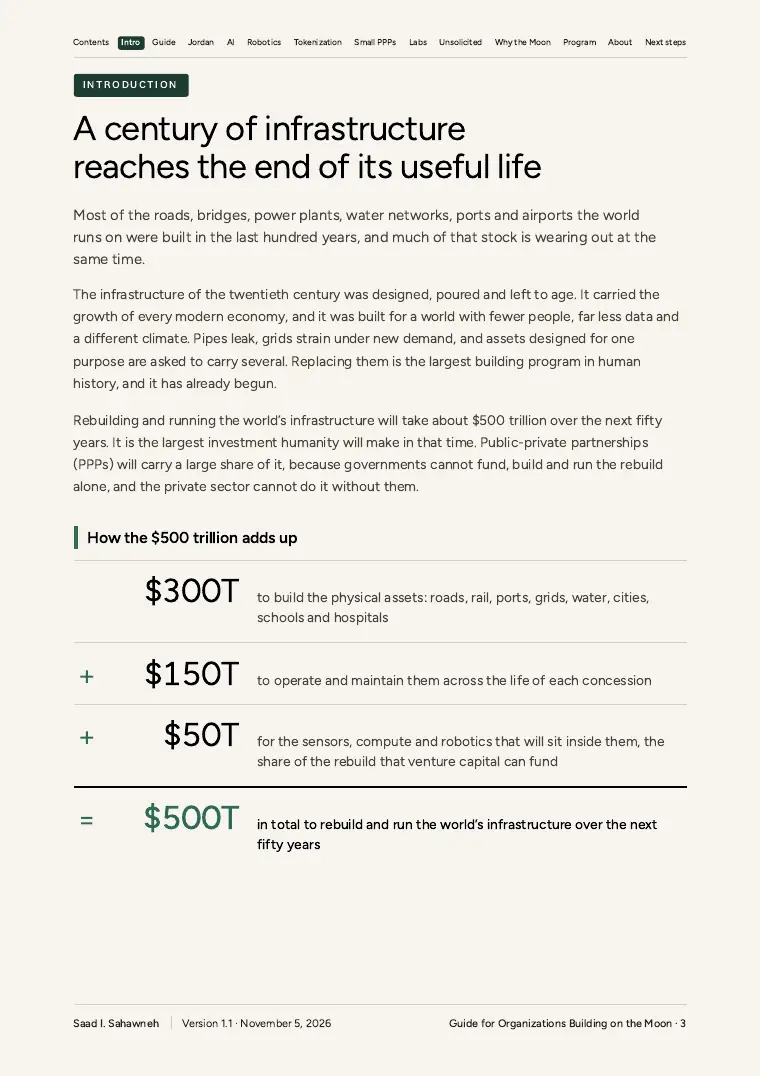
01Introduction
Why a century of infrastructure needs rebuilding, and the $500 trillion it will take.
Page 3 of 17
02The guide
Carry the $500 trillion PPP infrastructure opportunity to the Moon
Page 5 of 17
03Jordan and Aqaba
An $86 billion pipeline to start with
Page 6 of 17
04Artificial intelligence
How AI designs, structures and runs PPP projects, and what it means for organizations building on the Moon.
Page 7 of 17
05Robotics
How robots build infrastructure and keep it running, and what that means for organizations building on the Moon.
Page 8 of 17
06Tokenization
How tokenization funds projects from their own revenue, and the role it opens for organizations building on the Moon.
Page 9 of 17
07Small PPPs in parallel
Why many small PPPs teach a country faster than a few large ones.
Page 10 of 17
08PPP research labs
A lab in each sector, running ten small PPP projects a year.
Page 11 of 17
09Unsolicited proposals
How Jordan’s PPP law accepts direct proposals from private companies.
Page 12 of 17
10Why organizations building on the Moon
The Moon will need power, water and roads before people can stay
Page 13 of 17
11The program
The program can sit inside the organization’s strategy, engineering or business development team, with a PPP lead at its center and offers built from the machines, software and sites it already has.
Page 14 of 17
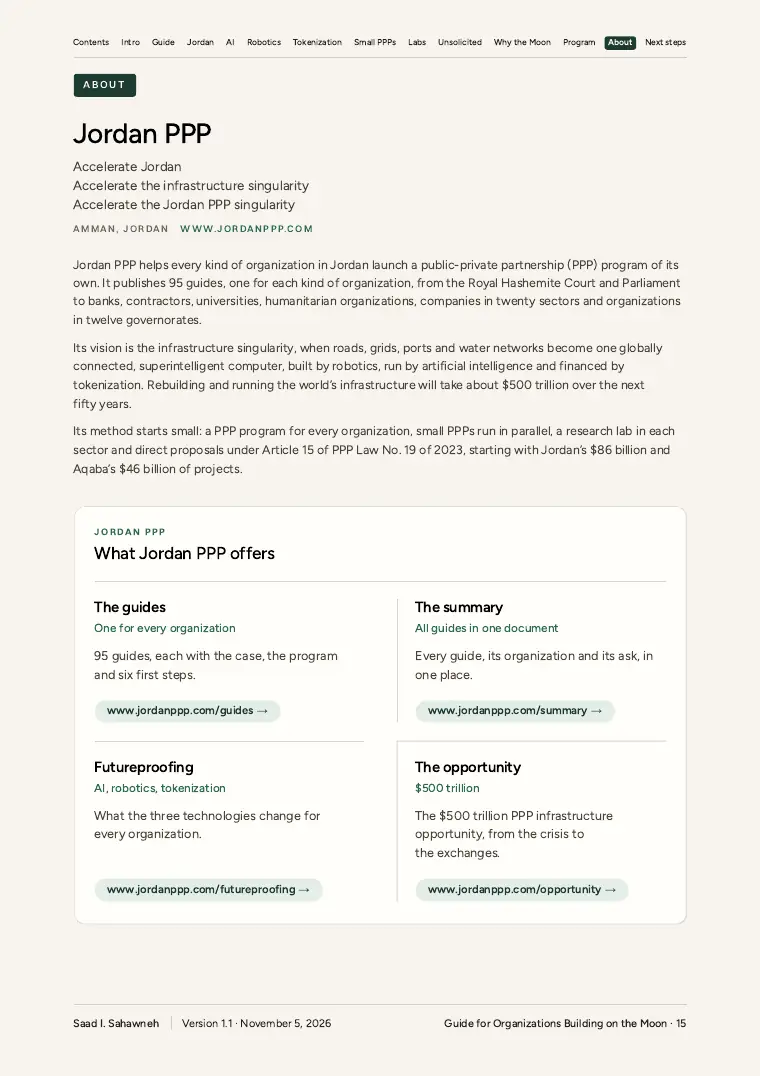
12About
About Jordan PPP and what it offers.
Page 15 of 17
13Next steps
How an organization building on the Moon can start: six first steps.
Page 16 of 17
Questions
Questions about the guide for Organizations Building on the Moon
- What does the guide for Organizations Building on the Moon propose?
- Your organization launches a PPP program to build power, landing pads, habitats, roads and water and oxygen plants on the Moon with robots, AI and tokenized finance, as public-private partnerships (PPPs) between space agencies and companies.
- Why should organizations building on the Moon launch a PPP program?
- The Moon will need power, water and roads before people can stay. Artemis II carried four astronauts around the Moon in April 2026, and Jordan signed the Artemis Accords that same month as the 63rd nation to join them. Staying on the Moon will take landing pads, power, water, habitats and communications, and space agencies are turning to partners to build and run them.
- Which PPP projects can organizations building on the Moon take part in?
- Jordan has about $86 billion of PPP and infrastructure projects in development, $46 billion of them anchored in Aqaba. Many of them, from desert solar fields to water, mining and robotics, use the same machines and methods that lunar infrastructure will need. An organization that builds and runs one PPP in Jordan’s desert can carry the same team, machines and data to the Moon.
- How can organizations building on the Moon start a PPP program?
- Any organization with a lunar ambition, in Jordan or abroad, can take this guide forward. The first steps use the engineers, machines and partners it already has. The guide sets out six first steps: mandate, team, pipeline, test site, partners and pilot.
- What does a PPP program give organizations building on the Moon?
- The organization gains long service contracts with space agencies and companies, a place in the consortia that build the first lunar infrastructure and test sites in Jordan that earn from every machine tested there.
- Is the guide for Organizations Building on the Moon free?
- Yes. It is free to read on this page and free to download as a 17-page PDF, with the case for a PPP program, Jordan’s pipeline, the role of AI, robotics and tokenization, the program and six first steps.
Guide 69 of 95
Browse all 95 guides