
What this guide is for
Your center launches a PPP program to research, test and certify the technologies that public-private partnership (PPP) projects will run on, from new materials and energy systems to AI and robotics.
The case
Research centers turn new ideas into evidence a contract can rely on
Infrastructure has long been built with methods proven decades ago, because a new material, machine or model has had few places to prove itself on a real asset. The projects of the next fifty years will be built and run with technologies that are still in the lab today, and the centers that test and certify them will decide which ones reach the field. This guide invites research centers and laboratories in Jordan to launch a PPP program, starting with the projects at home.
The guide
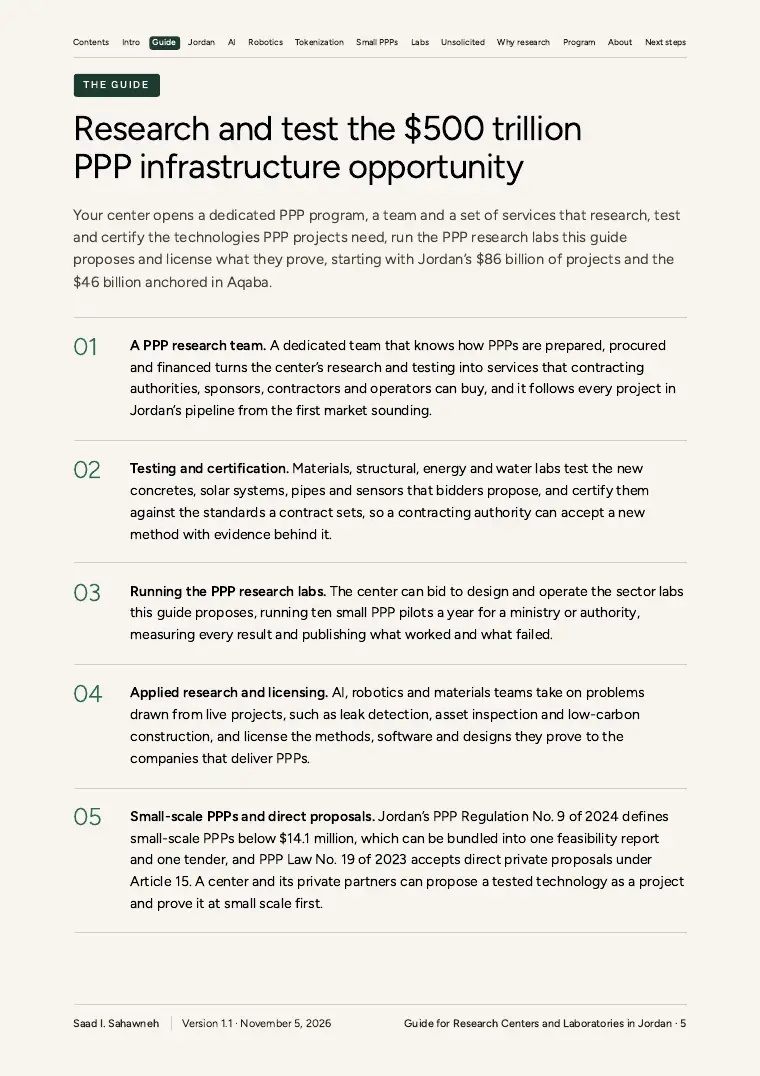
Research and test the $500 trillion PPP infrastructure opportunity
Your center opens a dedicated PPP program, a team and a set of services that research, test and certify the technologies PPP projects need, run the PPP research labs this guide proposes and license what they prove, starting with Jordan’s $86 billion of projects and the $46 billion anchored in Aqaba.
01
A PPP research team
A dedicated team that knows how PPPs are prepared, procured and financed turns the center’s research and testing into services that contracting authorities, sponsors, contractors and operators can buy, and it follows every project in Jordan’s pipeline from the first market sounding.
02
Testing and certification
Materials, structural, energy and water labs test the new concretes, solar systems, pipes and sensors that bidders propose, and certify them against the standards a contract sets, so a contracting authority can accept a new method with evidence behind it.
03
Running the PPP research labs
The center can bid to design and operate the sector labs this guide proposes, running ten small PPP pilots a year for a ministry or authority, measuring every result and publishing what worked and what failed.
04
Applied research and licensing
AI, robotics and materials teams take on problems drawn from live projects, such as leak detection, asset inspection and low-carbon construction, and license the methods, software and designs they prove to the companies that deliver PPPs.
05
Small-scale PPPs and direct proposals
Jordan’s PPP Regulation No. 9 of 2024 defines small-scale PPPs below $14.1 million, which can be bundled into one feasibility report and one tender, and PPP Law No. 19 of 2023 accepts direct private proposals under Article 15. A center and its private partners can propose a tested technology as a project and prove it at small scale first.
Why research centers
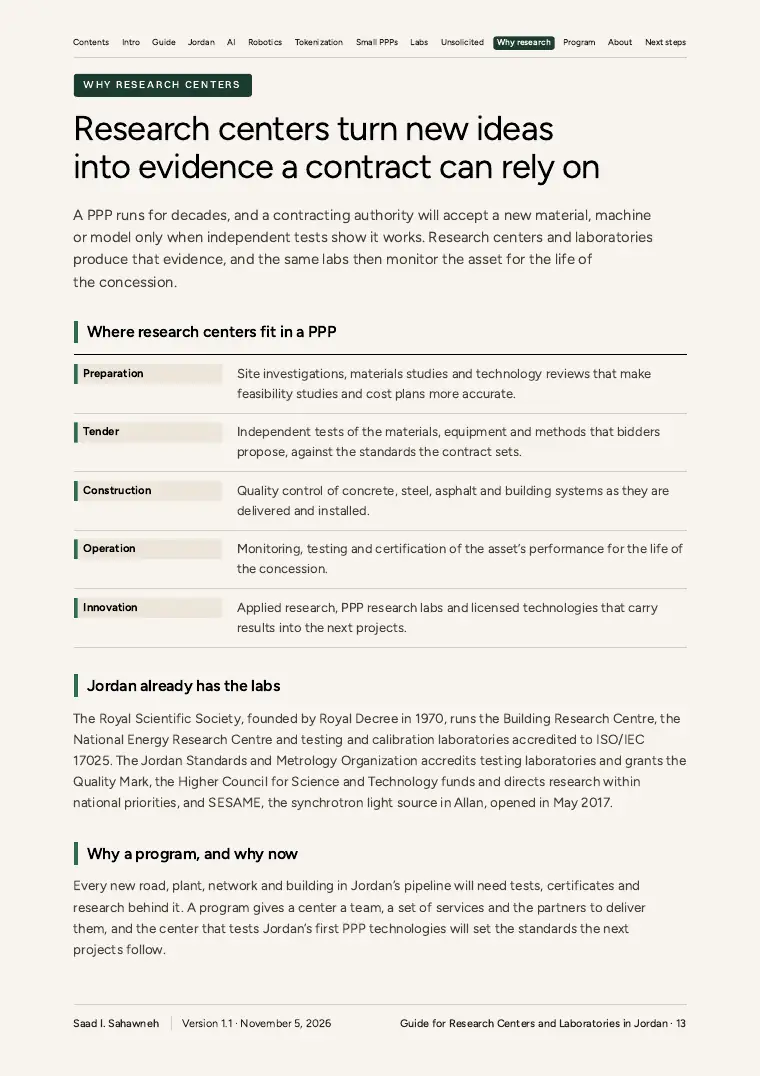
Research centers turn new ideas into evidence a contract can rely on
A PPP runs for decades, and a contracting authority will accept a new material, machine or model only when independent tests show it works. Research centers and laboratories produce that evidence, and the same labs then monitor the asset for the life of the concession.
Where research centers fit in a PPP
- Preparation
- Site investigations, materials studies and technology reviews that make feasibility studies and cost plans more accurate.
- Tender
- Independent tests of the materials, equipment and methods that bidders propose, against the standards the contract sets.
- Construction
- Quality control of concrete, steel, asphalt and building systems as they are delivered and installed.
- Operation
- Monitoring, testing and certification of the asset’s performance for the life of the concession.
- Innovation
- Applied research, PPP research labs and licensed technologies that carry results into the next projects.
Jordan already has the labs
The Royal Scientific Society, founded by Royal Decree in 1970, runs the Building Research Centre, the National Energy Research Centre and testing and calibration laboratories accredited to ISO/IEC 17025. The Jordan Standards and Metrology Organization accredits testing laboratories and grants the Quality Mark, the Higher Council for Science and Technology funds and directs research within national priorities, and SESAME, the synchrotron light source in Allan, opened in May 2017.
Why a program, and why now
Every new road, plant, network and building in Jordan’s pipeline will need tests, certificates and research behind it. A program gives a center a team, a set of services and the partners to deliver them, and the center that tests Jordan’s first PPP technologies will set the standards the next projects follow.

Futureproofing
Futureproof Research Centers and Laboratories in Jordan for the infrastructure singularity
This free 17-page guide shows how, with small PPPs in parallel, PPP research labs, artificial intelligence, robotics, tokenization and six first steps.

Jordan and Aqaba
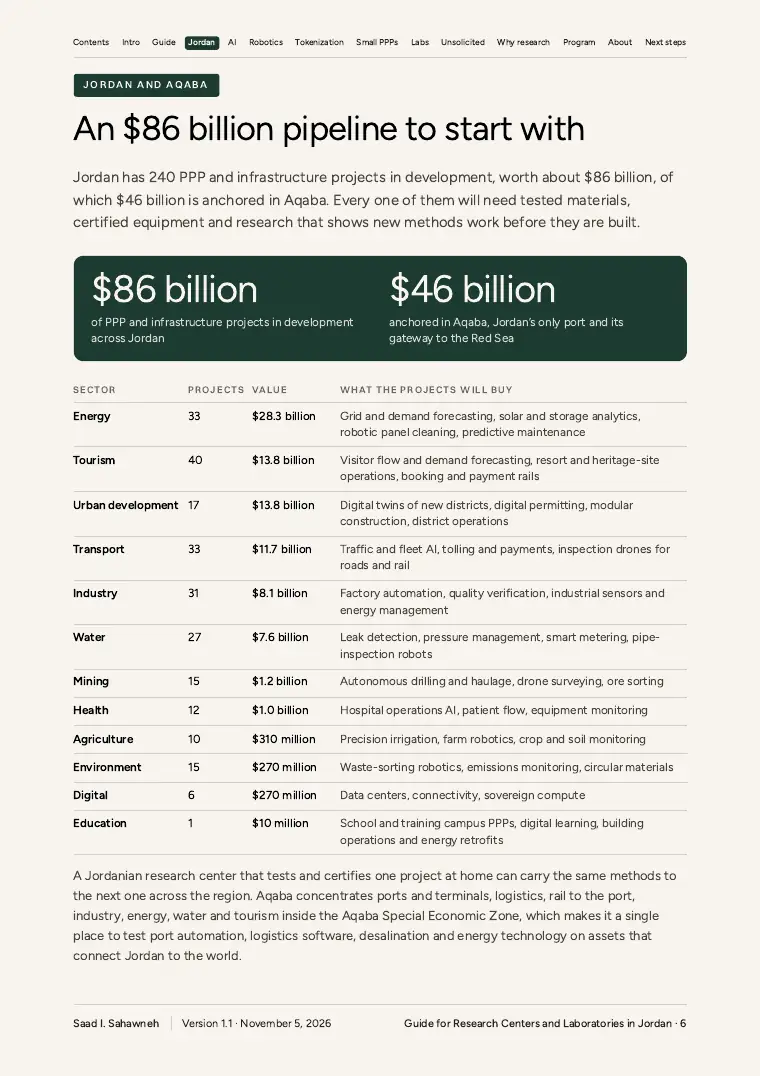
An $86 billion pipeline to start with
Every one of them will need tested materials, certified equipment and research that shows new methods work before they are built. A Jordanian research center that tests and certifies one project at home can carry the same methods to the next one across the region.
- $86B
- of PPP and infrastructure projects in development in Jordan
- $46B
- of them anchored in Aqaba

Artificial intelligence
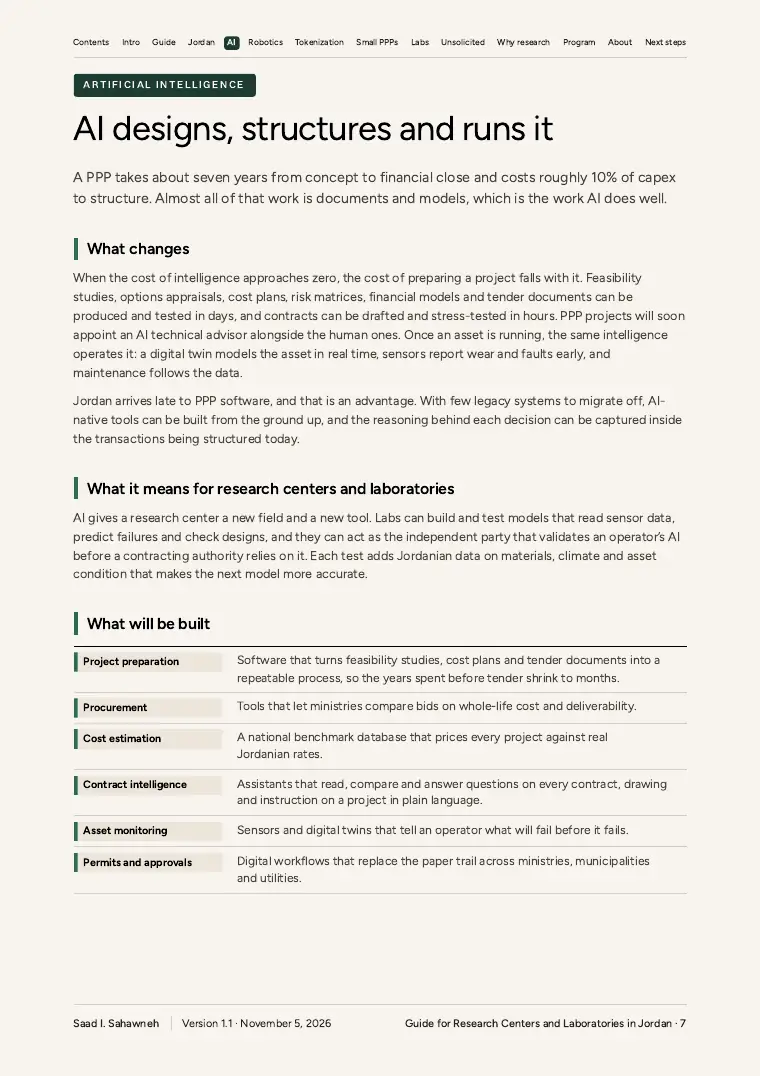
AI gives a research center a new field and a new tool. Labs can build and test models that read sensor data, predict failures and check designs, and they can act as the independent party that validates an operator’s AI before a contracting authority relies on it. Each test adds Jordanian data on materials, climate and asset condition that makes the next model more accurate.

Robotics
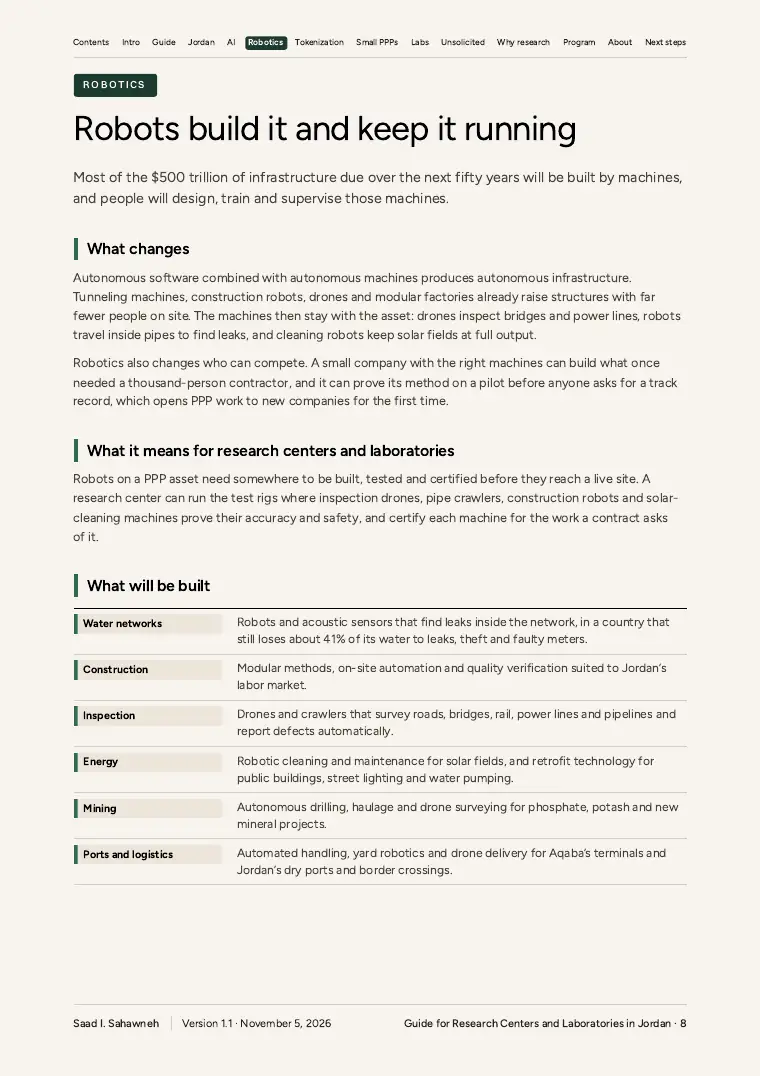
Robots on a PPP asset need somewhere to be built, tested and certified before they reach a live site. A research center can run the test rigs where inspection drones, pipe crawlers, construction robots and solar-cleaning machines prove their accuracy and safety, and certify each machine for the work a contract asks of it.

Tokenization
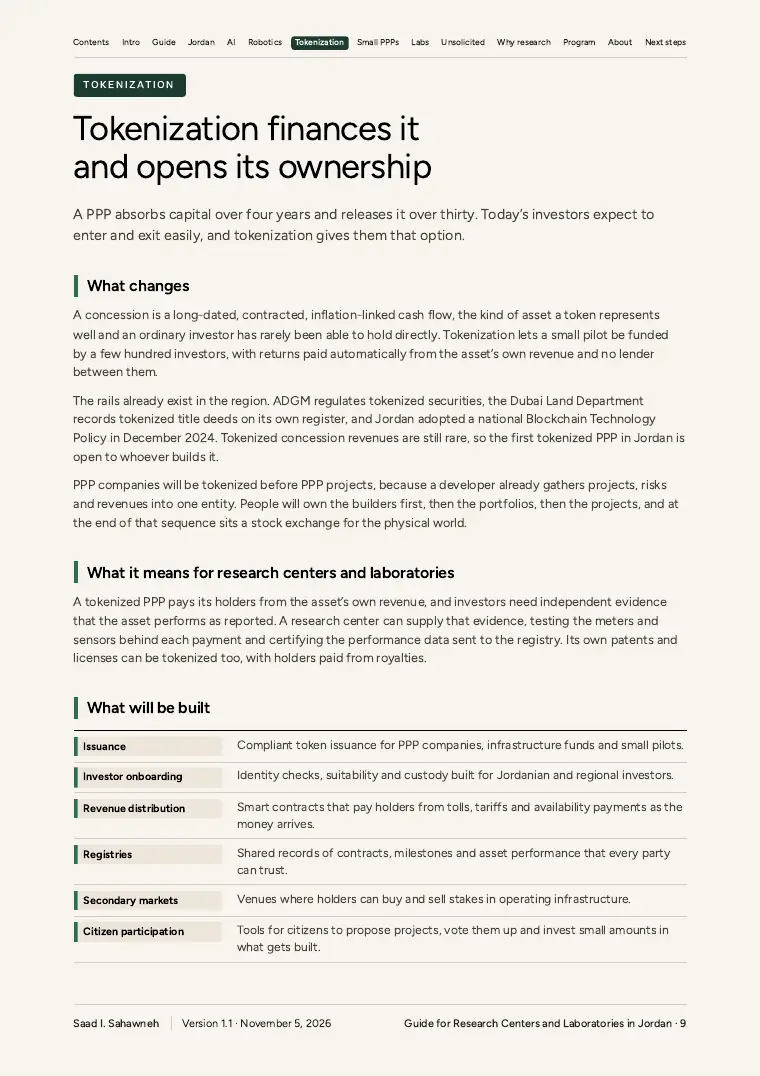
A tokenized PPP pays its holders from the asset’s own revenue, and investors need independent evidence that the asset performs as reported. A research center can supply that evidence, testing the meters and sensors behind each payment and certifying the performance data sent to the registry. Its own patents and licenses can be tokenized too, with holders paid from royalties.

Small PPPs and research labs
A research center is a natural operator for a lab. It already runs test rigs, measures results and publishes them, so it can bid to run a ministry’s lab, take ten small PPP pilots a year from design to result and turn each finding into a standard, a certificate or a license that larger projects can use.

Unsolicited proposals
Article 15 asks for an innovative solution for a public service, and a technology a center has researched and tested can be one. A direct proposal lets the center and its private partners bring a proven material, sensor network or AI service to a ministry as a project of its own, protect the intellectual property behind it and keep the right to match the best offer at tender.
The program
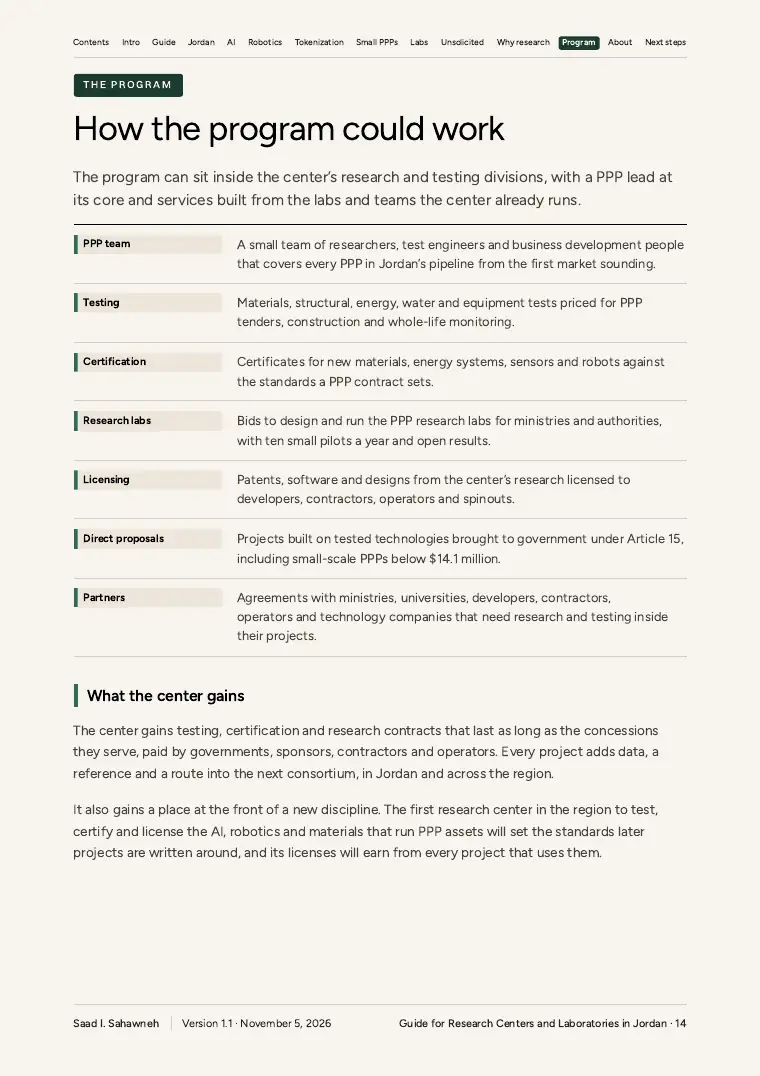
How the program could work
The program can sit inside the center’s research and testing divisions, with a PPP lead at its core and services built from the labs and teams the center already runs.
- PPP team
- A small team of researchers, test engineers and business development people that covers every PPP in Jordan’s pipeline from the first market sounding.
- Testing
- Materials, structural, energy, water and equipment tests priced for PPP tenders, construction and whole-life monitoring.
- Certification
- Certificates for new materials, energy systems, sensors and robots against the standards a PPP contract sets.
- Research labs
- Bids to design and run the PPP research labs for ministries and authorities, with ten small pilots a year and open results.
- Licensing
- Patents, software and designs from the center’s research licensed to developers, contractors, operators and spinouts.
- Direct proposals
- Projects built on tested technologies brought to government under Article 15, including small-scale PPPs below $14.1 million.
- Partners
- Agreements with ministries, universities, developers, contractors, operators and technology companies that need research and testing inside their projects.
What the center gains
The center gains testing, certification and research contracts that last as long as the concessions they serve, paid by governments, sponsors, contractors and operators. Every project adds data, a reference and a route into the next consortium, in Jordan and across the region.
It also gains a place at the front of a new discipline. The first research center in the region to test, certify and license the AI, robotics and materials that run PPP assets will set the standards later projects are written around, and its licenses will earn from every project that uses them.

Next steps
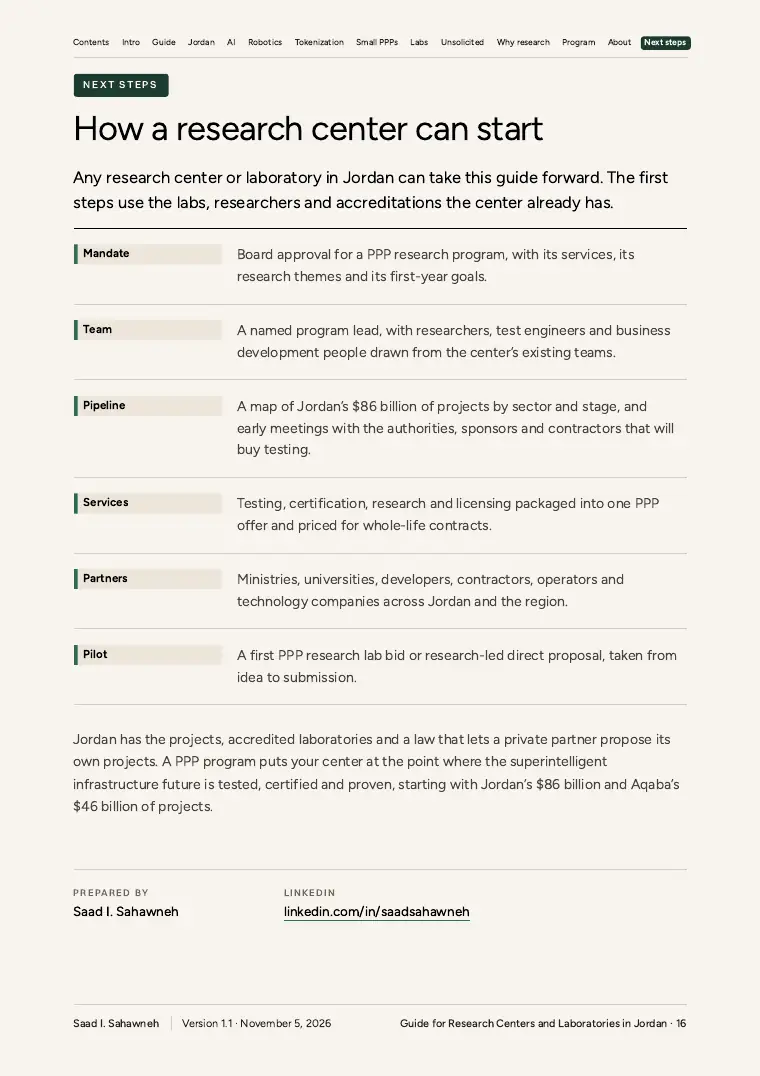
How a research center can start
Any research center or laboratory in Jordan can take this guide forward. The first steps use the labs, researchers and accreditations the center already has.
01
Mandate
Board approval for a PPP research program, with its services, its research themes and its first-year goals.
02
Team
A named program lead, with researchers, test engineers and business development people drawn from the center’s existing teams.
03
Pipeline
A map of Jordan’s $86 billion of projects by sector and stage, and early meetings with the authorities, sponsors and contractors that will buy testing.
04
Services
Testing, certification, research and licensing packaged into one PPP offer and priced for whole-life contracts.
05
Partners
Ministries, universities, developers, contractors, operators and technology companies across Jordan and the region.
06
Pilot
A first PPP research lab bid or research-led direct proposal, taken from idea to submission.
Jordan has the projects, accredited laboratories and a law that lets a private partner propose its own. A PPP program puts your center at the point where the superintelligent infrastructure future is tested, certified and proven, starting with Jordan’s $86 billion and Aqaba’s $46 billion of projects.
The full document
Inside this guide
Seventeen pages and thirteen chapters, from the case for a PPP program to the first steps, written for research centers and laboratories in Jordan.
- 17
- pages
- 13
- chapters
- 3
- technologies
- 6
- first steps
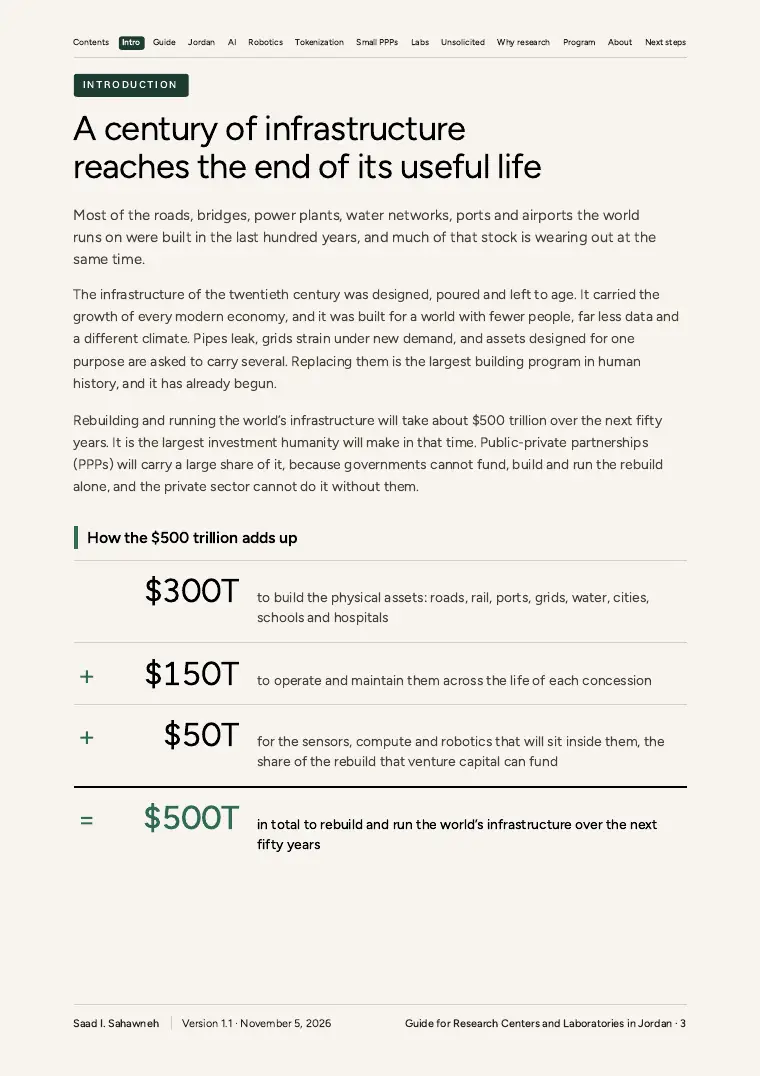
01Introduction
Why a century of infrastructure needs rebuilding, and the $500 trillion it will take.
Page 3 of 17
02The guide
Research and test the $500 trillion PPP infrastructure opportunity
Page 5 of 17
03Jordan and Aqaba
An $86 billion pipeline to start with
Page 6 of 17
04Artificial intelligence
How AI designs, structures and runs PPP projects, and what it means for research centers and laboratories.
Page 7 of 17
05Robotics
How robots build infrastructure and keep it running, and what that means for research centers and laboratories.
Page 8 of 17
06Tokenization
How tokenization funds projects from their own revenue, and the role it opens for research centers and laboratories.
Page 9 of 17
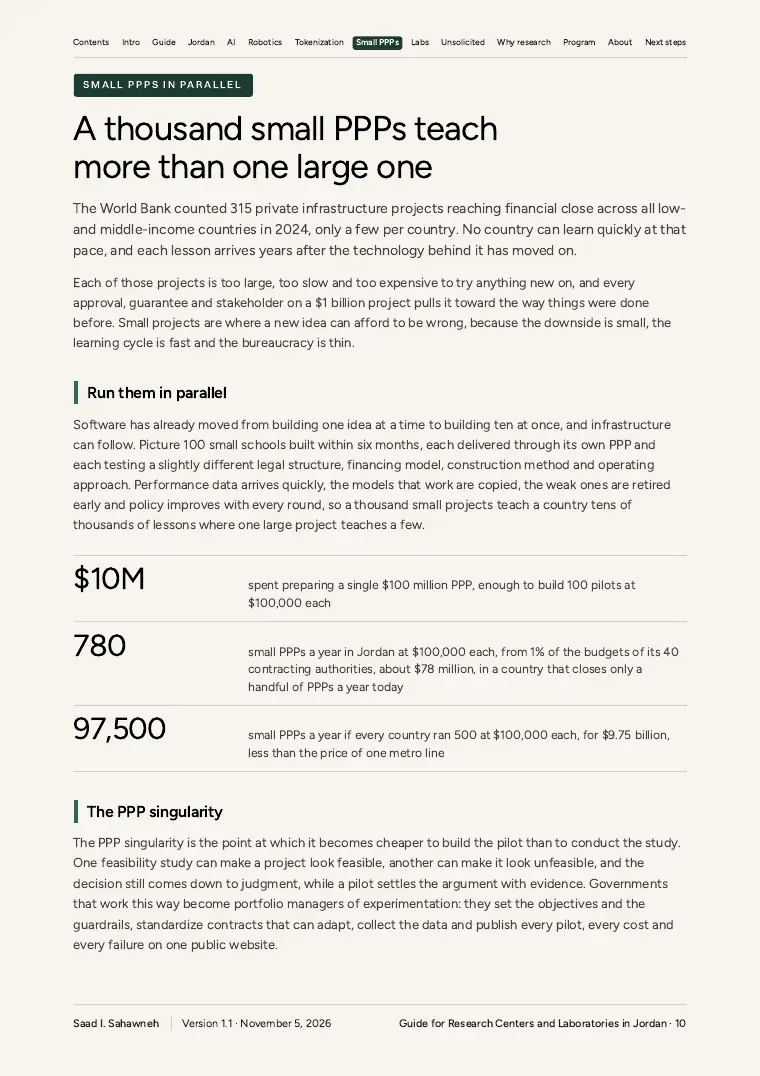
07Small PPPs in parallel
Why many small PPPs teach a country faster than a few large ones.
Page 10 of 17
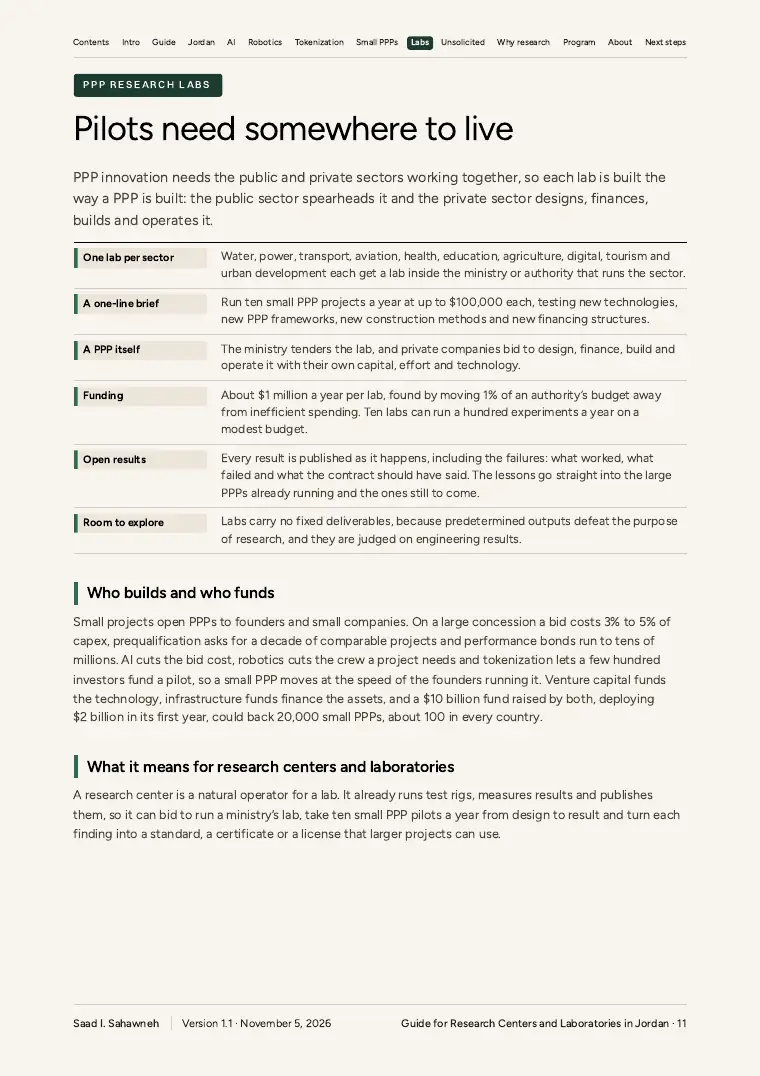
08PPP research labs
A lab in each sector, running ten small PPP projects a year.
Page 11 of 17
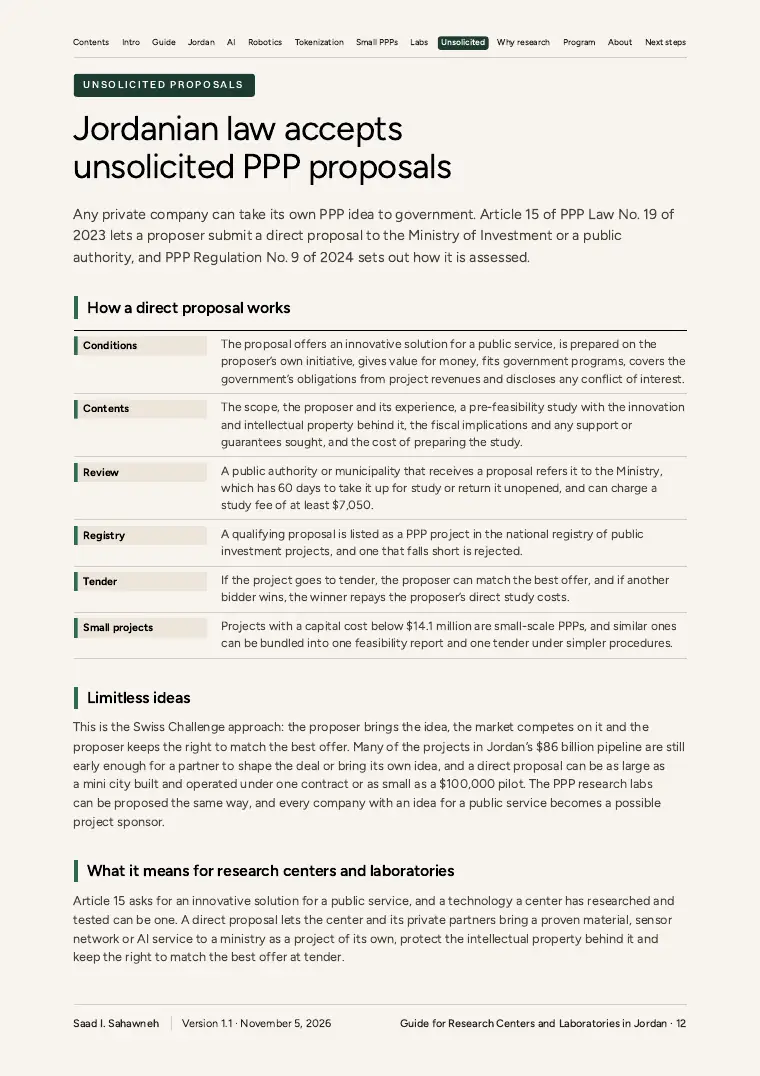
09Unsolicited proposals
How Jordan’s PPP law accepts direct proposals from private companies.
Page 12 of 17
10Why research centers
Research centers turn new ideas into evidence a contract can rely on
Page 13 of 17
11The program
The program can sit inside the center’s research and testing divisions, with a PPP lead at its core and services built from the labs and teams the center already runs.
Page 14 of 17
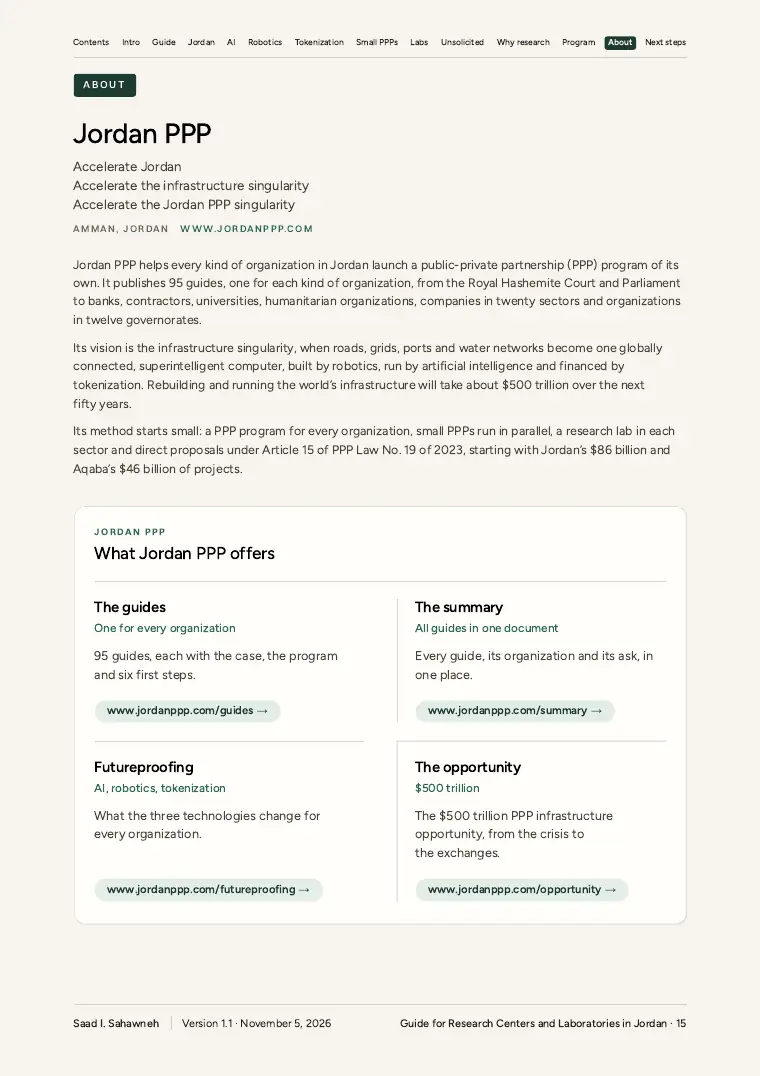
12About
About Jordan PPP and what it offers.
Page 15 of 17
13Next steps
How a research center can start: six first steps.
Page 16 of 17
Questions
Questions about the guide for Research Centers and Laboratories in Jordan
- What does the guide for Research Centers and Laboratories in Jordan propose?
- Your center launches a PPP program to research, test and certify the technologies that public-private partnership (PPP) projects will run on, from new materials and energy systems to AI and robotics.
- Why should research centers and laboratories in Jordan launch a PPP program?
- Research centers turn new ideas into evidence a contract can rely on. A PPP runs for decades, and a contracting authority will accept a new material, machine or model only when independent tests show it works. Research centers and laboratories produce that evidence, and the same labs then monitor the asset for the life of the concession.
- Which PPP projects can research centers and laboratories in Jordan take part in?
- Jordan has about $86 billion of PPP and infrastructure projects in development, $46 billion of them anchored in Aqaba. Every one of them will need tested materials, certified equipment and research that shows new methods work before they are built. A Jordanian research center that tests and certifies one project at home can carry the same methods to the next one across the region.
- How can research centers and laboratories in Jordan start a PPP program?
- Any research center or laboratory in Jordan can take this guide forward. The first steps use the labs, researchers and accreditations the center already has. The guide sets out six first steps: mandate, team, pipeline, services, partners and pilot.
- What does a PPP program give research centers and laboratories in Jordan?
- The center gains testing, certification and research contracts that last as long as the concessions they serve, paid by governments, sponsors, contractors and operators. Every project adds data, a reference and a route into the next consortium, in Jordan and across the region.
- Is the guide for Research Centers and Laboratories in Jordan free?
- Yes. It is free to read on this page and free to download as a 17-page PDF, with the case for a PPP program, Jordan’s pipeline, the role of AI, robotics and tokenization, the program and six first steps.
Guide 64 of 95
Browse all 95 guides